You’re staring at a blank document, the cursor blinking. You need to write a sub contractor work proposal letter, but every sentence sounds either too stiff or too casual. It’s a common frustration, especially when you’re bidding for a job and first impressions matter. The answer isn’t to panic or start from scratch. It’s to find a solid sample that gives you both structure and confidence.
Using a letter template isn’t cheating. It’s a smart shortcut. A good sample shows you the expected flow, the right salutation and closing, and the tone that fits professional correspondence. You get a ready-made framework, and you fill in your specific details. That’s how you turn anxiety into a polished draft in minutes.
Not all sub contractor work proposal letters are the same. Are you writing to a general contractor you’ve worked with before, or is this a cold pitch to a new construction firm? The relationship determines the tone. For a regular partner, you can be more direct. For a first contact, stick to a formal business letter format with a respectful salutation like “Dear Mr. [Last Name].” Avoid outdated greetings like “To Whom It May Concern” unless you truly have no name.
The best samples are customizable. Take the core paragraphs—introduction, scope of work, pricing, timeline—and rewrite them in your own words. Don’t copy the sample verbatim; read it, understand why each section exists, then write your version. Your authentic voice makes the letter feel personal and trustworthy. For example, instead of saying “We are pleased to submit our proposal,” you might start with “Here’s how we can handle the electrical work on your project.” That grabs attention and sounds like you.
Pay attention to tone in writing. A sub contractor work proposal letter should be confident but not arrogant. You’re offering a solution, not begging for work. Keep sentences short and active. “We complete jobs on schedule” is stronger than “We strive to complete jobs on schedule.”
Tailoring the opening paragraph
The first few lines decide if the reader keeps going. Open with a specific reference: “Thank you for the opportunity to bid on the HVAC installation for the Elm Street project.” That shows you’ve done your homework. If you’re responding to an urgent request, you might mention that—check our urgent procurement proposal letter for phrasing ideas. Avoid generic openings like “I am writing to propose…”
Common mistakes to avoid
One frequent error is using the wrong salutation and closing for digital vs. printed letters. If you’re emailing the proposal, you don’t need a physical letterhead design—just a clean subject line and a polite sign-off like “Best regards.” For a printed version, include your company letterhead with address and contact info. Another mistake is sending the letter without proofreading. Read it aloud, or have a colleague check it. A typo in a price or deadline can cost you the contract.
Also watch out for letter writing etiquette: don’t assume the contractor already knows your capabilities. Spell out exactly what you’ll do, what you won’t do, and how you handle changes. That prevents misunderstandings later.
Making the letter work for you
Think of the sample as a springboard, not a crutch. Once you’ve written a few proposals, you’ll develop your own letter structure and stop relying on templates. That’s the goal. The more you practice, the faster the process becomes. And the more your letters feel both professional and personal—that’s what gets you hired.
Before you send, double-check the digital letter format if you’re attaching a PDF or pasting it into an email body. Keep the font simple, the margins standard, and the spacing easy to read. A clean, well-formatted proposal shows you pay attention to details, which is exactly what a contractor wants in a subcontractor.
Samples for Inspiration
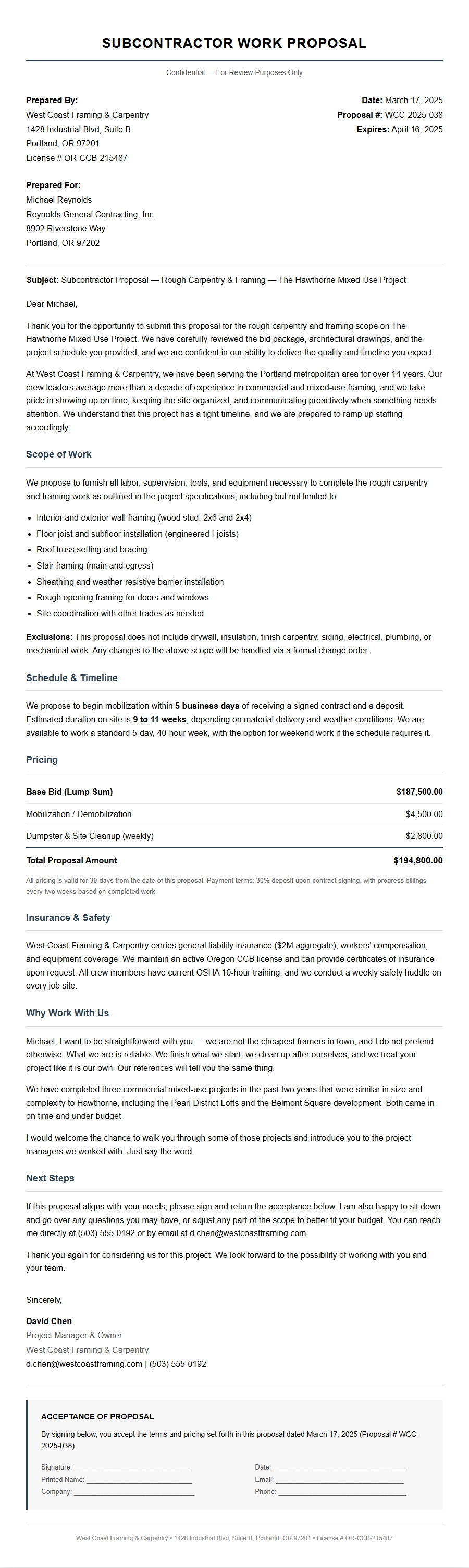
Subcontractor Work Proposal Letter Template
General Subcontractor Work Proposal
To: ABC General Contracting From: ProBuild Subcontractors LLC Date: March 25, 2025 Project: Westside Commercial Complex
We are pleased to submit this proposal to serve as your subcontractor for the interior finishing work on the above project. Our scope includes drywall installation, taping, and texturing across all three floors as per your specifications.
Scope of Work:
Hang and finish approx. 12,000 sq. ft. of 5/8-inch drywall
Apply tape and joint compound to all seams (Level 4 finish)
Light sanding and touch-ups before paint
Pricing:
Item
Quantity
Unit Price
Total
Drywall hanging (labor)
12,000 sq.ft.
$1.50/sq.ft.
$18,000.00
Taping & finishing
12,000 sq.ft.
$1.25/sq.ft.
$15,000.00
Materials (board, compound, tape)
Lump sum
—
$6,500.00
Total
$39,500.00
We can mobilize within one week of contract award and complete within 30 working days. A payment schedule of 30% upon start, 40% at 50% completion, and 30% upon final inspection is proposed. Please contact us to discuss any adjustments.
Electrical Subcontractor Proposal
To: BrightFuture Builders From: Voltech Electric Inc. Date: March 25, 2025 Re: Electrical services for Maple Residence Multi-Unit Project
Thank you for inviting us to bid on the electrical work for your new residential development. We specialize in code-compliant, energy-efficient installations.
Proposed Work Includes:
Rough-in wiring for 24 units (120/240V AC)
Installation of panel boards, breakers, and meter stacks
Lighting fixtures, switches, and outlet placement per plans
Smoke/CO detectors and GFCI circuits as required
Fee Structure:
Item
Amount
Labor (estimated 400 hours @ $85/hr)
$34,000.00
Materials (wiring, panels, devices)
$28,500.00
Permits & inspection fees
$1,200.00
Total Fixed Price
$63,700.00
We hold a valid Class A electrical license and have $2M liability insurance. Work will be performed by IBEW-certified journeymen. Proposed schedule: start within two weeks, finish in 6–8 weeks. We look forward to partnering with you.
Plumbing Subcontractor Bid
To: Titan Construction Corp. From: ClearFlow Plumbing Services Date: March 25, 2025 Project: Downtown Office Tower Phase 2
We are submitting this bid to handle all rough-in and finish plumbing for the 5th through 8th floors. Our team has completed similar projects for schools and high‑rises.
Scope Includes:
Copper supply lines, DWV piping, and venting per code
Installation of water closets, urinals, sinks, and faucets (specs attached)
Water heater connections and backflow preventers
Cost Breakdown:
Floor
Labor
Materials
Subtotal
5th
$8,200
$11,500
$19,700
6th
$7,900
$10,800
$18,700
7th
$8,400
$11,200
$19,600
8th
$7,600
$10,500
$18,100
Total
$76,100.00
We have bonds available and can provide a performance bond if required. Start date: April 15. Completion target: July 30. We guarantee work for one year. Let me know if you need any more details.
Painting Subcontractor Proposal Letter
To: FineLine Developers From: ColorCoat Pro Painting Date: March 25, 2025 Project: Oakwood Estates – 12 Custom Homes
We are excited to submit our proposal for all interior and exterior painting on the Oakwood project. Our crew of 10 painters can handle the volume efficiently while maintaining high quality.
Exterior Work (per home):
Two coats of Sherwin-Williams Duration on siding & trim
Priming on raw wood surfaces
Pressure washing before paint
Interior Work (per home):
Ceilings – flat white latex; walls – eggshell in customer-selected colors
Doors, baseboards, and cabinets – semi-gloss enamel
Pricing Table:
Scope
Per Unit
Qty
Total
Exterior painting
$4,500
12
$54,000
Interior painting
$6,200
12
$74,400
Materials (paint, primer, tape, drop cloths)
$2,100
12
$25,200
Grand Total
$153,600.00
We will provide daily clean-up and minimize dust. Schedule: start May 1, finish by August 30. Payment terms: 25% deposit, remainder in three draws. References available.
Carpentry Subcontractor Proposal
To: Modern Frame Homes From: WoodWright Carpentry LLC Date: March 25, 2025 Job: Framing & trim for Riverbend Duplexes
We are pleased to bid on the structural framing and finish carpentry for the two duplex buildings. Our team specializes in platform framing and custom millwork installation.
Scope of Work:
Floor and wall framing (2x6 studs, 24” OC), roof trusses
Sheathing with OSB, house wrap, and window/door rough openings
We can begin within five days of notice. Projected duration: 10 weeks. All work guaranteed to meet IRC standards. We carry workers’ comp and general liability insurance. We look forward to a successful partnership.
Landscaping Subcontractor Proposal
To: GreenScape Developers From: Nature’s Edge Landscaping Date: March 25, 2025 Project: The Pines Senior Living Community – Phase 1
We propose to handle all site landscaping for the new senior living complex. This includes hardscape, softscape, and irrigation.
Our Scope:
Grading & topsoil placement (approx. 2 acres)
Installation of paver walkways, patios, and retaining walls
Planting: trees (12), shrubs (200), perennials (400), and sod
Drip irrigation system with controller
Cost Estimate:
Category
Price
Hardscape materials & labor
$35,000.00
Softscape (plants, sod, soil amendments)
$27,500.00
Irrigation system (supply & install)
$12,000.00
Total
$74,500.00
We will use regionally native plants to reduce water use. Maintenance during establishment is included for 60 days after planting. Proposed start: April 1, completion by May 15. We are ready to begin upon contract.
IT Services Subcontractor Proposal
To: SmartBuild General Contractor From: TechWire Low-Voltage Inc. Date: March 25, 2025 Re: Structured cabling & AV for Innovation Center
We are submitting this proposal to act as your low-voltage subcontractor for the upcoming office build-out. Our team is BICSI-certified and experienced in commercial installations.
Deliverables:
Cat6a data cabling for 150 drops
Cable management, patch panels, and termination
AV wiring for conference rooms (projector, speakers, control)
Security camera and access control cable rough-ins
Pricing Summary:
Item
Qty
Unit Price
Total
Data cable drop (labor & materials)
150
$180.00
$27,000.00
AV package (2 rooms)
2
$4,500.00
$9,000.00
Security & access rough-in
1
$6,200.00
$6,200.00
Total
$42,200.00
Certification testing of all cables is included. Timeline: 3 weeks after drywall. Payment net 30 upon monthly progress billing. We have $1M cyber liability and property damage insurance. Ready to answer any questions.
Cleaning Subcontractor Proposal
To: CleanSlate Construction From: QuickShine Post-Construction Cleaning Date: March 25, 2025 Project: Final clean for 44-unit apartment building
We are happy to offer our post-construction cleaning services for your recently completed apartment project. Our team will make each unit, common areas, and exterior ready for occupancy.
Cleaning Scope per Unit:
Vacuum and mop all hard floors
Wipe down all surfaces, cabinets, windows inside and out
Remove construction dust, labels, and stickers
Clean bathrooms (toilets, showers, mirrors) and kitchen appliances
Common Areas: lobby, hallways, stairs, elevator, trash removal
Quote:
Area
Price per Unit
Qty
Total
Residential units (1-bed)
$350
28
$9,800
Residential units (2-bed)
$400
16
$6,400
Common areas
Lump sum
—
$2,500
Exterior windows & doors
Lump sum
—
$1,200
Total
$19,900.00
We will supply all eco-friendly cleaning products and equipment. We can start within 48 hours of your notice and finish in 5 working days. We are insured and bonded.
Concrete Subcontractor Proposal
To: HearthStone Builders From: SolidForm Concrete Inc. Date: March 25, 2025 Project: Fairview Community Center – Foundation & Slab
We submit this proposal to provide all concrete work for the new community center. We have a plant within 10 miles to ensure fresh concrete delivery.
Work Included:
Excavation and forming for footings (continuous and spread)
Pour and finish 6” slab on grade with vapor barrier & rebar mesh
Exterior flatwork: sidewalks, loading dock apron, and steps
Curing, control joints, and sealing
Pricing Breakdown:
Item
Cubic Yards
Unit Price
Total
Footings concrete (3000 psi)
40
$145/cy
$5,800.00
Slab concrete (3500 psi, fiber)
120
$155/cy
$18,600.00
Flatwork concrete (4000 psi)
30
$160/cy
$4,800.00
Rebar, mesh, vapor barrier, labor
$12,000.00
Total
$41,200.00
We will perform slump tests and provide cylinder break reports. Schedule: start March 30, complete in 14 days (weather permitting). We accept progress payments. Thank you for your consideration.
Roofing Subcontractor Proposal
To: Apex General Contracting From: Summit Roofing Co. Date: March 25, 2025 Re: Roof replacement for Hillside Apartments (3 buildings)
We are pleased to offer our services for the tear-off and replacement of all roofs on the Hillside apartment complex. We are licensed, insured, and offer a 15-year workmanship warranty.
Scope:
Remove existing asphalt shingles, underlayment, and flashing
Install new ice & water shield (6’ up eaves), synthetic underlayment
Install architectural shingles (CertainTeed Landmark) and ridge vents
Replace all vent boots, drip edge, and step flashing
Proposal Details:
Building
Squares (100 sq.ft.)
Price per Square
Total
Building A
22
$480
$10,560.00
Building B
28
$480
$13,440.00
Building C
25
$480
$12,000.00
Teardown & disposal fee
—
—
$5,600.00
Total
$41,600.00
We can start as early as April 5 and complete roughly one building per week. We use magnet sweepers daily to collect debris. A dumpster will be provided for old materials. Please call to discuss any specifics.
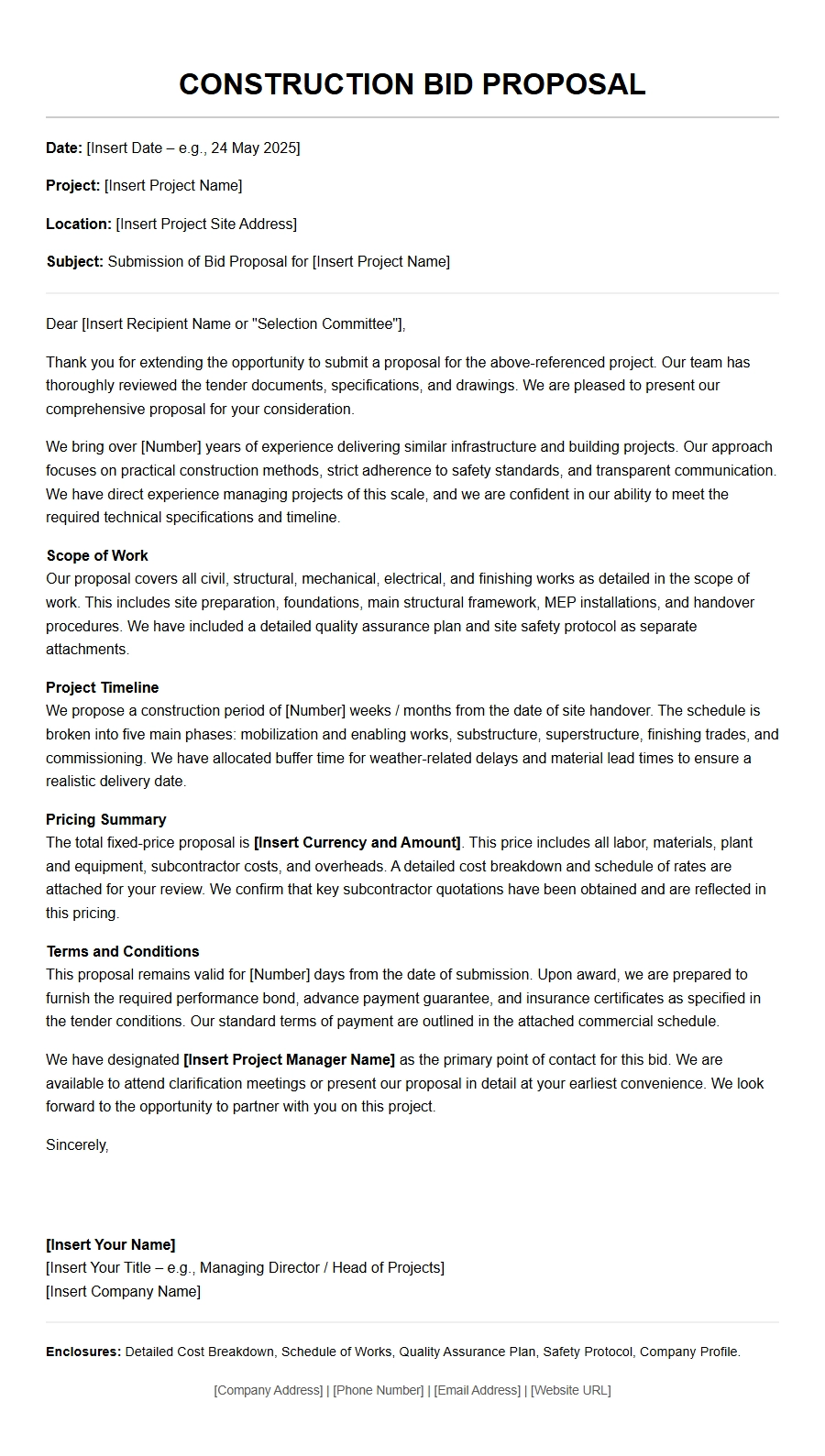 Sample Construction Bid Proposal Letter
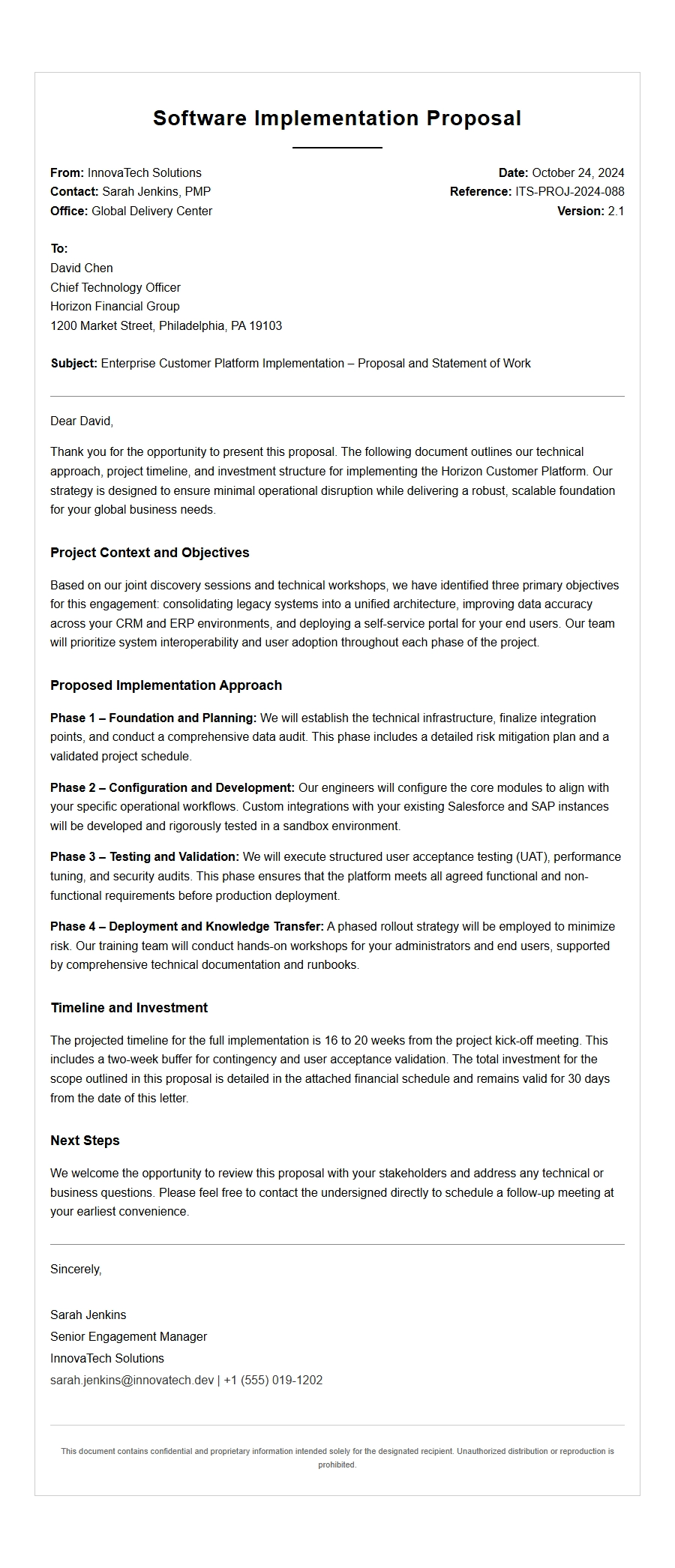 Enterprise Software Implementation Proposal Letter Example
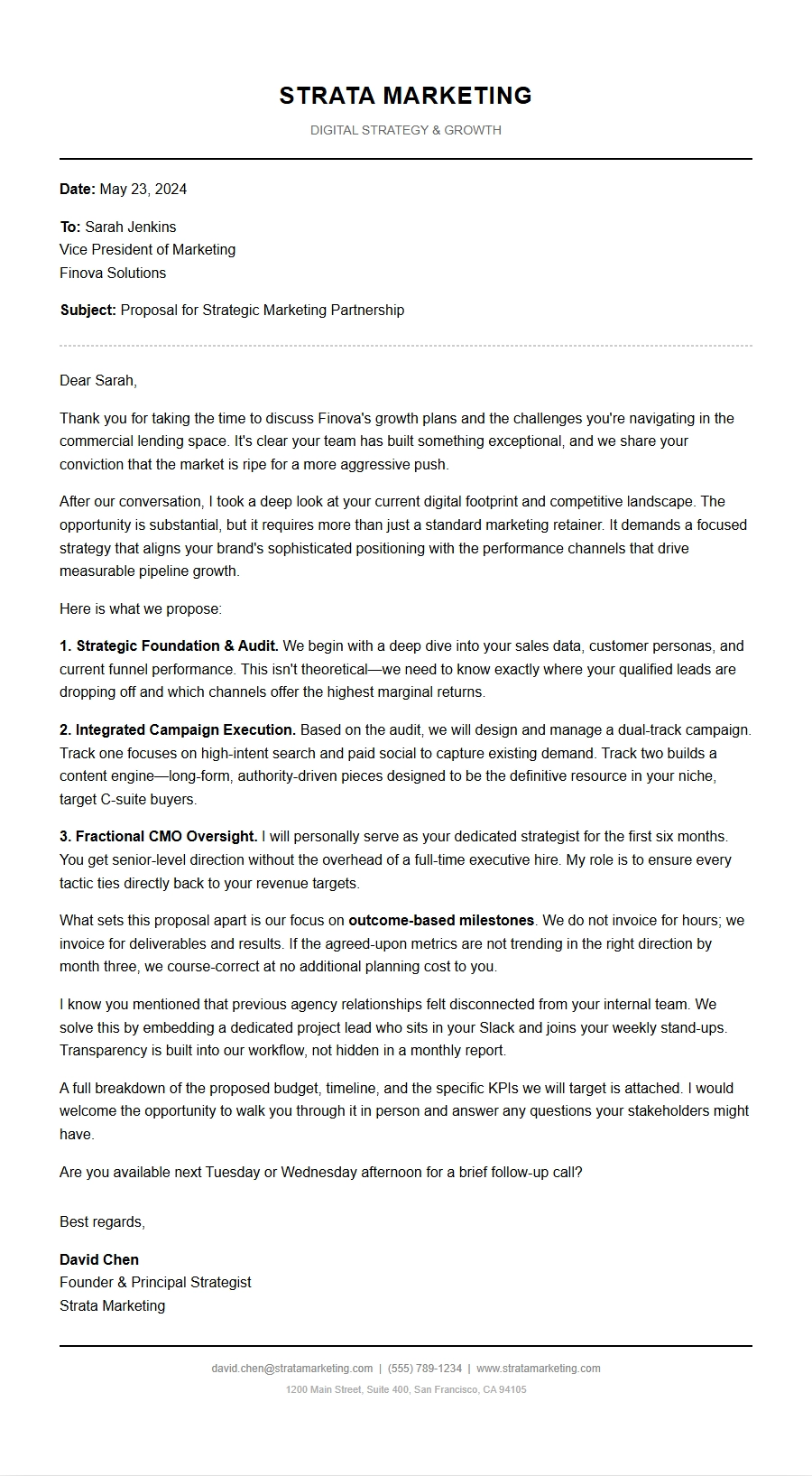 Marketing Agency Service Proposal Letter Template
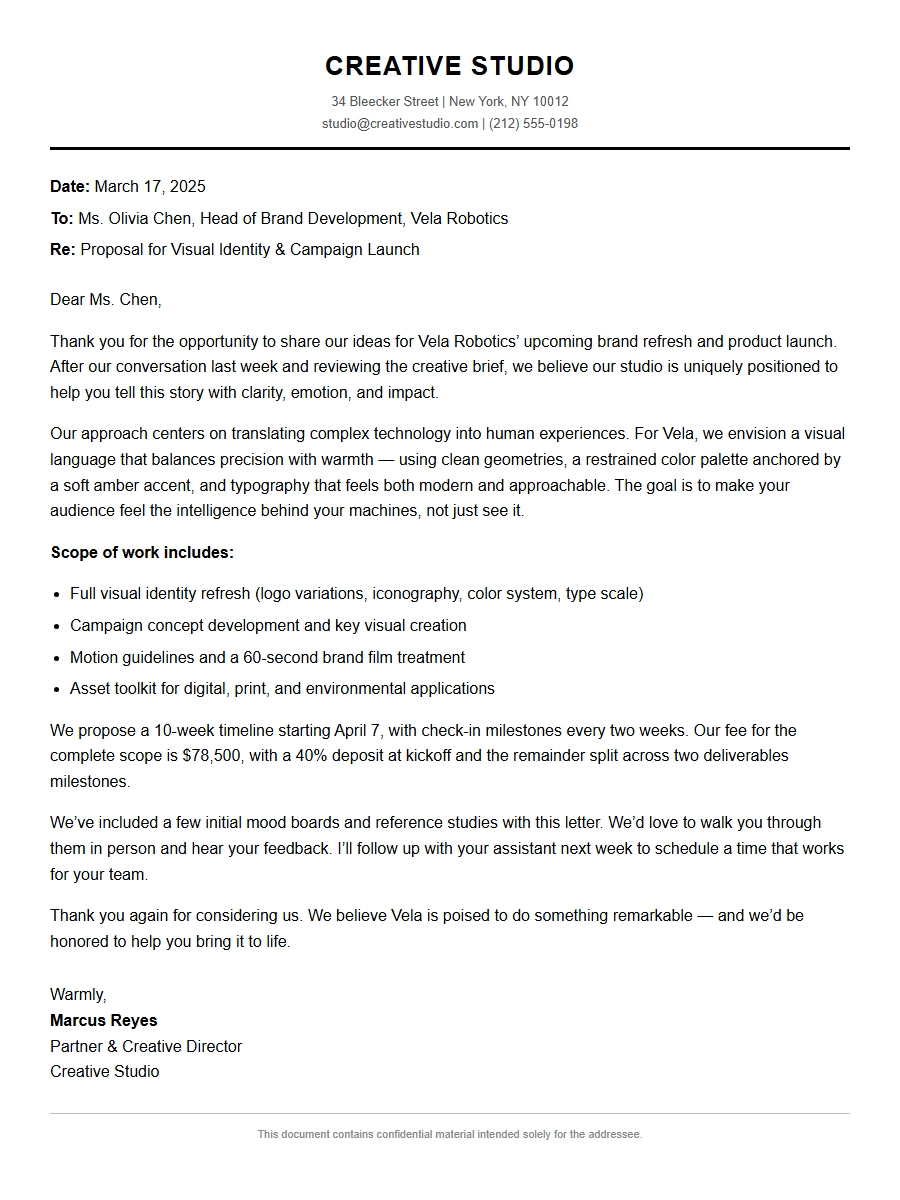 Creative Studio Project Proposal Letter
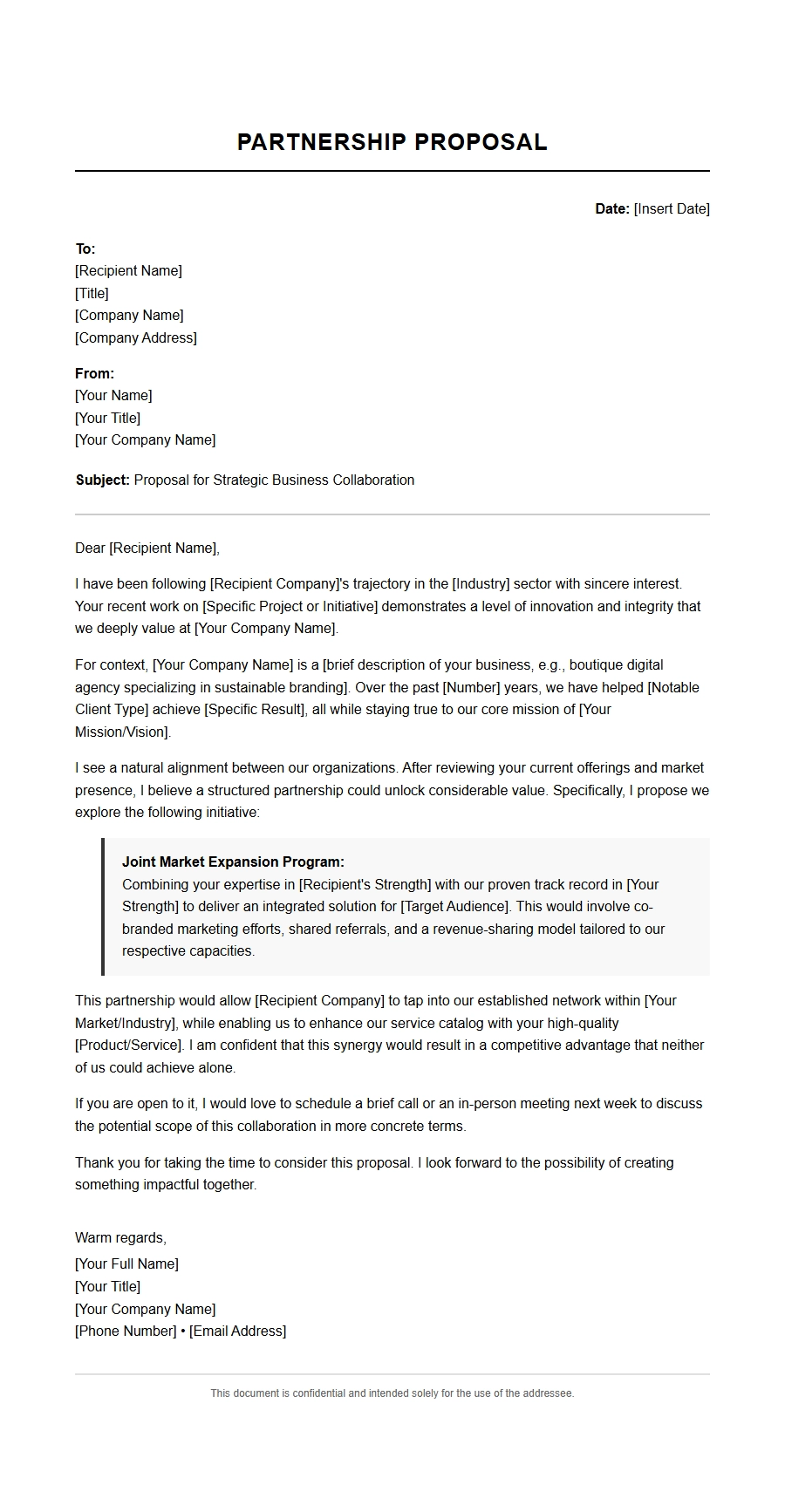 Small Business Partnership Proposal Letter Template
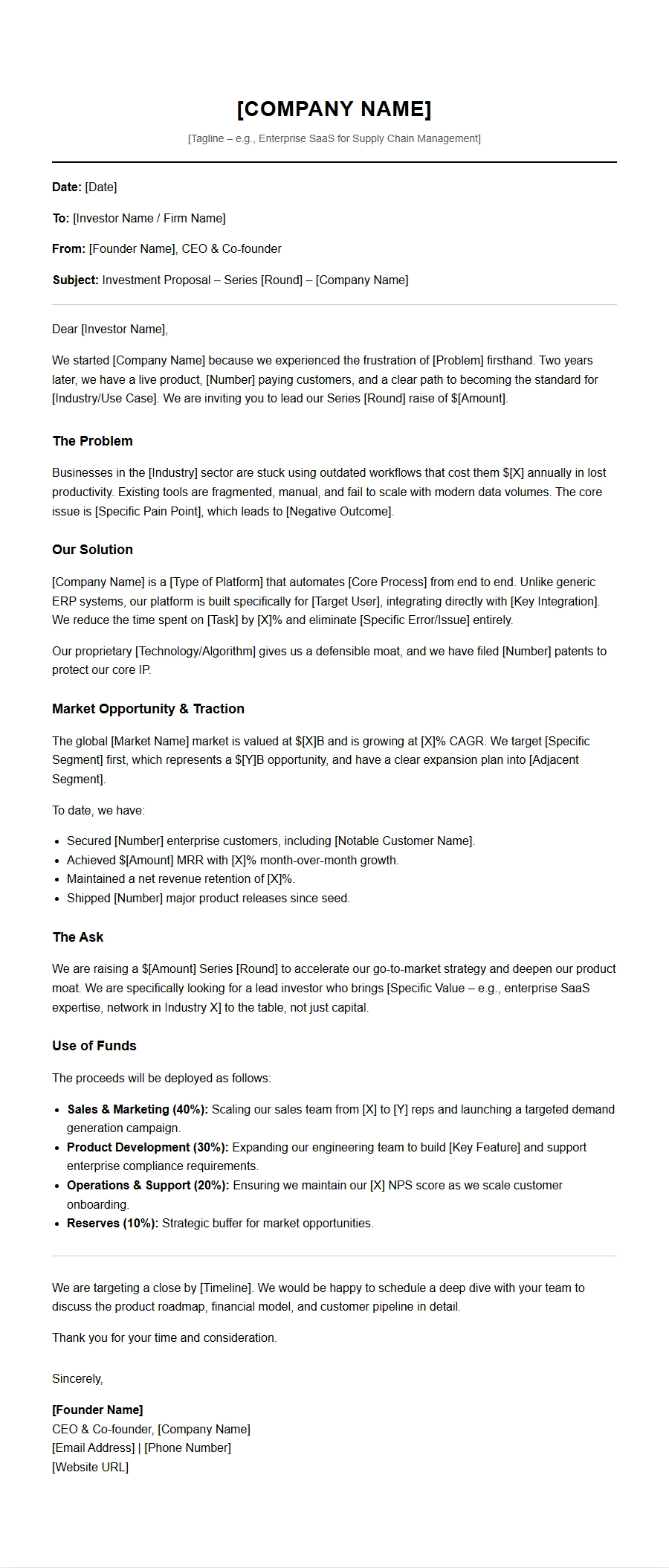 Startup Investment Proposal Letter Template