You’ve submitted a proposal, nailed an interview, or pitched a project. Now you’re waiting. That silence can be frustrating. You want to follow up—but how? Write too soon and you seem pushy. Wait too long and you might be forgotten. A pending decision follow up letter is the professional nudge that keeps you on their radar without sounding desperate. It’s a short, polite reminder that you’re still interested and ready to move forward.
Using a letter sample isn’t cheating. It’s a smart shortcut. Good samples give you the right structure, tone, and key phrases. They save you from staring at a blank page. But the best samples leave room for your personal voice. You’ll adapt them to sound like you, not a generic robot. Think of a sample as a scaffold—you build the real content around it.
Category: Business Letters
How to pick the right sample for your situation
Not all follow‑ups are the same. A follow‑up after a job interview differs from one after a business proposal. Start by matching the sample to your context. If the decision involves a formal contract, use a professional correspondence template with a clear subject line and proper salutation. For a less formal setting—like a small client pitch—a shorter, warmer version works better. The key is to mirror the tone of your earlier communication.
Industry also matters. In creative fields, you can be a bit more conversational. In legal or finance, stick to business letter format and avoid casual language. When you choose a sample, look for one that includes a standard salutation and closing. That saves you from guessing the letter writing etiquette for your industry.
Adapting the sample without losing your authentic voice
Once you have a template, replace the generic details with your own. Mention the specific decision you’re waiting on—reference the date of your interview or the title of your proposal. Use your natural tone. If you’d normally write “Thanks for your time,” say that. Don’t force a stiff phrase like “I express my gratitude.” Keep the structure, but swap the words until it sounds like you.
A quick tip for the opening paragraph: get straight to the point. “I’m following up on my application for the Marketing Manager role. I’m still very interested and wanted to check on the status of the hiring decision.” That shows respect for the reader’s time. Avoid long intros or re‑explaining everything. The recipient already knows the context.
Common mistakes to avoid
One frequent error is using an outdated salutation like “To Whom It May Concern” when you actually have the person’s name. Always address the letter to a specific person if possible. Another mistake is ignoring the format. A digital letter format (email) should be shorter, with a clear subject line. A printed letter needs proper spacing, letterhead design if you have one, and a clean layout. Don’t copy a printed template into an email verbatim—it often looks clunky.
Also, proofreading is non‑negotiable. A typo in a follow‑up suggests you don’t care about details. Read it aloud or ask a colleague to check. And remember: if you include attachments, mention them in the body. A simple “I’ve attached an updated executive summary for your review” works.
How to tailor the follow‑up to your specific situation
Your follow‑up should reference what you sent earlier. For example, if you previously submitted a closing deal proposal letter, your follow‑up can mention that you’re available to discuss terms further. Similarly, if your original message was an environmental sustainability initiative proposal letter, you could add a quick update about a new relevant milestone.
For operational or efficiency‑focused proposals, reference the projected outcomes. A follow‑up after an operational efficiency improvement proposal letter might include a short note about how the plan aligns with current goals. If time is a factor—like an urgent procurement proposal letter—your follow‑up should politely remind them of the deadline. And for cross‑border deals, a international trade agreement proposal letter follow‑up often benefits from referencing any regulatory changes that might speed up the decision.
Closing with confidence
The best follow‑up letters feel both professional and personal. Treat the sample as a springboard, not a crutch. With practice, you’ll write them faster and more naturally. Now go send that note. A well‑timed follow‑up often moves a pending decision in your favor.
Helpful Examples
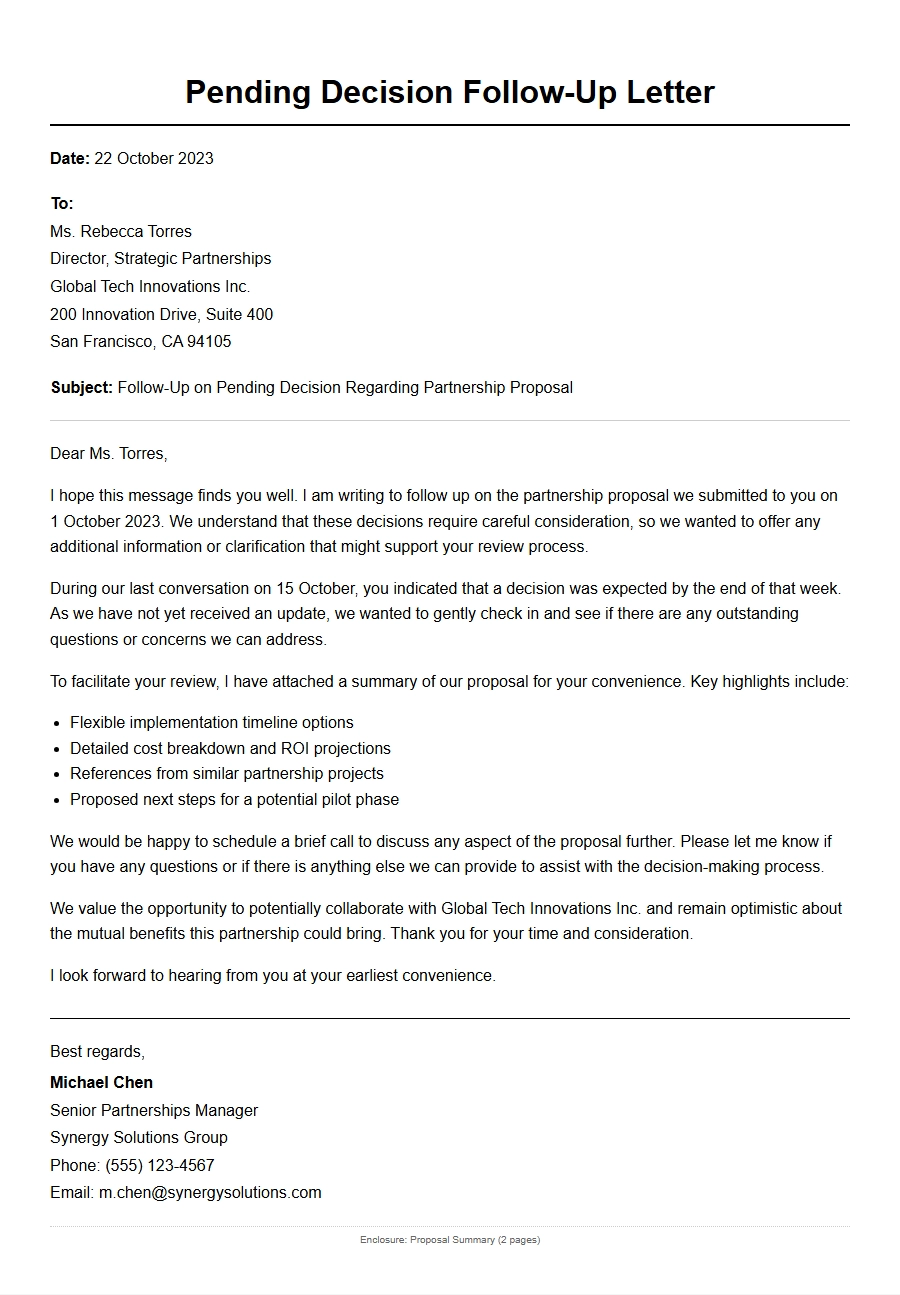
Pending Decision Follow Up Letter Template
Polite Follow-Up on Proposal Status
Dear Ms. Martinez,
I hope this message finds you well. I am writing to respectfully follow up on the business proposal we submitted on February 10, 2025, regarding the implementation of your cloud-based inventory system. We understand that such decisions require careful evaluation, and we remain enthusiastic about the opportunity to partner with your company.
To assist your review, we have prepared a brief summary of the key deliverables:
Phase
Deliverable
Timeline
1
System architecture design
2 weeks after approval
2
Integration testing
3 weeks
3
Full deployment & training
5 weeks
If any additional information or clarification would be helpful, please do not hesitate to reach out. I would be glad to schedule a brief call to address any concerns. We greatly value the time your team has invested in reviewing our proposal and look forward to your favorable decision.
Thank you for your consideration.
Best regards, Andrew Chen Senior Account Manager
Follow-Up with Supporting Data
Dear Dr. Williams,
I am writing to follow up on the research partnership proposal we sent on January 25, 2025. Since our last conversation, we have compiled additional case studies and ROI projections that directly address the metrics discussed during our meeting.
Please find below a summary of estimated cost savings over three years:
Year
Projected Savings
Implementation Cost
1
$45,000
$12,000
2
$78,000
$3,500
3
$102,000
$2,000
We believe these figures demonstrate a strong return on a modest investment. Our team would be delighted to present these findings in a follow-up webinar tailored to your department. Please let me know if you would prefer a brief phone call or a written Q&A session.
We are confident that our solution aligns perfectly with your strategic goals. I look forward to hearing from you at your earliest convenience.
Warmly, Dr. Patricia Nguyen Director, Business Development
Gentle Reminder After Initial Meeting
Hello Mr. Thompson,
It was a pleasure meeting you and your team last Tuesday to discuss our digital marketing proposal for the upcoming product launch. I wanted to check in regarding the status of your decision, as we are eager to begin the preparatory work required for a successful campaign.
During our meeting, we highlighted three core advantages:
Customized audience targeting using AI-driven analytics
Real-time performance dashboards for your team
A dedicated account manager available 24/7
We have already reserved initial creative resources to ensure a smooth start once the proposal is approved. If there are any remaining questions or if you require further breakdowns of the budget, I am available for a brief call this Thursday or Friday.
Thank you for giving us the opportunity to present our services. We remain committed to helping you achieve outstanding results.
Best regards, Sarah Mitchell Marketing Consultant
Decision Pending – Alternate Proposal Options
Dear Ms. Garcia,
I understand that the final decision on our proposal for your office expansion is still pending. To make the choice easier, we have developed two alternative packages that might better suit your current budget or timeline constraints.
Please review the options below:
Package
Scope
Cost
Delivery Time
Standard
Full design + construction
$85,000
8 weeks
Express
Modified design, pre-approved materials
$62,000
5 weeks
Phased
Incremental work in 2 phases
$45,000 (Phase 1)
4 weeks per phase
Each option maintains our quality standards and includes a one-year warranty. I would be happy to walk you through the specifics over a short video call. Please let me know which path interests you most, or if you need additional customizations.
We are keen to move forward and welcome any feedback that could move the decision along.
Sincerely, James Lee Project Manager
Urgent Follow-Up on Expiring Proposal
Dear Mr. Patel,
I hope you are doing well. This is a courteous follow-up regarding the IT infrastructure proposal we submitted on March 1, 2025. As noted in the original terms, the pricing and resource availability are guaranteed only until March 31, 2025 — just seven days from now.
We understand that your organization is evaluating multiple options, but we wanted to ensure you have the most favorable conditions before the deadline expires. Here are the key reasons to decide now:
20% discount on the first year of managed services
Priority onboarding for early adopters
Free extended training for up to five staff members
If you need a short extension or an updated quote, please contact me immediately. Otherwise, we encourage you to sign the agreement at your earliest convenience so that we can lock in these benefits.
Thank you for your attention to this matter. I look forward to your positive response.
Best regards, Emily Ross Sales Director
Follow-Up Requesting Feedback on Presentation
Dear Dr. Kim,
I hope your week is going well. Following our presentation on the new laboratory equipment proposal last Wednesday, I wanted to check if you and your committee have had the chance to discuss the next steps. We greatly appreciated the thoughtful questions raised during the session.
To help us understand your perspective better, could you please share any feedback on the following points?
Does the proposed timeline align with your academic calendar?
Are there any additional technical specifications you would like to see?
Would a demonstration of the equipment be useful before making a decision?
We have already prepared a short demo video and can send it within 24 hours if that is helpful. Our technical team is also available for a live session at your convenience.
We are committed to ensuring that our proposal meets your exact requirements. A quick note on your impressions would be immensely valuable as we await the final decision.
Thank you for your time and consideration.
Warm regards, Robert Chen Product Specialist
Second Follow-Up with Reference Contacts
Dear Ms. Okafor,
I am writing once again to kindly check on the status of our proposal for the community health initiative. During our last exchange, you mentioned that references from similar projects would assist the board’s decision. I have now collected three recent references who have agreed to speak with you.
Please find their details below:
Organization
Contact Person
Phone
Hope Medical Center
Dr. Anne Peters
+1 555 0123
Green Valley Clinic
Mr. Samuel White
+1 555 0456
Urban Health Alliance
Ms. Clara Diaz
+1 555 0789
All have confirmed they are available for a brief call at your convenience. Additionally, I have attached (in a separate email) the formal testimonial letters from each partner. I hope this information will provide the confidence your board needs to move forward.
Please let me know if there is anything else I can supply. I remain optimistic about the potential collaboration.
Thank you for your continued consideration.
Best regards, David Osei Program Coordinator
Follow-Up Emphasizing Mutual Benefits
Hello Mr. Johannson,
I wanted to reconnect regarding the joint venture proposal we submitted last month. I understand that decision-making involves many stakeholders, and I respect your process. However, I believe it is worth highlighting how quickly the market is moving — both our companies could gain a significant advantage by acting soon.
Our proposal offers the following shared benefits:
Exclusive access to our proprietary analytics platform for the first year
Revenue sharing starting at 60/40 in your favor for the first 12 months
Co-branded marketing campaigns across three major channels
We have already begun preliminary work to ensure a seamless launch; delaying may cause us to lose momentum. I would love to schedule a final alignment meeting with your executive team to address any lingering concerns.
Let’s set a date this week or next. I am confident that together we can achieve results that exceed our individual capabilities.
Looking forward to your reply.
Warmly, Isabella Rossi VP of Strategic Partnerships
Follow-Up to Government Agency Committee
Dear Members of the Procurement Committee,
I am writing to follow up on the proposal submitted on February 28, 2025, in response to RFP #2025-04 for municipal water treatment upgrades. We understand that the evaluation process is thorough and appreciate the committee’s diligence.
For your convenience, we reiterate the core components of our offer:
Component
Description
Cost
Filtration system
Advanced membrane technology
$1,200,000
Installation
Full site preparation and setup
$350,000
Maintenance
Three-year service contract
$180,000/year
All pricing remains firm for 60 days from submission. We have also received necessary environmental certifications that may expedite permits. If there are any additional compliance questions, our regulatory team is ready to provide documentation.
We respectfully request an update on the expected decision timeline. Thank you for your service to our community, and we hope to contribute to its infrastructure.
Sincerely, Engineer Thomas Reed Senior Project Lead
Follow-Up with Revised Pricing and Timeline
Dear Mr. Choi,
I hope this message finds you in good spirits. Since our proposal for the e-commerce platform redesign is still under review, I wanted to share a revised offer that we believe addresses your earlier concerns about budget and launch speed.
We have restructured the project as follows:
Reduced upfront cost by 15% (new total: $42,500)
Accelerated timeline from 10 weeks to 8 weeks
Added two extra training sessions at no charge
To support this, we will use a modular approach that allows some features to go live earlier, generating revenue faster. A side-by-side comparison with the original proposal is available upon request.
I believe this revised plan aligns more closely with your initial feedback. If the new terms are agreeable, we can move to contract signing within this week. Otherwise, I am open to discussing further adjustments.
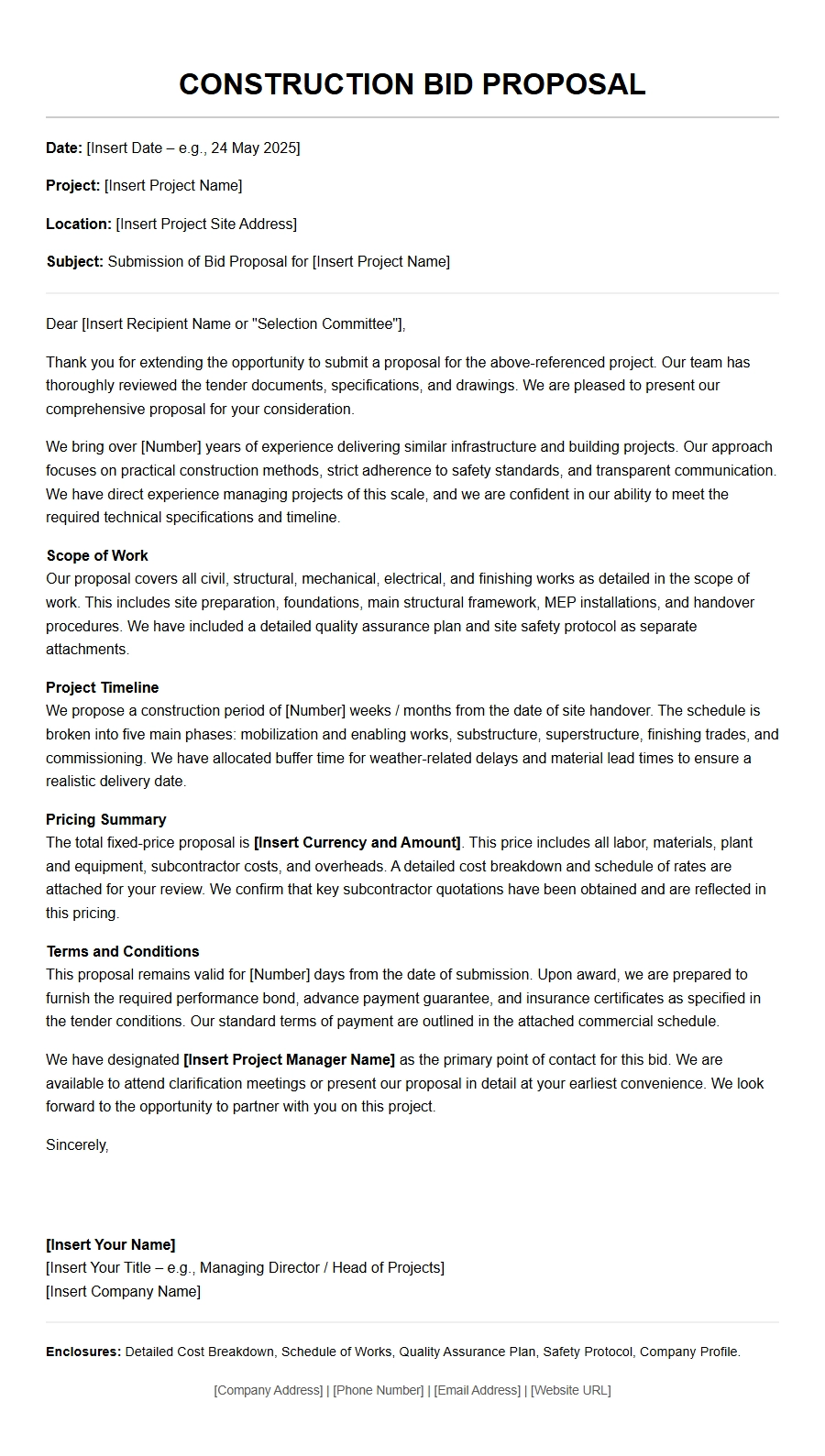 Sample Construction Bid Proposal Letter
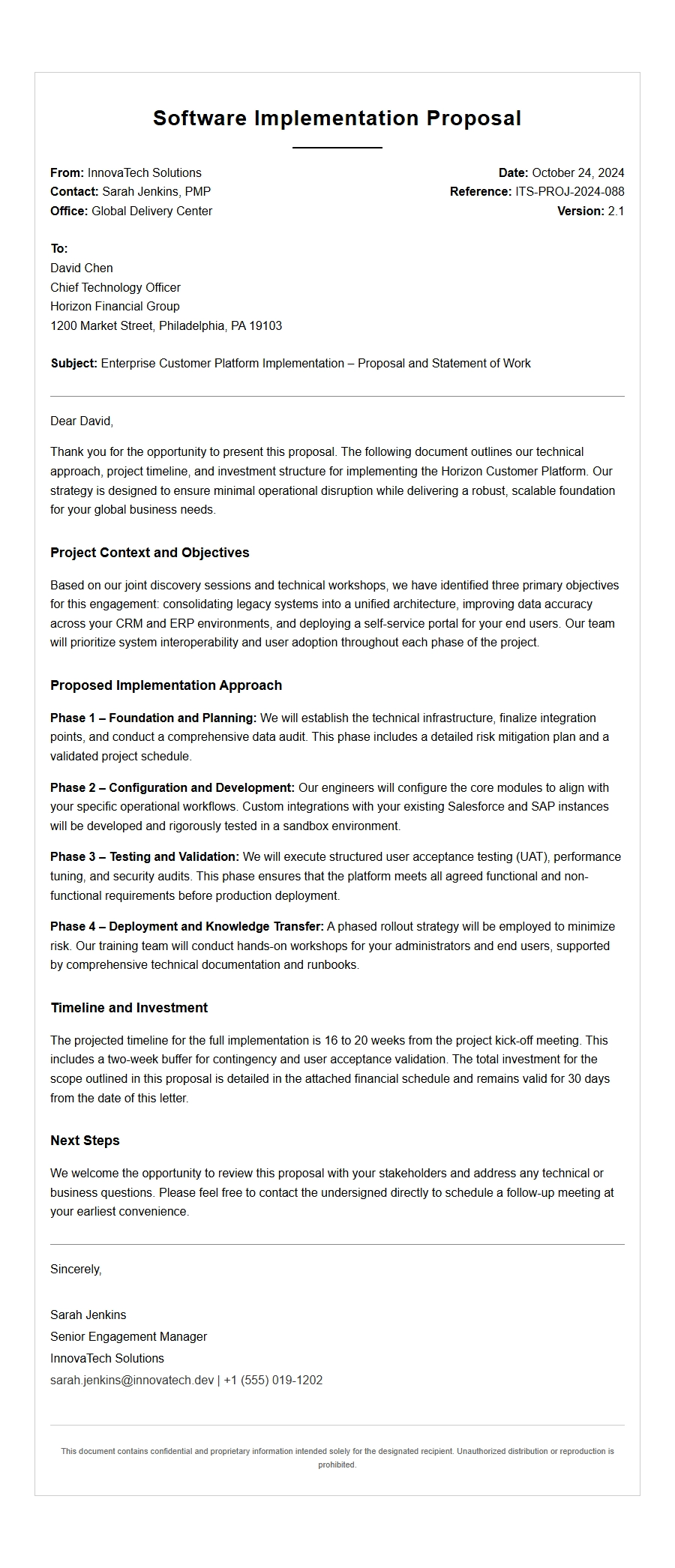 Enterprise Software Implementation Proposal Letter Example
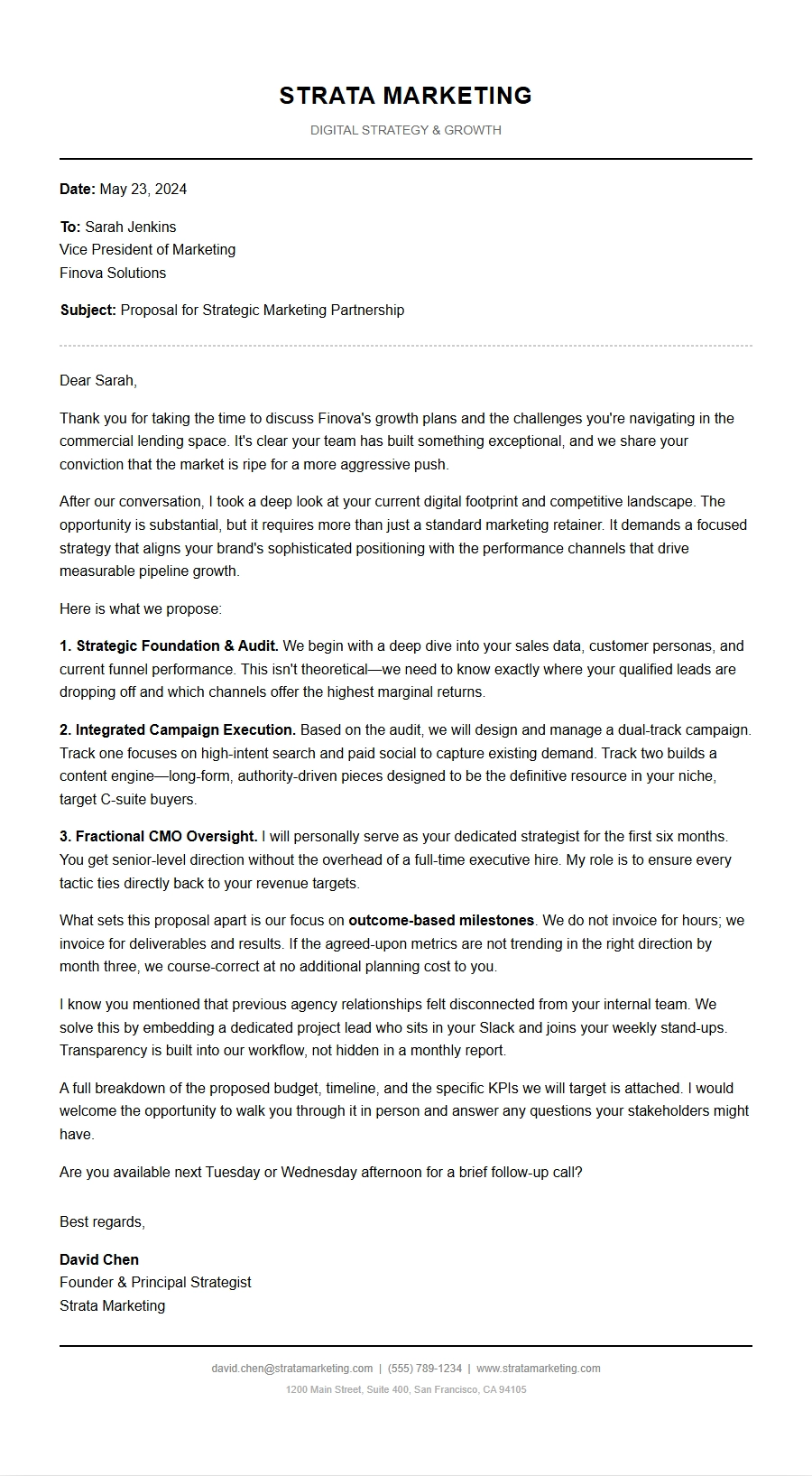 Marketing Agency Service Proposal Letter Template
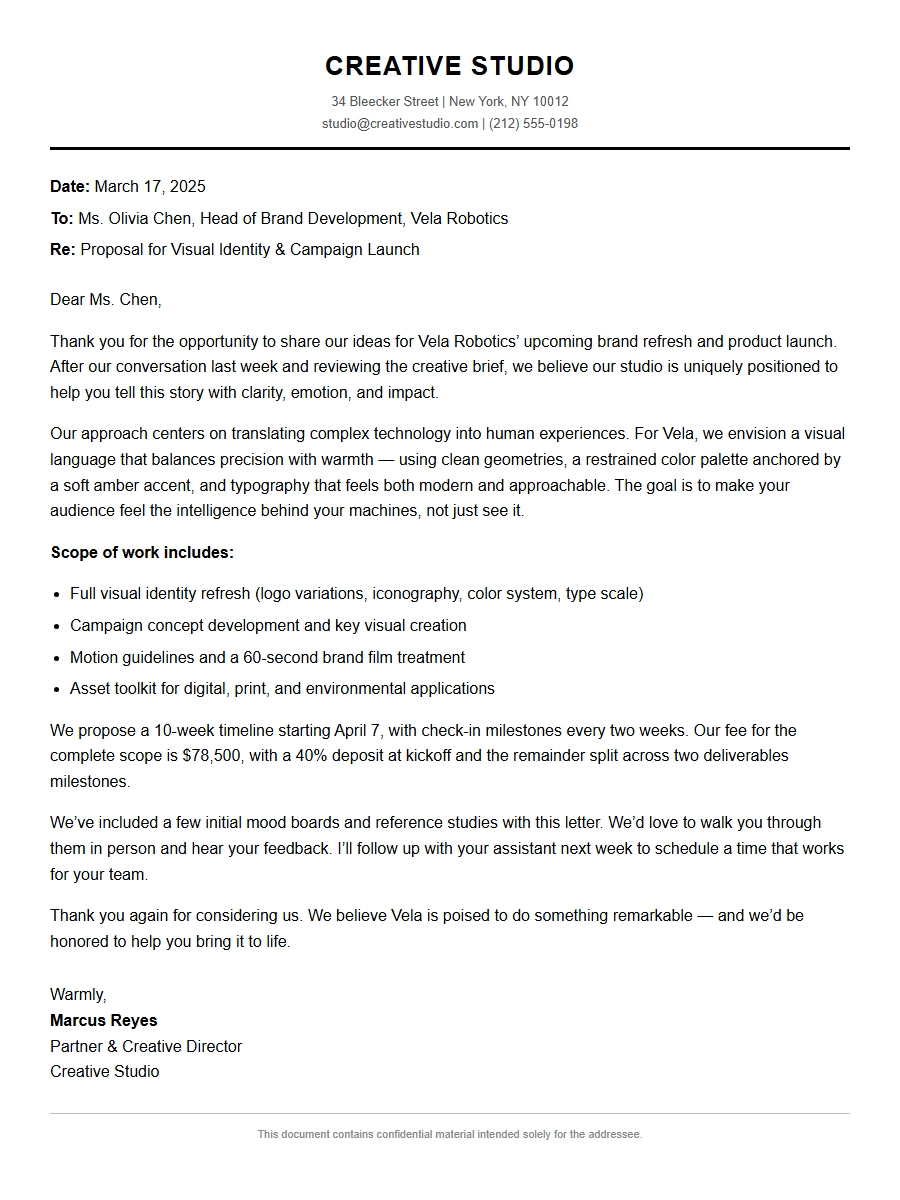 Creative Studio Project Proposal Letter
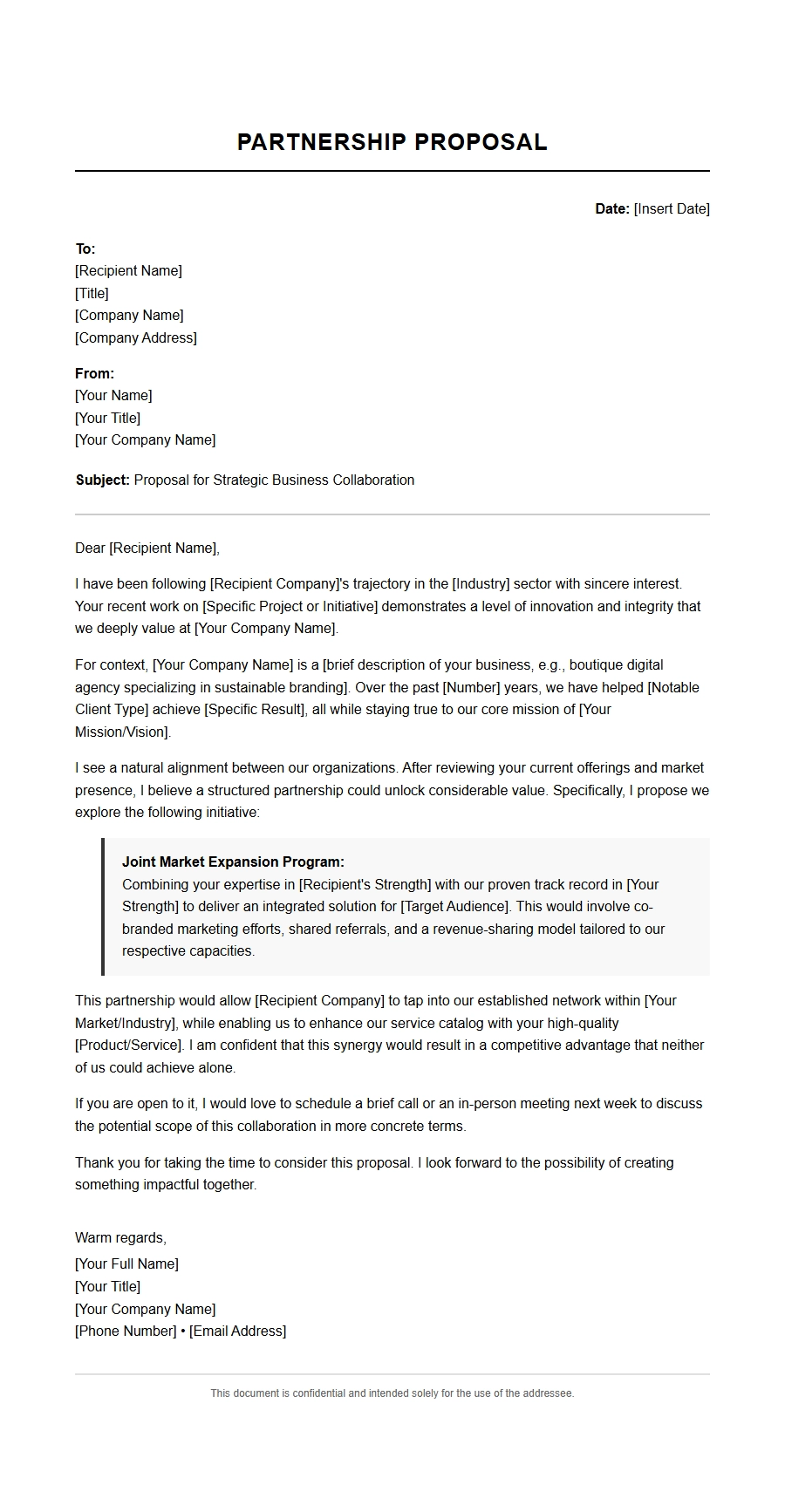 Small Business Partnership Proposal Letter Template
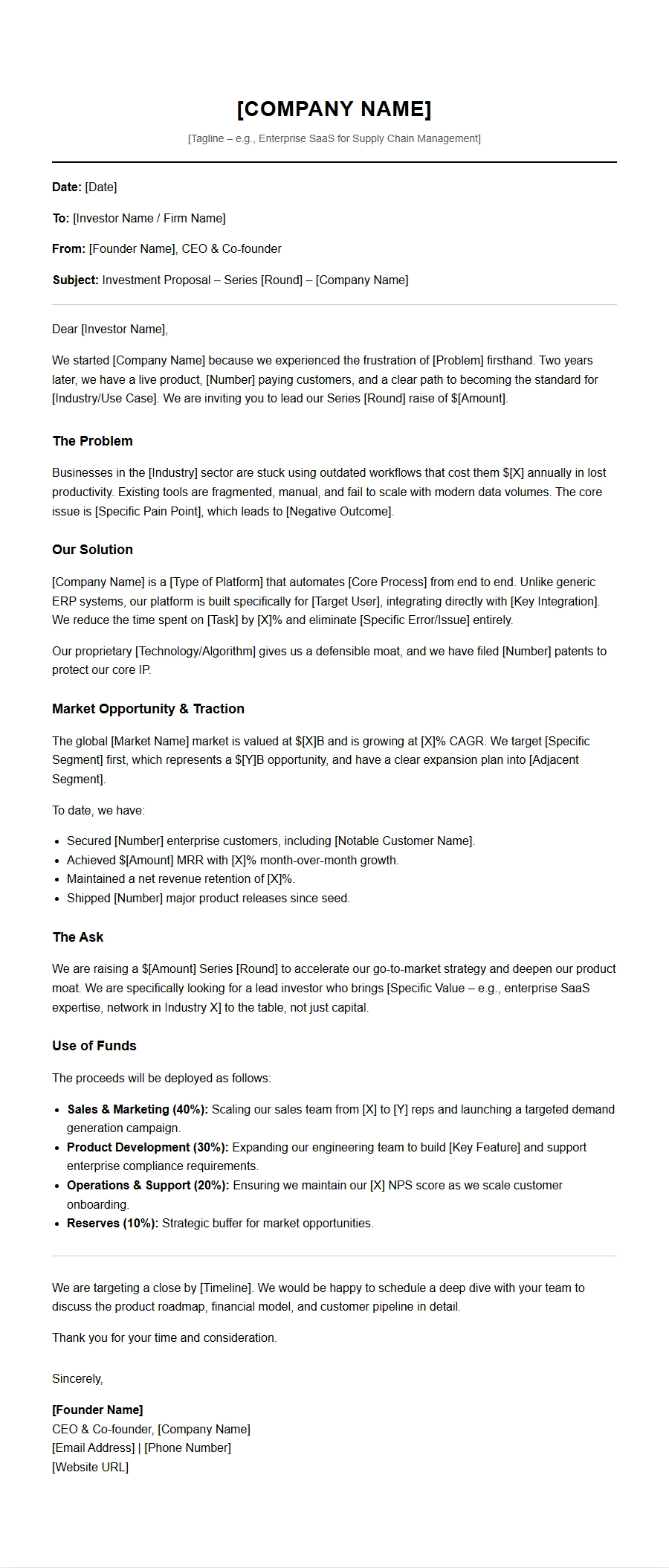 Startup Investment Proposal Letter Template