Sample Condolence Letters After Cremation Services
When someone you know has lost a loved one and the cremation service has already taken place, you may feel like you've missed your chance to offer comfort. That ache of wanting to say something, but not knowing how or when, can leave you staring at a blank card or email for far too long. The truth is, a thoughtful message sent after the formal service can mean just as much — sometimes more.
Why sending a note after cremation matters
Cremation services are often more private or smaller than traditional funerals. Friends and extended family may not have had a chance to attend, grieve together, or say goodbye. A letter that arrives in the days or weeks following the service tells the bereaved: I haven't forgotten. You're still on my mind. That kind of reminder is a real gift.
You don't need an elaborate letter or perfect poetry. What matters most is your honesty and your presence on the page. A simple, direct condolence letter is far more comforting than a flowery one that sounds like it was copied from a greeting card factory.
What to include when you write your condolences
Start by acknowledging the loss directly. Use the person's name. Say something like, "I was so sorry to hear about your mother, Helen." This grounds your message in reality and shows you're willing to sit with the painful truth, not look away from it.
Next, share a specific memory or quality about the person who died. This is the heart of the letter. You might say, "I'll never forget how she always asked about my garden and actually listened to the answer." If you didn't know the deceased well, you can still mention something you admired from a distance: "I always saw how kind he was to the delivery drivers at work."
Then offer your support without conditions. Avoid vague promises like "let me know if you need anything." Instead, say something concrete: "I'm bringing dinner by on Thursday. I'll leave it on the porch if you're not up for company." This lets the person off the hook from having to ask for help.
Finally, close with a warm, straightforward sign-off. "With deepest sympathy," or "Thinking of you," followed by your name, is more than enough.
Common mistakes in condolence letters after cremation
One of the biggest errors is writing a letter that focuses entirely on your own shock or sadness. While your feelings are valid, the letter's job is to comfort the recipient, not to process your own grief. Keep the spotlight on them and their loved one.
Another mistake is using clichés that can feel dismissive. Phrases like "they're in a better place" or "this was their time" often hurt more than they help. You simply don't know what the grieving person believes about what happens after death. Safer to stick with "I'm so sorry for your loss" and let them fill in the spiritual blanks.
Also, avoid writing a novel. A few heartfelt paragraphs are powerful. A long, rambling letter can feel like a burden to read when someone is exhausted by grief.
Adapting a sample to sound like you
Using a condolence letter sample is not cheating. It's a smart way to get the structure and tone right so you can focus on what's personal. Start with a basic letter template, then swap out generic phrases for your own memories and voice. Read it aloud. If it sounds stiff, rewrite that sentence in your natural speaking style.
A quick tip: Open with a direct, honest line. Most condolence letters lose their power in a long, cautious opening. Jump in. Say what happened and that you care.
Email vs. handwritten note
A handwritten note sent through the mail feels more personal and lasting. If you choose email, keep the digital letter format clean — short paragraphs, no fancy fonts, and a simple subject line like "Thinking of you and your family." Email is fine when you want to reach out quickly or when you don't have the person's mailing address. The words matter more than the medium.
For a more formal letter, such as one you might send on behalf of a business or organization, follow standard business letter format. Use a formal salutation and closing like "Dear Mr. Smith" and "With sincere condolences." If you're writing on company letterhead, keep the letterhead design simple so your message remains the focus.
Choosing the right tone
Match your tone in writing to your relationship with the bereaved. For a close friend, you can be more conversational and open. For a colleague or acquaintance, stay warm but more restrained. The goal is professional correspondence when the situation calls for it, but never cold or distant. If you're unsure, err on the side of being too warm. No one ever complained that a condolence note felt too kind.
Before you send it
Read your letter one more time. Check for typos, but don't obsess over perfection. A small mistake is human and often endearing. What you want to avoid is any wording that could be misinterpreted. Proofreading once for tone is more important than proofreading five times for punctuation.
The best condolence letter after a cremation service is the one you actually send. It doesn't have to be perfect. It just has to be yours. Write from your heart, keep it simple, and send it today. Your words will land exactly when they're needed most.
Samples You Can Use
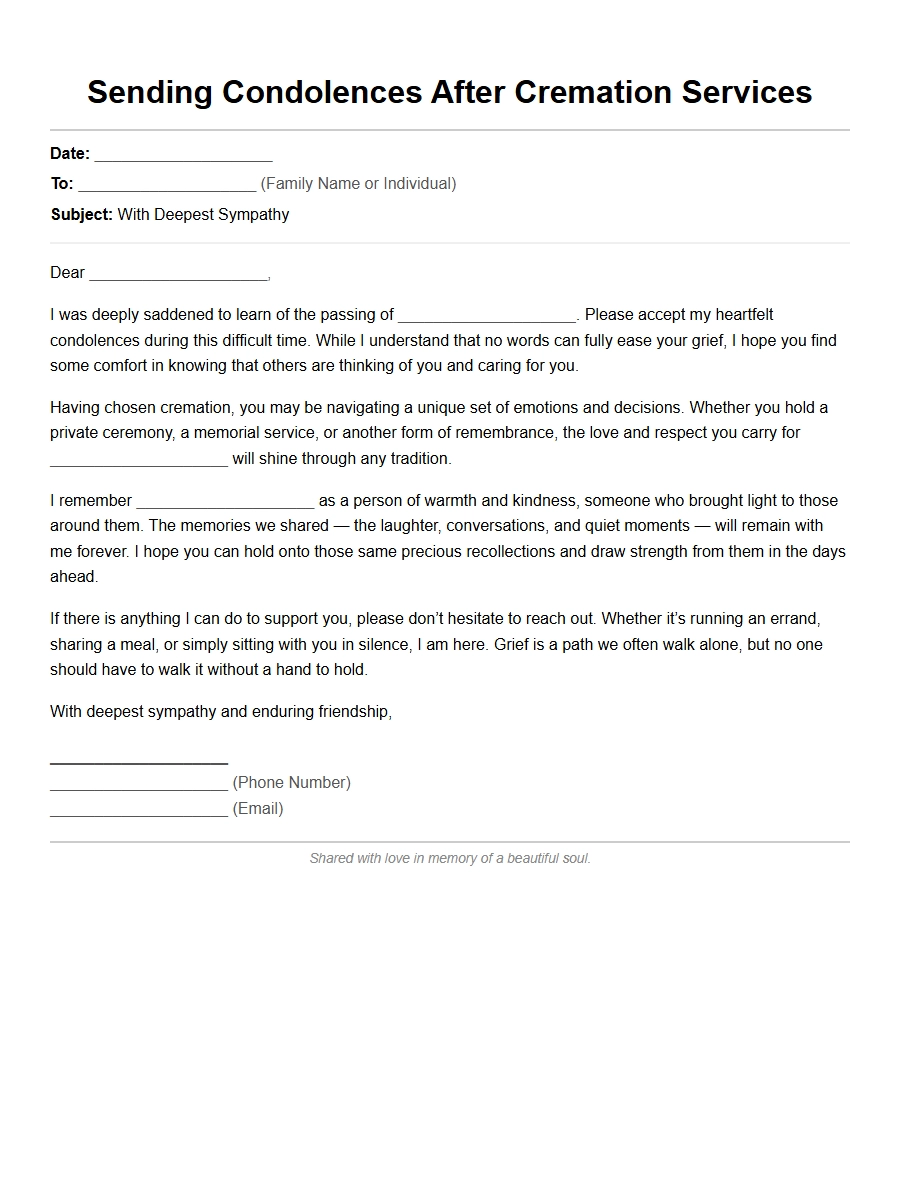
Sample Condolence Letters After Cremation Services
Formal Condolence from Employer
Date: March 15, 2025
To: Mrs. Helen Carter From: James Whitfield, CEO – Meridian Corp.
Dear Mrs. Carter,
On behalf of the entire Meridian team, I extend our deepest sympathy to you and your family following the passing of your husband, Robert. We learned that you chose cremation services, and we respect this personal decision. During this difficult time, please know that you remain in our thoughts.
To honor Robert’s memory, we have arranged a small contribution in his name to the Cancer Research Foundation. We will also be adjusting your work schedule to allow you time for the memorial service and any further arrangements.
Summary of Support Offered:
Item
Details
Donation
$500 to Cancer Research Foundation
Bereavement Leave
5 paid days from March 17–21, 2025
Memorial Service Attendance
Company representatives will attend on March 22
Please feel free to reach out if you need further assistance. With sincere condolences.
Personal Letter to a Widow
Date: April 2, 2025
Dearest Sarah,
I was heartbroken to hear about Tom’s passing. I know that after the cremation service you held last week, you may still be processing everything. I wanted you to know that I am here for you — whether you need someone to talk to, help with daily errands, or just a quiet companion.
Tom was a wonderful friend, and I cherish the memories of our camping trips together. The way he told stories around the campfire will never be forgotten. If you ever want to share memories or just sit in silence, I’m just a phone call away.
Practical Help I Can Offer:
Meal deliveries: I can bring dinner every Tuesday and Thursday for the next month.
Transportation: I’m free to drive you to any appointments or to the memorial garden where Tom’s ashes will be placed.
Grocery runs: Let me know when you need supplies; I can pick them up.
Please take all the time you need. Sending you love and strength, and remembering Tom with great fondness. With deepest sympathy,
Condolence from Religious Leader
Date: April 5, 2025
Dear Margaret and family,
Grace and peace to you in this time of sorrow. I learned that your beloved husband, John, was honored with a cremation service, and I want to assure you that our faith holds that the ashes of the body return to the earth while the soul rests in God’s eternal embrace. We held a special prayer during our Sunday service for John’s soul and for your comfort.
If you wish, we can arrange a memorial blessing for the ashes at our church columbarium or a private scattering in the garden of remembrance. Please let me know if you would like to discuss this.
Upcoming Support Opportunities:
Event
Date
Details
Prayer Group
Wednesdays at 7 PM
Focus on grief support
Pastoral Visit
April 10, 3 PM
I will come to your home
Memorial Service
To be scheduled
Blessing of ashes at church
You are not alone. Our congregation surrounds you with love. In Christ’s compassion,
Support Group Offering Condolences
Date: April 8, 2025
Dear Linda,
On behalf of the Grief Support Network, we extend our heartfelt condolences on the loss of your mother, Evelyn. We understand that you chose cremation services, and we respect the variety of ways people honor their loved ones. Our group offers a safe space for those navigating loss, whether through traditional burial or cremation.
We would like to invite you to our next meeting, where we will focus on “Honoring a Life After Cremation.” Members will share ideas for memorialization, such as creating a memory garden, scattering ashes in meaningful places, or keeping a small urn at home.
Upcoming Meeting Details:
Date
Time
Location
Topic
April 15, 2025
7:00 PM
Community Center, Room 203
Honoring a Life After Cremation
May 6, 2025
7:00 PM
Online via Zoom
Grief and Self-Care
Please feel free to bring a friend or family member. You are welcome as you are. With warm sympathy,
Funeral Home Thank You Letter
Date: March 28, 2025
To: The Anderson Family From: Peaceful Journey Funeral Home
Dear Mr. and Mrs. Anderson and family,
We want to thank you for entrusting us with the cremation services for your beloved father, Richard. It was an honor to assist you during this difficult time. We hope the ceremony you held was meaningful and provided some comfort.
As a follow-up, we have prepared a summary of the services provided and any remaining details. If you have questions about the death certificates, the disposition of ashes, or memorial options, please do not hesitate to contact us. We are here to support you through every step.
Service Summary:
Service
Date Completed
Status
Transportation & Care of Deceased
March 20, 2025
Completed
Cremation
March 22, 2025
Completed
Death Certificate Filing
March 25, 2025
In Process – 5 copies ordered
Urn Delivery
March 27, 2025
Delivered to family
We also offer assistance with obituary writing and planning a memorial gathering if desired. Please call us anytime. With sincere sympathy,
Friend Sharing Memories
Date: May 1, 2025
Dear Chris,
I am so sorry to hear about your dad’s passing. I attended the cremation service and was moved by how peaceful it was. Your father was such a kind and gentle man. I’ll always remember the summer afternoons we spent fishing at the lake—he taught us patience and how to bait a hook without getting tangled. Those memories are treasures.
After the service, I spoke with your mom briefly. She mentioned that you might scatter his ashes at the lake this fall. If you need any help organizing that, please count me in. I can help with transportation, food, or even just being there to support you.
Things I Can Help With:
Driving – I have a minivan that can take up to 7 people.
Catering – I can order sandwiches and drinks for the gathering.
Memory board – I’d love to bring photos and create a display.
Let’s stay in touch. I’m thinking of you all. With love,
Inquiry About Ash Scattering
Date: April 12, 2025
Dear Aunt Susan,
I was deeply saddened to hear about Uncle Paul’s passing. I know you had the cremation service last week, and I hope it brought you some sense of closure, even though I couldn’t be there in person. I’ve been thinking about him a lot — his laugh, his stubbornness, his love for gardening.
I wanted to ask if you have decided what to do with his ashes. I remember Uncle Paul always said he wanted to be scattered in the rose garden he planted behind the house. If you need help arranging a small ceremony or if you want to travel somewhere meaningful, please let me know. I’d be happy to contribute time or funds to make it special.
Possible Options We Could Discuss:
Private scattering in the rose garden with immediate family
A small memorial bench with a plaque near the garden
Planting a tree with his ashes mixed into the soil
Please take your time, but know that I am ready to help in any way. With affectionate sympathy,
Team Condolence from Coworkers
Date: March 30, 2025
Dear Mr. and Mrs. Garcia,
Our office team was deeply saddened to learn of the passing of your son, Daniel. We know that you held a cremation service last Saturday, and many of your colleagues were able to attend and pay their respects. Daniel was a valued member of our accounting department, always ready with a smile and a helping hand.
As a token of our sympathy, we have collected donations from coworkers and are contributing to two causes that were dear to Daniel: a local youth coding club and the animal shelter where he volunteered. Below is a summary of our collective gesture.
Condolence Contributions:
Item
Amount/Details
Donation to Youth Coding Club
$320
Donation to Animal Shelter
$280
Sympathy Card Signed by 22 colleagues
Delivered to your home
Meal Voucher (local restaurant)
$100 gift card enclosed
We will remember Daniel always. Please accept our heartfelt condolences. On behalf of the team,
Neighbor Offering Practical Help
Date: April 18, 2025
Dear Mrs. Patel,
I was so sorry to hear about your husband, Raj’s, passing. I know the cremation service was held yesterday, and I wanted to reach out and offer some practical help. Grief is hard enough without worrying about daily chores. I live next door, so I’m always nearby.
If you need someone to water plants, pick up mail, or walk your dog, just call. I can also help with meals — I’ll bring over a casserole and some soup tomorrow. Please don’t hesitate to ask for anything else. Also, if you plan to scatter Raj’s ashes at the park he loved, I’d be glad to accompany you or help organize the moment.
Help Calendar (I’m Available For):
Day
Time
Task
Monday
9 AM – 12 PM
Grocery shopping
Wednesday
2 PM – 5 PM
Errands / driving
Friday
Evening
Dinner drop-off
You are not alone in this. With deepest sympathy, your neighbor,
Veterans Organization Condolence
Date: May 5, 2025
Dear Mrs. Thompson,
On behalf of the American Veterans Honor Society, we extend our heartfelt condolences on the passing of your husband, Sergeant First Class Michael Thompson. We were informed that his cremation service took place on May 2, 2025. As a veteran who served with distinction in the 3rd Infantry Division, Michael deserves our utmost respect and gratitude.
We would like to offer a military honors ceremony at the National Veterans Cemetery, where his ashes can be interred in the columbarium. This includes a flag presentation, a 21-gun salute, and the playing of Taps. Please contact our office to schedule this at your convenience. Additionally, we will issue a memorial certificate and a flag to you.
Veterans Benefits & Honors Available:
Benefit
Details
Military Funeral Honors
Includes flag, rifle salute, Taps
Burial Flag
Provided free of charge
Presidential Memorial Certificate
Issued within 2 weeks
Headstone or Marker for Ashes
Available for columbarium niche
We stand ready to serve you. Please accept our deepest gratitude for Michael’s service and our sympathy for your loss. Sincerely,
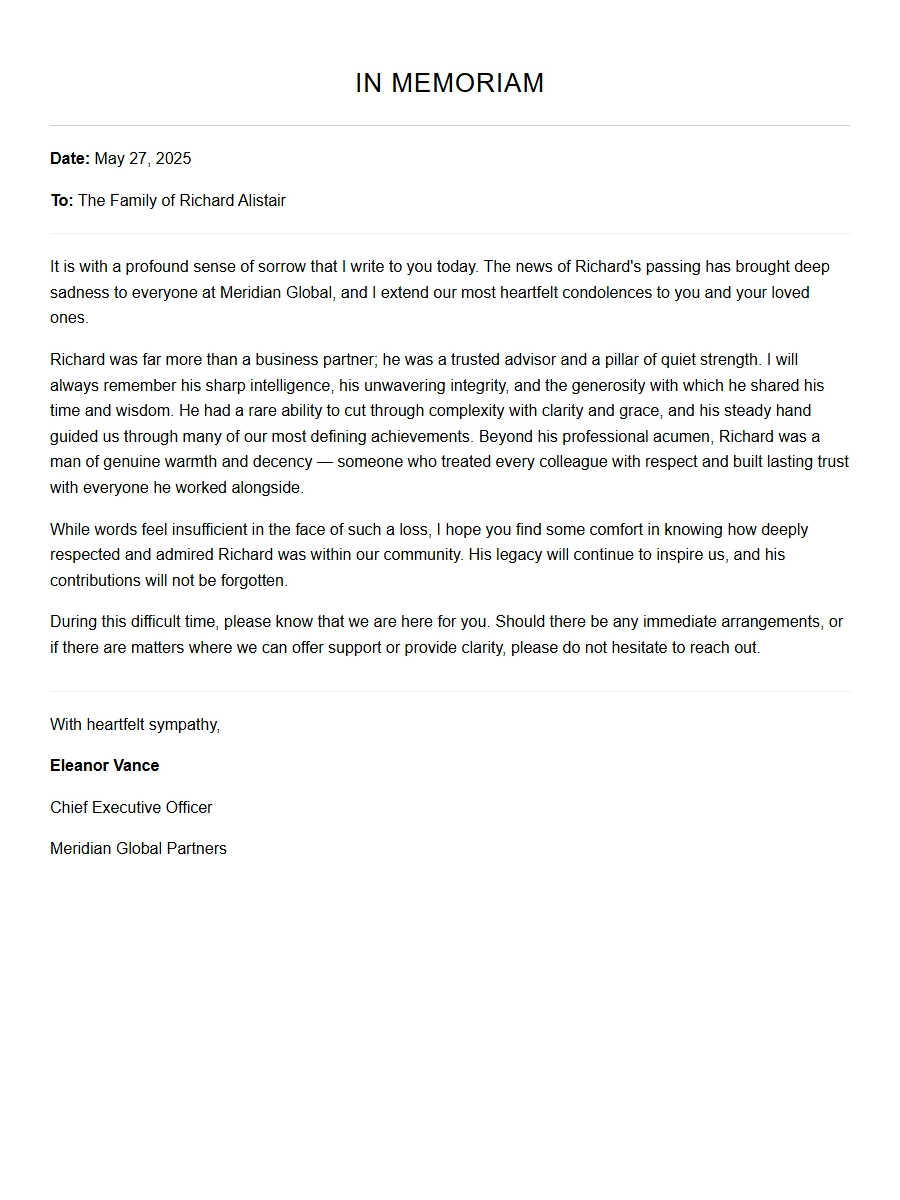 Formal Condolence Message for a Business Partner
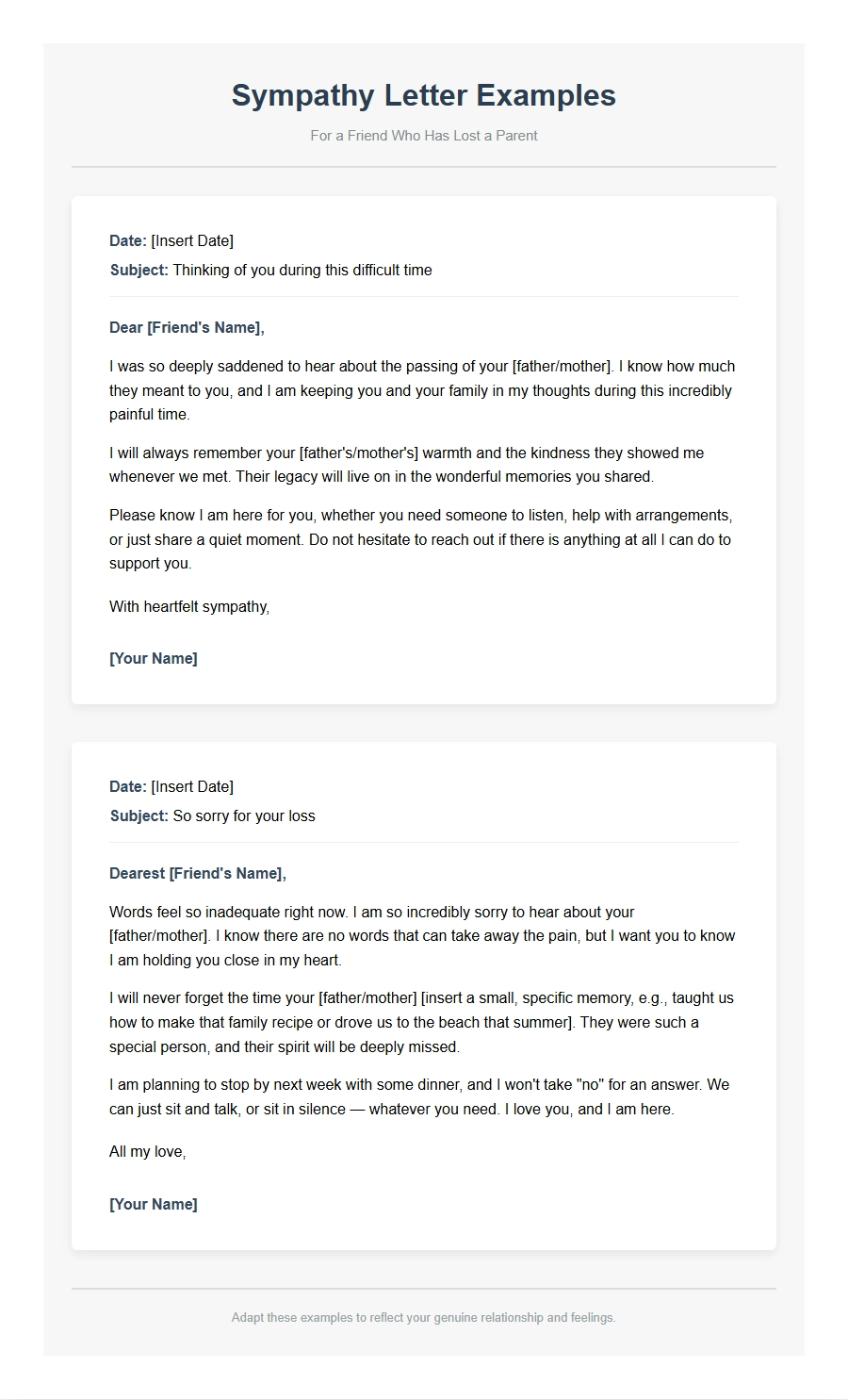 Sympathy Letter Examples for a Friend Who Lost a Parent
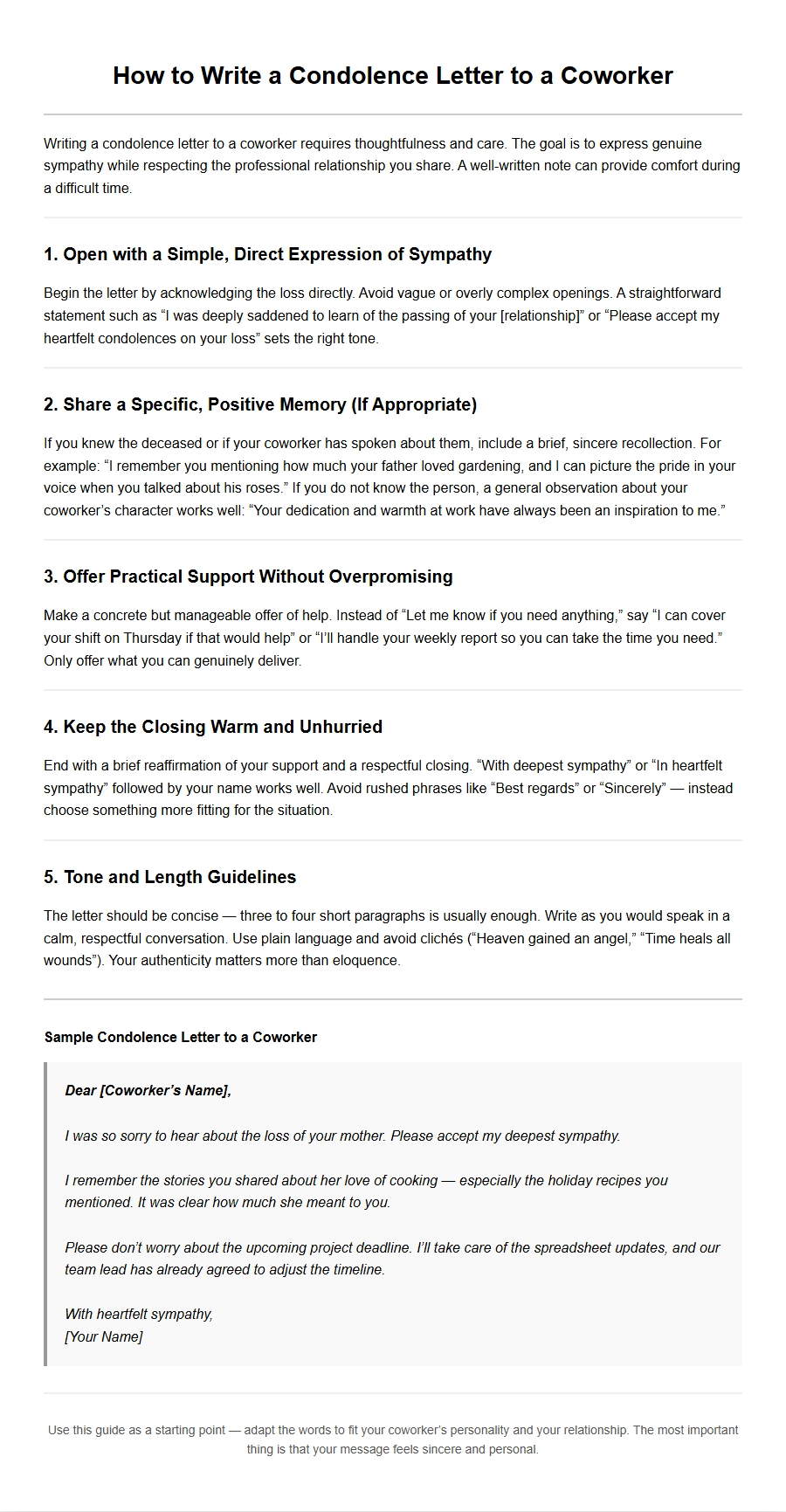 How to Write a Condolence Letter to a Coworker
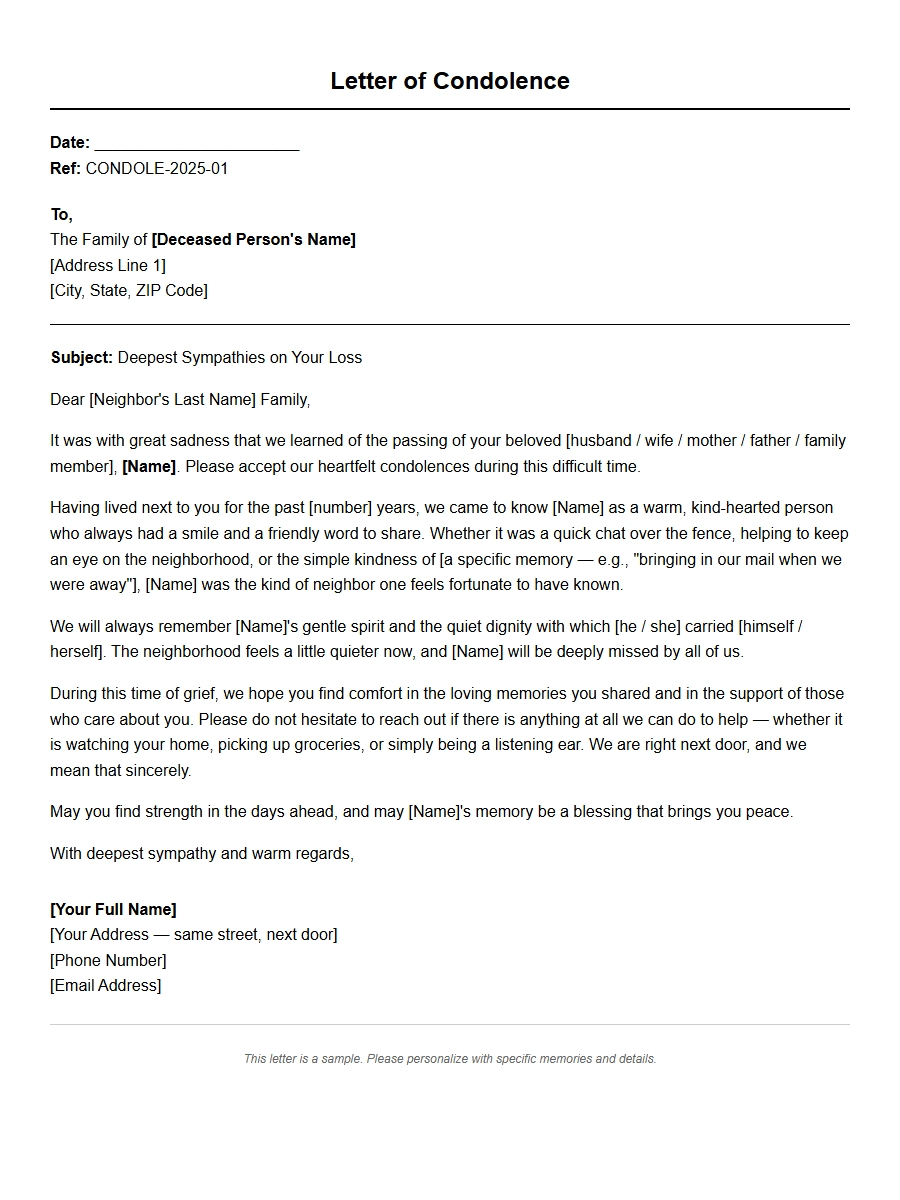 Condolence Letter Sample for a Neighbor
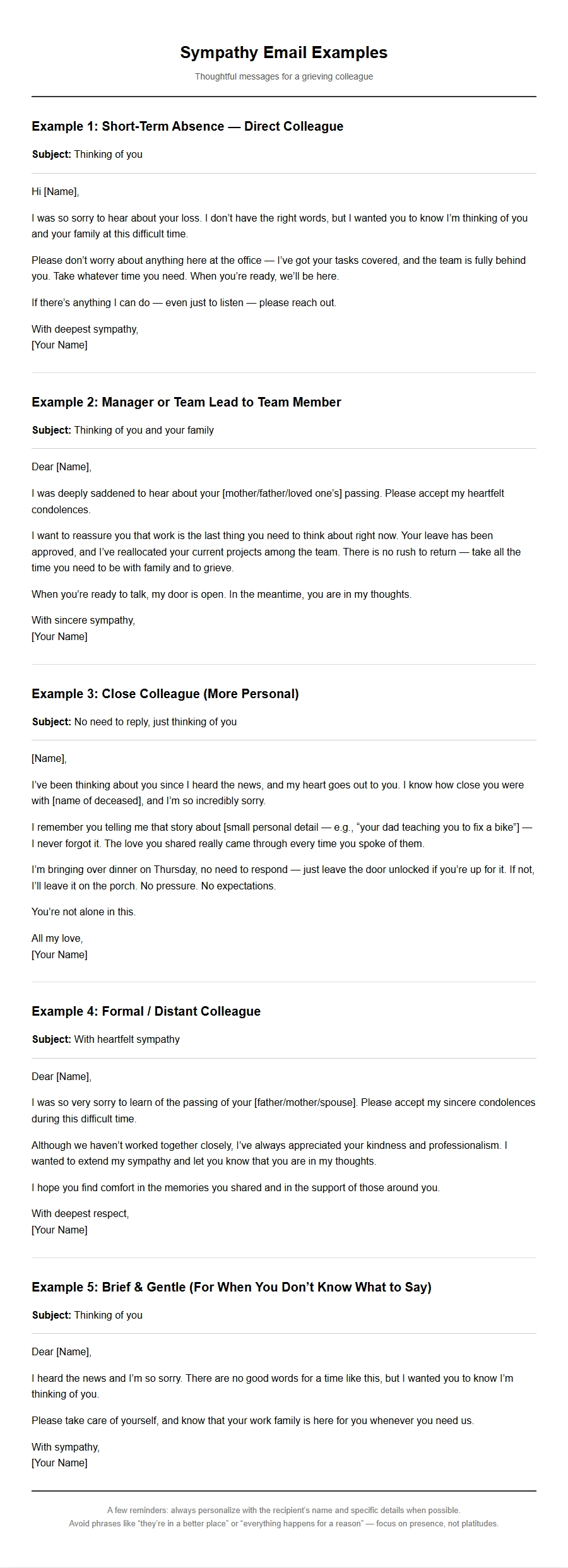 Sympathy Email Examples for a Grieving Colleague
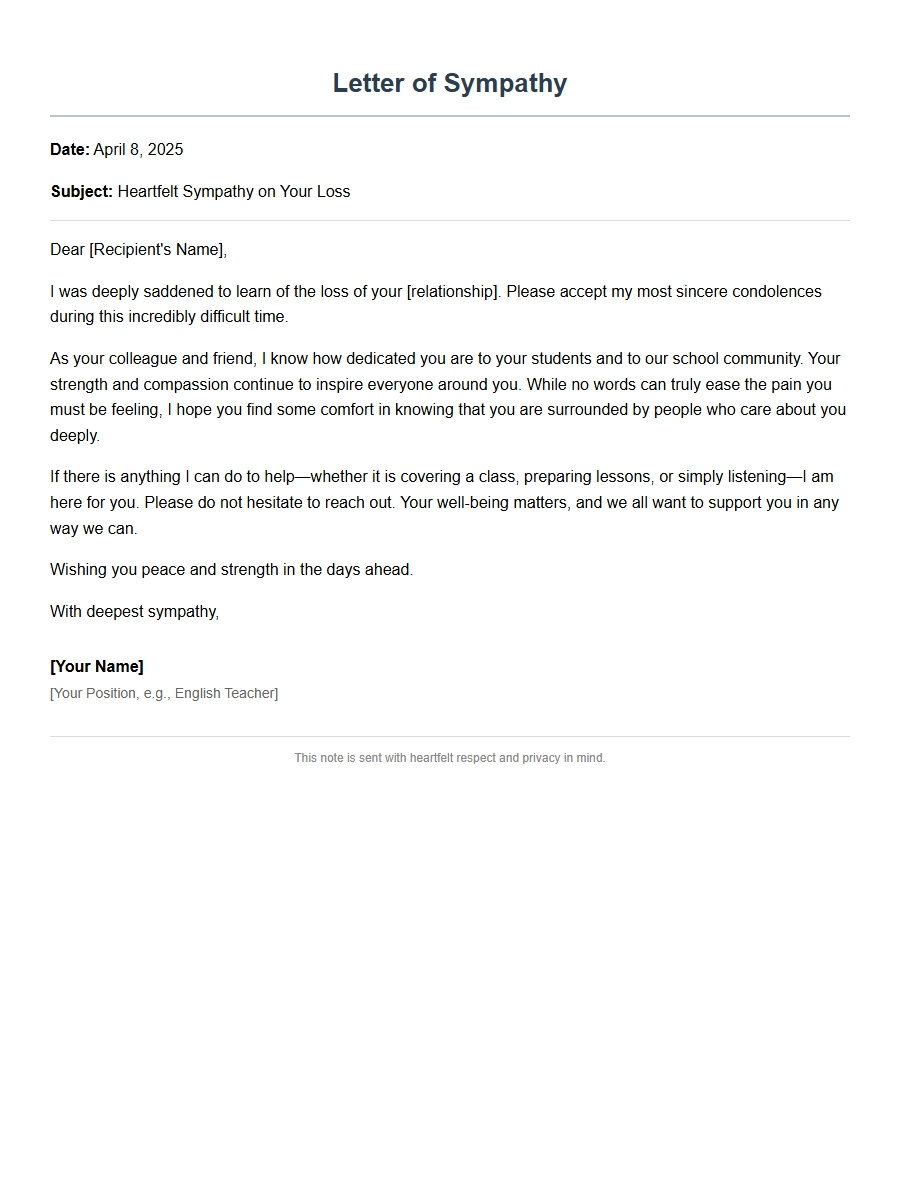 Condolence Words for a Teacher