You need to send an operational efficiency improvement proposal letter, but the blank page is staring back at you. Maybe your boss asked for a formal recommendation to streamline a process, or you’re pitching a new workflow tool to leadership. Either way, the pressure to sound credible and clear is real. That’s where a solid sample comes in—not as a crutch, but as a time-saver that gives you structure and confidence.
Why using a letter sample isn’t cheating
Professional correspondence doesn’t have to be reinvented every time. A good letter template acts like a roadmap: it shows you where to start, how to organize your points, and what phrases land well. The trick is picking one that fits your specific situation—formal enough for executives, but flexible enough to let your own voice come through. Think of it as borrowing the scaffolding, not the whole building.
Category: Operational Efficiency Proposal Letters
How to choose the right sample for your proposal
Not all proposal letters are created equal. If you’re addressing a department head who values data, look for a sample that includes space for metrics and impact. If you’re writing to a more traditional board, choose one with a formal business letter format and a clear salutation and closing. The tone matters too. A letter of recommendation might use warmer language, but your efficiency proposal should strike a balance between professional and persuasive.
Ever received a letter that felt too stiff or too casual? That’s what you want to avoid. Start by matching the sample’s level of formality to your company culture. If your workplace leans informal, adapt the salutation (use “Hi [Name]” instead of “Dear Mr.”). The goal is to sound like you, not like a template.
This is where most people stumble. They copy-paste the sample and change a few words. The result? A letter that reads like a robot wrote it. Instead, read the sample through, then set it aside. Write your opening paragraph from scratch, using the sample’s structure as a guide. Keep the key phrases that feel natural—like “I recommend we implement…”—but swap out any jargon or generic lines that don’t fit your project.
A quick tip: tailor the opening paragraph to grab attention. Start with the problem you’re solving. For example: “Our current inventory approval process takes an average of three days. I’m proposing a simple automation that cuts that to two hours.” That hooks the reader and shows you understand their pain.
Common mistakes that sink a proposal letter
Even experienced writers make these errors. One is using outdated salutations like “To Whom It May Concern” when you know the recipient’s name. Another is ignoring the format difference between a printed letter and a digital letter format. If you’re emailing the proposal, skip the letterhead design and use a clear subject line instead.
Proofreading is nonnegotiable. A typo in an efficiency proposal undercuts your credibility. Read it aloud, then have someone else glance at it. And watch your tone—stay confident without exaggerating. Instead of “This will revolutionize everything,” say “This should reduce processing time by 20% based on our tests.”
If you’re adapting a sample from another context, say a vendor partnership proposal letter, remember to swap the focus. That letter emphasizes mutual benefit; yours should emphasize internal improvements and ROI.
Putting it all together: your letter structure
A standard operational efficiency proposal letter follows a simple arc:
Opening: State the problem and your proposed solution.
Body: Explain the current process, the inefficiency, and your recommended change. Add specific metrics or examples.
Close: Offer to discuss further, include a call to action (e.g., “I’d like to present a quick demo next Tuesday”), and thank them for their time.
Keep paragraphs short—two to four sentences each. Use subheadings if the letter runs long, but in a one-page proposal, simple paragraphs work fine. Make sure your salutation and closing match the formality you’ve chosen.
Need inspiration from a related scenario? The structure in a distributor agreement proposal letter shows how to outline terms and benefits clearly—useful for when you need to list action items in your efficiency pitch.
Using the sample as a springboard, not a script
The best letters feel both professional and personal. They answer the unspoken question the reader has: “Why should I pay attention?” Your sample gives you the bones. Your experience gives it flesh. After you’ve written a couple of these, the process will get faster. You’ll know which phrases to keep and which to drop. And that anxiety you felt staring at the blank page? It’ll fade.
One last thing: after sending your proposal, don’t forget to follow up. A simple check-in email can move things forward. If you need a model for that, check out a pending decision follow-up letter to keep the conversation alive.
Now go ahead—pick a sample, adapt it, and send that letter. You’ve got this.
Samples You Can Use
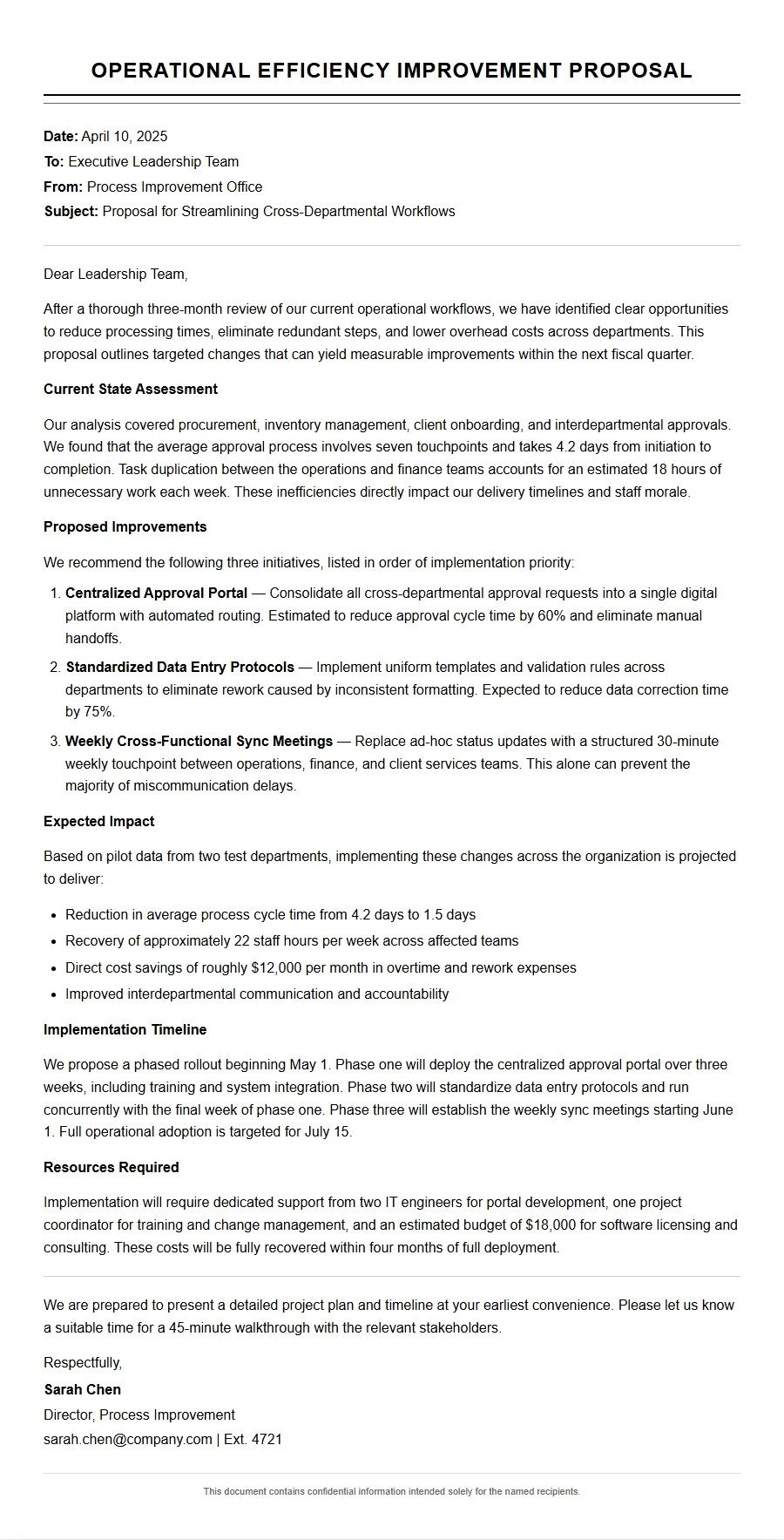
Proposal for Operational Efficiency Improvement
Streamlined Inventory Management Proposal
Dear Management Team,
Following our recent review of warehouse operations, I propose implementing a barcode-based inventory tracking system to boost operational efficiency. This system reduces manual counting errors and speeds up stock reconciliation by an estimated 40%.
Key benefits include:
Real-time stock visibility across all locations
Automated reorder alerts when thresholds are met
Reduced labor hours for physical inventory counts
Estimated costs and savings:
Item
Cost
Annual Savings
Barcode scanners (10 units)
$5,000
$12,000
Software license
$3,000/year
$8,000
Training & implementation
$2,000
--
Total
$10,000
$20,000
I recommend starting a pilot in the main warehouse within 30 days. Your approval is requested to move forward with vendor selection.
Sincerely, John Smith, Operations Manager
Process Automation for Customer Service
To: Head of Customer Support From: Efficiency Task Force
This letter proposes automating responses to frequently asked questions to cut resolution times and free up agents for complex issues. Our analysis shows 35% of incoming queries are repetitive.
Proposed changes:
Deploy a chatbot on the website to answer 20 common questions
Use email auto-triage to route tickets to the right department
Create a knowledge base accessible to both customers and agents
Expected impact over six months:
Metric
Current
Projected
Average response time
4 hours
15 minutes
Agent workload (tickets/day)
25
10
Customer satisfaction score
78%
90%
Implementation cost is $15,000, with ROI expected in 8 months. Please review and provide feedback for the next planning session.
Best regards, Jane Doe
Vendor Consolidation for Cost Efficiency
Executive Summary:
Our current use of five separate office supply vendors creates inefficiencies in ordering, delivery coordination, and payment processing. This proposal recommends consolidating to a single preferred vendor.
Advantages:
Volume discounts up to 15% on standard items
Single monthly invoice reduces accounting time by 3 hours
By consolidating to OfficeMax with a 10% negotiated discount, projected savings are $5,000 annually. I propose a 3-month trial period with a phased transition.
Please approve this plan by August 15th to capture end-of-quarter deals.
Remote Work Productivity Enhancement
To: HR Director From: Department Leads
We request approval for a structured remote work policy that includes mandatory daily stand-up meetings and shared digital dashboards. This will improve coordination and reduce project delays.
Key elements:
15-minute daily video calls per team
Centralized task board updated weekly
Quarterly productivity reviews with benchmarks
Expected outcomes:
Metric
Current
Target
Project completion rate
85%
95%
Employee engagement score
3.2/5
4.0/5
Response time to team messages
4 hours
1 hour
No additional costs are needed, as existing tools like Slack and Trello suffice. We request a decision by next Monday to align with the quarterly planning cycle.
Thank you, Operations Committee
Energy Efficiency Upgrades for Operations
Dear Facilities Manager,
This proposal outlines switching to LED lighting and installing motion sensors in our production facility to reduce energy costs. Current lighting accounts for 22% of total electricity usage.
Implementation plan:
Conduct an audit of all lighting fixtures
Replace 200 fluorescent tubes with LEDs
Install 50 motion sensors in low-traffic areas
Cost-benefit analysis:
Expense
Amount
Annual Saving
LED fixtures
$12,000
$4,500
Motion sensors
$3,500
$2,000
Installation labor
$2,000
--
Total
$17,500
$6,500
Payback period: 2.7 years. With utility rebates available, net cost drops to $12,000. I recommend scheduling installation during the annual maintenance shutdown in December.
Looking forward to your approval.
Lean Manufacturing Workflow Redesign
To: Production Director From: Continuous Improvement Team
We propose reorganizing the assembly line into a cellular layout to reduce movement waste by 30%. Current layout has workers walking 500 feet per product cycle.
Proposed changes:
Group machines by product family
Create U-shaped cells for single-piece flow
Implement Kanban cards for inventory pull
Expected improvements:
Measure
Current
After Change
Cycle time per unit
45 minutes
32 minutes
Work-in-progress inventory
500 units
200 units
Defect rate
3%
1%
Total redesign cost: $25,000, including relocation of equipment and worker training. We propose a two-week pilot in Department A before company-wide rollout.
Awaiting your decision.
Digital Document Management System
Dear IT Director,
Our paper-based invoice processing takes 6 days per batch and wastes 40 hours monthly. I propose adopting an electronic document management system (EDMS) to digitize and automate workflows.
System features:
Optical character recognition for automatic data entry
Cloud storage with secure access controls
Automated approval routing for invoices and contracts
Cost analysis:
Component
Annual Cost
Time Saved (hours/month)
EDMS license (50 users)
$18,000
120
Scanners and setup
$5,000
30
Training
$2,000
--
Total annual savings: $15,000 in labor, plus elimination of paper and storage costs. ROI in 18 months. I request a demo with three vendors next week.
Regards, Accounts Payable Manager
Cross-Training Program for Staff Flexibility
To: Training Coordinator From: Operations Supervisor
We propose a formal cross-training program to allow staff to cover multiple roles, reducing downtime during absences and improving operational resilience.
Program structure:
Identify key skills per department (5 critical roles)
Train 2 backup employees per role over 4 weeks
Rotate trainees through hands-on sessions
Anticipated benefits:
Area
Current Impact
After Program
Absence coverage
2-day delays
Same-day coverage
Employee skill depth
1 skill per person
3 skills per person
Overtime costs (monthly)
$4,000
$1,500
Cost: $8,000 for training materials and temporary backfill. I propose a pilot in the shipping department starting next month.
Please review and approve.
Supply Chain Lead Time Reduction
Dear Supply Chain Manager,
This letter proposes using local suppliers for 30% of raw materials to cut lead times from 14 days to 5 days. Current reliance on overseas vendors causes frequent delays.
Evaluation of local options:
Acme Metals: 3-day delivery, 10% premium cost
Best Steel: 4-day delivery, 5% premium cost
Projected impact:
Metric
Current (Overseas)
Proposed (Local)
Average lead time
14 days
4 days
Inventory holding cost/month
$20,000
$14,000
Stockout incidents/month
3
0
Net cost increase of $6,000 annually is offset by $72,000 savings in reduced holding costs. I recommend trialing with two local suppliers for 90 days.
Awaiting your go-ahead.
Quality Control Automation Proposal
To: Manufacturing VP From: Quality Assurance Lead
We propose installing automated visual inspection systems on two production lines to increase defect detection speed and reduce manual inspection errors.
System specifications:
High-resolution cameras with AI-based defect detection
Real-time alerts for out-of-spec products
Integration with existing PLCs for auto-rejection
Cost and benefit data:
Investment
Amount
Annual Savings
Two inspection systems
$60,000
--
Installation and calibration
$15,000
--
Reduced scrap rate (2% to 0.5%)
--
$40,000
Labor reallocation (2 inspectors)
--
$30,000
Payback period: 1.5 years. I suggest we start with Line 3 as a pilot in Q1 next year.
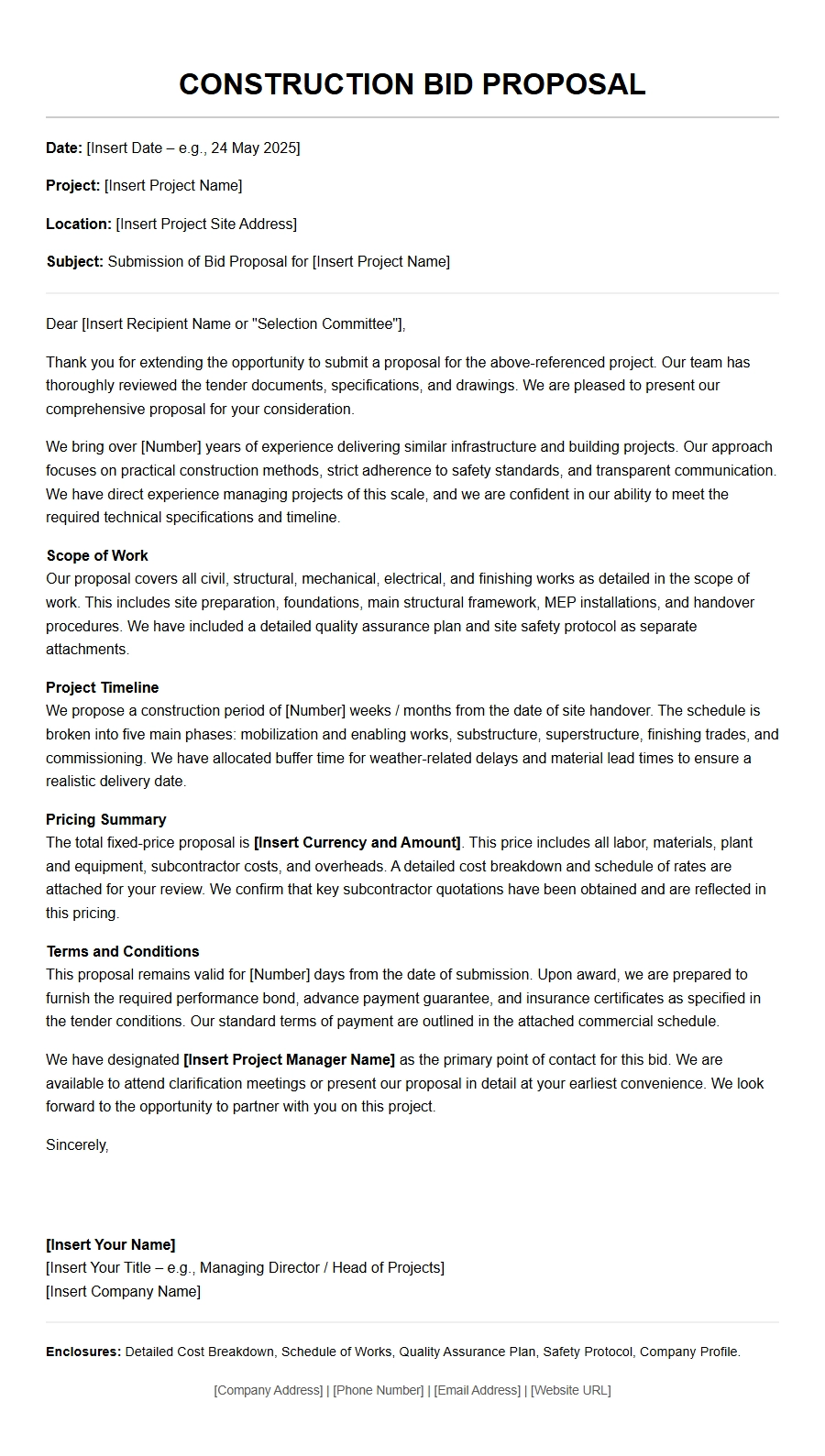 Sample Construction Bid Proposal Letter
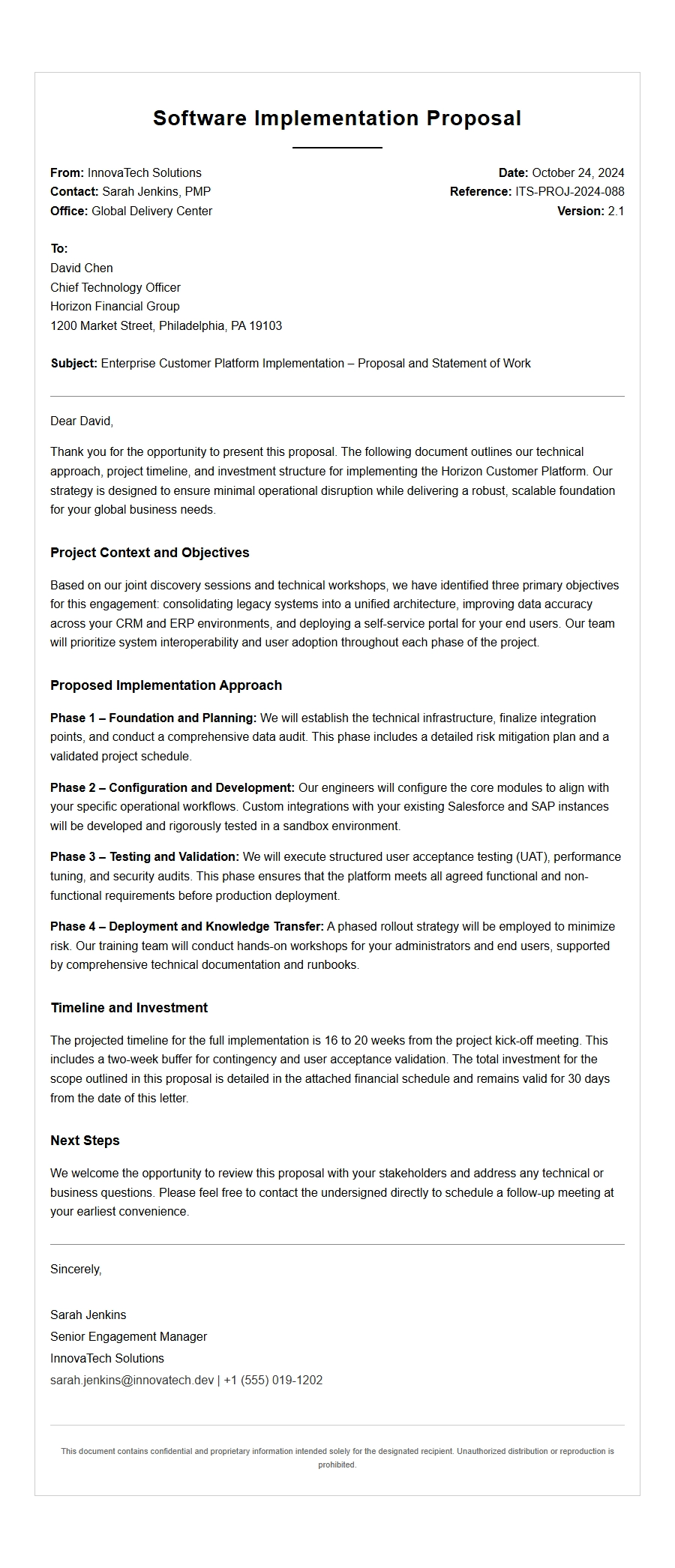 Enterprise Software Implementation Proposal Letter Example
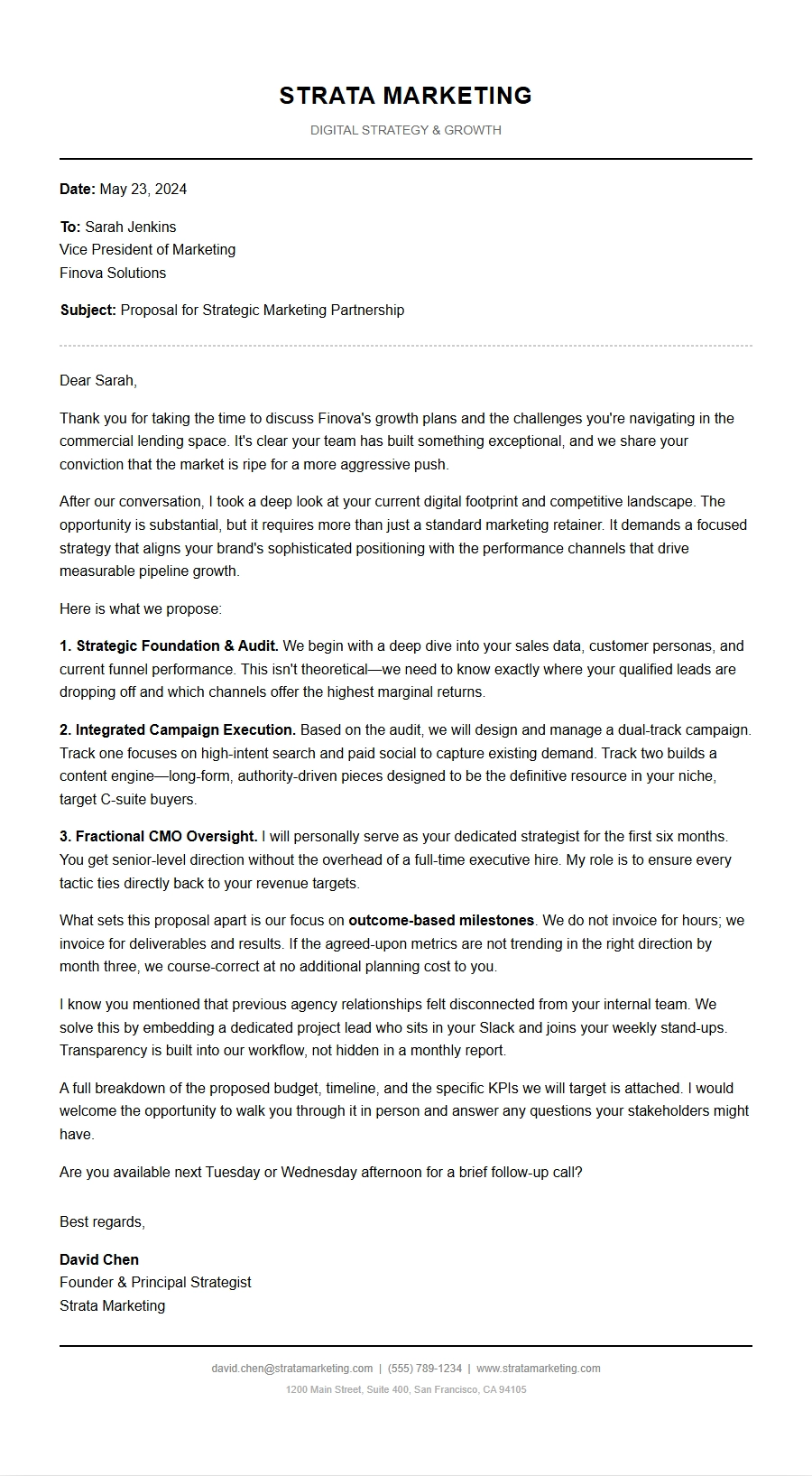 Marketing Agency Service Proposal Letter Template
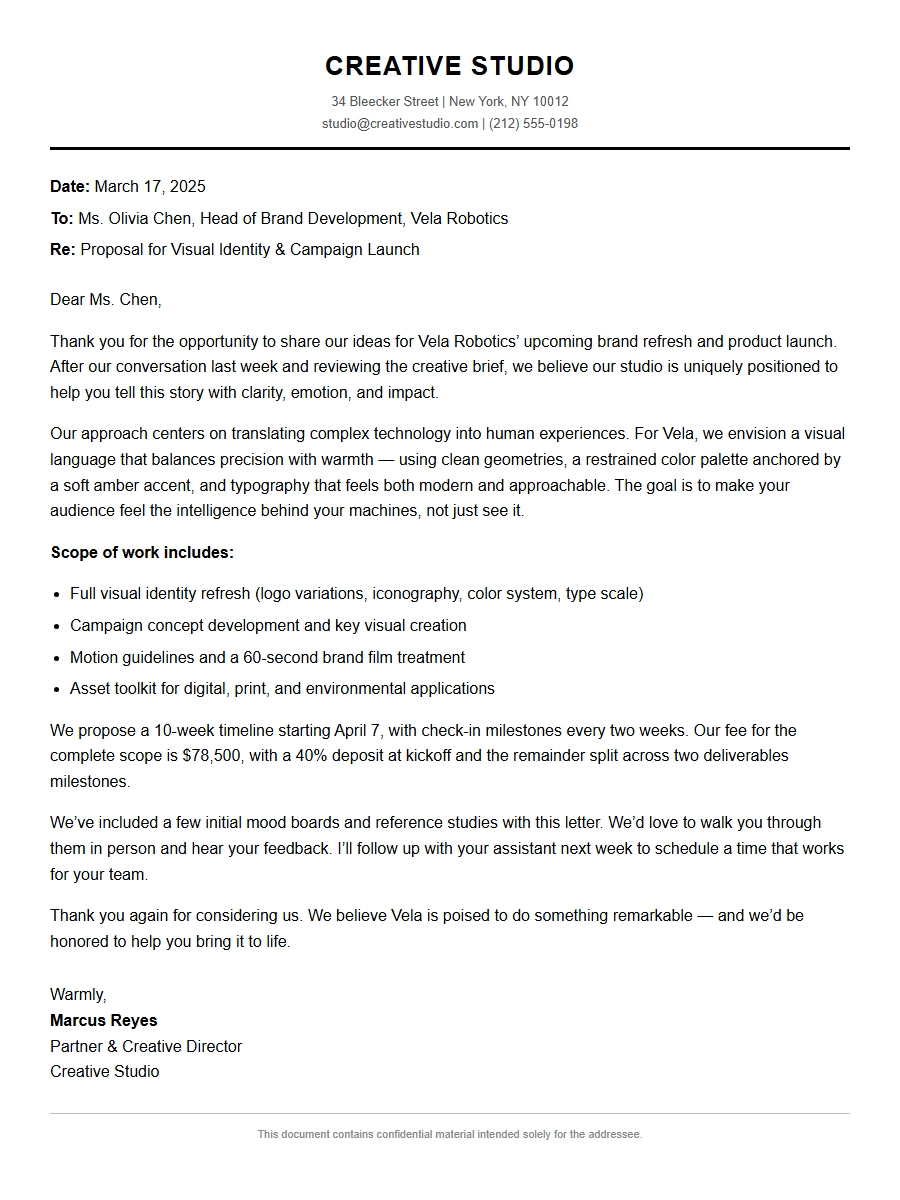 Creative Studio Project Proposal Letter
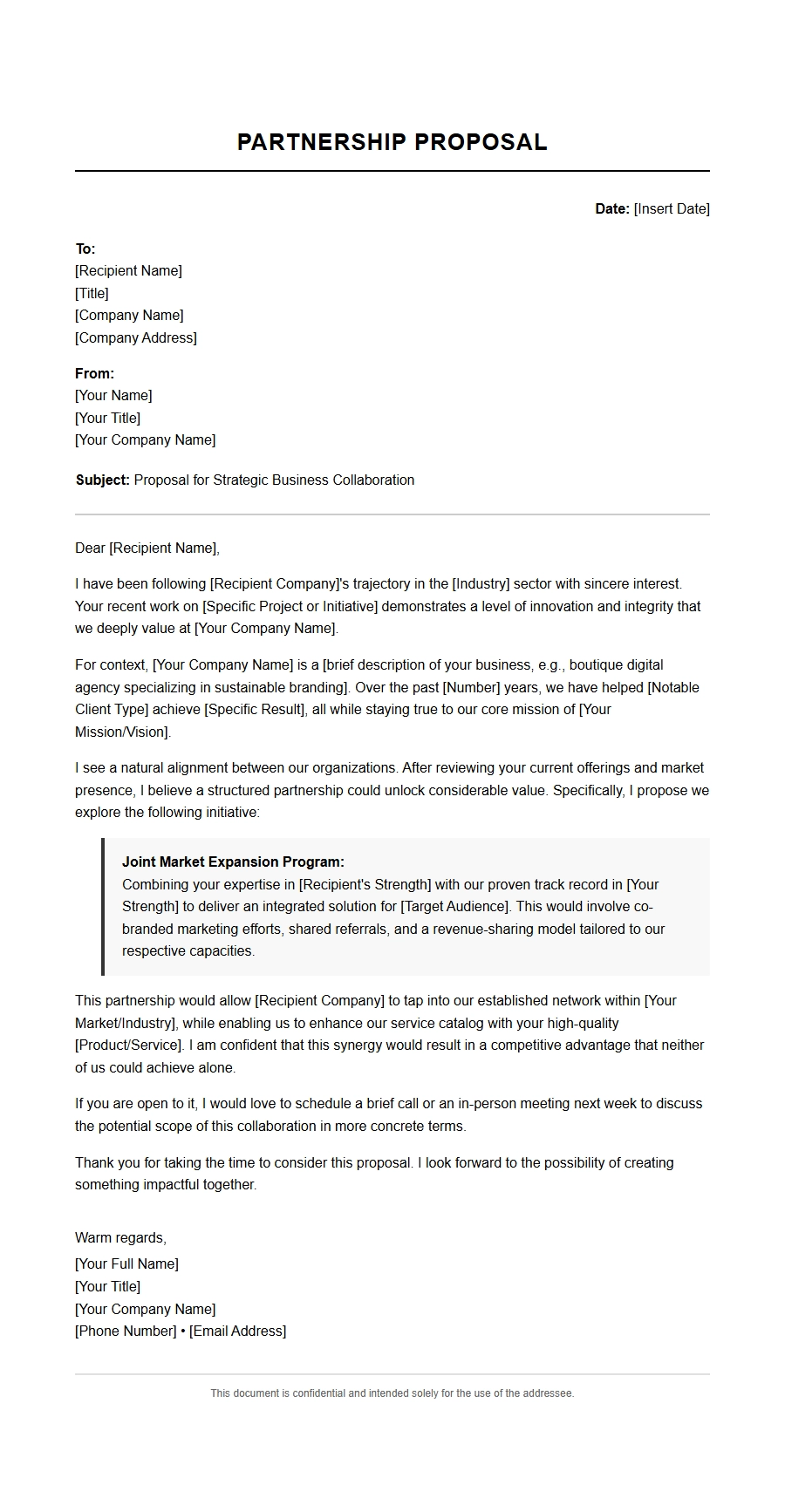 Small Business Partnership Proposal Letter Template
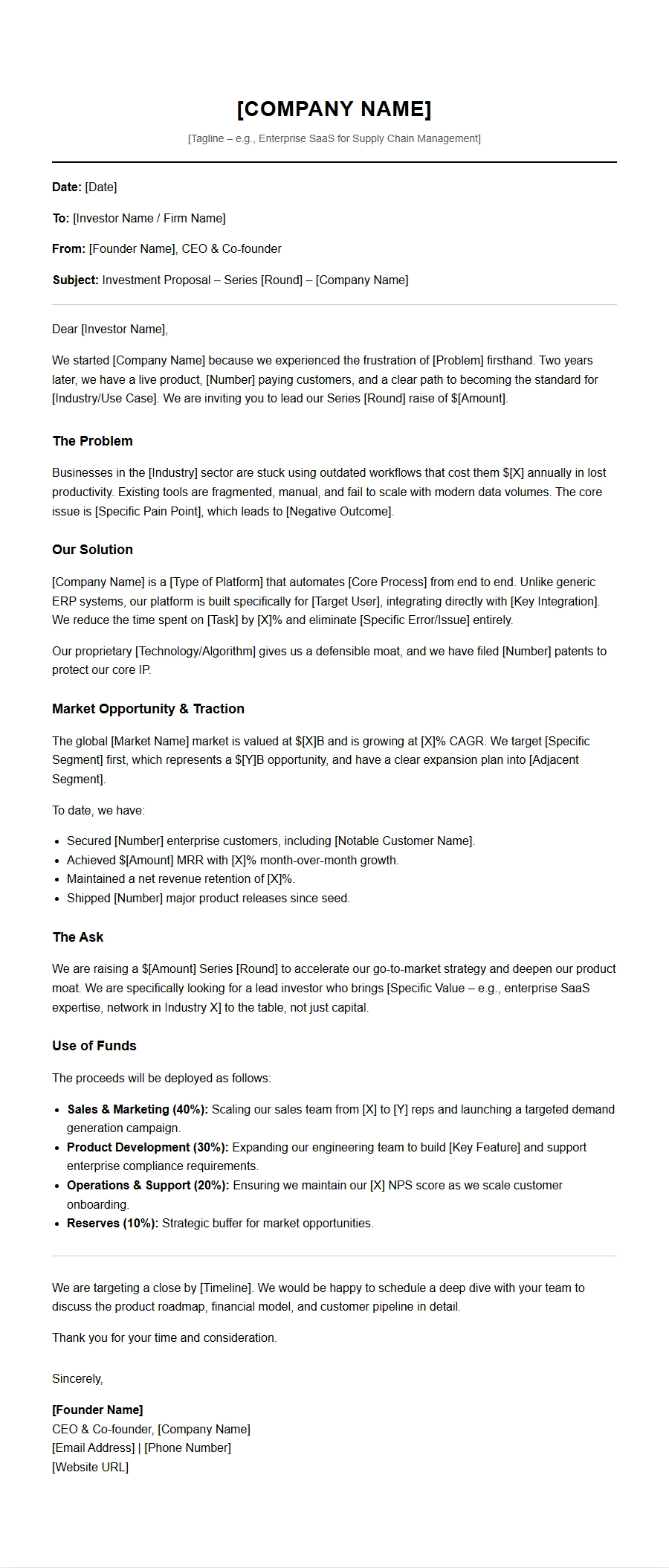 Startup Investment Proposal Letter Template