Sample Recommendation Letter for a Nonprofit Board Volunteer
You’ve been asked to write a letter recommending someone for a nonprofit board volunteer commitment. Maybe you’re a former colleague, a fellow board member, or a community leader. You know the person well and believe in their dedication. But when you sit down to write, the blank cursor blinks back at you. Where do you start? What’s the right tone? How formal should it be?
That’s exactly where a good sample can save you. Using a letter sample isn’t cheating—it’s a smart shortcut. The best samples give you structure, key phrases, and a clear sense of professional correspondence standards. You still bring the personal details and your own voice. Think of it as a scaffold you can build on, not a script you copy word for word.
Before you grab the first template you see, pause. Not all samples fit every situation. A recommendation for a board role is different from a cover letter for a paid job. Board volunteers need to show passion, reliability, and alignment with the mission. Your letter should reflect that. Look for a sample that uses a formal but warm tone—something that balances respect with genuine enthusiasm. Avoid templates that sound like generic employee references.
Once you find a good fit, adapt it without losing your authentic voice. The sample gives you a solid letter structure: a professional salutation, a confident opening, a body that highlights specific contributions, and a respectful closing. Your job is to swap in real examples. Instead of saying “She is committed,” say “She personally recruited five new volunteers for our annual food drive.” Specifics carry weight. They show, not just tell.
Pay attention to the opening paragraph. That’s where you grab the reader’s attention. Mention the candidate’s name, the role they’re being considered for, and your relationship to them right away. For example: “I am pleased to recommend Jane Doe for the board of GreenFuture Alliance. I served alongside her on the fundraising committee for two years.” That’s clear and direct. No fluff.
Common mistakes trip people up. Using “To Whom It May Concern” when you know the board chair’s name. Forgetting to check if the letter will be emailed as a PDF or printed on letterhead. Digital letter format matters: if you’re sending by email, skip the letterhead design and use a clean subject line and standard font. If it’s a printed letter, include your address and the date. Also, avoid outdated salutations like “Dear Sir or Madam.” Use the person’s name if you can find it.
Tone in writing for a board recommendation should be respectful but not stiff. Use contractions like “you’ll” or “it’s” sparingly—they can feel too casual in this context. But don’t go the other direction and sound like a legal document. Phrases like “It is with great pleasure” are fine, but follow them with a concrete reason.
Proofreading is non-negotiable. A single typo can undermine your credibility. Read the letter out loud to catch awkward phrasing. Ask someone else to glance at it. Check that the salutation and closing match the level of formality. “Sincerely” works for nearly every board recommendation. “Yours truly” is fine too. Avoid “Best regards” if you want to stay slightly more formal.
The best letters feel both professional and personal. They remind the reader that behind the format is a real person with real impact. Use the sample as a springboard, not a crutch. The more you practice, the faster you’ll get. Next time you face a blank page, you’ll know exactly where to begin.
Practical Writing Samples
Sample Recommendation Letter for a Nonprofit Board Volunteer
Recommendation for Board Vice Chair Role
To the Nominating Committee,
I am writing to recommend Sarah Mitchell for the position of Board Vice Chair. Sarah has served on our board for three years and has demonstrated exceptional commitment to our mission. She chairs the Fundraising Committee, where she helped increase annual donations by 40%.
Her key contributions:
Led the “Give Together” campaign, raising $150,000.
Mentored two new board members during onboarding.
Attended 95% of board and committee meetings over the past year.
Sarah’s strategic thinking, collaborative spirit, and dedication make her ideal for Vice Chair. I am confident she will continue to strengthen our board.
Please contact me for further details. Respectfully, James Rivera, Board Chair
Recommendation for National Nonprofit Board Award
Selection Committee,
I enthusiastically nominate Linda Tran for the 2025 Exceptional Board Service Award. Linda has served on our board for six years, including two terms as Treasurer. Her volunteer commitment is extraordinary.
Achievement
Impact
Oversaw audit process
Reduced financial discrepancies to 0%
Led board retreat planning
Improved board cohesion scores by 30%
Recruited three diverse members
Increased board representation
Linda devotes 15+ hours monthly beyond meetings. She is a tireless advocate, often attending community events on our behalf. Her passion and integrity are unmatched.
I strongly endorse her for this honor. Sincerely, Dr. Mark Chen, Executive Director
Recommendation for New Board Candidate
Dear Board Development Committee,
I am pleased to recommend Derek Wilson for a seat on our board. Derek has volunteered with our Food Bank program for two years, logging over 200 hours. He also completed our board readiness training.
Reasons for recommendation:
Strong financial literacy – he is a CPA with nonprofit audit experience.
Deep community connections – he serves on two local advisory councils.
Commitment to equity – he proposed inclusive outreach strategies now used by staff.
Derek understands board governance and is eager to serve. He has the time, skills, and passion to be an effective trustee.
I am confident he will be a valuable addition. Best regards, Patricia Owens, Board Secretary
Recommendation for Foundation Board Position
Foundation Search Committee,
I write today to recommend Rita Patel for your board of trustees. I served as Board President while Rita was a member of our nonprofit board, and I witnessed her exceptional volunteer commitment firsthand.
During her three-year term, Rita:
Chaired the Governance Committee, revising bylaws to ensure compliance.
Led a strategic planning group that redefined our mission statement.
Donated above-average time, attending 100% of special events.
Rita’s ability to ask tough questions and build consensus would benefit any foundation. She is principled, organized, and deeply committed to philanthropy.
Please consider her candidacy. I offer my full support. Warmly, Robert Kim, Former Board President
Recommendation for Special Project Leadership
To the Project Steering Committee,
I recommend Michael Torres to lead our Capital Campaign Advisory Group. Michael has been a board volunteer for five years and currently chairs our Facilities Task Force.
Relevant qualifications:
Skill
Demonstration
Project management
Completed renovation under budget
Fundraising expertise
Secured two major gifts ($50K each)
Stakeholder engagement
Facilitated community forums with 200+ attendees
Michael’s volunteer commitment is remarkable – he dedicates 10–15 hours weekly. His calm leadership and attention to detail will ensure project success.
I urge you to accept him for this role. Respectfully, Angela Brooks, Committee Chair
Recommendation for Board Fellowship Program
Fellowship Selection Board,
I am honored to recommend Jessica Hartwell for the Board Fellows Program. Jessica has volunteered on our junior board for 18 months, where she co-led a mentorship initiative.
Her commitment is evident:
Attended 12 of 13 board meetings as a guest observer.
Completed a board governance self-assessment certificate.
Raised $5,000 through a peer‑to‑peer campaign.
Jessica consistently asks insightful questions and seeks feedback. She is eager to learn about fiduciary duties, strategic oversight, and ethical leadership. I believe this fellowship will prepare her to become an outstanding board member in the nonprofit sector.
She has my highest recommendation. Sincerely, David Lee, Community Leader & Board Advisor
Recommendation for Board Term Renewal
Governance Committee,
I support the renewal of Amanda Foster’s board term. Amanda has served for three years and remains one of our most engaged volunteers.
Performance highlights:
Metric
Result
Meeting attendance
98% (only missed one due to emergency)
Committee participation
Active on two: Finance & Advocacy
Donor cultivation
Introduced 15 new major donors
Amanda’s volunteer commitment has only grown. She recently completed a grant writing workshop to support our Development team. Her institutional memory and relationships are invaluable.
I strongly recommend another three-year term. Best regards, Karen Shepherd, Board Member
Recommendation for Corporate Board Position
Corporate Nominating Committee,
I write to recommend Thomas Gray for your board of directors. Thomas has served on our nonprofit board for four years and currently chairs the Audit Committee. His volunteer commitment is exemplary.
Thomas dedicates 20+ hours monthly to board duties despite a full‑time role. He brings a results‑oriented mindset and ability to translate nonprofit governance best practices into corporate settings.
He would be an asset to your board. Please contact me for more details. Sincerely, Dr. Nora Singh, Nonprofit CEO
Recommendation for Governance Training Program
Training Selection Panel,
I recommend Elena Martinez for the Advanced Governance Training Program. Elena is a board member with three years of service and a deep commitment to board excellence.
Why she deserves this opportunity:
She proactively sought mentorship from our board historian.
She organized a board workshop on conflict of interest policies.
She consistently reads board packets and arrives prepared.
Elena’s volunteer commitment goes beyond meetings – she volunteers at our afterschool program monthly. With advanced training, she will be poised to take on a committee chair role.
I fully endorse her candidacy. Respectfully, John Walters, Board Member
Recommendation for Board Service Award
Award Selection Committee,
I nominate Nancy Chu for the Outstanding Board Volunteer Award. Nancy has served on our board for five years, and I have seen her volunteer commitment grow each year.
Key contributions:
Area
Accomplishments
Program evaluation
Designed impact metrics adopted organization-wide
Board diversity
Co-chaired recruitment pilot, adding three new perspectives
Fundraising
Hosted two events netting $30K each
Nancy also volunteers weekly at our shelter. Her dedication inspires staff and fellow board members. She embodies servant leadership.
I strongly believe she deserves this recognition. Sincerely, Olivia Park, Volunteer Coordinator
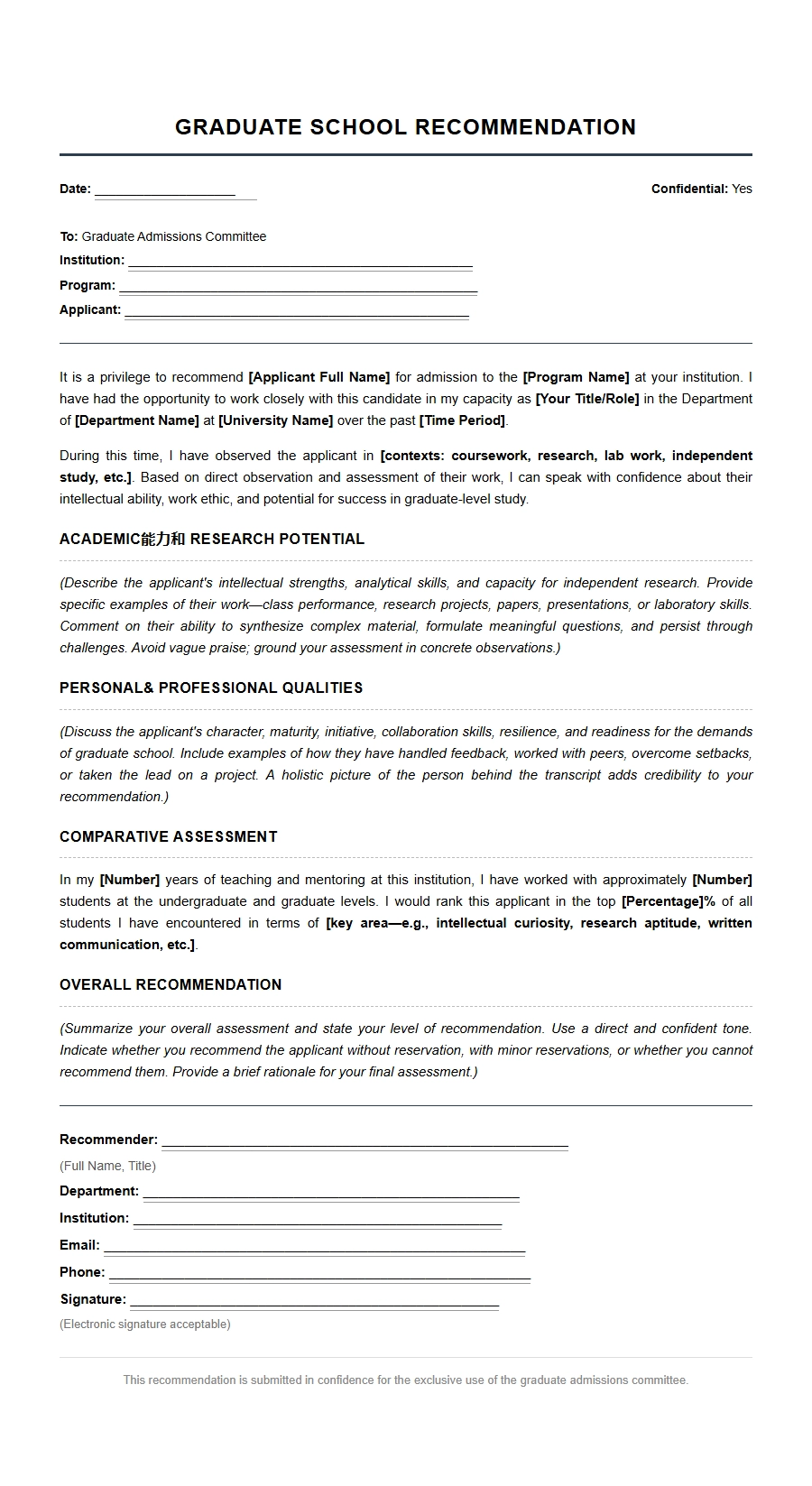 Format for Graduate School Faculty Recommendation Letters
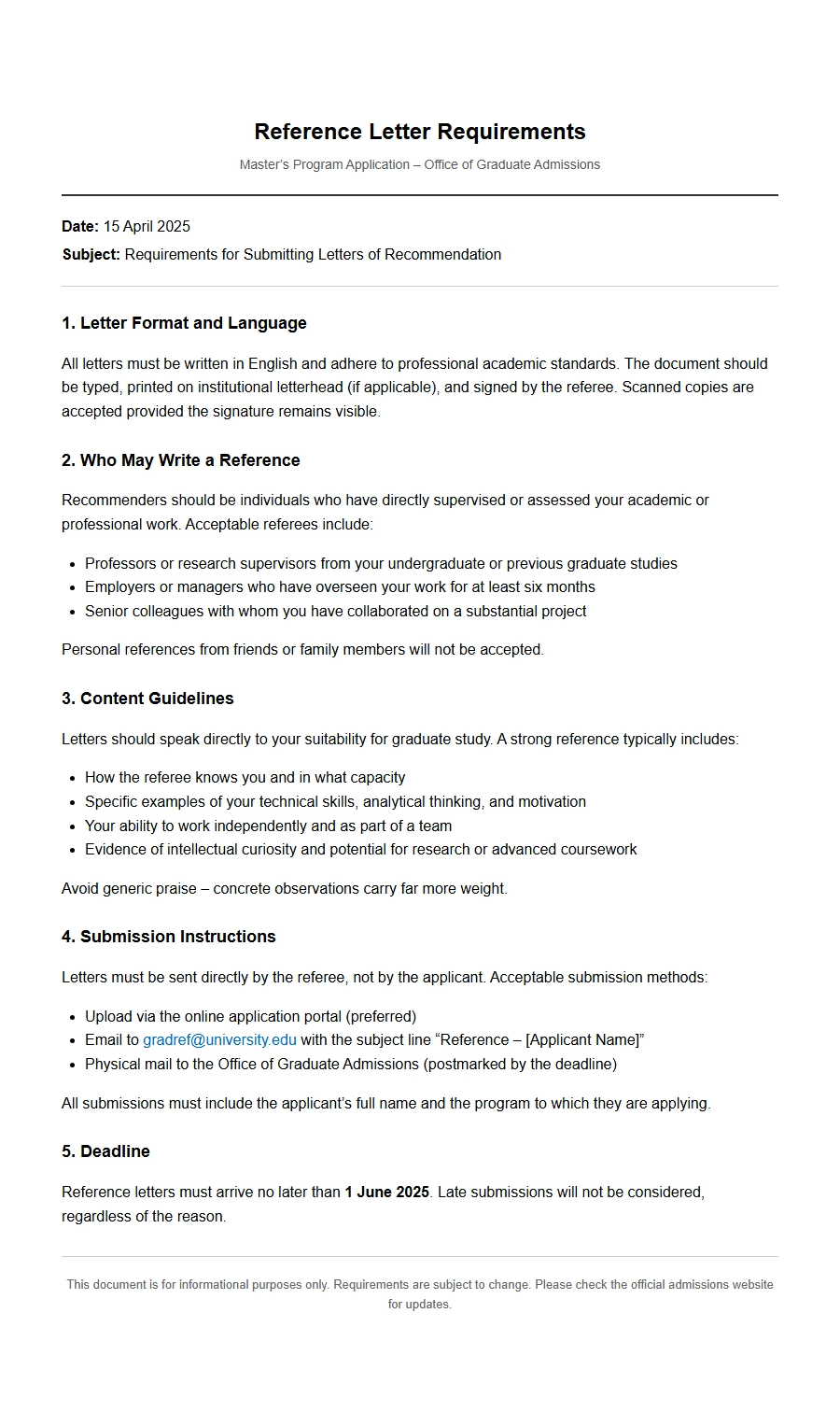 Master's Program Reference Letter Requirements
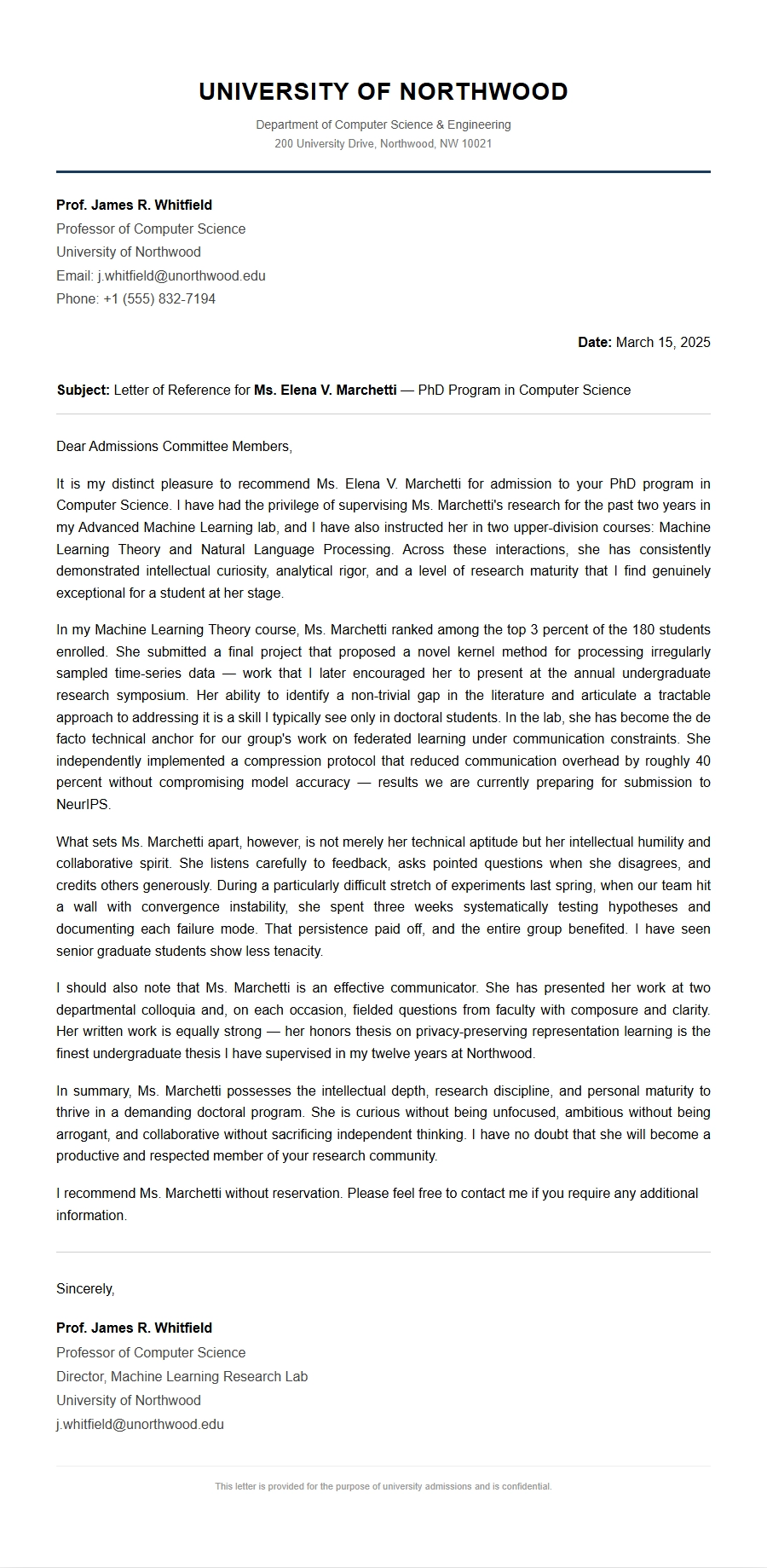 The Perfect Structure for a University Reference Letter
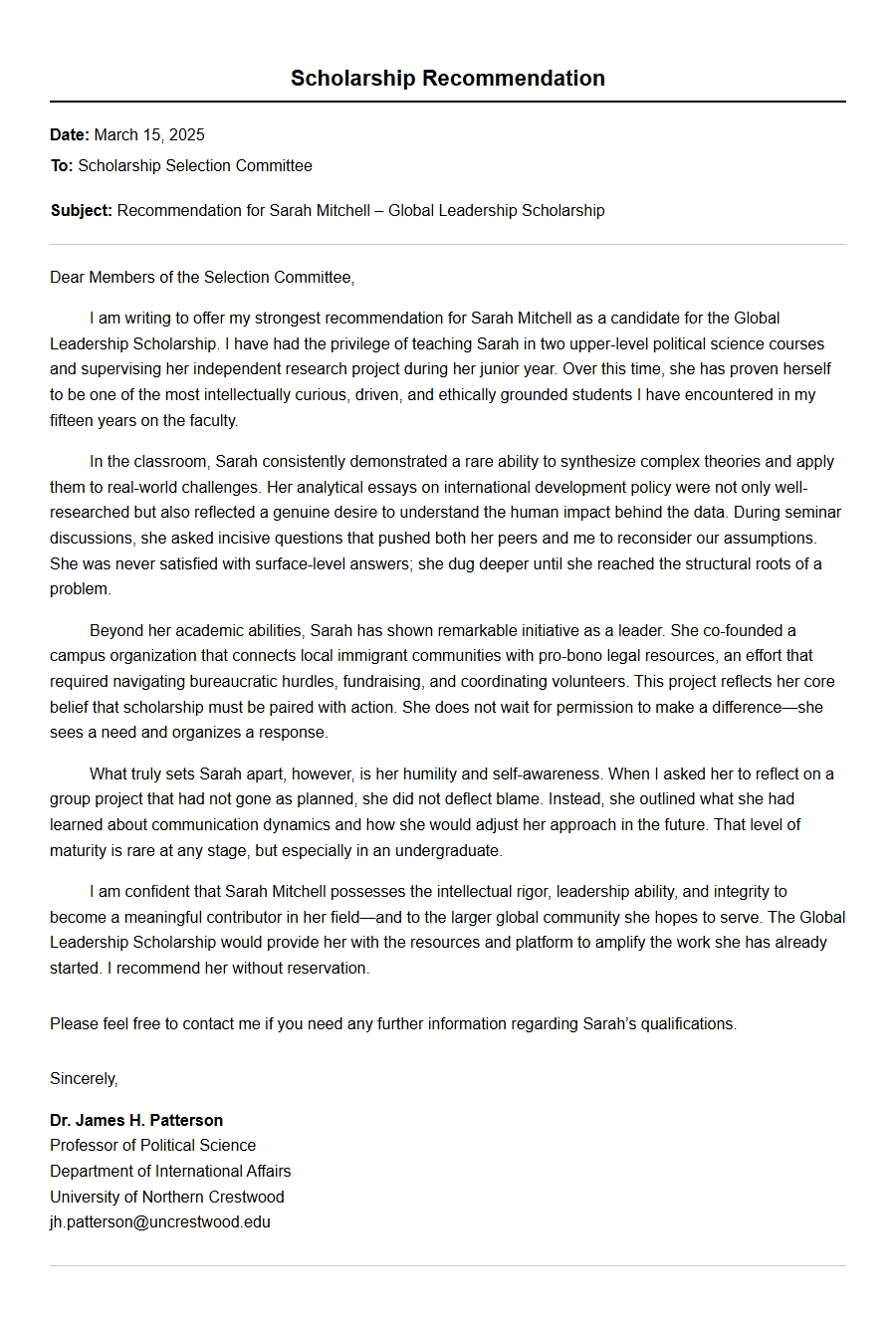 scholarship essay recommendation portion - Recommendation Letters
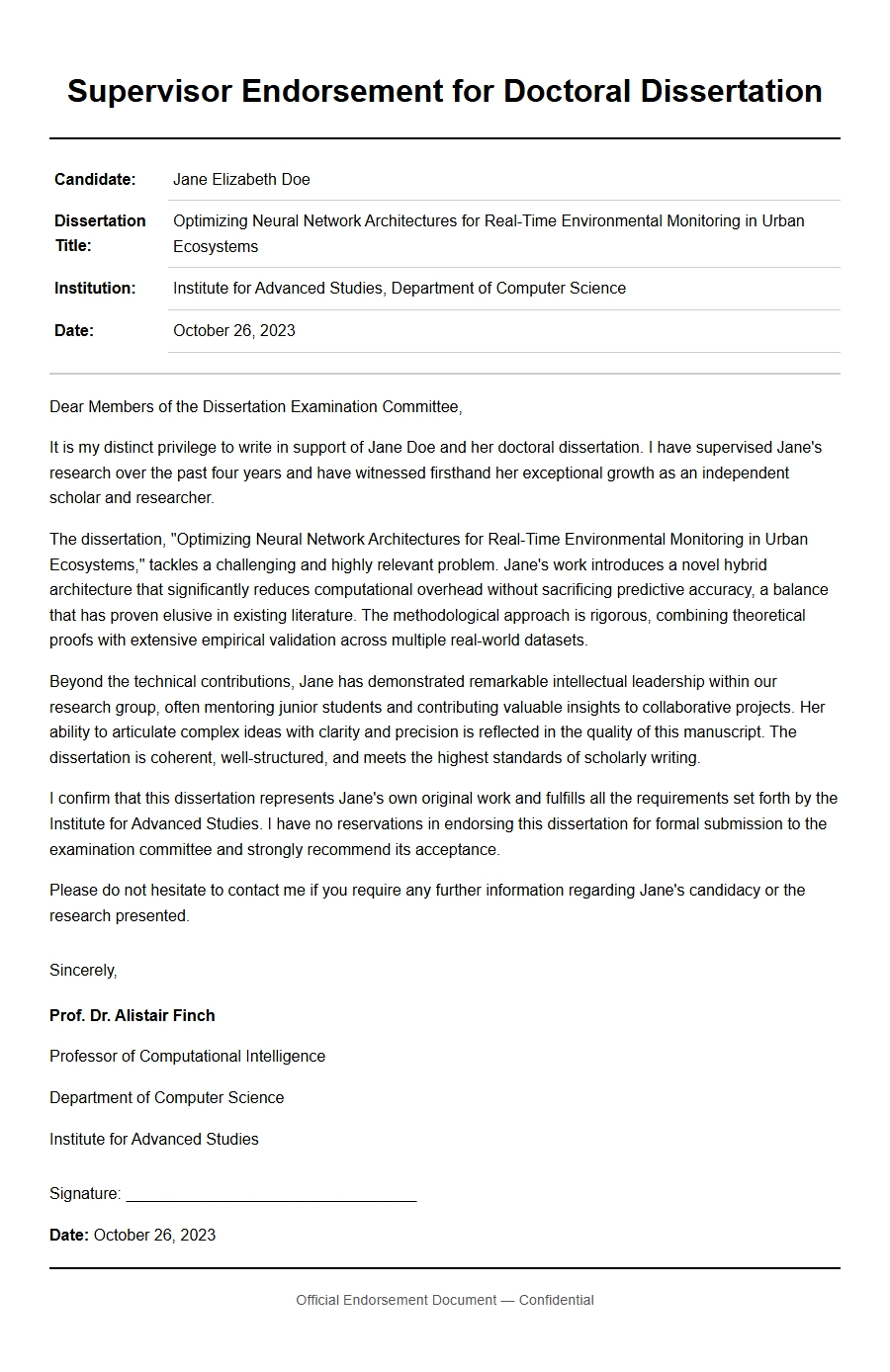 Sample PhD Supervisor Endorsement Letter
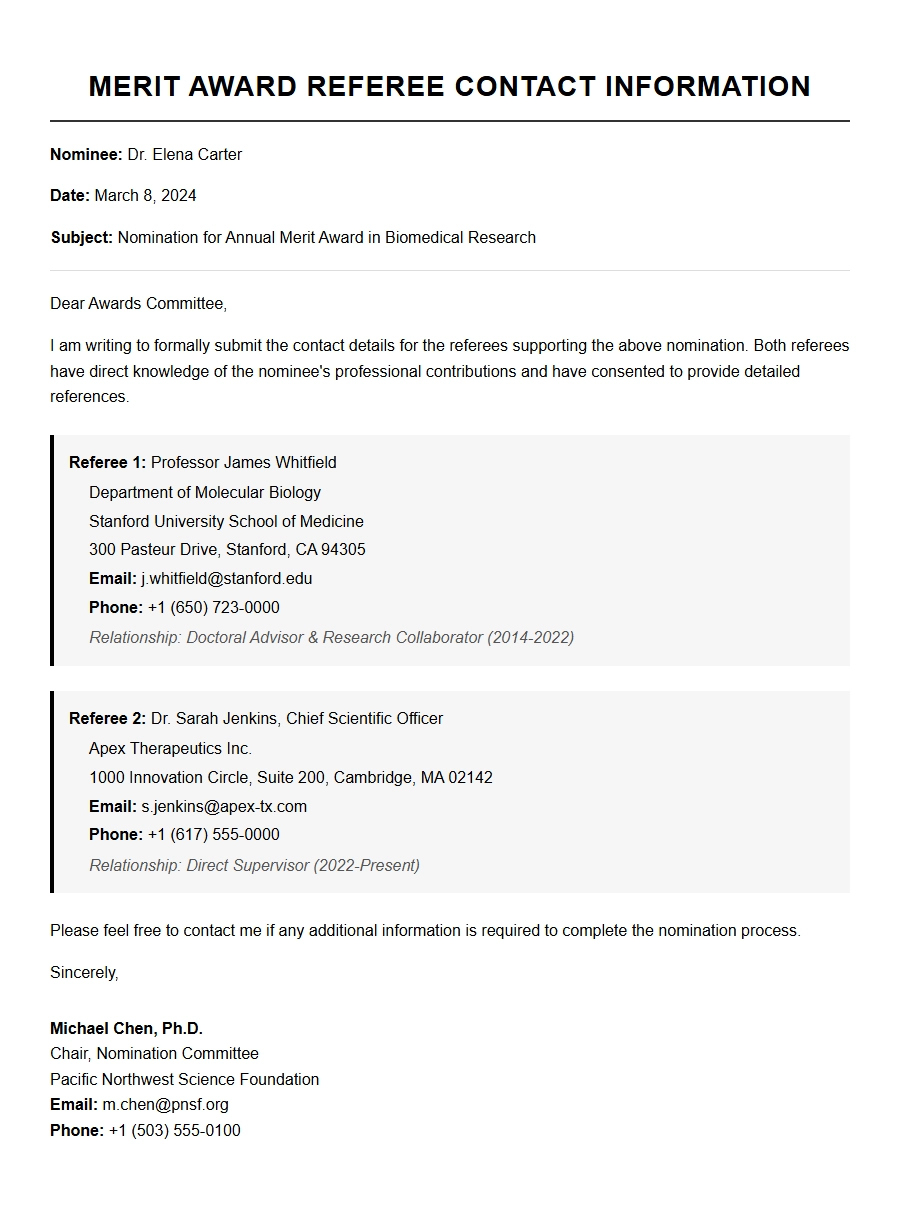 How to Find Your Merit Award Referee Contact Info