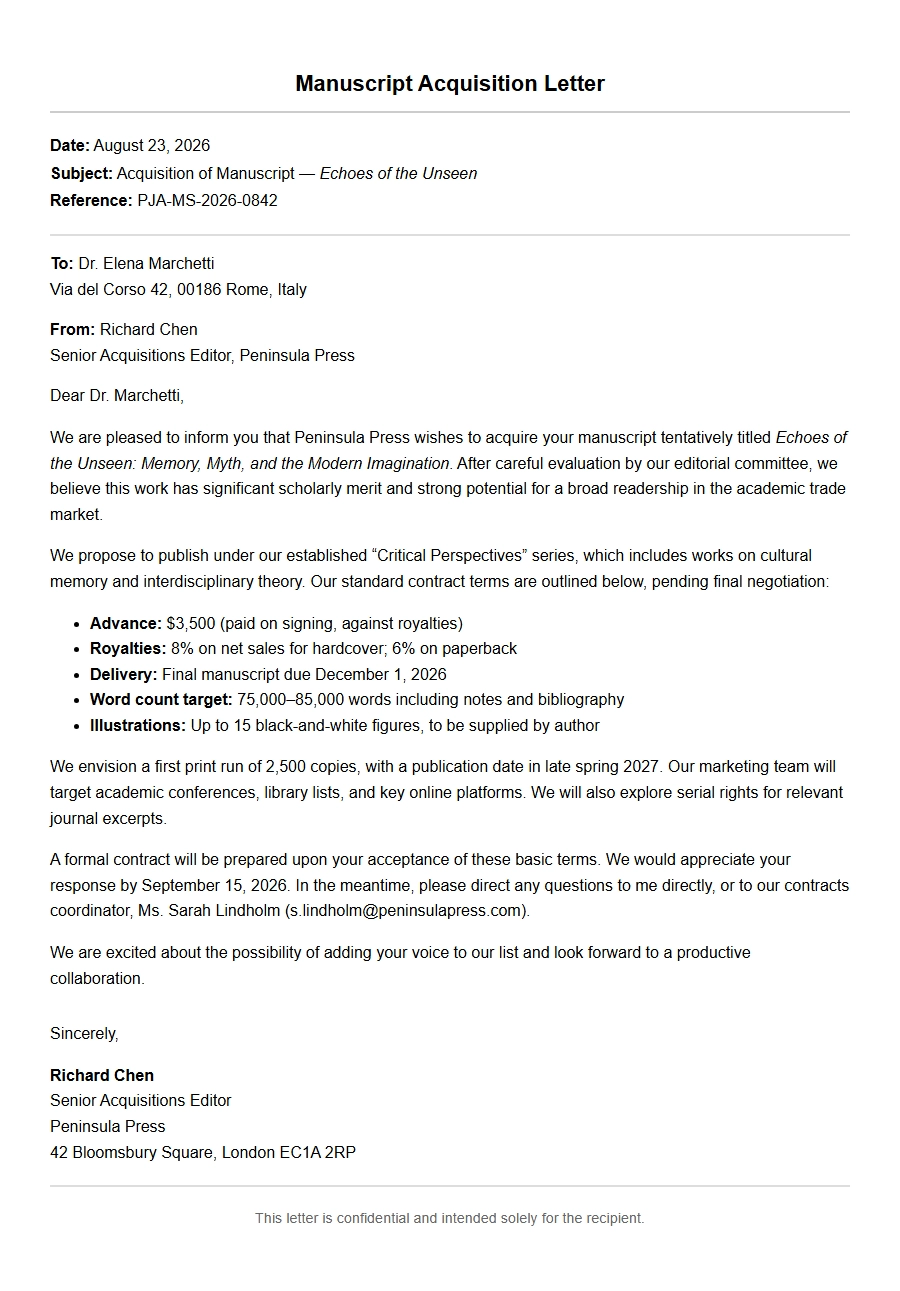
How to Write a Publisher Manuscript Acquisition Recommendation Letter
You’re staring at a blank document, trying to draft a letter to recommend a manuscript for publisher acquisition. Where do you even start? You know the author’s work is strong, but translating that into a professional, persuasive letter feels like a whole other skill. It’s a common frustration—and the fix is simpler than you think.
Using a letter sample isn’t cheating. It’s a smart shortcut. A well-designed template gives you the right structure, the appropriate tone, and the crucial phrasing you need—while leaving plenty of room for your own voice. Think of it as a framework, not a cage. With a solid base, you can focus on what really matters: explaining why this manuscript deserves a publisher’s attention.
Category: Professional Correspondence
Before you start adapting a sample, pause and consider your specific situation. Is this a formal letter of recommendation for a scholarly publisher? Or a more informal pitch to a small press? The right sample depends on the tone you need. For academic or trade acquisitions, business letter format with a proper salutation and closing is expected. For a digital submission, you might use a slightly more direct approach—but still maintain professional letter writing etiquette.
When you find a letter template that fits, don’t just copy and paste. Read it through and ask: “What would I say differently?” That’s where personalization happens. Start by tweaking the opening paragraph to grab the reader’s attention. Instead of a generic “I am writing to recommend…,” try something like: “I’ve been in publishing for over a decade, and this manuscript stands out because…”. That small shift makes your professional correspondence feel both credible and human.
One common mistake is using outdated salutations like “To Whom It May Concern.” That feels cold and lazy. If you can’t find the editor’s name, use “Dear Acquisitions Editor” or “Dear Manuscript Review Committee.” Similarly, watch your closing. “Sincerely” works for formal letters; “Best regards” is fine for semi-formal emails. The tone in writing should match the relationship you have with the publisher.
Another pitfall is ignoring the format. If you’re sending your letter by email, skip the letterhead design—just include your name, title, and contact info in a signature block. For a printed letter, a clean letterhead adds polish. Either way, keep the digital letter format easy to scan: short paragraphs, clear subject line, and no massive blocks of text.
Tailoring your message also means using the right keywords naturally. For example, if the manuscript is about animation rigger skeleton binding (you’d be surprised how many niche topics cross my desk), your letter should speak to that expertise. Avoid stuffing terms; instead, weave them into context: “The author’s technical background in animation rigging gives this manuscript a unique practical angle that most textbooks lack.” That demonstrates real-world experience—exactly what formal writing tips emphasize.
Need help structuring your letter? Look at cover letter examples for manuscript submissions—they share the same logic. Start with an introduction that states your relationship to the author and the manuscript. Then explain why the work matters, using specific details. Follow with a brief note about the author’s qualifications. Close with a clear recommendation and your willingness to provide more information.
Proofreading is non-negotiable. A typo in a letter of recommendation can undermine your credibility. Read the letter aloud, use a tool like Grammarly, and have a colleague glance at it. Also check dates, titles, and names—getting the publisher’s name wrong is an instant red flag.
Finally, remember that practice makes the process faster. The first time you adapt a sample, it might take twenty minutes. The next time, you’ll do it in ten. Use the sample as a springboard, not a crutch. The best letters feel both professional and personal—like a real person wrote them about a real manuscript they believe in. That’s what editors notice. And that’s what gets a manuscript acquired.
How to Write a Publisher Manuscript Acquisition Recommendation Letter
Literary Agent Recommendation
To: Acquisitions Editor, Horizon Publishing
Re: Manuscript Echoes of the Forgotten by Clara Diaz
I am writing to strongly recommend this manuscript for acquisition. Having represented Clara Diaz for three years, I can attest to her growing audience and disciplined craft. Echoes of the Forgotten is a literary thriller with crossover appeal comparable to The Girl on the Train and Night Film. The narrative structure—alternating between a detective’s log and a victim’s diary—creates sustained tension.
Market highlights from my pre-submission analysis:
Factor
Assessment
Target audience
30–55, women readers, book-club friendly
Comparable titles
Gillian Flynn’s Sharp Objects
Pre-publication buzz
130+ requests at BEA, 22 blurbs requested
Author platform
45K newsletter subs, 12K Twitter followers
I am prepared to negotiate a two-book deal. The manuscript is fully revised and ready for copy-edit. Please contact me at your earliest convenience to discuss.
Peer Reviewer Endorsement for Acquisition
To: Editorial Board, University Press of the Valley
Manuscript:Rethinking Colonial Arithmetics by Dr. Keisha Omari
As a blind reviewer for this manuscript, I endorse its acquisition without reservation. The work fills a gap in postcolonial mathematics studies—a niche that has seen increasing course adoption over the past five years. Dr. Omari’s use of archival sources from Ghana, India, and Jamaica is unprecedented.
Key strengths from my evaluation:
Originality: Challenges the Eurocentric canon with concrete data.
Readability: Accessible to advanced undergraduates while satisfying specialists.
Citations: Comprehensive bibliography (340+ entries), 70% from the last decade.
Potential risks are low: the author has a solid track record with three peer-reviewed articles on related topics. The proposed length (280 pages) is standard for the series. I recommend a print run of 1,200 hardcover with simultaneous e-book. Acquisition will strengthen the press’s presence in African Studies and History of Science.
Contest Judge Acquisition Recommendation
To: Acquisitions Team, Shadow Mountain Press
Recommendation based on: 2024 First Novel Contest (Winner: The Last Mapmaker)
As a judge, I scored this manuscript highest among 140 entries. The Last Mapmaker by Yuto Oshiro possesses the quiet intensity that drives breakout literary debuts. The writing is polished—no structural issues—and the voice is singular.
Judging criteria breakdown:
Criterion
Score (1-10)
Comment
Plot
9
Innovative layered mystery in a fantasy world
Characterization
10
Protagonist’s arc is earned and emotional
Prose
9
Lyrical but never overwritten
Market viability
8
Strong for crossover YA/adult readers
I urge your press to acquire this work. The author is open to revision and eager to publish with a small but respected house. A quick decision would secure the winning title before other publishers approach.
Former Editor Recommendation
To: Acquisitions Director, Beacon House Books
Re:Silicon Dreams by Leigh Nakamura
I previously edited Leigh Nakamura’s first book at Penguin, which sold 12,000 copies in trade paperback. Silicon Dreams—a near-future thriller about AI ethics—is even stronger. The pacing, dialogue, and concept are commercially viable for a 30,000 first print.
Why this manuscript fits your list:
Your strength in sci-fi/tech (e.g., Last Algorithm, 2022) aligns perfectly.
Leigh’s audience has grown to 50K newsletter subscribers; pre-orders will be strong.
The manuscript is ready except for a minor continuity fix in chapter 12.
I know the author’s work habits—she delivers clean copy on time. She is open to a standard advance ($5,000–$10,000) with a 10% royalty on net. I have no financial stake; I simply believe in the book. Please consider fast-tracking this acquisition before another house snaps it up.
University Press Director Recommendation
To: Acquisitions Committee, Midwest University Press
Manuscript:Agrarian Revolt in the Andes, 1870–1920
I recommend the above manuscript for acquisition. As Director of the Latin American Studies Series at Northeastern University Press (retired), I have evaluated over 200 proposals. This one stands out for its meticulous use of land-title records and oral histories from Quechua communities.
Comparison with our existing list:
Metric
Our average
This manuscript
Specialist audience size
800
1,200 (est.)
Course adoption potential
40
65 (strong for 400-level courses)
Subsidy needed
$15,000
$8,000 (partial subsidy from author’s grant)
The author, Dr. Emma Lucero, is tenured at Berkeley and has three excellent journal articles on this period. She will deliver a clean manuscript in 18 months. I strongly recommend acquiring this title as a cloth and e-book package, with a first print of 800 copies.
Literary Scout Recommendation
To: Foreign Rights Manager, Atlantic Press
Title:The Memory Palace of Stars by S.P. Kincaid
In my role as a literary scout, I monitor emerging British authors for acquisition by European publishers. This manuscript—a lyrical speculative novel—has already sparked conversations at Frankfurt. I recommend Atlantic Press acquire world English rights before Frankfurt ends.
Why this title is a priority:
Sub-rights potential: audio (audible-ready), and Spanish/Italian translations already being queried.
Comparable to The Night Circus and The Starless Sea with a fresh cultural lens (Kincaid is Māori-British).
Two publishers have already expressed interest. A pre-emptive offer of £15,000 could secure it.
The manuscript is complete at 90,000 words. I have arranged a meeting with the author’s agent tomorrow. Please give me authority to open negotiations. This could anchor your fall 2025 list.
Bestselling Author Recommendation
To: Editorial Director, Zenith Books
Recommendation for acquisition:Bloodline of the Sun by Maya Chen
I write to urge you to acquire this manuscript. Having written seven bestsellers, I recognize breakout potential. Bloodline of the Sun is a multigenerational saga set in Taiwan and California, with the emotional heft of Pachinko and the pacing of The Most: A Novel. Chen’s prose is unflinching yet tender.
I have read the full manuscript and discussed marketing with the author:
Element
Details
Length
120,000 words, tight
Author platform
60K Instagram followers, 15K newsletter
Blurb commitment
I will provide a blurb; two other NYT bestsellers may also
Series potential
Standalone, but sequel possibility hinted
I have no financial interest—I simply mentor Chen through a writing program. The advance request is modest ($20,000). I am confident this will earn out quickly and become a cornerstone of your literary fiction list.
Manuscript Reader Recommendation
To: Acquisitions Manager, Fresh Voices Press
Report on:The Grief Gene by Jordan Stoltz
As a first-reader for your press, I assess around 60 novels per year. The Grief Gene ranks in my top five. It explores inherited trauma through a speculative science lens—a hot topic in book clubs and academic circles.
Detailed assessment:
Plot: Solid three-act structure, with a mid-point twist that redefines stakes.
Characters: Flawed, relatable, diverse representation (geneticist with PTSD; Cuban-American family).
Market fit: Fits your “Science and Soul” imprint perfectly.
Risks: Minimal. One timeline needs slight tightening; author agrees to revisions.
I recommend acquisition with a standard contract. The author has a MFA and strong online presence (BookTok 80K views on previous work). If we move quickly, we can announce at AWP. I estimate initial print 3,000 combined hardcover and trade paper.
Editorial Board Chair Recommendation
To: Publisher and Acquisitions Committee, Island Press
Proposed acquisition:Coastal Resilience: New Models for the Anthropocene
On behalf of the editorial board, I present this manuscript for acquisition. It is a contributed volume from nine leading scientists and policy experts, edited by Dr. Helen Vo. We have reviewed the proposal, sample chapters, and author CVs.
Evaluation summary:
Criterion
Rating
Notes
Scholar quality
Excellent
All contributors are R1 professors with high h-indices
Uniqueness
High
Only book combining ecology with indigenous knowledge
Market demand
Growing
Climate-related course adoption up 30% in 2 years
Production cost
Moderate
Color figures needed, but author provides a $10K subvention
I recommend a simultaneous print and open-access digital edition. The board voted 8-1 in favor. Permission to proceed to contract negotiations is requested.
Agent Recommending Catalog Title
To: Rights Director, Phoenix Literary Agency
Manuscript for publisher acquisition:The Silent Senate by Marco Bellini
I am writing to recommend that we offer this manuscript to publishers for acquisition. The Silent Senate is a political thriller set in present-day Rome—a genre that has been underperforming only because of stale execution. Bellini’s fresh voice and insider knowledge (he is a former parliamentary aide) revitalize it.
Why this should be our lead title for spring:
Comparable to The Name of the Rose and The Da Vinci Code but with real political depth.
Author has a built-in audience from his podcast (500K monthly downloads).
We already have interest from three major houses; a bidding war is likely.
I recommend we prepare a submission package: full manuscript, author bio, marketing one-pager. Acquiring rights now and then selling to a trade publisher could yield a $150K+ advance. Let’s act before the Frankfurt buzz fades.
 Format for Graduate School Faculty Recommendation Letters
 Master's Program Reference Letter Requirements
 The Perfect Structure for a University Reference Letter
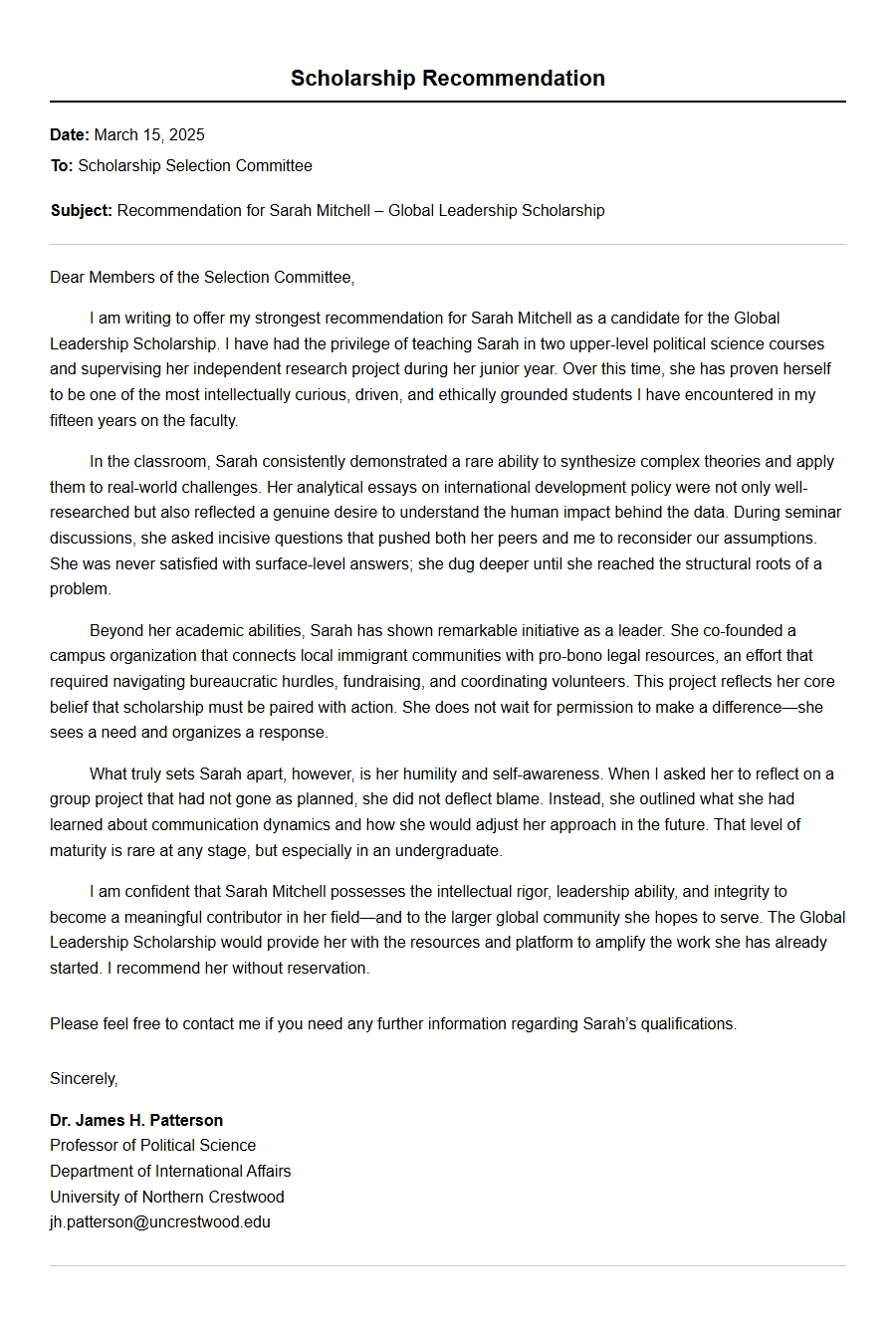 scholarship essay recommendation portion - Recommendation Letters
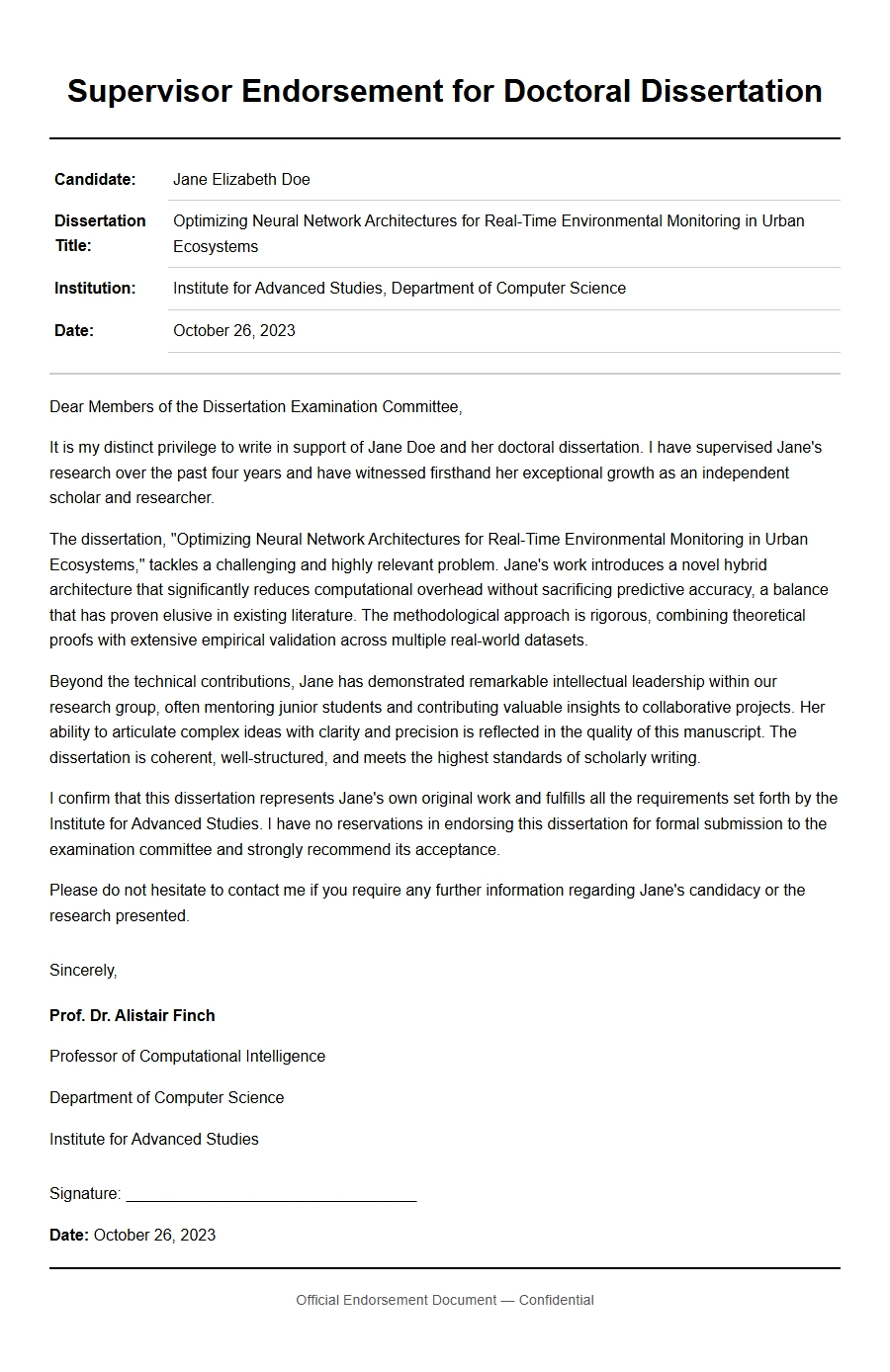 Sample PhD Supervisor Endorsement Letter
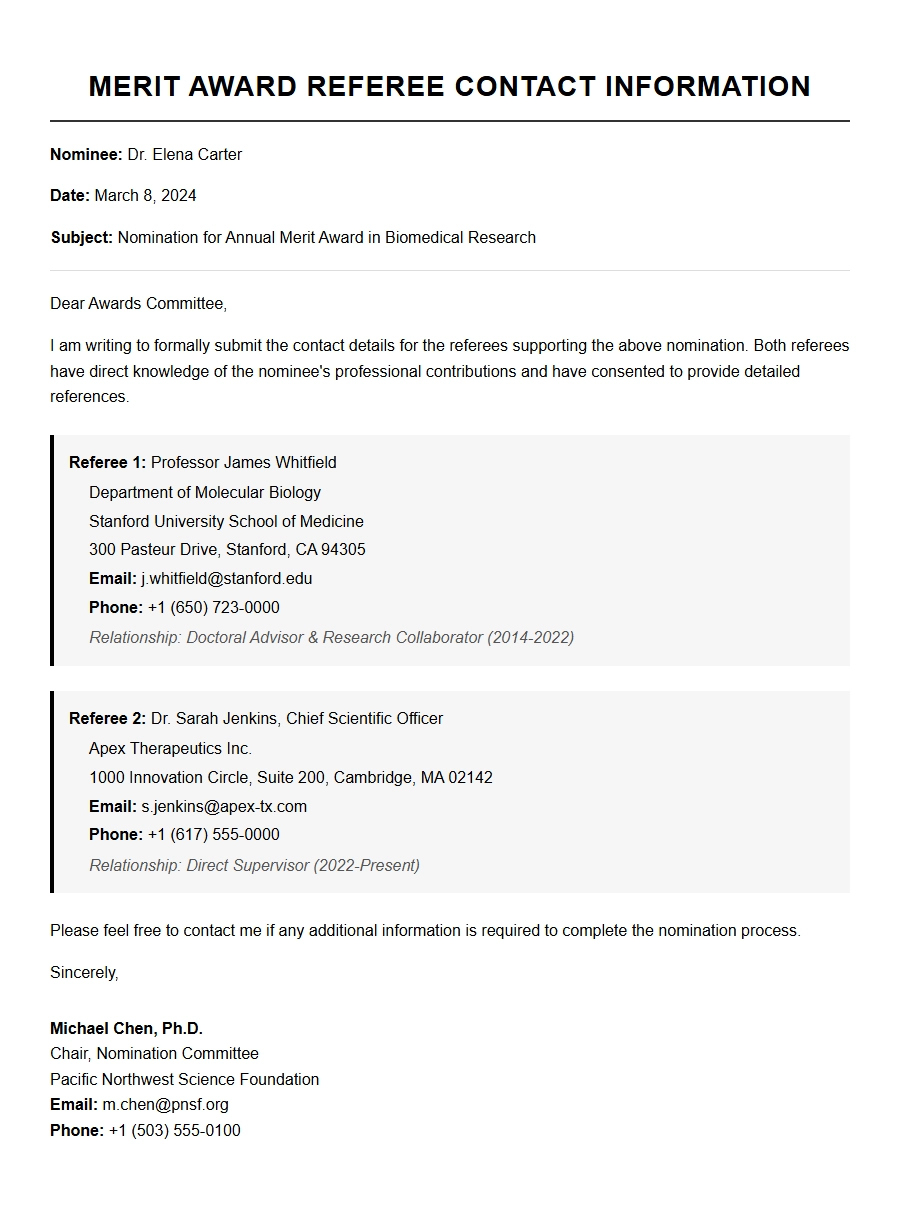 How to Find Your Merit Award Referee Contact Info