The Perfect Structure for a University Reference Letter
You’ve got a student who deserves a spot. They’ve got the grades, the drive, and the story. But the reference letter feels like a wall you can’t get past. You’re not alone—that blank page is one of the hardest parts of professional correspondence. The truth is, a good sample isn’t cheating. It’s a smart shortcut that gives you structure, tone, and the right phrasing so you can focus on what actually matters: describing a real person.
Why a sample helps more than starting from scratch
A university admissions reference letter has a clear job: convince an admissions committee that this candidate will succeed in a demanding academic environment. That’s a specific kind of letter structure. A good sample shows you exactly where to put your recommendation, how to prove it, and how to close with confidence. You don’t need a different formula for every student. You need a solid skeleton you can adapt. That’s what a letter template gives you—room to personalize without second-guessing where things go.
If you’re writing for a top-tier program, the tone matters more than you think. A letter of recommendation that sounds too casual can hurt a student’s chances. One that’s too stiff feels like a form letter. A sample helps you land in that sweet spot—professional but human. That’s the core of good tone in writing for this context.
How to pick the right sample for your situation
Not all reference letters are the same. The letter you write for a PhD applicant should be more detailed and research-focused than the one you write for an undergraduate transfer. If you’re supporting a student with a nontraditional background—say, someone applying alongside a creative portfolio—your letter should emphasize adaptability and initiative. For that, check out this sample for a creative portfolio applicant to see how to match tone with context.
If the student worked closely with you in a role like a teaching assistant, you’ll want to emphasize responsibility and reliability. A teaching assistant reference letter example can help you structure that sort of evidence naturally. The key is to match the sample type to the student’s story—not the other way around.
Adapting a sample without losing your voice
Category: Reference letter adaptation strategies
Here’s the trick: use the sample for structure, not copy the language word-for-word. If a sample says “demonstrated exceptional analytical skills,” and your student was strong in group projects, shift it to something like “took the lead on collaborative data analysis tasks in my lab course.” That keeps the professional business letter format intact while making it personal. Most samples are customizable for a reason—don’t be afraid to rewrite whole sentences to match what you actually observed.
A common mistake is sticking with outdated salutation and closing styles. “To Whom It May Concern” still works in a pinch, but if the application asks for a specific officer’s name, find it. Similarly, “Sincerely” is always safe, but “With strong recommendation” can feel more active and relevant. These small choices in letter writing etiquette signal that you’ve actually read the instructions.
Tailoring the opening paragraph to grab attention
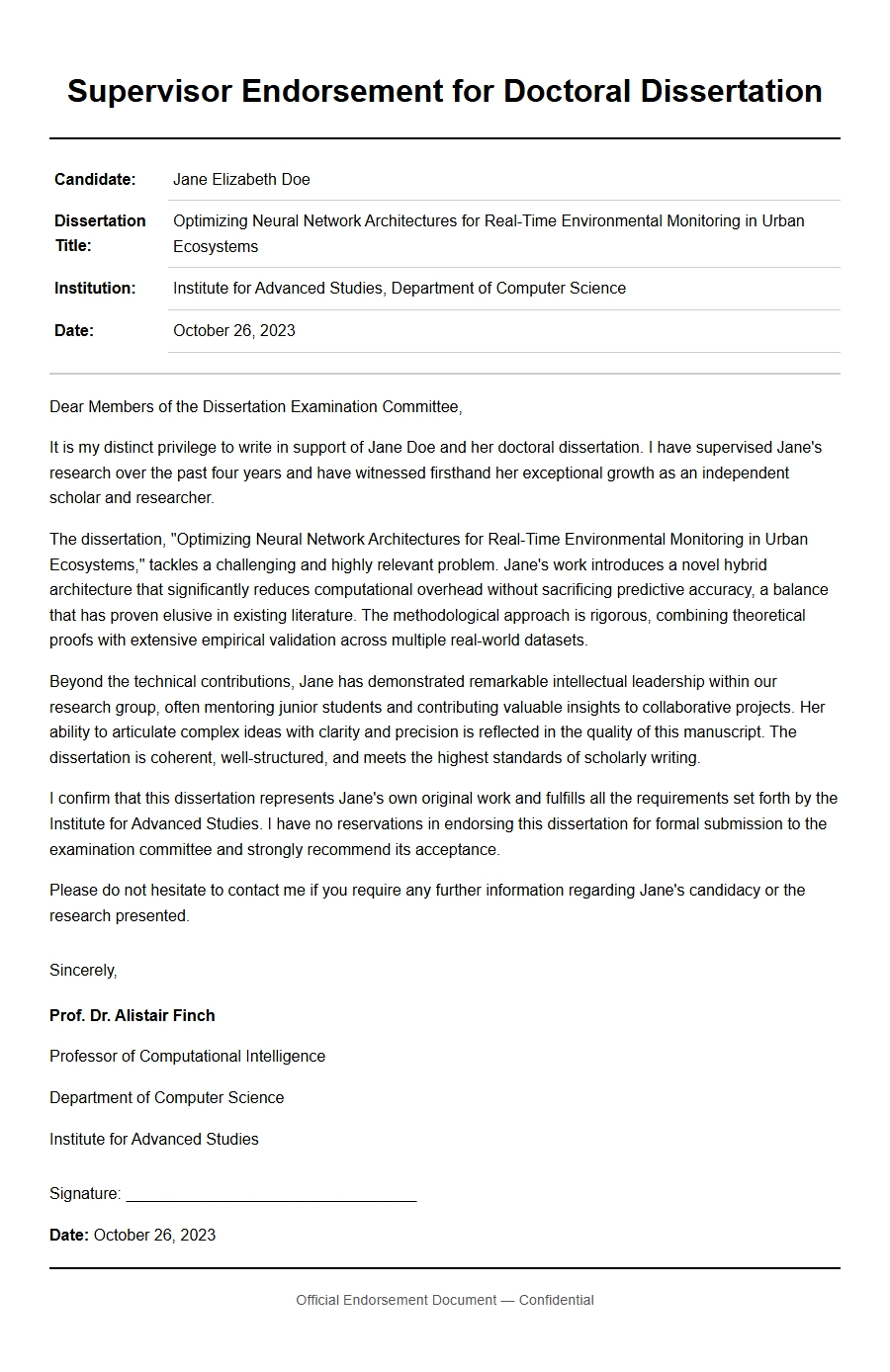
You don’t need a dramatic hook. The best openings are direct and specific. “I’m writing to recommend Jane Doe for your Master’s in Environmental Policy. I supervised her undergraduate thesis on urban water sustainability, and I’ve rarely seen a student combine research discipline with that level of community engagement.” That sentence already answers the main question: who are you, what is your relationship, and why does it matter? If you’re writing for a student who needed strong mentorship, a PhD supervisor endorsement sample can show you how to frame that guidance as growth.
One tip: mention a specific project or paper title early. It gives the reader context and shows you’re not working from vague memory. It also helps your letter stand out in a stack of cover letter examples that all sound the same.
Formatting choices that matter
Digital submission is the norm now, but some universities still expect a signed PDF with a letterhead design. Use your institution’s official letterhead if you can. If you’re submitting via an online portal, a clean digital letter format with consistent spacing and a standard font (like Times New Roman or Calibri) works best. Avoid fancy design elements—they don’t help and can look unprofessional.
For email submissions, skip the letterhead entirely. Write a standard email with a clear subject line: “Recommendation for [Student Name] – [Program Name].” Attach your letter as a PDF. That’s professional correspondence at its simplest and most effective.
Common mistakes and how to avoid them
One of the biggest errors is writing a letter that’s too generic. “John is a good student” says nothing. “John’s final project on machine learning for medical imaging was the top submission in my seminar” says everything. Avoid vague praise. Use specific examples, even if they’re short.
Another mistake is forgetting to proofreading letter carefully. A typo in a reference letter looks careless—it reflects on both you and the student. Read it out loud before you send it. If you can, ask a colleague to glance at it. Most mistakes are easy to catch if you slow down.
If you’re writing multiple letters, keep a master list of your students’ key accomplishments. That helps you avoid repeating the same phrasing across letters. A prop master inventory-style recommendation checklist can help you stay organized without missing details.
Turning the sample into a springboard
The best reference letters feel like a conversation. They’re structured enough to be credible, but personal enough to be memorable. Use the sample as a starting point, not a final draft. Tweak the language until it sounds like you. Swap out weak verbs for stronger ones. Make sure every sentence serves one purpose: proving that this student deserves a chance.
And if you’re writing for a student who needs a contextual story—like overcoming a challenge or navigating a difficult environment—a neighbor noise complaint reference letter might seem unrelated, but its structure for explaining context without judgment can actually teach you how to frame a student’s resilience without over-explaining.
You’ll get faster with practice. The first letter takes an hour. The fifth takes twenty minutes. And the student you’re writing for gets a real shot because you took the time to do it right. That’s worth the effort.
Writing Examples
The Perfect Structure for a University Reference Letter
Structure of a Teacher Recommendation Letter
A strong teacher recommendation for university admissions typically includes the following sections:
Introduction: Establish the relationship — how long you have known the student, in what capacity, and your subject area.
Academic Performance: Describe the student's intellectual curiosity, class participation, and specific achievements (e.g., top grades, complex projects).
Personal Qualities: Highlight traits such as perseverance, collaboration, or leadership, with concrete examples.
Comparison to Peers: Rank the student among all students you have taught (e.g., "top 5% in 15 years").
Conclusion: Reiterate your endorsement and offer to provide further information.
Keep the tone professional and supportive, focusing on the student's fit for the target university.
Key Sections in a Counselor's Letter
School counselors often use a structured format that includes:
Section
Content
Context
Describe the school environment, curriculum rigor, and how the student stands out within it.
Academic Profile
Briefly note GPA, course load, and any academic trends or challenges overcome.
Extracurricular Involvement
Highlight leadership roles, community service, and sustained commitment outside class.
Personal Attributes
Discuss character, resilience, and contributions to the school community.
Overall Endorsement
Provide a clear rating (e.g., "strongly recommend") and a concluding statement.
Counselors should avoid repeating information already in the application, instead adding nuanced insights.
Employer Reference for Graduate Admissions
An employer recommendation letter for graduate school should follow this structure:
Opening: State your position, your relationship to the candidate, and the duration of employment.
Work Performance: Describe specific projects, responsibilities, and skills relevant to the graduate program (e.g., research, data analysis, teamwork).
Professional Growth: Note promotions, increased responsibility, or initiative taken by the candidate.
Personal Qualities: Mention reliability, leadership, communication, and ability to handle pressure.
Comparison to Colleagues: Rank the candidate among peers (e.g., "among the top 10% of employees I have supervised").
Closing: Reaffirm support for the applicant's academic pursuits and provide contact details.
Focus on transferable skills and potential for graduate-level work.
Peer Recommendation for Undergraduate Programs
Peer recommendations are less formal but still require a clear structure:
Introduction: Explain how you know the applicant (e.g., study partner, club member) and for how long.
Shared Experience: Describe a specific situation where you observed the applicant's strengths — for example, leading a group project or helping a friend through a difficult assignment.
Character Insight: Offer personal observations about integrity, empathy, or motivation that an authority figure might not see.
Impact on You: Briefly state how the applicant influenced or inspired you.
Conclusion: Express confidence in their success at university and recommend them wholeheartedly.
Keep the tone authentic and avoid exaggerating.
Structure of a Committee Evaluation Letter
When a group of teachers or advisors writes a joint recommendation, the structure often includes:
Committee Introduction: List members and their roles (e.g., math teacher, counselor, coach).
Holistic Profile: Provide a composite view of the student across academics, extracurriculars, and character, integrating multiple perspectives.
Specific Contributions: Each member may add a paragraph on their area — e.g., the English teacher discusses writing ability, the coach discusses leadership.
Unanimous Endorsement: State that the committee collectively supports the application.
Rating Summary: Include a table if helpful:
Aspect
Rating (1-5)
Comment
Academic
5
Exceptional in STEM and humanities
Extracurricular
4
Captain of debate team
Character
5
Kind and collaborative
This type of letter can be especially convincing.
Common Format for Academic Reference Letters
Most academic recommendation letters share this basic format:
Sender Details: Name, position, institution, contact information (optional in body).
Salutation: "Dear Admissions Committee" or specific recipient name.
Paragraph 1 — Introduction: Relationship and duration; overall recommendation strength.
Paragraph 3 — Personal Attributes: Maturity, collaboration, motivation, resilience.
Paragraph 4 — Closing: Reiterate support, willingness to provide more information, and signature.
Maintain a length of one to one-and-a-half pages. Use concrete examples rather than vague praise.
Optional Additions: Extracurriculars and Leadership
Some recommenders choose to add a dedicated section for extracurriculars and leadership. This may include:
Roles: List clubs, sports, volunteer work, and positions held (e.g., president, treasurer).
Impact: Describe specific outcomes — such as successfully organizing a fundraiser or mentoring new members.
Time Commitment: Mention years involved and hours per week to show depth.
Skills Developed: Link activities to university readiness (e.g., team management, public speaking).
If the application already lists activities, the recommender should add context or interpretation rather than duplicate facts.
Also consider a brief table comparing the applicant’s involvement to typical peers:
Activity
Applicant’s Level
Typical Peer
Debate
Captain, 3 years
Member, 1 year
Volunteering
200+ hours
~50 hours
How to Structure a Strong Conclusion
The conclusion of a recommendation letter is crucial. It should:
Reinforce Endorsement: Use phrases like "I recommend [Name] without reservation" or "I am confident [Name] will excel."
Summarize Key Strengths: Briefly restate the two or three most impressive qualities (e.g., analytical skills, leadership, resilience).
Show Willingness: Offer to answer any follow-up questions and provide contact information.
Add a Personal Touch: Sometimes include a short anecdote that encapsulates the student’s character.
Sign Off: Use a professional closing ("Sincerely,") followed by full name and title.
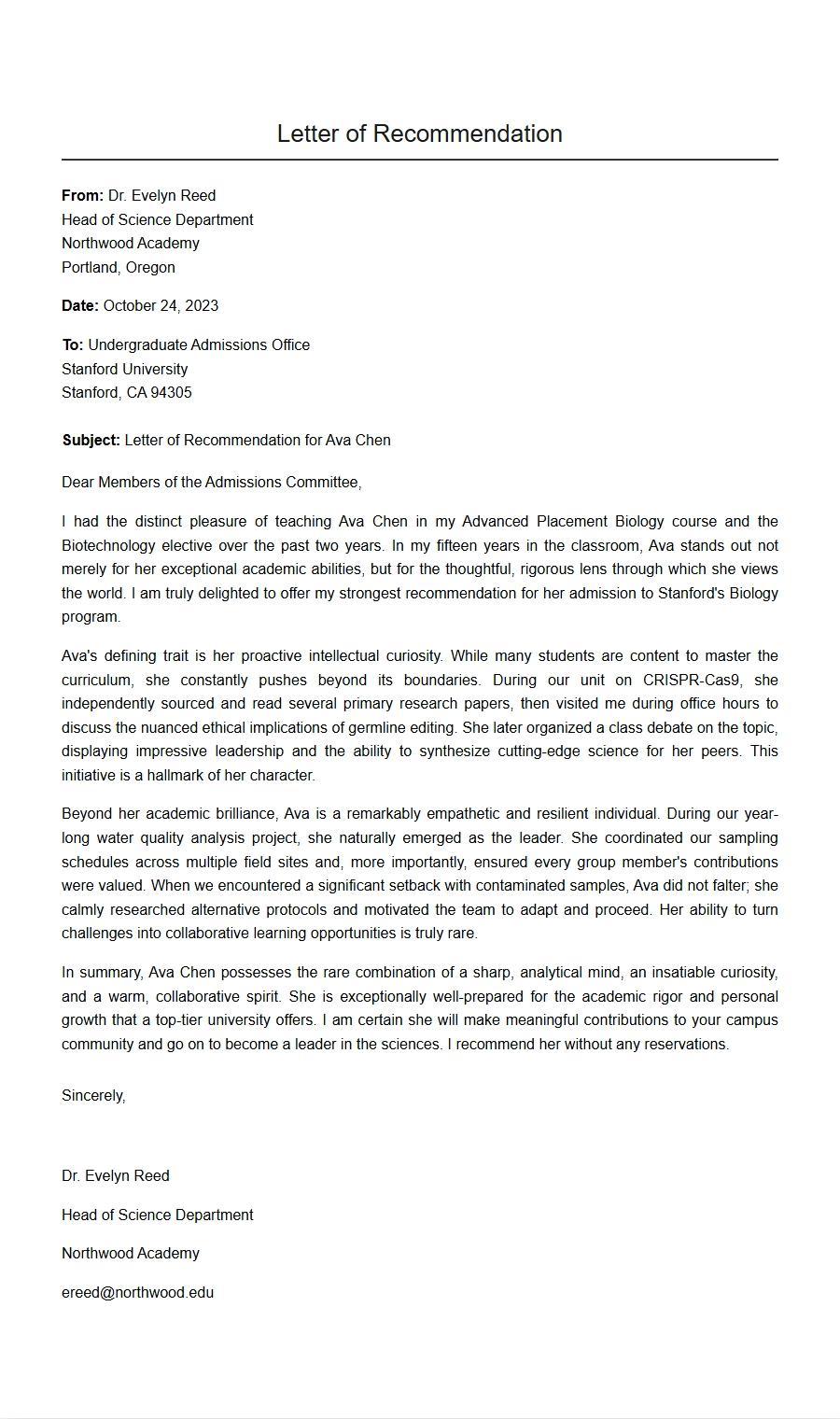
Example closing paragraph: "In summary, Jane is one of the most intellectually curious and collaborative students I have taught. I am confident she will make significant contributions to your university community. Please feel free to contact me for further details."
Reference Letter for Transfer Students
Transfer applications require a reference that addresses the student’s reasons for moving and readiness. Structure as follows:
Context: Describe the current institution, courses taken, and why the recommender knows the student.
Academic Progress: Note grades, but also improvement or unique experiences at the current school.
Reasons for Transfer: If appropriate and positive, mention the student’s rationale (e.g., seeking a stronger program in a specific field) — avoid negative comments about current school.
Fit for New Institution: Explain why the student would thrive in the new environment based on research or specific programs.
Maturity: Highlight the student’s adaptability, self-awareness, and ability to handle change.
Closing Endorsement: Strongly support the transfer and express confidence.
Remember: The letter should not simply repeat the transfer statement; it adds a recommender’s perspective.
Letter of Recommendation for Scholarship
Scholarship recommenders often emphasize financial need along with merit. The structure may differ slightly:
Opening: Identify the scholarship name and your relationship to the applicant.
Academic Excellence: Provide evidence of high achievement, such as GPA, awards, or honors courses.
Financial Context (optional): If appropriate, comment on the student’s determination despite economic challenges (without oversharing private details).
Character and Community: Highlight volunteer work, part-time jobs, or family responsibilities that show responsibility and grit.
Future Potential: Explain how the scholarship would impact the student’s goals and contribute to society.
Conclusion: Strongly advocate for the award; include contact information.
Qualification
Evidence
Academic
3.9 GPA, Dean's List last two semesters
Financial Need
Single‑parent household; works 20 hrs/week
Leadership
Founder of tutoring club
Keep the focus on why the candidate is uniquely deserving of the scholarship funds.
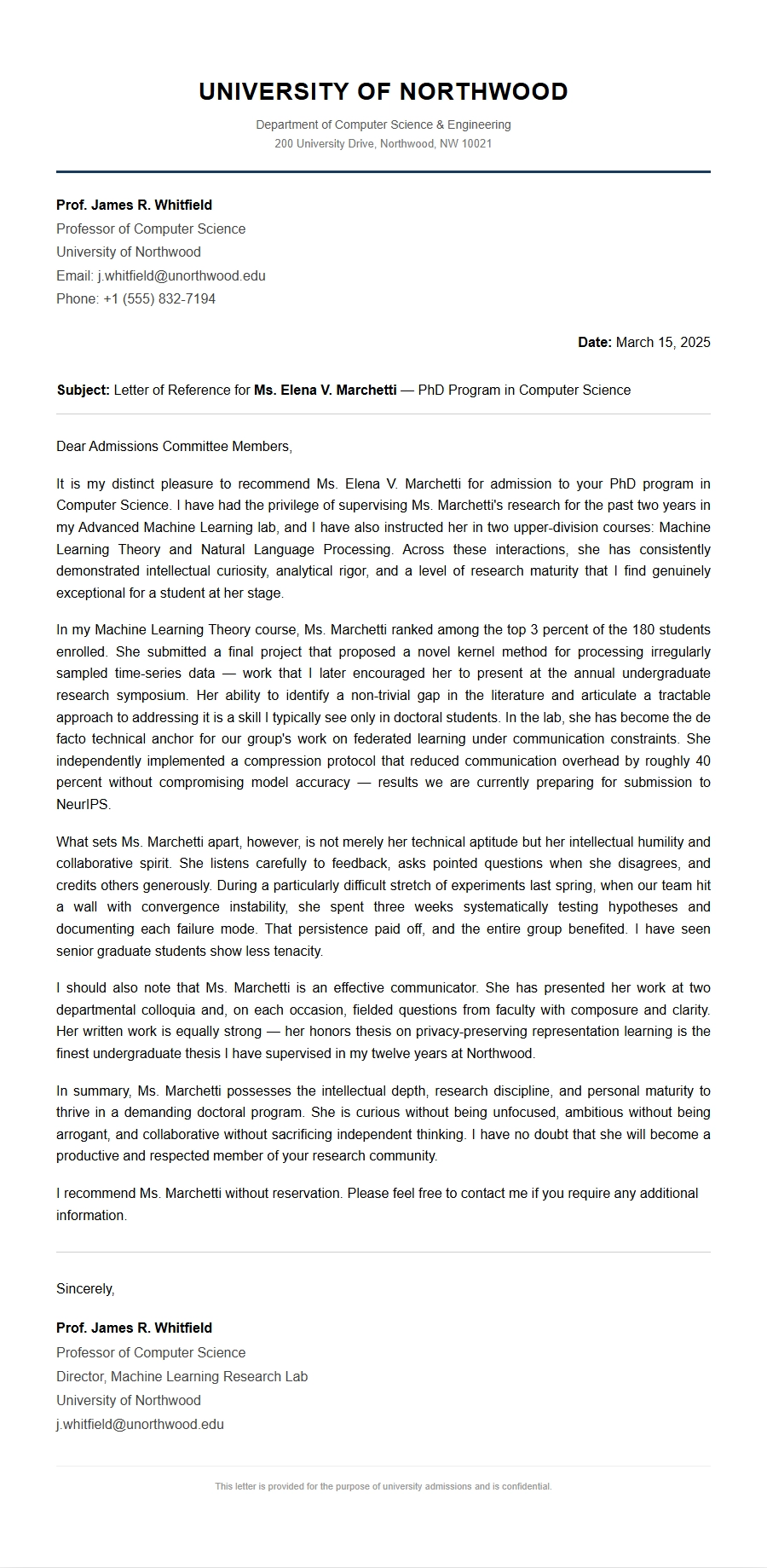
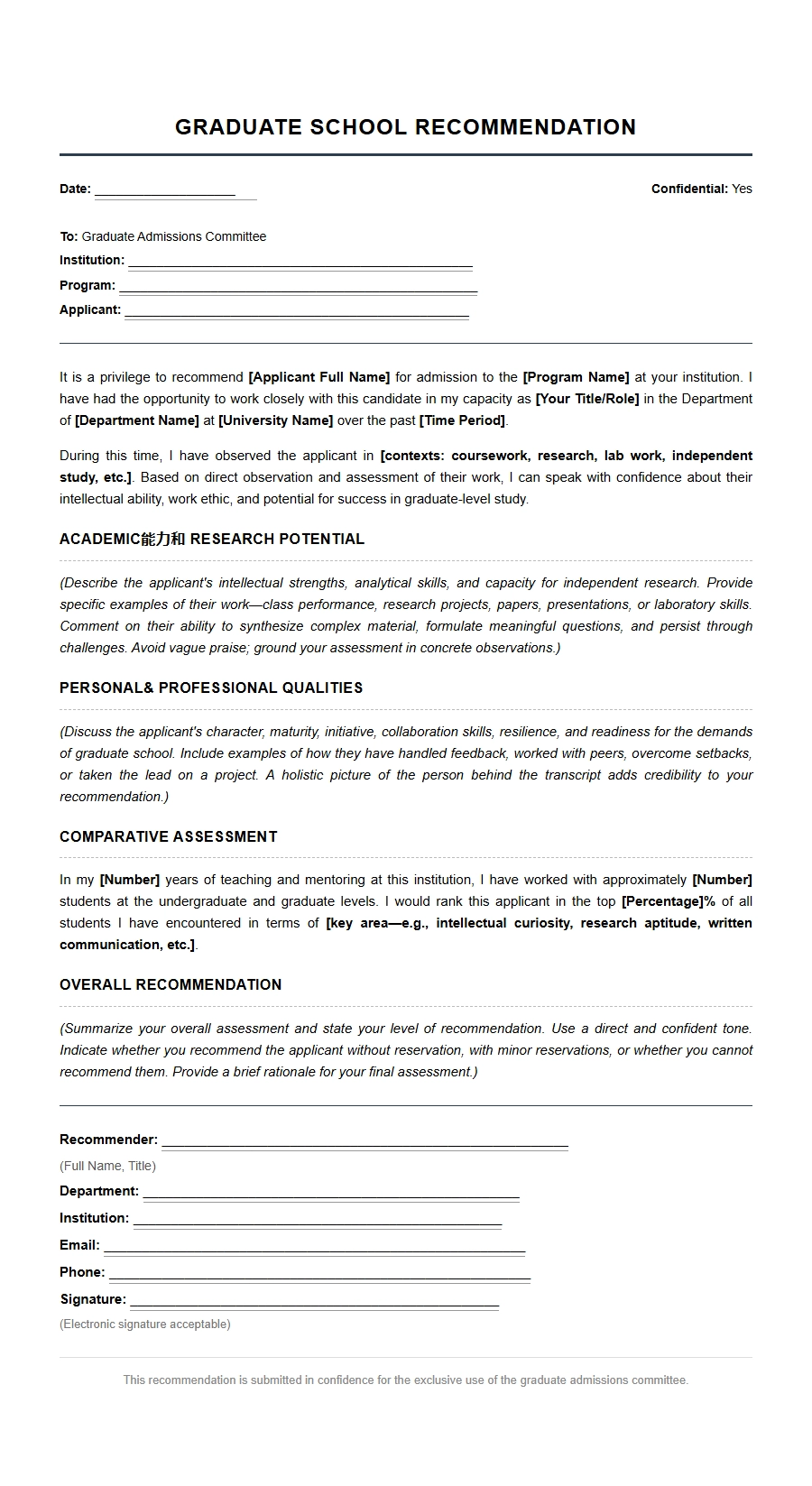 Format for Graduate School Faculty Recommendation Letters
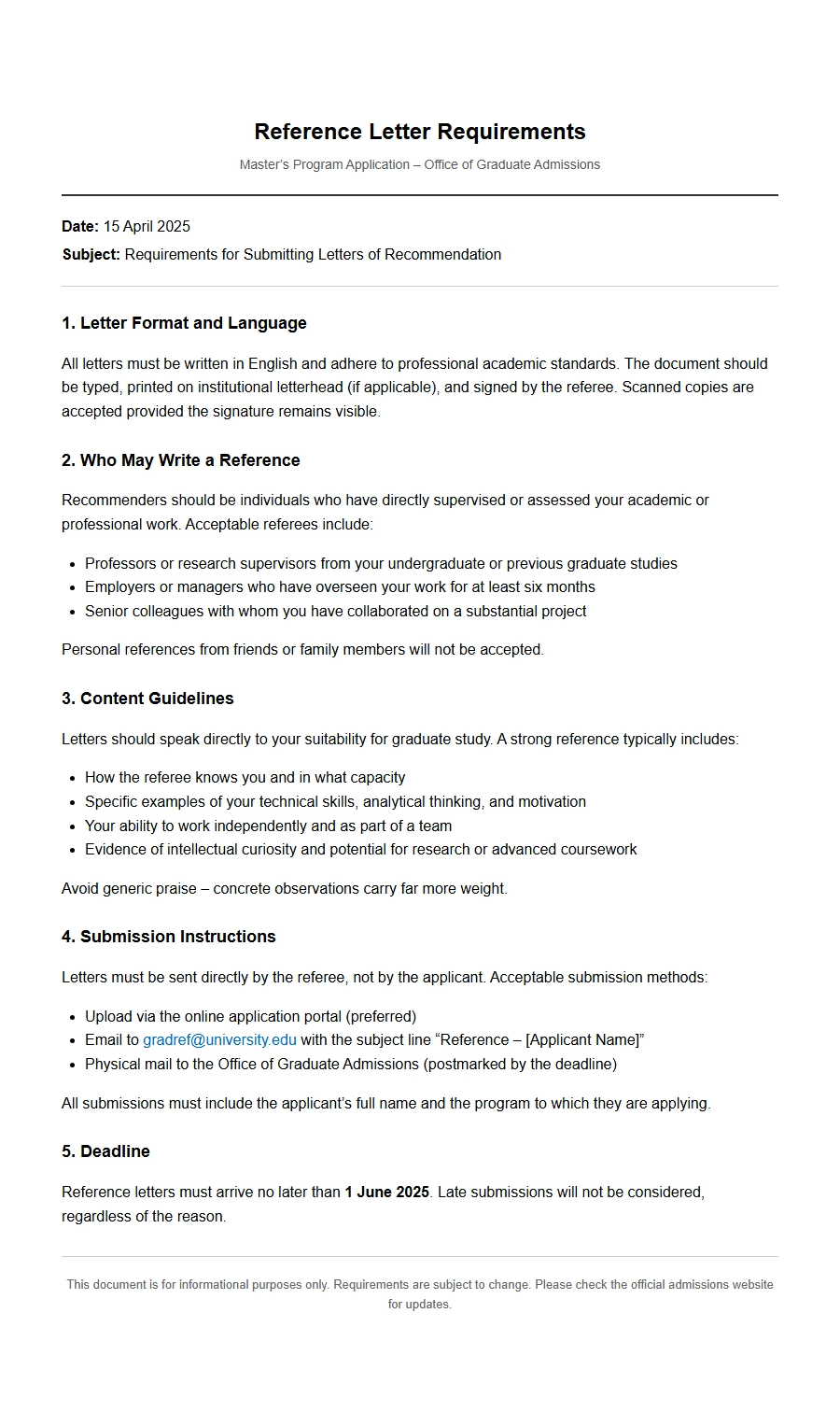 Master's Program Reference Letter Requirements
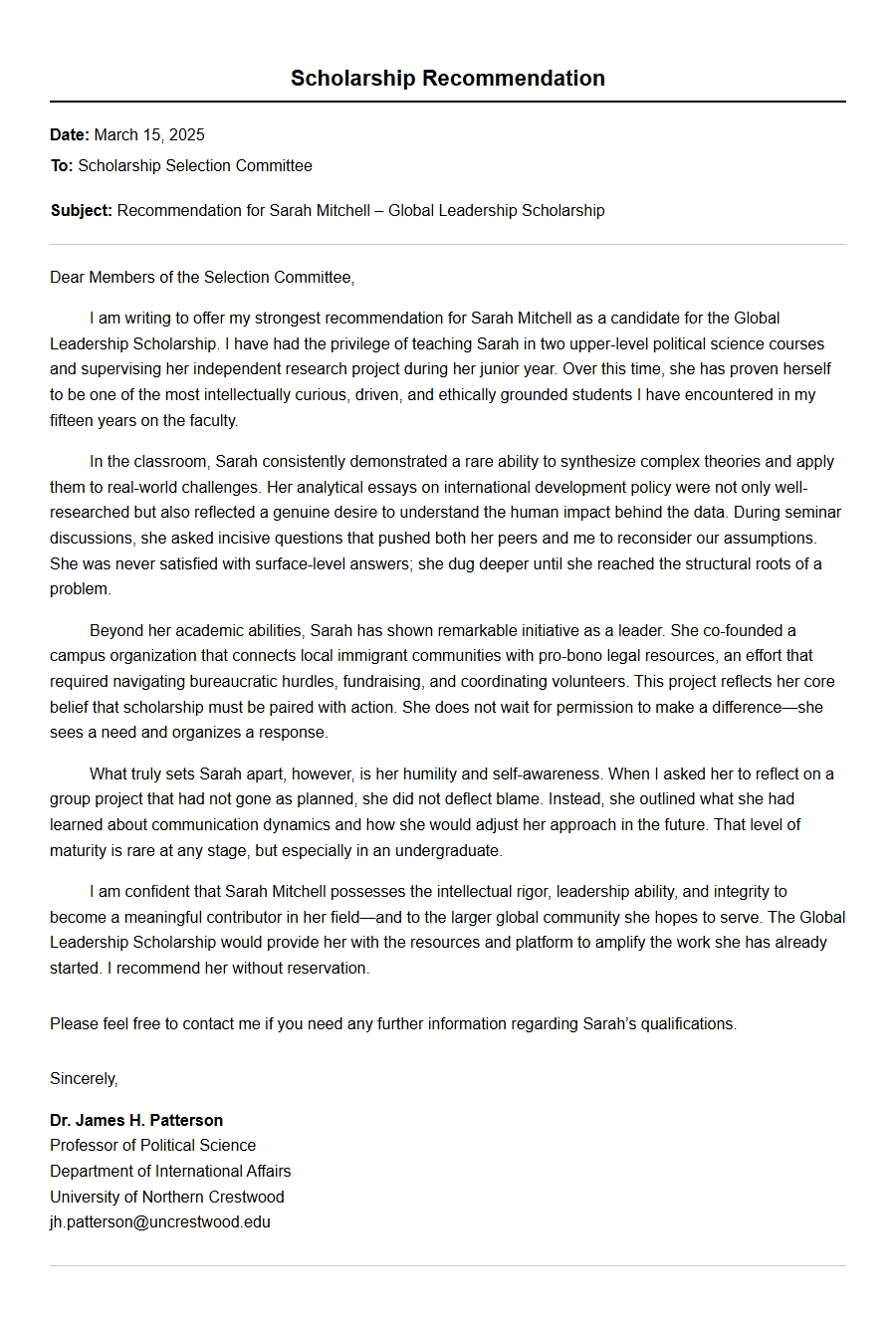 scholarship essay recommendation portion - Recommendation Letters
 Sample PhD Supervisor Endorsement Letter
 How to Find Your Merit Award Referee Contact Info
 college application recommendation letter example - Recommendation Letters