Getting stuck on the right words when you need to request someone's power of attorney document can feel surprisingly difficult. Maybe you're an adult child trying to help aging parents, or a friend who's been named as agent. You know the document exists, but formally asking for a copy or an original requires a tone that's both respectful and legally sound. That anxiety is normal. But a well-structured sample can cut through that uncertainty fast.
Using a letter template isn't taking shortcuts. It's working smarter. A good sample gives you a proven letter structure, the right salutation and closing, and the specific language needed for professional correspondence around legal documents. All you do is personalize it. You bring the relationship; the sample brings the structure.
What a power of attorney document request letter actually does
This isn't a casual note. You're asking for a legal instrument that gives someone authority over financial, medical, or property decisions. The letter needs to clearly state which power of attorney you're requesting, why you need it, and how it should be delivered. The tone should be cooperative, not demanding, even when you have a legal right to the document.
For example, if you're the named agent and the principal has lost their copy, your request letter needs to explain your role, reference the original signing date, and provide options for the other party to send a certified copy. That's a lot of details to organize from scratch.
How to pick the right sample for your specific situation
Every request is different. You might be asking a family member, a lawyer's office, or a financial institution. Each requires a slightly different tone in writing. A letter to your mom's attorney should be more formal than one to your sibling. Look for a sample that matches your audience and purpose.
If you're requesting a copy from a third party like a bank or title company, check whether they have their own forms first. Many institutions have specific procedures and won't honor a generic request. But a customizable letter is still useful as a starting point—it gives you the business letter format and key phrases to adapt.
Step-by-step: adapting a sample without sounding robotic
First, read the entire sample out loud. Does it sound like something you'd actually say? If the language feels stiff or overly legalistic, adjust it. Your goal is to sound like a competent, cooperative person, not a form letter.
Second, personalize the opening paragraph immediately. State your name, your relationship to the principal, and exactly what document you're requesting. Specificity builds trust. A vague request gets delayed. A clear one gets handled quickly.
Third, keep the closing warm but direct. Thank them in advance, specify a reasonable deadline, and offer to provide any additional information. That shows letter writing etiquette in action.
Common mistakes that slow everything down
The biggest one? Using outdated salutation and closing lines. "To whom it may concern" feels impersonal and lazy. Use a real name if you can find it. "Dear Mr. Chen" works much better. Also, don't forget to specify the format. If you need a certified copy versus a photocopy, say that clearly.
Another mistake is ignoring the medium. If you're sending this as an email, use digital letter format—a clear subject line, no full letterhead design needed, and shorter paragraphs. If you're printing and mailing it, include your letterhead design with your contact info and reference numbers. The medium changes the business letter format you should follow.
And don't skip proofreading letter steps. A typo in the document title or date can create confusion and delay. Ask someone else to read it before you send it, especially if the request is urgent.
Making the letter feel both professional and personal
This is where a good sample really helps. It gives you a solid skeleton, but you bring the voice. Use contractions like "I'm" and "we'll" naturally. Add a short personal note if it's appropriate, like "I know you're busy, and I really appreciate your help with this." That simple line changes the whole feel of the letter.
If you need to write a letter of recommendation for someone who's acting as agent, or you're responding to a request yourself, the same principles apply. Clear structure, respectful tone, and specific details.
Think of the sample as a springboard
A cover letter examples approach works here too—you use the sample to understand the expectations, then you make it your own. The more you practice this, the faster it gets. Next time you need to adapt a resignation letter sample or write any professional correspondence, you'll have the confidence to do it in minutes instead of staring at a blank page.
If you're writing to a long-distance family member or someone going through a difficult situation, adjust your tone with extra care. Acknowledging their circumstances thoughtfully can make the request feel like a conversation, not a demand. Trust in your own knowledge of the person, and let the sample handle the legal scaffolding.
The best letters do two things: they get the job done, and they leave the relationship intact. A good sample helps with the first. You handle the second.
Examples You Can Adapt
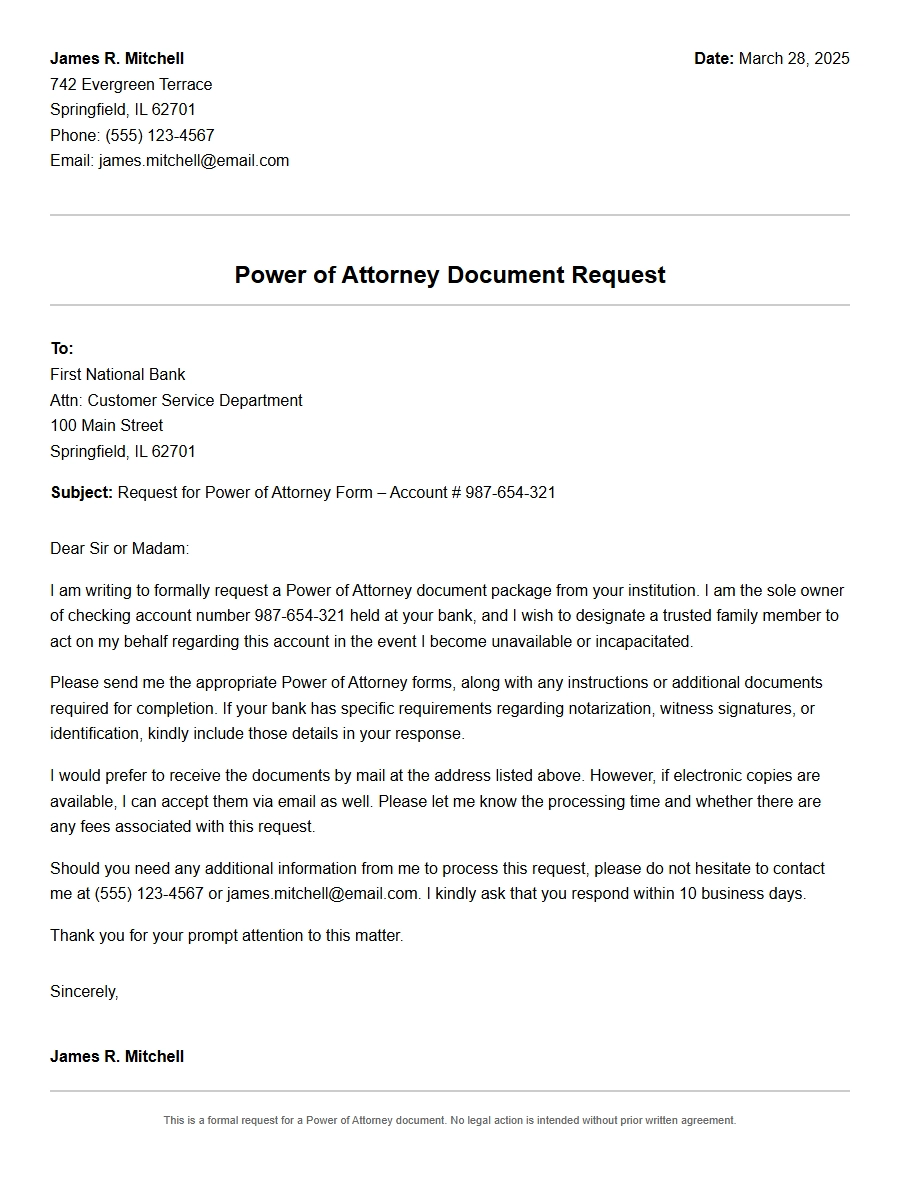
Power of Attorney Document Request Letter
Request for Medical Power of Attorney
Dear [Healthcare Provider Name],
I am writing to formally request a copy of your standard medical power of attorney form. My mother, [Patient's Name], is currently under your care and we wish to designate me as her healthcare agent. Please provide the document along with any required instructions for completion and notarization.
Below are the details for the request:
Field
Information
Patient Name
[Patient's Name]
Date of Birth
[DOB]
Medical Record #
[Record #]
Requested Agent
[My Name]
Relationship
Son/Daughter
Please send the form to the address below or email a PDF copy. I understand that notarization may be required. Thank you for your prompt assistance.
Sincerely, [Your Name] [Address] [Phone]
Letter to Bank Requesting Durable Power of Attorney Forms
To the Manager, [Bank Name] Branch
I am writing to request the necessary forms and instructions to establish a durable power of attorney for my elderly father, [Father's Name], who holds accounts at your branch. We need to ensure I can manage his finances should he become incapacitated.
Please provide the following documents:
Durable Power of Attorney form specific to [State]
List of required identification and notarization details
Any additional forms for bank-specific POA acknowledgment
For reference, my father’s account details are:
Item
Details
Account Holder
[Father's Name]
Account Number
[Account #]
Type
Checking/Savings
Please mail the forms to my address or make them available for pickup. I can provide my identification upon request. Thank you for your cooperation.
Best regards, [Your Name] [Phone Number]
Request to Attorney for Drafting Power of Attorney Document
Dear Attorney [Last Name],
I am writing to formally request your assistance in drafting a comprehensive power of attorney document for my personal affairs. I would like to appoint my spouse, [Spouse's Name], as my agent with broad authority over financial and property matters.
Please confirm your availability and provide an estimate of fees. I would appreciate if you could include the following provisions:
General durable power of attorney effective immediately
Authority to handle real estate transactions, banking, and investments
Specific instructions for gifting limitations
Springing clause if preferred based on your advice
I have attached a list of my assets for your reference. Please let me know what additional information or identification you require. I look forward to your response.
Thank you, [Your Name] [Phone]
Request for Power of Attorney for Property Management
Dear [Property Management Company],
I am writing to request a power of attorney document to authorize my brother, [Brother's Name], to manage my rental property located at [Property Address] while I am abroad. Please provide the standard POA form used by your company or advise if you require a specific notarized document.
Please email the form or let me know where I can download it. I will ensure it is properly executed and notarized before returning it to you. Thank you for your assistance.
Sincerely, [Your Name] [Email]
Family Request for Limited Power of Attorney for School Pickup
Dear [School Principal's Name],
We are writing to request a limited power of attorney form that allows our neighbor, [Neighbor's Name], to pick up our children from school on days when we are delayed. Please provide the school’s standard authorization document or any preferred format.
Child details:
[Child 1 Name], Grade [X]
[Child 2 Name], Grade [Y]
We would like the POA to be valid from [Date] to [Date] and include authority for emergency medical consent if you require that. Please note that we will include our contact numbers and the neighbor’s identification details on the form.
Kindly send the document by email or provide a physical copy at the front office. We appreciate your help in keeping our children safe.
Thank you, [Parent Names] [Phone]
Request to Financial Advisor for Investment Power of Attorney
Dear [Advisor Name],
I am requesting a power of attorney document to authorize my daughter, [Daughter's Name], to manage my investment portfolio in the event of my incapacity. Please provide the firm’s specific POA form and guidelines for execution.
My account details for reference:
Account Type
Account Number
Brokerage
[Acct #]
IRA
[Acct #]
I would like the POA to cover trading, withdrawals, and tax-related decisions. Please include any required witness or notary sections. Also, please advise if you need a copy of my existing estate plan. I look forward to your response.
Best regards, [Your Name] [Phone]
Request to County Clerk for Statutory Power of Attorney Form
To the County Clerk, [County Name] Office
I am writing to request a copy of the statutory power of attorney form as provided under [State] law. I need this document to grant my sister, [Sister's Name], authority to handle my personal affairs while I am deployed overseas.
Please provide the form by mail or direct me to an online resource. If there is a fee for copies, please let me know the amount and acceptable payment methods.
Additional information:
My full name: [Your Name]
Proposed agent: [Sister's Name]
Notarization required: Yes
Witnesses required: Yes, two adults
Thank you for your assistance. I appreciate a prompt reply as I have a limited window to execute the document before my departure.
Sincerely, [Your Name] [Address]
Request for Power of Attorney to Handle Insurance Claims
Dear [Insurance Company Name] Claims Department,
I am writing to request a power of attorney form to authorize my spouse, [Spouse's Name], to handle all insurance claims on my behalf following my recent accident. Please send the specific POA document your company requires for third-party claim handling.
Policy details:
Policy Number
Policyholder
Date of Loss
[Policy #]
[My Name]
[Date]
Please include any instructions regarding notarization, witness requirements, and whether you accept electronic signatures. Additionally, indicate if a separate medical release is needed. I prefer to receive the form via email. Thank you for your prompt attention.
Regards, [Your Name] [Phone]
Letter Requesting Power of Attorney for Pet Care During Travel
Dear [Veterinary Clinic Name],
I am requesting a temporary power of attorney document to allow my friend, [Friend's Name], to make veterinary decisions for my dog, [Dog's Name], while I am traveling abroad from [Start Date] to [End Date]. Please provide your clinic’s standard authorization form or a simple POA template.
Pet details:
Pet Name: [Dog's Name]
Breed: [Breed]
Microchip #: [Chip #]
Vaccination records: On file
I would like the POA to include authority for emergency treatments, medications, and routine check-ups. Please also advise if you require notarization or if a signed witness is sufficient. You can fax or email the form to me. Thank you for your help.
Sincerely, [Your Name] [Phone]
Request for Power of Attorney for Minor Child Guardianship
Dear [Law Office Name],
I am writing to request a power of attorney document that temporarily grants guardianship of my minor child, [Child's Name], to my parents while I undergo medical treatment overseas. Please draft a short-term POA that covers educational, medical, and daily care decisions.
Child’s information:
Child's Name
Date of Birth
School
[Child's Name]
[DOB]
[School Name]
Timeframe: From [Start] to [End]. Please include clauses for emergency medical consent, school enrollment authority, and travel permission within the country. I will need two notarized copies. Kindly provide a cost estimate and turnaround time. I appreciate your prompt assistance in this urgent matter.
 Thanking a Mentor for Guidance: Sample Messages
 Expressing Gratitude: Handwritten Letter Example
 Expressing Thanks in a Formal Personal Letter
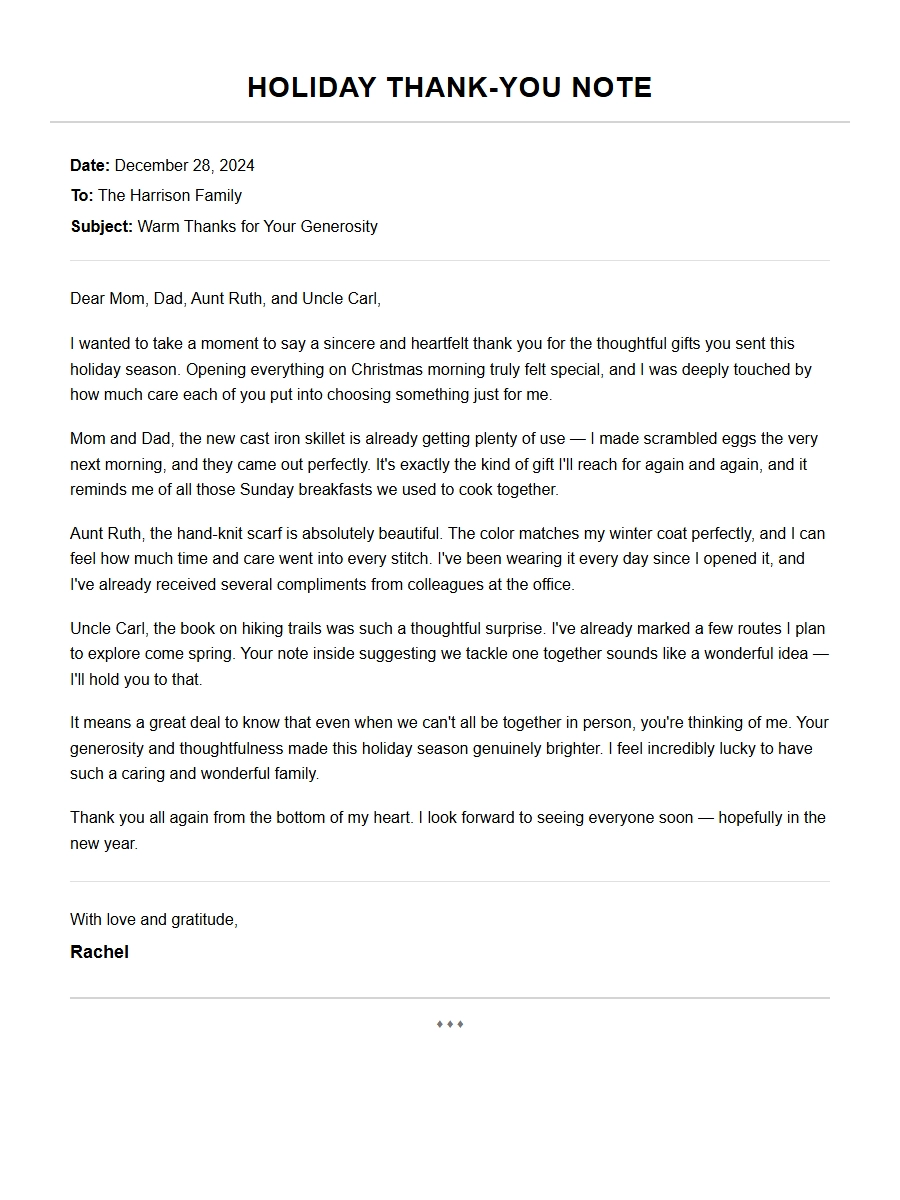 Thank You Letter Examples for Family Holiday Gifts
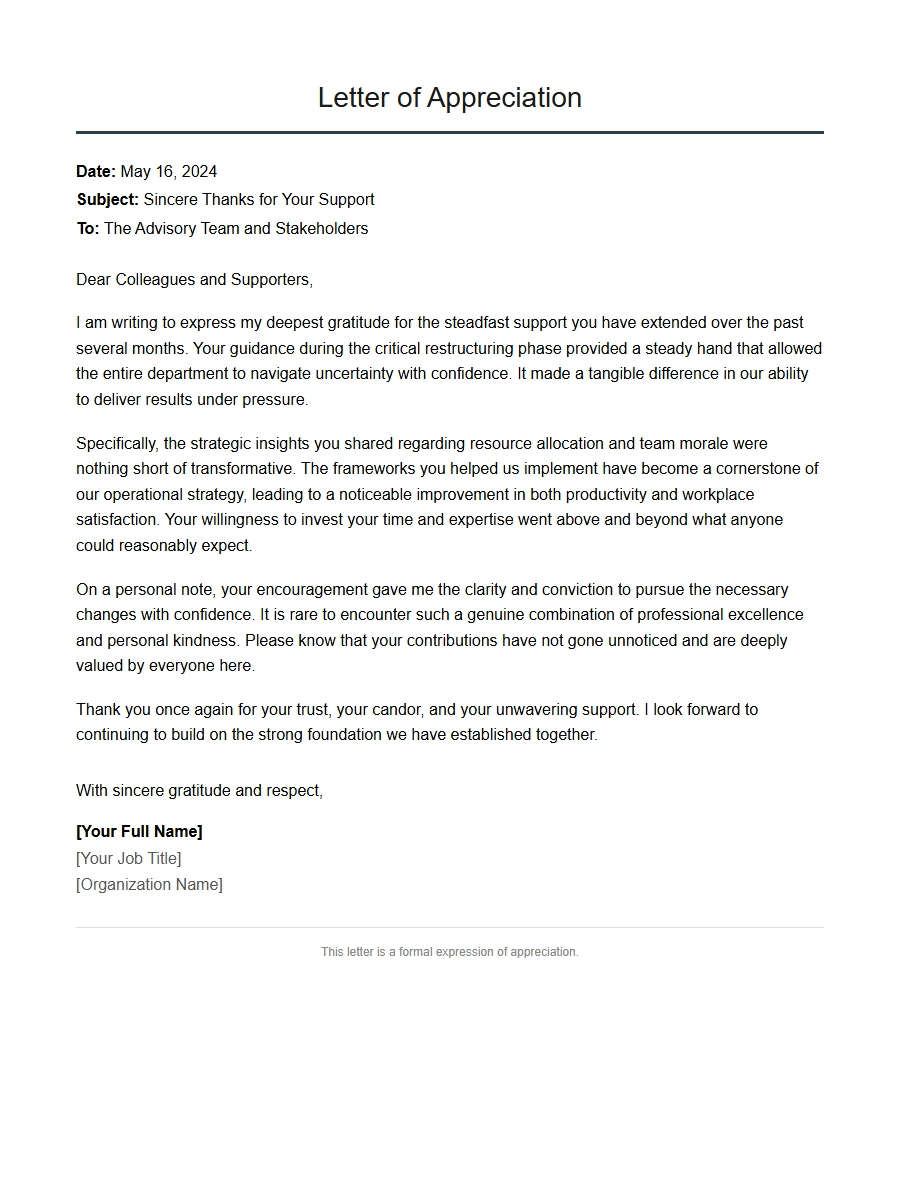 Sample Thank You Letter for Support
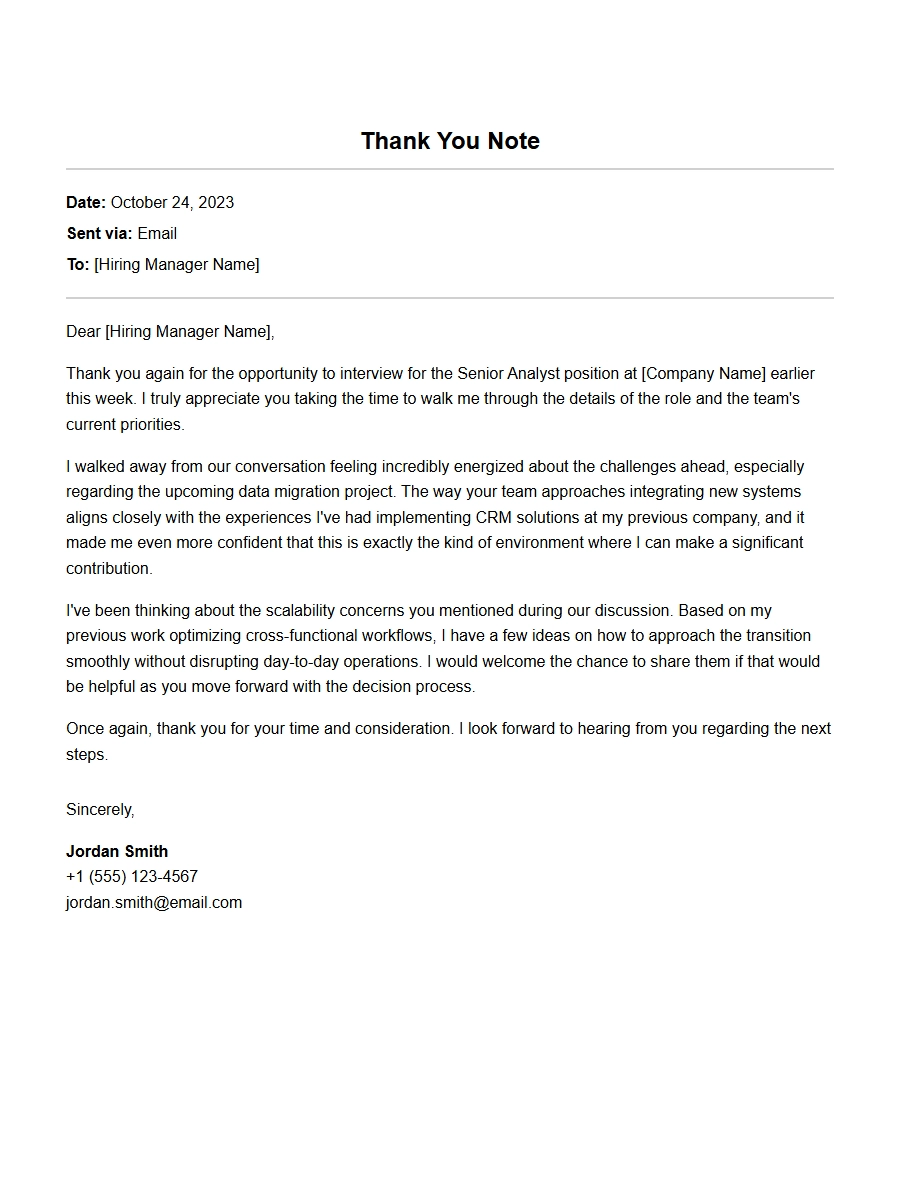 How to Write a Personal Thank-You Note After an Interview