How to Write a Maintenance Issue Letter to Your Landlord
You notice the leak under the sink, or the heat hasn't worked in three days, and now you have to write to your landlord. It feels awkward. You don't want to sound demanding, but you also need the problem fixed. A clear, professional letter is your best tool here. It creates a record, shows you're reasonable, and gets you results faster than a text message or a frantic phone call.
Using a sample letter isn't cheating. It's a smart way to get the structure right while you focus on the facts. A good template handles the letter structure, the salutation and closing, and the formal tone. You just fill in the details. This saves time and keeps your communication professional, which landlords appreciate.
Category: Personal Letters
What to include in your maintenance request letter
Your letter needs to be clear and direct. Start with your name, your unit number, and the date. Use a standard business letter format even if you're sending it by email. This sets a serious tone.
Describe the problem specifically. Don't just say "the bathroom is broken." Say "the toilet in the master bathroom runs constantly and makes a loud hissing noise, wasting water." List when you first noticed the issue. If the problem is urgent, like a gas leak or no electricity, say so clearly. You don't need to be dramatic, but do be precise.
How to adapt a sample without sounding robotic
A customizable letter is only useful if you make it sound like you. Read the sample, understand its flow, then rewrite the key parts in your own words. Keep the tone in writing polite but firm. If you've been a good tenant for years, you can mention that. "I've always appreciated how quickly you handle things, and I'm hoping for the same prompt attention to this plumbing issue." That feels personal and respectful.
Don't copy a sample word-for-word. It will sound stiff. Instead, borrow the structure and the key phrases, like "I am writing to formally request a repair" or "Please let me know a convenient time for the contractor to enter my unit." Letter writing etiquette says you should be courteous but clear. Avoid threats. Avoid apologizing excessively. State the problem and ask for action.
Common mistakes people make
One big mistake is using an outdated salutation and closing. "To Whom It May Concern" feels cold. If you know your landlord's name, use "Dear Mr. Jones" or "Dear Sarah." If you don't, "Dear Property Manager" works. Close with "Sincerely" or "Best regards," then your name and contact number.
Another mistake is ignoring the format. If you send a printed letter, use a clean letterhead design with your address and the date at the top. If you're sending an email, put a clear subject line like "Maintenance Request: Unit 3B – Broken Water Heater." Keep the body short. Use line breaks between paragraphs. A digital letter format should be just as formal as a printed one.
Practical tips for a smooth process
Keep a copy of every letter you send. This creates a paper trail. If you send it by email, ask for a read receipt. If by mail, send it certified. This protects you if the issue drags on. When you adapt a letter template, change the phrasing to match your situation. For example, if you're writing a professional introduction letter to a business owner you might be more formal, but for a landlord you can be more direct. Context matters.
Proofread your letter before sending. A typo makes you look careless. Read it out loud. Does it sound like you? Does it explain exactly what you need? A well-written note shows you're organized and serious. That helps your request get priority.
Using samples for other professional correspondence
Once you get comfortable with this format, you'll find that the same principles apply to many types of professional correspondence. The structure you learn here—clear subject line, factual body, polite request, proper closing—works for resignation letter sample, cover letter examples, and even a letter of recommendation. You're not just learning to complain about a leak. You're learning how to write clearly and respectfully in any situation.
If you ever need to write a scheduling appointment via written request format, the same rules apply. State the purpose, suggest times, and ask for confirmation. If you find yourself apologizing for missing an appointment, use a similar structure but focus on accountability and a plan to fix it. The letter structure stays the same, but the tone in writing shifts slightly.
View the sample as a springboard
The best letters feel both professional and personal. Your landlord is a person, not a corporation. Write like a reasonable person asking for a reasonable fix. Use the sample to get started, but let your voice come through. Over time, writing these notes will feel faster and more natural. You'll know exactly what to say and how to say it. That confidence comes from practice, but it starts with a clear, simple letter today.
Realistic Samples
How to Write a Maintenance Issue Letter to Your Landlord
Urgent Water Leak in Bathroom
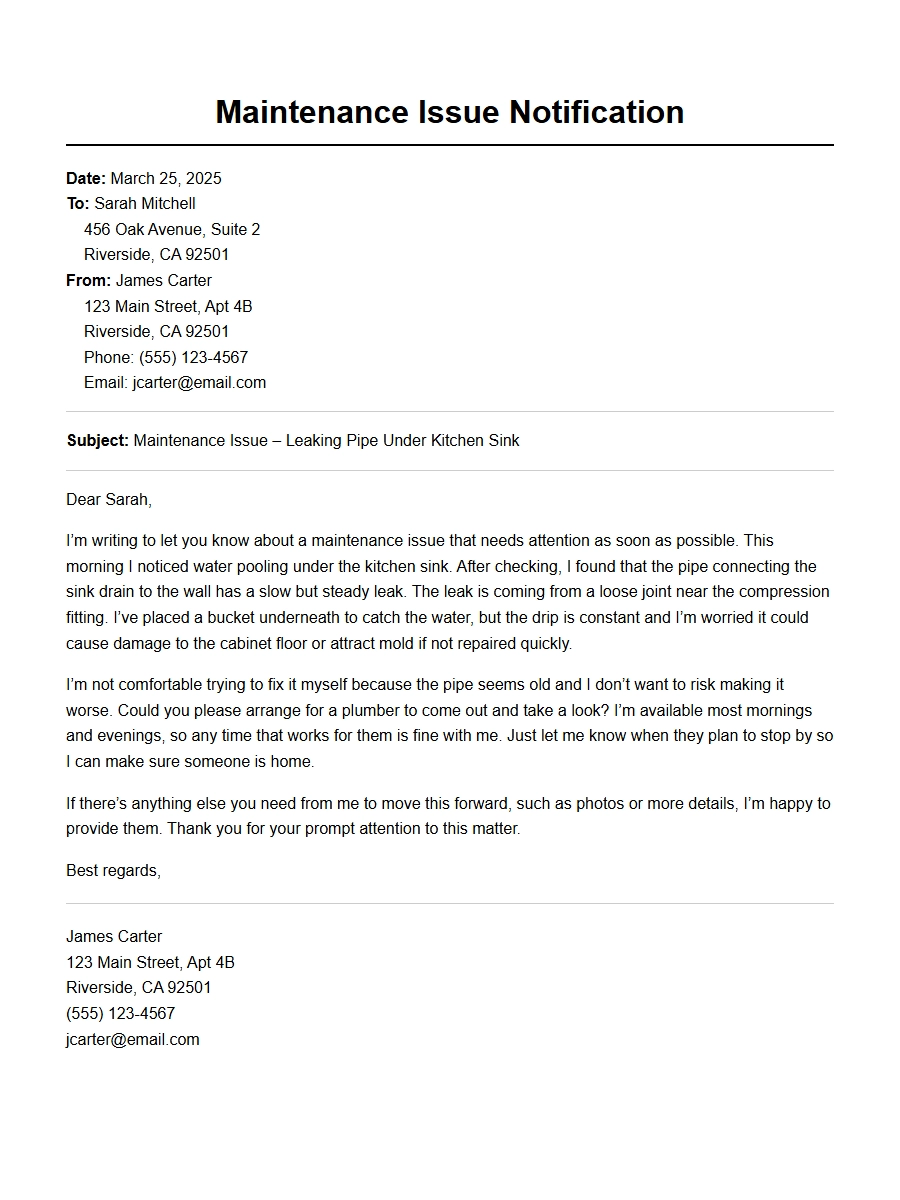
Dear Landlord,
I am writing to notify you of an urgent water leak in the bathroom of Apartment 3B. This morning, I noticed water pooling around the base of the toilet and running down the wall behind it. The leak has already dampened a section of the floor and is worsening. I believe it requires immediate attention to prevent damage to the subfloor and potential mold growth.
Please arrange for a plumber to inspect and repair the leak as soon as possible. I am available most weekdays after 4 PM and all weekend. If you need to access the apartment, please give me at least a few hours' notice. You can reach me at (555) 123-4567 or by email.
Thank you for your prompt attention to this matter.
Sincerely, Jane Tenant
Broken Heating System During Winter
Dear Property Manager,
I am writing to report that the heating system in my unit (Apt 2A) has stopped working. It is currently 28°F outside, and the indoor temperature has dropped to 55°F despite my setting the thermostat to 72°F. The system blows cold air only, and the pilot light appears to be out. This issue began yesterday evening.
Since this is a critical health and safety concern, I request a heating technician visit today. I will be home all day. Please call me at (555) 987-6543 to confirm the service appointment. Below is a summary of the problem:
Type of issue: Furnace not producing heat
Date first noticed: January 10, 2025
Thermostat setting: 72°F, actual temp 55°F
Other affected units: Unknown, but neighbor reports similar issue
Thank you for addressing this promptly.
Best regards, Mike S.
Non-Functional Dishwasher Request
To: Landlord / Maintenance Dept.
I am writing to inform you that the dishwasher in our rental unit (123 Maple St, Apt 4) has stopped working. It does not fill with water and makes a humming noise but won't start the cycle. The unit is a GE model, approximately 3 years old. This issue started last Tuesday after a regular load.
We request a repair or replacement. Could you please send a technician to diagnose the problem? We are available evenings after 6 PM and all day Saturday. If repair is not feasible, we understand a replacement may be necessary. Please let me know the next steps.
Below is a quick reference for your records:
Item
Details
Unit
GE Dishwasher (Model GDF510PSJ0SS)
Issue
No water intake, humming sound
Date reported
January 15, 2025
Preferred contact
Email: tenant@email.com
Thanks for your help.
Respectfully, Pat L.
Persistent Mold Issue in Bedroom
Dear Landlord,
I want to notify you about a recurring mold problem in the corner of my bedroom ceiling. Despite cleaning it twice, the black spots return within a few weeks. The area is near an exterior wall, and I suspect there is a moisture leak from the roof or inadequate ventilation. The mold is approximately 2 square feet and has a musty smell. I am concerned about health effects.
Please have someone inspect the roof and attic above my unit and assess the source of moisture. Additionally, I recommend a professional mold remediation to ensure it is properly removed. I can be reached at (555) 222-3333 to schedule access. I work from home so almost always available.
I look forward to your prompt response, as this is affecting my living conditions.
Sincerely, Alex R.
Faulty Electrical Outlet in Living Room
Dear Maintenance Supervisor,
I am writing to report a faulty electrical outlet in the living room of Apartment 5C. The outlet on the north wall no longer holds plugs securely – they fall out easily. Additionally, when I plugged in a lamp last night, there was a brief spark and the outlet emitted a burning smell. I immediately unplugged everything and turned off the circuit breaker for safety.
This is a potential fire hazard, so I request a licensed electrician inspect and replace the outlet as soon as possible. I am home weekday mornings. Please contact me at (555) 444-5678 to arrange a visit. Thank you.
Below are the outlet details:
Location: Living room, north wall, right socket
Issue: Loose plug, sparking, burning odor
Date discovered: February 3, 2025
Breaker status: Turned off for safety
Kind regards, Jordan K.
Stuck Window Unable to Close
To the Landlord,
This letter is to notify you that the bedroom window in my unit (Apt 7B) is stuck partially open and will not close. The window is a double-hung vinyl type. The left side has slid down about 4 inches and is jammed. I have tried lifting and pushing from both sides, but it won't budge. This is a security concern because it remains open, and with winter temperatures, the room is very cold.
Please arrange for a repair person to fix or replace the window mechanism. I am available for entry on Monday, Wednesday, or Friday after 2 PM. My contact number is (555) 666-7890. I would appreciate a timely resolution.
Thank you for your attention.
Sincerely, Taylor M.
Pest Infestation in Kitchen
Dear Landlord,
I am writing to report a serious pest infestation in my kitchen. Over the past week, I have seen cockroaches (small brown ones) near the sink, behind the refrigerator, and in the pantry. I have sealed all food containers and cleaned thoroughly, but they keep coming. I believe there may be a nest behind the dishwasher or in the wall crevices. This is unsanitary and stressful.
I request a professional exterminator to treat the unit as soon as possible. I also ask that adjacent units be inspected to prevent the infestation from spreading. I am available Tuesday or Thursday evenings. Please call or text me at (555) 888-1234 to schedule.
Below is a log of sightings:
Date
Time
Location
# Seen
Feb 10
8 PM
Kitchen counter
2
Feb 11
7 AM
Behind fridge
1
Feb 12
9 PM
Pantry shelf
3
Thank you for your prompt action.
Best, Sam D.
Garbage Disposal Not Working
Dear Landlord,
I'm writing to let you know that the garbage disposal in my kitchen sink (Apt 6D) has stopped working. When I flip the switch, I hear only a faint hum and the unit does not spin. I checked the reset button underneath and pressed it, but no change. There is no visible jam or foreign object. The disposal is a Waste King model, about 4 years old.
Please send a maintenance person to repair or replace it. I would prefer a visit between 10 AM and 2 PM on weekdays. You can reach me at (555) 777-4321. Thank you.
Summary:
Issue: Motor hums but doesn't grind; likely seized motor
Model: Waste King L-111
Date reported: March 2, 2025
Regards, Chris W.
Cracked Ceiling from Roof Leak
Dear Property Manager,
I am writing to notify you of a cracked ceiling in the hallway of my apartment (Unit 9A). A large crack about 3 feet long has appeared, and the paint is bubbling. There is also a brown water stain indicating a leak from the roof or the unit above. I noticed this after heavy rain last weekend. The crack is expanding, and I am concerned about plaster falling.
Please have a roofer and an interior repair person inspect the damage. I am home every day after 3 PM. Please contact me at (555) 321-9876 to coordinate. I appreciate your attention to this matter.
Below is a damage description:
Feature
Details
Location
Hallway ceiling, near light fixture
Dimensions
36 inches x 1/4 inch wide crack
Stain
Brown, approx 12-inch diameter
Active leak
Yes, during rain
Thank you for your prompt action to prevent further damage.
Sincerely, Morgan H.
Loose Stair Railing Safety Hazard
To the Landlord,
I want to bring to your attention a safety hazard: the wooden handrail on the staircase leading to the second floor (near my apartment, Unit 1A) is loose. The railing moves significantly when grasped, and the bracket on the wall side is pulling away from the drywall. This poses a fall risk, especially for elderly residents or children.
I request an immediate repair. The railing needs to be re-secured with proper anchors. Please have a handyman or contractor come to fix it. I can show you the exact spot if needed. My phone number is (555) 456-7890. Thank you for ensuring the safety of the building.
Details:
Location: Common staircase, between first and second floor
 Thanking a Mentor for Guidance: Sample Messages
 Expressing Gratitude: Handwritten Letter Example
 Expressing Thanks in a Formal Personal Letter
 Thank You Letter Examples for Family Holiday Gifts
 Sample Thank You Letter for Support
 How to Write a Personal Thank-You Note After an Interview