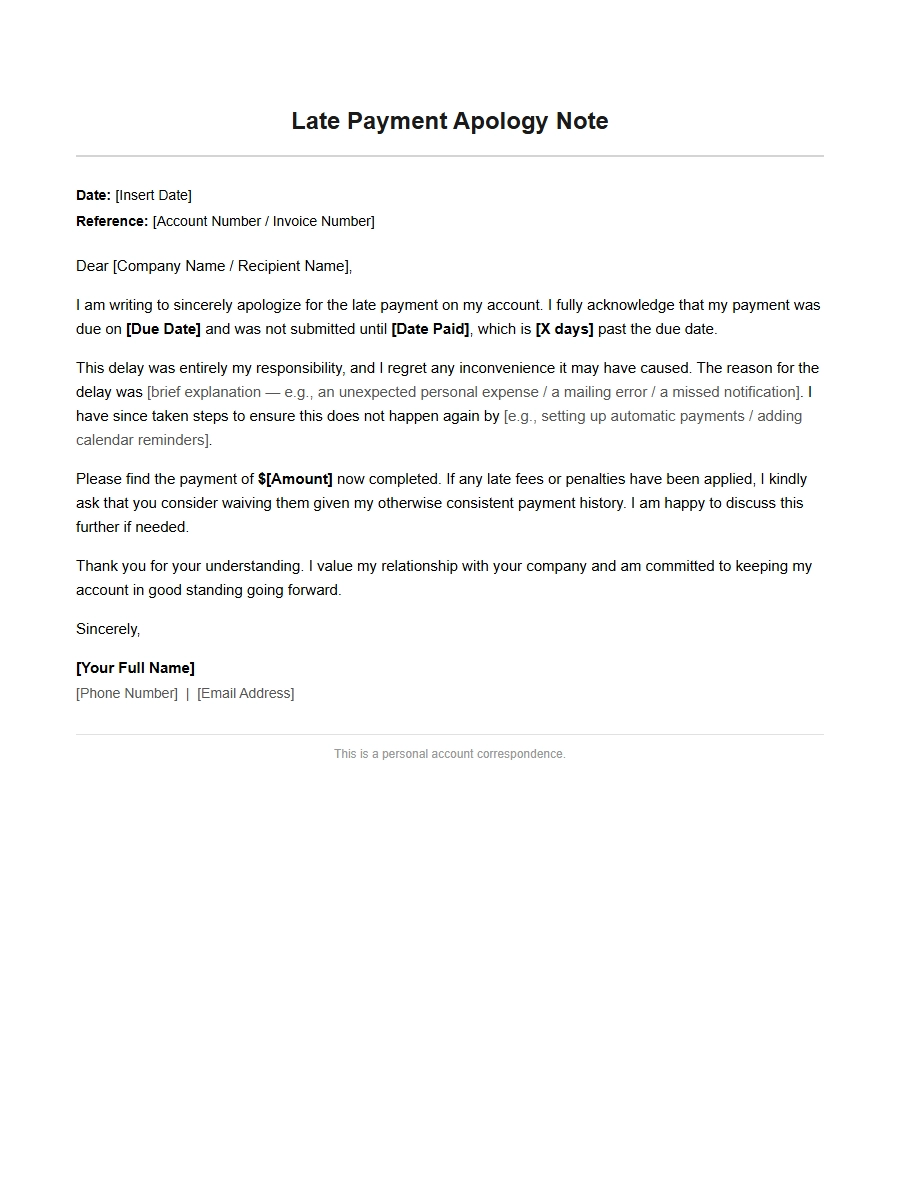
Apology Letter for Late Payment on Personal Account
Why writing an apology for late payment feels so awkward
You realize you forgot to send that check for the personal loan your aunt gave you. Or maybe your rent payment went through three days late, and now you need to explain it to your landlord. Standing in front of a blank screen, you freeze. You know you messed up, but how do you put that into words without sounding careless or making excuses?
That anxiety is normal. A late payment on a personal account—whether it's a family loan, a shared utility bill, or an informal credit arrangement—creates a small crack in trust. The right apology letter can repair that crack. The wrong one can make things worse.
Using a sample is not cheating
You might feel like copying a template is lazy. But it's actually a smart way to start. A good letter template gives you the structure and tone you need while leaving space for your specific situation. You're not copying someone else's life—you're borrowing a framework that works. Think of it like using a recipe when you cook dinner. The ingredients are yours, but the method is proven.
Samples provide key phrases for professional correspondence without forcing you to reinvent letter writing etiquette from scratch. They show you how to open, apologize, explain (without over-explaining), and promise to fix the issue. Then you personalize the details.
When you need an apology for late payment personal account note
This note is different from a formal business letter. Personal accounts involve relationships—family, friends, neighbors, or small landlords. The stakes are less about credit scores and more about feelings. You might need one for:
An informal loan from a relative
A late rent payment to a private landlord
A shared expense you covered late (like a group trip or family gift)
A missed payment on a personal credit arrangement with a friend
Each scenario requires a slightly different tone. A note to your mom can be warmer than one to a landlord you barely know. But both need sincerity and a concrete plan to make things right.
How to adapt a sample without sounding fake
Start by picking a sample that matches the relationship. If the sample uses "Dear [Name]" and a formal salutation, but you normally call your cousin by a nickname, adjust the salutation and closing. A letterhead design isn't necessary for a personal note—handwriting or a plain email works fine. But if you're sending a printed letter, keep the letter structure clean: date, salutation, body, closing, signature.
Then rewrite the opening paragraph in your own voice. The sample might say "I am writing to sincerely apologize for the delay in my payment." You could say, "I'm sorry this payment is late. I didn't plan it that way, and I feel terrible about it." The difference is tone in writing—one is formal, the other feels human. Pick what fits your relationship.
Don't turn the explanation into a long excuse. A sentence like "I had an unexpected expense last month" is honest. A paragraph about every obstacle you faced feels defensive. End with a clear next step: "I will transfer the full amount by Friday and add $10 to cover late fees." That shows accountability.
Common mistakes that ruin a good apology
One huge mistake is using an outdated salutation like "To Whom It May Concern" for someone you know. It feels cold and impersonal. Another is forgetting to proofread the letter before sending. A typo in the amount or date looks careless, especially when you're apologizing for a careless error. Double-check the details.
Also avoid writing the apology in a digital letter format that feels too casual. If you're emailing, use a clear subject line like "Apology for late payment – personal account." Don't hide the purpose in a vague "Hello" subject. And if you're printing it, skip the fancy business letter format—a simple paper with your name and date is enough.
Some people send a follow-up apology but then forget to follow through on the payment plan. That destroys trust faster than the original lateness. Your words only matter if your actions match.
Where to find the right sample for your situation
A general search for "apology letter" can give you dozens of results, but many are too stiff or too vague. Look for samples written specifically for personal accounts, not corporate debt. You might also find useful patterns in related personal letters that share a similar tone. For example, if you're writing to apologize to a neighbor or acquaintance, the same care you'd use when welcoming a new neighborhood resident applies—politeness and warmth without overfamiliarity.
If the late payment involves something like a shared medical bill, you might borrow the respectful tone from a letter requesting records from a previous healthcare provider. The goal is the same: clear, respectful communication.
For deeper apologies that need to rebuild trust, the structure of a repairing relationship through written apology letter can guide you—even if your issue is financial, the relational aspect matters just as much. And if the late payment is related to a missed appointment or service, a scheduling appointment via written request shows how to be direct about next steps while staying polite.
Finally, if your late payment apology is tied to a loss or hardship, consider the empathy shown in a condolences message for loss of a parent. Not the same situation, but the skill of writing with genuine feeling transfers directly.
Your apology letter is a step, not the final answer
Think of the sample as a starting point. You're not supposed to copy it perfectly—you're supposed to use it to get out of your own head and onto the page. The first time you write one of these, it might take twenty minutes. The second time, five. Practice helps you find your voice faster.
The best apology letters feel both professional and personal. They show respect for the relationship and honesty about the mistake. That balance comes from knowing when to follow the template and when to break away. Use the sample, but make it yours.
Useful Writing Samples
Apology Letter for Late Payment on Personal Account
Apology for Late Credit Card Payment
Date: March 15, 2025
Account: Visa Platinum ****1234
Dear Customer Service Team,
I am writing to sincerely apologize for the late payment on my credit card account. The payment of $250.00 was due on March 1, 2025, but due to a recent unexpected medical expense, I was unable to make the transfer on time. I understand that this lapse may incur a late fee and affect my credit history.
I have now processed the full payment via online banking today. Please find the details below:
Item
Details
Amount Paid
$250.00
Payment Date
March 15, 2025
Confirmation
#PAY123456
I kindly request that you waive the late fee this one time as a gesture of goodwill. I have been a loyal customer for over five years and always strive to pay on time. I have set up automatic reminders to prevent this from happening again.
Thank you for your understanding. I truly value your service.
Sincerely, John M. Doe
Apology for Late Personal Loan Installment
Date: April 2, 2025
Loan Account: PLN-987654
Dear Loan Officer,
I am writing to express my deep regret for missing the March installment on my personal loan. The payment of $320.00 was due on March 20, 2025, but I overlooked the date due to a family emergency.
I have now remitted the overdue amount along with the current month’s installment. Here is a summary:
March overdue: $320.00
April installment: $320.00
Total paid: $640.00
Payment method: Bank transfer (ref #LOAN-567890)
Please update my account to reflect the payments and confirm if any late charges have been applied. If so, I would appreciate knowing how I can settle them promptly. I am arranging automatic monthly transfers to avoid future lapses.
I apologize for any inconvenience this may have caused and thank you for your continued support.
Yours faithfully, Sarah L. Johnson
Apology for Late Rent Payment
Date: May 5, 2025
Property: 123 Oak Street, Apt 4B
Dear Mr. Anderson,
I am writing to sincerely apologize for the late payment of this month’s rent. The amount of $1,200.00 was due on May 1, 2025, but I encountered an unexpected car repair that delayed my payroll deposit.
I have now deposited the full rent plus a late fee of $60.00 into your account. Details:
Description
Amount
Rent for May
$1,200.00
Late fee (as per lease)
$60.00
Total
$1,260.00
I am truly sorry for the delay and any stress it may have caused. Please let me know if you received the payment. Going forward, I will keep a buffer fund to ensure rent is always paid on time.
Thank you for your patience.
Best regards, Emily T. Brooks
Apology for Late Utility Bill Payment
Date: June 10, 2025
Account Number: UTIL-334455
Dear Billing Department,
I am writing to apologize for the late payment of my electricity bill. The invoice for $89.75 was due on May 28, 2025, but I was out of town and forgot to schedule the payment online.
I have now paid the bill plus the late penalty. Below are the details:
Original amount: $89.75
Late penalty: $4.50
Total paid: $94.25
Payment confirmation: #UTIL-20250610-001
I have set a recurring payment reminder in my calendar to ensure this does not happen again. Please confirm that my account is now current and that no service interruption will occur.
Thank you for your understanding. I appreciate your reliable service.
Sincerely, Michael G. Chen
Apology for Late Phone Bill Payment
Date: July 3, 2025
Account: Mobile 555-0198
Dear MobileCare Support,
I am writing to apologize for the delay in paying my monthly phone bill. The amount of $65.00 was due on June 25, 2025, but I experienced a technical issue with the auto-pay system.
I have manually settled the balance today. Here is a summary:
Item
Details
June bill
$65.00
Late fee applied
$5.00
Payment method
Credit card
Reference
MBLL-20250703
I have updated my payment settings and verified that auto-pay is now functional. Please restore any restricted features and reassure me that my service will remain active. I apologize for the inconvenience.
Thank you for your prompt attention.
Best, Priya K. Singh
Apology for Late Subscription Fee Payment
Date: August 12, 2025
Subscription: Premium Streaming Plan
Dear Billing Team,
I am writing to apologize for the late renewal of my streaming subscription. The annual fee of $179.00 was due on July 31, 2025, but I mistakenly thought it would be deducted automatically from my card, which had expired.
I have now updated my payment method and processed the payment. Details:
Subscription: Premium Plan (annual)
Amount due: $179.00
Late fee: $0 (kindly requested waiver)
Payment date: August 12, 2025
I would be grateful if you could reactivate my account immediately. I have also enabled renewal reminders to avoid this issue next year. Thank you for your patience.
Sincerely, David R. Martinez
Apology for Late Medical Bill Payment
Date: September 5, 2025
Patient Account: MED-772233
Dear Billing Office,
I am writing to sincerely apologize for the late payment of my recent medical bill. The statement for $345.00 was issued on August 10, 2025, with a due date of August 25, 2025. Unfortunately, I misplaced the invoice and only discovered it yesterday.
I have now sent the full amount via check (enclosed) and also included a small extra payment of $10.00 to cover any late processing fees. Details:
Description
Amount
Medical services (Aug 2025)
$345.00
Additional courtesy payment
$10.00
Total enclosed
$355.00
Please confirm receipt and that my account is up to date. I apologize for any extra administrative work caused by my oversight.
Thank you for your understanding.
Best regards, Katherine L. Davis
Apology for Late Tuition Fee Payment
Date: October 1, 2025
Student ID: STU-20230456
Dear Finance Office,
I am writing to apologize for the delay in paying my fall semester tuition. The balance of $2,500.00 was due on September 15, 2025, but I was awaiting loan disbursement from my bank.
The funds have now been transferred. Below is the payment breakdown:
Tuition (Fall 2025): $2,500.00
Late registration fee (as per policy): $50.00
Total paid: $2,550.00
Transaction ID: TUITION-20251001
I kindly request that any late penalty be applied as per the university policy, and I assure you that future payments will be made on time. Please clear my hold and allow me to register for courses.
Thank you for your cooperation.
Sincerely, Alexis N. Rodriguez
Apology for Late Insurance Premium Payment
Date: November 8, 2025
Policy Number: INS-88473B
Dear Customer Service,
I am writing to apologize for the late payment of my car insurance premium. The quarterly installment of $215.00 was due on October 31, 2025, but I was hospitalized and unable to manage my finances.
I have now paid the amount via online transfer. Please find details below:
Description
Amount
Premium (Q4 2025)
$215.00
Late fee (if applicable)
$15.00
Total
$230.00
I request that my policy not be cancelled and that coverage remain continuous. I am happy to pay any extra fees. I will set up auto-pay to avoid future delays.
Thank you for your kind understanding.
Yours faithfully, Robert J. Wilson
Apology for Late Payment on Personal Account Note
Date: December 20, 2025
Note ID: PER-6789-10
Dear Lender,
I am writing to apologize for the late payment on the personal promissory note I signed with you. The installment of $150.00 was due on December 5, 2025, but a family medical emergency depleted my available funds.
I have now made the payment along with a small late fee. Here is the record:
Original amount due: $150.00
Late fee (agreed 5%): $7.50
Total paid: $157.50
Method: Cash deposit (receipt #10987)
I deeply value our relationship and the trust you placed in me. I am working extra hours to ensure remaining payments are on schedule. Please let me know if you received the funds or if any additional documentation is needed.
 Thanking a Mentor for Guidance: Sample Messages
 Expressing Gratitude: Handwritten Letter Example
 Expressing Thanks in a Formal Personal Letter
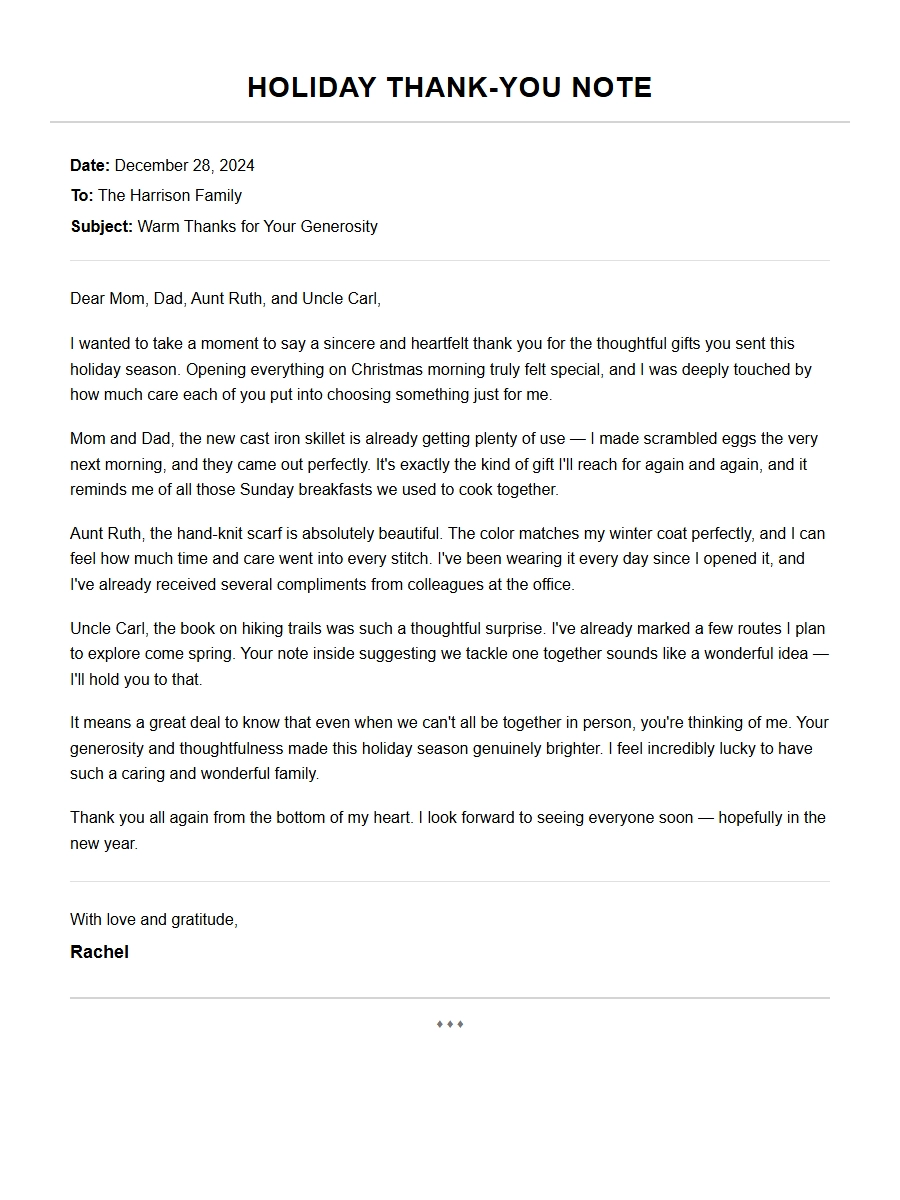 Thank You Letter Examples for Family Holiday Gifts
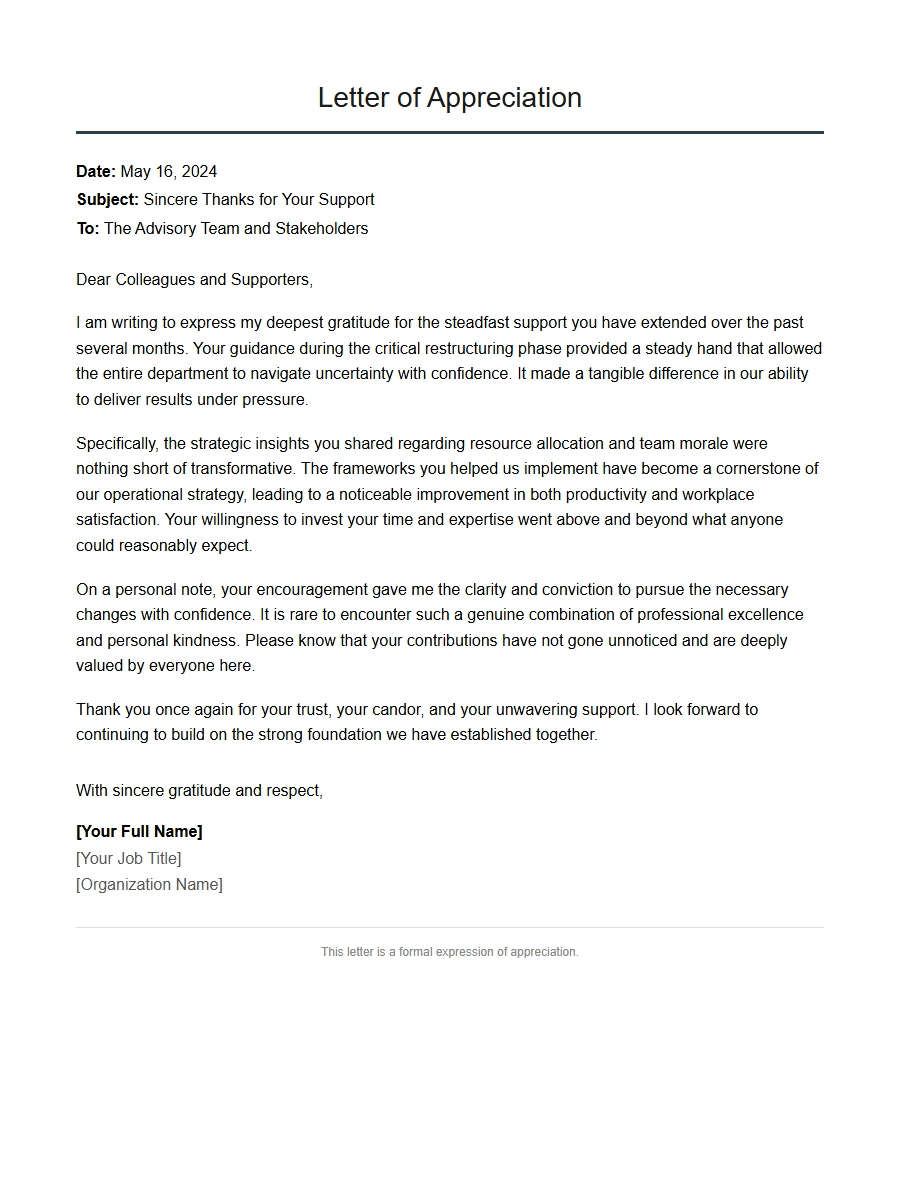 Sample Thank You Letter for Support
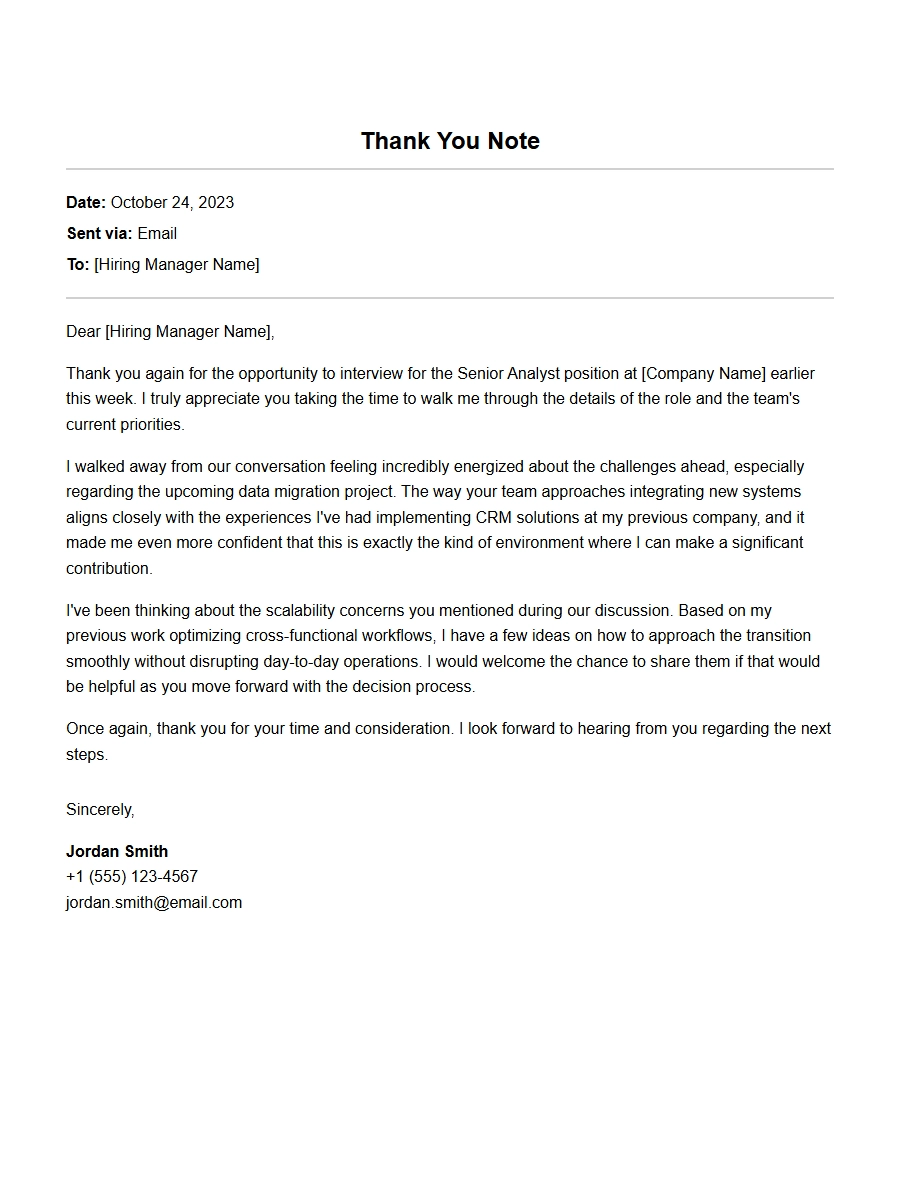 How to Write a Personal Thank-You Note After an Interview