Condolence Message for Loss of Parent: Free Sample
You need to send a condolence note for someone who lost a parent, but the words just won’t come. That blank page feels heavier than it should. It’s not that you don’t care—it’s that you care too much to get it wrong. The right sample can turn that frozen moment into a warm, respectful message in minutes.
Why using a condolence letter sample isn’t cheating
Writing a sympathy message from scratch is hard, especially when you’re already thinking about the person grieving. A good sample gives you a structure that works: a respectful opening, a heartfelt middle, and a closing that leaves room for comfort. It’s not a crutch—it’s a starting point that saves you from second-guessing every sentence. You still bring the personal details, the memory that was yours alone, and the tone that fits your relationship.
In fact, most professional correspondence—whether it’s a resignation letter sample or a letter of recommendation—starts the same way. You find a solid template, then adapt it. A condolence message follows the same logic. You just need a structure that holds the weight of the moment.
Category: Personal Letters – This type of note falls under personal correspondence, much like a letter of apology or a letter offering help to a neighbor. The key difference is the emotional weight and the need for genuine empathy.
Where to start: choosing the right sample for loss of a parent
Think about your relationship with the grieving person. If you’re a close friend or family member, a semi-formal letter with a personal memory works well. If you’re a colleague or acquaintance, a more formal condolence message with a professional tone is appropriate. Look for samples that match that distance—too casual can feel dismissive, too stiff can feel cold.
Most samples follow a standard letter structure: a salutation (Dear [Name]), a sentence acknowledging the loss, a brief memory or quality of the parent, an offer of support, and a respectful closing. That’s the backbone. Your job is to fill in the parts that only you can write.
How to personalize a condolence message sample without losing your voice
Start by reading the sample aloud. Does it sound like you? If not, swap the bigger phrases for your natural speech. For example, change “I was deeply saddened to learn of your mother’s passing” to “I was so sorry to hear about your mom.” The meaning stays the same, but the tone feels more genuine.
One common mistake is using clichés like “she’s in a better place” or “time heals all wounds.” Even if you mean well, these can feel hollow. Instead, mention something specific: “I’ll always remember how your dad laughed at my terrible jokes during the barbecue.” That memory is yours, and it shows you saw the person, not just the role.
Don’t forget the salutation and closing
For a condolence letter, “Dear [Name]” is always safe. Avoid outdated salutations like “To whom it may concern” – that’s for business letters, not grief. For closing, “With deepest sympathy,” “Thinking of you,” or “With love” all work. Match the closing to how you normally speak to that person.
Common mistakes to avoid when writing a condolence note
One big error: trying to explain the loss or find a reason. You don’t need to make sense of it. Just acknowledge the pain and offer your presence. Another is ignoring the format. If you’re sending an email, keep the subject line simple (“Thinking of you”) and avoid long paragraphs. For a handwritten card, use a pen that won’t smudge and keep your handwriting legible. The tone in writing should match the medium – email can be slightly more conversational, but a card feels more permanent.
Always proofread your letter. A typo in a condolence note can feel careless, even if it isn’t. Read it twice, preferably after a short break. Ask someone you trust to glance at it if you’re unsure.
Tailoring the opening paragraph to feel genuine
The first sentence is the hardest. Don’t start with “I’m sorry for your loss” – that’s so common it becomes white noise. Instead, try: “I’ve been thinking about you ever since I heard about your father.” Then immediately follow with a specific thought or memory. That shows you’ve already put effort in, not just copied a formula.
If you’re writing for someone you don’t know well, keep it simpler: “I was so sorry to learn of your mother’s passing. Please know I’m thinking of you and your family.” That’s enough. You don’t need a long story; sincerity comes from brevity.
Using the sample as a springboard, not a script
A sample gives you a safe framework, but the best condolence messages feel both professional and personal. Read it, adapt it, then set it aside. Write your own version from memory. Then compare – you’ll probably keep the structure but use your own words. That’s the goal.
If you’re writing multiple notes (say, for a family), resist the urge to copy-paste. Each recipient deserves a slightly different message. You can reuse the same structure, but change the memory or the offer of help.
For more guidance on writing heartfelt personal letters, you might find our article on repairing a relationship through a written apology useful – it covers the same principles of tone and authenticity. Or, if you’re helping a neighbor who recently lost a parent, our note on offering assistance with snow removal shows how to blend practical help with empathy.
Remember: the reader will appreciate that you took the time, not that you wrote a perfect letter. Use the sample to get started, then trust your own heart to finish it. With a little practice, the process becomes faster and the words come easier.
Samples You Can Use
Condolence Message for Loss of Parent: Free Sample
To a Colleague
Dear [Colleague's Name],
I was deeply saddened to learn of the passing of your [mother/father]. Please accept my heartfelt condolences during this difficult time. I know how close you were, and I can only imagine the depth of your loss.
While I never had the privilege of meeting your parent, the way you spoke about them always conveyed warmth and admiration. Their legacy of kindness and strength clearly lives on in you.
If there is anything I can do to support you—whether covering a meeting, helping with a project, or simply being a listening ear—please do not hesitate to reach out. You are in my thoughts and prayers.
With sincere sympathy, [Your Name]
For a Close Friend
Dearest [Friend's Name],
I am so sorry for the loss of your [father/mother]. Words cannot express how heartbroken I am for you. Your parent was such a wonderful person, and I feel fortunate to have known them.
I will always cherish the memories we shared together—the laughter at family dinners, the wise advice they gave, and the unconditional love they showed to everyone around them. They were truly one of a kind.
Grief is a heavy burden, but please know that you do not carry it alone. I am here for you, day or night, to talk, to cry, or to just sit in silence. Let me know if you need help with anything practical—meals, errands, or childcare. You are loved.
All my love, [Your Name]
To a Neighbor
Dear [Neighbor's Name],
We were so sorry to hear about the passing of your [mother/father]. Please accept our deepest sympathy. Your parent was a kind and friendly presence in our neighborhood, and we will miss seeing them in the garden or chatting on the street.
Losing a parent is never easy, and we want you to know that we are thinking of you during this time. If you need someone to water the plants, collect the mail, or just have a cup of tea with, we are right next door.
We have also arranged a small meal delivery on Tuesday—please do not feel you need to prepare anything. Just take the time you need to grieve and remember the wonderful person they were.
With warm sympathy, [Your Name] and Family
To a Relative (Aunt/Uncle)
Dear Aunt [Name] / Uncle [Name],
I was so saddened to hear about the loss of my beloved [grandparent]. They were a pillar of our family, and their love and wisdom have shaped us all. I will never forget the summers we spent together—the stories, the laughter, and the simple joy of being in their presence.
Please know that I am thinking of you and sending all my love. Grief is a journey, and we will walk it together as a family. I have already spoken with cousins about organizing a memorial gathering next month to celebrate their life.
For now, please take care of yourselves. I am here to help with anything you need—whether it is sorting through photo albums, running errands, or just sitting with you in quiet remembrance.
With love and deepest sympathy, [Your Name]
For a Child's Friend's Parent
Dear [Parent's Name],
I was so sorry to hear about the loss of your [mother/father]. Our children have been such good friends, and I know how much your family means to you. Please accept my heartfelt condolences.
I remember how your parent would always wave to the kids from the porch and ask about school—they were such a warm presence. Their love for your family was evident in everything they did.
If you need help with carpool, playdates, or anything at all, please let me know. We are happy to have [child's name] over for dinner or a playdate whenever you need a moment to breathe or to take care of arrangements.
You and your family are in our hearts. Sending you strength and peace.
With sympathy, [Your Name]
To a Boss or Manager
Dear [Boss's Name],
I was deeply sorry to learn of the passing of your [mother/father]. Please accept my sincere condolences. I understand how profoundly this loss must affect you, and I want you to know that the entire team is thinking of you.
Your parent raised a remarkable person—your integrity, compassion, and dedication are a testament to their influence. We have all benefited from your leadership, and we are grateful for the example they set.
Please do not worry about work during this time. We have everything covered. Take as much time as you need to be with your family and to grieve. If there is any specific support we can offer—whether covering your schedule or handling urgent matters—just say the word.
With deepest sympathy and respect, [Your Name] and the Team
Email to a Team Member
Dear [Team Member's Name],
I was so sorry to hear about the loss of your [father/mother]. On behalf of the whole team, I want to extend our deepest condolences. Your parent was clearly a wonderful person, and we are thinking of you during this difficult time.
We have put together a small gesture to honor their memory—a donation to [charity name] in their name, and a collection of cards and messages from everyone in the department. You will receive them later this week.
Please take all the time you need. We have redistributed your current tasks among the team, so there is no pressure to return until you are ready. If you need someone to talk to, or just want to share memories of your parent, we are here to listen.
With heartfelt sympathy, [Your Name] on behalf of [Team/Department Name]
Message with Memory Table
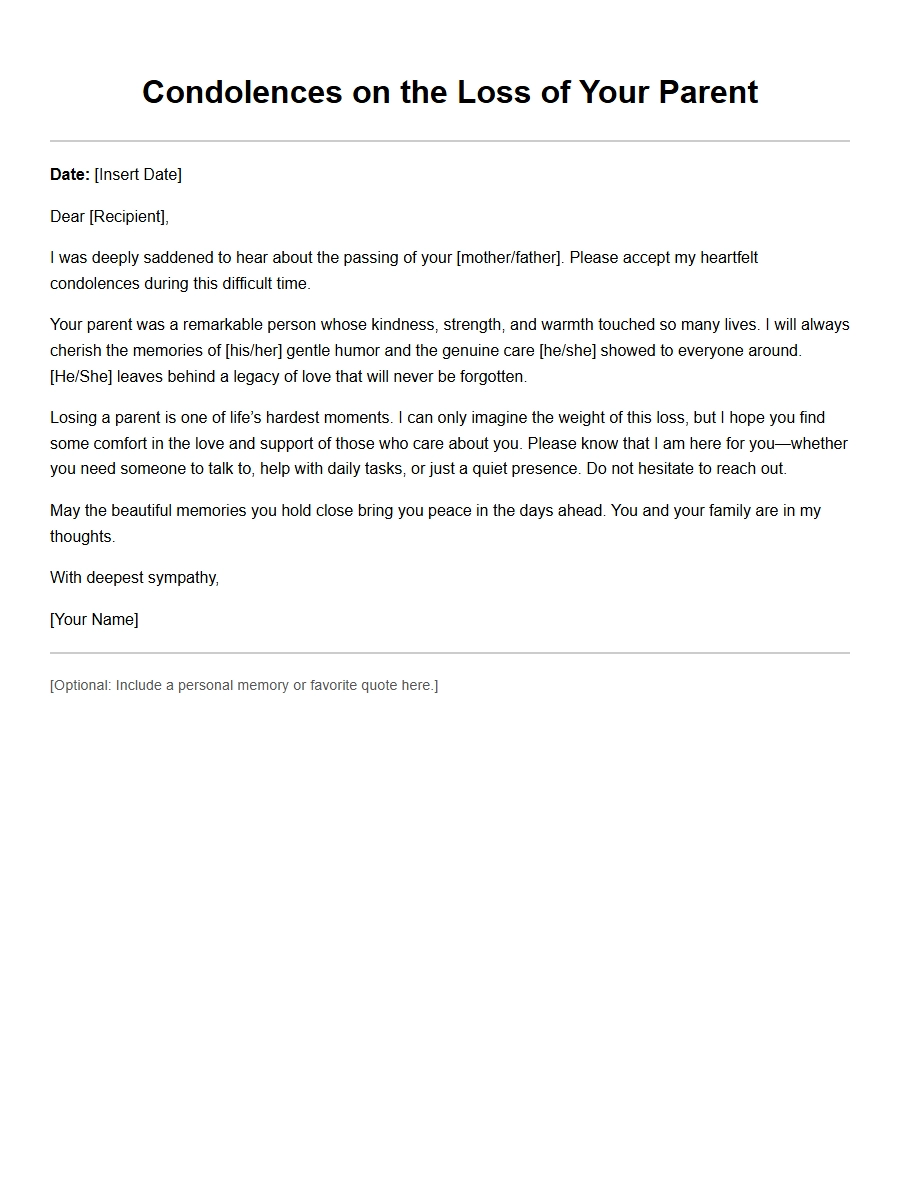
Dear [Name],
I was heartbroken to learn of your [mother/father]'s passing. They were such a special person, and I hold many precious memories of them. I wanted to share a few that I will always treasure:
Date
Memory
Summer 2018
Your parent taught me how to bake their famous apple pie—we laughed so hard when the crust fell apart!
Holiday 2020
They insisted on playing charades, even over video call. Their dramatic acting had us all in stitches.
Last March
We had a long conversation about gardening. I still use their tip for growing tomatoes.
Their kindness and humor touched so many lives. I am grateful for the time we had with them. Please let me know if you need anything—I am here for you.
With love and sympathy, [Your Name]
A Structured Condolence with Helpful Offer
Dear [Name],
I am so sorry for the loss of your [mother/father]. This is a time of great sorrow, and I want to offer my deepest sympathy and support. I know that practical help can be a comfort, so I have listed below what I can do for you—please feel free to take me up on any of it:
Meals: I can prepare and deliver dinner on any day of the week. Just tell me your preferences.
Errands: Grocery shopping, pharmacy runs, or picking up dry cleaning—I am free most afternoons.
Pet care: Happy to walk your dog or feed your cat while you attend to arrangements.
Children: Offer to pick up the kids from school or watch them for a few hours.
Company: I can come over just to sit with you, or we can go for a quiet walk.
Do not hesitate to call or text anytime. You are not alone. Your parent was a wonderful person, and their memory will live on in all of us who loved them.
With warm and sincere sympathy, [Your Name]
Brief Sympathy Card Message
Dear [Name],
Thinking of you in the sad time of losing your [mother/father]. I am so sorry for your loss. Your parent was a source of light and love, and I feel blessed to have known them.
I will always remember their gentle smile and the way they made everyone feel welcome. May the many happy memories bring you comfort in the days ahead.
Please know that I am here for you—whether you need a shoulder to cry on, a hand with daily tasks, or just a quiet moment of shared remembrance. You are in my heart.
 Thanking a Mentor for Guidance: Sample Messages
 Expressing Gratitude: Handwritten Letter Example
 Expressing Thanks in a Formal Personal Letter
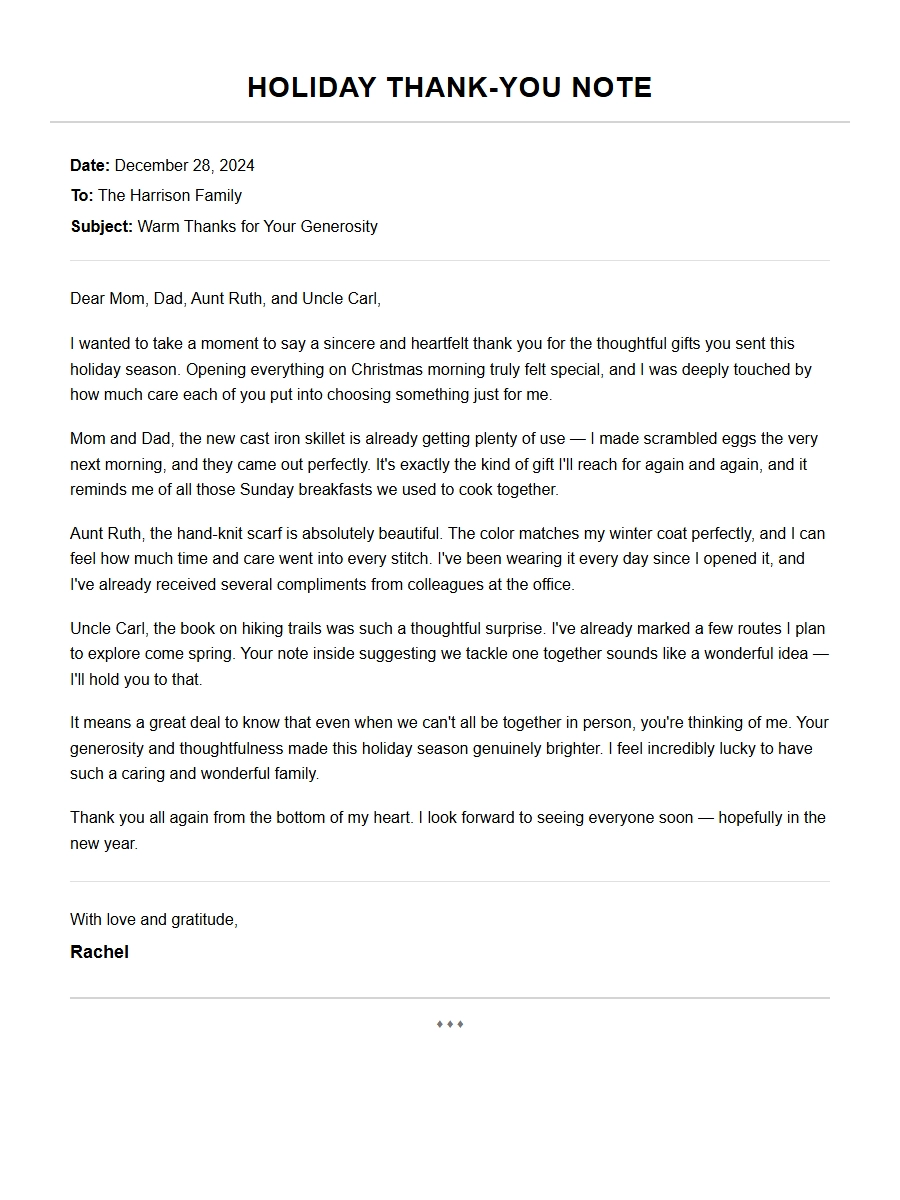 Thank You Letter Examples for Family Holiday Gifts
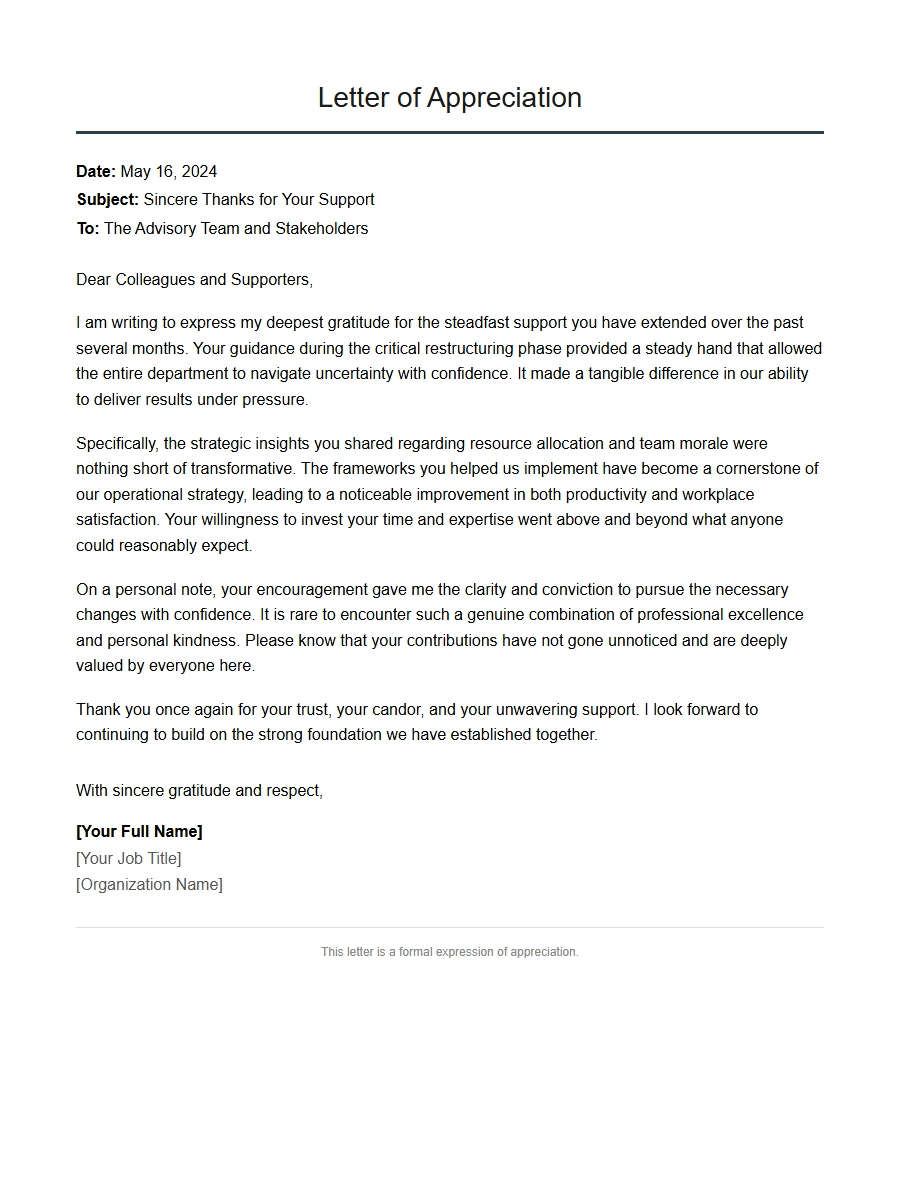 Sample Thank You Letter for Support
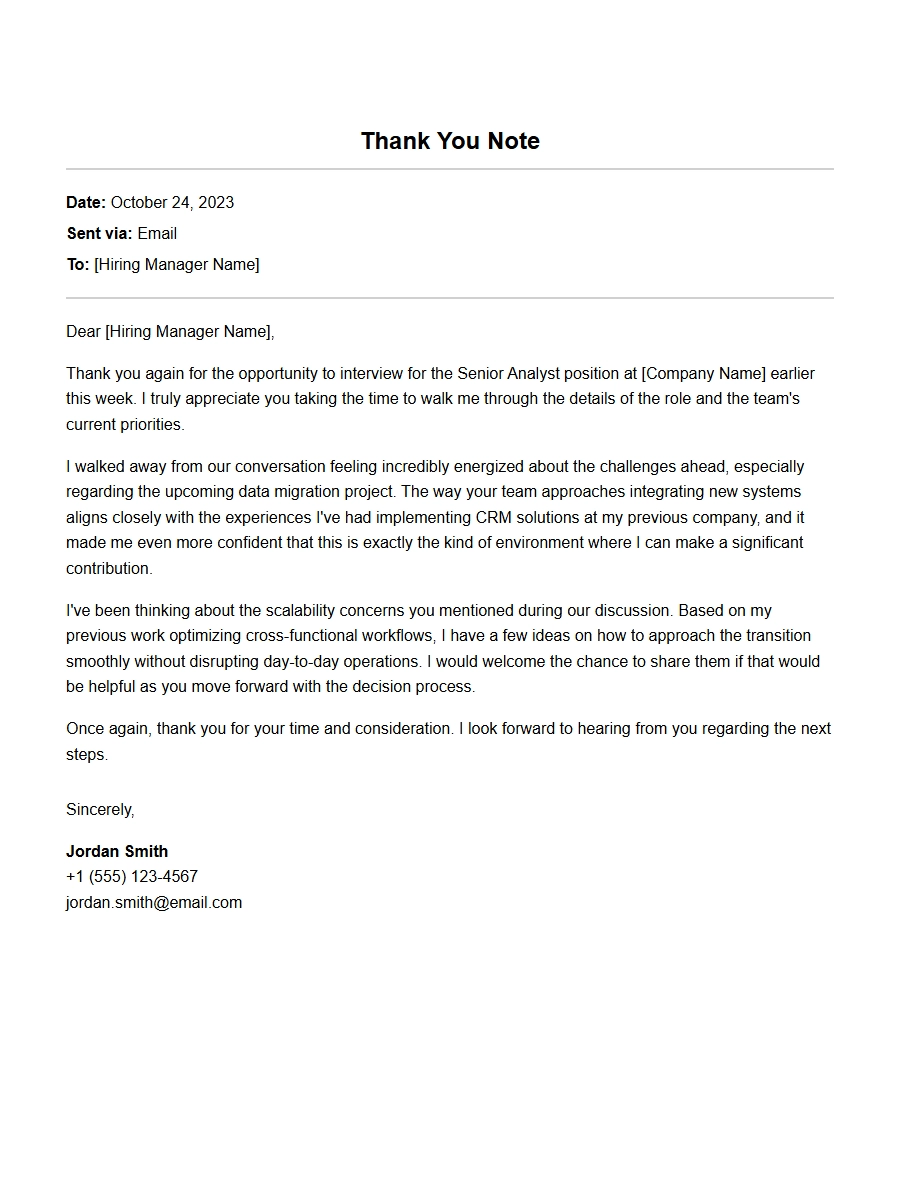 How to Write a Personal Thank-You Note After an Interview