Staring at a blank page when you need to write a letter sharing a memory of someone who has passed away can feel paralyzing. You want to honor them, comfort the recipient, and not mess it up. The right sample turns that anxiety into a confident, polished draft in minutes. It’s not cheating—it’s working smart.
Using a letter template gives you a structure you can lean on. You don’t have to invent the format or worry about letter writing etiquette from scratch. Samples provide the tone in writing that works for condolence letters—respectful, warm, and personal—while leaving plenty of room for your own voice. You’ll save time and avoid sounding stiff or robotic.
Category: Condolence Letters
Pick the right sample for your situation
Not every memory letter should sound the same. If you’re writing to a close family member, you can be more informal and share a funny story. For a colleague or acquaintance, you’ll want a more professional correspondence tone—sympathetic but restrained. A good sample will show you the letter structure for both cases: how to open, what to include in the middle, and how to close warmly. Always match the sample to the relationship you had with the deceased and the recipient.
Make the sample yours without losing your voice
Once you’ve chosen a template, don’t just fill in the blanks like a robot. Read it aloud. Does it sound like you? Change the salutation and closing to something natural. If you always called the person “Grandpa,” use that instead of “grandfather.” Swap generic phrases like “fond memories” with a specific moment: “I can still see him teaching me to bait a hook on that rusty dock.” That personal detail makes the letter unforgettable.
A quick tip: Tailor the opening paragraph to grab the recipient’s heart. Start with a shared memory, not a bland “I was saddened to hear.” For example: “John and I once spent an entire rainy afternoon trying to fix his old lawnmower—we never did get it running, but we laughed until we cried.” That hooks them immediately.
Avoid these common mistakes
Even with a good sample, it’s easy to slip up. One frequent error is using outdated salutations like “To Whom It May Concern” for a condolence letter. That’s too cold. Stick with “Dear [Name]” or just the person’s first name if you’re close. Another mistake: ignoring digital letter format when sending by email. An email condolence should have a clear subject line (e.g., “Thinking of you and remembering your dad”) and a simple signature—no fancy letterhead design needed. If you’re mailing a printed letter, use quality paper and handwrite the envelope if your handwriting is legible.
Don’t forget to proofread your letter. A typo in a memory letter can feel disrespectful. Read it once, then read it aloud again. Ask someone you trust to check it if you’re unsure.
When writing for different relationships or settings
If you knew the deceased very well, your letter can be longer and more detailed. You might even want to read tips on writing when you knew them well to avoid oversharing or becoming too emotional. But if you’re writing to a childhood friend’s family after years apart, keep the tone lighter and focus on the good times you shared. There are samples designed exactly for that—check out a sample letter for loss of a childhood friend to see how it’s done.
Maybe you weren’t able to attend the funeral or memorial. In that case, you’ll want to express regret without making the recipient feel guilty. A sample letter expressing regret over absence can show you the right words to say “I wish I could have been there” without adding pressure. And if the death happened in an office setting, the language needs to be professional yet compassionate. For that, see appropriate language for death in an office setting.
Finally, don’t forget the sign-off. A simple “With love and sympathy” or “Thinking of you” works. If you want more options, look at how to sign off a formal sympathy letter. There’s no single right way, but matching your closing to the tone of the letter makes it feel complete.
Use the sample as a springboard, not a crutch
The best memory letters feel both professional and personal. A sample gives you a safe place to start—but your own words and memories are what make the letter matter. Practice helps. The more you write, the faster you’ll get. Next time you need to share a memory, you’ll know exactly how to begin.
Useful Formats
How to Write a Condolence Letter Sharing a Memory
To a Childhood Friend's Family
Dear Mr. and Mrs. Jenkins,
I was deeply saddened to hear of Sarah's passing. I have so many fond memories of growing up together, but one stands out especially. Do you remember the summer we built that rickety treehouse in your backyard? Sarah was the mastermind—she insisted we needed a secret password and a flag. We spent hours collecting scrap wood and arguing over paint colors. She laughed so hard when I fell off the ladder that she nearly fell too. That moment captures her joyful, determined spirit perfectly.
Sarah was a true friend who made every ordinary day extraordinary. I cherish the memory of her teaching me to whistle using a blade of grass—never did get it right, but she never gave up trying. Her warmth and loyalty stayed with me long after we moved away.
Please know that I am thinking of your family and holding those sunny afternoons close to my heart. With deepest sympathy, Emily.
For a Beloved Grandfather
Dear Grandma and the family,
I am writing to share a memory of Grandpa that always makes me smile. Every Saturday morning, he would take me to the local bakery for a cinnamon roll. While we waited in line, he’d tell stories about his own childhood—how he once tried to catch a chicken with his bare hands and ended up chasing it into a neighbor’s garden. He always laughed at his own tales, his eyes crinkling at the corners.
One winter, he taught me to whittle a small boat from a block of pine. We sat on his workshop stools, shavings piling on the floor, while he patiently guided my clumsy fingers. He said, "Mistakes are just part of the carve." That boat still sits on my desk today, a little lopsided but priceless.
Grandpa’s gentle patience and laughter shaped me more than he ever knew. I am so grateful for those Saturday mornings and the whittling lessons. With love, your granddaughter.
For a Mentor Who Loved Gardening
Dear Mrs. Hartwell,
I was so sorry to hear about Professor Adams’s passing. He was an extraordinary mentor, but one memory I will always treasure happened outside the classroom. He invited a few of us to his home for a garden party. While everyone admired his roses, he pulled me aside to show me his favorite tomato plants. He spoke with such enthusiasm about soil pH and companion planting—not like a professor, but like a kid showing off a new toy.
He let me pick a ripe cherry tomato and pop it into my mouth. It was the sweetest I’d ever tasted. Then he laughed and said, "That's the secret: a little bit of love and a lot of patience." That advice has stayed with me in both gardening and in my career.
Professor Adams sowed seeds of curiosity in everyone he met. I will forever remember that sunny afternoon and his quiet, generous wisdom. With sincere condolences, your former student.
To a Colleague's Spouse
Dear Linda,
I was heartbroken to learn about Tom’s passing. He was not only a brilliant colleague but also a true friend. I recall our many late nights working on the Henderson project. Around midnight, Tom would always pull out a pack of gummy bears and insist we take a candy break. He’d tell the same lame joke every time, and we’d groan but end up laughing anyway.
One evening, our whole team got stuck in a brainstorming rut. Tom stood up, grabbed a marker, and started drawing ridiculous cartoons on the whiteboard—a cat in a spaceship, a dancing pencil. Within minutes, we were all laughing and ideas started flowing. That was Tom: he could lighten the heaviest room with his playful spirit.
I’ll miss his gummy bears and his silly doodles. But mostly, I’ll miss the way he made everyone feel included and valued. Please accept my deepest sympathies. With warm regards, your husband’s friend.
For a Neighbor Who Gave Advice
Dear the Lee Family,
I was so sad to learn of Mr. Lee’s passing. He was the kind of neighbor everyone wishes they had—always ready with a wave and a wise word. I’ll never forget the summer I moved into my first house. I was struggling to fix a leaky faucet, and Mr. Lee appeared at my door with a toolbox and a smile.
He spent two hours teaching me how to replace a washer, patiently explaining each step. As we worked, he told stories about repairing his own home over forty years. He said, "Everything in a house can be fixed if you take your time." At the end, he handed me a spare wrench and said, "Keep this handy." That wrench is still in my drawer.
Mr. Lee didn’t just fix my faucet—he taught me that community begins with small acts of kindness. I will always remember his generosity and the way he made me feel welcome. Sending you love and peace, your grateful neighbor.
To a Sibling's Partner
Dear Alex,
I’m writing through tears, but I wanted you to know a memory of my brother that I hold close. When we were kids, David and I shared a room. Every night, he would sneak a flashlight under the covers and read comic books. He’d whisper the funny parts to me until we both giggled so hard my mom would knock on the door to shush us.
Later, when I was in college and struggling with a breakup, he drove six hours just to take me out for pizza. He didn’t say much—he just sat with me and let me talk. At the end of the night, he said, "I’ll always be your big brother, no matter how far." And he meant it.
David’s loyalty and quiet love were his greatest gifts. I am so glad you two found each other and that he had you by his side. You brought him such happiness. With all my heart, your sister-in-law.
For a Community Volunteer
Dear Ms. Alvarez and the entire Rivera family,
I was deeply saddened by the loss of your mother. Marta was a pillar of our community, always the first to sign up for the food drive or the park cleanup. I particularly remember the year we organized the holiday gift wrapping booth. Marta was in charge, and she brought a giant roll of shiny red paper and an enormous bow.
She showed a shy eight-year-old how to fold the corners neatly. The boy’s face lit up when he finished, and Marta whispered, "You’re a wrapping wizard!" That simple praise gave him confidence that lasted all afternoon. She had that effect on everyone—she saw the best in people and helped them see it too.
Marta’s legacy is woven into the fabric of this town. Every time I see someone help a neighbor, I think of her. Thank you for sharing her with us. With heartfelt sympathy, a fellow volunteer.
To a High School Teacher's Family
Dear the Johnson family,
I was so sorry to hear about Ms. Johnson’s passing. She was my 10th grade English teacher, and she changed my life. One memory stands out: she had us write a poem about a place we loved. I wrote about my grandmother’s kitchen, full of jumbled details and clumsy metaphors. Instead of a grade, she wrote a personal note at the bottom.
It said: "Your words have a heartbeat. Keep writing." That note is still tucked in my journal. She had a way of seeing potential in every student. When I struggled with a difficult essay, she stayed after class to talk it through, never rushing. She taught me that writing isn’t about perfection—it’s about truth.
Ms. Johnson’s encouragement carried me through college and now into my own writing career. I hope you know how many lives she touched. Her kindness echoes in every sentence I write. With gratitude and sorrow, a former student.
For a Military Veteran Friend
Dear the Ramirez family,
It is with a heavy heart that I write to share a memory of your father, Sergeant Ramirez. I served with him overseas, and I will never forget his resilience. One night after a grueling patrol, he gathered a few of us around a small fire. He pulled out a harmonica and played a tune he said his mother used to hum.
The music was soft and haunting, but it reminded us all of home. After he finished, he said, "No matter how far we are, we carry our families in our hearts." That moment of quiet connection gave us strength for the weeks ahead. He was the bedrock of our unit—always calm, always steady.
When I think of courage, I think of him. He taught me that true strength is sharing your heart with your brothers and sisters. I will carry his harmonica tune with me forever. With deepest respect, your father’s comrade.
To a Caregiver's Family
Dear the Patel family,
I was deeply touched to hear about your mother’s passing. Anita was my mother’s home health aide for three years, and she became part of our family. I want to share a memory from last Christmas. Mom was feeling very low, unable to join us for dinner. Anita insisted on setting up a small tree in her room and decorating it with paper snowflakes she had made with her own children.
She sat beside Mom and sang carols in her soft, off-key voice. Mom started humming along, and for the first time in weeks, she smiled. Anita looked at me and said, "It’s the little things." She understood that dignity and joy matter every single day.
Anita’s compassion went far beyond her duties. She gave my mother comfort and laughter in hard times. I hope you know how much she meant to us. She taught us that caregiving is an act of love. With eternal gratitude, a grateful family.
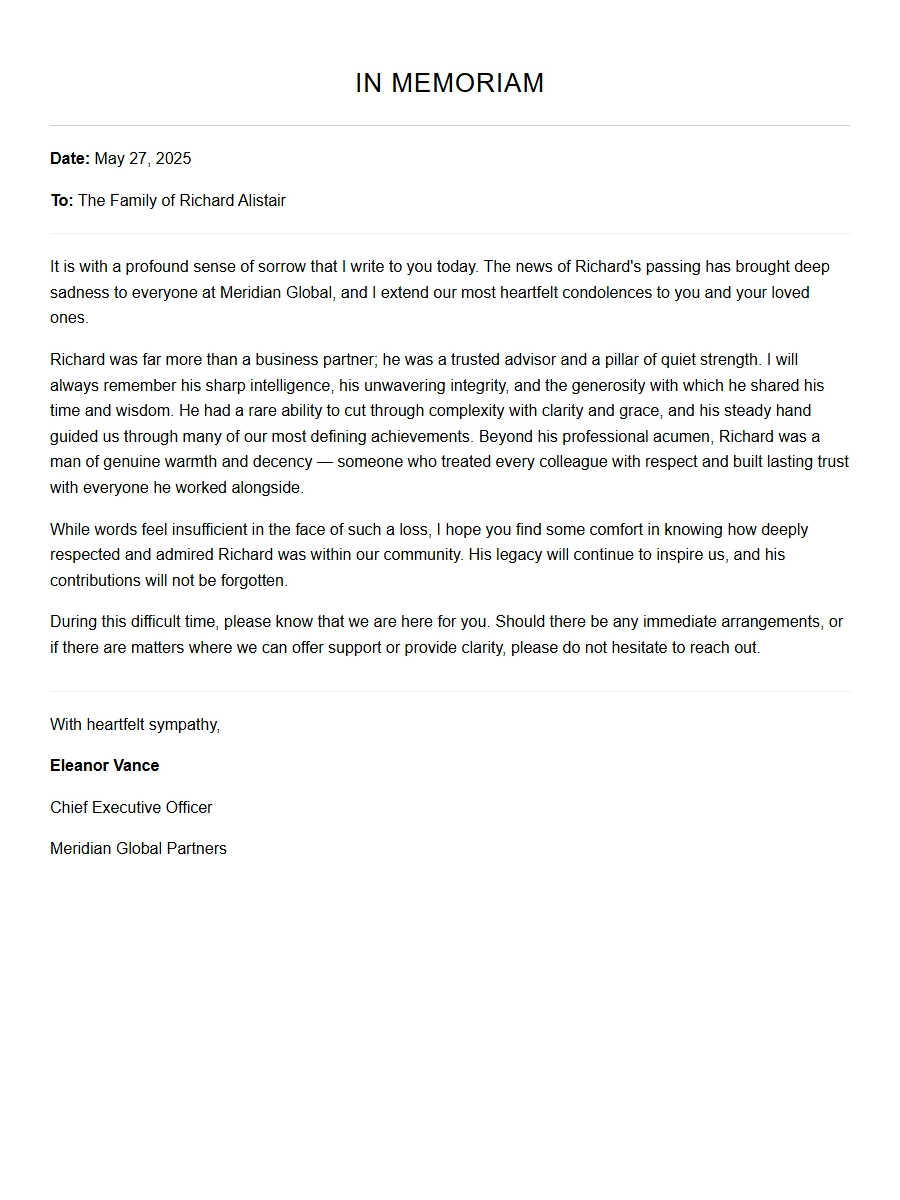 Formal Condolence Message for a Business Partner
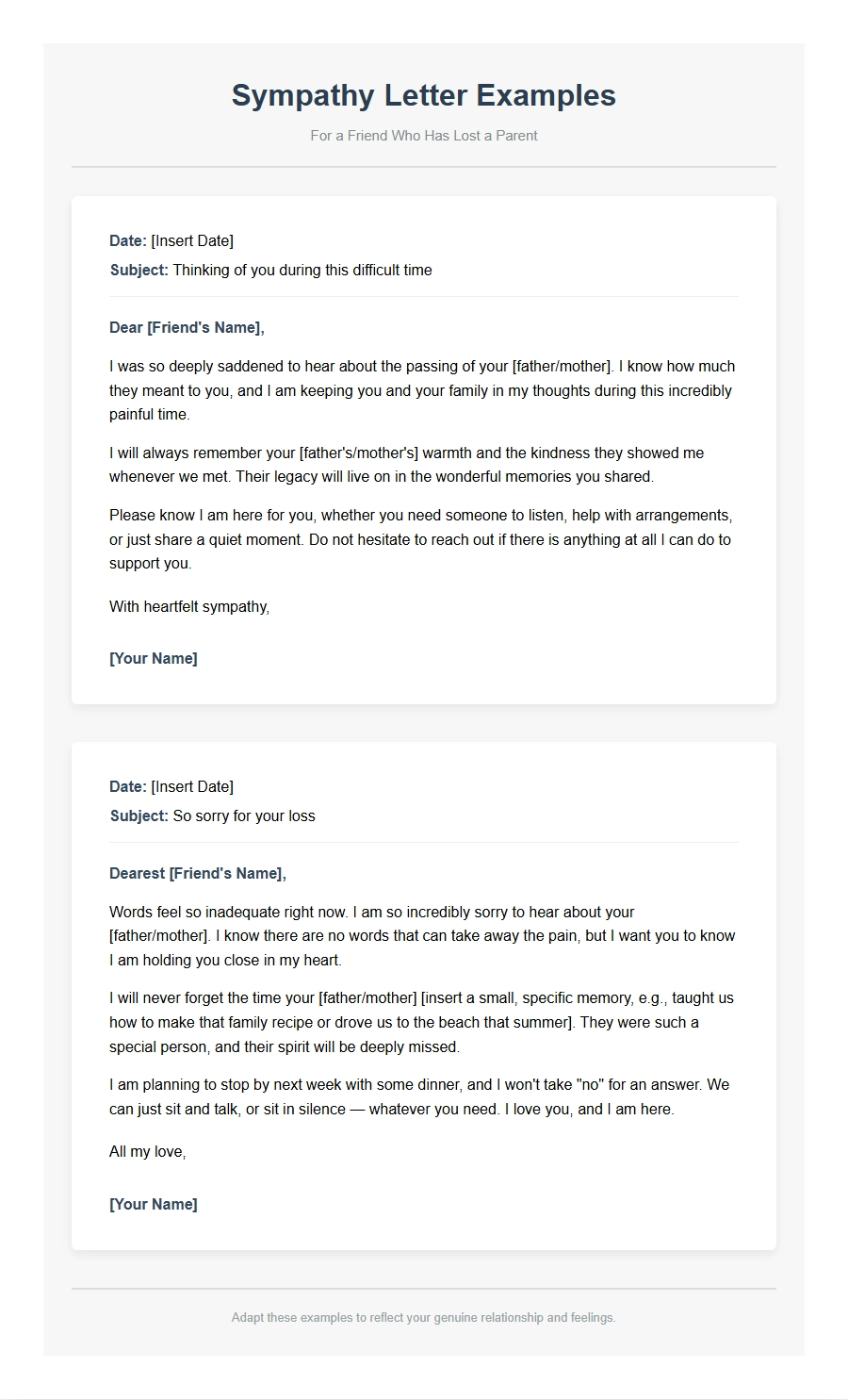 Sympathy Letter Examples for a Friend Who Lost a Parent
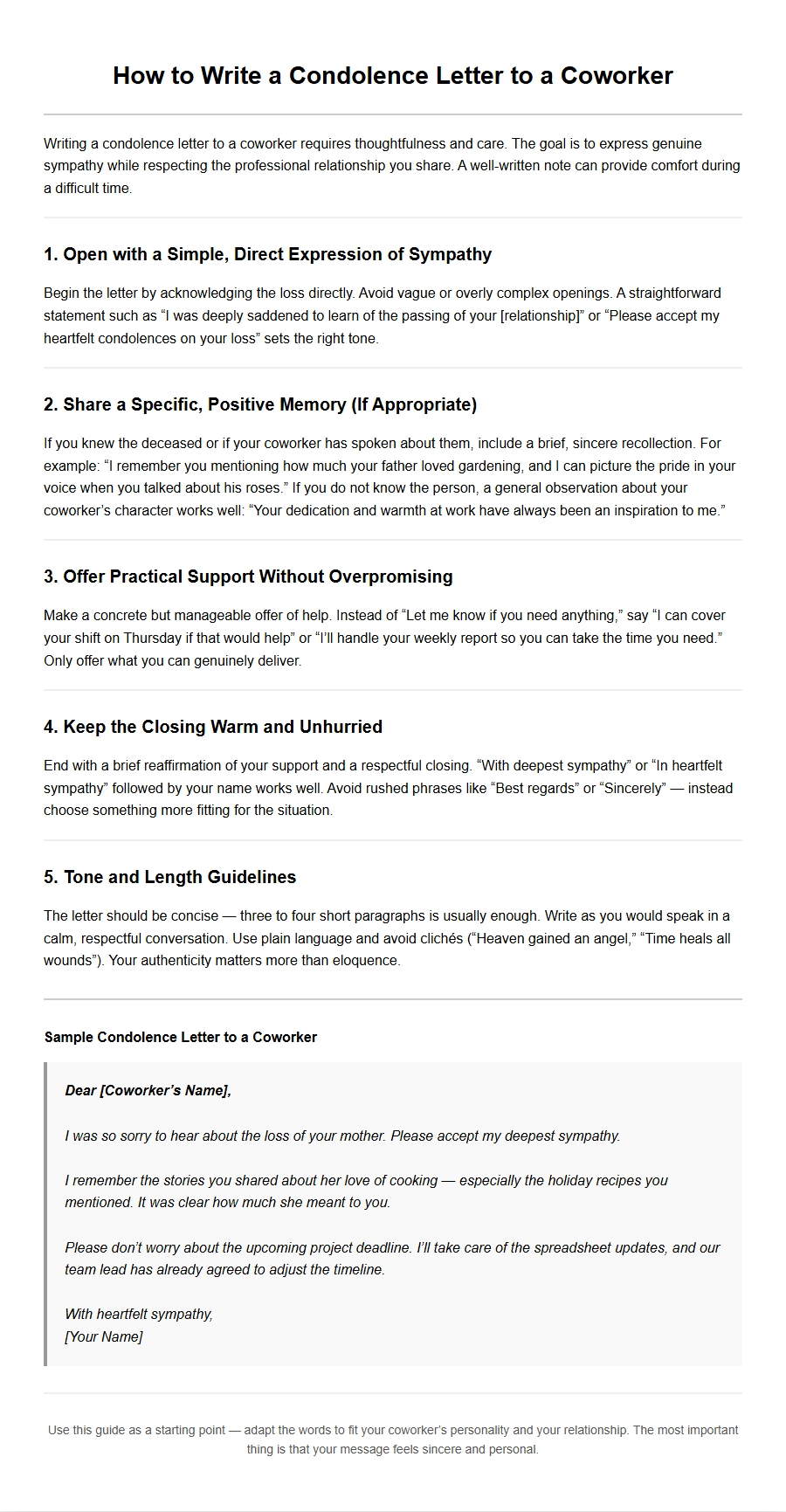 How to Write a Condolence Letter to a Coworker
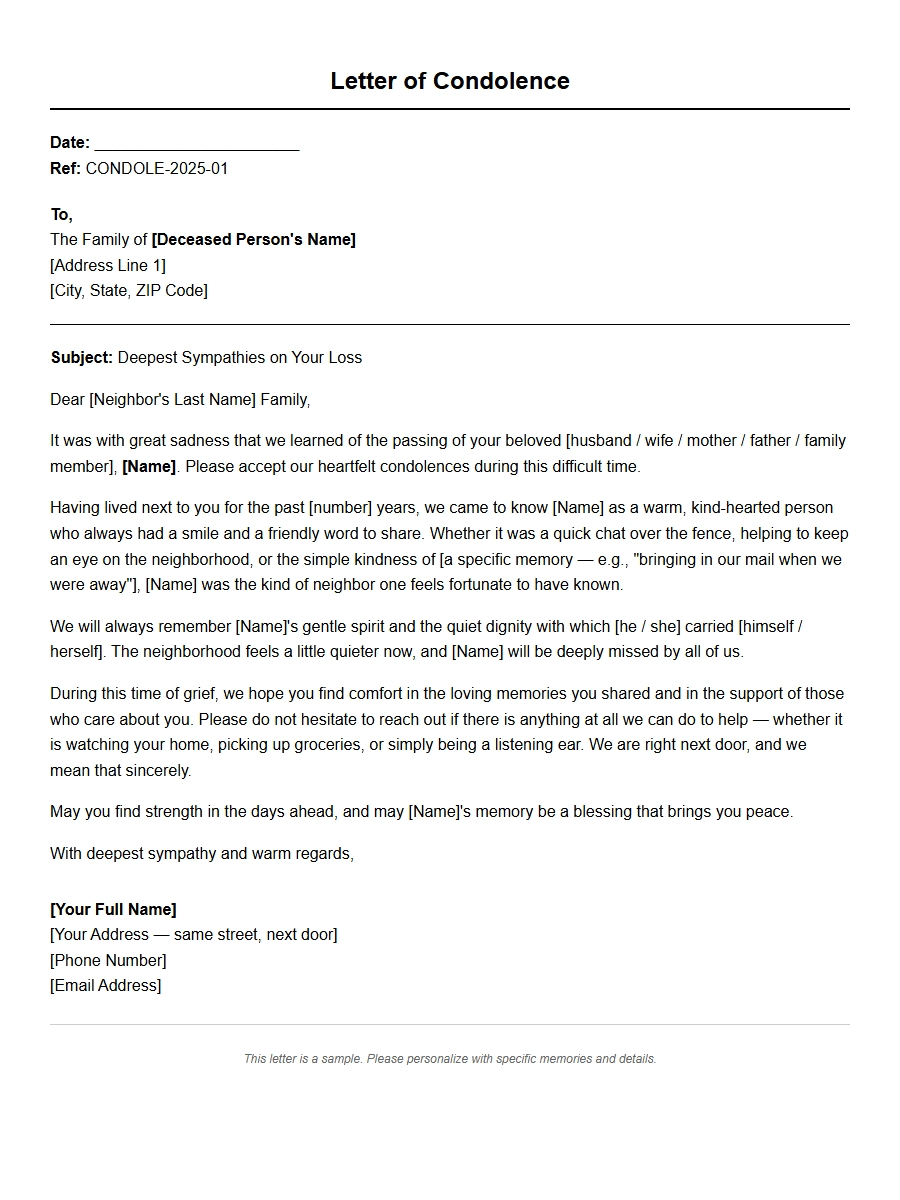 Condolence Letter Sample for a Neighbor
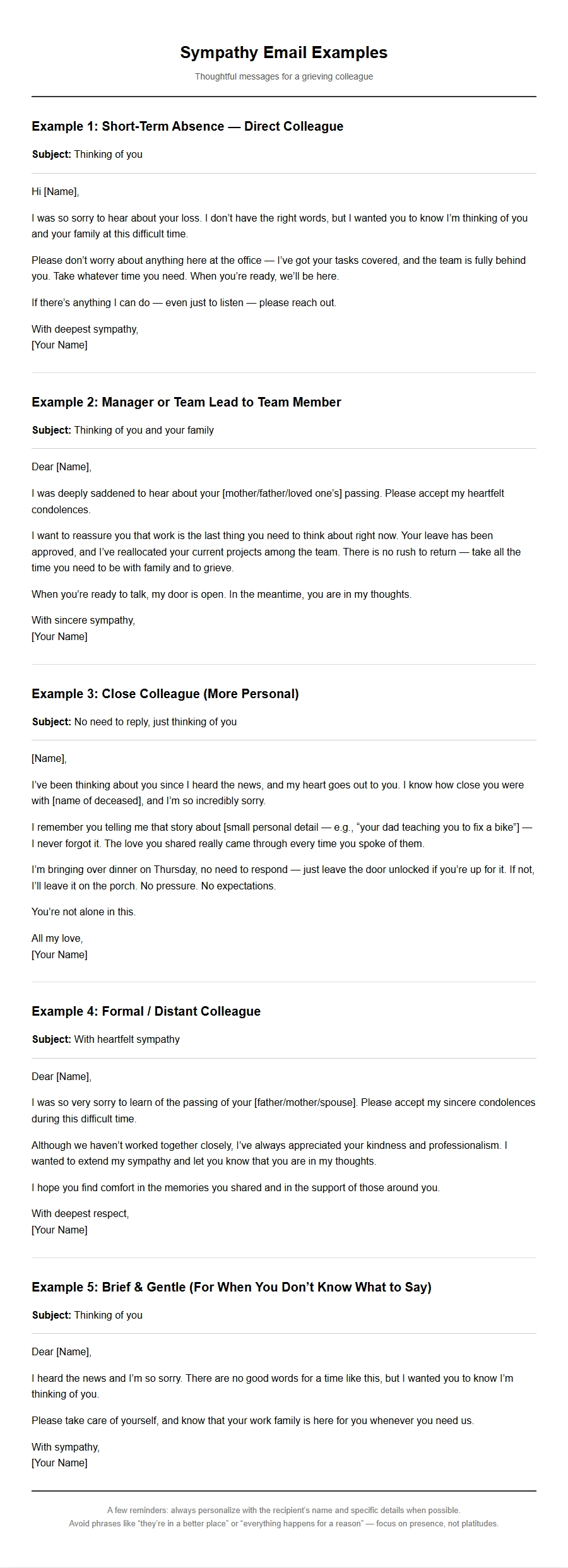 Sympathy Email Examples for a Grieving Colleague
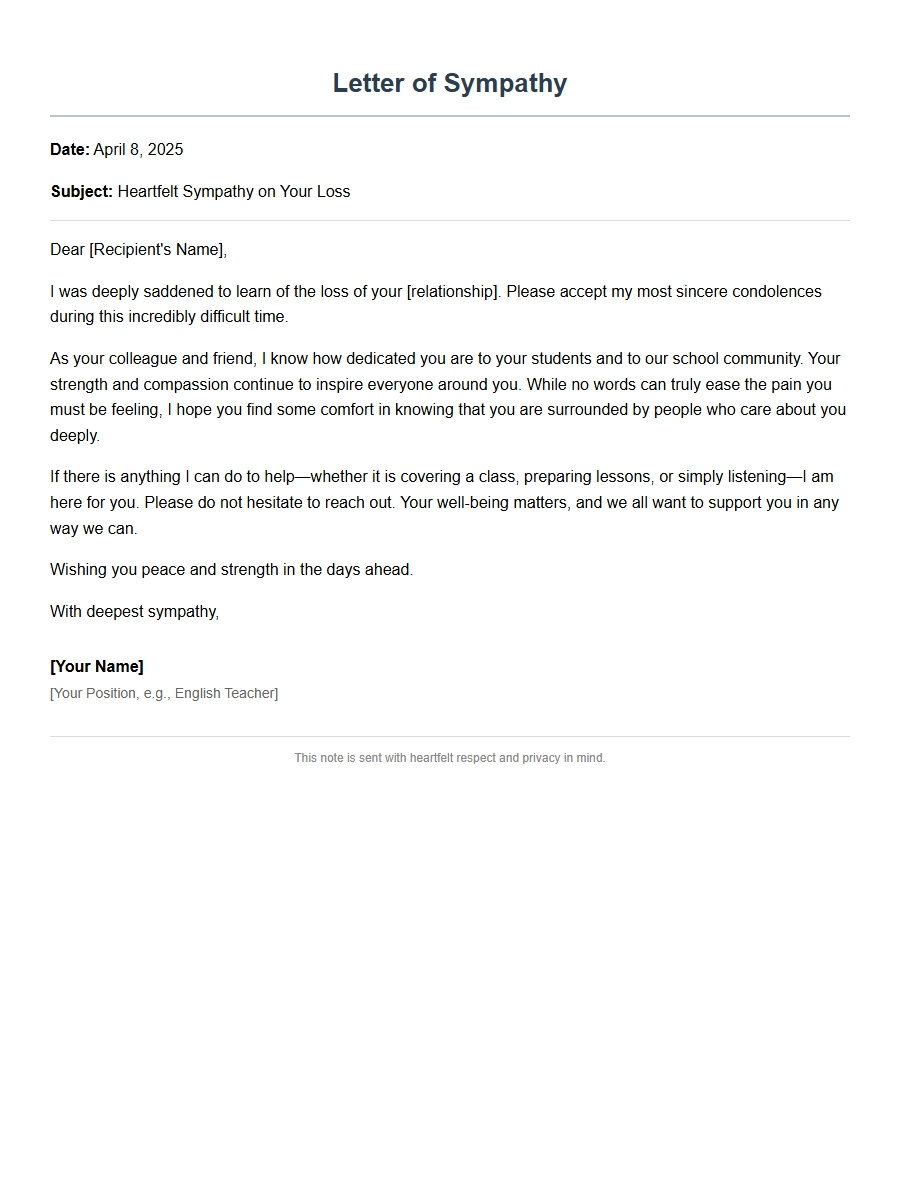 Condolence Words for a Teacher