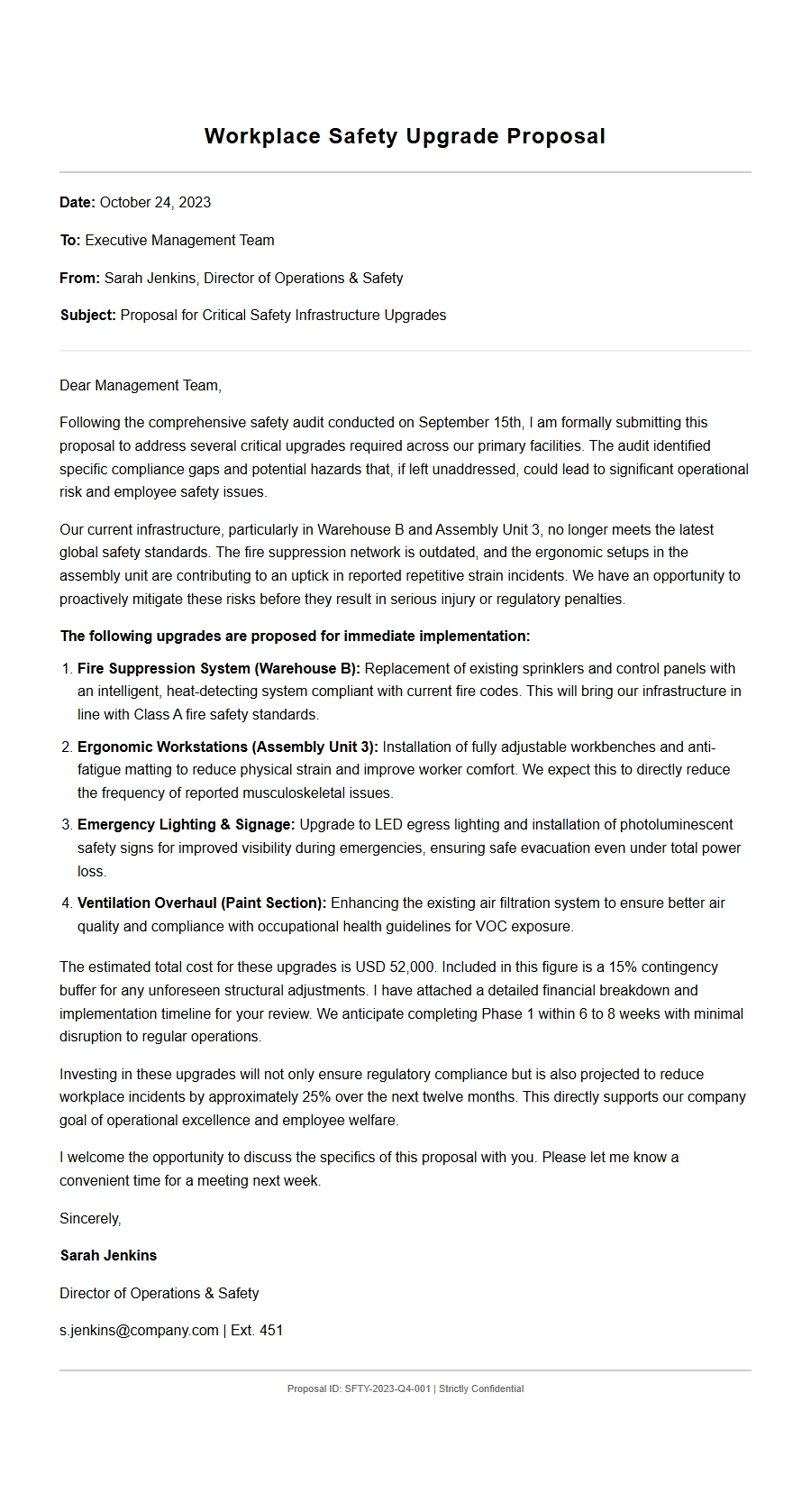
workplace safety upgrade proposal letter - Business Proposal Letters
You’ve spotted a real safety hazard on the shop floor, and you know an upgrade is overdue. But when you sit down to write a formal proposal to your boss or the safety committee, the blank screen stares back. You’re not alone. A good sample letter can turn that anxiety into a clear, convincing document in minutes.
Using a sample isn’t cheating. It’s a smart shortcut that gives you structure, tone, and key phrases while leaving room for your specific details. Think of it as a starting point, not a crutch. The trick is knowing how to pick the right template and customize it so it sounds like you.
Category: Business Proposal Letters
What is a workplace safety upgrade proposal letter?
This is a formal request you send to decision-makers asking them to fund improvements that reduce risk. It could be for new machine guards, better ventilation, ergonomic workstations, or upgraded fire suppression systems. The goal is to clearly explain the problem, propose a solution, and justify the cost—often with a sense of urgency.
You might send this letter to your manager, a safety director, or even a board of directors. The tone in writing needs to be professional but persuasive. A sample helps you strike that balance without starting from scratch.
How to choose the right sample for your situation
Not all letter templates are created equal. Look for one that matches the formality of your workplace and the seriousness of the hazard. A minor ergonomic tweak might call for a semi-formal email, while a major structural change requires a full business letter format with letterhead design.
Check if the sample addresses a similar type of safety issue. If your concern is chemical exposure, a sample about slip-and-fall risks won’t fit quite right. Pick one that gives you a framework you can adapt without rewriting every sentence.
Adapt the sample without losing your voice
Once you have a sample, don’t just swap in your name and hit send. Read it through and change phrases that sound too corporate or generic. Use your own words for the reasons an upgrade matters. For example, instead of “enhance operational efficiency,” say “reduce the number of near-miss incidents we’ve been tracking.”
A good sample includes salutation and closing options. Use the recipient’s full name if you know them. End with a call to action—like requesting a meeting or approval by a certain date. Keep the letter structure intact: introduction, problem, solution, cost/benefit, request, closing.
Common mistakes to avoid
One big one is ignoring the format. If you’re sending the letter by email, drop the formal address block and use a clear subject line. For printed letters, make sure your letterhead design is professional and includes your contact info.
Another mistake is using outdated language. Avoid “To Whom It May Concern” when you can find a real name. And don’t overload the letter with technical jargon. Your reader might not be a safety expert. Explain the hazard in plain terms, and back it up with data if you have it.
Don’t forget proofreading letter is essential. A typo or a wrong dollar figure can kill your credibility. Read it out loud or ask a colleague to look it over.
Practical tips for a strong proposal
Open with a sentence that grabs attention. Instead of “I am writing to propose,” try “Last month we had three near-misses in the packaging area due to outdated guards. Here’s a fix that will prevent injuries and save us downtime.”
Tailor the opening paragraph to your audience. If they care mostly about costs, lead with the ROI. If they care about employee morale, mention how the upgrade improves working conditions. The customizable letter is your friend—make it fit their priorities.
If you’re comparing solutions, use a short table or bullet points in the body (but keep paragraphs flowing). For instance, list the current problem, the proposed upgrade, the estimated cost, and the expected benefit. This makes your case easy to scan.
The best proposals feel both professional and personal. Use the sample to get the structure right, then pour your own knowledge and urgency into it. Practice makes it faster. Next time you need to write a safety upgrade letter, you’ll know exactly where to start—and you’ll finish with a confident draft that gets results.
Useful Writing Samples
workplace safety upgrade proposal letter - Business Proposal Letters
[
{
"title"
"Ergonomic Workstation Upgrade Proposal",
"body"
"
Date: October 12, 2024
To: Management Team, Office Operations From: Safety Committee
We propose upgrading all workstations in the open‑plan area to reduce repetitive‑strain injuries. The recommended improvements include height‑adjustable desks, ergonomic chairs, monitor arms, and footrests.
Cost Estimate:
Item
Qty
Unit Price
Total
Adjustable standing desk
30
$450
$13,500
Ergonomic chair
30
$350
$10,500
Monitor arm (dual)
30
$120
$3,600
Footrest
30
$40
$1,200
Total
$28,800
Benefits:
Reduced workers’ compensation claims by up to 30%
Improved employee productivity and comfort
Compliance with ANSI/HFES 100‑2017 ergonomic standards
We request approval of this proposal to proceed with a phased installation over the next quarter. A 15% productivity increase is expected to offset the investment within 18 months.
"
},
{
"title"
"Fire Safety Equipment Installation Proposal",
"body"
"
Date: October 15, 2024 To: Plant Manager, ABC Manufacturing From: EHS Department
Our facility currently lacks adequate fire suppression and detection systems in the storage wing. This proposal outlines the necessary upgrades to meet NFPA 101 life‑safety codes.
Proposed Upgrades:
Install 120 sprinkler heads in high‑rack storage areas
Add 25 smoke detectors with central alarm panel
Replace all Class A fire extinguishers with multipurpose ABC units
Implement emergency strobe lighting in exit corridors
Cost Breakdown:
Component
Cost
Sprinkler system (materials & labor)
$34,500
Smoke detectors & panel
$8,200
Fire extinguishers (40 units)
$2,800
Strobe lighting (15 fixtures)
$4,500
Total
$50,000
Timeline: Installation can be completed in 4 weeks, with minimal disruption to production.
Approving this proposal will reduce our fire risk rating and may lower annual insurance premiums by an estimated 8–12%. We look forward to your decision.
"
},
{
"title"
"Machine Guarding Upgrade Proposal",
"body"
"
Date: October 18, 2024 To: VP of Operations, XYZ Fabrication From: Safety Engineer
Recent risk assessments indicate that 14 presses and shears missing interlocked guards or light curtains. We propose upgrading them to comply with OSHA 1910.212 and ANSI B11.19 standards.
Proposed Scope:
Install interlocked sliding gates on 8 press brakes
Add safety light curtains with muting on 6 shears
Replace worn lockout/tagout stations near each machine
Provide operator training on new guarding systems
Cost Estimate:
Item
Qty
Unit Cost
Total
Interlocked gate system
8
$1,200
$9,600
Light curtain set (2‑beam)
6
$1,800
$10,800
LOTO stations
14
$150
$2,100
Training (half‑day)
1
$3,000
$3,000
Total
$25,500
Expected Outcomes: Eliminate crushing and amputation risks, reduce near‑miss reporting, and reach zero‑incident status in the fabrication department. This proposal directly supports our annual safety goal.
"
},
{
"title"
"Ventilation System Improvement Proposal",
"body"
"
Date: October 21, 2024 To: Director of Facilities, ChemPro Labs From: Industrial Hygienist
Air quality sampling shows elevated levels of volatile organic compounds (VOCs) and particulate matter in the synthesis lab. We propose upgrading the existing ventilation system to meet ACGIH threshold limit values.
Recommended Actions:
Increase fume hood exhaust capacity by 30%
Install HEPA‑filtered recirculating units in adjacent offices
Add real‑time continuous VOC monitoring with alarms
Upgrade ductwork to stainless steel for chemical resistance
Cost Summary:
Item
Cost
Fume hood retrofit (4 units)
$28,000
HEPA recirculators (3 units)
$12,000
VOC monitoring system
$9,500
Ductwork replacement
$18,000
Total
$67,500
Benefits:
Protect employee respiratory health
Maintain compliance with OSHA PELs
Extend equipment lifespan by reducing corrosive exposure
Implementation can be phased over 8 weeks. We are ready to contractor bids immediately upon approval.
Date: October 24, 2024 To: Warehouse Operations Manager, FastShip Logistics From: Safety Coordinator
A recent fire drill revealed that 40% of our emergency lights and exit signs are non‑functional or outdated. We propose a complete upgrade to LED‑based, self‑testing units to comply with NFPA 101 and OSHA 1910.37.
Scope of Work:
Replace 80 incandescent exit signs with LED edge‑lit signs
Install 60 new emergency battery‑backup LED floodlights
Add 20 photoluminescent pathway markers for low‑visibility areas
Provide maintenance log software for automated testing
Cost Estimate:
Item
Qty
Unit Price
Total
LED exit sign
80
$65
$5,200
Emergency floodlight
60
$120
$7,200
Pathway marker
20
$25
$500
Testing software license
1
$1,800
$1,800
Total
$14,700
Projected Impact: Improved evacuation times, reduced fire code violations, and lower electricity consumption by 75% compared to existing units. Payback estimated under 2 years via energy savings and avoided fines.
"
},
{
"title"
"Fall Protection Equipment Proposal",
"body"
"
Date: October 28, 2024 To: Site Director, Skyline Construction From: Safety Manager
Our residential and commercial projects require updated fall protection gear to meet OSHA 1926.501 standards. We are proposing a company‑wide replacement of all personal fall arrest systems (PFAS) and the installation of engineered anchor points.
60 self‑retracting lifelines (SRLs) for 30‑ft heights
40 steel roof anchors (temporary)
Training for all crew on proper inspection and use
Cost Breakdown:
Item
Cost
Harnesses & lanyards (80 sets)
$32,000
SRLs (60 units)
$18,000
Roof anchors (40 units)
$4,800
Training program (3 half‑day sessions)
$6,000
Total
$60,800
Key Benefits:
Eliminate fall hazard exposure on all job sites
Reduce experience modification rate (EMR) for insurance
Support pre‑qualification requirements for larger contracts
We request a decision by November 15 to place bulk order before year‑end.
"
},
{
"title"
"Safety Training Program Upgrade Proposal",
"body"
"
Date: November 1, 2024 To: HR Director, TotalCare Health From: Chief Safety Officer
Current safety training is limited to annual videos. We propose a comprehensive, interactive program covering hazard recognition, emergency response, and job‑specific safety procedures for all 200 employees.
Program Components:
Classroom & hands‑on sessions (8 hours per employee)
Train‑the‑trainer certification for 10 supervisors
Implementation Cost:
Item
Amount
Curriculum development
$15,000
Instructor fees (40 days)
$24,000
Online platform license (annual)
$5,000
Materials & PPE for drills
$3,500
Certification costs
$2,000
Total
$49,500
Expected Outcomes:
Reduce incident rate by 40% within one year
Meet ANSI Z490.1 training standards
Qualify for potential insurance premium discounts
We are prepared to begin pilot sessions in February 2025 pending approval.
"
},
{
"title"
"PPE Vending Machines Proposal",
"body"
"
Date: November 4, 2024 To: VP of Operations, MultiSite Industries From: Supply Chain & Safety Team
Our six plants currently distribute PPE through manual stockrooms, leading to waste and non‑compliance. We propose installing automated PPE vending machines at each site to improve availability and reduce costs.
Proposed Solution:
One vending machine per facility (6 total)
Stocked with safety glasses, earplugs, gloves, respirators, and coveralls
Integrated with employee badge system for tracking usage
Cloud‑based inventory management
Cost Estimate per Machine:
Component
Cost
Equipment & installation
$18,000
First‑year stock (average)
$8,500
Software & support fee
$2,400
Per machine total
$28,900
Total for 6 machines: $173,400
Advantages:
Reduces PPE usage by 22% (reported industry average)
Eliminates out‑of‑stock emergencies
Provides real‑time compliance data for audits
We recommend a pilot at our largest site before scaling. Payback expected within 14 months.
"
},
{
"title"
"Safety Signage & Floor Marking Proposal",
"body"
"
Date: November 7, 2024 To: Facility Manager, Central Storage Co. From: Safety Consultant
Our warehouse lacks consistent safety signage and aisle markings, increasing the risk of forklift‑pedestrian incidents. We propose a complete upgrade to meet OSHA 1910.145 and ANSI Z535 standards.
Proposed Work:
Install 50 ANSI‑compliant caution/danger signs at hazard zones
Apply 4‑inch yellow lane tape for pedestrian walkways
Mark 30 forklift travel lanes with durable epoxy paint
Add reflective barrier delineators at corners
Cost Breakdown:
Item
Cost
Safety signs (pre‑printed)
$2,500
Floor marking tape (200 rolls)
$4,800
Epoxy paint & application
$7,200
Delineators (120 units)
$1,200
Installation labor
$5,000
Total
$20,700
Expected Results:
Clear separation of pedestrian and vehicle zones
Reduced risk of struck‑by incidents
Improved efficiency in traffic flow
Work can be completed over one weekend to avoid disruption. We will provide a site‑specific proposal upon request.
"
},
{
"title"
"Anti-Slip Flooring & Mat Upgrade Proposal",
"body"
"
Date: November 10, 2024 To: Cafeteria & Kitchen Manager, GoodFood Inc. From: Risk Management Department
Slip‑and‑fall incidents account for 60% of our workplace injuries last year, predominantly in wet kitchen areas. We propose replacing worn tiles with slip‑resistant flooring and installing anti‑fatigue mats in workstations.
Specific Upgrades:
Replace 1,200 sq ft of ceramic tile with slip‑resistant vinyl (coefficient of friction >0.7)
Install 30 anti‑fatigue mats (3’x5’) at prep stations
Apply abrasive tape on all entrance ramps
Add floor drains and slope correction in high‑splash zones
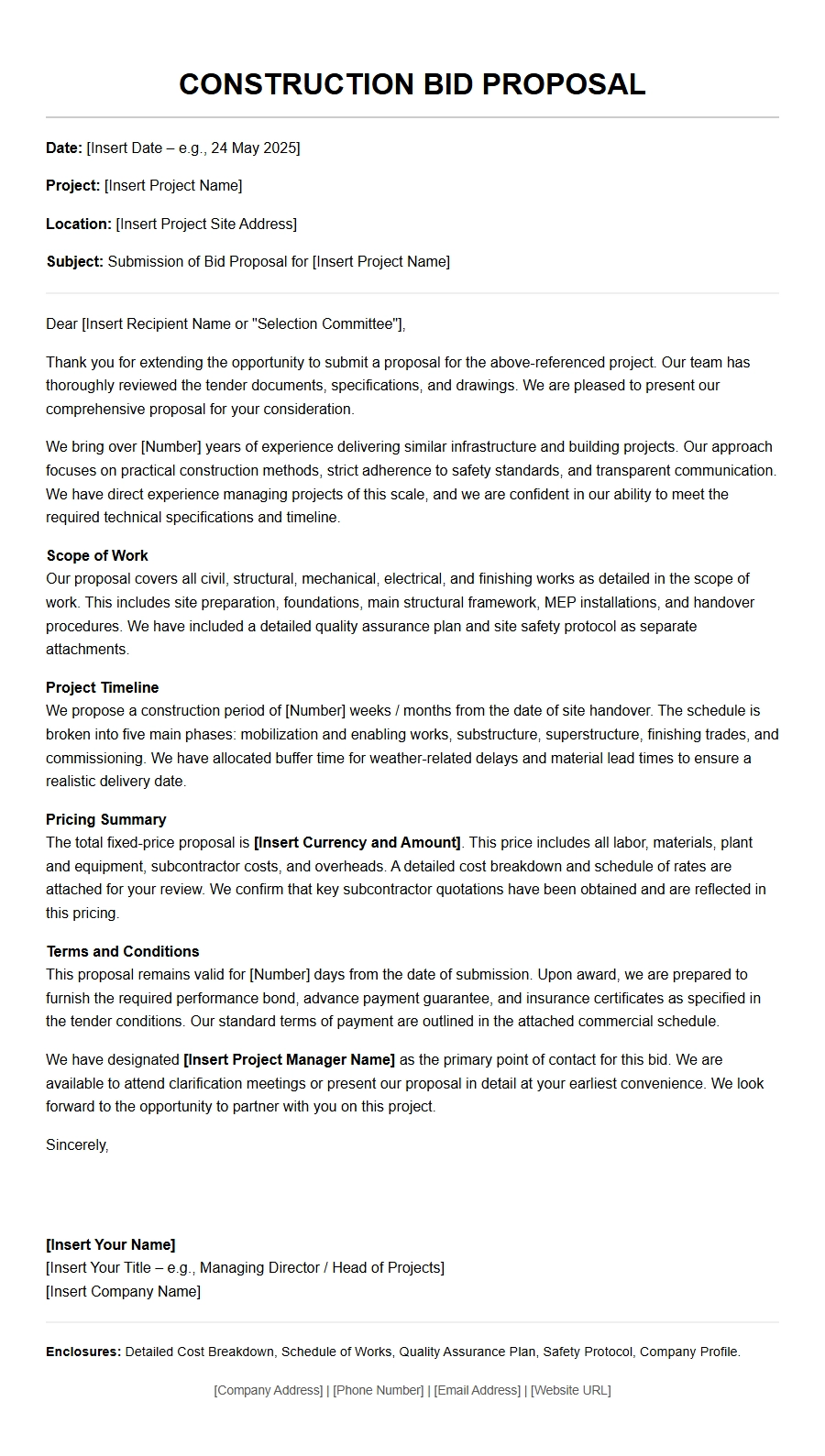 Sample Construction Bid Proposal Letter
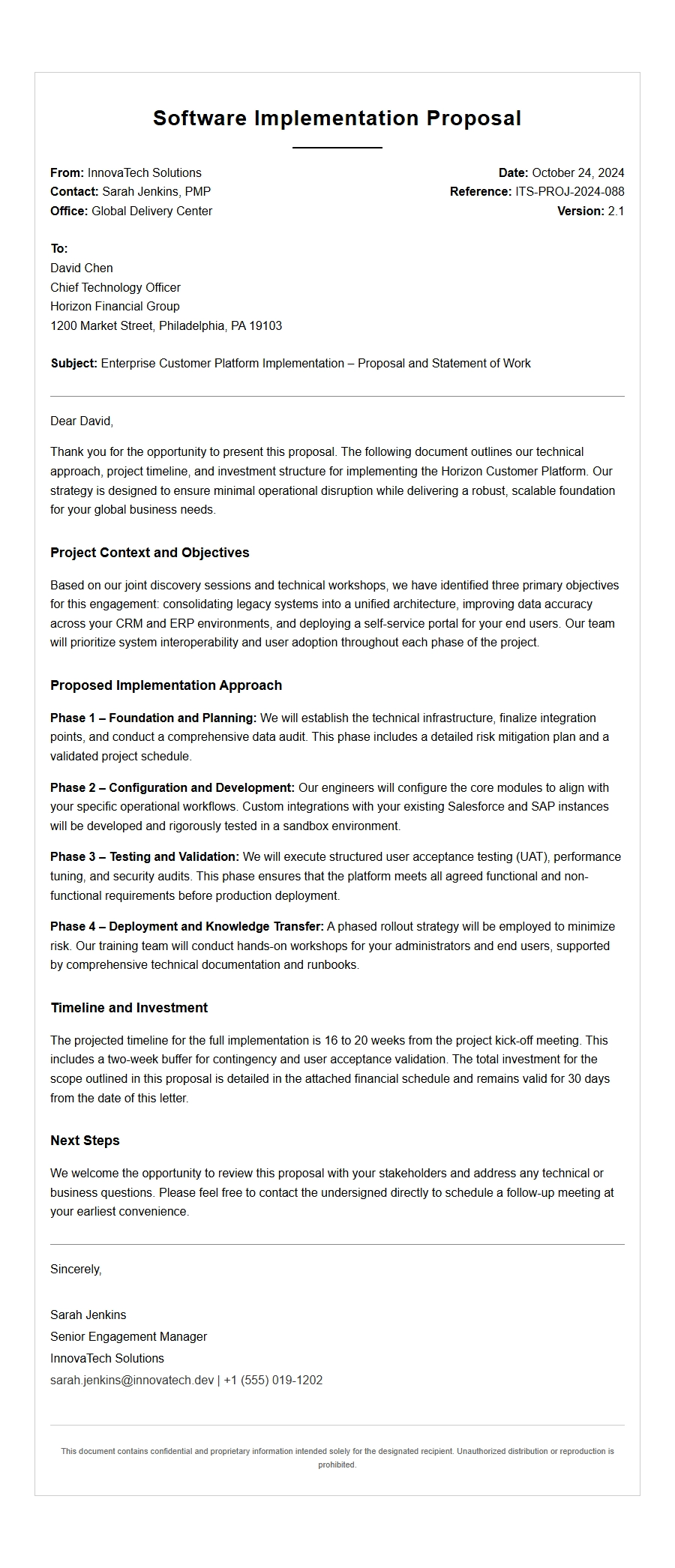 Enterprise Software Implementation Proposal Letter Example
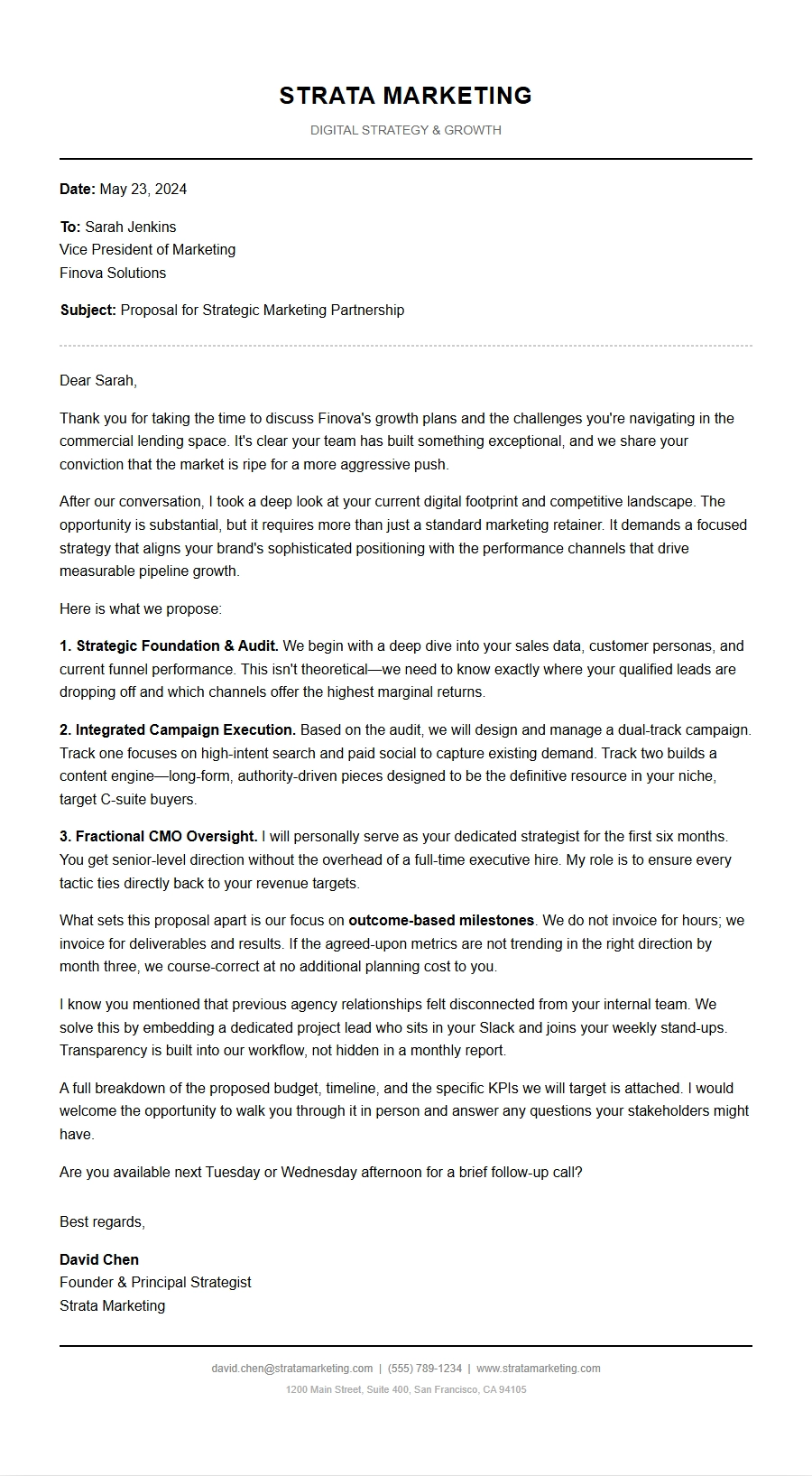 Marketing Agency Service Proposal Letter Template
 Creative Studio Project Proposal Letter
 Small Business Partnership Proposal Letter Template
 Startup Investment Proposal Letter Template