How to Write a Qualifications Portfolio Proposal Letter
You’re staring at a blinking cursor, and the clock is ticking. Maybe you need to submit a qualifications portfolio proposal letter for a major contract. Or perhaps you’re updating your professional correspondence for the first time in years. That blank page feels heavy. You know what you want to say, but the structure escapes you. It’s a familiar frustration.
Here’s the thing: using a sample isn’t cheating. It’s a smart shortcut. A good letter template gives you the structure and tone you need, while leaving plenty of room for your own voice. Think of it as a roadmap, not a script. It saves you from worrying about salutation and closing rules or business letter format, so you can focus on what actually matters—your message.
Category: Business Proposal Letters
How do you choose the right sample?
Not all letters are the same. A qualifications portfolio proposal letter needs to feel confident and specific. You’re not just introducing yourself; you’re making a case. Look for a sample that matches the formality of your situation. If you’re writing to a government agency, lean formal. If it’s for a long-time partner, a semi-formal tone works better. The right cover letter examples or resignation letter sample can guide you, but a proposal letter needs its own focus on evidence and value.
Pay attention to letterhead design if you’re sending a printed version. For email, a clean digital letter format works best. Don’t use outdated salutations like “To Whom It May Concern” unless you have no other option. It’s a small detail, but it sets the tone for everything that follows.
How do you adapt it without losing your voice?
This is where most people stumble. They copy the sample word for word. That’s a mistake. The sample gives you letter structure, but your voice adds the personality. Start by changing the opening paragraph. Tailor it to grab attention. Instead of “I am writing to submit my qualifications,” try “Our team recently helped a similar organization reduce costs by 20%, and I’d like to do the same for you.” It’s specific and confident.
Keep an eye on tone in writing. A qualifications portfolio proposal letter should be professional but not stiff. Use contractions like “we’ll” and “you’re.” It makes the letter feel human. If the sample you’re using sounds too corporate, soften it. Replace jargon with plain language. You want the reader to feel like they’re talking to a real person, not a committee.
Also, consider the medium. If you’re sending a letter of recommendation or a proposal via email, your subject line matters. Something like “Proposal for [Project Name] – Qualifications and Approach” is clear and direct. For printed letters, make sure the proofreading letter step isn’t skipped. Read it aloud. Ask a colleague to check it. Small typos can undermine your credibility.
What common mistakes should you avoid?
The biggest one is ignoring the customizable letter aspect. A generic letter feels lazy. Change the date, the recipient’s name, and the specific details of your qualifications. Don’t just swap in your name and call it done.
Another mistake? Using an outdated salutation or closing. “Sincerely” is fine for most formal letters. “Best regards” works for semi-formal ones. Avoid “Yours faithfully” unless you’re writing a very traditional letter. And don’t forget to include your contact information in the letterhead or signature block. It sounds obvious, but it’s often overlooked.
Ever received a letter that felt too stiff or too casual? That’s a tone mismatch. Match your tone to your audience. If you’re unsure, lean professional. You can always soften it in a follow-up.
How do you make your opening stand out?
The first two sentences are what matter most. Don’t bury your value. If you have a specific achievement or relevant experience, lead with it. For example: “When we improved turnaround time by 30% for a similar client, we knew we had a system that worked. I believe it can work for you too.” It’s direct and builds interest.
Avoid generic phrases like “I am writing to express my interest.” Instead, tie your qualifications to the reader’s needs. If you’re submitting a municipal contract application letter, mention your experience with public sector projects. If it’s a healthcare facility management proposal letter, highlight your knowledge of compliance and patient safety. Specificity builds trust.
Some situations require a faster response. If you’re submitting an emergency response business proposal letter, your tone needs to convey urgency without panic. Be direct. State your qualifications and availability clearly. Use short sentences. The reader doesn’t have time for filler.
In those cases, the structure of a template is even more valuable. It helps you stay focused. You don’t have to invent a format. You just fill in the critical details and hit send.
Use the sample as a springboard, not a crutch
The best letters feel both professional and personal. They follow the rules of letter writing etiquette but still sound like they came from a real human. A sample can get you to that point faster. Over time, you’ll learn which formal writing tips work for your voice and which ones to skip. Practice makes the process faster. The next time you face a blank page, it won’t feel so blank. You’ll know exactly where to start.
Ready-to-Use Examples
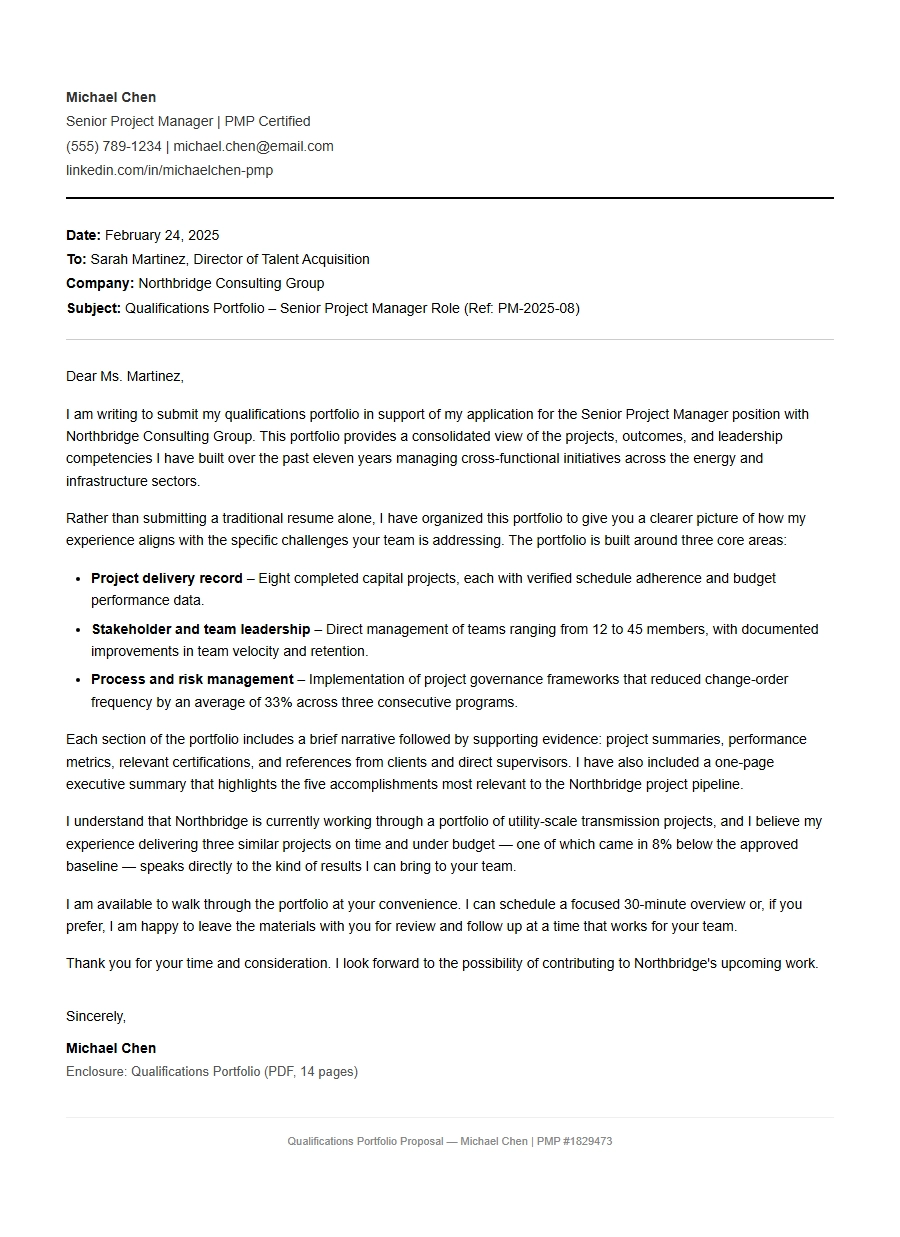
How to Write a Qualifications Portfolio Proposal Letter
Standard Portfolio Proposal Letter
Date: March 15, 2025
To: Jane Doe, Procurement Manager Acme Corporation 123 Business Lane, Metro City
Subject: Proposal for Digital Marketing Services – Qualifications Portfolio Attached
Dear Ms. Doe,
We are pleased to submit our qualifications portfolio in response to your request for digital marketing services. Our portfolio outlines over a decade of experience driving measurable results for clients across multiple industries.
Key Highlights from Our Portfolio:
Project
Client
Result
SEO Overhaul
TechStart Inc.
Organic traffic +320% in 6 months
Social Media Campaign
FreshFoods Co.
Engagement rate 8.5%, sales +45%
Email Automation
ConsultPro Ltd.
Conversion rate 12% (industry avg 4%)
As a full-service agency, we combine strategy, creative execution, and data-driven optimization. We have enclosed a comprehensive portfolio that details our processes, team credentials, and case studies.
We would welcome the opportunity to present our approach in a short meeting. Please contact us at (555) 123-4567 to schedule a convenient time.
Sincerely, Alex Morgan Senior Account Director, GrowthMark
Government RFP Portfolio Letter
Date: April 2, 2025
To: State Procurement Office Attention: RFP #2025-IT-789 1500 Capitol Avenue, Springfield
Subject: Qualifications Portfolio Submission for IT Infrastructure Modernization
Dear Evaluation Committee,
In response to RFP #2025-IT-789, we hereby submit our qualifications portfolio demonstrating our capability to modernize the state’s IT infrastructure. Our team has successfully completed similar projects for three other state governments.
Project: State of Jefferson – Cloud Migration / Value: $2.3M / Timeline: On budget, 2 months early
Project: City of Lakes – Network Security Upgrade / Value: $850K / Compliance: 100% audit pass rate
Project: Coastal County – Data Center Consolidation / Savings: 35% operational costs
The attached portfolio includes detailed resumes of our key personnel, past performance reports, and our proposed methodology. We are ready to begin work within 30 days of contract award.
We look forward to your favorable consideration.
Respectfully, Michael Torres VP, Public Sector Solutions, InfraTech Inc.
Consulting Engagement Proposal
Date: January 10, 2025
To: Robert Chen, CEO Bloom Health Systems 55 Wellness Ave, MedCity
Subject: Proposal for Strategic Consulting – Qualifications Portfolio Enclosed
Dear Robert,
Following our discussion about operational efficiency, I am delighted to present our consulting proposal along with our qualifications portfolio. Our firm specializes in healthcare operations optimization, and we believe we can help Bloom Health achieve a 20% reduction in administrative costs within 12 months.
Portfolio of Relevant Engagements:
CarePlus Hospitals: Redesigned patient intake process – wait times reduced 45%.
WellnessFirst Network: Rolled out telehealth platform – increased patient satisfaction by 32 points.
Our proposed engagement includes a diagnostic phase, co-creation of solutions, and hands-on implementation support. The portfolio provides full case details, team bios, and client testimonials.
I would appreciate the opportunity to present our plan to your leadership team. I will call your office next Tuesday to arrange a meeting.
Warm regards, Dr. Susan Park Managing Partner, OptiHealth Consulting
Research Grant Portfolio Letter
Date: February 28, 2025
To: National Science Foundation Grant Review Committee, Program: Advanced Materials 2415 Eisenhower Avenue, Alexandria, VA
Subject: Qualifications Portfolio for Grant Proposal – Nanocomposite Coatings
Dear Committee Members,
Enclosed please find our qualifications portfolio supporting the attached grant proposal titled “Self-Healing Nanocomposite Coatings for Aerospace Applications.” Our team brings together three principal investigators with complementary expertise.
Researcher
Role
Selected Publications
Patents
Dr. Elena Vasquez
PI, Materials Chemistry
12 peer-reviewed papers
3
Dr. James Otieno
Co-PI, Mechanical Testing
8 papers, 2 book chapters
1
Dr. Lisa Huang
Co-PI, Process Engineering
15 papers, h-index 18
5
The portfolio includes a list of prior grants managed, equipment facilities available, and recent research outcomes. Our preliminary data strongly supports the feasibility and innovation of the proposed work. We are confident in our ability to execute and deliver transformative results.
Thank you for considering our submission.
Sincerely, Dr. Elena Vasquez Professor, Department of Materials Science University of Innovation
Creative Design Project Proposal
Date: May 20, 2025
To: Amanda Wright, Creative Director Artisan Brands Co. 789 Design District, Studio City
Subject: Proposal for Rebranding Campaign – Qualifications Portfolio
Dear Amanda,
Thank you for inviting us to bid on Artisan Brands’ rebranding project. Our creative studio has extensive experience in brand identity and digital asset creation, as demonstrated in the attached portfolio.
UrbanEco Apparel: Logo, website, and social media kit – launch campaign generated 50K new followers.
GreenLeaf Wellness: Illustrated brand guidelines – used consistently across 40+ product lines.
Our portfolio includes mood boards, style guides, before/after comparisons, and client feedback. We propose a four-phase approach: Discovery, Concept Development, Refinement, and Delivery. Our timeline is 10 weeks from contract signing.
We would be thrilled to bring your vision to life. Let’s schedule a call to discuss next steps.
Best regards, Carlos Mendez Creative Director, Studio Nuevo
Subcontractor Opportunity Letter
Date: June 12, 2025
To: Prime Construction Inc. Attn: Subcontracting Department 2000 Builder’s Way, Metropolis
Subject: Qualifications Portfolio for Electrical Subcontracting – Project: Riverfront Tower
Dear Sir or Madam,
We are writing to express our interest in serving as the electrical subcontractor for the Riverfront Tower project. Our qualifications portfolio highlights our 20-year track record in commercial electrical installations, including high-rises and mixed-use developments.
Relevant Completed Projects:
Project
Size
Scope of Work
Completion
Harbor View Condos
15 stories
Full electrical, fire alarm, BMS
On time, under budget
Metro Tech Park
500,000 sq ft
Power distribution, lighting, backup gen
Zero safety incidents
St. Luke’s Medical
8 stories
Emergency power, nurse call, data
LEED Gold certified
Our portfolio includes licenses, insurance certificates, safety records, and client references. We are ready to mobilize with a skilled crew and state-of-the-art equipment.
We welcome the opportunity to discuss our capabilities further.
Yours truly, David Kim Estimating Manager, BrightSpark Electric
Partnership Proposal Portfolio
Date: July 8, 2025
To: Partnership Committee Global Health Alliance 14 Aid Road, Geneva
Subject: Strategic Partnership Proposal – Qualifications Portfolio of Community Health Solutions
Dear Committee,
We are excited to submit this partnership proposal accompanied by our qualifications portfolio. Our organization has developed and scaled community health programs in 12 low-resource countries, and we believe a collaboration with Global Health Alliance can amplify impact globally.
Portfolio Highlights:
Program: Maternal Health in Rural Tanzania – reduced mortality 40% over 3 years.
Program: Mobile Clinics in Myanmar – reached 150,000 individuals with vaccinations.
Program: Clean Water Initiative in Haiti – installed 200 filtration systems serving 50,000 people.
The attached portfolio provides detailed program descriptions, monitoring data, partnership models, and financial management examples. We propose a joint approach combining our field expertise with your advocacy network.
We look forward to exploring this partnership further and are available for a virtual meeting at your earliest convenience.
With gratitude, Dr. Amina Diallo Executive Director, HealthBridge International
Freelance Contract Portfolio Letter
Date: August 1, 2025
To: Hiring Manager TechFlow Solutions PO Box 987, Innovate Park
I am writing to apply for the Senior UX Designer contract position at TechFlow Solutions. My qualifications portfolio showcases a decade of experience delivering user-centered designs for SaaS platforms and mobile apps.
Portfolio Project Examples:
FinDash: Redesigned dashboard – user task completion improved 55%.
HealthTrack: Created patient portal – reduced support tickets by 40%.
ShopEase: Mobile checkout flow – increased conversion by 28%.
The attached PDF includes wireframes, user flows, prototype links, and results metrics. I also have included testimonials from past clients and a brief case study on my design process.
I am available for a 6-month contract starting September 1st. My rate is $85/hour, and I can commit to 40 hours per week. I would be happy to discuss how my skills can benefit TechFlow’s upcoming product launch.
Thank you for your consideration.
Best, Rachel Nguyen UX Designer (Independent)
Construction Bid Portfolio Letter
Date: September 5, 2025
To: Bid Committee City of Riverside – Public Works 200 Civic Center Drive, Riverside
Subject: Qualifications Portfolio for Bridge Rehabilitation Project – Bid #2025-BR-112
Dear Committee,
We are pleased to submit our qualifications portfolio in support of our bid for the Riverside Bridge Rehabilitation project. Our firm has delivered over 30 bridge projects in the past 15 years, with a strong record of safety, quality, and schedule adherence.
Selected Past Bridge Projects:
Bridge Name
Type
Contract Value
Completion
Elm Street Viaduct
Steel girder
$4.2M
On time, 1 month early
Oak Creek Crossing
Concrete arch
$6.8M
OSHA VPP Star site
Pine Valley Bridge
Suspension rehab
$9.1M
Zero change orders
The portfolio includes our safety statistics, equipment list, key personnel resumes, and financial statements. We are confident we can complete this project within the specified budget and timeline.
We look forward to the opportunity to serve the City of Riverside.
Respectfully, Anthony Rossi President, Rossi Construction Group
Technology Solution Portfolio Letter
Date: October 18, 2025
To: Sarah Lin, VP of IT OmniRetail Corp. 100 Commerce Blvd, Megamall
Subject: Proposal for AI-Powered Inventory Management – Qualifications Portfolio Enclosed
Dear Sarah,
Following our exploratory meeting, we are pleased to present this proposal for an AI-driven inventory management solution tailored to OmniRetail’s needs. Our qualifications portfolio details our track record of implementing similar solutions for retailers.
Implementation Case Studies from Our Portfolio:
BigBox Stores: Reduced overstock by 25%, realized $3M savings in first year.
FashionChain: Improved demand forecasting accuracy to 94%, reduced stockouts 60%.
GroceryMart: Integrated with existing ERP – ROI achieved in 8 months.
The portfolio includes system architecture diagrams, deployment timelines, security attestations, and client testimonials. We propose a phased rollout starting with a pilot in three distribution centers.
We are eager to move forward and have reserved a team for an early 2026 start. I will send a meeting invitation for deeper technical discussions.
Sincerely, Mark Takahashi Director of Enterprise Sales, AI Solutions Corp.
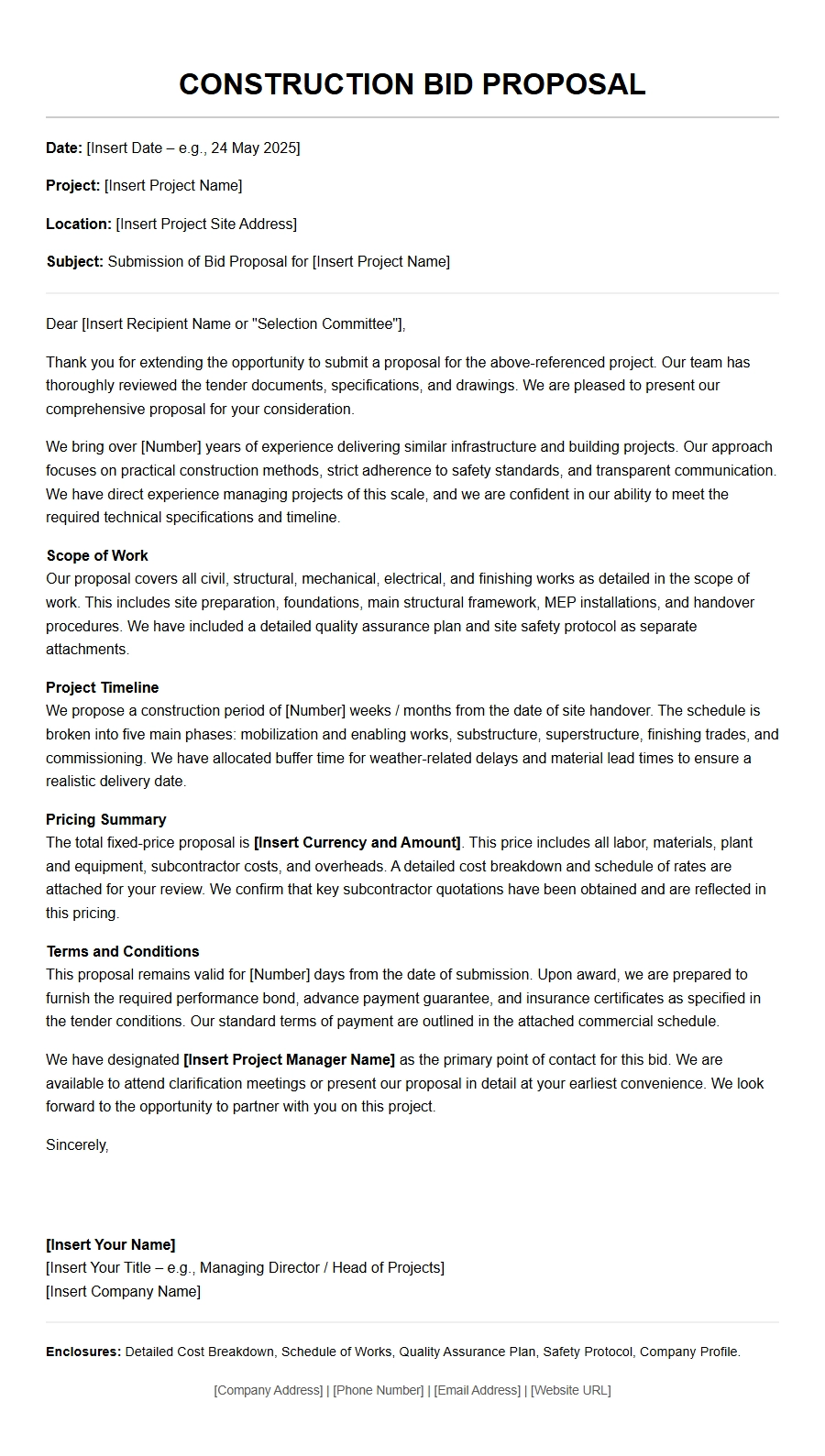 Sample Construction Bid Proposal Letter
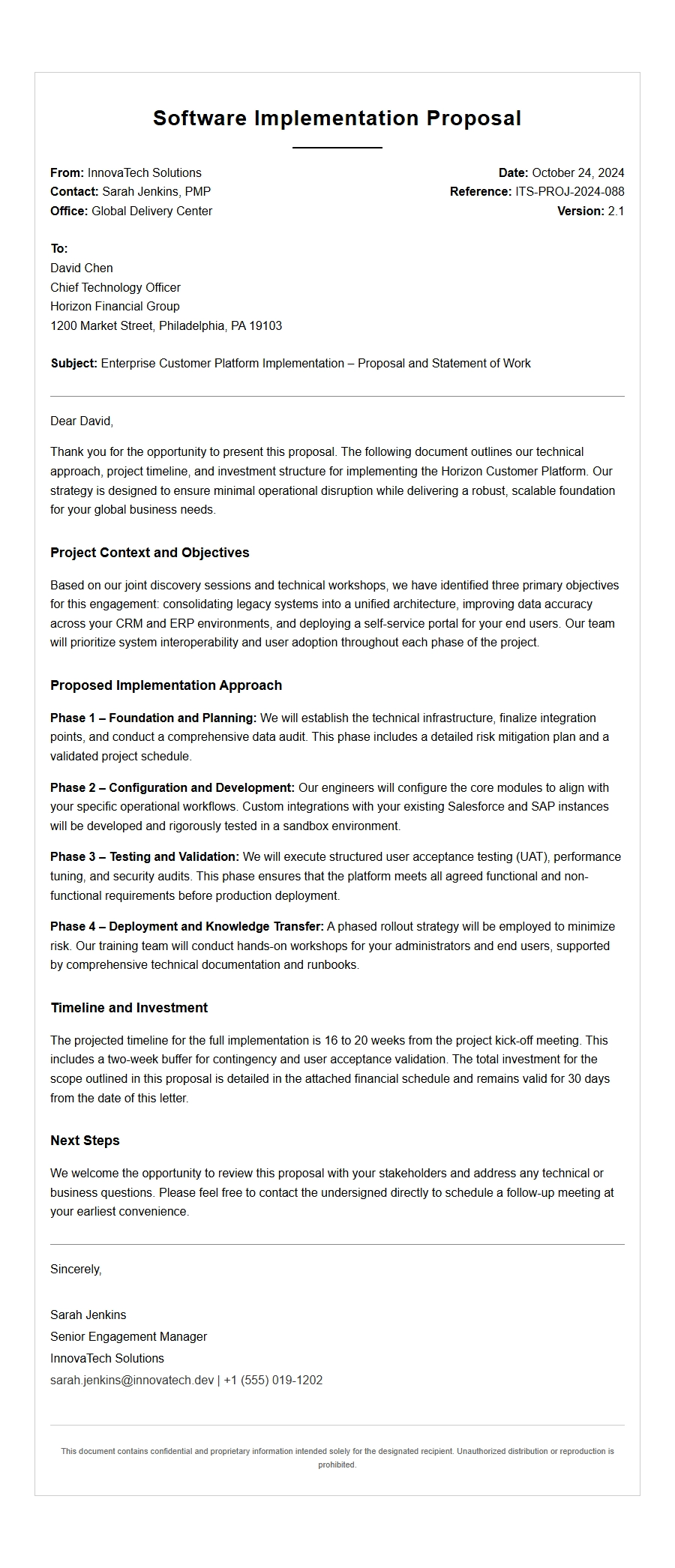 Enterprise Software Implementation Proposal Letter Example
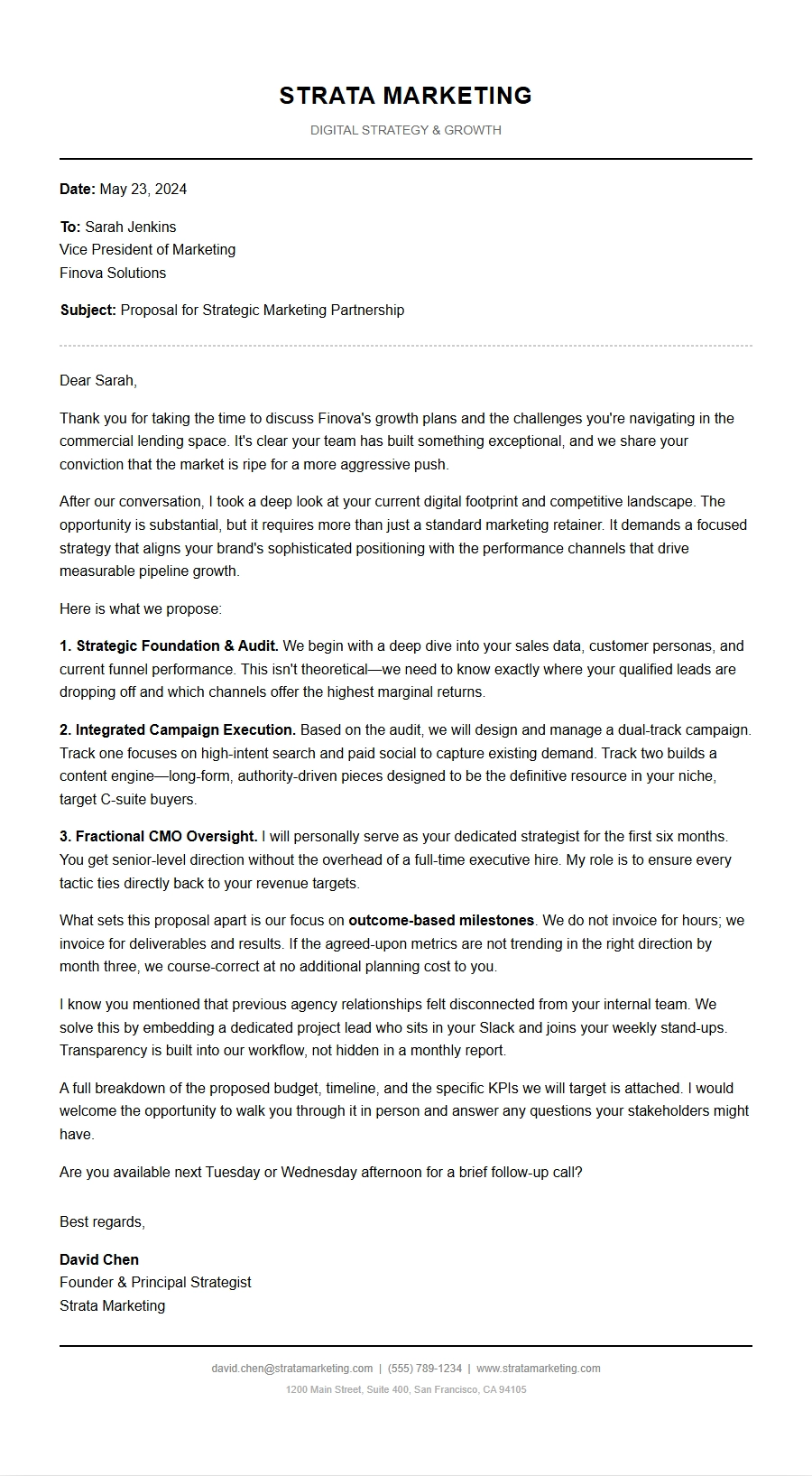 Marketing Agency Service Proposal Letter Template
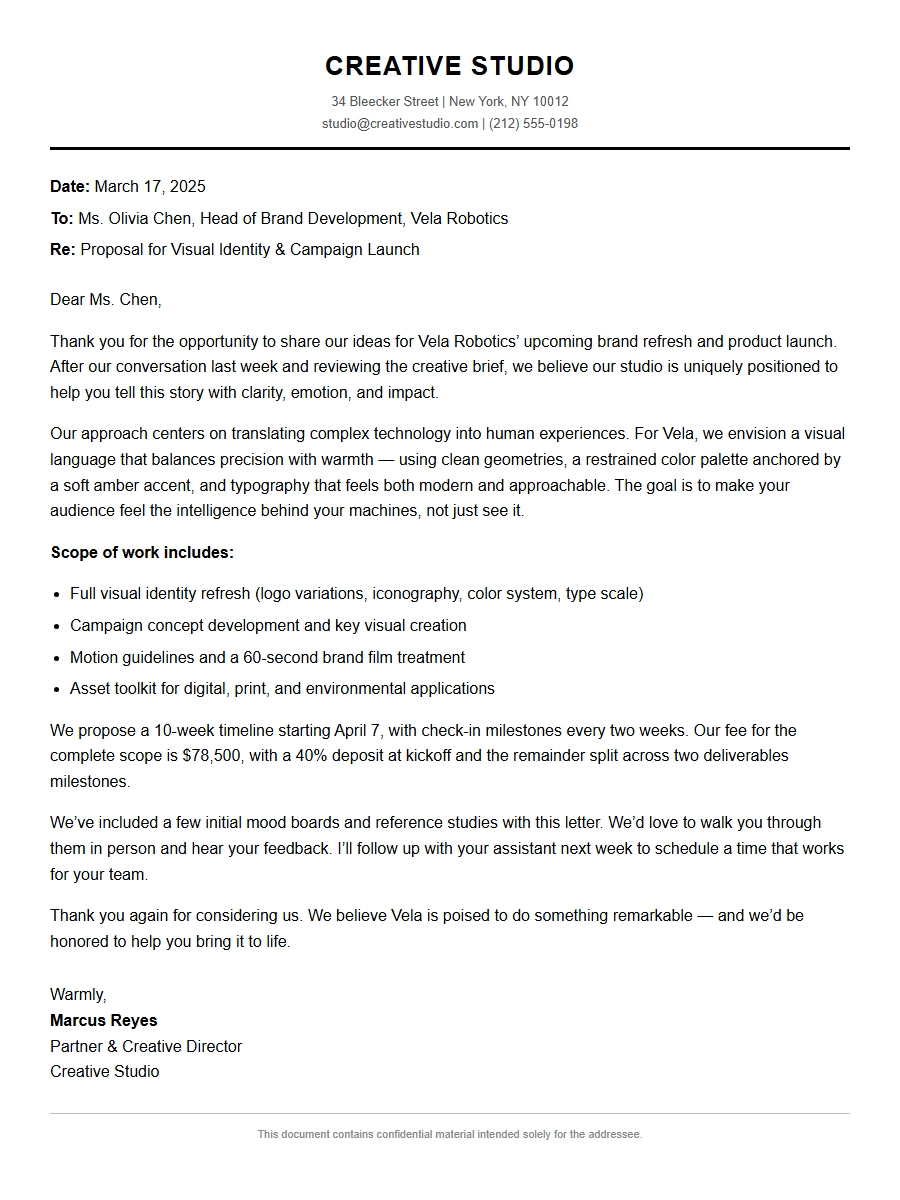 Creative Studio Project Proposal Letter
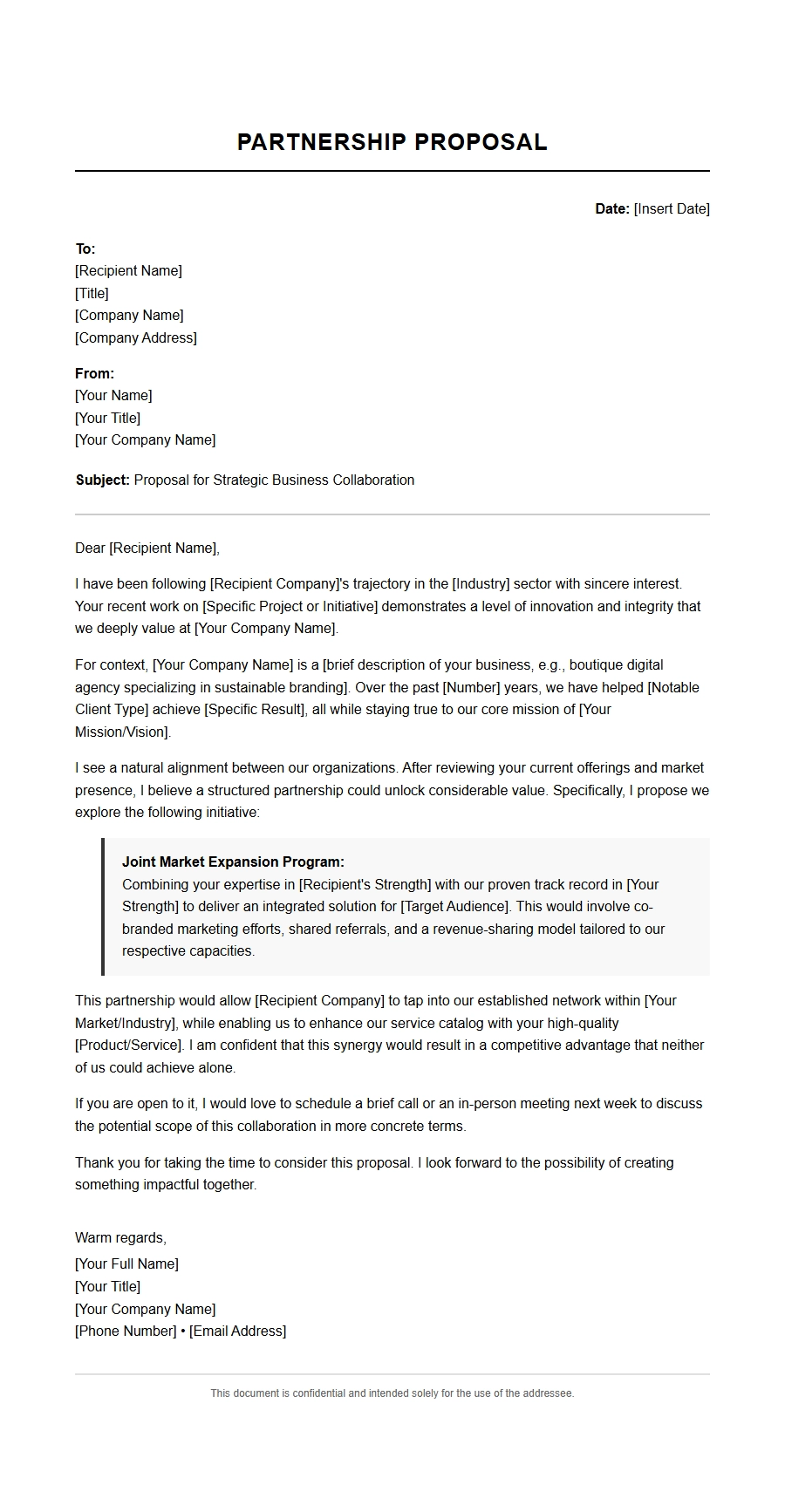 Small Business Partnership Proposal Letter Template
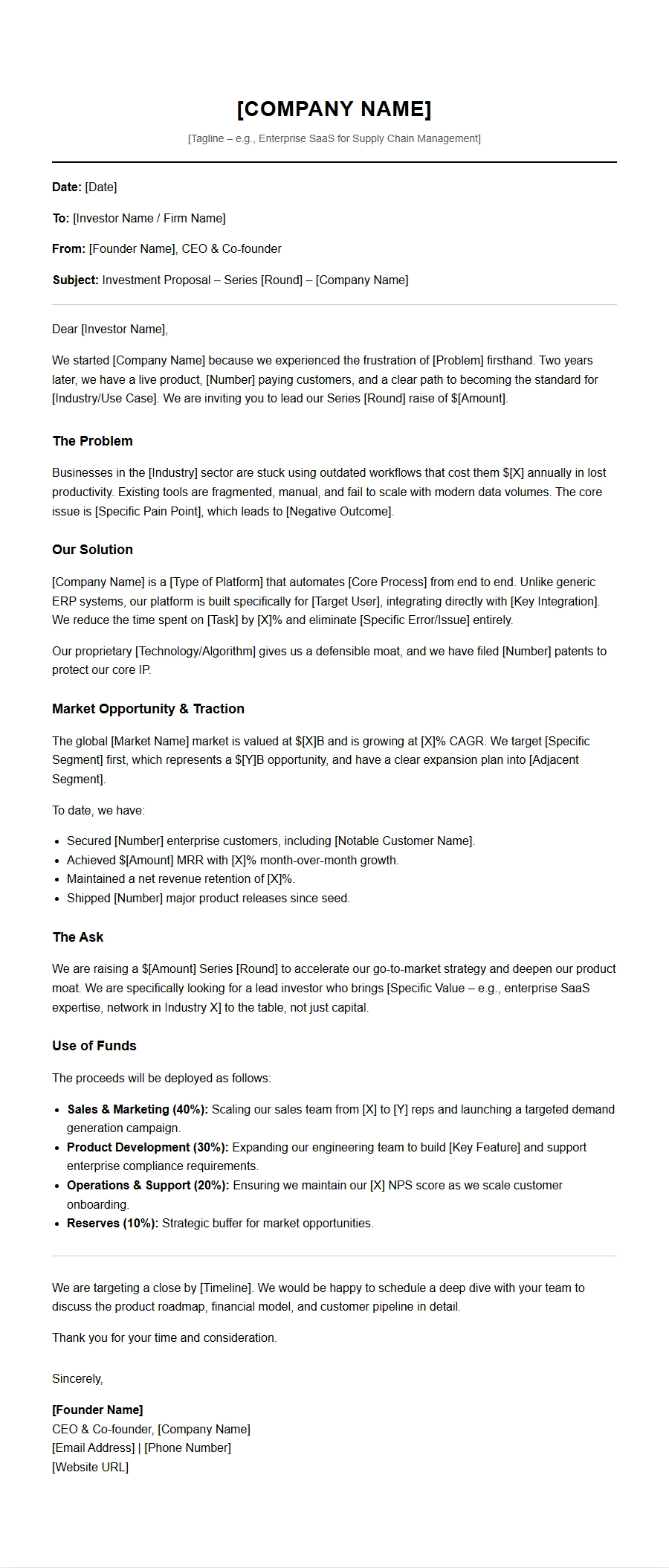 Startup Investment Proposal Letter Template