Perfect Wording for Product Launch Customer Invites
You’ve spent months building something great. The features are polished, the demo is ready, and the launch date is on the calendar. But when you sit down to write the invitation that will get customers to show up, the words just don’t come. It’s a familiar kind of pressure. You want to sound professional, but not stuffy. Exciting, but not desperate.
This is exactly where a well-written sample invitation letter becomes your best tool. It’s not about cheating. It’s about starting from a structure that already works. It gives you the **business letter format**, the key phrases, and the logical flow so you can focus on adding your specific product details and brand voice.
In the world of **customer invitation letters**, a product launch invite has a unique job to do. It needs to create anticipation and clearly communicate the value of attending. It’s different from a general newsletter or a sales pitch. It’s a personal call to witness something new.
What tone should you use?
First, decide on the tone. Are you a cutting-edge tech startup inviting early adopters? Or an established brand launching a premium line? Your wording should match. A formal invitation might use “We cordially invite you,” while a casual one might say “Join us for a first look.” Both work, but in different contexts.
The biggest mistake is making the invitation about the product’s features. Make it about the customer’s gain. “See how our new tool cuts your workflow in half.” “Be the first to taste our new seasonal blend.” The best **invitation wording** answers the reader’s silent question: “What’s in it for me?”
Sometimes, the best way to nail a professional invite is to look at other successful examples. While a charity gala letter asks for support, the structure of a compelling ask is very similar. It introduces a need and invites action.
What are the key parts of a launch invite?
A good product launch letter needs a few essential components. Without them, your message gets messy and customers lose interest.
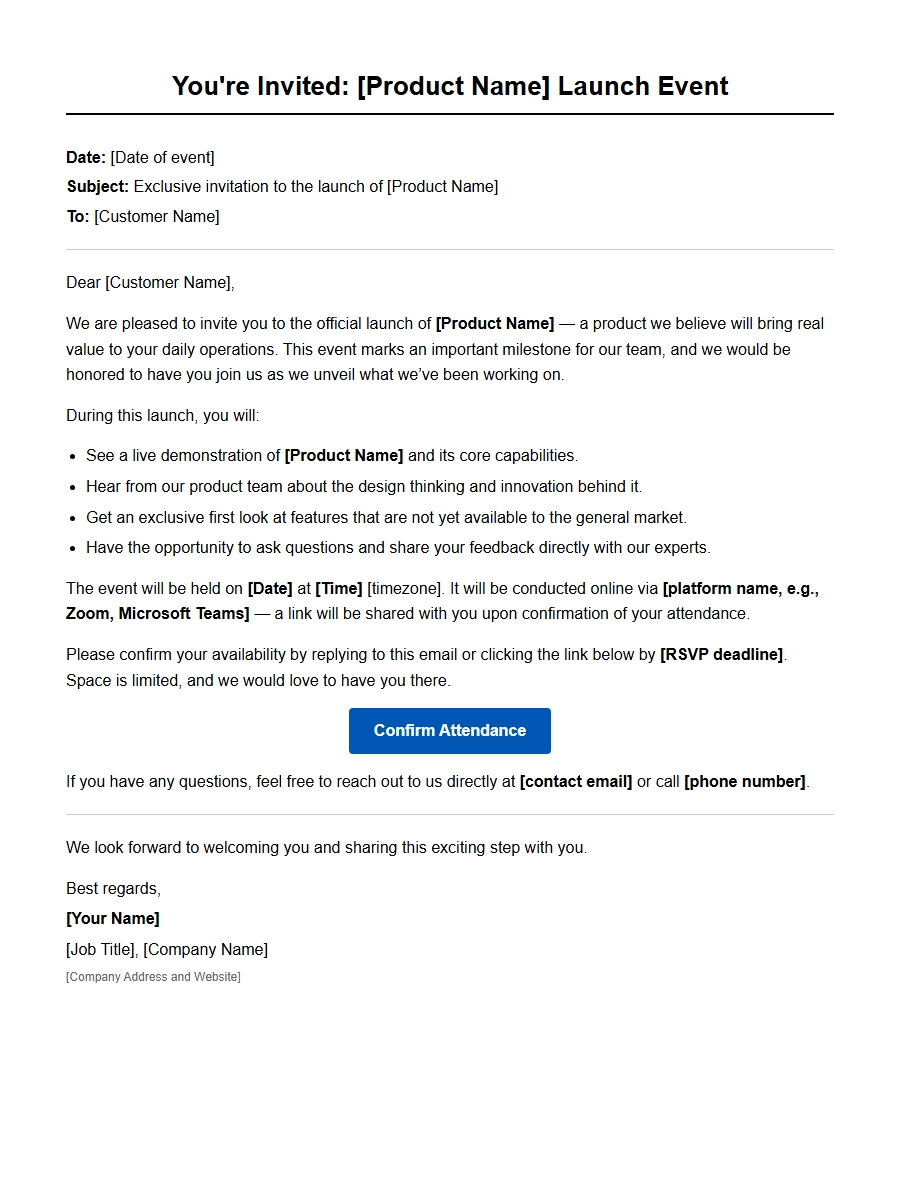
The subject line or headline. Be clear and spark curiosity. “You’re Invited: The Launch of [Product Name]” works because it’s direct. It tells the reader exactly what to expect.
The salutation and opening. A warm but direct greeting sets the tone. “Hi [Name], we built this for you” feels personal. It immediately connects the product to the customer’s needs.
The details. Don’t bury the date and time. Use bold text for the key info. If it’s a virtual event, make the link obvious. If it’s in person, include the address and parking instructions. Clear details build trust.
A strong call to action. “Reserve your spot” is much better than “Let us know.” Be specific about what you want them to do. A weak CTA is the fastest way to lose momentum.
How to adapt a sample without losing your voice
Once you have a sample, customize it heavily. Don’t just swap the product name. Add a line about what you’ve learned from your customers. Mention a specific update they requested. This personal touch transforms a template into genuine **professional correspondence**.
For a product launch, you want to create a sense of exclusive community. That feeling of being “in the know” is something you also see in well-crafted personal invites. A bridal shower invitation makes the guest feel specially selected. Your launch invite should do the same for your customer.
If your product is creative or artistic, borrowing evocative language from an arts contest invitation can help set the right mood. It signals that your launch is an event, not just another sales email.
The goal is to make people feel wanted and excited to join. This is similar to the community-driven pull you find in a family reunion gathering invitation. A good invite makes the reader feel like they’re part of something special.
Even the personal warmth from a family dinner invitation can inspire you. The principle of making someone feel personally wanted is the same, even in a business context.
Common mistakes to avoid
Ever received an email that felt like it was written by a robot? That happens when the **letter template** isn’t customized enough. Avoid long, generic sentences. Keep it concise.
Another mistake is using outdated language. “Dear Sir or Madam” feels stiff for most modern product launches. Use “Hi [Name]” or “Hello [Name]” unless your industry requires a formal approach.
Don’t forget to proofread. A typo in the link or time is an easy way to lose credibility. Read it out loud before you hit send. If it sounds awkward to you, it will sound awkward to your customer.
Use the sample as a springboard
The perfect product launch invite feels less like a mass email and more like a personal note from a founder who is genuinely excited to share something new. Use the sample as your roadmap, but let your own voice drive the car. Write it, step away, and come back with fresh eyes. If it sounds like something you’d be happy to receive, you’re ready to launch.
Ready-to-Use Examples
Perfect Wording for Product Launch Customer Invites
Exclusive Launch Event for Premium Customers
Dear valued customer,
We are thrilled to invite you to the exclusive launch of our latest product, InnovateX Pro. As a member of our premium customer circle, you get first access to see, touch, and experience the future of productivity.
Detail
Information
Date
Friday, May 24, 2025
Time
6:00 PM – 9:00 PM
Venue
Skyline Pavilion, 123 Tech Avenue
Dress Code
Smart Casual
What to expect:
Live product demonstration by our CEO
Hands-on experience stations
Complimentary refreshments and networking
Exclusive pre-order discount of 20%
Please RSVP by May 10 via the link in your email. Seats are limited. We look forward to celebrating with you.
Warm regards, The InnovateX Team
Product Launch Webinar Invitation
Hello,
You are cordially invited to our virtual product launch webinar for CloudSync 3.0 – the next generation of seamless data management. Join us from anywhere in the world to see what’s new.
Time (EST)
Agenda
10:00 AM
Welcome & Opening Remarks
10:15 AM
Product Walkthrough & Features
10:45 AM
Q&A Session
11:00 AM
Exclusive Launch Offer Announcement
Date: Wednesday, June 5, 2025 Platform: Zoom (link sent after registration)
To reserve your spot, please register using the link below. All registrants will receive a free trial of CloudSync 3.0 for one month. Don’t miss this opportunity to be among the first to upgrade your workflow.
Register now at: cloudsync.com/webinar-register
We look forward to seeing you online!
The CloudSync Team
Early Access Invitation for Loyal Customers
Dear loyal customer,
As one of our most valued patrons, you are invited to get early access to our newest kitchen appliance – ChefMaster Elite. Before we open sales to the public, you can order now and enjoy exclusive perks.
Early access benefits:
Priority shipping – receive your unit before anyone else
Free accessory bundle worth $75
Lifetime warranty upgrade at no extra cost
Members-only pricing – see table below
Variant
Public Price
Your Price
ChefMaster Elite (Standard)
$299
$249
ChefMaster Elite (Pro)
$399
$329
Use promo code EARLY25 at checkout. This offer is valid until May 30, 2025. Quantities are limited, so act now.
You’re invited to celebrate the launch of SoundWave Bluetooth Earbuds at our flagship store! Bring your friends and enjoy an evening of music, demos, and exclusive deals.
Event Details
Date
Saturday, April 19, 2025
Time
2:00 PM – 6:00 PM
Location
123 Main Street, Downtown
Special highlights:
Test the earbuds with live audio stations
Meet the product designers
Snap a photo at our immersive booth
Receive a free charging case with any purchase
Enter to win a year’s supply of accessories
No RSVP required – just drop in! First 50 guests get a complimentary drink. We can’t wait to see you there.
Best, The SoundWave Team
VIP Launch Party for Beta Testers
Dear beta tester,
Your feedback helped shape EcoCharge 2.0, and now we want to thank you in style. You are cordially invited to our VIP launch party – an evening of celebration, surprises, and first dibs on the final product.
Schedule
Activity
7:00 PM
Cocktail Reception
7:45 PM
Unveiling Ceremony
8:15 PM
Product Showcase & Hands-on
9:00 PM
Networking & Giveaways
Date: Thursday, May 8, 2025 Venue: The Loft, 456 Innovation Drive
Each attendee will receive a complimentary EcoCharge 2.0 unit as our gift. Please confirm your attendance by May 1 using the personalized link in your email. Space is very limited.
Thank you for being part of our journey.
Cheers, The EcoCharge Team
Product Launch Breakfast Briefing
Dear executive,
We invite you to a breakfast briefing for the launch of DataGuard Enterprise Suite. Join us for a concise, high-value session designed for decision-makers like you.
Time
Item
8:00 AM
Breakfast & Networking
8:30 AM
Keynote: The Future of Data Security
9:00 AM
Product Demo & Case Studies
9:30 AM
Q&A & One-on-One Meetings
Date: Tuesday, June 10, 2025 Location: The Grand Ballroom, Hilton Metropolis
Seating is limited to 50 guests. Please RSVP by June 3. You will receive a detailed briefing packet and a complimentary one-month trial. We look forward to an insightful morning.
Regards, DataGuard Events Team
Virtual Launch Event with Demo
Hello,
You’re invited to the virtual launch of ArtFlow Studio – a revolutionary digital painting tool for creatives. Watch our live demo from the comfort of your home.
What you’ll see:
Real-time painting on an interactive canvas
New AI-assisted brush engine
Cloud collaboration for teams
Exclusive early-bird pricing available only during the event
Date: Monday, May 12, 2025 Time: 3:00 PM – 4:30 PM (UTC) Platform: YouTube Live (link will be emailed)
Register using the form at artflow.studio/launch-event. All registrants get a free 14-day trial. Join us and unleash your creativity!
Best, The ArtFlow Team
Launch Day Special Offer Invitation
Dear customer,
We are launching PowerGen Solar Charger today, and you are invited to take advantage of an exclusive, time-limited offer. For the next 48 hours, you can purchase the PowerGen at a special launch price.
Product
Regular Price
Launch Price
Savings
PowerGen 20W
$49
$34
30% off
PowerGen 40W
$79
$54
31% off
PowerGen Bundle (2 units)
$129
$89
31% off
Use code LAUNCH25 at checkout. Free shipping on orders over $50. This offer ends May 15 at 11:59 PM. Don’t miss your chance to own the most efficient solar charger on the market.
Shop now: powergen.com/launch-day
Thank you for being a part of our journey.
Sincerely, The PowerGen Team
Partner Product Launch Co-Invite
Dear partner,
We are excited to co-host the launch of SecureLink VPN Pro, developed in collaboration with our technology partner, NetShield Inc. You are invited to join us for this milestone event.
Why attend:
Learn how SecureLink VPN Pro can protect your business
Network with NetShield engineers and our team
Receive a 20% partner discount on annual subscriptions
Get early access to reseller materials
Event Details
Date
Thursday, May 22, 2025
Time
4:00 PM – 7:00 PM
Location
NetShield HQ, 789 Security Blvd
Please RSVP by May 15. A light dinner will be served. We value your partnership and look forward to growing together.
Best regards, The SecureLink Team & NetShield Inc.
Trade Show Launch Invitation
Dear attendee,
We are thrilled to invite you to the official launch of VisionGlass AR at the Global Tech Expo 2025. Visit our booth for an exclusive first look.
Booth Information
Expo Dates
June 12–14, 2025
Booth Number
#1425 in Hall B
Daily Demo Times
10 AM, 1 PM, 4 PM
What awaits you:
Live demonstration of VisionGlass AR with interactive applications
Exclusive trade show pricing – save 25% on pre-orders
Free AR demo kit for first 100 visitors
Meet our R&D team and get your questions answered
Don’t forget to bring this invitation to receive a voucher for a complimentary coffee. We can’t wait to show you the future of augmented reality.
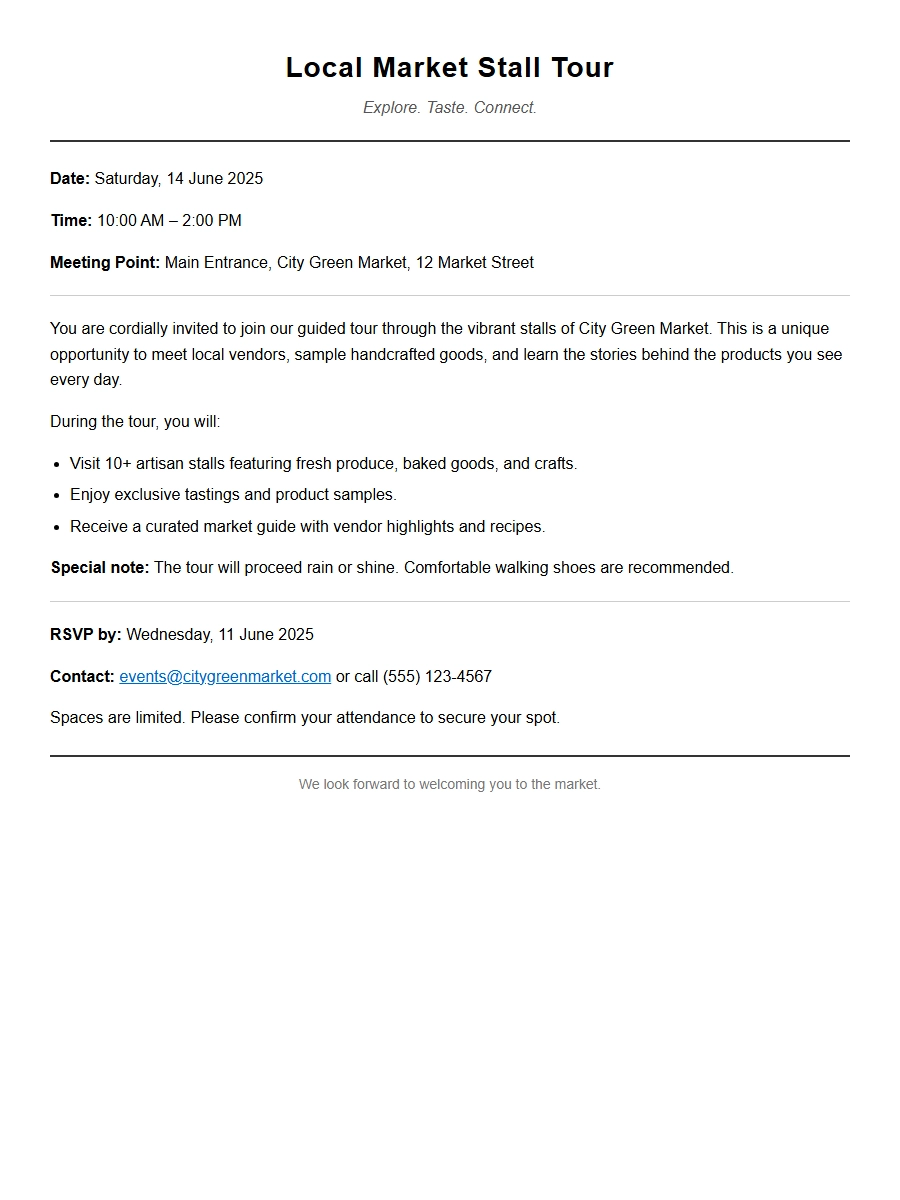 sample invitation for local market stall tour - Invitation Letters
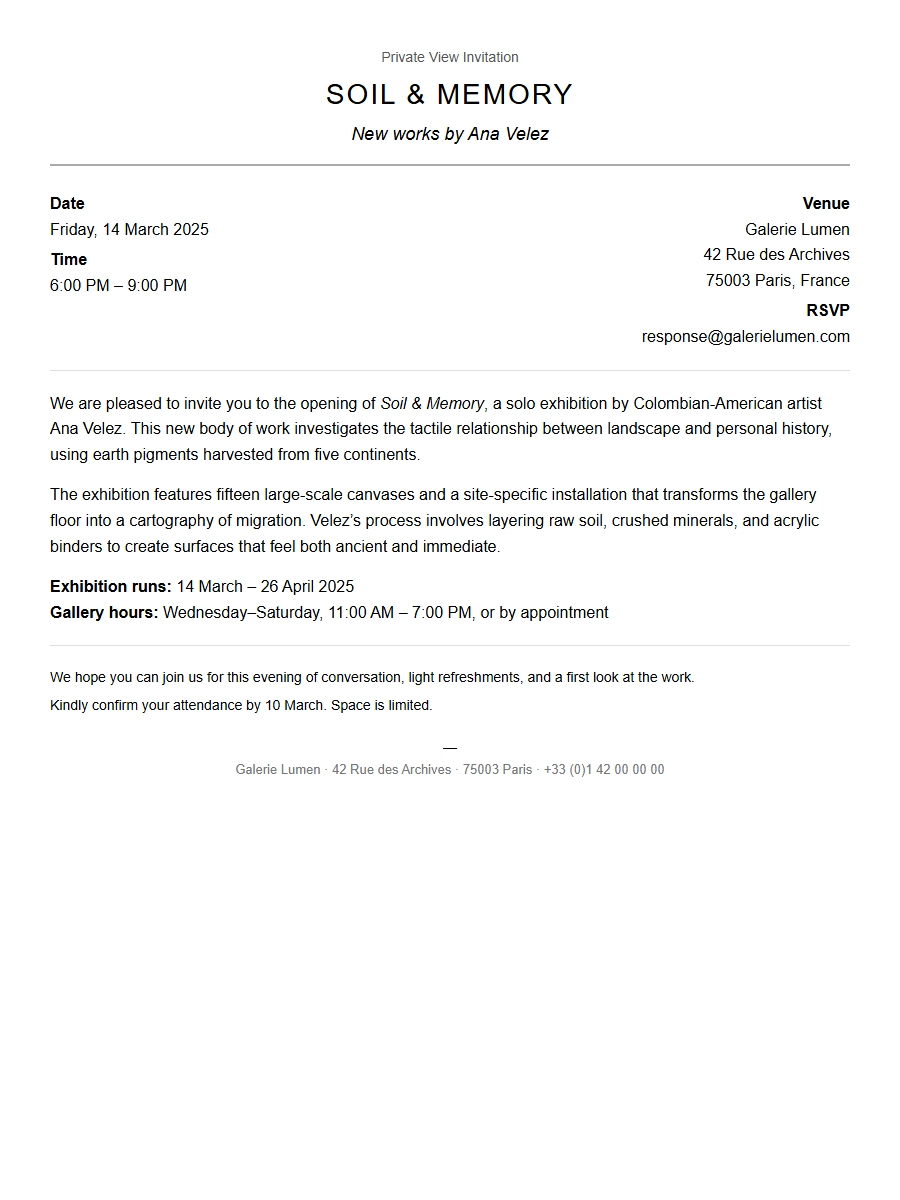 Art Exhibition Opening Invitation Wording Ideas
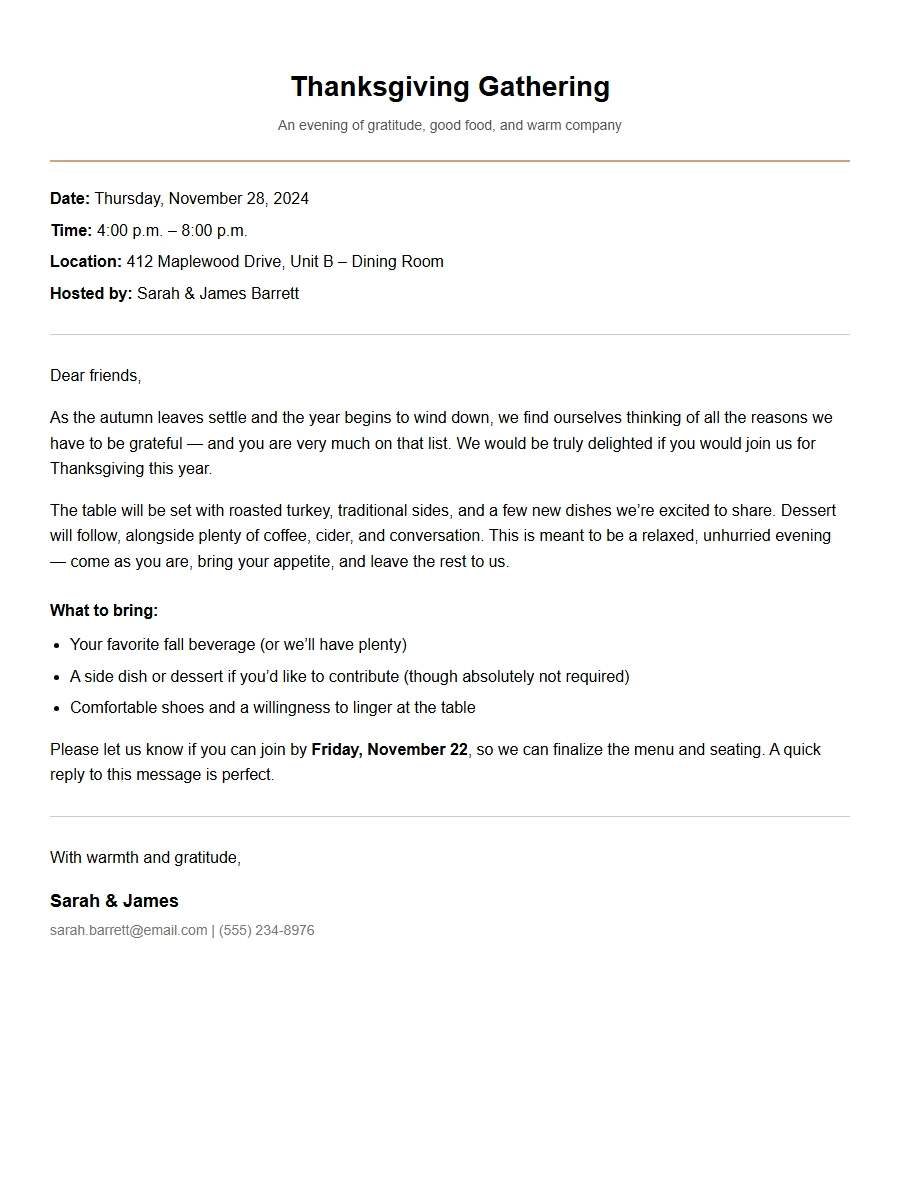 Thanksgiving Meal Gathering Invitation Text
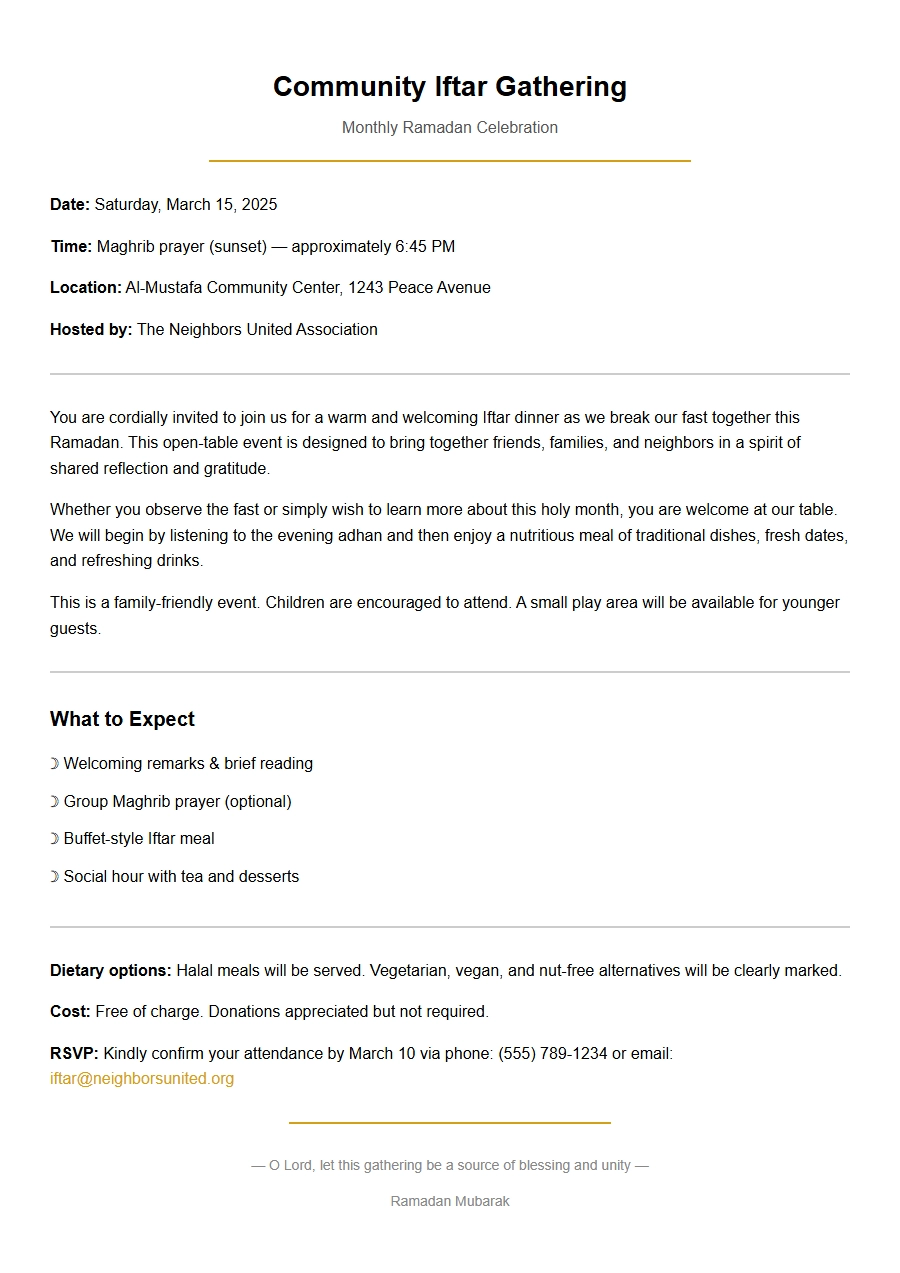 Ramadan Iftar Community Event Invitation
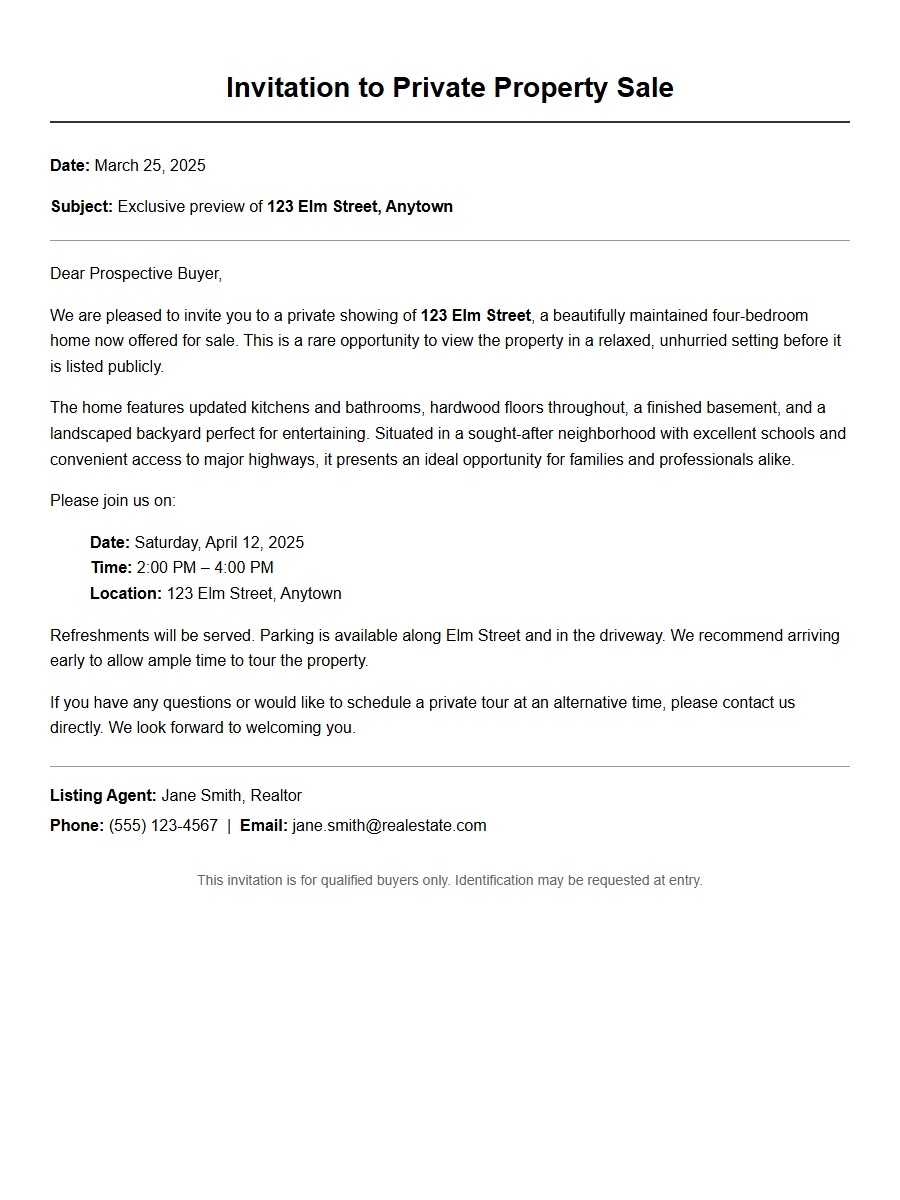 Sample Wording for Property Sale Invitations
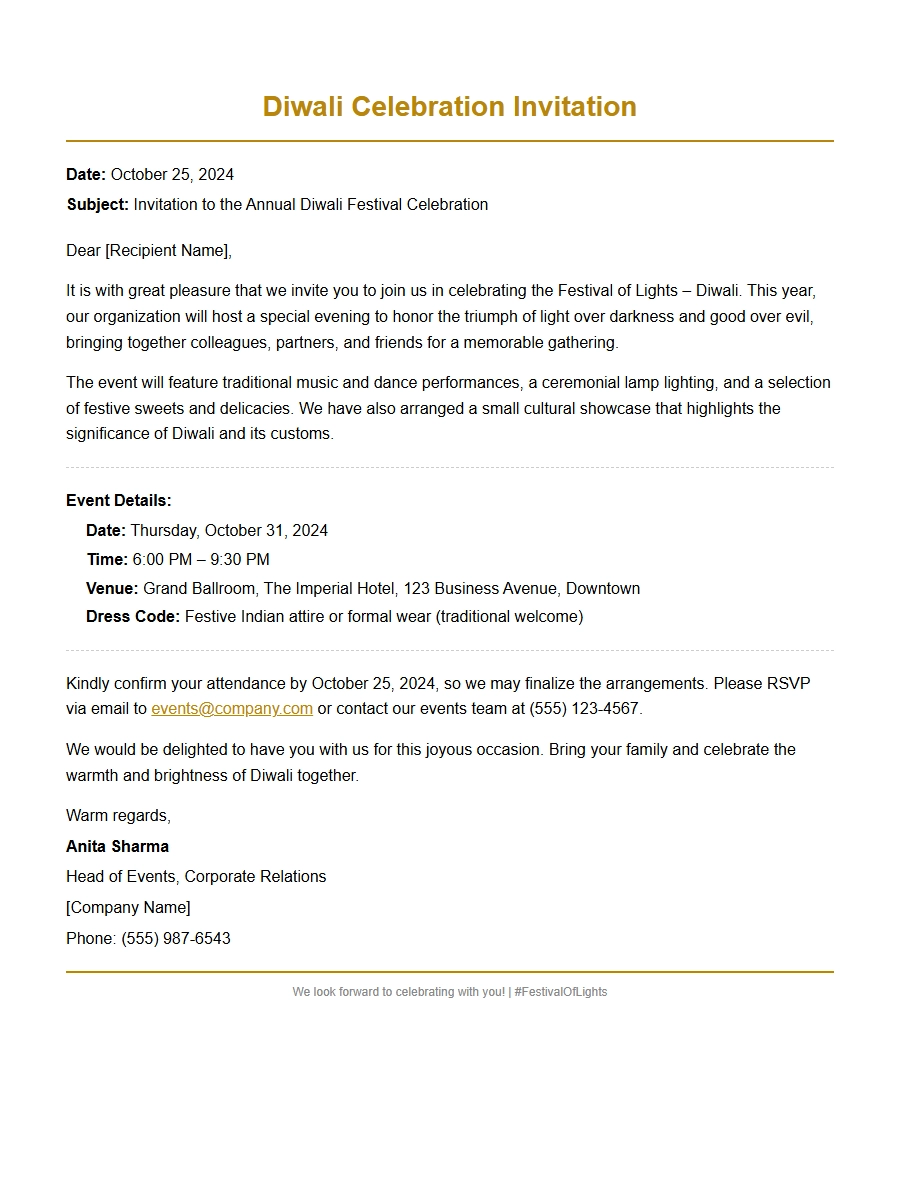 Diwali Festival Celebration Invitation Draft