You’ve landed the role of organizing a black tie gala, and now you need to send out formal invitation letters. The pressure to get the language just right—elegant but not stiff, official but not cold—can stop you in your tracks. But staring at a blank page is the last thing you need when invitations are due. A well-chosen sample can turn that anxiety into a confident draft in minutes.
Using a sample isn’t cheating. It’s a smart strategy that gives you a proven structure, the right tone, and key phrases you can personalize. Think of it as a starter template that saves you from reinventing the wheel. You still make it your own—every invitation should reflect your event’s personality and your organization’s voice.
What makes a black tie gala invitation letter different?
A black tie gala signals formality, elegance, and a sense of occasion. Your invitation letter needs to match that expectation. The salutation, body, and closing all carry weight. You’ll use formal titles like “Mr.” or “Dr.”, a respectful opening such as “It is our distinct pleasure to invite you,” and a clear note about dress code. The tone should convey importance without sounding pompous.
If you’re unsure about the level of formality, look at similar events in your field. A charity gala for a nonprofit might lean warmer than a corporate awards dinner. The key is consistency—your letter structure should mirror the event’s prestige.
Category: Formal Invitations
How to choose the right sample for your gala
Not all invitation letters are created equal. A black tie gala sample will include elements like “black tie required” or “formal attire,” and it may reference a specific cause or honoree. If your event is semi-formal, you can tone down the language but keep the respectful structure. Consider the industry: a gala for a local museum might use slightly different phrasing than one for a corporate anniversary.
When you browse templates, look for ones that include space for a guest name, event date, time, venue, RSVP details, and a personal note. The best samples are customizable—they let you swap out the reason for the gala while keeping the polished framework.
Adapting a sample without losing your voice
Once you pick a sample, treat it as a framework, not a script. Start by changing names and event details. Then adjust the tone. If the sample uses “We cordially request the honor of your presence” but your organization is more modern, try “We warmly invite you to join us.” That small shift keeps the formality but feels less stiff.
Pay close attention to the opening paragraph. This is where you hook the reader. Instead of a generic line, lead with a compelling reason: “Because of your generous support, we have transformed our scholarship program—now we want to celebrate with you in style.” That personal touch makes the invitation feel exclusive.
Common mistakes to avoid
Even with a good sample, people slip up. One classic error is using outdated salutations like “To Whom It May Concern” for a guest you know by name. Always use a specific name and proper title. Another mistake is ignoring the format. A printed letter on letterhead looks different from an email. For digital invitations, keep the same professional language but shorten paragraphs and avoid long lines. Test how the letter appears on mobile.
Also, proofread carefully before sending. A typo in the date or dress code can cause confusion. Read the letter aloud to catch awkward phrasing. And don’t forget the closing—use “Yours sincerely” if you used the recipient’s name, “Yours faithfully” if you didn’t.
Tone in writing: balancing elegance and warmth
The best invitation letters feel both professional and personal. You’re not sending a contract; you’re extending a hand. For a black tie gala, you might include a short line about the event’s impact (“Your presence helps fund vital research”) to give the invitation meaning beyond the party. Avoid hype words like “incredible” or “unforgettable” unless they match your brand. Simple, direct language often sounds more sincere.
If you need ideas for other types of formal correspondence, you can look at invitation drafts for different occasions. For instance, a vendor showcase event invitation draft might use a more business-like tone, while a Mother’s Day celebration letter is warmer and shorter. Compare the structures to see how language shifts with the event type. Similarly, baby naming celebration invites lean casual, and yoga retreat sign-up letters blend informality with clarity. Even alumni meetup texts can give you ideas for a less formal RSVP line. The point is to borrow what works for your context.
Use the sample as a springboard
Your first draft won’t be perfect, and that’s fine. Start with a solid template, then customize it until it sounds like you. Over time, you’ll develop a feel for what works—and you’ll write these letters faster each time. The goal is a letter that your guests open, read, and feel eager to respond to.
So pull up a sample, make a cup of coffee, and write the first sentence. The rest will follow.
Ready-to-Use Examples
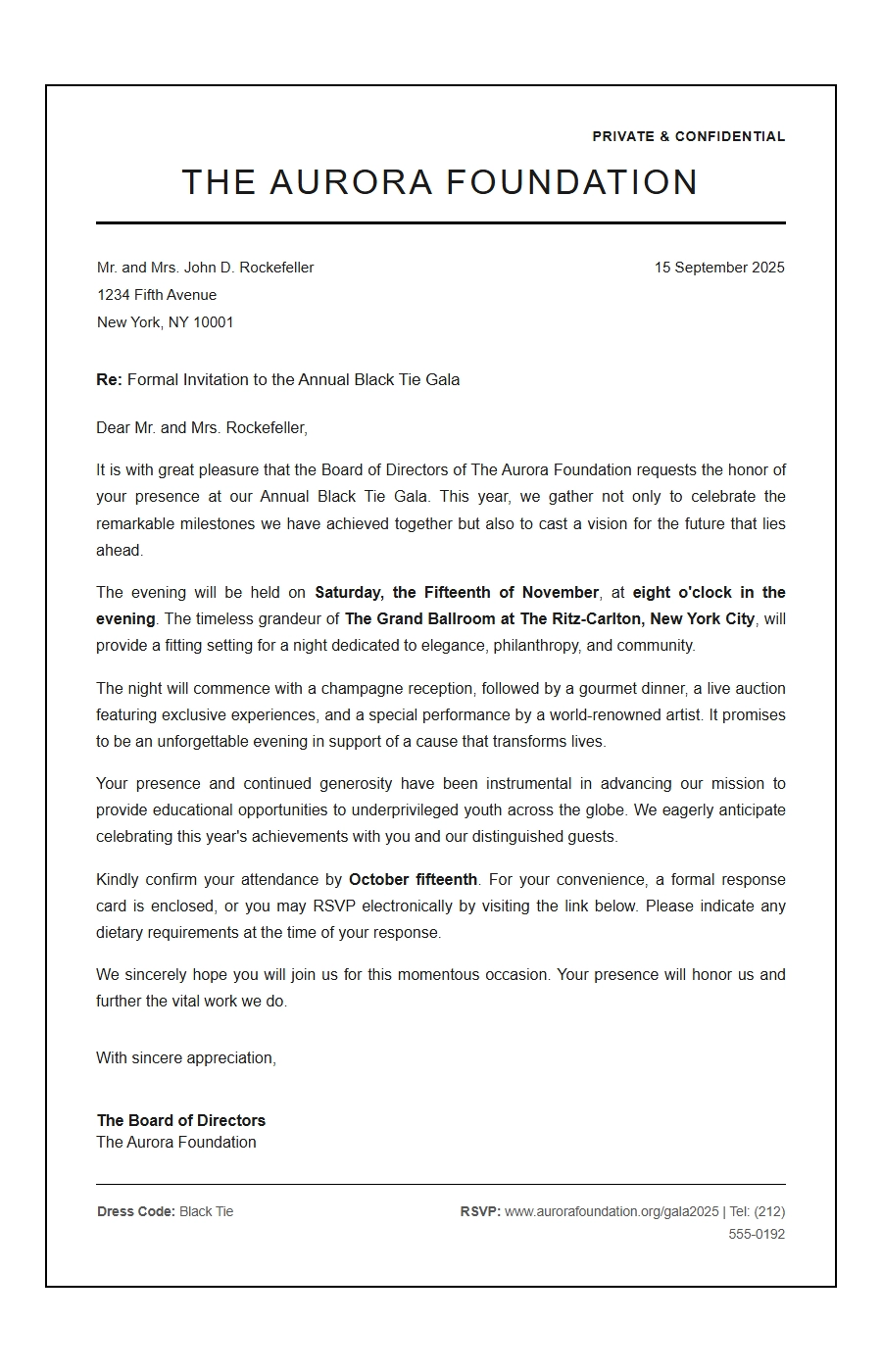
Formal Black Tie Gala Invitation Letter
Annual Charity Gala Invitation
You are cordially invited to the Annual Charity Gala, an evening of elegance and philanthropy in support of the Children’s Health Foundation.
The event will be held on Saturday, 15th November 2025 at The Grand Ballroom, 200 Park Avenue, New York, NY. Cocktails begin at 7:00 PM, followed by dinner and a live auction at 8:00 PM.
Dress code: Black Tie. Please reserve your place by 1st November.
Ticket Type
Price
Includes
Individual
$500
Dinner & open bar
Couple
$900
Two dinners & open bar
Table of 10
$4,500
Premier seating & champagne
For reservations, please reply to this invitation or contact our events team at gala@charity.org or (212) 555-0192.
Corporate Milestone Gala Invitation
On behalf of the Board of Directors, we are delighted to invite you to the 25th Anniversary Gala celebrating two and a half decades of innovation and success.
This black-tie affair will take place on Friday, 20th June 2025 at The St. Regis Hotel, 2 East 55th Street, New York, NY. Reception at 6:30 PM, dinner and awards ceremony at 7:30 PM.
Please RSVP by 1st June using the enclosed reply card or email us at rsvp@company.com. A formal invitation will be mailed upon confirmation.
Guest of Honor: Founder & CEO, James Harrison
Entertainment: Live orchestra and silent auction
Parking: Valet parking included
We look forward to celebrating this milestone with you.
University Alumni Black Tie Gala
Dear Alumni, the University of Cambridge Alumni Association invites you to the annual Black Tie Gala, honoring distinguished graduates and supporting future scholarships.
Join us on Saturday, 8th March 2025 at King’s College Hall, Cambridge. Drinks reception from 7:00 PM, dinner and keynote address at 8:00 PM. Dress: Black tie.
Please confirm attendance by 20th February using the link: alumni.gala@cam.ac.uk. Seats are limited.
Category
Fee
Benefit
Standard
£150
Dinner & networking
Supporter
£250
Premium table & program mention
Bring your memories and your dancing shoes for an unforgettable evening.
Museum Fundraising Gala Invitation
The Metropolitan Art Museum requests the honor of your presence at our annual Black Tie Gala, a night dedicated to preserving cultural heritage.
Date: Saturday, 12th April 2025 at The Museum Great Hall, 1000 Fifth Avenue, New York, NY. Evening begins with cocktails at 6:30 PM, followed by a curated dinner and auction of exclusive artworks.
Dress code: Black tie. Your attendance supports our education programs.
Keynote Speaker: Dr. Elena Rossi
Live Music: Jazz quartet
Special Exhibit: New impressionist collection
Kindly RSVP by 28th March to development@metmuseum.org. Donation options include a patron table at $10,000.
Political Campaign Gala Invitation
Senator Maria Lopez cordially invites you to a Black Tie Gala supporting her re-election campaign for a stronger, more equitable state.
Date: Friday, 5th September 2025 at The Ritz-Carlton, 1150 22nd Street NW, Washington, DC. Reception at 7:00 PM, dinner and remarks at 8:00 PM. Black tie attire required.
Your presence and support are vital. Please RSVP by 22nd August to events@lopezcampaign.org or call (202) 555-0147.
Sponsorship Level
Amount
Inclusions
Host
$25,000
Table for 10 & photo with Senator
Friend
$5,000
Two tickets & program mention
Together, we can make a difference.
Medical Research Gala Invitation
On behalf of the Mayo Clinic Research Fund, we invite you to our annual Black Tie Gala, raising funds for groundbreaking cancer research.
The evening will be held on Saturday, 22nd November 2025 at The Hilton Chicago, 720 South Michigan Avenue, Chicago, IL. Doors open at 6:30 PM, dinner at 7:30 PM, followed by a keynote from Dr. Sarah Klein.
Dress code: Black tie. Please RSVP by 8th November to gala@mayoclinic.org.
Dinner Menu: Three-course gourmet meal
Auction: Luxury items and experiences
Entertainment: Acclaimed pianist
Your participation brings hope to millions. Individual tickets are $750; tables of 10 are $7,000.
Film Festival Gala Invitation
The Cannes Film Festival Board is pleased to invite you to the Closing Night Black Tie Gala, celebrating the best in international cinema.
Join us on Saturday, 24th May 2025 at Palais des Festivals, Cannes, France. Red carpet arrivals at 7:00 PM, followed by the awards ceremony and a gourmet dinner.
Attire: Black tie. Please confirm your attendance by 10th May to gala@festival-cannes.com.
Package
Cost
Details
Standard
€500
Seating & reception
VIP
€1,200
Premium seats & after-party
Celebrate cinema under the stars.
Military Ball Gala Invitation
General Robert Mitchell and the Officers of the 1st Infantry Division request the pleasure of your company at the Annual Military Ball, a formal black-tie event honoring service and sacrifice.
Date: Saturday, 1st November 2025 at The Army Navy Club, 901 17th Street NW, Washington, DC. Reception at 1800 hours, dinner and ball at 1900 hours.
Dress: Black tie or full dress uniform. RSVP by 15th October to ball@1stinfantry.mil.
Ceremony: Presentation of colors and awards
Dinner: Formal seated meal
Dancing: Live band
Let us honor our heroes together. Tickets are $200 per person.
Environmental Fundraiser Gala Invitation
The Green Earth Alliance invites you to our annual Black Tie Gala, an evening dedicated to protecting our planet for future generations.
Event details: Saturday, 13th September 2025 at The Nature Center, 1500 River Road, Portland, OR. Cocktails at 6:00 PM, dinner and presentation at 7:00 PM. Black tie requested.
Please RSVP by 1st September to gala@greenearth.org. Your contribution supports reforestation and clean water initiatives.
Tier
Price
Recognition
Tree Planter
$350
Certificate & thank-you gift
Forest Protector
$1,000
Table for two & naming on donor wall
Together, we make a difference.
New Year's Eve Black Tie Gala Invitation
Ring in 2026 with elegance! The Plaza Hotel invites you to a spectacular New Year’s Eve Black Tie Gala.
Join us on Wednesday, 31st December 2025 at The Plaza, 768 Fifth Avenue, New York, NY. Doors open at 8:00 PM, champagne toast at midnight. Dress: Black tie.
Reserve your place by 15th December to newyear@plazaevents.com.
Dinner: Six-course gourmet menu
Entertainment: Live band and DJ
Party favors: Custom champagne flutes
Make this New Year unforgettable. Tickets from $850 per person.
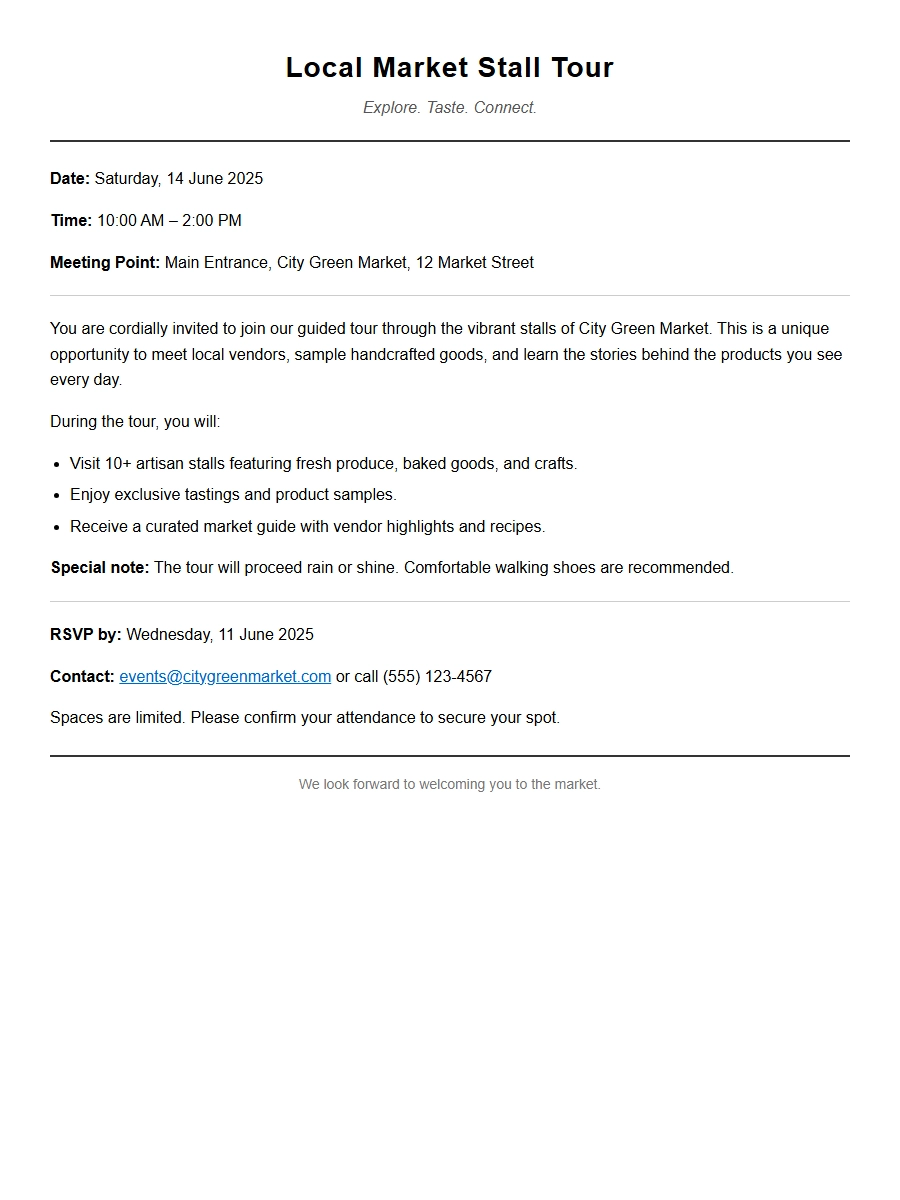 sample invitation for local market stall tour - Invitation Letters
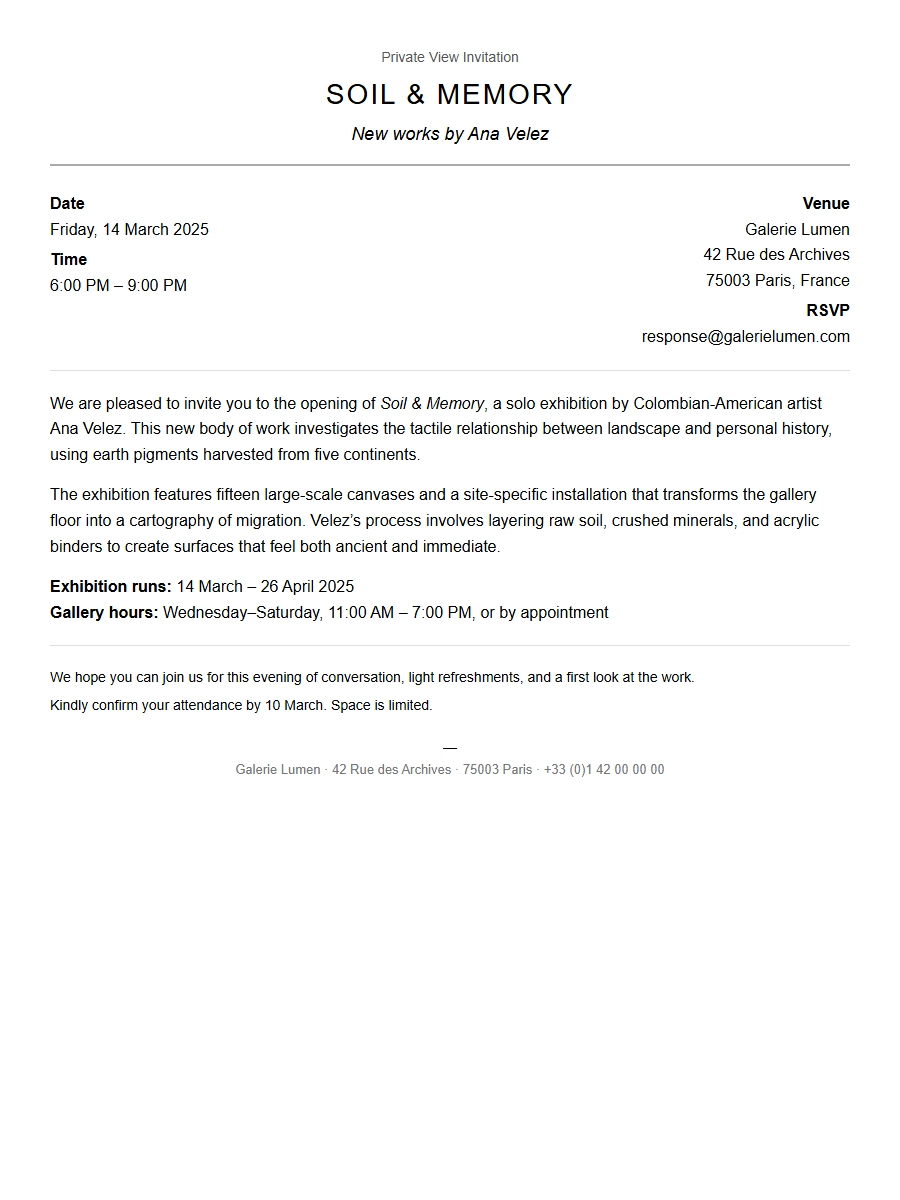 Art Exhibition Opening Invitation Wording Ideas
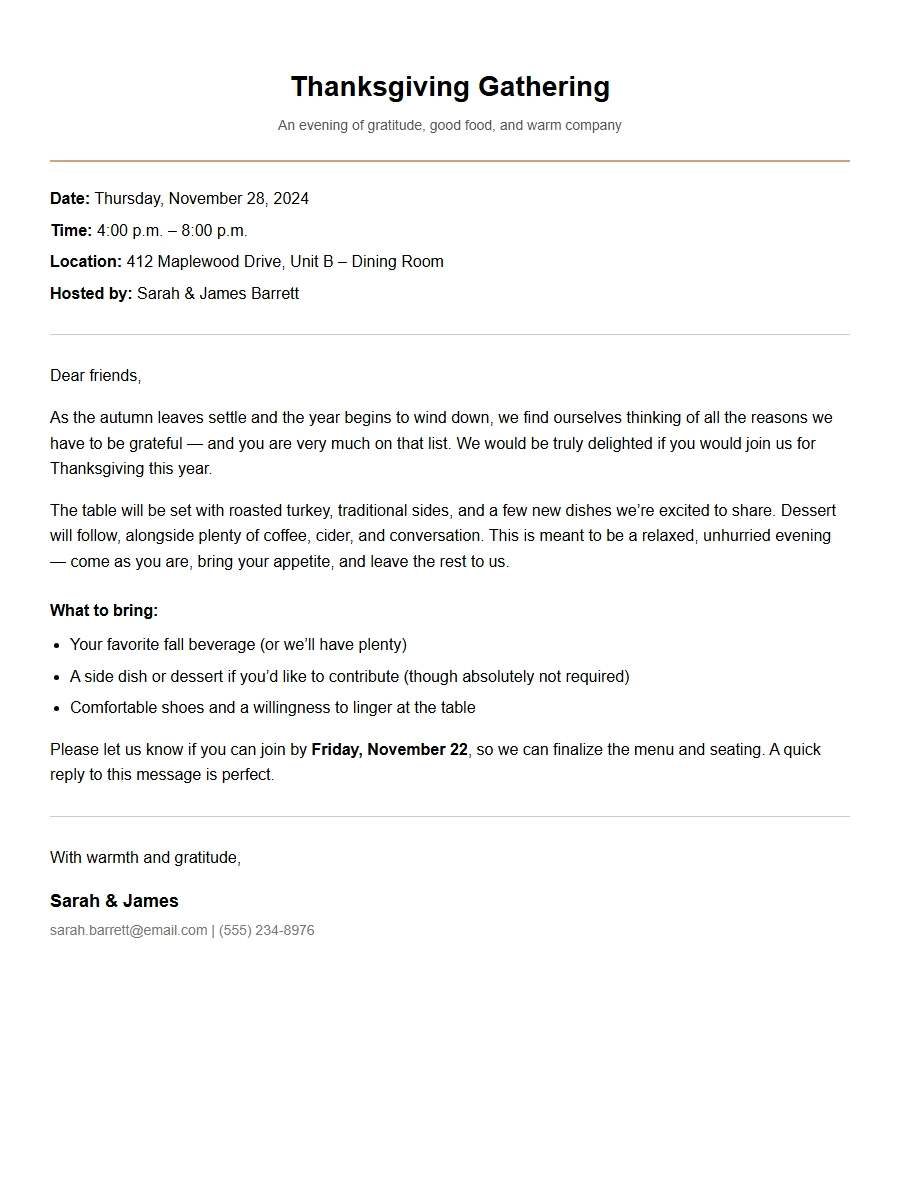 Thanksgiving Meal Gathering Invitation Text
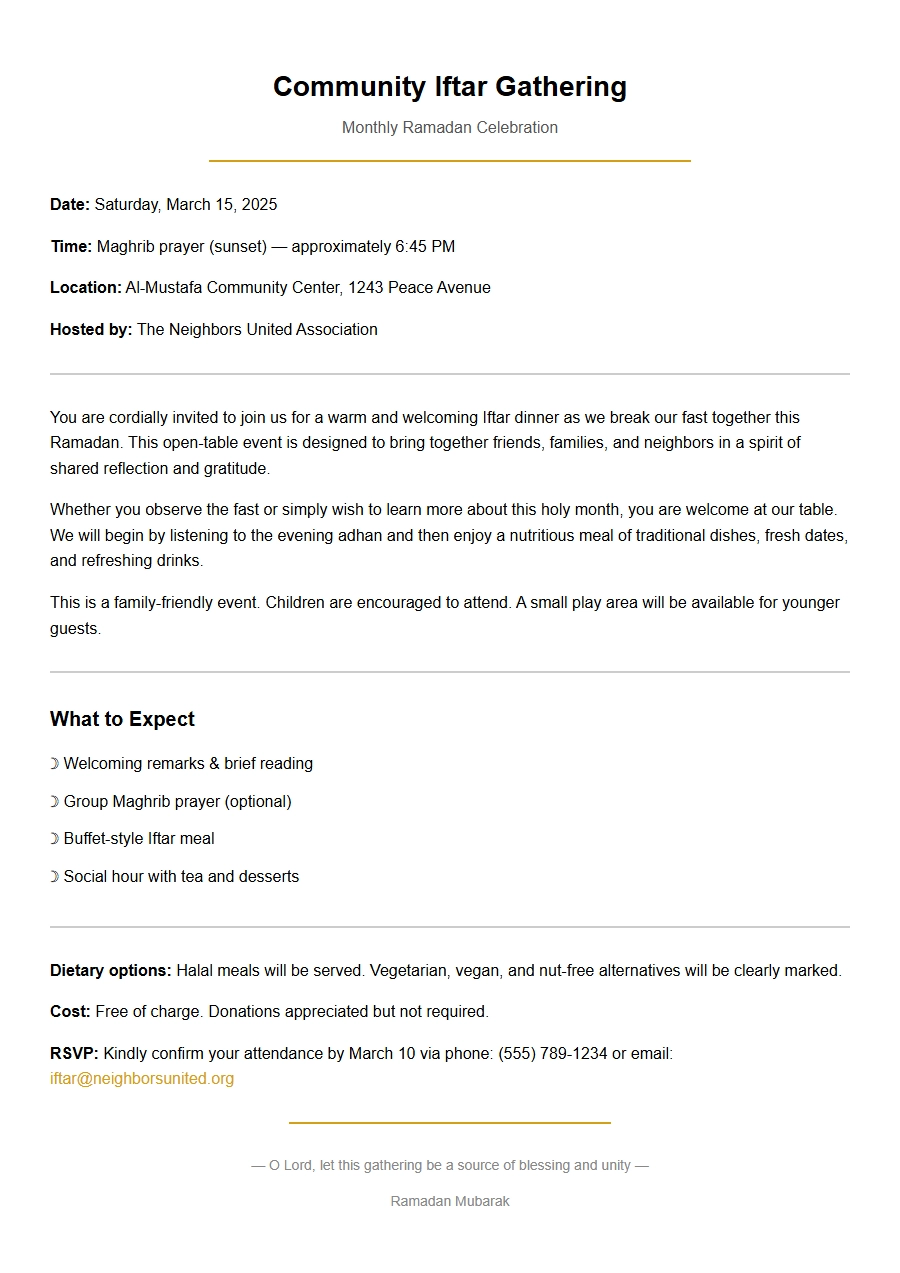 Ramadan Iftar Community Event Invitation
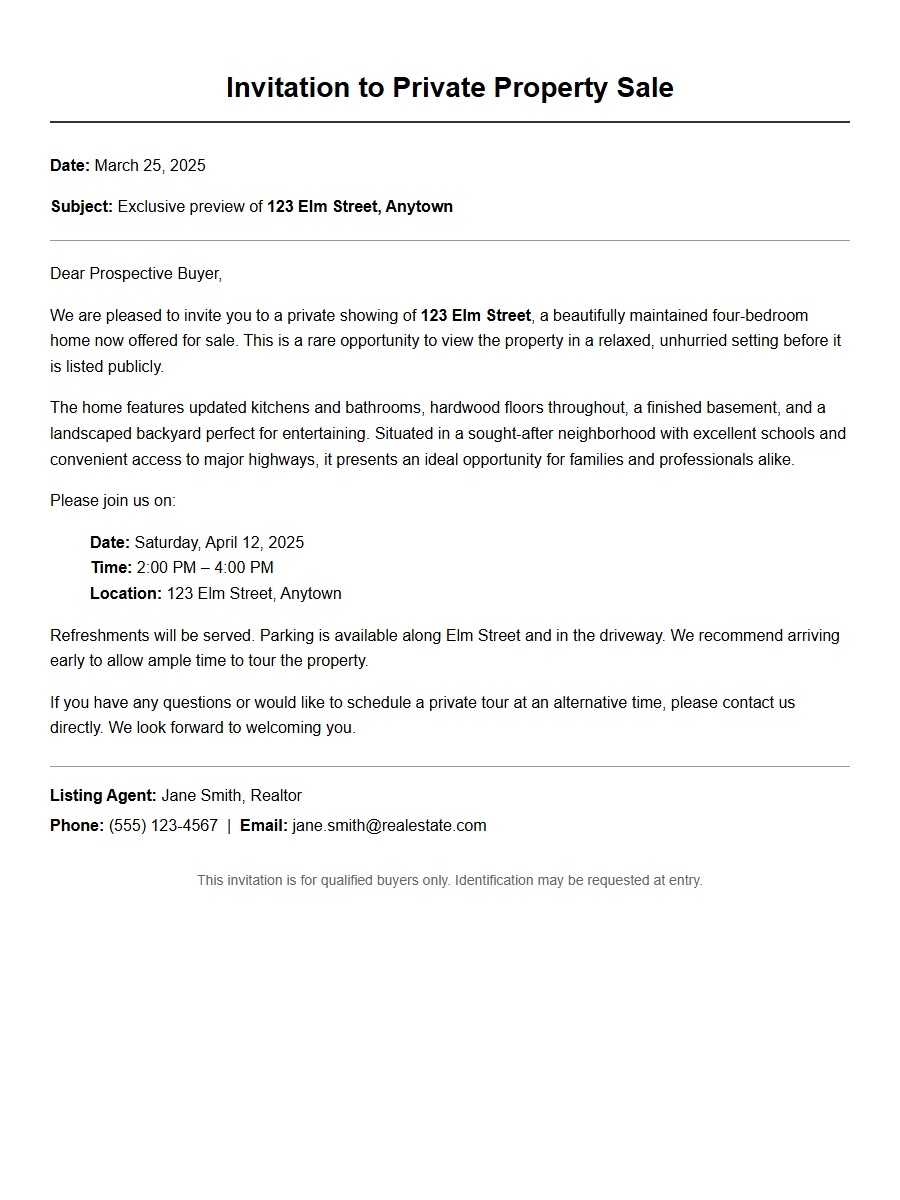 Sample Wording for Property Sale Invitations
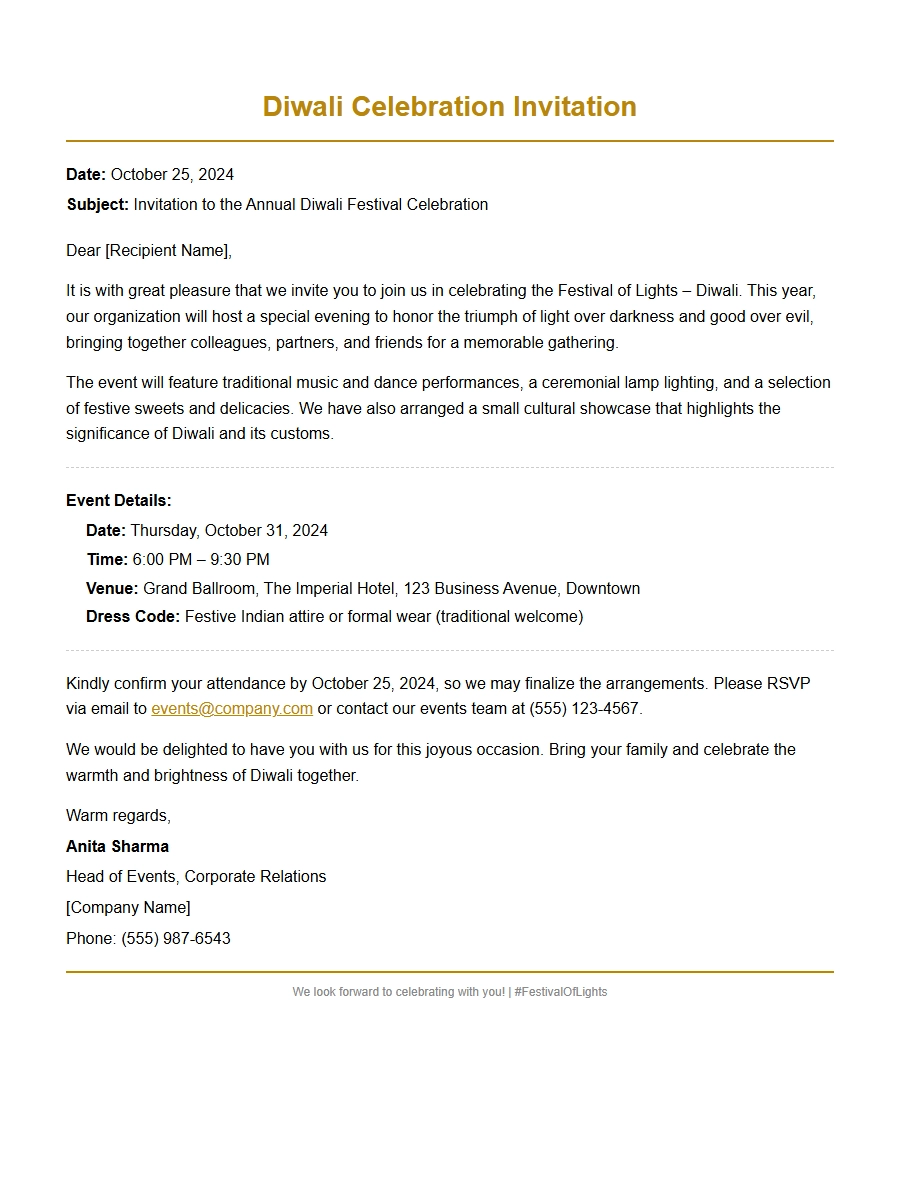 Diwali Festival Celebration Invitation Draft