Staring at a blank page when you need to write a professional invitation can feel paralyzing. You've got the launch date locked in, the venue is ready, and the guest list is sorted. But putting that all into words that actually make clients want to come? That's where things get sticky.
Looking for a sample isn't cutting corners. It's a smart starting point. A good invitation letter template gives you the structure of professional correspondence so you don't have to reinvent the wheel. The real skill is knowing how to adapt it so it still sounds like you—not a generic corporate robot.
Let's walk through exactly how to invite clients to a company launch without losing your authentic voice.
Why use a template in the first place?
Starting from scratch is overrated. A solid sample shows you the correct business letter format, the right salutation and closing for your audience, and how to structure your thoughts logically. It's a framework. You bring the personal details, the specific value, and the genuine excitement about what you're launching. Using a template lets you focus on the content that matters instead of stressing over formatting.
[Category: Client Invitation / Corporate Launch]
How do you pick the right tone for your company launch?
Before you start typing, decide on the vibe. A tech startup launching a new app can get away with a more casual, energetic tone. A law firm or financial advisory group needs a polished, formal writing approach. Look back at your past emails to clients. If you usually write short and direct, don't suddenly draft a 500-word essay for this invitation. Consistency is a key part of good letter writing etiquette. Your invitation should feel like a natural next message from your company, not an awkward outlier.
If your launch involves a specific event—like a demo day or an open house—you might borrow wording from a sample email invitation for a networking mixer to get the flow right.
How do you tailor an invitation without losing your voice?
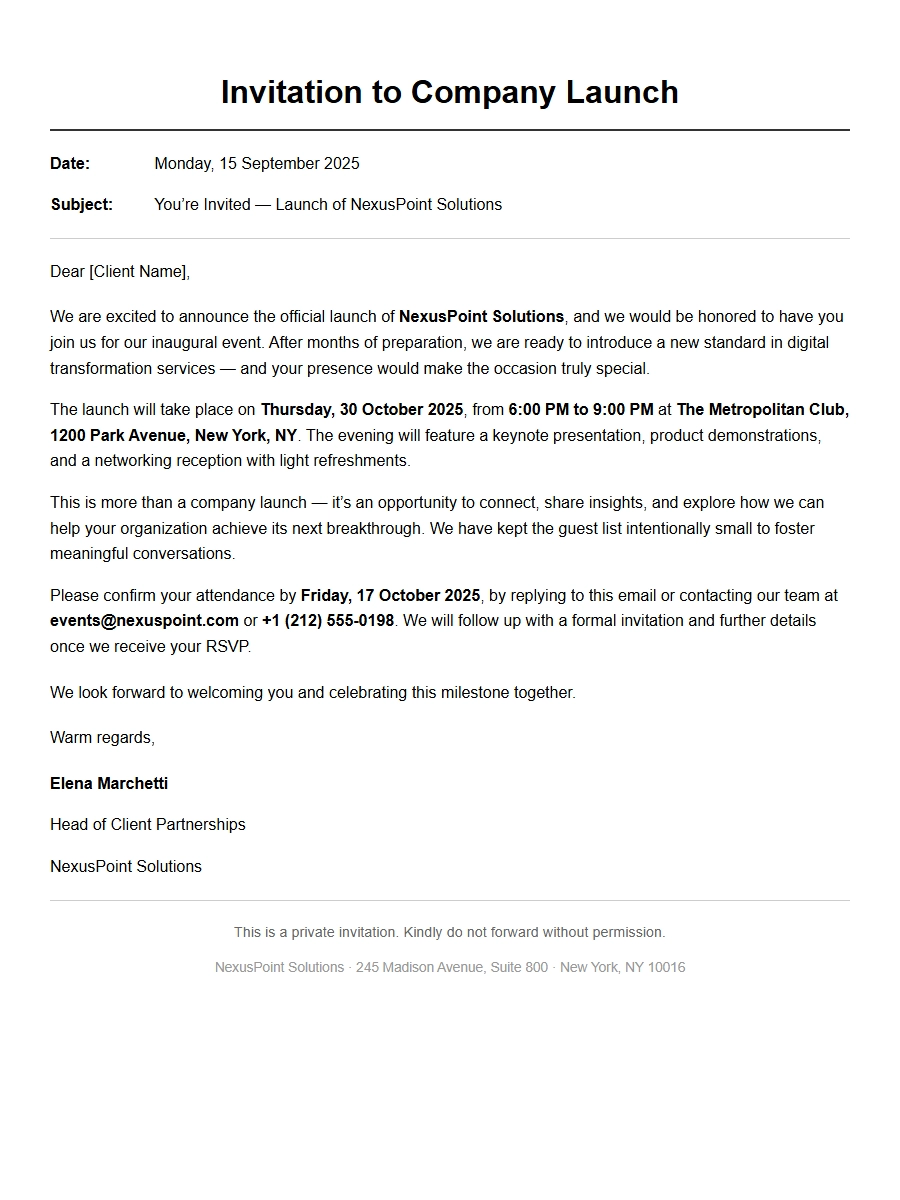
This is where most people mess up. They find a template and just swap out the names. That's a missed opportunity. The opening paragraph is your hook. Instead of "We are pleased to announce our new office," try "You've been a key part of our journey, so we wanted you to be the first to see where we're headed next."
Mention something specific to the client relationship if you can. That small personal touch is worth more than a perfectly formatted letterhead design. If you're including a small gift or token at the event, you can get phrasing ideas from an invitation letter template for a housewarming gift—it helps you present the gesture gracefully without making it feel transactional.
What are the common formatting mistakes?
One of the biggest errors is ignoring the delivery method. A proper digital letter format for email needs a strong subject line and shorter paragraphs. A physical printed letter allows for more formality but demands careful proofreading—a typo on a nice card stock looks sloppy.
Don't use outdated salutations. "To whom it may concern" feels cold for a launch invitation. Use the client's name or a group name like "Dear Valued Partners" if you have to address a crowd. Also, be crystal clear with your RSVP instructions. If you're hosting a meal or a gathering, look at wording for a college send-off party invite or invitation text for a Thanksgiving meal gathering to see how they handle food and logistics politely.
For larger events where you're expecting a crowd, clarity is king. Steal the directness from wording for a track meet spectator invite—it sounds simple, but being direct about time, place, and what to expect goes a long way.
What comes after you send the invitation?
Getting the invite out is just the start. A great launch invitation opens a conversation. Be ready to answer questions, confirm attendance, and build excitement in the replies. Use your sample as a springboard to get the structure and tone right, but lean into your own knowledge of the client to make it personal.
The more you practice this, the faster it gets. Eventually, you'll be able to pull together a polished, warm invitation in minutes. Just remember: the template gives you the bones, but your voice brings the life to it.
Writing Examples
How to Invite Clients to Your Company Launch
Formal Invitation for VIP Clients
Dear [Client Name],
We are delighted to invite you to the exclusive launch of [Company Name] on [Date] at [Venue]. As a valued client, your presence would honor us.
The evening will feature a cocktail reception, a keynote by our CEO, and a preview of our new services.
Event Detail
Information
Date
[Date]
Time
[Time]
Location
[Venue Address]
Please RSVP by [RSVP Date] via email to [RSVP Email] or call [Phone]. We look forward to celebrating with you.
Warm regards, [Your Name]
Invitation to Existing Clients with RSVP Options
Hello [Client Name],
You are cordially invited to the launch of our new company, [Company Name]. Join us for an evening of networking and innovation.
Please indicate your attendance using the table below and reply by [RSVP Date].
Guest Name
Attending?
Number of Guests
[Your Name]
☐ Yes / ☐ No
___
Additional Guest
☐ Yes / ☐ No
___
Reply to [Email] or call [Phone]. We hope to see you there.
Best regards, [Your Name]
Email-Style Launch Invitation with Highlights
Subject: You're Invited to Our Company Launch!
Dear [Client Name],
We are thrilled to announce the launch of [Company Name] and would love for you to join us.
Event highlights include:
Networking with industry leaders
Product demonstrations
Exclusive giveaways
Complimentary refreshments
When: [Date] at [Time] Where: [Venue]
Please RSVP to [Email] by [Date]. We look forward to celebrating with you.
Sincerely, [Your Name]
Virtual Company Launch Invitation
Dear [Client Name],
We are excited to invite you to the virtual launch of [Company Name]. Experience our new offerings from the comfort of your home or office.
Agenda:
Time (EST)
Session
10:00 AM
Welcome & Introduction
10:15 AM
Keynote Speech
10:45 AM
Product Demo
11:30 AM
Q&A Session
Register for free at [Registration Link]. You will receive the access link one day prior.
We hope you can join us online.
Best, [Your Name]
Launch Invitation with Exclusive Offer for Attendees
Dear [Client Name],
You are invited to the grand launch of [Company Name]. As a token of our appreciation, each attendee will receive a special discount on first services.
Offer details:
20% off any new service package
Free consultation session
Priority support for 3 months
Event date: [Date] at [Time] Venue: [Venue]
RSVP by [Date] to [Email] to secure your spot and claim the offer.
Warmly, [Your Name]
Formal Invitation with Event Agenda Table
Dear [Client Name],
We have the pleasure of inviting you to the launch of [Company Name]. The event will follow the agenda below:
Time
Activity
6:00 PM
Registration & Welcome Drinks
6:30 PM
Opening Remarks
7:00 PM
Company Presentation
7:45 PM
Networking Reception
9:00 PM
Close
Dress code: Business Casual. Kindly RSVP by [Date] to [Email] or call [Phone].
We look forward to your presence.
Sincerely, [Your Name]
Personal Invitation from CEO
Dear [Client Name],
I am writing to personally invite you to the launch of [Company Name]. Your support and partnership have been invaluable, and I would be honored to have you join us.
This event marks a milestone for our team. I would love to share our vision and celebrate together.
Date: [Date] Time: [Time] Location: [Venue]
Please save the date. I will follow up with formal details soon. For now, please reply to this email if you are interested.
With gratitude, [CEO Name]
Invitation for Product-Specific Launch
Dear [Client Name],
We are launching a new division – [Division Name] – and we want you to be among the first to see our innovative product line.
Product highlights:
Eco-friendly materials
AI-powered features
User-friendly interface
Join us on [Date] at [Time] at [Venue] for a live demonstration.
RSVP to [Email] by [Date]. Seats are limited.
Best regards, [Your Name]
Invitation Emphasizing Partnership
Dear [Client Name],
As a key partner in our success, we invite you to the official launch of [Company Name]. This celebration is as much yours as it is ours.
We have planned a special evening:
Time
Event
7:00 PM
Cocktail Hour
8:00 PM
Partner Appreciation Speech
9:00 PM
Dinner & Music
Date: [Date] at [Venue]
Kindly confirm attendance by [Date] to [Email]. We look forward to honoring our partnership.
Warm regards, [Your Name]
Follow-Up Reminder Invitation
Dear [Client Name],
This is a friendly reminder about our upcoming company launch on [Date]. We hope you can join us.
If you have not yet RSVPed, please do so by [RSVP Date]. The event details are below:
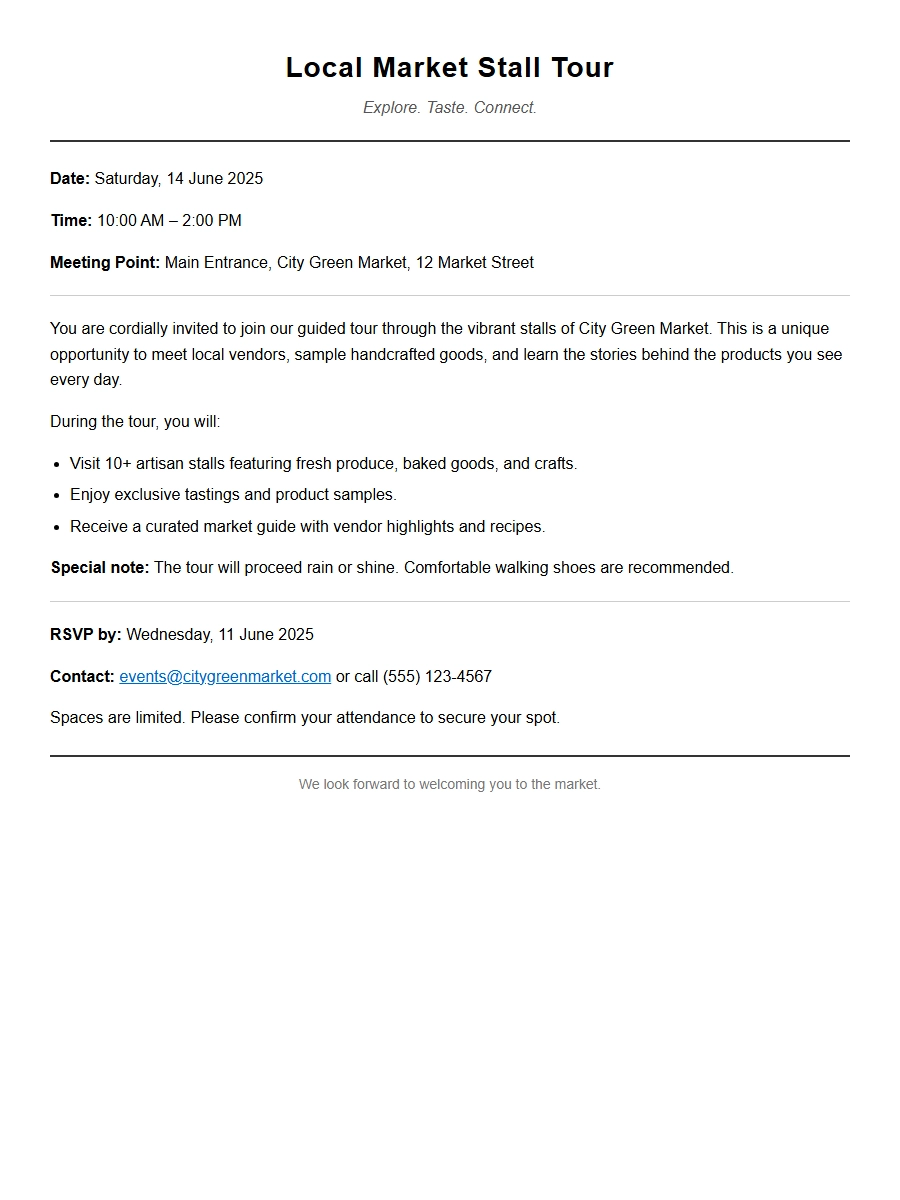 sample invitation for local market stall tour - Invitation Letters
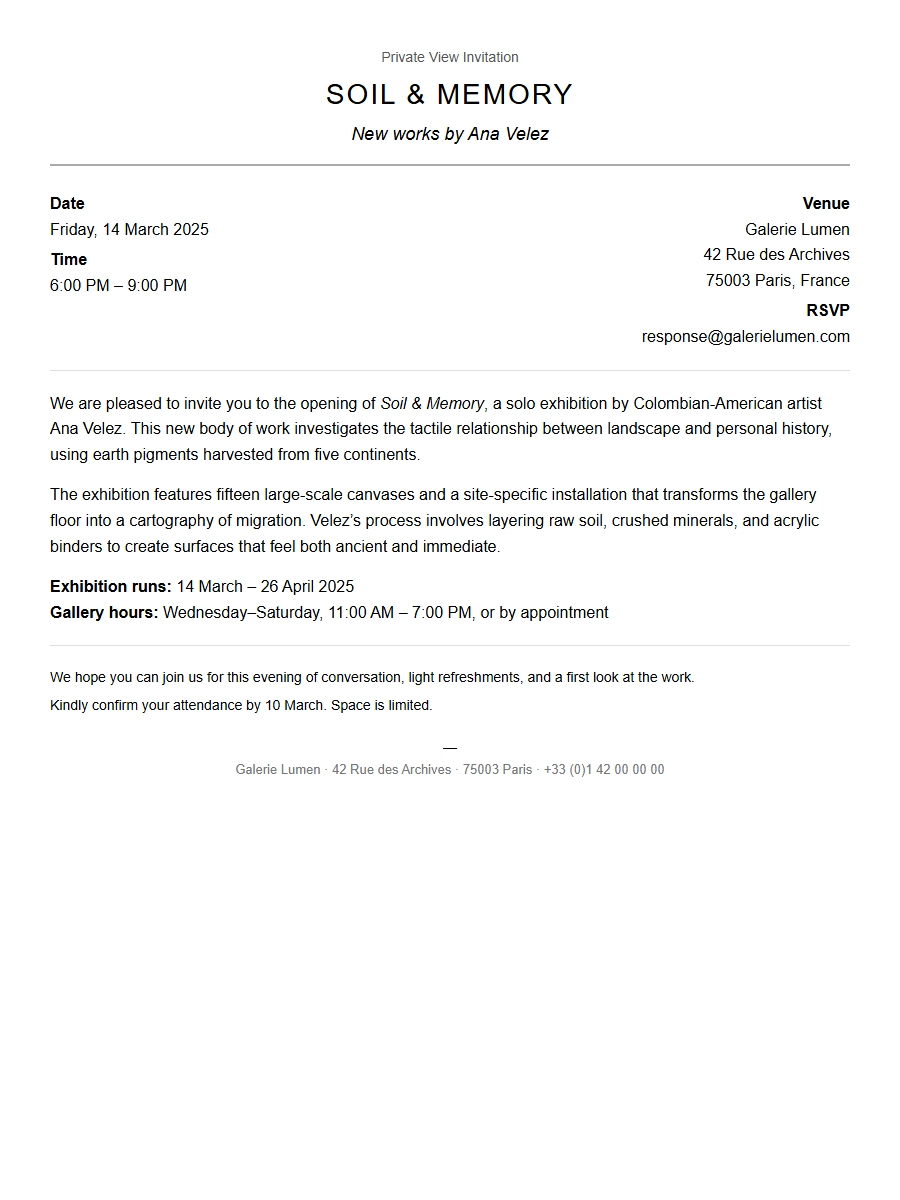 Art Exhibition Opening Invitation Wording Ideas
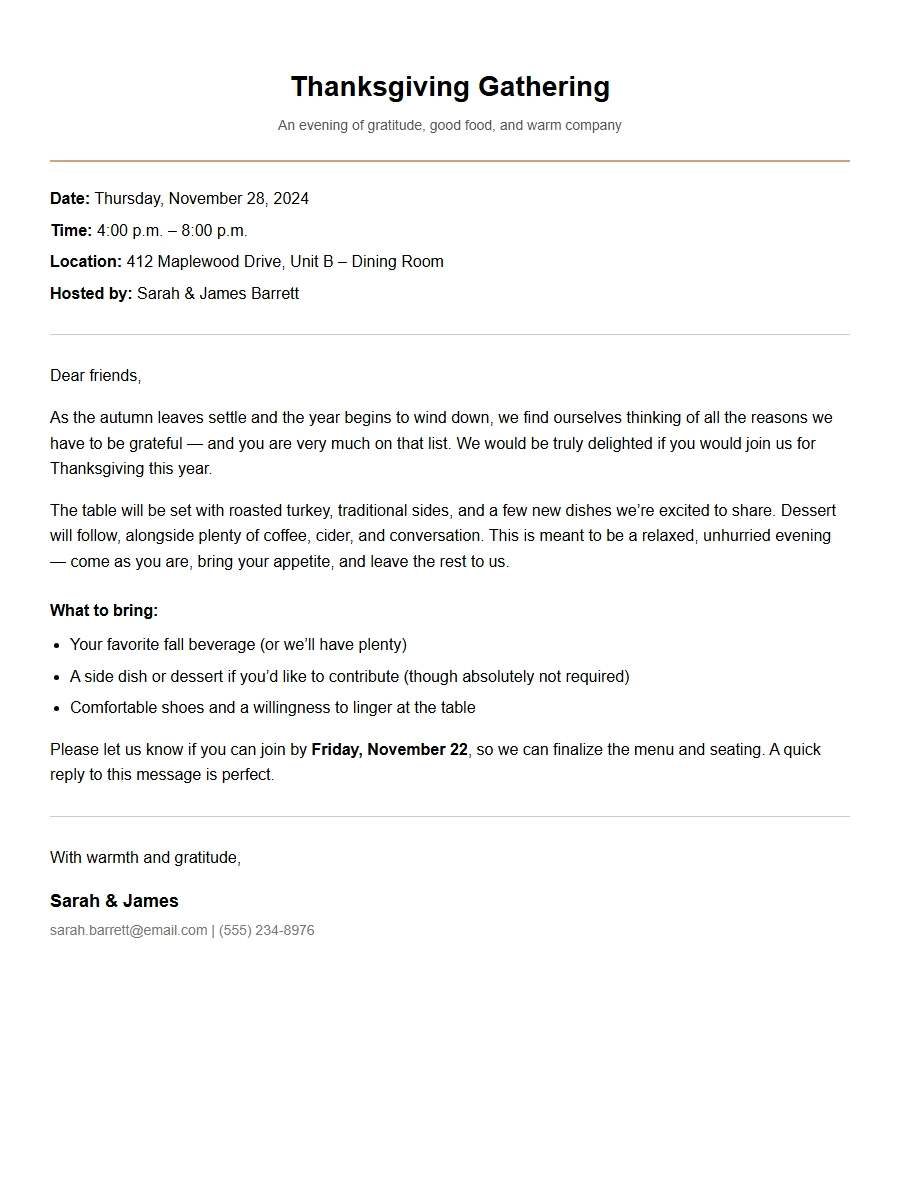 Thanksgiving Meal Gathering Invitation Text
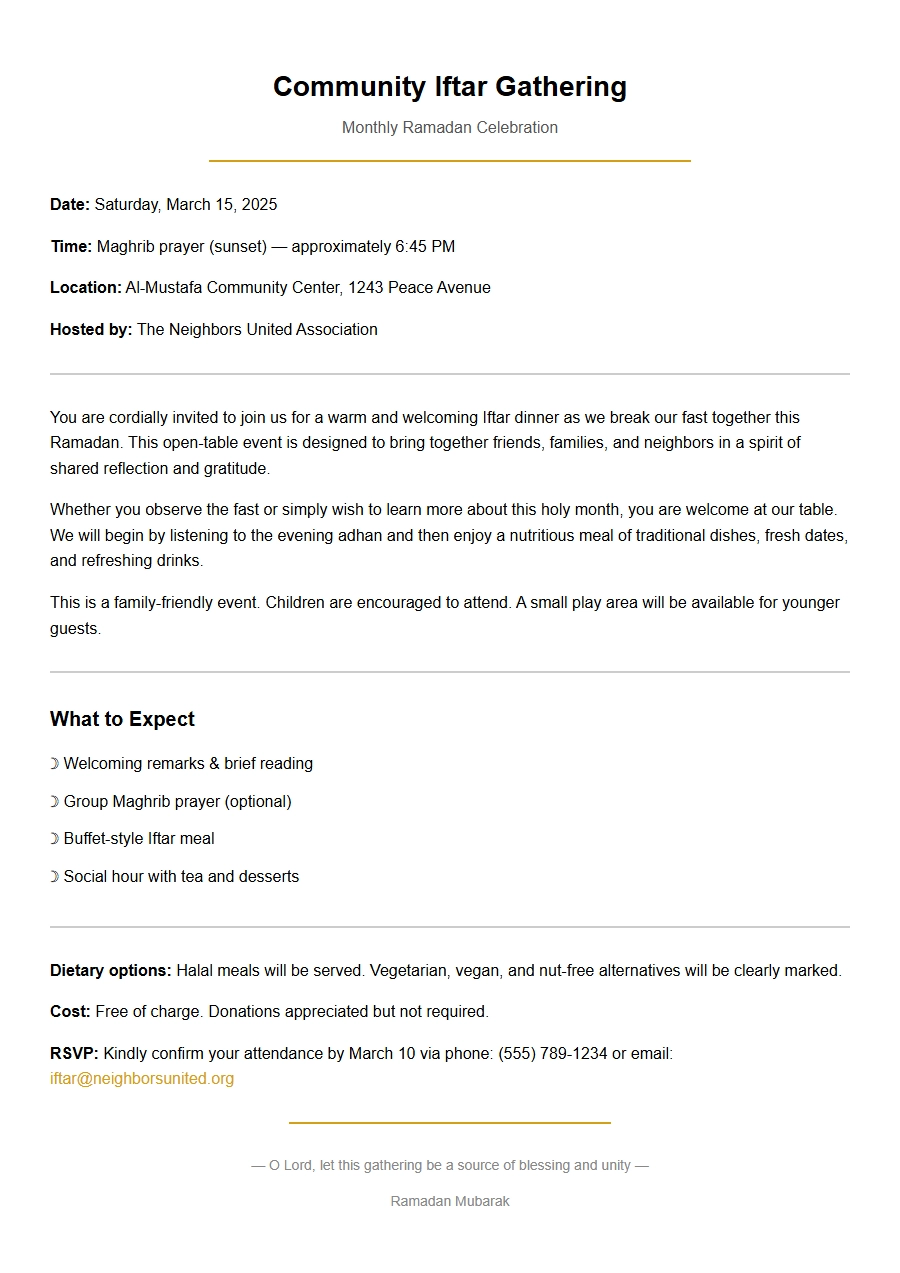 Ramadan Iftar Community Event Invitation
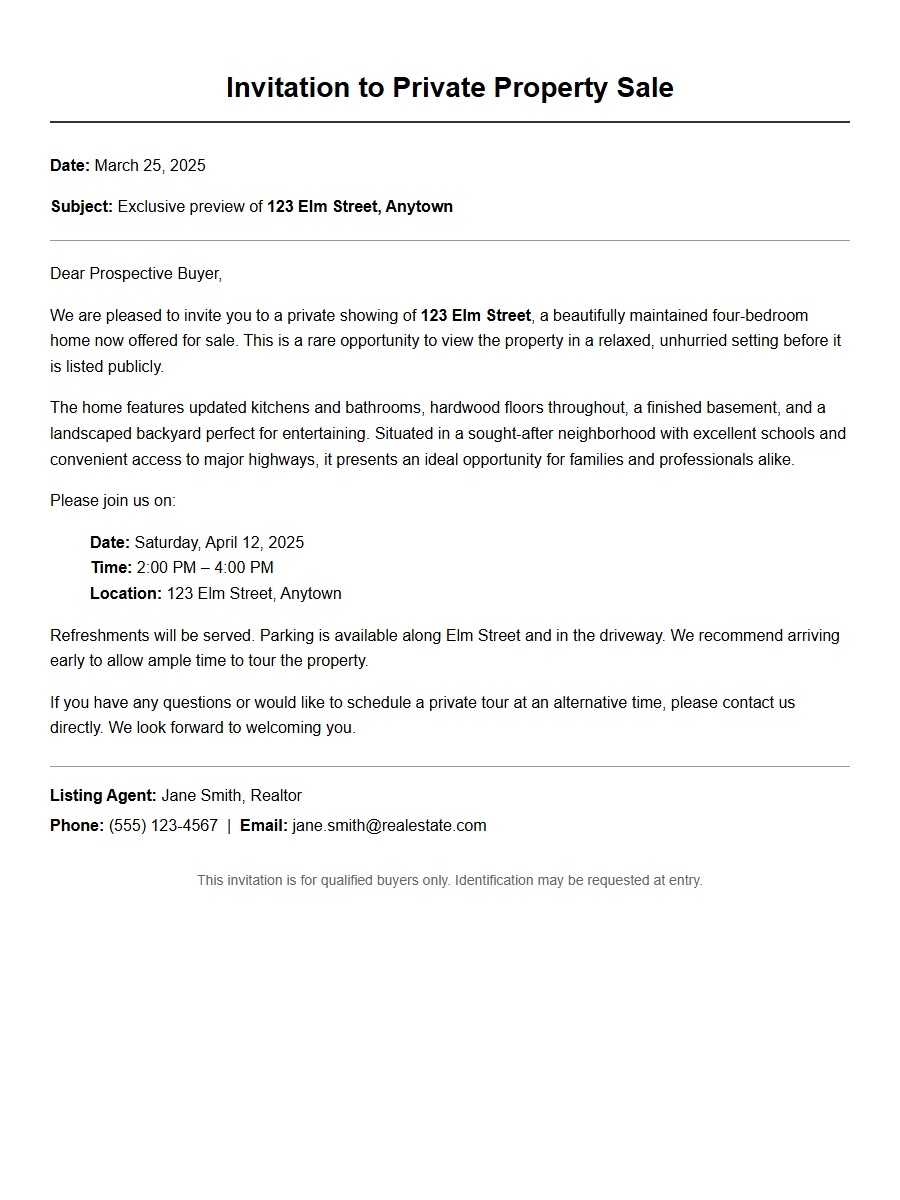 Sample Wording for Property Sale Invitations
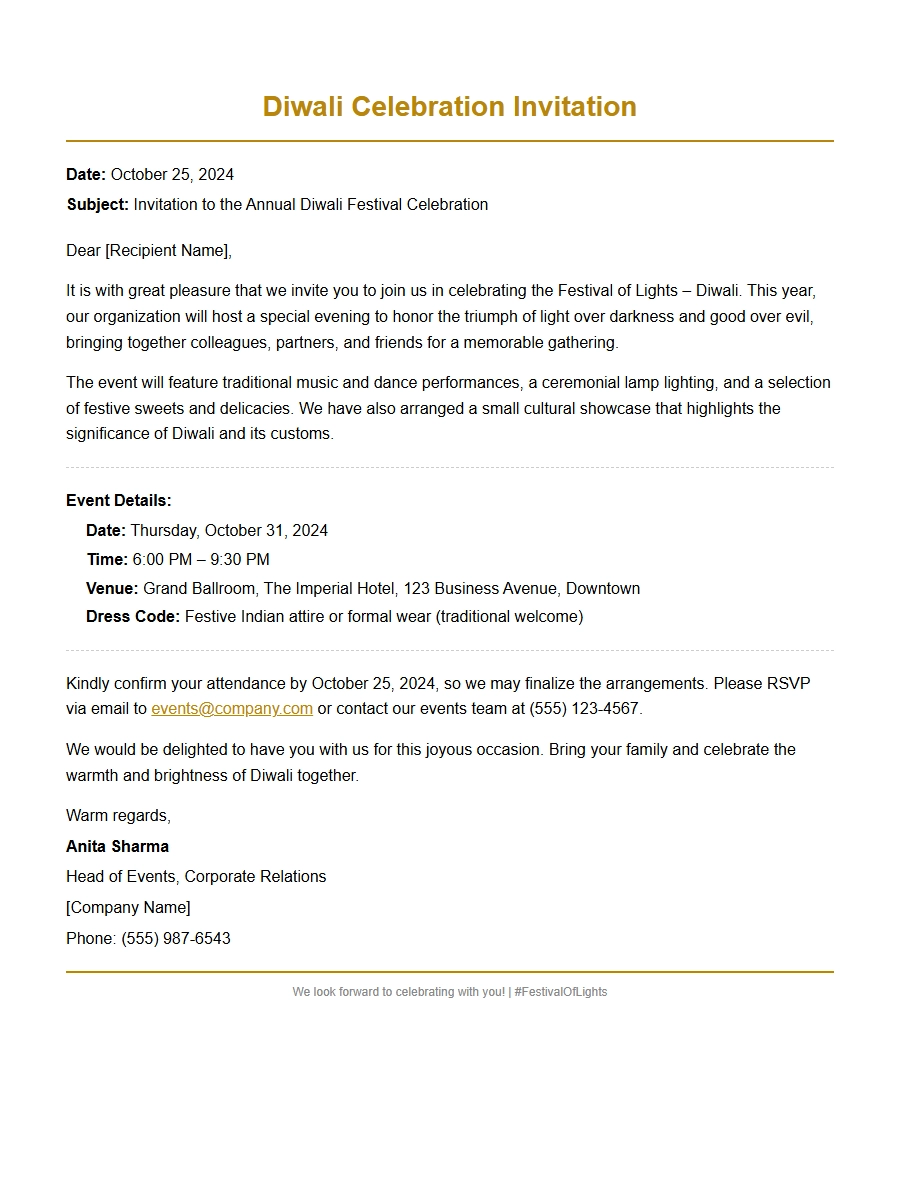 Diwali Festival Celebration Invitation Draft