You’ve planned the menu, checked the turkey size, and even mapped out the seating. But now you’re staring at a blank screen, trying to write the invitation text for your Thanksgiving meal gathering. It shouldn’t be this hard—but the fear of sounding too stiff or too sloppy can freeze you up. The good news? A well-chosen sample turns that paralysis into a confident draft in minutes.
Using a sample isn’t cheating. It’s a smart shortcut. A strong invitation sample gives you structure, tone, and key phrases, while leaving plenty of room for your own voice. Think of it as a framework: you fill in the details, adjust the warmth, and suddenly you’ve got clean, inviting copy that feels like you.
Category: Invitation Letters
What kind of tone does your Thanksgiving invitation need?
Before you grab any sample, get clear on your audience. Are you inviting close family and friends over for a casual potluck? Or are you hosting a formal Thanksgiving dinner for colleagues and neighbors? The tone should match.
For a casual gathering, your invitation text can be relaxed: “Come on over for turkey, pie, and maybe a board game.” For a more formal affair, you’ll want a structured opening, a polite request for an RSVP, and a clear dress code. A good invitation sample will show you both ends of the spectrum.
How to adapt a sample without losing your authentic voice
Start with a template that reflects your desired formality. Most Thanksgiving invitations follow a simple letter template: greeting, enthusiastic invite, key details (date, time, location, what to bring), and a warm closing. The trick is to rewrite the middle paragraph in your own words.
For example, if the sample says “We would be delighted if you could join us for Thanksgiving dinner,” but you’re a more casual person, swap it for “We’d love to have you over for turkey and laughs.” The structure stays the same, but the voice becomes yours.
Attention-grabbing opening lines that actually work
The first sentence sets the mood. Instead of “You are cordially invited,” try “Ready for the best leftovers of the year?” or “Thanksgiving just isn’t the same without you.” A little personality right upfront makes people want to read the rest.
If you’re sending a more professional correspondence—say, inviting your boss or a formal group—stick to something like “I’m pleased to invite you to our annual Thanksgiving gathering.” That feels respectful without being cold.
Common mistakes that scream “generic template”
One of the biggest blunders is ignoring the difference between digital and print formats. If you’re sending an email, your subject line matters (something like “Save the Date: Thanksgiving at Our Place”). For a printed card, you need to think about letterhead design and spacing.
Another mistake: outdated salutations. “Dear Sir or Madam” feels like a relic. Use the person’s name, or a friendly “Hi everyone” for group invites. Also, don’t forget to proofreading your letter. A typo in the date or time can ruin the whole thing.
Where to find the right structure for any event
If you need a similar format but for a different occasion, you can adapt the same principles. For instance, a bridal shower invitation shares the same basic structure—guest list, RSVP, gift expectations—but with a more celebratory tone. Check out our sample wording for a bridal shower invitation letter to see how the same bones work with different content.
And if this Thanksgiving gathering is part of a larger holiday season, you might find inspiration in our wording for holiday season party invites. The key is to match the tone to the event—casual for friends, polished for professional connections.
Make it personal without overcomplicating it
You don’t need to rewrite the entire sample. Change the name, the menu details, and the closing line. Add a note about a family tradition or a request to bring a side dish. That small personal touch makes the invitation feel custom, even if you started with a standard template.
Also remember: people don’t expect perfection. They want to know they’re welcome. A slightly imperfect but warm invitation beats a flawless cold one every time.
Different events, same smart approach
The same logic applies to other gatherings you might host. If you’re planning a donor appreciation event, the invitation needs to express gratitude and provide logistics—again, structure from a sample can guide you. See our invitation letter for donor appreciation event for how to shift tone from family fun to professional appreciation.
Similarly, a New Year’s party invite can borrow the same “warm welcome + details + RSVP” format. Check out sample wording for a New Year event invite for ideas that keep the energy high without losing clarity.
When you need a more formal invitation
Sometimes a Thanksgiving invite crosses into professional territory—like inviting clients or conference attendees. The format then leans toward business letter format: a clear subject line, formal salutation, body with purpose and call to action, and a professional closing. Our invitation letter for conference attendance shows how to maintain professionalism while still sounding human.
Use the sample as a springboard, not a crutch
Once you’ve written a few invitations, the process gets faster. You’ll start to internalize the rhythm: greeting, hook, details, closing. Next time, you won’t even need a sample—you’ll just write.
For now, grab that template. Adjust the words to match your voice. Read it out loud. If it sounds like you, you’re done. The best invitations feel both professional and personal—and with a little practice, you’ll nail that balance every time.
Samples You Can Use
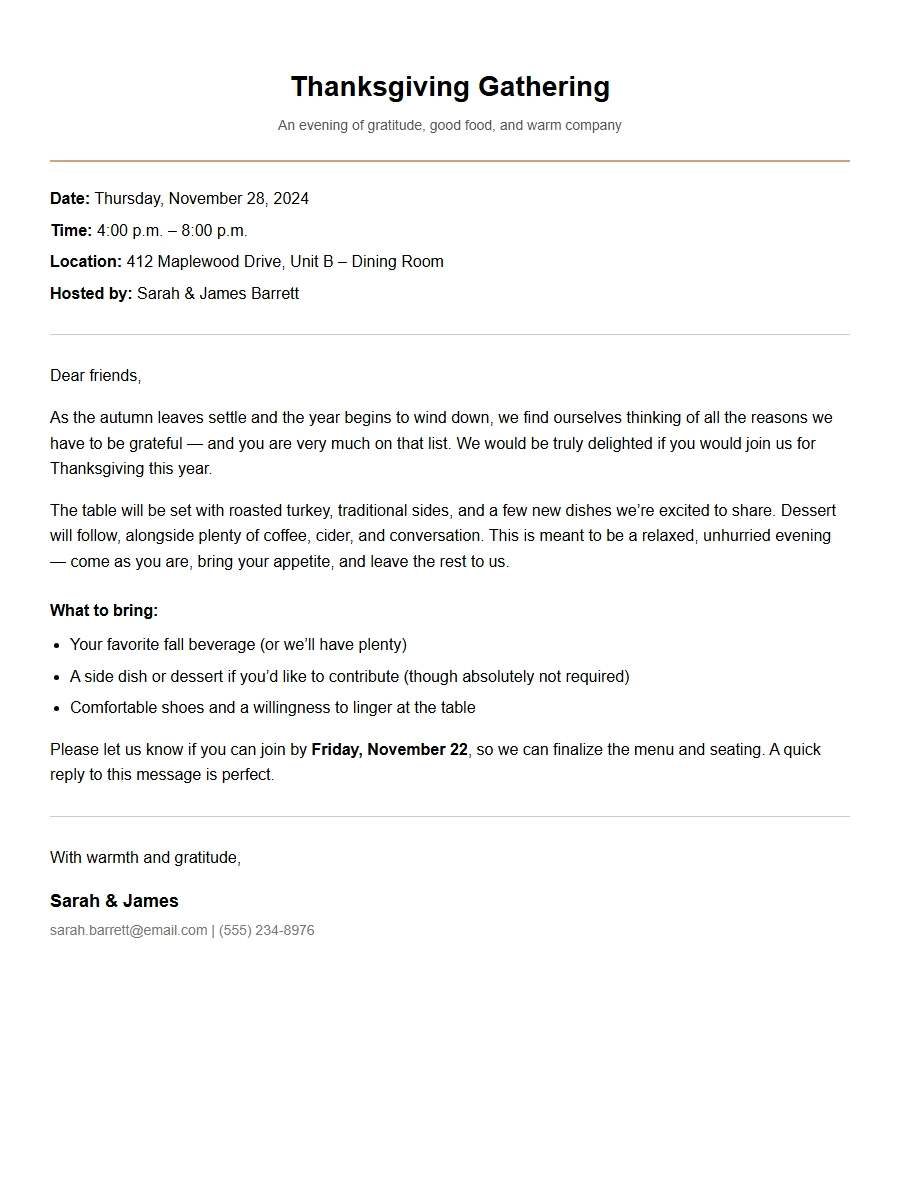
Thanksgiving Meal Gathering Invitation Text
Family Thanksgiving Dinner Invitation
Dear Family,
We are delighted to invite you to our annual Thanksgiving dinner at our home on Thursday, November 23rd, 2023. The festivities will begin at 2:00 PM and last into the evening. Our address is 123 Harvest Lane, Pleasantville.
This year we are hosting a traditional sit-down meal featuring roast turkey, stuffing, mashed potatoes, cranberry sauce, and pumpkin pie. Please bring a favorite side dish or dessert to share. We will have plenty of beverages and seating.
We ask that you RSVP by November 16th so we can finalize the menu and table settings. You can reply to this email or call (555) 123-4567. Please let us know about any dietary restrictions.
We look forward to gathering together and giving thanks for our wonderful family.
With love, Uncle Bob and Aunt Sue
Friendsgiving Potluck Celebration
Hey everyone,
You are cordially invited to our annual Friendsgiving Potluck on Saturday, November 19th, from 4:00 PM to 9:00 PM at Mark's place: 456 Oak Avenue, Apt 3B.
Bring your favorite dish, appetizer, or dessert to share. We will provide the turkey, drinks, and tableware. This is a casual gathering – games, music, and plenty of laughter are guaranteed.
To help plan, please sign up with what you plan to bring using the link below. RSVP by November 14th.
Potluck sign-up table (ideas):
Dish Type
Examples
Appetizers
Veggie tray, cheese platter
Side dishes
Green bean casserole, sweet potatoes
Desserts
Pie, cookies, brownies
Contact Mark at (555) 987-6543 if you have questions. Let's give thanks for friendship!
Cheers, Mark and Jenny
Church Community Thanksgiving Feast
Dear Members and Friends of Grace Community Church,
You are warmly invited to our annual Thanksgiving Community Feast on Thursday, November 23rd at the church fellowship hall. Doors open at 11:30 AM, and we will serve dinner promptly at 12:30 PM.
This year we are hosting a free full Thanksgiving meal for all who wish to join – whether you are a member of our congregation or a neighbor in need. The menu includes turkey, ham, dressing, vegetables, rolls, and an assortment of pies.
We also need volunteers to help with serving, clean-up, and delivering meals to homebound members. If you can assist, please sign up at the welcome table this Sunday or call the church office at (555) 246-8109.
Please RSVP by November 20th so we can prepare enough food. You can reply to this email or fill out the form on our website.
Let us come together in gratitude and fellowship.
Blessings, Pastor Sarah
Thanksgiving Dinner at the Senior Center
Dear Residents and Families,
The Pleasant Valley Senior Center is hosting a special Thanksgiving Dinner on Wednesday, November 22nd from 12:00 PM to 2:00 PM at our main dining hall, 888 Golden Age Drive.
We welcome all seniors and their guests to share a traditional meal with us. A special menu has been prepared: roasted turkey with gravy, garlic mashed potatoes, green beans, cranberry relish, and apple or pumpkin pie for dessert.
Please note the following details:
Cost: Free for residents; $5 per guest (pay at door).
Transportation: A shuttle will run from the senior apartments – call (555) 369-1212 for pickup times.
Dietary needs: We can accommodate low-sodium and diabetic-friendly options upon request.
RSVP by November 17th by calling the front desk at (555) 369-1200. We look forward to celebrating together!
Warm regards, Linda Martinez, Activities Director
Neighborhood Thanksgiving Block Party
Hello neighbors,
It's time for our annual Thanksgiving Block Party on Saturday, November 18th from 3:00 PM to 7:00 PM on Maple Street between Elm and Oak.
This is a potluck-style outdoor gathering (weather permitting, with a rain tent). Please bring a dish to share, your own chair, and any games you'd like to play. The block committee will supply the turkey, rolls, and hot cider. We will set up tables on the street.
We encourage everyone to decorate your front porch or yard with a fall theme – prizes for the most creative display!
Schedule:
3:00 PM – Setup and socializing
4:00 PM – Dinner is served
5:30 PM – Pie contest judging
6:00 PM – Music and games
Please RSVP to your block captain or use the online sign-up by November 14th. Let's give thanks as a community!
Best, The Maple Street Block Association
Thanksgiving Brunch Gathering
Dear friends,
Instead of a heavy dinner, let's celebrate Thanksgiving with a cozy Brunch Gathering on Thursday, November 23rd from 10:00 AM to 1:00 PM at our home, 789 Berry Lane, Riverside.
We will serve a brunch menu featuring a Turkey & Brie quiche, sweet potato pancakes, cranberry muffins, fruit salad, and mimosas. Feel free to bring your favorite brunch item or a breakfast casserole if you wish.
This is a relaxed, come-as-you-are event. We have a fire pit outside for toasting marshmallows, and kids are welcome. Please let us know by November 19th if you can join, and include any allergies or food restrictions.
We are thankful for each of you and look forward to sharing a wonderful morning together!
With gratitude, Emily and Tom
Vegetarian Thanksgiving Dinner Invitation
Dear friends,
We are hosting a Vegetarian Thanksgiving Dinner on Thursday, November 23rd at 4:00 PM at 123 Green Street, Eco-Village. This will be a meat-free celebration featuring a savory mushroom wellington, roasted root vegetables, quinoa-stuffed acorn squash, and a vegan pumpkin cheesecake for dessert.
All dishes are plant-based, but we will have dairy and gluten options available. If you would like to contribute, please bring a vegan or vegetarian side dish or a bottle of organic wine.
To help us plan, please RSVP by November 15th via text to (555) 234-5678 or email. Include the number of guests and any dietary needs.
Let's give thanks for the bounty of the earth and for our wonderful community of health-conscious friends.
Peace, Lisa and Raj
Thanksgiving Dinner for Office Colleagues
Dear Team,
You are invited to the Company Thanksgiving Dinner on Wednesday, November 22nd from 6:00 PM to 9:00 PM at The Grand Ballroom, 500 Commerce Drive, Suite 200.
This event is our way of saying thank you for your hard work all year. A full buffet dinner will be served, including turkey, ham, all the trimmings, and a dessert table. Drinks will be provided.
We will have a brief program with announcements and a team gratitude circle. Please bring a small non-perishable food item for our charity drive (optional). Dress is business casual.
Please RSVP by November 15th via the internal portal or to your manager. Indicate any dietary restrictions. Spouses or partners are welcome – please include their names.
We look forward to celebrating together!
Best, The HR & Culture Committee
Thanksgiving Family Reunion Dinner
Hello Family,
Get ready for the Annual Thanksgiving Family Reunion on Saturday, November 25th at Aunt Martha's farm, 1000 County Road 7. Activities start at 11:00 AM, with dinner served around 2:00 PM.
We will have a traditional turkey dinner, but we also need family members to bring their specialties. Please check the assignment below and bring enough for at least 12 people.
Family Name
Bring this dish
The Smiths
Mashed potatoes & gravy
The Johnsons
Green bean casserole
The Browns
Dessert (pie or cake)
Uncle Mike
Rolls and butter
Grandma Rose
Cranberry sauce
After dinner, we will have a hayride, bonfire, and family photo. Bring blankets and outdoor chairs. RSVP to Aunt Martha by November 18th at (555) 456-7890.
We are so thankful for our growing family!
Love, Cousin Jenny
Thanksgiving Meal for Those in Need (Volunteer Invitation)
Dear Volunteers,
We invite you to help serve Thanksgiving Dinner to Homeless and Low-Income Families on Thursday, November 23rd at the City Shelter, 200 Main Street. Shifts are available from 10:00 AM to 4:00 PM.
We need volunteers for the following roles:
Food servers – help plate and serve meals
Kitchen helpers – assist with prep and cleanup
Runners – deliver meals to those unable to leave
Greeters – welcome guests and manage seating
If you can donate non-perishable food items, please bring them to the shelter by November 20th. Items needed: canned vegetables, stuffing mix, canned fruit, and boxes of pie crust mix.
Please sign up online or call (555) 777-8888 by November 18th. Bring a smile and a giving heart. Let's ensure everyone has a warm meal this Thanksgiving.
Thank you for your compassion, The Shelter Outreach Team
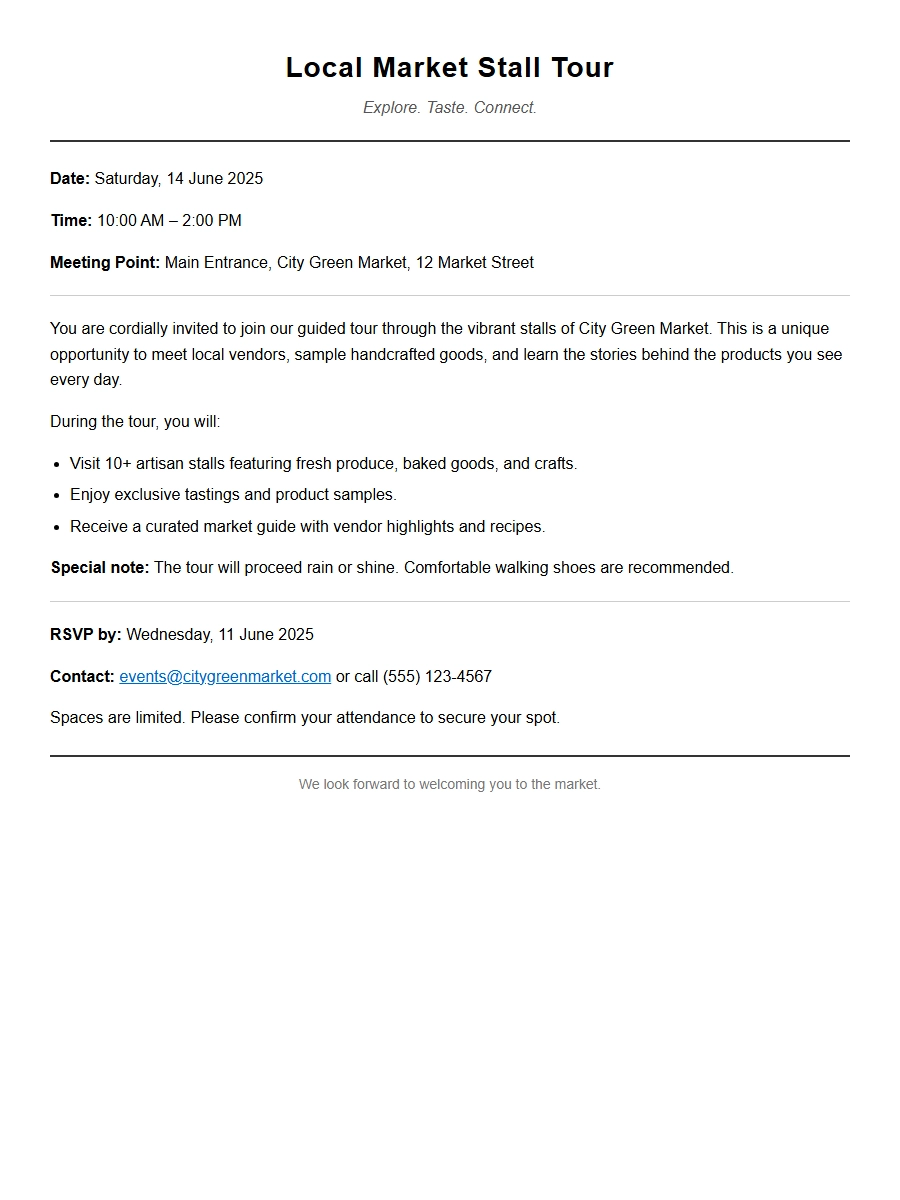 sample invitation for local market stall tour - Invitation Letters
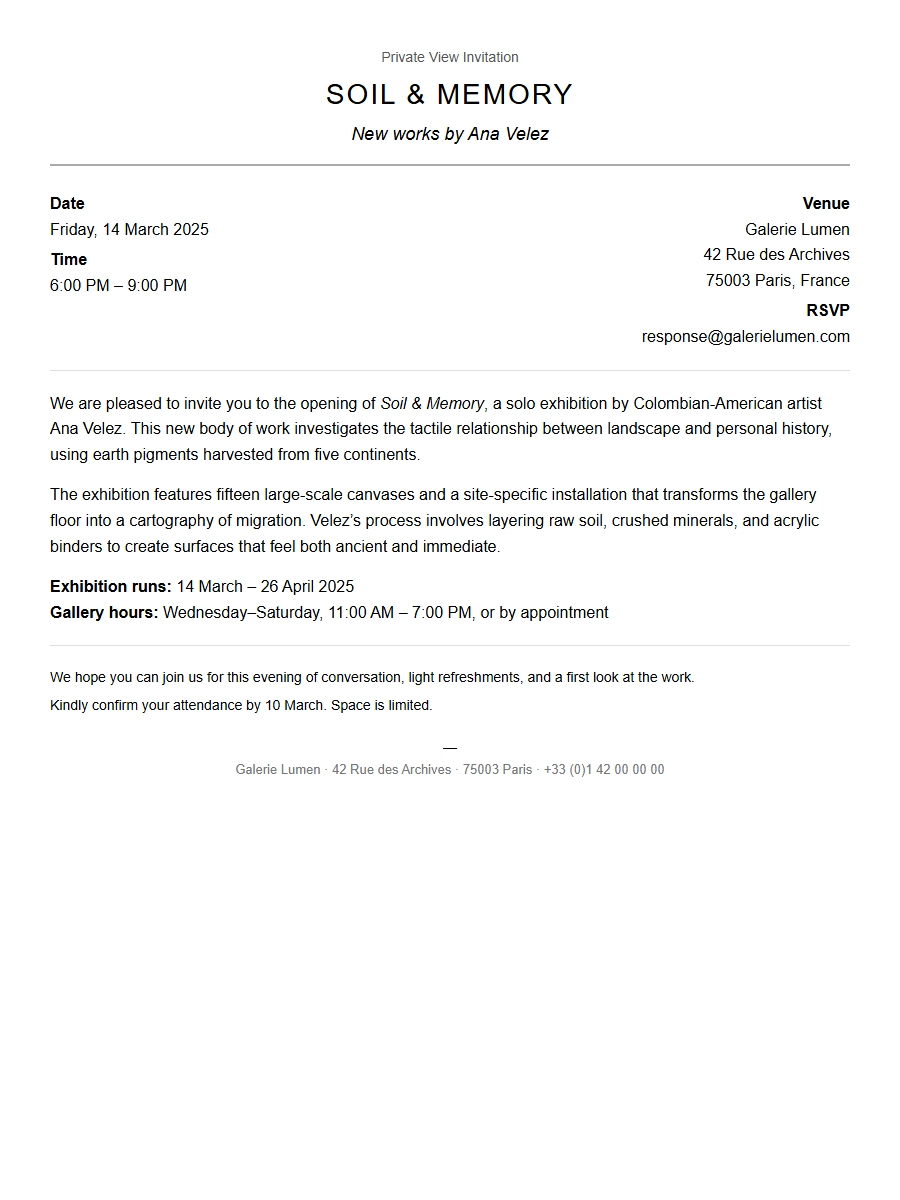 Art Exhibition Opening Invitation Wording Ideas
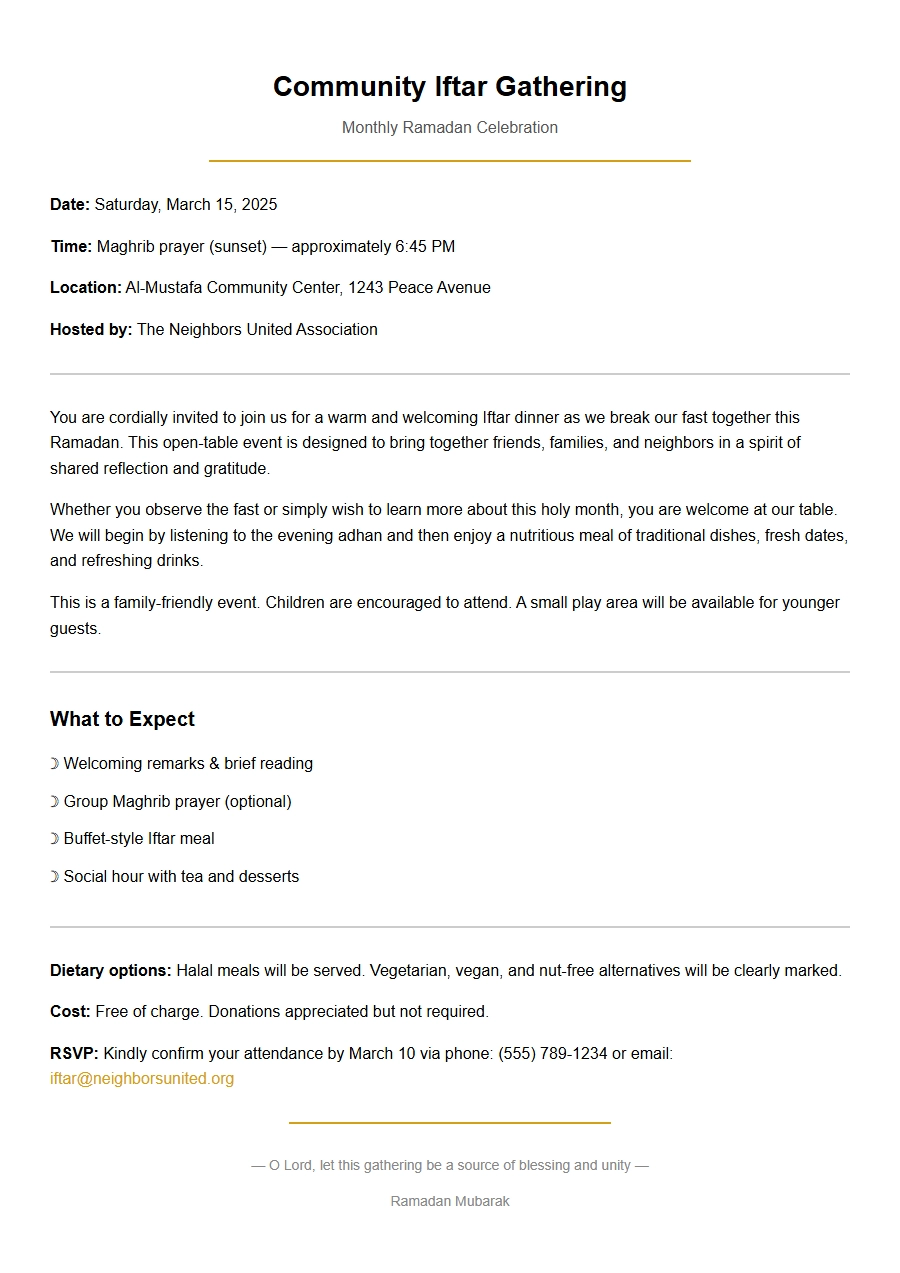 Ramadan Iftar Community Event Invitation
 Sample Wording for Property Sale Invitations
 Diwali Festival Celebration Invitation Draft
 Mother's Day Celebration Invitation Draft