You've got an annual general meeting coming up and you need to send the invite. Not just any invite—one that sounds professional, sets the right tone, and actually gets shareholders to open it. But every time you sit down to write, the cursor just blinks at you. That blank page is a familiar frustration. The good news? You don't have to start from scratch.
Using a sample for your annual general meeting invite isn't cheating. It's a smart shortcut. A well-written sample gives you the structure of professional correspondence, shows you how to balance formality with warmth, and provides key phrasing you can adapt. You just need to know how to make it your own.
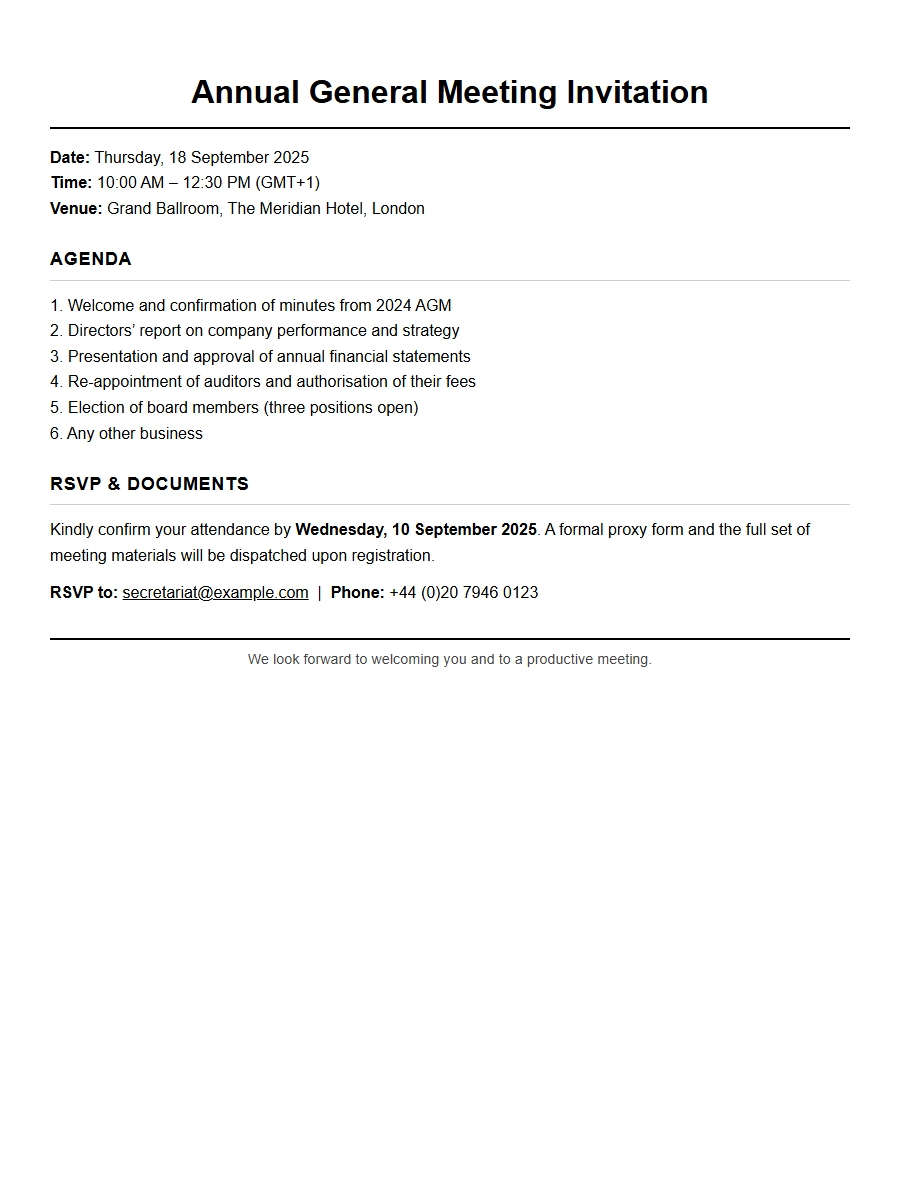
Category: Annual General Meeting Invitations
What makes annual general meeting wording different?
An AGM invite is a formal business letter, but it's also a call to action. You're asking busy people to show up, listen, and often vote. The tone should be respectful but not stiff. Think of it as professional correspondence with a conversational edge. You want shareholders to feel informed, not lectured.
Your letter structure matters. Start with a clear subject line or header. Use a proper salutation and closing—"Dear Shareholder" works for most, but if you're writing to board members, "Dear [Name]" feels more personal. End with a polite request for their attendance and a clear RSVP instruction.
How to pick the right sample (and adapt it)
Not all letter templates are created equal. Look for samples that match your company's culture. A tech startup might prefer a more direct, less formal invite. A law firm or financial institution will lean toward traditional business letter format. Pay attention to the tone in writing—does the sample sound like someone you'd trust with your investment?
Once you have a good sample, customize it. Swap out the generic date and time, but also change the opening paragraph to reflect what's special about this year's meeting. Maybe you have a new initiative to announce or a record dividend. Lead with that. A strong opener grabs attention and makes people want to read more.
Common mistakes to avoid
Old-fashioned salutations like "To whom it may concern" feel distant. In 2025, even formal letters can open with "Dear Shareholder" or "Dear [Name]." Another pitfall: ignoring the digital letter format. Most AGM invites go by email now. That means shorter paragraphs, a clear subject line, and a clickable link to the virtual meeting. If you're sending a printed letter, you'll need a proper letterhead design, but keep the text clean and scannable.
Don't forget to proofread your letter. One typo in the meeting time can cost you attendance. Read it aloud, or ask a colleague to check. Letter writing etiquette still applies—even in email, a courteous closing like "Thank you for your continued support" goes a long way.
Adapting the tone for different audiences
Your shareholders aren't a monolith. Some are long-term investors who expect a formal update. Others are newer and may respond better to a semi-formal style. A good sample gives you a starting point, but you can adjust the customizable letter to match your audience. For a board of directors, you might reference past resolutions. For a general shareholder group, keep language simpler.
If you're also inviting stakeholders outside the board—like partners or advisors—you might look at our guide on stakeholder consultation invitation letters for ideas on balancing formality with inclusivity. Similarly, if your AGM has a celebratory aspect (like an anniversary), the wording in a silver anniversary dinner invitation can inspire a warmer tone. And if you're presenting to potential investors, you'll find useful phrasing in our investor presentation invitation draft.
Quick tips for the opening and closing
Your first sentence should tell the reader exactly what the letter is about. "We invite you to attend the Annual General Meeting of [Company Name] on [Date]." That's clear and direct. Then add the why: "This year, we'll review our performance and vote on key resolutions."
For the closing, avoid vague statements like "We look forward to your participation." Instead, be specific: "Please confirm your attendance by [Date] via [link or email]." Provide a clear next step. You can also include a note about voting materials—enclose them or provide a digital link.
Use the sample as a springboard
The best annual general meeting invite feels both professional and personal. A sample gives you the skeleton; you add the muscle and heart. Don't be afraid to rewrite whole sentences if they don't sound like you. The more you practice adapting templates, the faster the process becomes. Next time you need to draft a similar letter, you'll know exactly what to tweak.
Start with a solid foundation, adjust the tone to fit your company, and always double-check the details. That blank page won't feel so intimidating once you have a sample to build on.
Simple Examples
Annual General Meeting Invitation Wording
Formal AGM Invitation with Agenda
Dear Shareholder,
On behalf of the Board of Directors, we cordially invite you to the Annual General Meeting of XYZ Corporation. The meeting will be held on Friday, 14 June 2024, at 10:00 AM at the Oakwood Conference Centre, 25 Maple Street, London.
The agenda for the meeting is as follows:
Item
Description
1
Report of the Directors and Audited Financial Statements for the year ended 31 December 2023
2
Election of Directors
3
Appointment of Auditors and determination of their remuneration
4
Transaction of any other business
Light refreshments will be served after the meeting. Please confirm your attendance by 7 June 2024 via the enclosed reply slip or by email to agm@xyzcorp.com.
We look forward to your participation.
Yours faithfully, John Smith, Company Secretary
Informal AGM Reminder to Members
Hi everyone,
Just a friendly reminder that our Annual General Meeting is coming up next week. This is your chance to hear about what we’ve achieved over the past year and to have your say on key decisions.
Details:
Date: Wednesday, 19 June 2024
Time: 6:30 PM (doors open at 6:00)
Location: Green Room, Community Hall, 8 Oak Avenue
We’ll have a short presentation, followed by Q&A and elections for the management committee. A light supper will be provided.
If you haven’t already, please RSVP to info@ourclub.org so we can order enough food. See you there!
Best, Maria Torres, Secretary
AGM Invitation with Proxy Voting Instructions
Dear Member,
You are hereby invited to the Annual General Meeting of Greenfield Cooperative Housing Society on Saturday, 22 June 2024 at 11:00 AM at the Society’s Community Centre, Bluebell Road.
If you cannot attend in person, you may appoint a proxy to vote on your behalf. Please complete the proxy form below and return it to the Secretary no later than 20 June 2024.
Field
Details
Member Name
________________________
Proxy Name
________________________
Signature
________________________
Date
________________________
Key agenda items include approval of annual accounts, election of board members, and revision of maintenance fees. For further information, please contact secretary@greenfieldhousing.org.
Yours sincerely, Anita Patel, Secretary
AGM Invitation Including Financial Highlights
Dear Investor,
We are pleased to invite you to the Annual General Meeting of Pinehill Investments Ltd on Thursday, 27 June 2024 at 2:00 PM at the Grand Ballroom, Hilton Hotel, 17 River Street, Manchester.
Financial highlights for the year ended 31 March 2024:
Revenue: £12.5 million (up 18% from previous year)
Net profit: £2.3 million
Earnings per share: £0.45
Dividend declared: £0.15 per share
The full financial report will be presented and discussed. Afterwards, we will hold elections for two director positions and appoint auditors.
Please bring your shareholder pass and a valid ID. RSVP by 20 June to events@pinehillinvest.com or call 0800 123 456.
We look forward to welcoming you.
Warm regards, David Lee, CEO
AGM Invitation for a Non-Profit Organization
Dear Supporter,
You are warmly invited to the Annual General Meeting of Hope for All Charity. Your support makes our work possible, and we want to share our achievements and future plans with you.
Meeting details:
Date: Saturday, 6 July 2024
Time: 10:00 AM – 12:30 PM
Venue: Hope Centre, 12 Charity Lane, Birmingham
The agenda includes:
Welcome and opening remarks
Presentation of annual report and accounts
Election of trustees
Vote on proposed changes to the constitution
Open floor discussion
Tea and biscuits will be served. Please confirm your attendance by 30 June to info@hopeforall.org so we can prepare seating and materials.
Thank you for your continued dedication.
With gratitude, Emma Williams, Chairperson
AGM Invitation with Online Participation Details
Dear Shareholder,
You are cordially invited to the Annual General Meeting of TechNova Inc. This year we offer both in-person and online attendance options.
In-person: Friday, 12 July 2024 at 3:00 PM, TechNova Auditorium, 1 Innovation Drive, Cambridge. Online: Join via Zoom – link will be emailed upon RSVP.
To attend virtually, please register by 8 July 2024 at www.technova.com/agm2024. You will receive a confirmation with the meeting link and password.
Agenda highlights:
CEO’s report on annual performance
Review of financial statements
Election of board members (three seats open)
Proposed share buyback program (special resolution)
Proxy voting is permitted for both in‑person and online participants. Complete the proxy form enclosed with this letter and return it by 10 July.
We value your participation and look forward to seeing you, either in person or on screen.
Sincerely, Sarah Chen, Corporate Secretary
AGM Invitation Emphasizing Board Elections
Dear Member,
Your voice matters. The Annual General Meeting of the Riverside Residents Association will take place on Sunday, 21 July 2024 at 4:00 PM in the Main Hall, Riverside Community Centre, 9 Riverbank.
This year, four board positions are open for election. We encourage all members to consider standing. Nomination forms are available from the secretary and must be submitted by 14 July.
Candidates will present a short statement during the meeting.
Other agenda items:
Approval of 2023/24 annual accounts
Update on the playground renovation project
Discussion of proposed parking rules
Light refreshments will be provided. If you require special assistance, please contact admin@riversideresidents.org.
Let’s shape our community together.
Best regards, James O’Brien, Elections Officer
AGM Invitation with Catering and Venue Details
Dear Partner,
We are delighted to invite you to the Annual General Meeting of the Downtown Business Alliance on Tuesday, 30 July 2024 at 6:30 PM.
Venue: The Rooftop Terrace, The Meridian Hotel, 45 City Square, Bristol. Please note there is lift access and ample parking nearby.
We have arranged a buffet dinner to start at 6:30 PM, followed by the formal meeting at 7:30 PM. Menu includes vegetarian, vegan, and gluten‑free options.
Kindly confirm any dietary preferences when you RSVP to events@downtownbiz.com by 23 July.
Meeting agenda:
Welcome by the Chair
Review of the year’s events and financial report
Election of steering committee
Plans for the upcoming business festival
Any other business
Drinks will be available after the formal proceedings. We look forward to a productive evening of networking and decision‑making.
Yours, Liam Green, Event Coordinator
AGM Invitation for a Cooperative Society
Dear Member,
Pursuant to Rule 25 of the Society’s Bylaws, you are hereby notified that the Annual General Meeting of Sunflower Cooperative Credit Society will be held on Saturday, 3 August 2024 at 2:00 PM at the Multipurpose Hall, 88 Sunflower Avenue, Leeds.
Business to be transacted:
#
Item
1
Reading and confirmation of minutes of previous AGM
2
Presentation of annual report and audited accounts
3
Declaration of dividend – proposed at 6% per share
4
Election of three directors (retiring: Ms. Rao, Mr. Patel, Mrs. Singh)
5
Appointment of auditor for the coming year
Copies of the annual report will be available at the meeting and can also be downloaded from our website after 25 July.
Members must bring their passbooks and a photo ID for entry. Proxy forms are obtainable from the office and must be lodged by 1 August.
Thank you for your continued membership.
Yours in cooperation, Rajesh Kumar, Secretary
AGM Invitation with Special Resolution Notice
Dear Shareholder,
Notice is hereby given that the Annual General Meeting of GreenTech Energy plc will be held on Wednesday, 14 August 2024 at 11:00 AM at the Energy Hub, 15 Windmill Road, Edinburgh.
In addition to the ordinary business, a special resolution will be proposed to approve a change in the company’s name from “GreenTech Energy plc” to “EcoPower Renewables plc”.
The full text of the resolution is available from the company secretary and will be read at the meeting.
Other items on the agenda:
Consideration of the directors’ report and financial statements
Re‑election of directors
Re‑appointment of auditors
Voting on the special resolution requires a 75% majority of votes cast. If you cannot attend, please submit your proxy vote using the form provided, to be received by 12 August 2024.
For any queries, contact ir@greentech.energy or phone 0131 234 5678.
By order of the Board, Anna White, Company Secretary
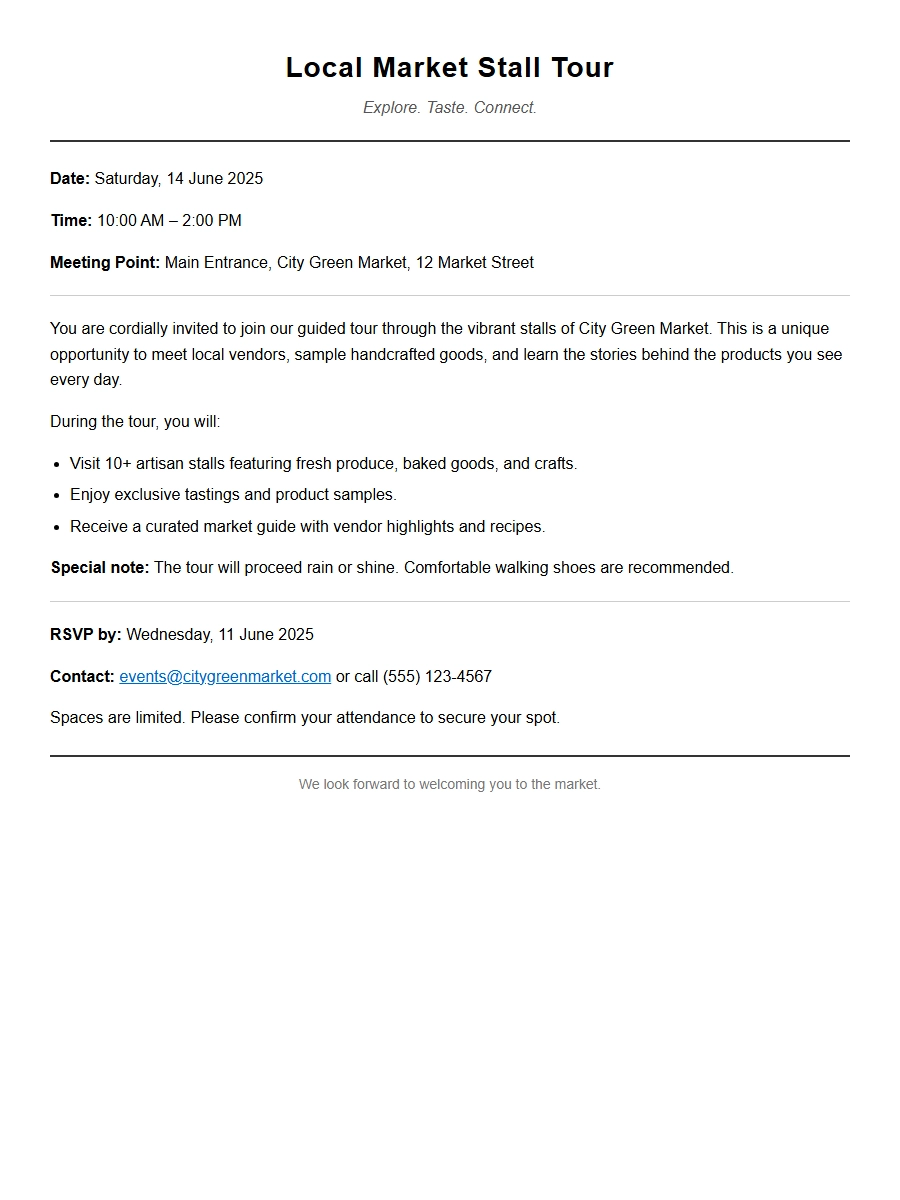 sample invitation for local market stall tour - Invitation Letters
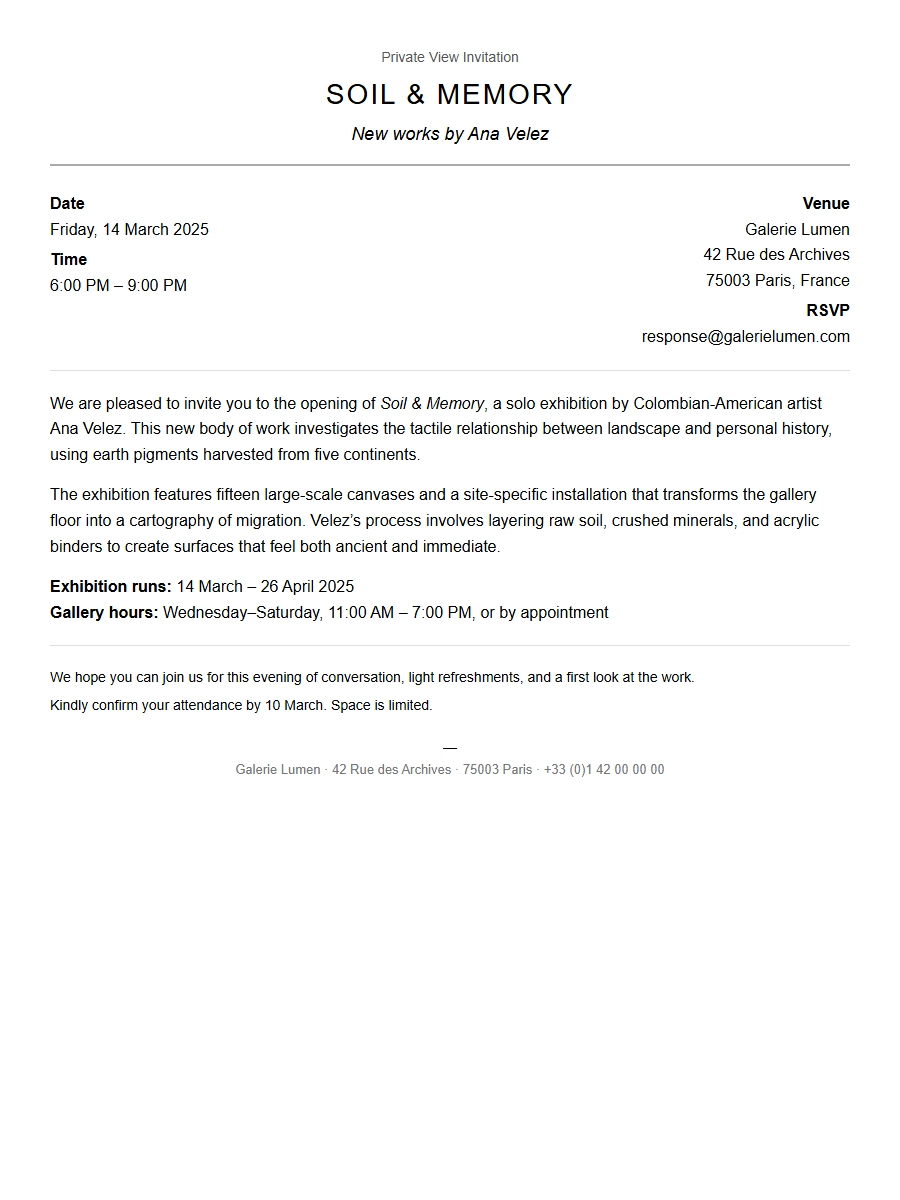 Art Exhibition Opening Invitation Wording Ideas
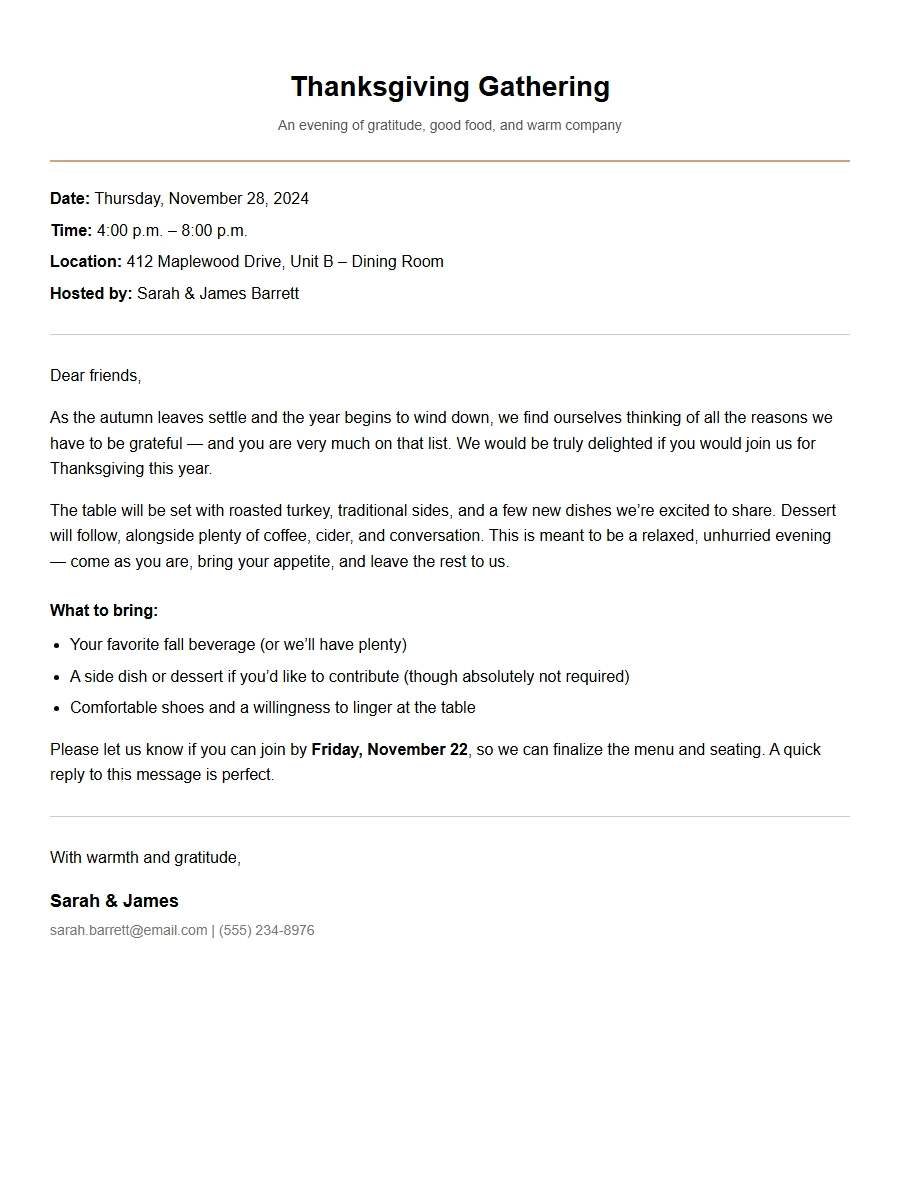 Thanksgiving Meal Gathering Invitation Text
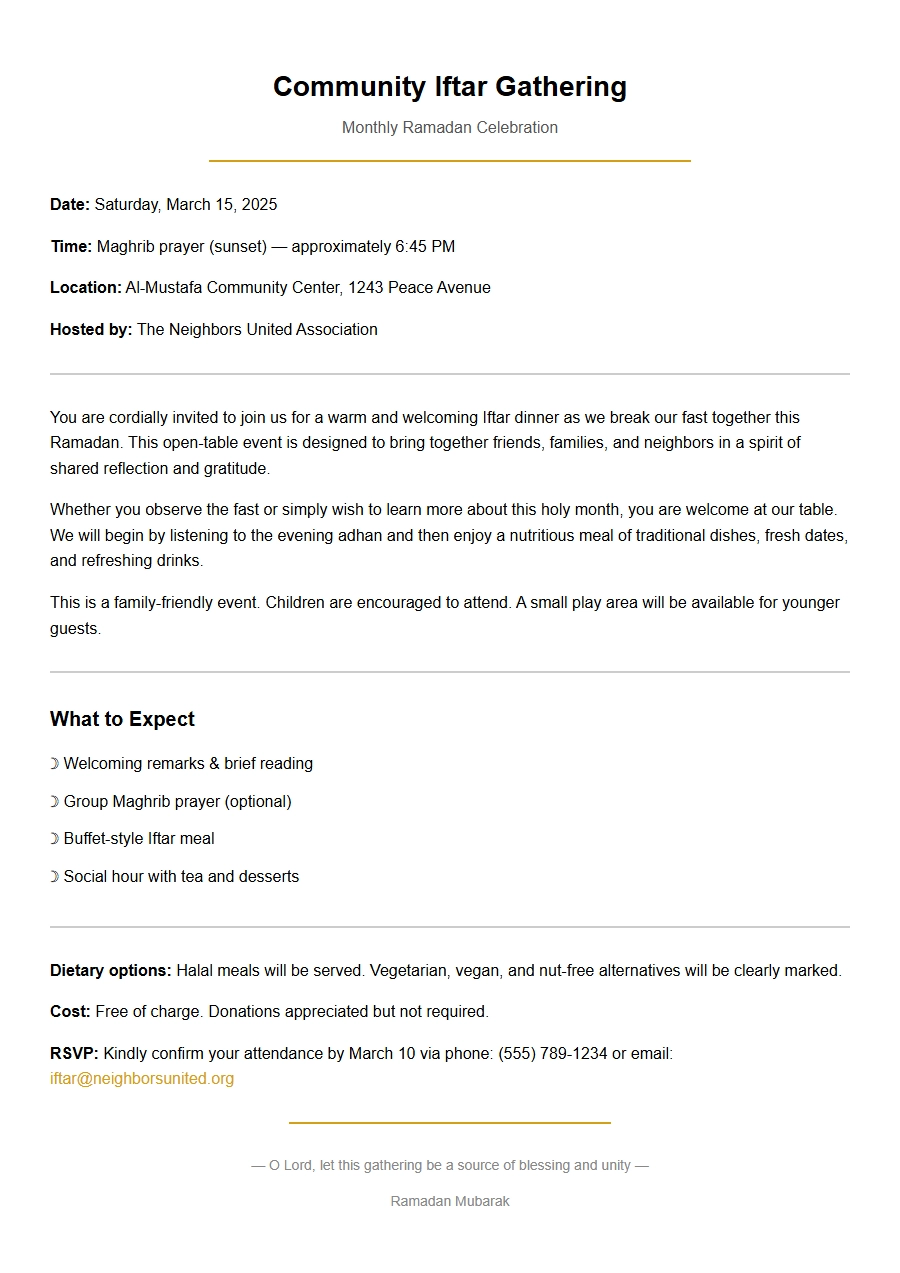 Ramadan Iftar Community Event Invitation
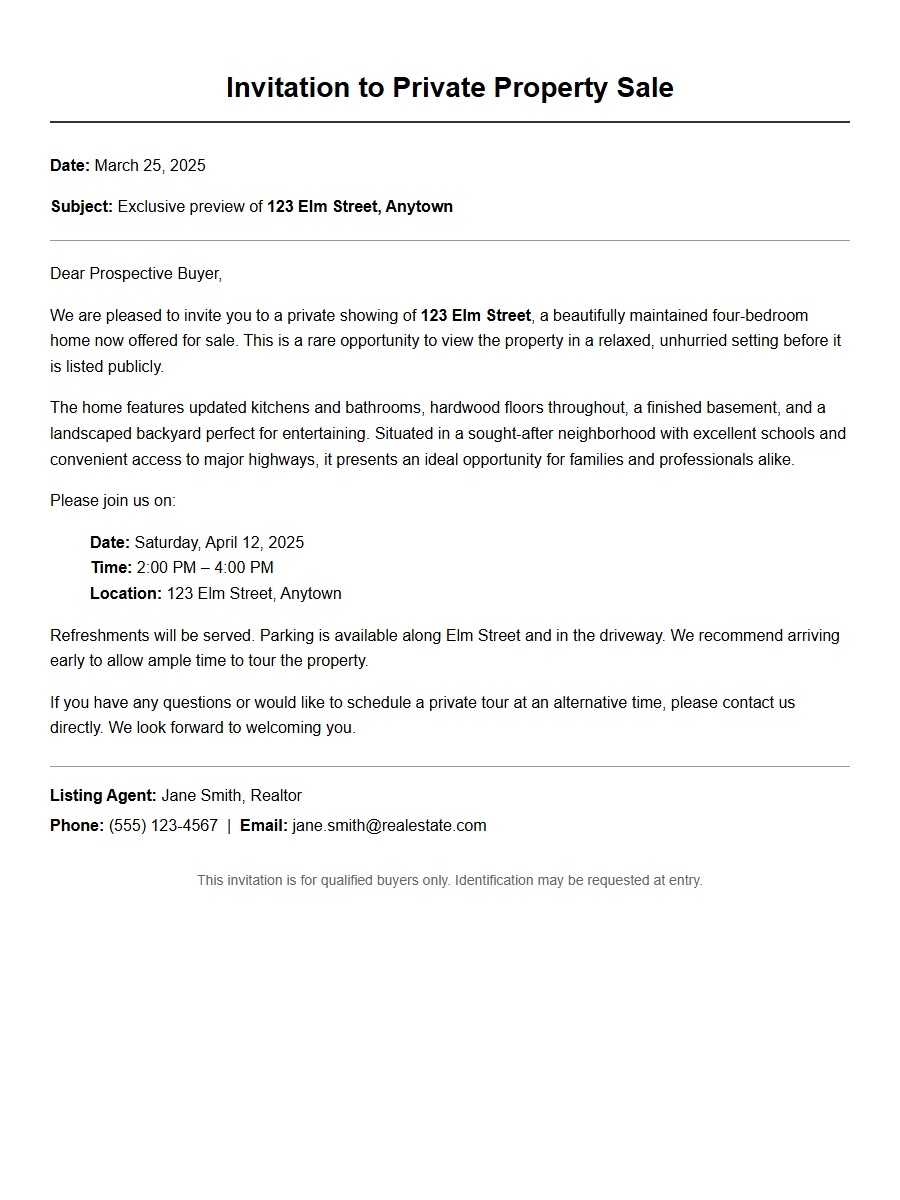 Sample Wording for Property Sale Invitations
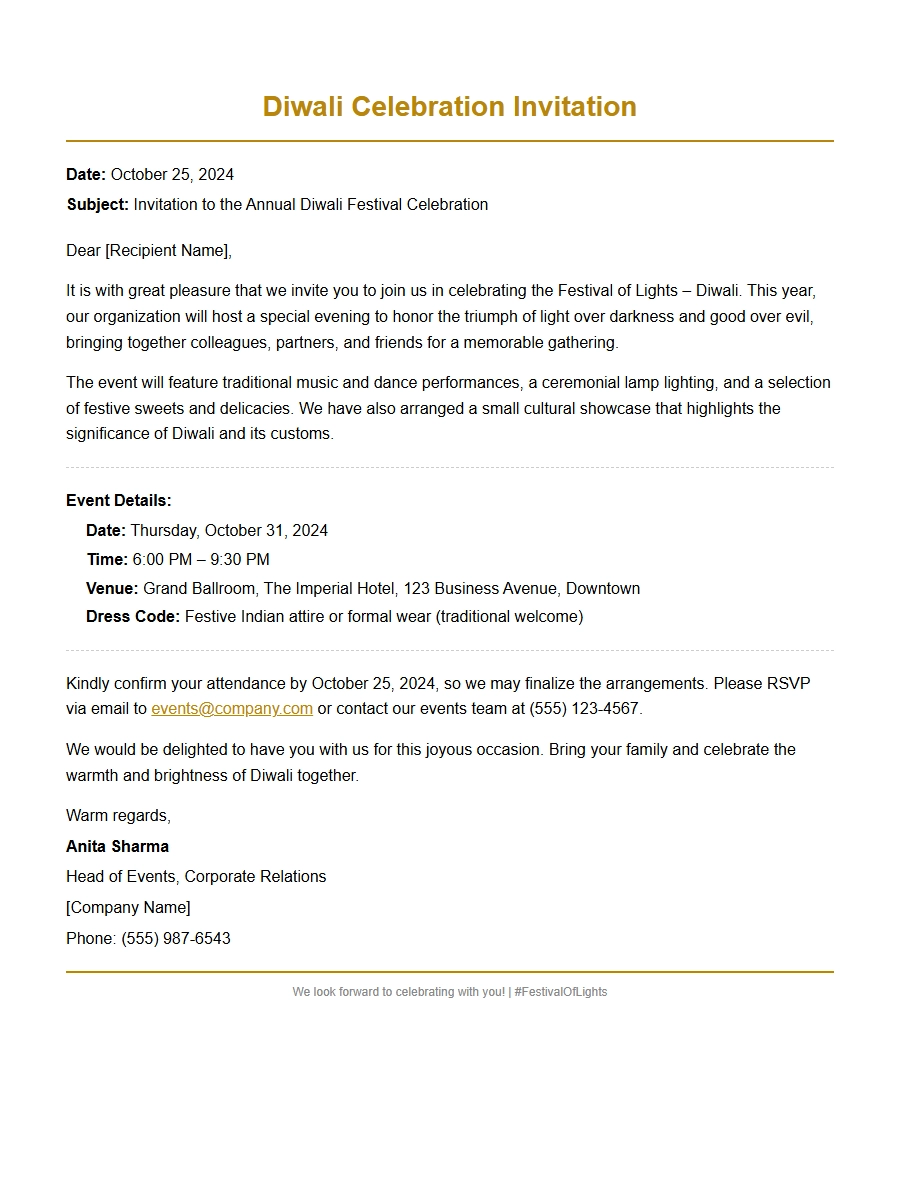 Diwali Festival Celebration Invitation Draft