Staring at a blank page when you need to invite top executives to a leadership summit can feel paralyzing—but the right sample wording turns that anxiety into a confident, polished draft in minutes. You know the event is important, but somehow the email draft just sits there, feeling either too stiff or too casual.
Using a sample wording for a leadership summit invite isn’t cheating. It’s a smart, time-saving strategy. A good letter template gives you a proven structure and the right business letter format so you can focus on the details that make your event unique. Think of it as a starting point that handles the etiquette while you add the personality.
This type of document generally falls under the formal invitation category. But even within formality, there’s room to sound human.
How formal should your summit invite be?
The tone depends entirely on your audience. If you are inviting C-suite executives from different companies, your professional correspondence needs to feel exclusive and respectful of their time. If it’s an internal summit for high-potential managers, you can be a bit more direct and encouraging.
Pay close attention to your salutation and closing. “Dear [Name]” is a safe, respectful start. “Hello [Name]” works for internal or less formal relationships. Avoid generic openings like “To Whom It May Concern” for a summit invite—it kills the personal feel immediately.
What to include in the opening paragraph
Don’t lead with “We are thrilled to invite you to…” Everyone leads with that. Instead, start with the reason your attendee matters. For example: “To tackle the challenges of the coming year, we need your leadership perspective. That is why you are personally invited to the 2024 Leadership Summit.”
This approach works for any digital letter format—whether you are sending an email or a PDF attachment. The key is making the recipient feel chosen, not just added to a mailing list.
A common mistake is treating a summit invite like a standard meeting request. It isn’t. A summit is strategic. Your tone in writing should reflect that. For comparison, an invitation letter for staff appreciation lunch can be warm and purely celebratory. A summit invite needs to balance appreciation with a sense of purpose.
Adapting the sample without losing your voice
Once you have a sample, read it out loud. Does it sound like something you would actually say? If not, change the words. Swap formal phrases like “we would like to request your presence” for “we hope you can join us.” Keep the structure, but make the language yours.
For a leadership summit, your letter structure should follow a clear flow: why the event matters, why they specifically are invited, what they will gain, and what to do next. This is standard letter writing etiquette for high-stakes invitations.
Compare this to a sample invitation for training session attendees. That document focuses on skill-building and logistics. Your summit invite should focus on vision, impact, and alignment. The format is similar, but the tone in writing is different.
Common mistakes to avoid
One big mistake is ignoring the format. An invitation draft for visual arts contest entry can be flashy and creative. A leadership summit invite needs to be clean, scannable, and professional. Use clear headings, short paragraphs, and a visible call to action.
Another mistake is forgetting to proofread. A typo in the event name or a wrong date in your customizable letter erodes trust. Take five minutes to double-check names, titles, and the link to register.
For high-level attendees, look at the invitation text for executive strategy retreat. That wording is designed for busy decision-makers. Your summit invite should feel similarly focused and respectful of their limited time.
Use the sample as a springboard
The best summit invitations feel both professional and personal. They follow a clear business letter format but read like a real person wrote them. Start with a strong letter template, adapt it to your audience, and read it one last time before hitting send. The more you practice tailoring these drafts, the faster the process becomes—and the more natural your invitations will sound.
Samples for Inspiration
Leadership Summit Invite Sample Wording
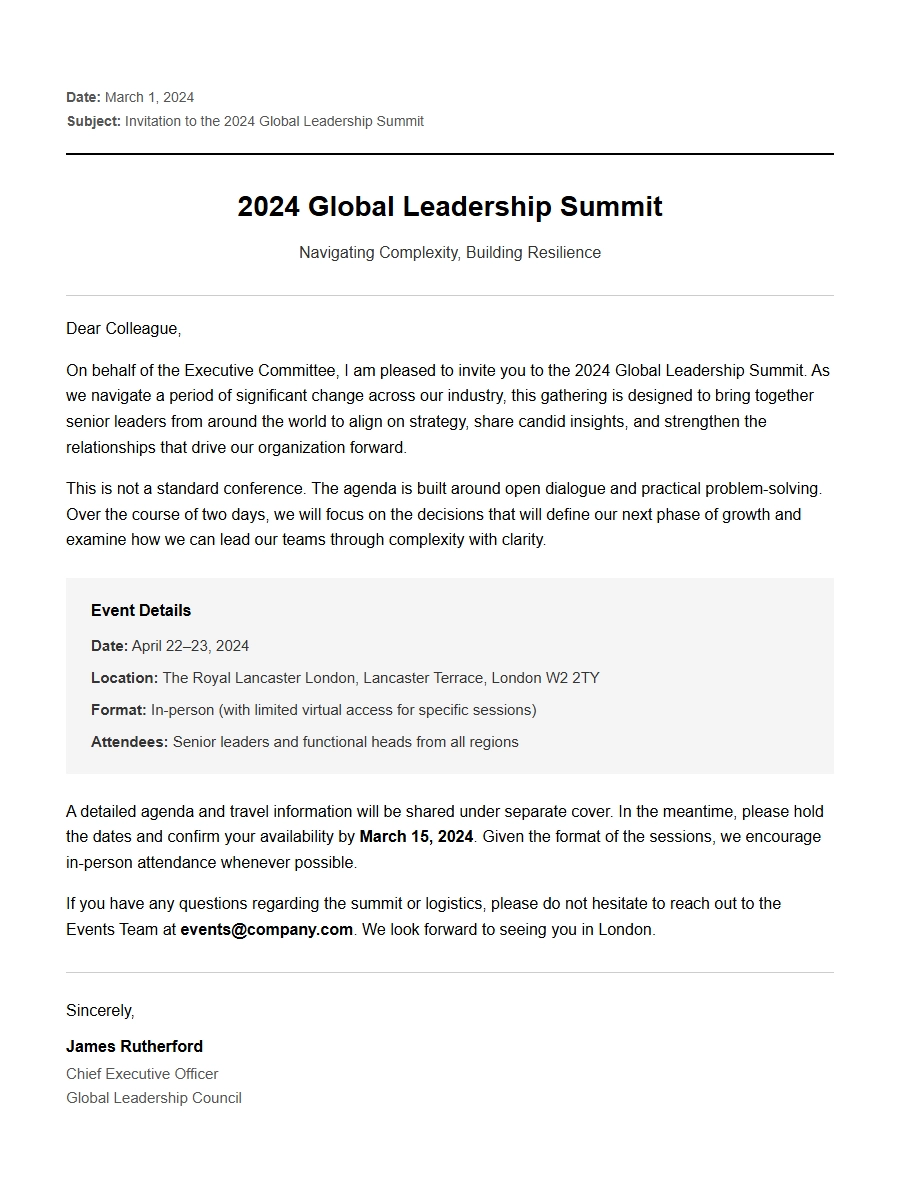
Formal Invitation to Leadership Summit
Dear [Recipient Name],
On behalf of the [Organization Name], it is our distinct pleasure to invite you to the annual Global Leadership Summit, taking place on October 15-17, 2025, at the [Venue Name] in [City].
This year’s theme, “Leading Through Change”, will focus on innovative strategies and resilient leadership. The summit features:
Keynote speeches from Fortune 500 CEOs
Interactive workshops on digital transformation
Networking receptions with industry pioneers
Your presence would greatly enrich our discussions. Please RSVP by September 1 using the enclosed invitation code: LS2025-VIP.
We look forward to welcoming you.
Sincerely, [Your Name] Summit Chair
Digital Invitation with Agenda Table
You are cordially invited to the Leadership Summit 2025 — a virtual event designed for forward-thinking executives.
Join us on November 5-6, 2025 via our dedicated online platform. The summit agenda includes:
Time (EST)
Session
Speaker
9:00 AM
Opening Keynote
Dr. Maria Santos
10:30 AM
Breakout: AI in Leadership
James Chen
2:00 PM
Panel: Remote Team Dynamics
Moderator: Lisa Park
To confirm your free attendance, click the link: [Registration Link]. Use code DIGI25 for early access resources.
Warm regards, The Summit Team
Speaker Proposal Invitation
Dear [Potential Speaker Name],
We are excited to invite you to submit a talk proposal for the Leadership Summit 2025 (March 12-14, [Year]). This year’s theme is “Innovation in Executive Strategy”.
We are particularly interested in topics such as:
Data-driven decision making
Cross-cultural leadership
Sustainable business models
Proposals should include a 200-word abstract, a brief bio, and three learning outcomes. Please send your submission by January 15 to [Proposal Email]. Selected speakers will receive a travel stipend and complimentary registration.
We would be honored to have you share your expertise.
Best regards, [Program Chair]
Sponsor Recruitment Letter
Dear [Sponsor Contact Name],
We invite your organization to become a sponsor of the Leadership Summit 2025, the premier gathering of C-suite executives and rising leaders.
By partnering with us, you will gain:
Exclusive branding on summit materials
Access to a curated networking dinner
Recognition in post-summit publications
Sponsorship packages are available at the following levels:
Level
Investment
Benefits
Platinum
$25,000
Keynote slot, 5 passes
Gold
$15,000
Workshop sponsorship, 3 passes
Silver
$7,500
Exhibitor booth, 2 passes
Let’s schedule a call to discuss which package aligns best with your goals. Reach out to [Sponsorship Manager] at [Phone Number].
Thank you for considering this opportunity.
Sincerely, [Your Name]
Delegate Registration Reminder
Dear [Delegate Name],
This is a friendly reminder that early-bird registration for the Leadership Summit 2025 closes on February 28. Don’t miss the opportunity to secure your spot at a discounted rate.
Event details:
Date: April 10-12, 2025
Location: [Hotel Name], [City]
Theme:Resilient Leadership in a Changing World
Currently, we have over 400 delegates registered, including:
Sector
Attendees
Technology
150
Finance
100
Healthcare
80
Non-profit
70
Register now using your personalized link: [Registration Link]. Code: EARLY25.
We look forward to seeing you there!
Best, Registration Team
VIP Invitation to Exclusive Dinner
Dear [VIP Name],
You are cordially invited to an exclusive VIP dinner hosted by [Organization Name] on the eve of the Leadership Summit 2025.
Date: March 11, 2025 | Time: 7:00 PM – 10:00 PM | Venue: The Rooftop Club, [City].
This intimate gathering will feature a fireside chat with renowned author Dr. Susan Lee and an opportunity to network with fellow industry titans. The dinner is strictly limited to 30 guests.
To confirm your attendance, please RSVP by February 20 to [VIP Coordinator] at [Email Address]. Dietary preferences can be noted in your reply.
We would be delighted to have you join us for an evening of meaningful conversation.
Warmly, [Your Name] CEO, [Organization]
Partner Invitation to Co-Host Workshop
Dear [Partner Name],
We invite your organization to co-host a workshop at the Leadership Summit 2025 (June 5-7, [Year]). The workshop will focus on “Building High-Performance Teams”.
As a co-host, you will:
Lead a 75-minute interactive session
Receive co-branding on all workshop materials
Gain access to attendee data (opt-in)
Proposed workshop structure:
Duration
Activity
Responsible
15 min
Welcome & Icebreaker
Joint
30 min
Case Study Presentation
Your Team
30 min
Group Discussion & Q&A
Facilitators
Please confirm your interest by April 1. We will then set up a planning call.
We value our partnership and believe this collaboration will be mutually beneficial.
Best regards, [Summit Director]
Volunteer Call for Leadership Summit
Dear [Applicant Name],
Thank you for your interest in volunteering at the Leadership Summit 2025. We are excited to invite you to join our volunteer team!
Volunteer roles include:
Registration desk support
Session room monitors
Wayfinding assistants
In exchange for your valuable help, you will receive:
Free access to all summit sessions
A volunteer t-shirt and swag bag
A certificate of participation
Please confirm your availability for September 20-22 by replying to this email. A brief orientation session will be held on September 10 (virtual, 6 PM EST).
We look forward to having you as part of our team!
Cheers, [Volunteer Coordinator]
Post-Summit Feedback Request
Dear [Attendee Name],
Thank you for attending the Leadership Summit 2025! Your feedback helps us improve future events. Please take a few minutes to complete our brief survey.
We would love your thoughts on:
Overall event satisfaction
Quality of speakers and sessions
Networking opportunities
Suggestions for next year
Survey link: [Survey URL]. It will take approximately 5 minutes. As a token of appreciation, respondents will be entered into a raffle to win a free registration for the 2026 summit.
We also invite you to join our LinkedIn group for this year’s summit: [Group Link].
Thank you again for making the summit a success!
With gratitude, The Summit Team
Networking Session Invitation
Dear [Recipient Name],
You are invited to a special Networking Lunch at the Leadership Summit 2025. This is an opportunity to connect with peers in a relaxed setting.
Event details:
Date: September 21, 2025
Time: 12:30 PM – 2:00 PM
Location: Summit Main Hall, Ballroom B
The lunch will feature roundtable discussions on the following topics (choose one when you RSVP):
Topic
Facilitator
Navigating Remote Leadership
Alex Turner
Diversity & Inclusion Strategies
Dr. Maya Patel
Innovation in Supply Chain
Kevin Zhao
Space is limited to 60 participants. Please RSVP by September 10 to [Email Address].
We hope you can join us for this engaging session!
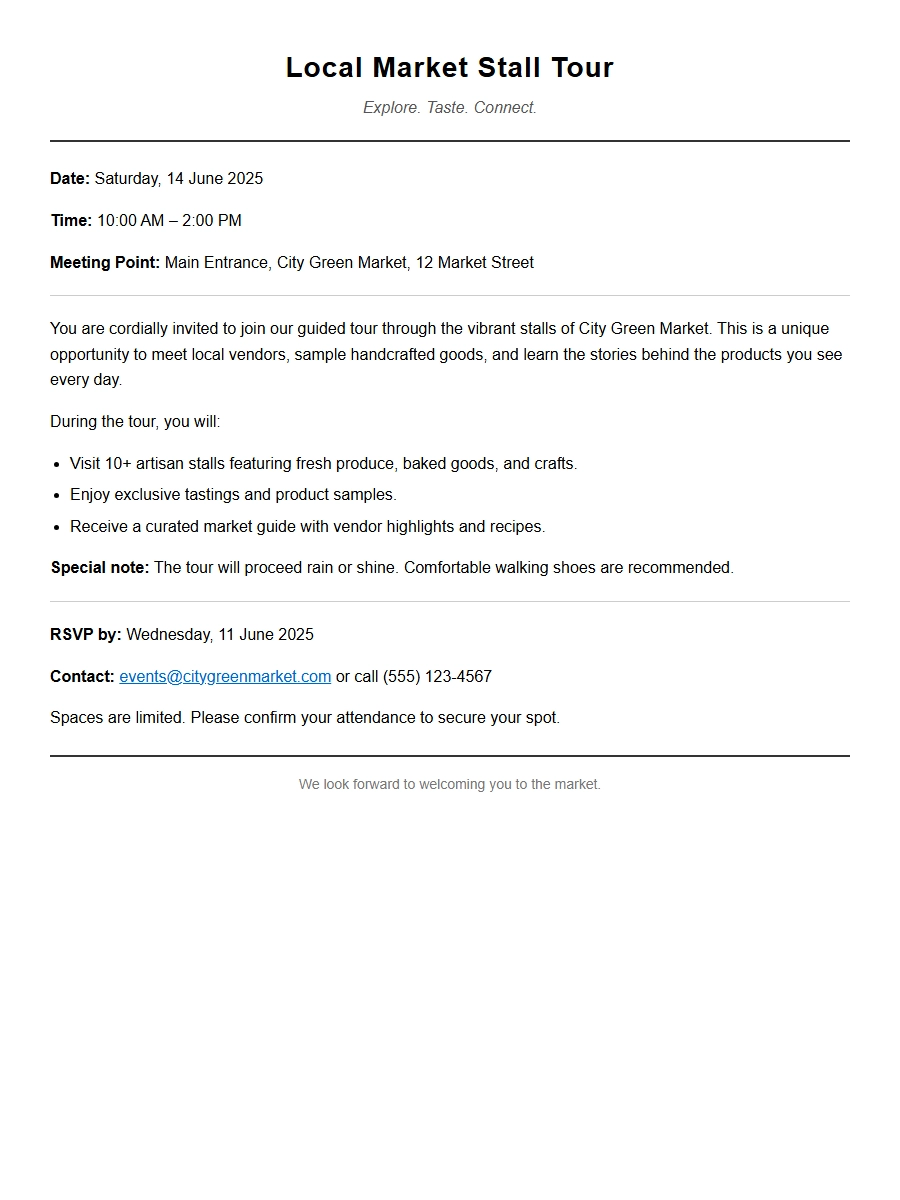 sample invitation for local market stall tour - Invitation Letters
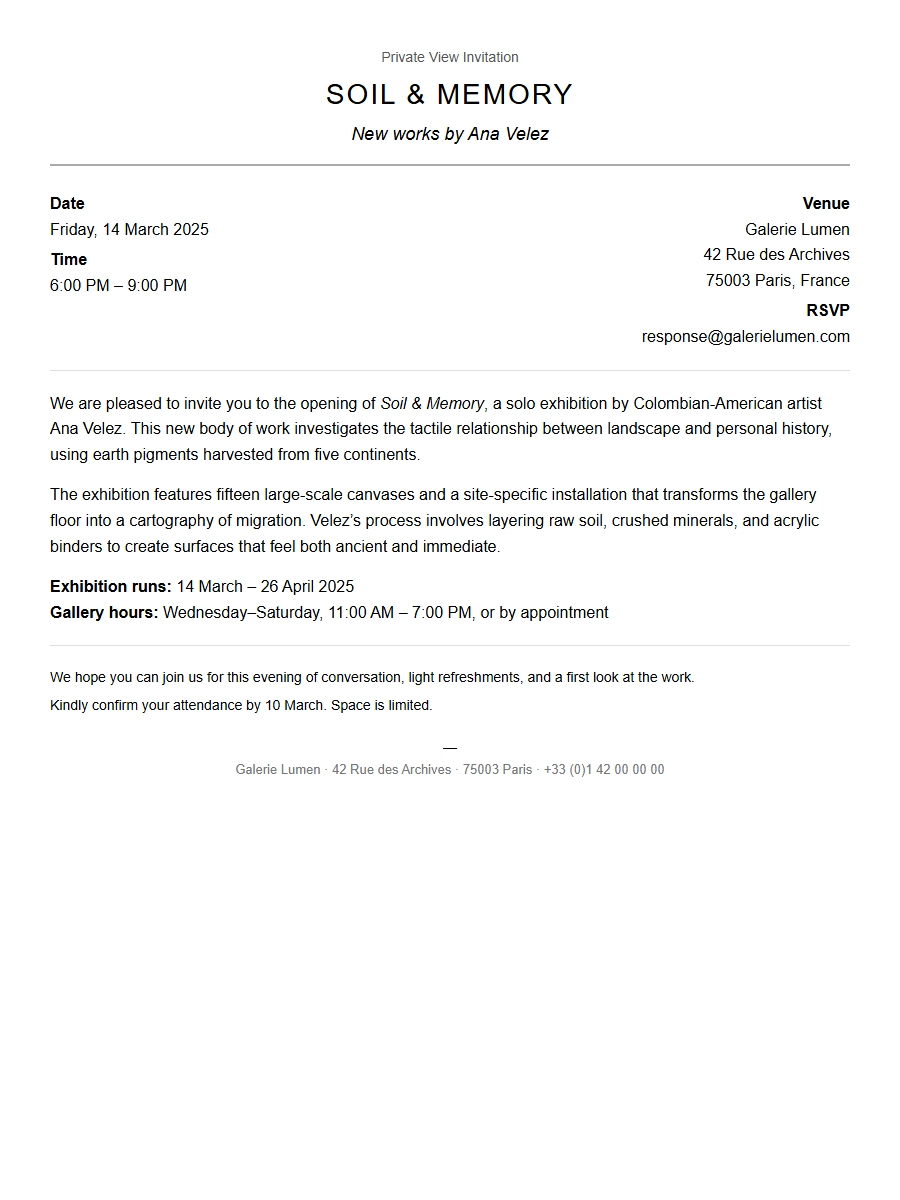 Art Exhibition Opening Invitation Wording Ideas
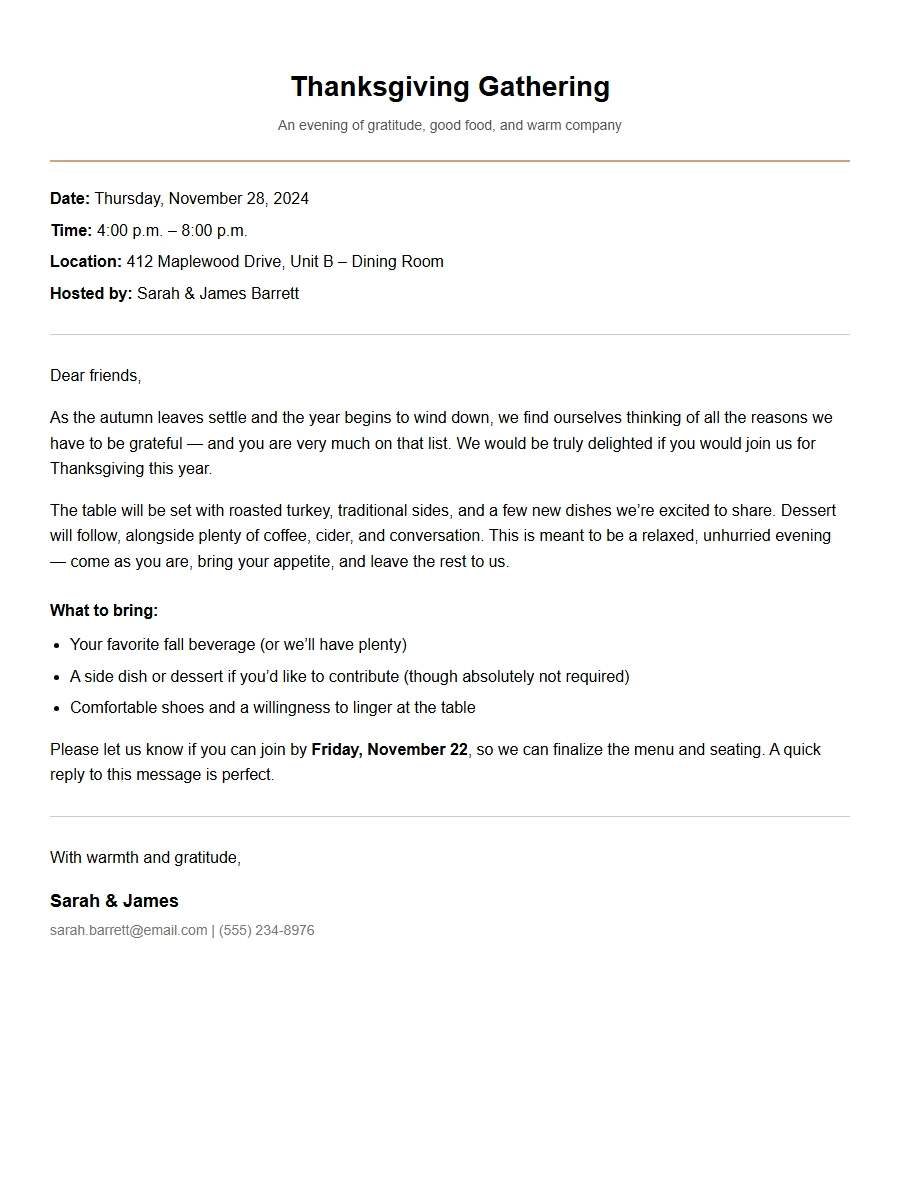 Thanksgiving Meal Gathering Invitation Text
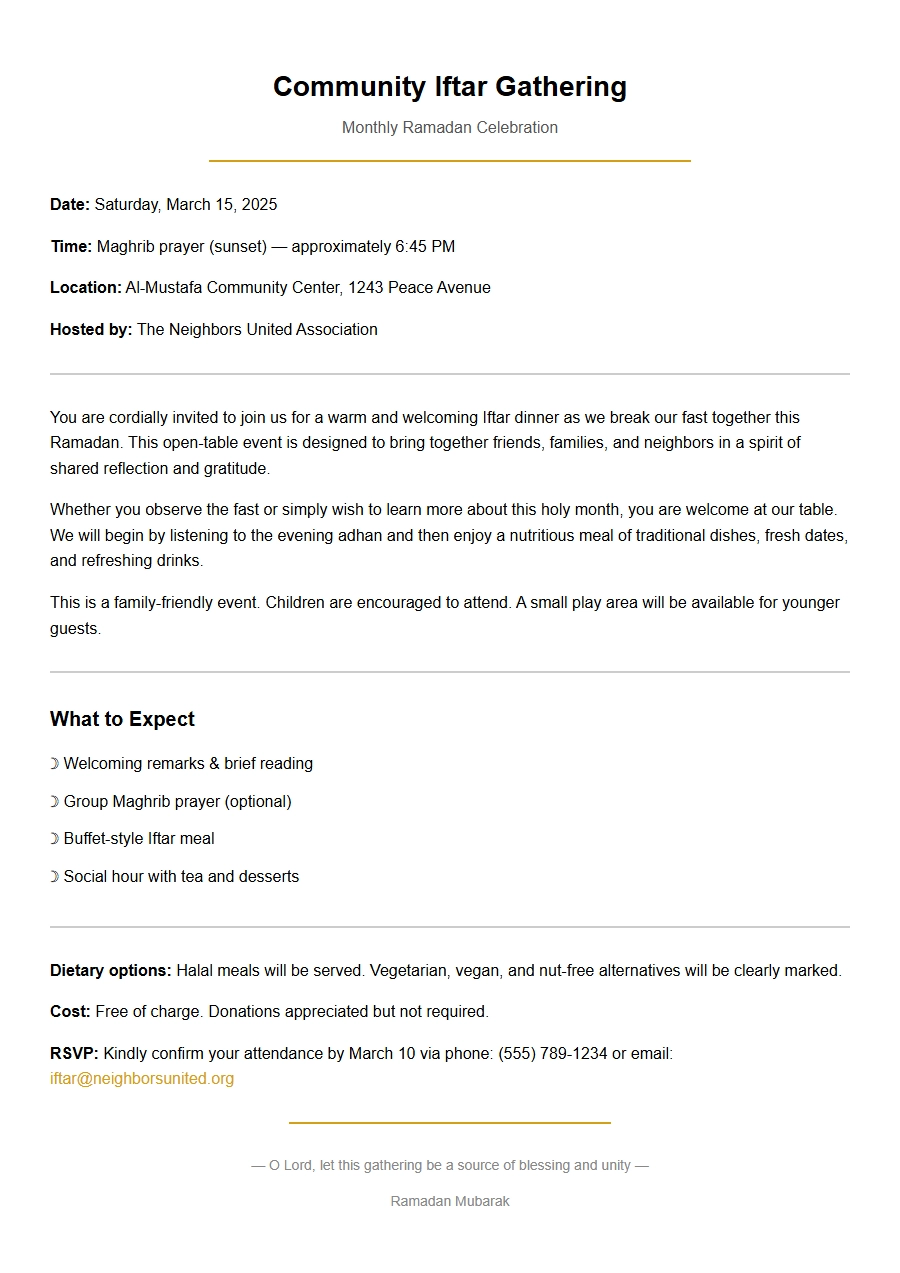 Ramadan Iftar Community Event Invitation
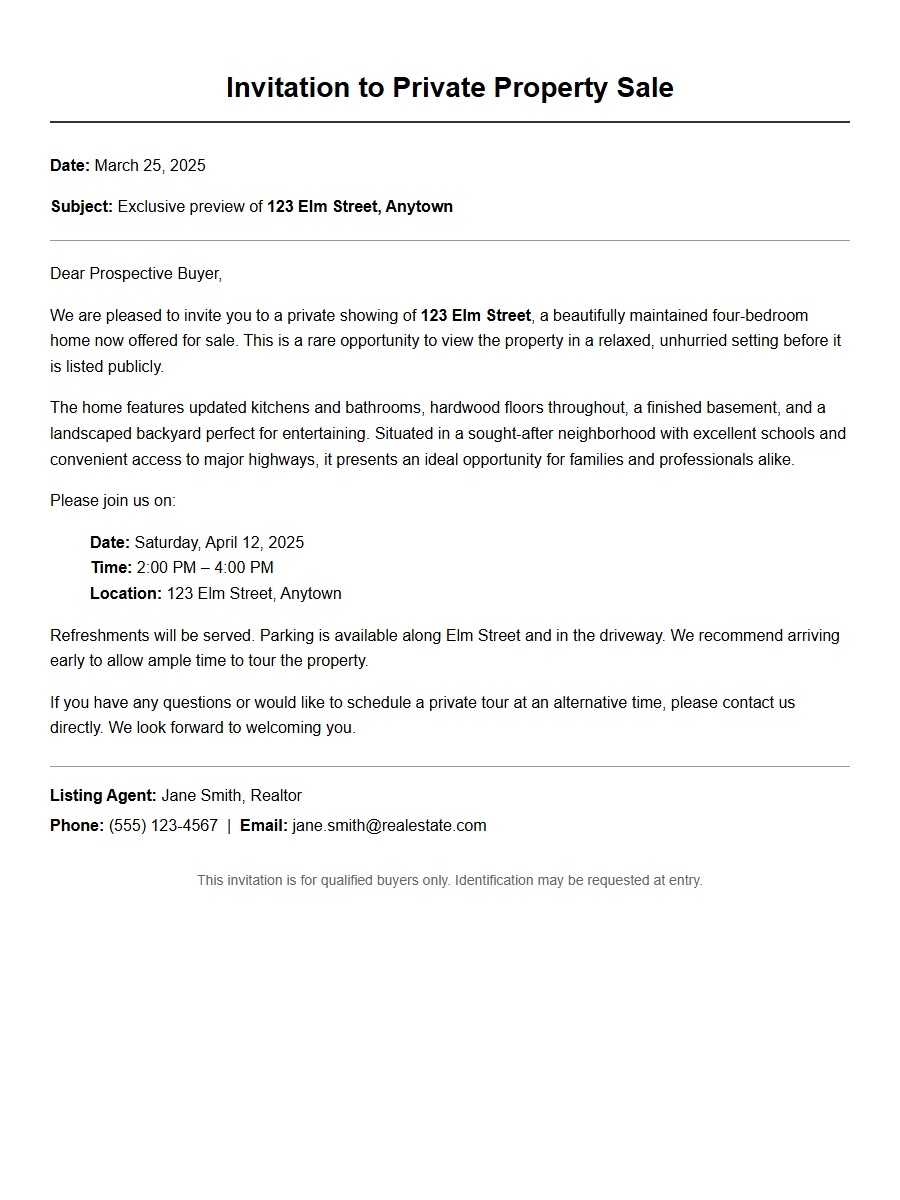 Sample Wording for Property Sale Invitations
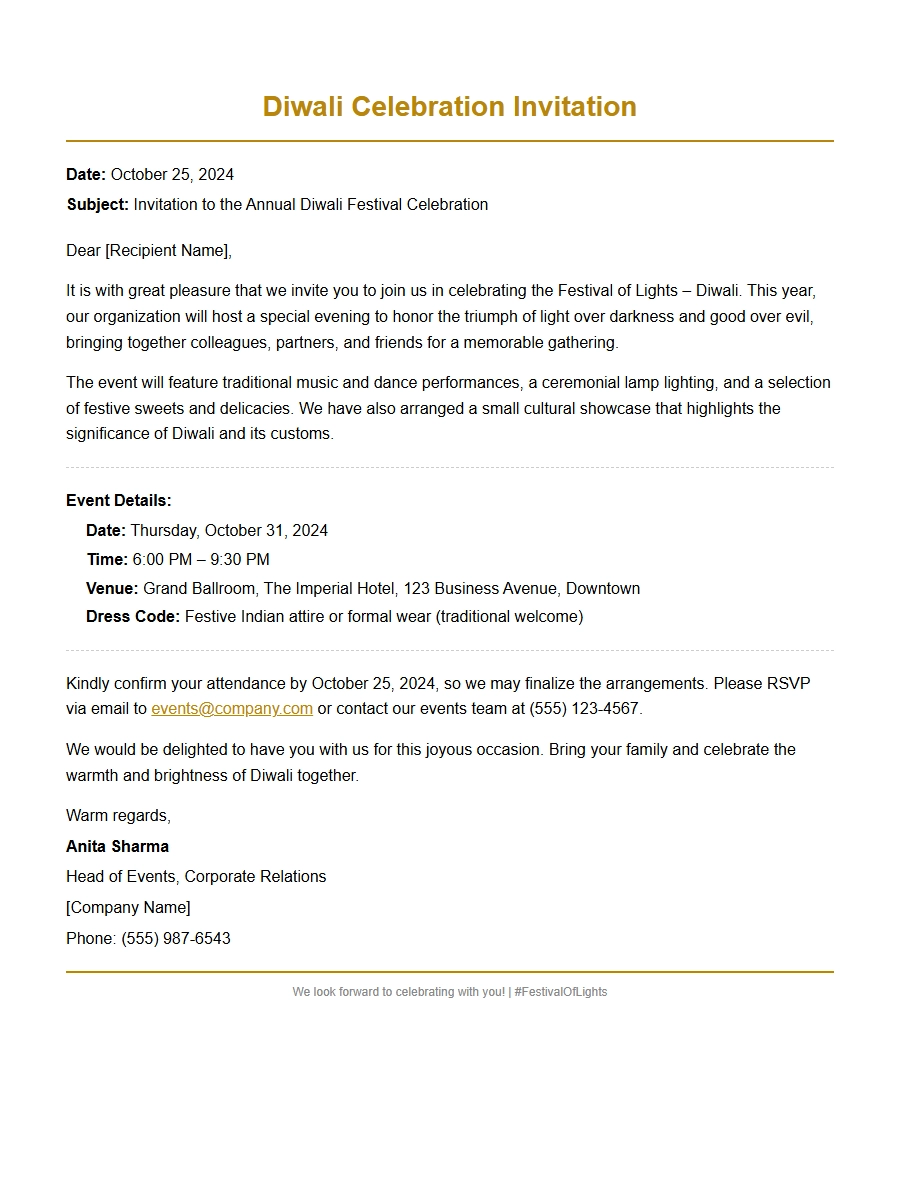 Diwali Festival Celebration Invitation Draft