Thank You to My Partner for My Birthday Celebration
You just had a birthday celebration your partner poured weeks of thought into. Maybe they coordinated with friends, baked your favorite cake, or quietly handled every detail so you could relax. Now you want to send a thank-you letter that truly reflects how much it meant—but the words feel clumsy or too generic. That’s normal. Gratitude is powerful, but expressing it clearly on paper can trip anyone up.
Using a sample letter to get started isn’t cheating—it’s a smart shortcut. A good template gives you structure, helps you choose the right tone, and provides phrases you can adjust to sound like you. But the real magic happens when you personalize it. You don’t want a stiff, one-size-fits-all note. You want something that feels genuine and specific to your relationship.
Why a sample makes sense for personal thank-you notes
Even if you’re a natural writer, drafting a letter to your partner about something as personal as a birthday party can feel awkward. You might overthink the tone: Is “I am writing to express my gratitude” too formal for someone you share a home with? Or does “OMG you’re the best” undersell how much effort they put in? A well-chosen sample bridges that gap. It shows you how to balance warmth with clarity, and it keeps you from forgetting key details—like mentioning the specific decorations you loved or the surprise you didn’t see coming.
Think of it as a skeleton. You supply the meat. The sample provides the structure: a strong opening, a middle that highlights what they did, and a closing that leaves them feeling seen. This approach also saves time. Instead of staring at a blank screen, you adapt a proven framework and fill in your own memories.
How to pick the right tone for your partner
Your letter’s tone should match your relationship and the size of the celebration. For a surprise party with lots of guests, a slightly formal yet warm tone works well. For an intimate dinner at home, keep it light and affectionate. Professional correspondence rules don’t apply here, but letter writing etiquette still matters: a thoughtful salutation and closing show you took the time to write carefully.
Avoid outdated greetings like “To whom it may concern” or stiff sign-offs like “Sincerely.” Instead, open with “Dear [Name],” or just their name if you’re close. Close with “With so much love,” “Gratefully yours,” or simply “All my thanks.” The goal is to sound like you, not a robot.
Adapting a sample without losing your authentic voice
Once you find a letter template you like, don’t copy it word for word. Read it aloud. Does it feel like something you’d actually say? Change any phrase that doesn’t fit. For example, if the sample says “Your meticulous planning made the evening flawless,” but you’d never say “meticulous” in real life, swap it for “your amazing attention to detail.”
Also, don’t skip the specific moments. Instead of “Thank you for the lovely party,” try “Thank you for remembering I love lemon cake and for getting everyone to sing at once—it made me laugh so hard.” Specifics prove you noticed their effort. That’s what makes a letter memorable.
Quick tips for tailoring the opening paragraph
Your first sentence sets the tone. Instead of a bland “I’m writing to thank you,” start with something like “Every time I think about Saturday night, I smile—because of you.” That immediately shows the letter is personal. If your partner planned a big surprise, you could open with “I had no idea you were pulling off such an incredible surprise, and I still can’t believe you kept it secret for weeks!” That grabs attention and makes them feel clever.
Common mistakes to avoid
One big error: using a business letter format for a personal note. You don’t need your address at the top or a date line. Keep it simple. Handwrite the letter if you can—it adds a personal touch. If you’re sending it via email, adjust the format accordingly. No one expects perfect letterhead design for a spouse’s thank-you.
Another mistake: ignoring the digital letter format if you’re sending it online. For email, use a friendly subject line like “All my thanks for my birthday” and keep paragraphs short. Avoid long blocks of text that feel overwhelming on a phone screen.
Also, proofread. Typos or missing words can make your note feel rushed. Run it through spell check or read it out loud. A clean letter shows respect for the reader—even if the reader is your partner.
Using related appreciation letters for inspiration
A sample is a launchpad, not a cage. Once you’ve adapted it, read it once more and ask: Does this sound like me? If yes, send it. If not, tweak another sentence. The best letters feel both professional and personal—a blend of structure and spontaneity. That balance gets easier with practice. The more you write, the faster you’ll find your rhythm. And your partner will appreciate the effort, no matter how many drafts it took.
Templates and Samples
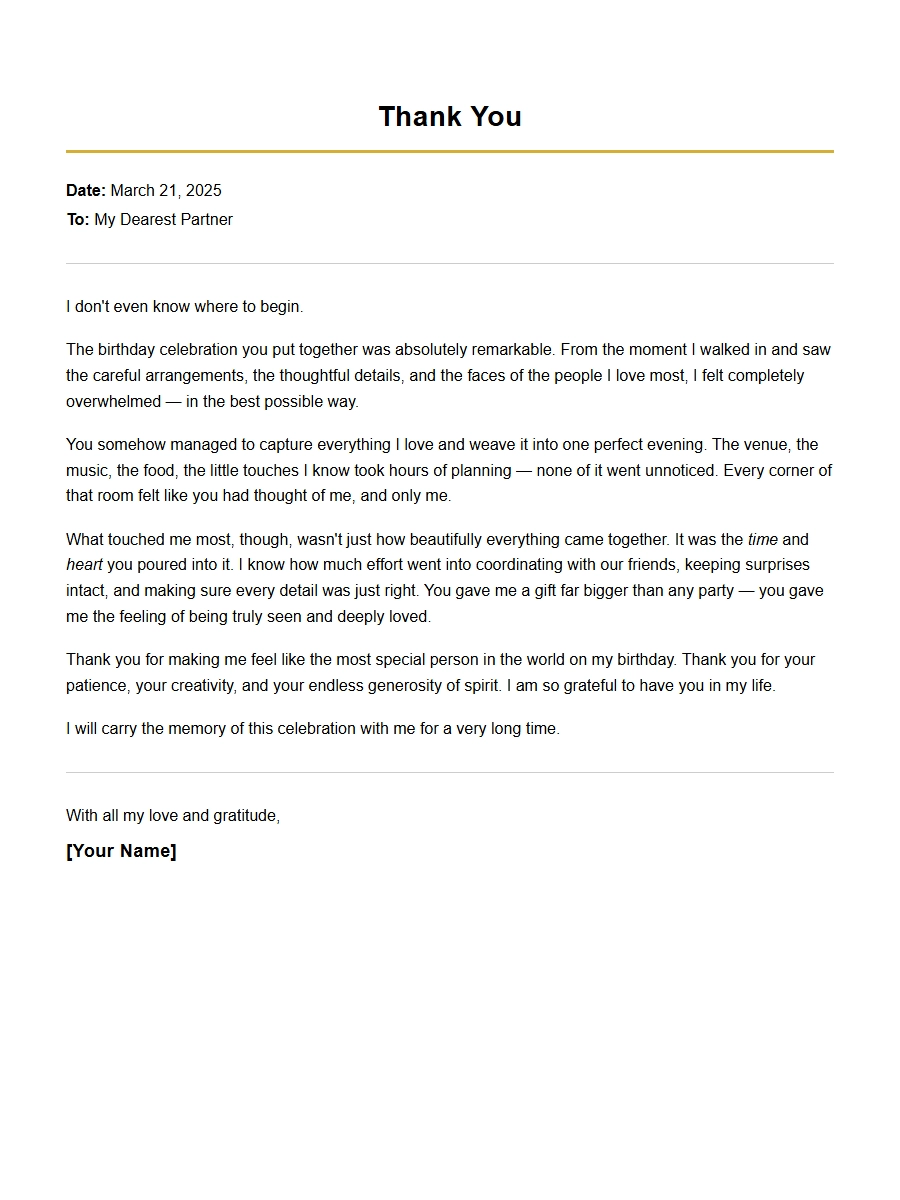
Thank You to My Partner for My Birthday Celebration
Formal Thank-You with Highlights Table
Dear [Partner's Name],
I want to express my deepest gratitude for the incredible birthday celebration you planned. Every detail, from the venue to the decorations, was perfect. Below is a quick summary of the highlights that made the day unforgettable:
Element
Why It Was Special
Venue
Cozy rooftop with a stunning sunset view
Menu
My favorite dishes, including the surprise dessert
Guest list
You gathered all my close friends from different stages of life
Music playlist
Every song reminded me of our shared memories
Thank you for the time, love, and creativity you poured into this. I felt truly celebrated and cherished. I am so lucky to have you as my partner.
With all my love, [Your Name]
Heartfelt Note with List of Appreciations
My dearest [Partner's Name],
Words cannot fully capture how grateful I am for the birthday party you put together. I want to thank you specifically for:
The hidden theme – you remembered my love for retro arcade games and turned the living room into a mini arcade.
The guest surprises – having my childhood best friend fly in was something I never expected.
Your homemade cake – it tasted even better than any bakery could make.
The thoughtful speech you gave made me tear up (in the best way).
You put so much heart into every detail. I promise to make your next celebration just as amazing.
Forever yours, [Your Name]
Casual Email-Style Thank-You
Hey [Partner's Name],
Just wanted to drop a quick note to say THANK YOU for the amazing birthday bash last weekend. You absolutely nailed it! Here are a few things that blew my mind:
The hand-painted banner you made – I’m keeping it forever.
How you coordinated with my mom without me noticing.
The photo booth props – everyone loved them.
The way you remembered I hate crowds and kept the guest list intimate.
I still can’t believe you pulled off the surprise fireworks. You made me feel like the luckiest person alive. Can’t wait to spoil you on your special day!
Love, [Your Name]
Humorous Thank-You for the Chaos
To my amazing partner-in-crime,
Thank you for planning my birthday celebration – and surviving it! I know there was a moment when the cake almost fell, the piñata refused to break, and you tried to hide the fact that you burned the first batch of appetizers. But honestly, those little mishaps made the day even more memorable.
You handled everything with grace (and a few frantic texts to your sister). I appreciate:
Your perseverance with the stubborn piñata.
The emergency pizza order that saved dinner.
How you laughed at yourself – it made everyone feel at ease.
Thank you for creating a party full of love, laughter, and delicious chaos. I wouldn’t change a thing.
Much love, [Your Name]
Grateful Note for Surprise Elements
Dear [Partner's Name],
I’m still floating from the surprise birthday celebration you organized. You managed to keep it completely secret – I had no idea. The moment I walked into the room and saw everyone, I was speechless.
I especially want to thank you for:
The surprise video montage from friends and family who couldn’t attend – I cried happy tears.
Hiring a live acoustic duo to play my favorite indie songs.
Arranging a charity donation in my name instead of gifts – that was so thoughtful.
You made my birthday not just about me, but about celebrating togetherness and giving back. I am deeply moved by your love and effort.
With gratitude, [Your Name]
Thank-You with Planned vs. Actual Table
Hey love,
I know planning a birthday party takes immense effort. I wanted to show you how much your planning paid off with a little comparison table:
Planned
Actual
Verdict
Dinner at 7 PM
Started at 7:30 (fashionably late)
Perfect timing
30 guests
28 showed up – cozy and intimate
Even better
Store-bought cake
You baked a three-layer chocolate mousse cake
Outstanding
Playlist on speaker
Live guitarist for two hours
Magical
You exceeded every plan. Thank you for the extra love and personal touches. I’m so grateful.
Yours, [Your Name]
Appreciation for Teamwork in Planning
Dear [Partner's Name],
Thank you not only for planning my birthday celebration but for including my friends and family in the planning process. I know you coordinated with my sister, my best friend, and even my roommate to pull off the perfect day.
You created a shared vision that made everyone feel involved. I noticed:
How you delegated tasks without stepping on toes.
You made sure my allergies were accommodated in the menu.
The seating arrangement helped mix old friends with new ones – conversations flowed naturally.
Your ability to lead and collaborate made the celebration feel like a community effort. I’m proud to have such a thoughtful and organized partner.
Love always, [Your Name]
Thank-You for Involving Friends and Family
To my wonderful partner,
Thank you for bringing together the most important people in my life for my birthday – some of whom I haven’t seen in years. You personally reached out to each person, collected photos for a memory book, and even arranged video calls for those overseas.
I especially appreciate:
The memory book with handwritten notes from everyone – I read it three times.
Setting up a group photo that now hangs on our wall.
How you made sure my grandmother felt comfortable with a quiet corner to rest.
You understood that the best gift was having the people I love in one room. Thank you for making that happen with so much care.
With all my heart, [Your Name]
Thank-You for Handling Logistics
Dear [Partner's Name],
I know planning a party involves countless behind-the-scenes tasks. Thank you for handling every logistical detail so I could simply enjoy the day. From catering to cleanup, you made it look effortless.
Here’s what I noticed you managed:
Task
How You Excelled
Venue booking
Secured our favorite park pavilion on short notice
Catering
Balanced dietary needs for all guests
Entertainment
Hired a magician that amazed both kids and adults
Cleanup
Had a team ready so we could relax afterward
Your organizational skills are unmatched. I loved that you still managed to dance and laugh with everyone. Thank you for making the day stress-free and joyful.
Love, [Your Name]
Thank-You for Personalization
My dearest [Partner's Name],
What made my birthday celebration truly special was how deeply personalized every element was. You didn’t just throw a generic party – you curated an experience that reflected my personality and our journey together.
I was moved by:
A photo timeline from our first date to now – displayed on a clothesline.
Custom fortune cookies with inside jokes inside each one.
A playlist containing songs from every concert we’ve ever attended together.
The birthday toast where you shared our favorite funny memory.
It’s rare to feel so seen and understood. You made me feel like the center of your world. Thank you for the time, research, and thoughtfulness.
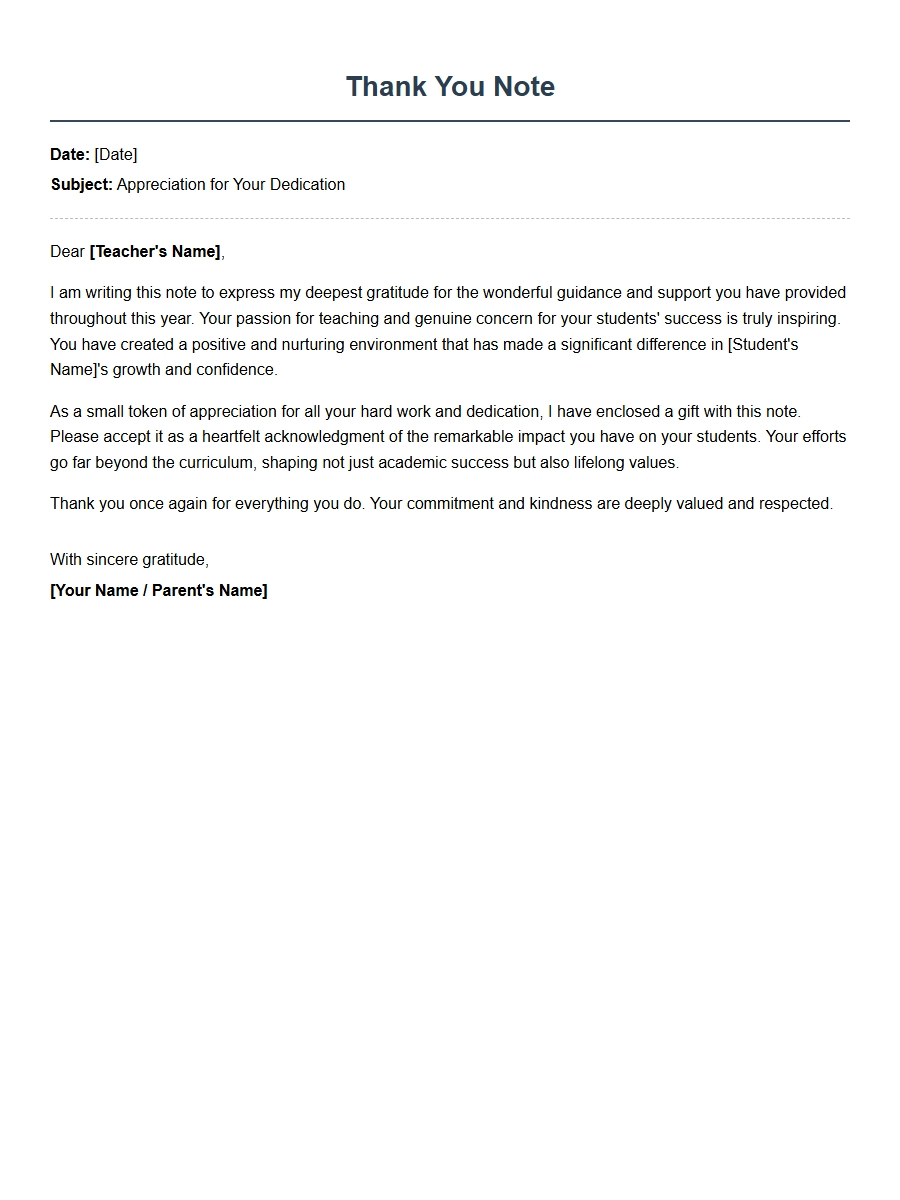 Sample Thank You Note for Teacher Gift
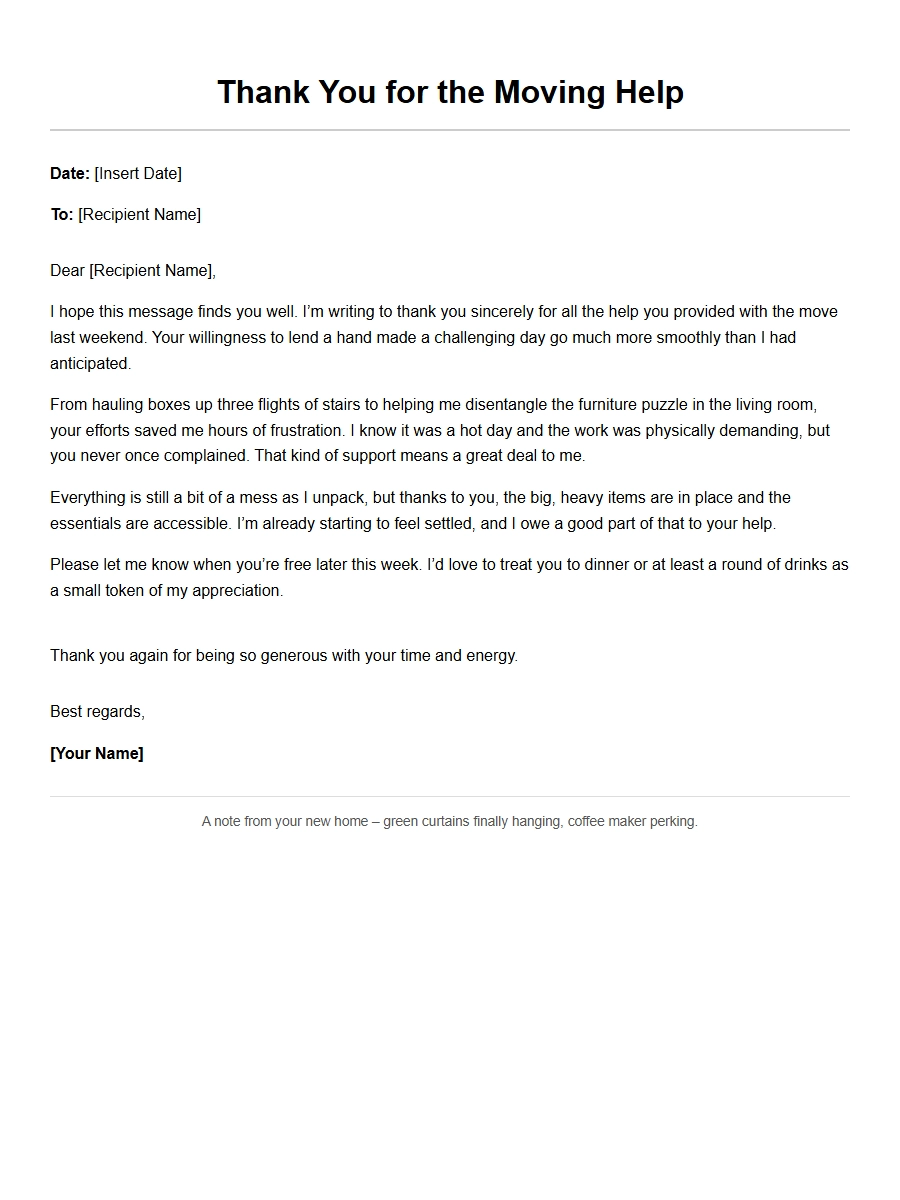 Thank-You Letter for Help with Moving
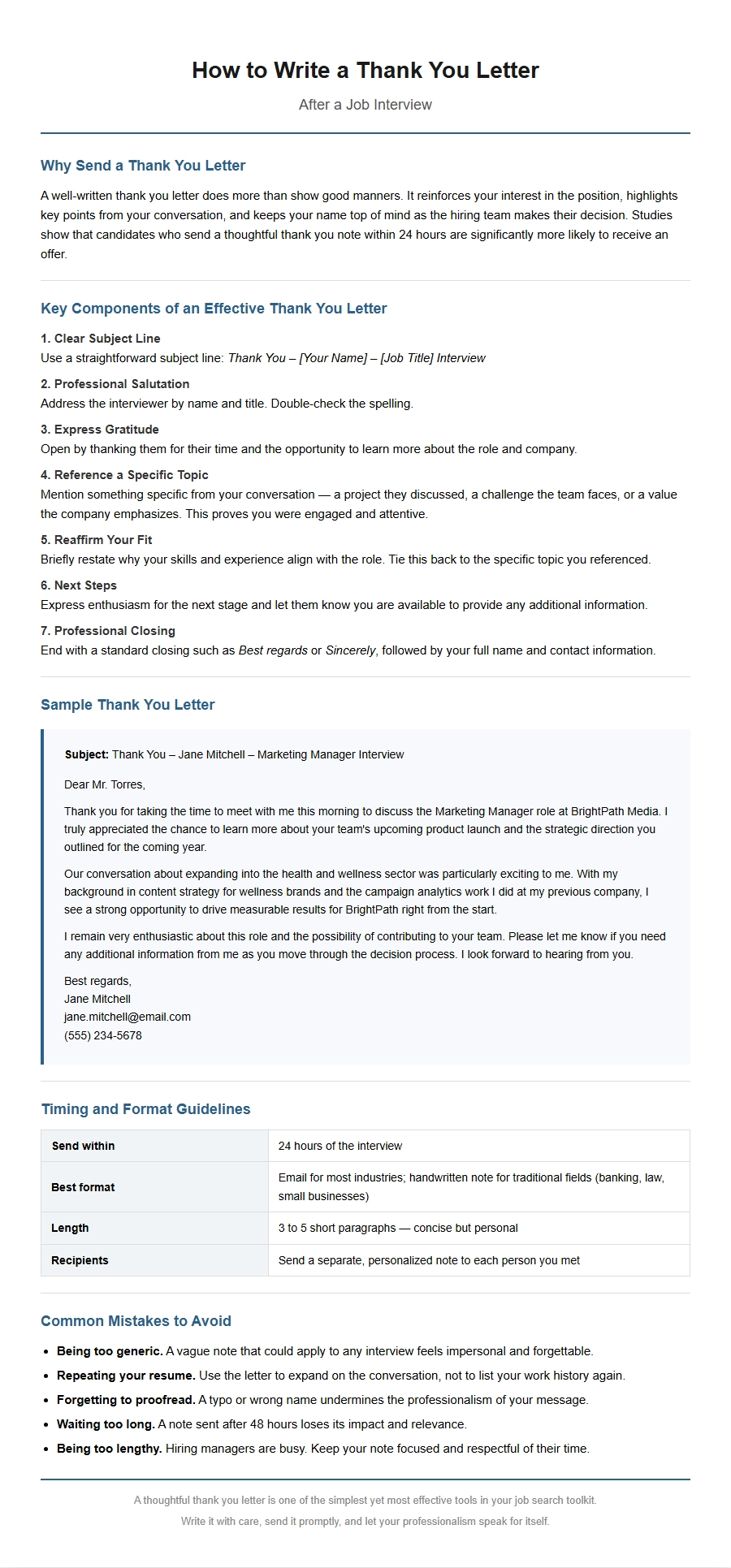 How to Write a Thank You Letter After an Interview
 professional thank you email example for client - Thank-You Letters
 Business Mentor Thank-You Letter Guide
 Thank You Letter for Sponsor Donation