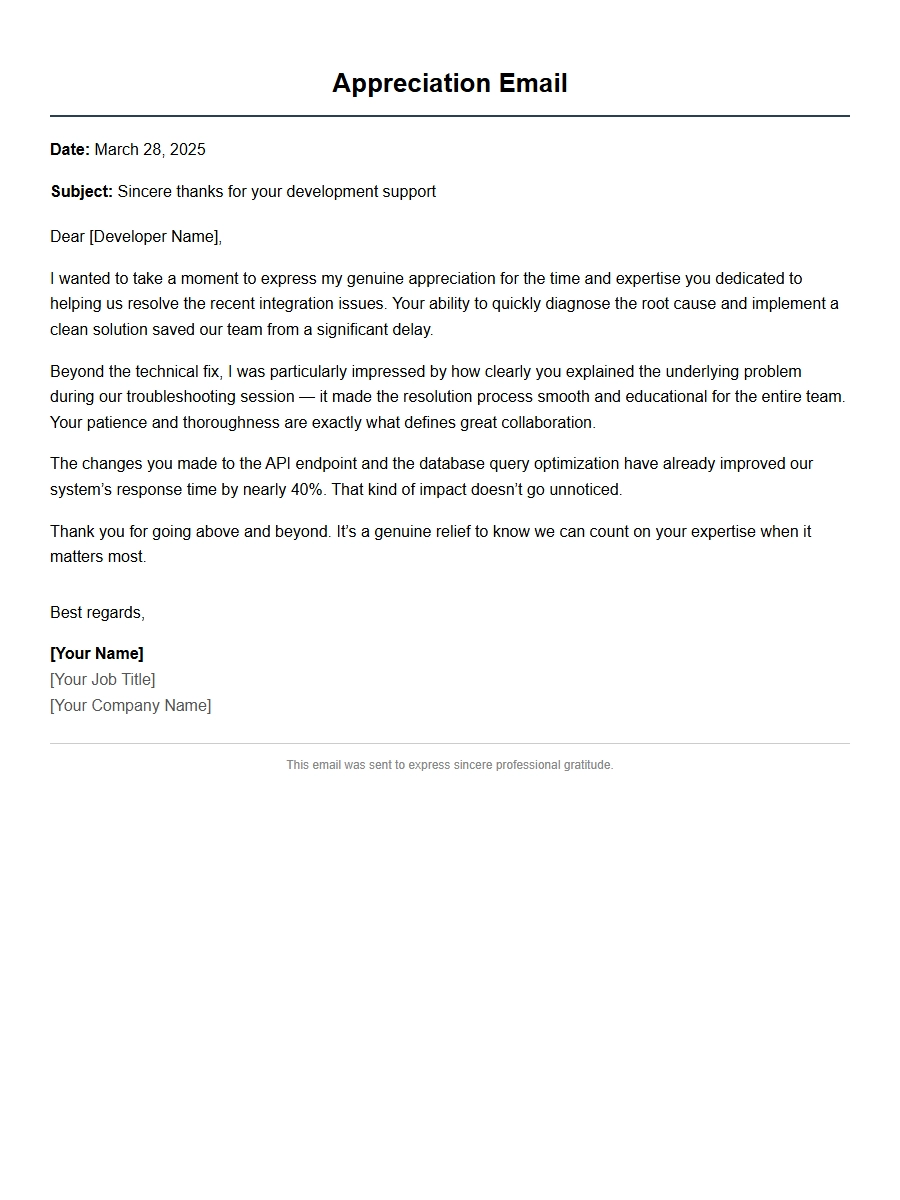
appreciation email for software developer help - Thank-You Letters
You just got unstuck. A developer fixed that gnarly bug, stayed late to help you ship a feature, or walked you through a confusing codebase. Now you owe them a thank-you—but staring at a blank email feels awkward. You want to sound grateful, not gushy. Professional, not stiff. The right sample email can turn that anxiety into a confident, polished note in two minutes.
Using a sample isn’t cheating. It’s a smart shortcut. A good letter template gives you the structure, tone, and key phrases you need—while leaving room for your own story. Think of it as training wheels for professional correspondence. You’ll avoid common pitfalls and still sound like you.
Category: Appreciation Letters
When should you send an appreciation email to a developer?
Any time their help made your life easier. Maybe you were stuck on a logic error for hours and they spotted it in two minutes. Maybe they wrote a quick script that saved you a day of manual work. Or maybe they patiently explained a concept you’d been struggling with. If their help had impact, say thank-you. Developers often get complaints or bug reports—a genuine thanks stands out.
How to choose the right sample for your situation
Not all thank-you emails are the same. If you work closely with the developer, a casual tone is fine: “Hey, thanks for your help on that pull request—really appreciate it.” If they’re more senior or from a different team, lean toward a slightly more formal approach. Think about your relationship and company culture. A business letter format (with a clear subject line, salutation, body, and closing) works for cross-team help. For a teammate, an email with a more relaxed tone in writing fits better.
How to adapt a sample without losing your authentic voice
Start with the sample’s structure—subject line, greeting, body, closing—but rewrite the middle part in your own words. Mention exactly what the developer did. Be specific: “When you helped me debug that async issue yesterday, your explanation about promises finally clicked.” Avoid generic lines like “thanks for your help.” Specificity shows you paid attention and makes the email feel personal.
Also, keep it short. Developers are busy. Get to the point, say what their help meant to you, and wrap up. A couple of paragraphs is plenty. Use their name in the salutation and closing—it humanizes the email.
Quick tip: tailor the opening to grab attention
Start with gratitude right away, but add a tiny detail. Instead of “Thanks for your help,” try “Thanks for jumping on that call yesterday—your fix saved me from rewriting the whole module.” The developer will immediately know which event you’re referring to and feel appreciated.
Common mistakes to avoid
One of the biggest is forgetting to proofread. A rushed email with typos undercuts your gratitude. Take thirty seconds to read it out loud. Also, avoid outdated salutations like “To whom it may concern”—that’s for cover letter examples, not a personal thank-you. If you’re sending this via work email, use a digital letter format with a clear subject line (e.g., “Thank-you for your help on project X”). Don’t worry about letterhead design unless you’re printing a formal note. Most developer thanks stay in email.
Another mistake: not acknowledging the impact. Explain how their help made a difference. Did it get a feature shipped on time? Did it reduce your stress? Developers want to know their effort mattered.
A quick example you can adapt
Here’s a simple structure you can modify:
Subject: Thanks for the help with the authentication bug
Greeting: Hi [Name],
Body: I wanted to thank you for your help debugging the login issue this morning. Your suggestion about the token expiry saved me hours of searching. I really appreciate you stopping your work to assist.
Closing: Thanks again, [Your Name]
That’s it. Short, specific, and genuine. If you want to go a step further, mention it to their manager or send a quick message in your team’s chat. Sometimes a public thank-you carries extra weight.
The best appreciation emails feel both professional and personal. A customizable letter gives you a solid foundation, but your own voice makes it memorable. Practice writing a few, and soon you’ll dash off thank-you notes without any hesitation. The next time a developer helps you out, you’ll know exactly what to say—and they’ll feel seen.
Templates and Samples
appreciation email for software developer help - Thank-You Letters
Thanks for Bug Fix
Dear Alex,
I wanted to take a moment to thank you for the swift and thorough fix you provided for the login timeout bug. Your debugging skills are impressive — you traced the root cause to a race condition in the session handler within just a few hours.
Your fix not only resolved the immediate issue but also improved the overall stability of the authentication module. Here’s a quick summary of what you accomplished:
Identified the asynchronous token refresh conflict
Refactored the session middleware to use atomic operations
Added proper error logging for future diagnostics
Wrote unit tests covering the edge cases
Thanks to your work, our users are no longer experiencing unexpected logouts during peak hours. Your dedication and technical expertise are deeply valued by the whole team.
Best regards, Sarah
Appreciation for Mentoring
Hi Jordan,
Thank you so much for the mentorship you’ve provided over the past month. Your patience in explaining complex design patterns and your willingness to pair program on the payment integration has been incredibly helpful.
I especially appreciated the way you broke down the following topics:
Topic
Key Takeaway
Dependency Injection
Decoupling modules for testability
REST API design
Resource naming and status codes
Database transactions
ACID properties and isolation levels
Code review best practices
Constructive feedback techniques
Your guidance has accelerated my learning curve significantly. I feel more confident tackling complex tickets now. Thank you for investing your time in my growth.
Sincerely, Priya
Thanks for Feature Development
Dear Marcus,
I’m writing to express my sincere gratitude for your outstanding work on the real-time notification feature. You took a vague requirement and turned it into a polished, scalable solution.
Here are the specific aspects that impressed me:
Architecture: You chose WebSockets over polling, reducing server load by 40%.
Reliability: You implemented a retry mechanism with exponential backoff for failed deliveries.
User experience: The toast notifications are smooth and non-intrusive.
Documentation: The API spec and integration guide you wrote were crystal clear.
The feature has been live for a week and user feedback is overwhelmingly positive. Your attention to detail and proactive communication during development made the entire process seamless.
Thank you for going above and beyond.
Warm regards, Emily
Appreciation for Code Review
Hi Chris,
Thank you for the thorough code review you did on my pull request for the search optimization branch. Your comments were precise and actionable — they helped me improve both the code quality and my own understanding of performance best practices.
Key improvements you suggested that made a noticeable difference:
Replacing O(n²) nested loops with a hash map lookup
Adding pagination to the search results endpoint
Using database indexing on the frequently queried columns
Implementing caching for repeated searches
After implementing your feedback, the search response time dropped from 3.2 seconds to 0.4 seconds. Your ability to spot inefficiencies is remarkable. Thank you for taking the time to explain each suggestion — it made the review a learning opportunity rather than just a gatekeeping step.
Thanks again, Lena
Thanks for Deployment Support
Dear Taylor,
I can’t thank you enough for the round-the-clock support you provided during the deployment of the new microservices architecture last weekend. When we hit the networking issue that blocked the staging environment, you dove into the configuration files without hesitation.
Here’s a timeline of what you resolved:
Time
Issue
Resolution
2:00 AM
SSL certificate mismatch
Updated cert chain and ingress rules
4:30 AM
Service mesh connectivity
Corrected Istio mTLS config
7:15 AM
Database migration failure
Rolled back and re-ran with proper order
Your calm demeanor under pressure and deep knowledge of Kubernetes saved us from a full outage. The deployment went live on schedule, and customers noticed zero downtime. You are a true professional.
With appreciation, Morgan
Thanks for Documentation Help
Hi Jamie,
Thank you for volunteering to overhaul the developer onboarding documentation. Your contributions have made it far easier for new hires to get up to speed. I especially liked the following sections you improved:
Setup Guide: You included troubleshooting steps for common environment issues.
API Reference: Updated with real-world use cases and error handling examples.
Architecture Overview: You added a clear diagram description and data flow explanations.
Since you updated the docs, the number of support requests from new team members has dropped by 60%. Your ability to write clearly and anticipate questions is a superpower. Thanks for making the knowledge accessible to everyone.
Cheers, Sam
Appreciation for Performance Optimization
Dear Riley,
Your recent work on optimizing the product listing page has had a tremendous impact. The page now loads in under 1 second, down from 6 seconds. I want to highlight the specific techniques you applied:
Database query optimization: You reduced N+1 queries by eager loading relationships.
Caching strategy: Implemented Redis cache for frequently accessed product data.
Frontend bundling: You split JavaScript chunks and lazy-loaded images.
Background jobs: Moved heavy report generation to a queue worker.
The improvement in user engagement metrics is already visible — bounce rate decreased by 15% and conversion rate increased by 8%. Your methodical approach to profiling and fixing bottlenecks sets a great example for the team. Thank you for making our users happier and our infrastructure more efficient.
Best, Casey
Thanks for Security Patch
Hi Dakota,
I want to express my gratitude for the rapid response you executed when we discovered the XSS vulnerability in the comment feature. You assessed the risk, wrote the fix, and deployed the patch within four hours — well before our SLA deadline.
Details of the security update you implemented:
Component
Vulnerability
Mitigation
Comment input sanitization
Stored XSS
Used DOMPurify and output encoding
Session tokens
Weak entropy
Switched to CSPRNG generation
API rate limiting
Brute force attacks
Added throttling per IP
Your diligence in also running a full security audit afterward gave us confidence that no other vulnerabilities exist. Thank you for keeping our platform safe and for your clear communication with the team about the incident.
Gratefully, Jordan
Appreciation for Pair Programming Session
Dear Quinn,
Thanks for the pair programming session yesterday on the payment gateway integration. Your live problem-solving approach was incredibly educational. I learned several techniques that I’ll apply regularly:
Debugging with breakpoints: You showed me how to inspect async call stacks effectively.
Test-driven development: We wrote tests before implementing the refund logic.
Refactoring patterns: You demonstrated extracting a shared service from duplicate code.
Git workflow: You explained interactive rebasing for cleaner commit history.
Not only did we complete the feature faster than estimated, but I also gained new skills that will improve my day-to-day coding. Your patience and teaching ability are exceptional. I hope we can do more pairs in the future.
Thank you, Avery
Thanks for Open-Source Contribution Help
Hi Logan,
Thank you so much for guiding me through my first open-source contribution to our internal library. Your step-by-step help made the process smooth and enjoyable. Specifically, you assisted with:
Fork and branch setup: You clarified the Git workflow for contributing upstream.
Code standards: You pointed out the style guide and lint rules I needed to follow.
Unit test writing: You helped me write test cases for the new utility function.
Pull request description: You taught me how to write a clear summary and link related issues.
Thanks to your mentorship, my PR was merged today. I now feel confident to contribute more regularly. Your willingness to help others grow is what makes our engineering culture great.
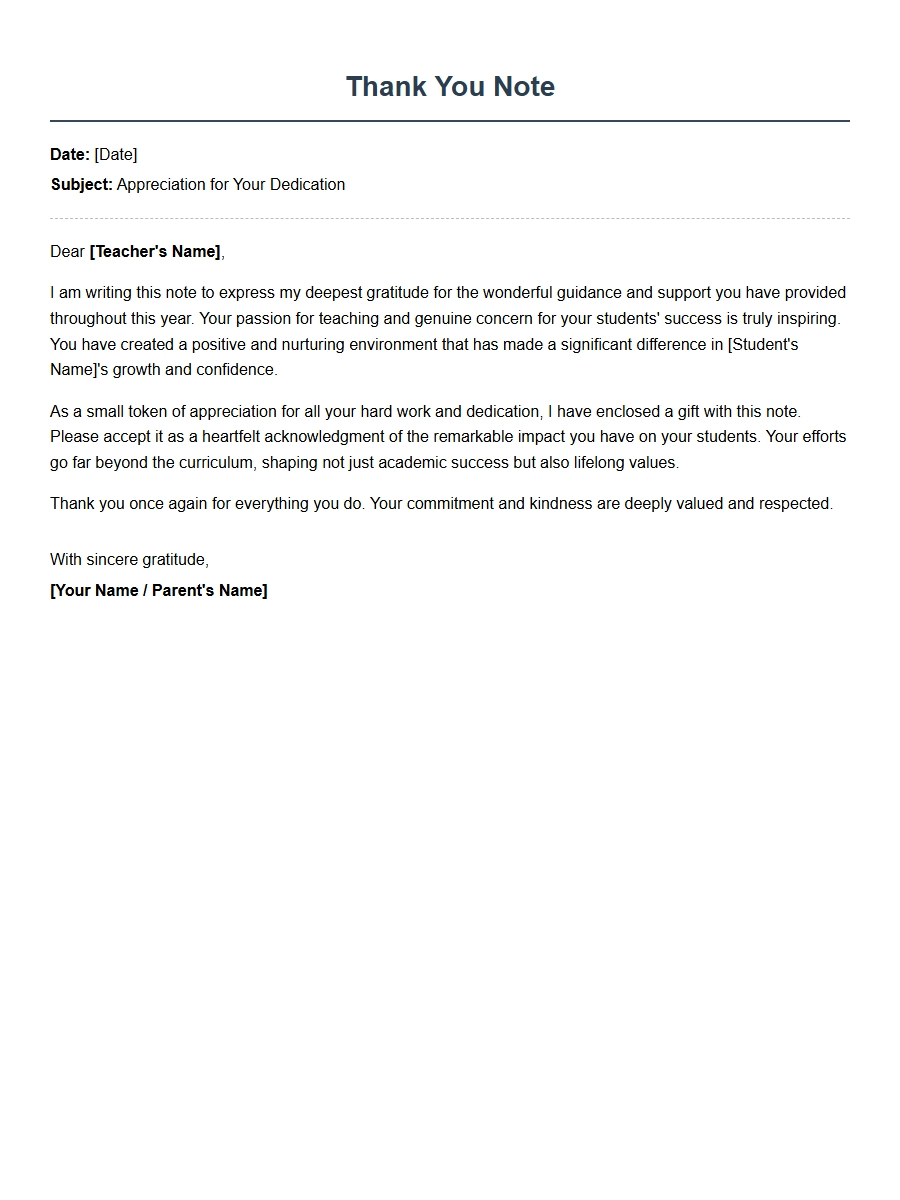 Sample Thank You Note for Teacher Gift
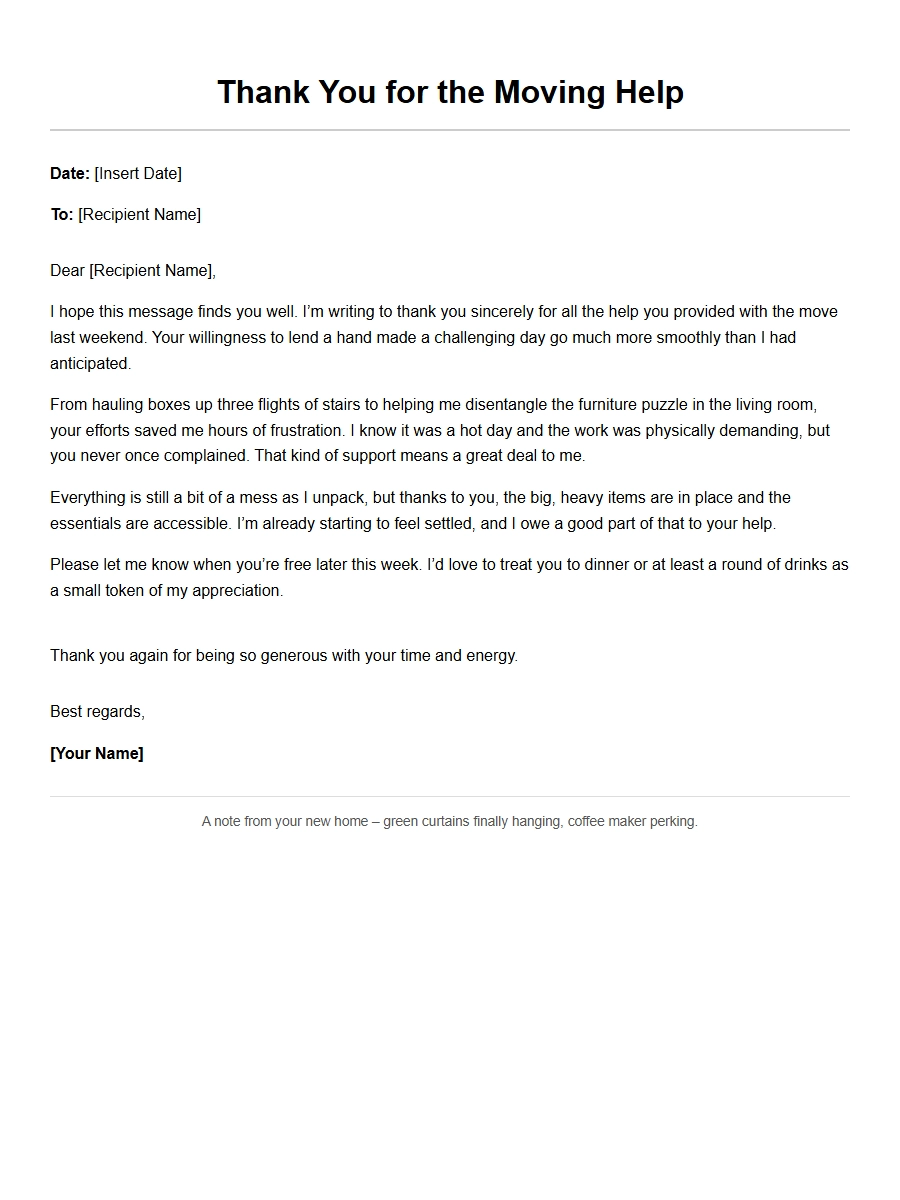 Thank-You Letter for Help with Moving
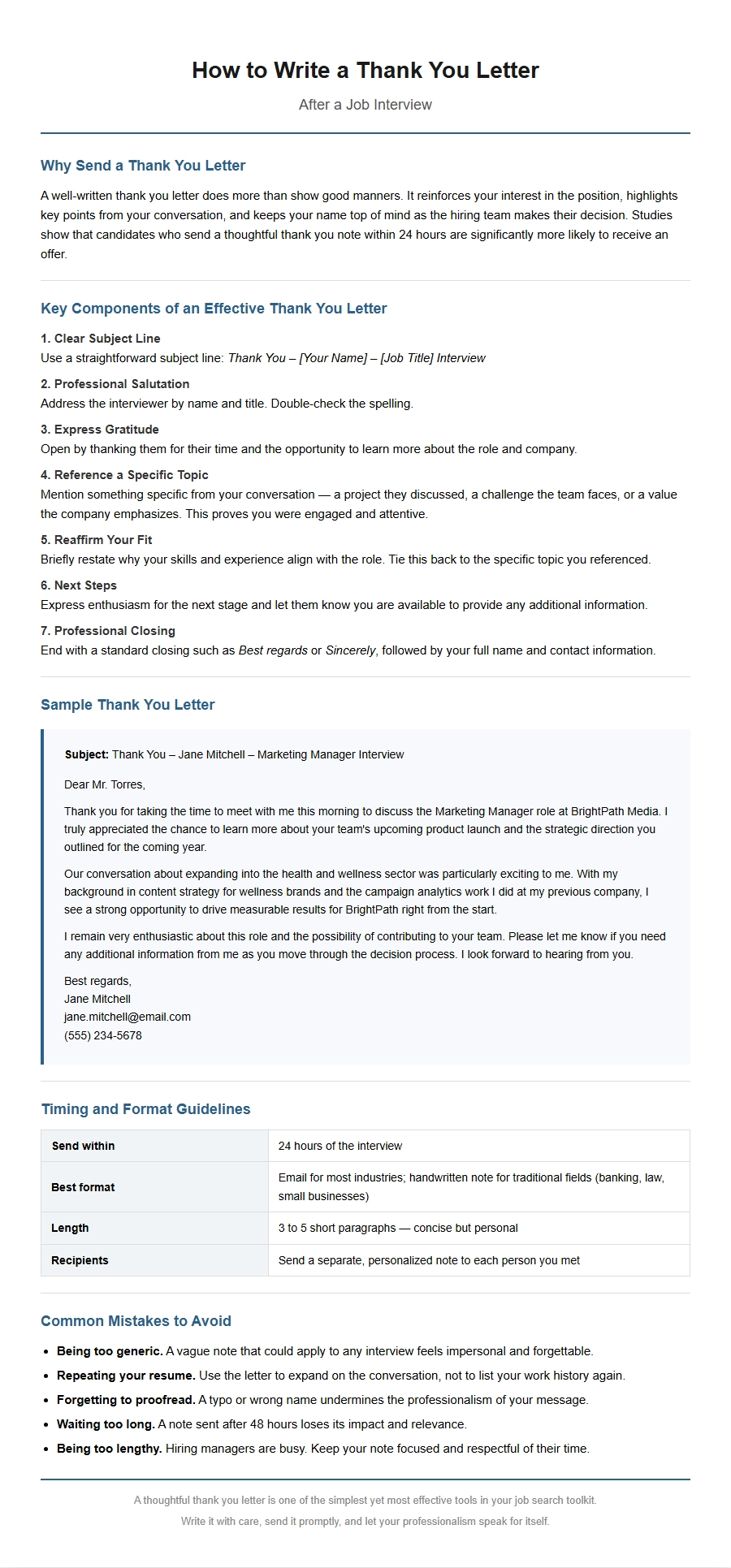 How to Write a Thank You Letter After an Interview
 professional thank you email example for client - Thank-You Letters
 Business Mentor Thank-You Letter Guide
 Thank You Letter for Sponsor Donation