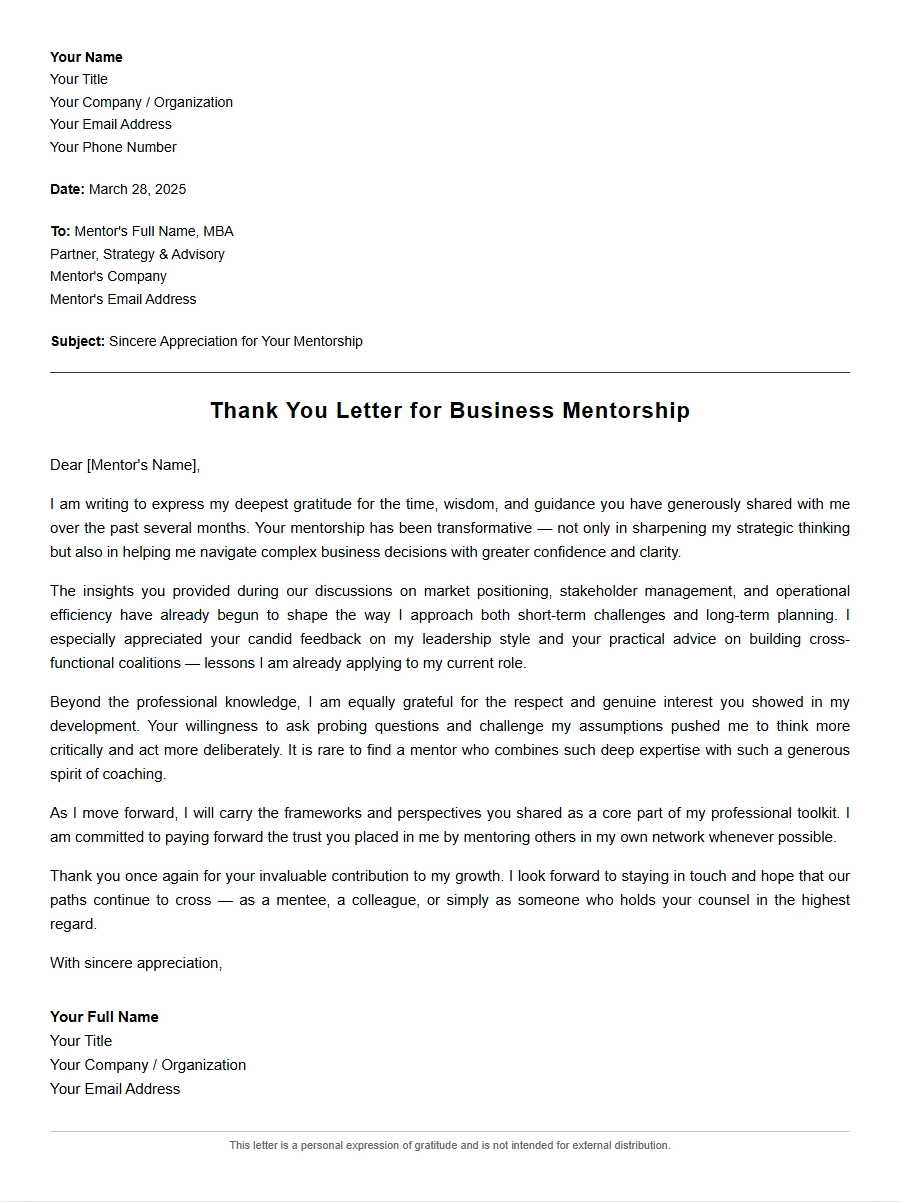
Writing a formal thank you letter for business mentorship can feel awkward. You want to express genuine gratitude without sounding stiff or overly rehearsed. But you also want to get it right—because this relationship matters. You don’t need to start from scratch. A good sample gives you structure, tone, and key phrases while leaving room for your own voice.
Using a letter template isn’t cheating. It’s a smart way to save time and avoid common pitfalls. Professional correspondence has certain expectations—salutation, body, closing—and a sample helps you hit those notes without second-guessing. You can focus on personalizing the message instead of worrying about format.
Category: Professional Correspondence
Think of a mentorship thank-you as a bridge: it acknowledges the time your mentor already gave, and it keeps the door open for future conversations. A well-written note can also remind them of your potential, which matters if you ever ask for a letter of recommendation down the road. The sample you choose should match your situation. If your mentor is formal and older, use a traditional business letter format. If you communicate mostly by email, a digital letter format with a clear subject line works just as well.
Start with the salutation. “Dear [Name]” is safe. Avoid outdated options like “To Whom It May Concern” or “Sir/Madam”—they sound impersonal. The opening paragraph should state why you’re grateful. Be specific: mention a piece of advice they gave or a skill you improved because of their guidance. This grabs attention and shows you were paying attention.
The body of your letter can expand on that. Share a short example of how their mentorship affected your work or confidence. Keep it honest—they’ll appreciate real details over generic praise. If you’re adapting a sample, don’t copy it word-for-word. Rewrite phrases to sound like you. The best customizable letter is one that still feels like your voice. For instance, if the sample says “I am deeply grateful for your time,” but you normally talk more casually, change it to “I really appreciate the time you spent with me last month.” The tone in writing should match your relationship.
Watch out for common mistakes. One is using a letterhead design when you’re sending an email—it looks out of place. Another is ignoring letter structure entirely; skipping a proper greeting or closing can seem rude. Always include a closing like “Sincerely” or “With appreciation,” followed by your name. Proofreading your letter is critical. A small typo can undermine your gratitude. Read it aloud or have a friend glance at it.
When you adapt a sample, focus on the opening paragraph first. That’s where most people get stuck. Write a sentence that directly addresses your mentor and your reason for writing. For example: “I wanted to thank you for the career advice you shared during our last meeting—it helped me approach my project with more confidence.” That’s more engaging than “Thank you for your mentorship.”
Finally, think about timing. Send your thank-you within a few days of a mentoring session or after a milestone. If you wait too long, it loses impact. For printed letters, use quality paper and a clean font. For email, keep it short and include your contact info in the signature.
Use the sample as a springboard, not a crutch. The best letters feel both professional and personal. The more you write these notes, the faster the process becomes. You’ll stop staring at a blank page and start writing with confidence. Your mentor will notice the effort—and that’s the real point.
Simple Examples
Business Mentor Thank-You Letter Guide
General Mentorship Appreciation
Dear Mentor Name,
I am writing to formally express my deepest gratitude for your invaluable mentorship over the past year. Your guidance has been a cornerstone of my professional growth, and I truly appreciate the time and wisdom you have shared.
Through our sessions, I have gained clarity on strategic decision-making and leadership challenges. Below are the key areas where your advice made a significant impact:
Focus Area
Impact
Strategic Planning
Developed a 3-year roadmap for my department
Networking
Introduced to five key industry contacts
Confidence Building
Improved presentation skills and boardroom presence
Thank you for challenging me to think bigger and for always being available with a supportive ear. I look forward to applying these lessons as I continue to grow in my career.
Warmly, Your Name
Post-Program Thank You
Dear Mentor Name,
As our formal mentorship program concludes, I want to thank you sincerely for the profound impact you have had on my professional journey. Your commitment to my development exceeded all expectations.
During these six months, I focused on three main goals. Your tailored advice helped me achieve each one:
Goal: Improve cross-functional communication – You coached me on active listening and conflict resolution techniques, resulting in a 30% faster project delivery.
Goal: Expand my leadership capabilities – Your recommendations on delegating tasks and empowering team members led to my promotion to senior manager.
Goal: Build a personal brand – With your guidance, I published two articles and spoke at an industry conference.
I am deeply grateful for the structured feedback and honest conversations. You have been more than a mentor—you have been a true advocate. Please know that your efforts have made a lasting difference.
With heartfelt thanks, Your Name
Project-Specific Guidance
Dear Mentor Name,
Thank you so much for the strategic advice you provided during our recent meeting regarding the Alpha Initiative project. Your insights were exactly what I needed to navigate the complexities of this high-stakes assignment.
Your suggestions on stakeholder management and risk mitigation have already paid off. Here is a summary of the actions I took based on your guidance:
Your Advice
Action Taken
Result
Map out key decision-makers
Created a stakeholder influence matrix
Secured buy-in from CFO within two weeks
Break the project into phases
Implemented agile sprint cycles
Delivered milestone two weeks early
Communicate wins early
Sent weekly progress updates
Increased team morale and executive visibility
I cannot thank you enough for helping me turn potential obstacles into opportunities. Your mentorship is truly a gift.
Best regards, Your Name
Networking Introduction Thanks
Dear Mentor Name,
I want to express my sincere gratitude for introducing me to Ms. Jane Doe at Innovate Corp. The connection you facilitated has already opened new doors for my career.
During our coffee meeting, Jane shared valuable insights on industry trends and offered to review my portfolio. I have since received an invitation to present my work at their upcoming quarterly review – a direct result of your thoughtfulness.
You have always emphasized the power of a strong network, and this experience has proven that. I now feel more confident reaching out to other professionals, and I plan to pay it forward by mentoring junior colleagues.
Thank you for going above and beyond. Your willingness to share your contacts and endorse me speaks volumes about your character. I am honored to have you as my mentor.
With appreciation, Your Name
Career Transition Acknowledgment
Dear Mentor Name,
I am writing to thank you for your extraordinary support during my recent career transition from marketing to product management. Without your encouragement and practical advice, this leap would have felt impossible.
You helped me identify transferable skills and craft a compelling narrative for interviews. The following table highlights the specific areas where your mentorship made a difference:
Challenge
Your Guidance
Outcome
Lack of product-specific experience
Recommended a certification course and side project
Completed course; built a prototype now used by 50 users
Nervousness in technical interviews
Conducted mock interviews and gave honest feedback
Received three job offers
Industry knowledge gap
Shared reading list and introduced to your PM network
Confident conversations with hiring managers
I have accepted a position at TechForward Inc. starting next month. I will always remember that this success started with your belief in me. Thank you for being my compass.
Gratefully, Your Name
Strategic Business Advice Thanks
Dear Mentor Name,
Thank you for the strategic business advice you shared during our last session. Your perspective on scaling operations while maintaining company culture has been transformative for my startup.
Since implementing your recommendations, I have seen tangible improvements. Here are the key takeaways and results:
Revised hiring plan: Instead of rushing to fill roles, we now prioritize cultural fit – employee retention has increased by 25%.
Customer feedback loop: You suggested a quarterly NPS survey; our score rose from 42 to 68 in two cycles.
Financial discipline: Using the budgeting framework you provided, we reduced unnecessary expenses by 15%.
Your ability to cut through noise and identify what truly matters is inspiring. I feel more equipped to lead my team through the next growth phase. Thank you for being so generous with your time and expertise.
With sincere thanks, Your Name
Industry Insights Gratitude
Dear Mentor Name,
I want to express my heartfelt thanks for the industry insights you have shared throughout our mentorship. Your deep knowledge of the renewable energy sector has been an eye-opener.
Your explanations of market trends and regulatory changes have helped me make smarter decisions. Below is a summary of the insights I found most valuable:
Topic
Key Insight
Application
Supply chain bottlenecks
Forewarned about lithium shortages
Secured alternative supplier contracts early
Policy shifts
Explained upcoming carbon credit changes
Adjusted pricing strategy to stay competitive
Emerging technologies
Introduced to solid-state battery developments
Initiated pilot project with a startup partner
Your willingness to demystify complex topics and share real-world examples has accelerated my learning curve tremendously. I feel much more confident in board discussions now. Thank you for being such a knowledgeable and generous mentor.
Best wishes, Your Name
Financial Planning Mentorship
Dear Mentor Name,
I am writing to thank you for the invaluable financial planning mentorship you have provided. Your expertise in budgeting, forecasting, and fundraising has been crucial for my business.
Specifically, your guidance on preparing for our Series A round was a game-changer. The following list outlines the concrete steps I took based on your advice:
Clean financial statements: Hired a part-time CFO to ensure GAAP compliance.
Investor deck revision: Used the storytelling framework you taught – closed $2M in funding within 3 months.
Cash flow management: Extended payment terms with vendors from 30 to 60 days, improving working capital.
Beyond numbers, you taught me the importance of financial discipline as a leadership tool. I now hold weekly finance reviews with my team, and we hit our quarterly targets ahead of schedule. Thank you for demystifying finance and empowering me to take control.
With deep gratitude, Your Name
Leadership Development Thanks
Dear Mentor Name,
Thank you for the outstanding leadership development that you have provided over the past year. Your coaching on emotional intelligence and team dynamics has reshaped how I manage my department.
I have seen measurable improvements in team performance and morale. Here is a quick overview of the changes I made and the results:
Action Taken
Before Mentorship
After Mentorship
Weekly one-on-ones
Ad-hoc, reactive
Structured, proactive feedback sessions
Conflict resolution
Often escalated to HR
Mediated by me; resolution rate up by 40%
Delegation
Micromanaged key tasks
Empowered team leads; I focus on strategy
Your emphasis on authentic leadership has made me a more respected and effective manager. I now lead with empathy and clarity, and my team consistently exceeds goals. Thank you for investing in my growth as a leader.
Warm regards, Your Name
Entrepreneurial Journey Encouragement
Dear Mentor Name,
I want to thank you from the bottom of my heart for the unwavering encouragement and pragmatic advice you have given me throughout my entrepreneurial journey. When I doubted myself, you reminded me of my vision.
You helped me navigate the toughest early-stage challenges. Below is a list of the milestones I achieved with your support:
Validated the business model – Your framework for customer interviews led to 50+ meaningful conversations and a pivot to our current offering.
Built the founding team – You advised on equity splits and hiring values-first; we now have a cohesive team of 8.
Secured first revenue – Used your sales script and closed three pilot customers in Month 4.
Maintained resilience – Your regular check-ins kept me grounded during cash-flow crunches.
I have officially launched my company, Nova Solutions, and we are growing steadily. None of this would have been possible without your mentorship. You are the reason I kept going. Thank you for believing in me.
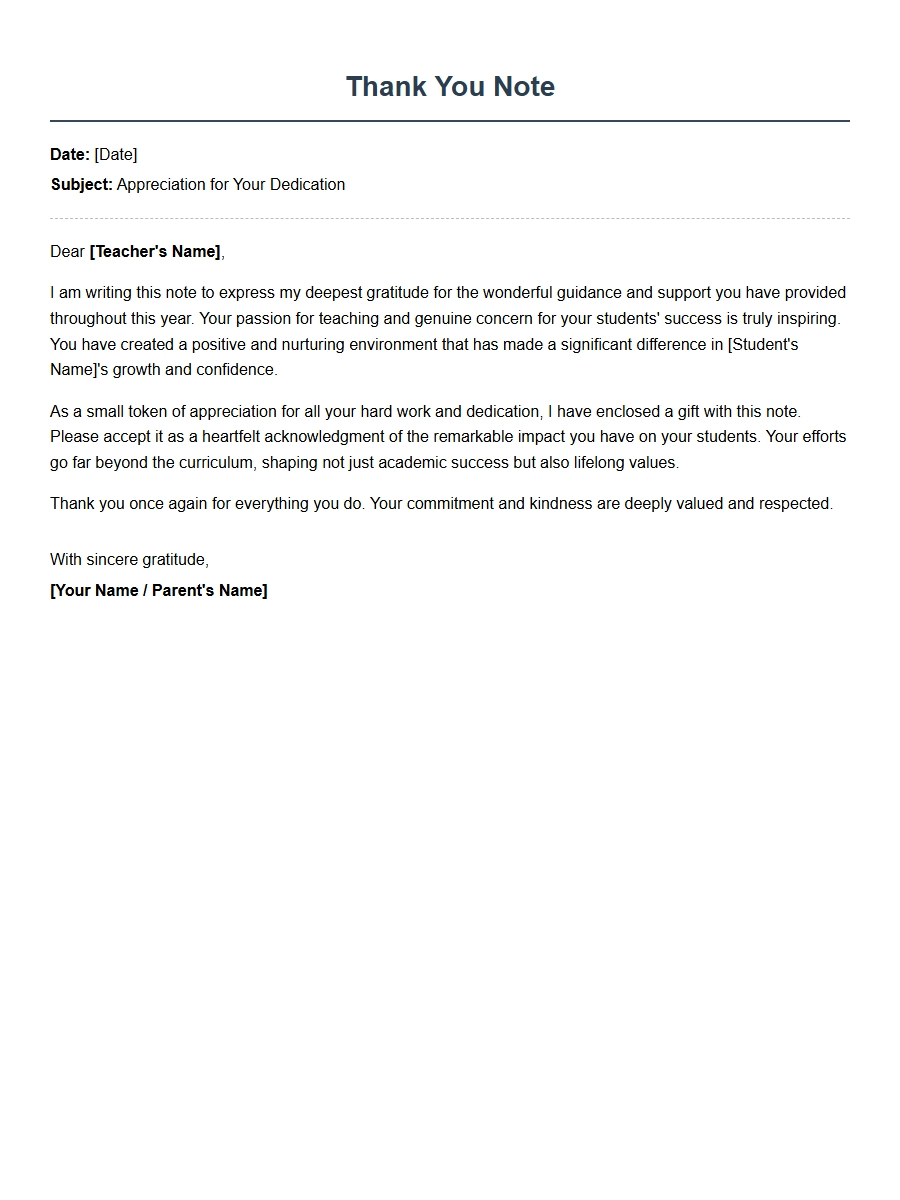 Sample Thank You Note for Teacher Gift
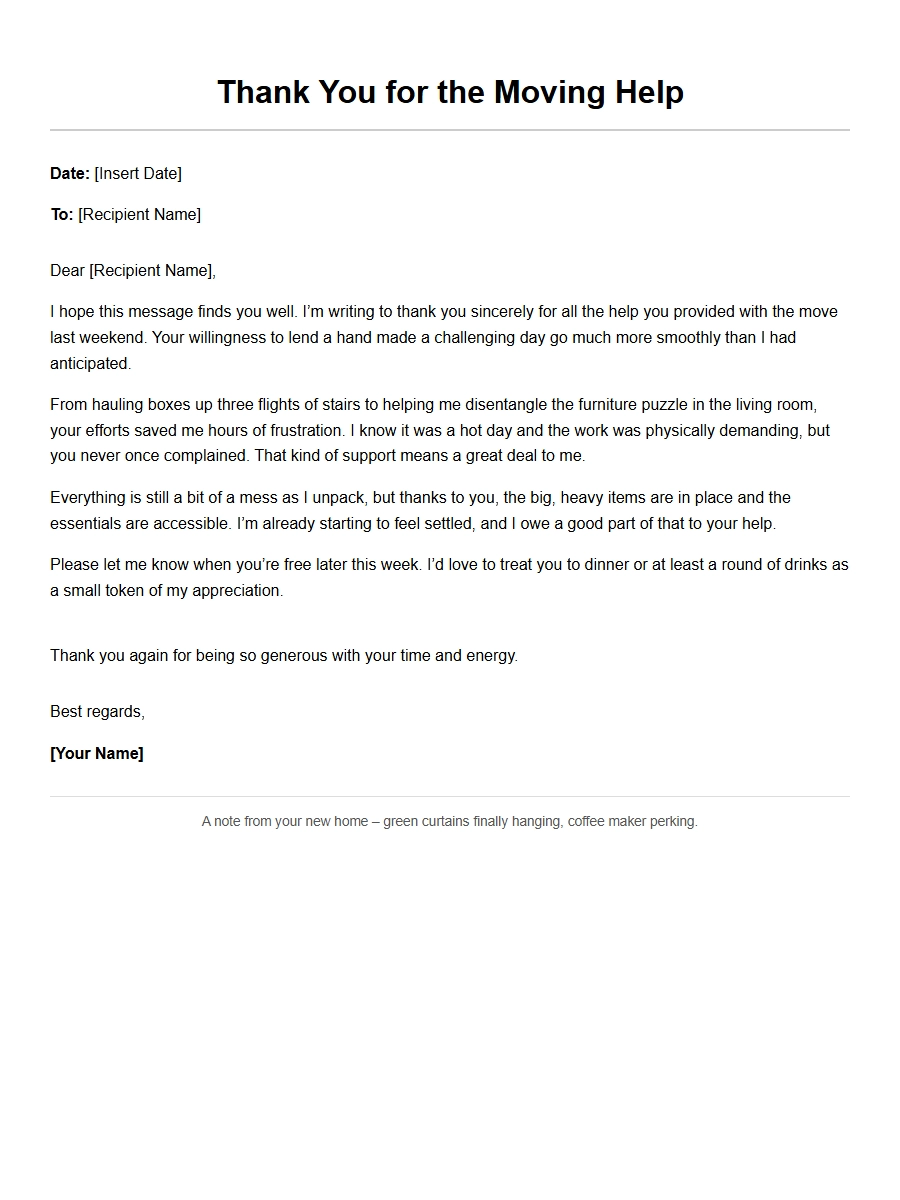 Thank-You Letter for Help with Moving
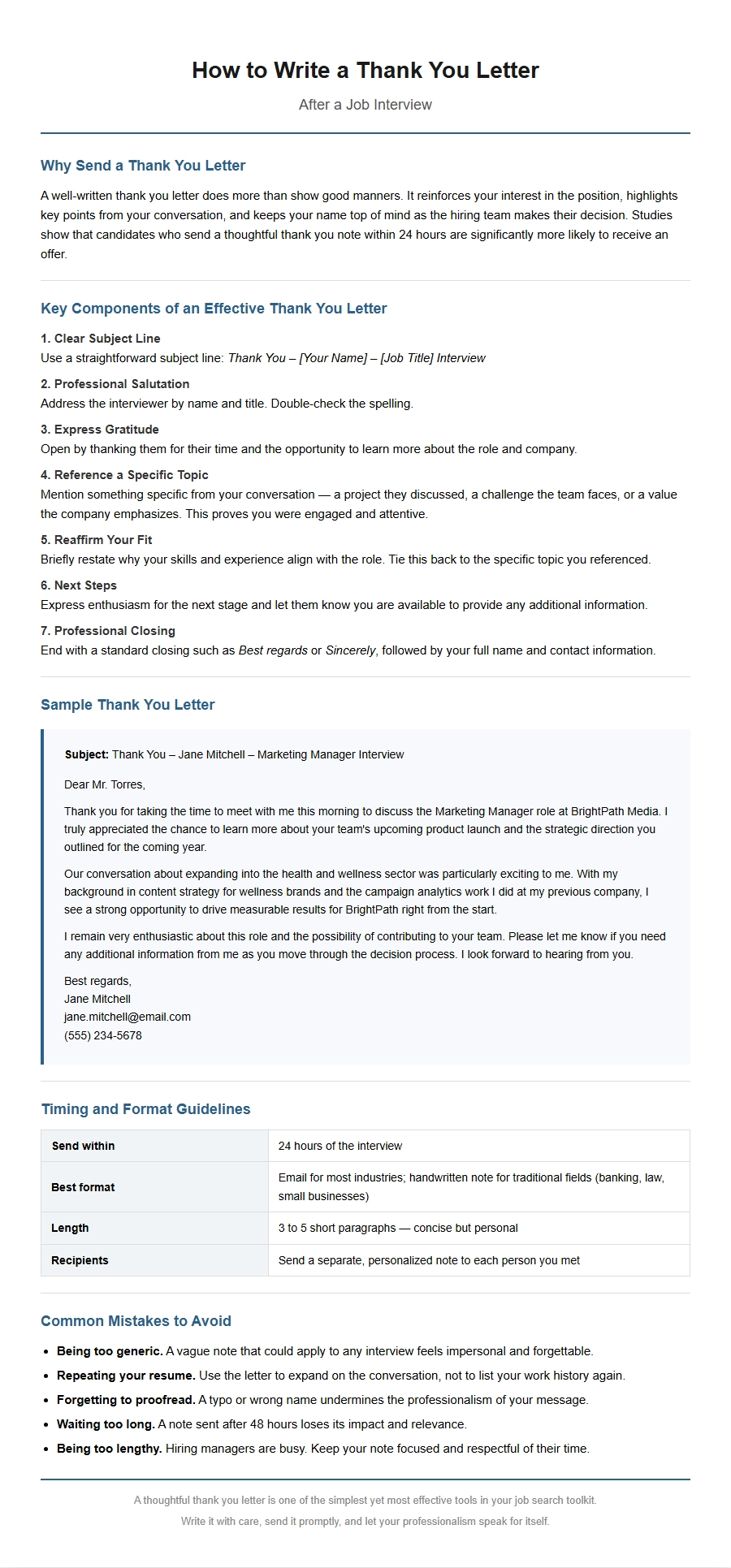 How to Write a Thank You Letter After an Interview
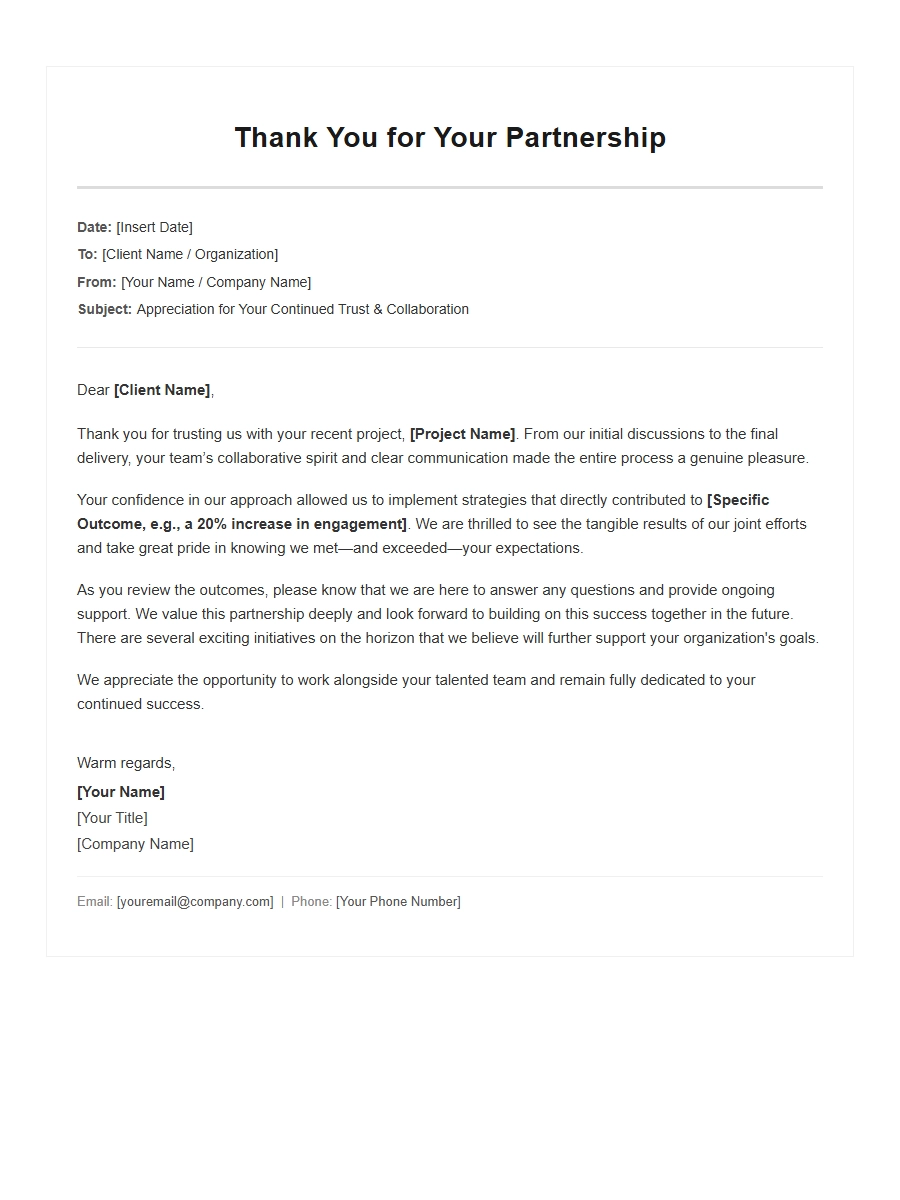 professional thank you email example for client - Thank-You Letters
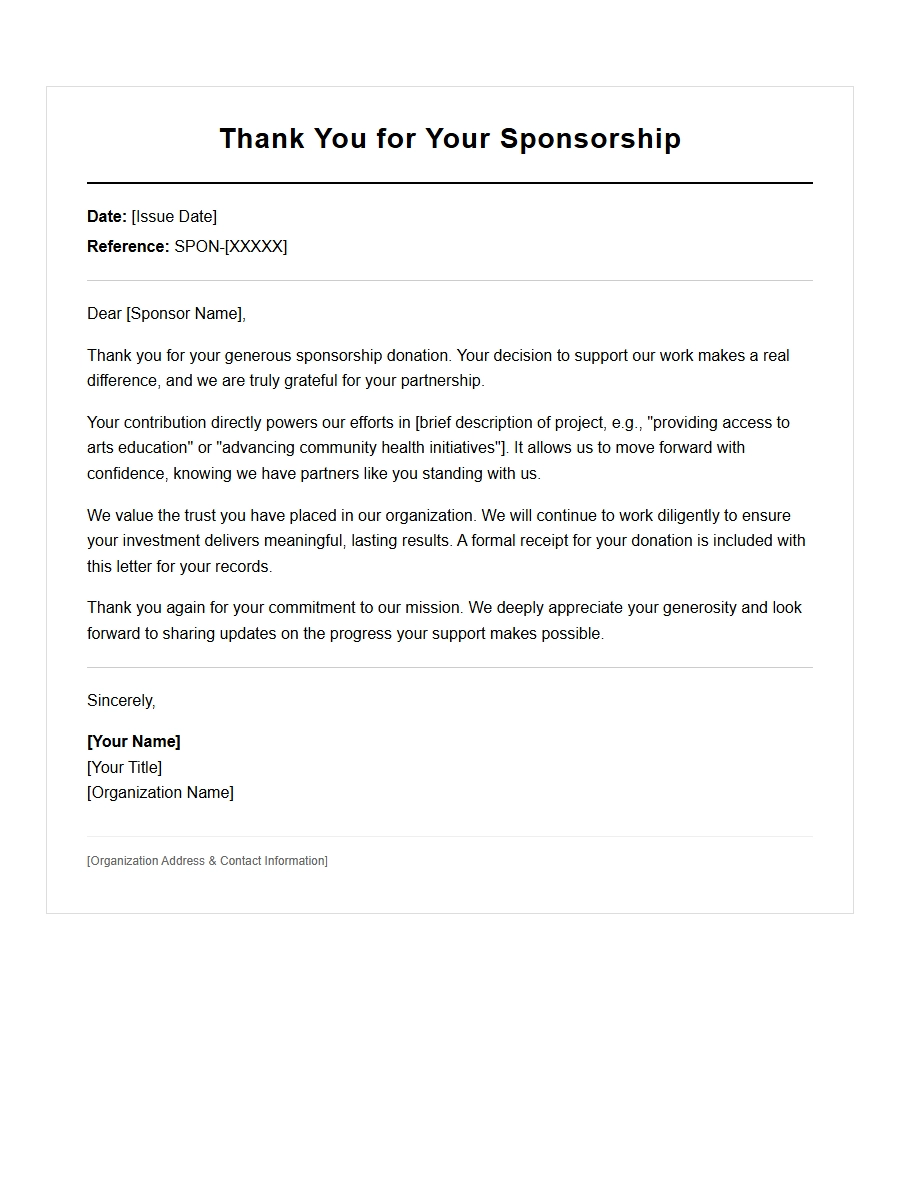 Thank You Letter for Sponsor Donation
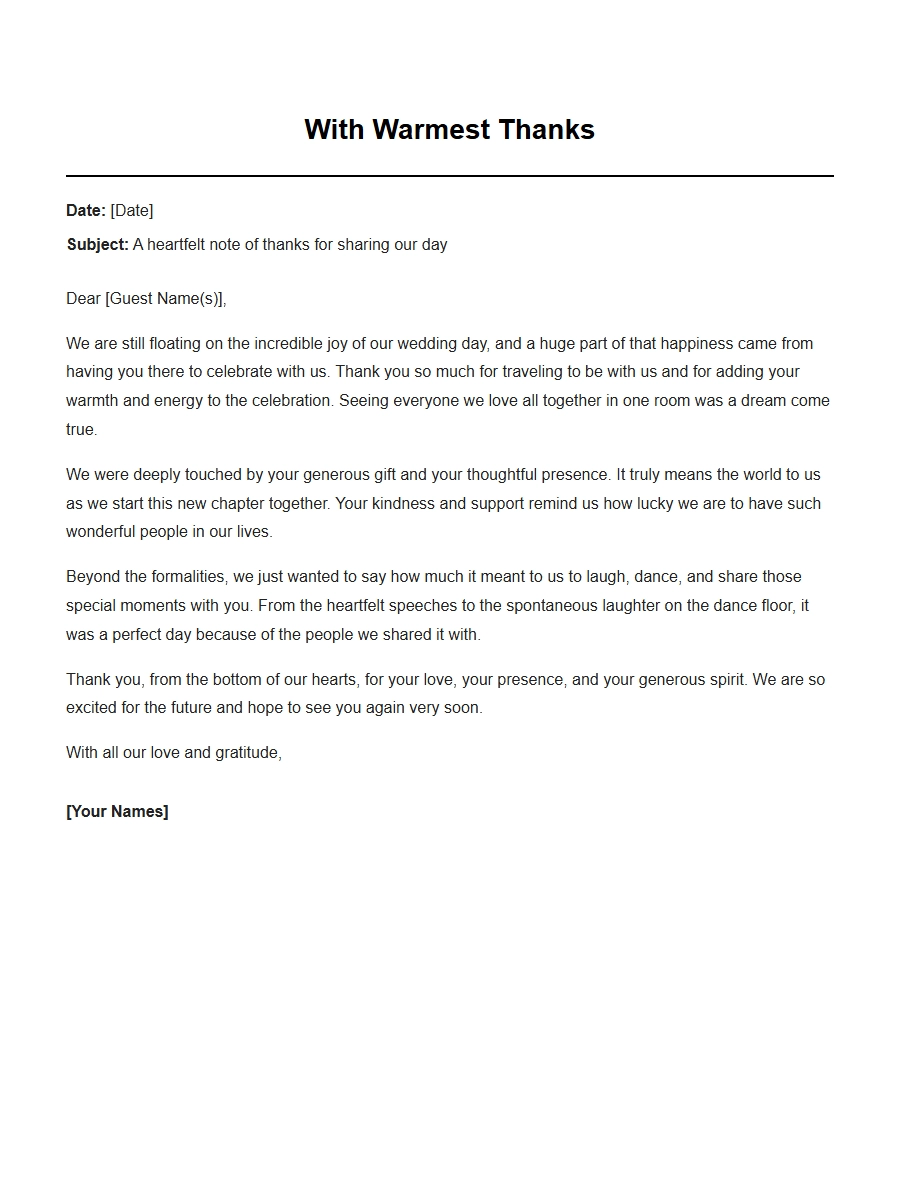 Wedding Gratitude Letter Template for Guests