Staring at a blank page when you need to thank an advisor for career path guidance can feel paralyzing. You know how much their advice meant, but putting that gratitude into words without sounding stiff or vague is harder than you expected. The good news is that a well-chosen sample turns that anxiety into a polished draft in minutes.
Using a letter template isn’t cheating—it’s a smart time-saver. Samples give you a solid structure, the right tone, and key phrases to build on, while leaving plenty of room for your personal story. Think of it as a framework that keeps you focused on what matters: showing genuine appreciation for how your advisor helped shape your career direction.
Category: Professional Thank-You Letters
Choosing the right sample for your situation
Not all thank-you letters are the same. If your advisor gave you informal guidance over coffee, a semi-formal note works best. If they wrote a letter of recommendation or sat on a formal review panel, you’ll want a more traditional business letter format. Look for a sample that matches the relationship you actually have—not the one you think you should have.
Industry matters too. A startup mentor might appreciate a short, direct email, while a university professor would expect a more polished printed letter. Pay attention to letter writing etiquette in your field. When in doubt, err on the side of formality and let your personal words warm it up.
How to adapt a sample without losing your voice
Start with a customizable letter that includes placeholder fields for the advisor’s name, your name, and specific advice you received. The goal is to replace general gratitude with concrete examples. Instead of “Thank you for your guidance,” say “Thank you for suggesting I pursue the marketing internship—it completely changed how I see brand strategy.” That specificity is what makes a thank-you professional correspondence feel real.
The opening paragraph is your hook. Skip clichés like “I hope this letter finds you well.” Jump straight into the reason you’re writing. Mention the advice itself in the first sentence. For example: “When you told me to focus on data analytics skills, I was skeptical—now it’s the core of my career plan.” That grabs attention and shows you actually listened.
Common mistakes to avoid
One big mistake is using outdated salutations like “To Whom It May Concern” in a thank-you letter. Always use the advisor’s name. If you’ve never met them in person, “Dear Dr. Singh” is fine—just double-check their title. Another pitfall is ignoring format. A digital letter for email needs a clear subject line and shorter paragraphs, while a printed letter requires letterhead design and proper salutation and closing. Don’t mix up the two.
Tone in writing is tricky. You want to sound grateful, not gushy. Use contractions like “I’ve” and “you’re” to keep it conversational. Read the draft aloud—if it sounds like you’re reading a speech, trim the formalities. Also, don’t forget to proofread the letter. A typo in a thank-you note can undermine the sincerity.
If you’re sending a thank you for helping move houses or a thank you for car repair service, the tone is casual. But thanking an advisor for career path guidance requires a step up in formality. That doesn’t mean you need to sound like a robot—just use formal writing tips to keep it respectful while staying human.
Structuring your thank-you note
A solid letter structure includes an opening that states your thanks, a middle paragraph with one or two specific examples of how the advice helped, and a closing that looks forward. Avoid listing too many details; pick the most impactful moment. For instance, instead of “You helped me with my resume, interview prep, and networking,” focus on the one piece of advice that shifted your whole approach.
If you’re unsure about the format, grab a cover letter examples structure for reference—it’s similar in tone. Many people also use a resignation letter sample for professional correspondence, but remember that a thank-you should feel warmer. The key is balancing gratitude with professionalism.
For a moving company quote comparison thank-you you keep it brief. For an advisor, you can expand a little, but still keep it to one page. Digital letter format works fine for email, but if you’re mailing a physical note, use good quality paper and a matching envelope.
Making it personal without getting too personal
You can mention career ambitions without oversharing. Something like “Your advice to take that project management course was spot-on—it directly led to my promotion” is perfect. Avoid vague statements like “You changed my life” unless you can back it up with a concrete example. That’s the core of professional correspondence—clear, specific, and respectful.
If your advisor also wrote you a letter of recommendation, mention that separately. Thank them for the time it took to write it, not just for the result. Small acknowledgments like that show you understand the effort behind the guidance.
And if you’ve ever needed to thank someone for pet sitting, you know that a personal touch matters. Same here: add a line about something you learned from them or a memory of a conversation. That turns a template into a genuine note.
Use the sample as a springboard, not a crutch
The best thank-you letters feel both professional and personal. Your advisor will appreciate that you took the time to tailor the message. Practice makes the process faster—the next time you need to thank someone for career guidance, you’ll have your own favorite structure ready to go. Use the sample to get started, then make it yours. That’s how you turn a helpful resource into a meaningful thank-you.
Samples You Can Use
How to Thank an Advisor for Career Guidance
Gratitude for Academic Advisor’s Career Roadmap
Dear Professor Chen,
I wanted to thank you sincerely for the career path guidance you shared during our last meeting. Your structured approach helped me see beyond my coursework. Specifically, the three-step roadmap you outlined has been invaluable:
Skill Audit: You encouraged me to list technical and soft skills, then compare them against job descriptions in my field. That exercise revealed a gap in data visualization.
Short-Term Wins: Your suggestion to take a Tableau certification course has already led to a project opportunity with the research group.
Long-Term Vision: The table you provided comparing industry vs. academia timelines gave me clarity.
I’m now more confident in my decisions because of your clear, actionable advice. I look forward to updating you on my progress.
With deepest gratitude, Jamie
Thank You for Mentoring a Mid-Career Pivot
Dear Marcus,
I can’t thank you enough for the career path guidance you’ve given me during this transition from finance to product management. Your tips about leveraging transferable skills were eye-opening. Here is a summary of the advice I’ve already applied:
Advice
Action Taken
Result
Reframe “risk analysis” as “product risk management”
Updated LinkedIn headline
Three recruiter inquiries
Join a PM study group
Enrolled in a 6-week cohort
Built a mock product case
Seek informational interviews
Scheduled two per week
One internal referral
Your ongoing encouragement and realistic tips have made the daunting process feel manageable. I’ll keep you posted as I land my first PM role.
Warmly, Lena
Appreciation for Industry Advisor’s Networking Tips
Hi Sarah,
Thank you for the excellent career path guidance during our coffee chat last week. Your advice on strategic networking was exactly what I needed to hear. Key takeaways I’m implementing:
Targeted outreach: Instead of mass emails, you showed me how to research mutual connections and mention specific projects.
Value-first approach: Offer a useful article or introduction before asking for help.
Follow-up rhythm: Your 3-touch system (thank-you note, helpful resource after 2 weeks, check-in after 1 month) keeps relationships warm.
I’ve already scheduled five meetings using your template. The quality of conversations has improved dramatically. Your willingness to share these practical tips has made a real difference in my job search strategy.
Gratefully, Alex
Thanks for Guiding My First Internship Search
Dear Dr. Reyes,
I want to express my deep appreciation for the career path guidance you consistently provide. As a sophomore, I felt lost about internship applications. Your tips helped me build a focused plan:
Resume Tailoring: Customize each application to highlight relevant class projects. You even reviewed my first draft.
Skill Courses: You recommended specific Coursera modules for Python and SQL—both now on my transcript.
Practice Interviews: Thanks to the mock sessions you arranged, I’ve conquered my nerves.
I’m thrilled to share that I just accepted a data analyst internship at TechCorp. Without your step-by-step guidance, I doubt I would have been this prepared. I’ll keep you updated on my progress.
With sincere thanks, Maya
Gratitude for Post-Graduation Career Blueprint
Dear Professor Park,
Thank you for the detailed career path guidance you provided in our exit meeting. Your four-part blueprint gave me confidence as I enter the job market:
Self-Assessment: Identify core values and non-negotiables for work environment.
Industry Research: Create a shortlist of companies that align with those values.
Targeted Applications: Focus on quality over quantity—aim for 5-6 tailored applications per week.
Continuous Learning: Enroll in one industry certification while job hunting.
I have already completed step 1 and am researching companies in cleantech, as you suggested considering my environmental passion. Your pragmatic framework has saved me from feeling scattered. I’ll reach out again once I land a role.
Warmest regards, Jordan
Thanks for Advisor’s Guidance on Certification Path
Hi Linda,
I’m writing to thank you for the insightful career path guidance regarding IT certifications. Your recommended sequence helped me avoid costly mistakes. Here’s my plan going forward:
Certification
Timeline (Your Advice)
My Status
CompTIA Network+
Foundational — take first
Enrolled, exam in 3 weeks
Cisco CCNA
After Network+ for depth
Planned for next quarter
AWS Solutions Architect
As capstone for cloud path
Targeting within 6 months
Your tips on study groups and practice labs have already made studying more effective. I’m excited to follow this stair-step approach. Thank you for taking the time to map out the best route for my career goals.
Best, Tom
Appreciation for Mentor’s Advice on Imposter Syndrome
Dear Elena,
Thank you for the honest career path guidance you shared during our last call. Your tips on overcoming imposter syndrome while transitioning roles were especially impactful. Here’s what I’m doing now because of your advice:
Track small wins: I keep a “done list” to remind myself of daily accomplishments.
Seek feedback early: Instead of waiting for perfection, I share drafts to normalize growth.
Build a support network: Following your suggestion, I joined a peer mentoring group.
You also recommended reframing “I don’t know” as “I’m learning.” That simple shift has reduced my anxiety significantly. Your willingness to share your own struggles made the advice feel trustworthy and actionable. I’m more resilient now because of your guidance.
With gratitude, Priya
Thanks for Guidance on Pivoting to a New Industry
Hi Kevin,
Thank you so much for the career path guidance you provided as I plan my pivot from marketing to UX research. Your tips were concrete and practical:
Portfolio projects: You suggested running a usability test on a local nonprofit’s website—I’ve documented the entire process.
Informational interviews: Your template script helped me book conversations with five UX researchers.
Skill-building timeline: You mapped a 6-month plan to learn qualitative analysis tools.
I also appreciated the table you created comparing my transferable skills (interviewing, survey design) with UX research requirements. That visual validated my potential. I’m now confident in my direction and have already sent out two applications. Your generosity with your time has been a career-changer.
Warmly, Sam
Gratitude for Advisor’s Tips on Leadership Track
Dear Mr. Thompson,
I want to thank you for the career path guidance you offered during our mentorship session. Your insights on transitioning from individual contributor to team lead have been invaluable. Here are the key tips I’m applying:
Build trust first: One-on-ones to understand each team member’s motivations.
Delegate intentionally: Assign stretch tasks that match growth goals.
Communicate context: Explain the “why” behind decisions to foster ownership.
You also shared a simple framework for giving constructive feedback in a table format:
Situation
Behavior
Impact
Missed deadline
Not flagging early
Team had to scramble
Great presentation
Thorough preparation
Client impressed
Using SBI feedback has already improved my team’s responsiveness. Your practical, action-oriented advice continues to guide my leadership journey.
Sincerely, Rita
Thanks for Guiding My Graduate School Decision
Dear Professor Singh,
I am extremely grateful for the career path guidance you provided as I debated between two graduate programs. Your systematic comparison helped me make a confident choice. Here’s the decision matrix you helped me create:
Factor
Program A
Program B
Research alignment
Strong (ML focus)
Moderate
Funding offer
Full tuition + stipend
Partial scholarship
Alumni network in industry
Extensive
Limited
Location for internships
Tech hub
Rural
Your tip to rank factors by importance clarified my priorities. I accepted Program A and already feel it’s the right fit. Thank you for taking the time to walk through each option with me—your guidance has set my career on a promising path.
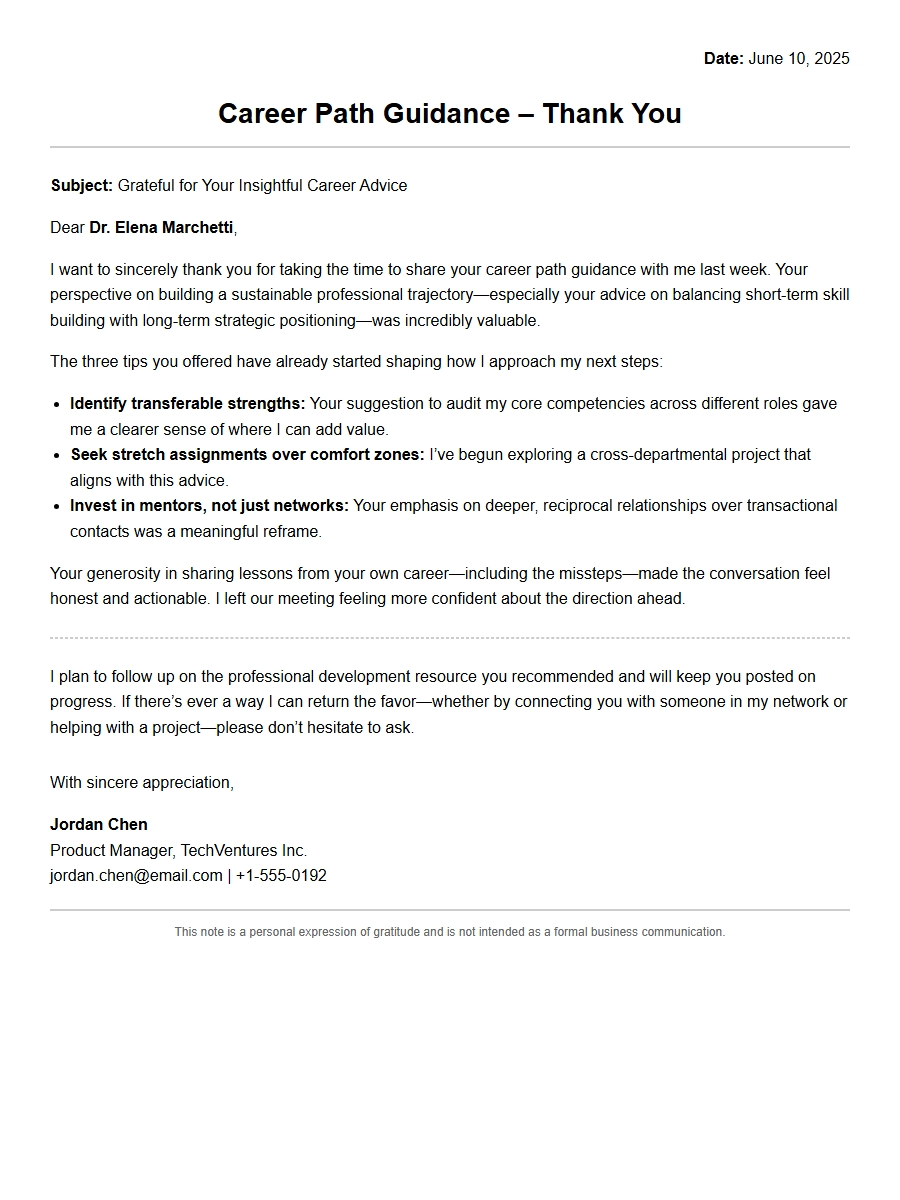
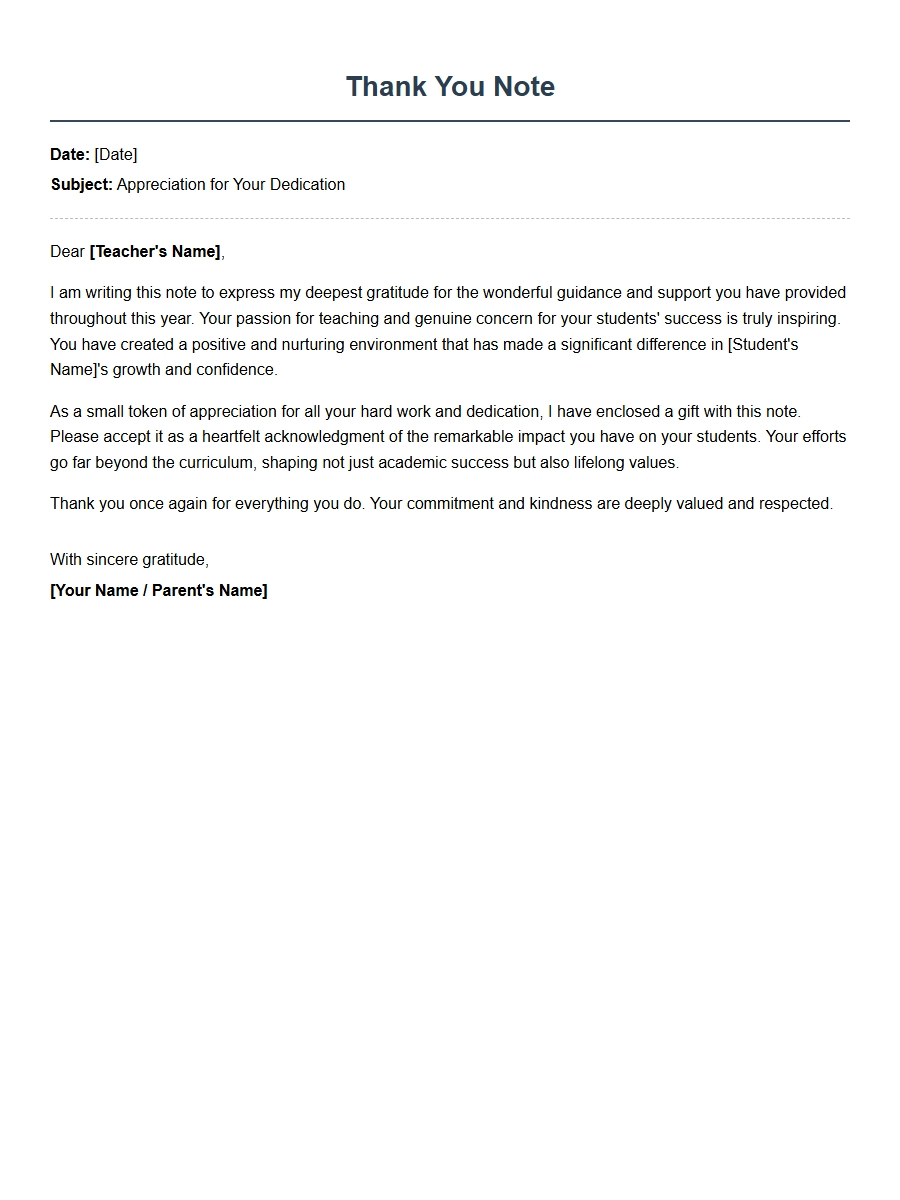 Sample Thank You Note for Teacher Gift
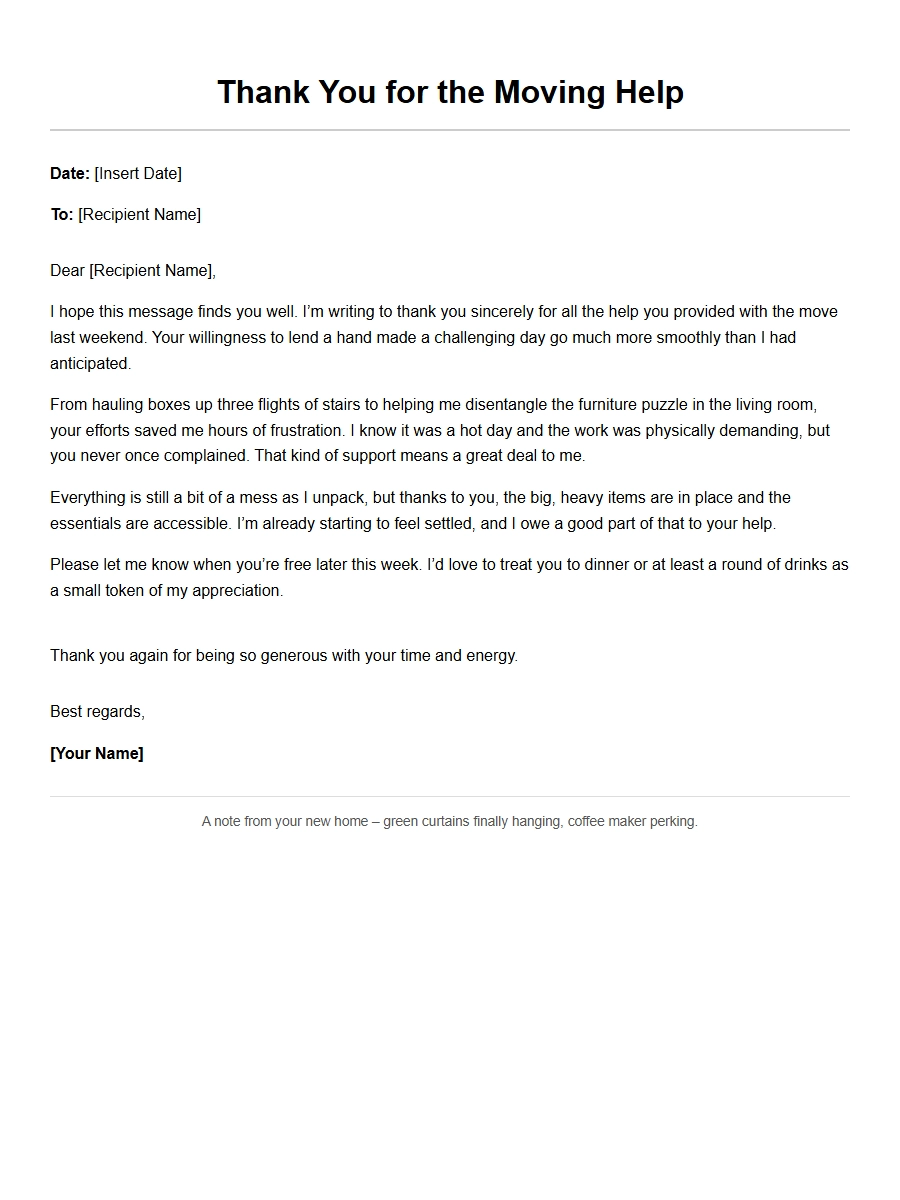 Thank-You Letter for Help with Moving
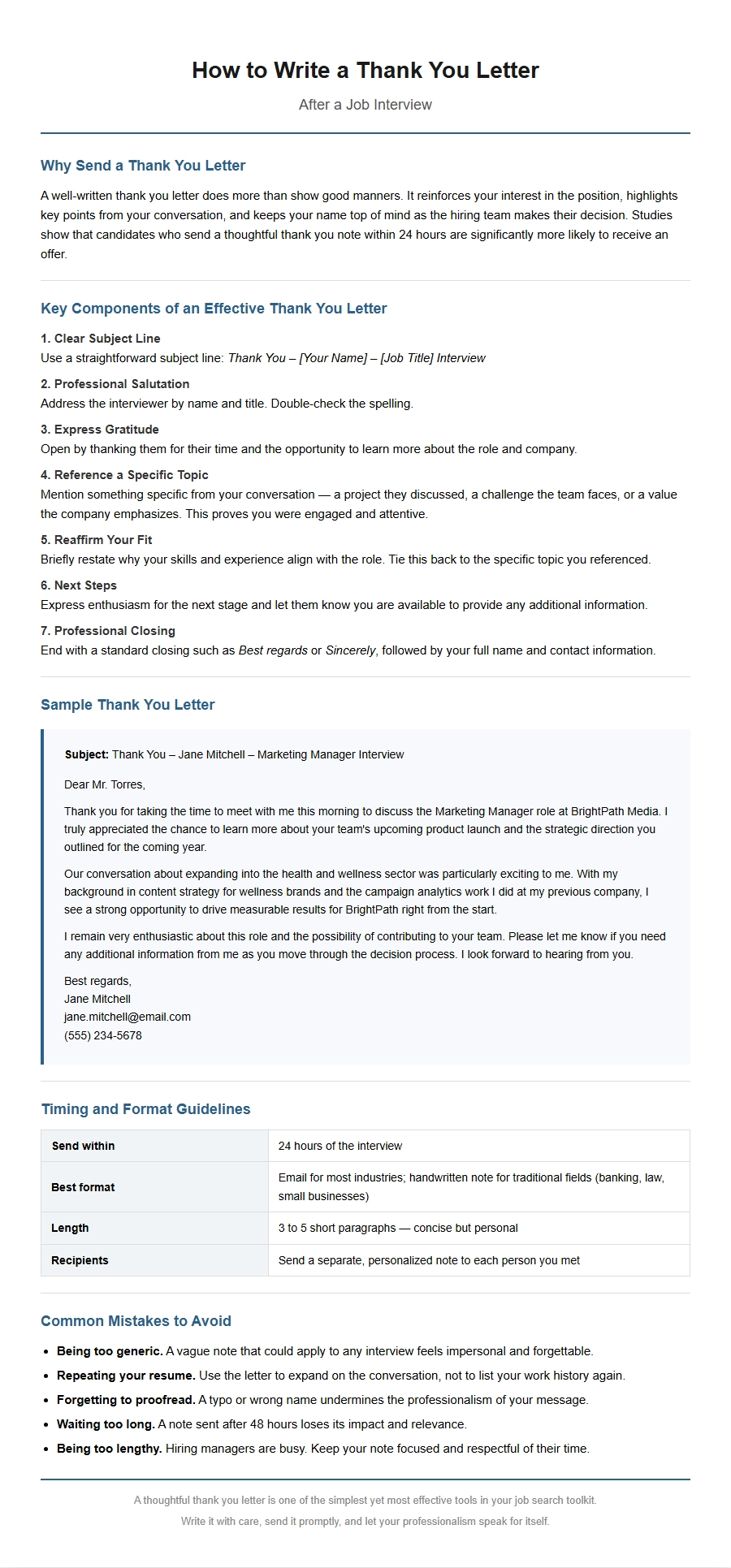 How to Write a Thank You Letter After an Interview
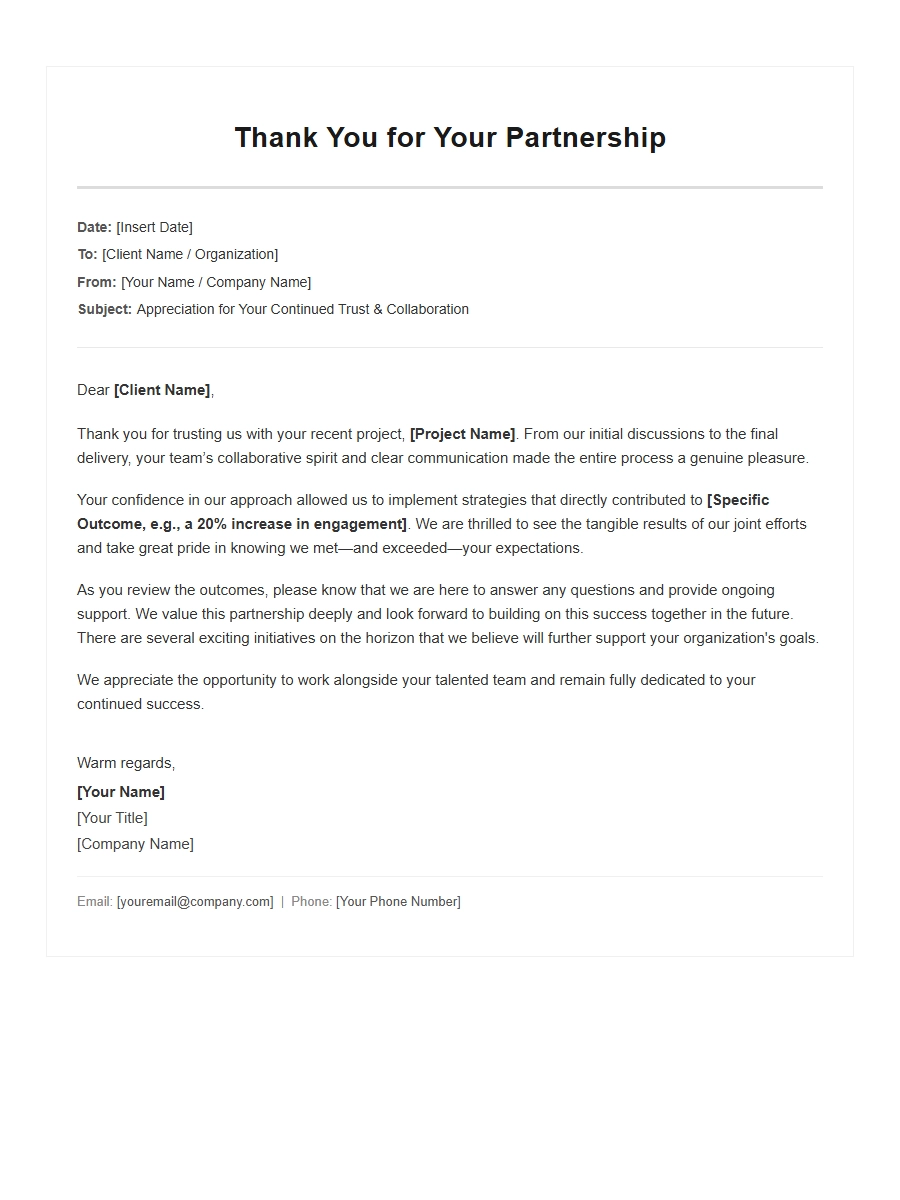 professional thank you email example for client - Thank-You Letters
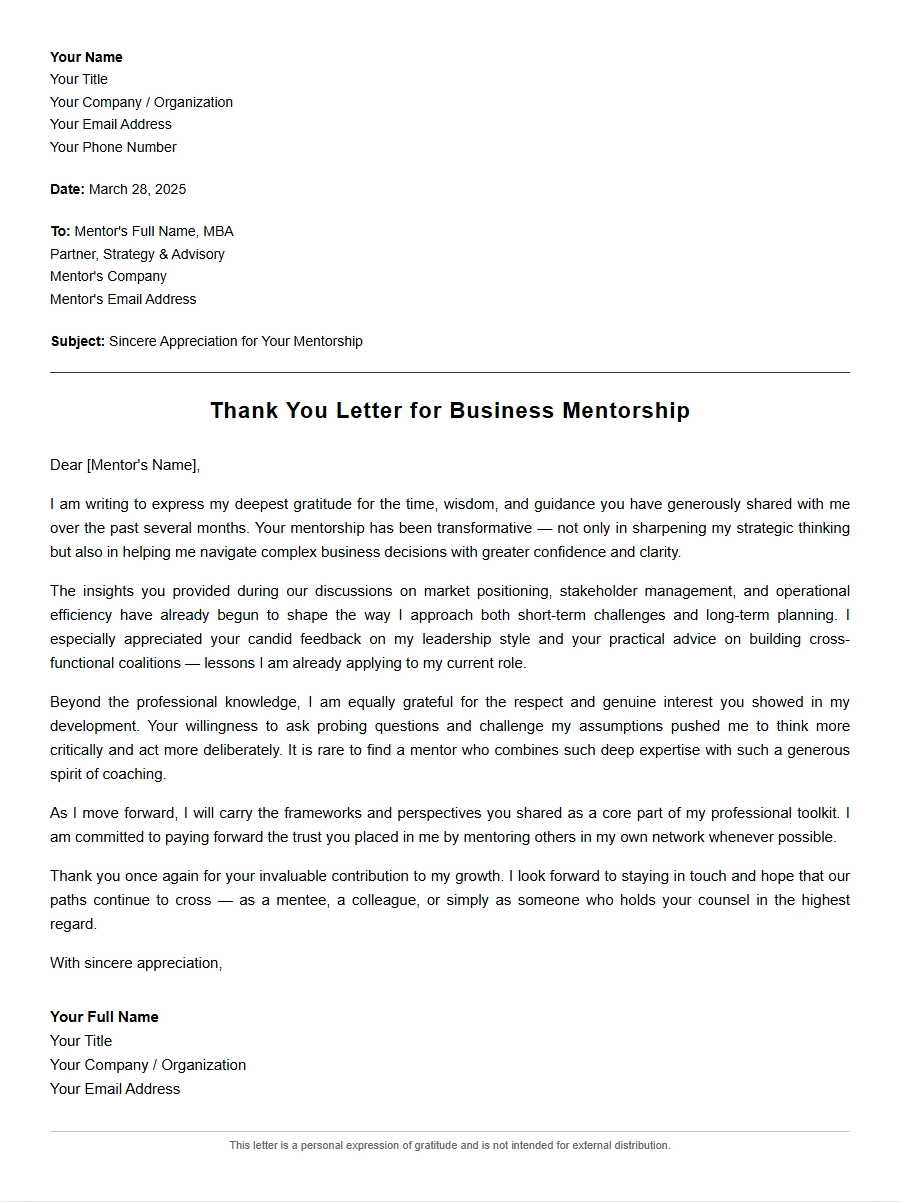 Business Mentor Thank-You Letter Guide
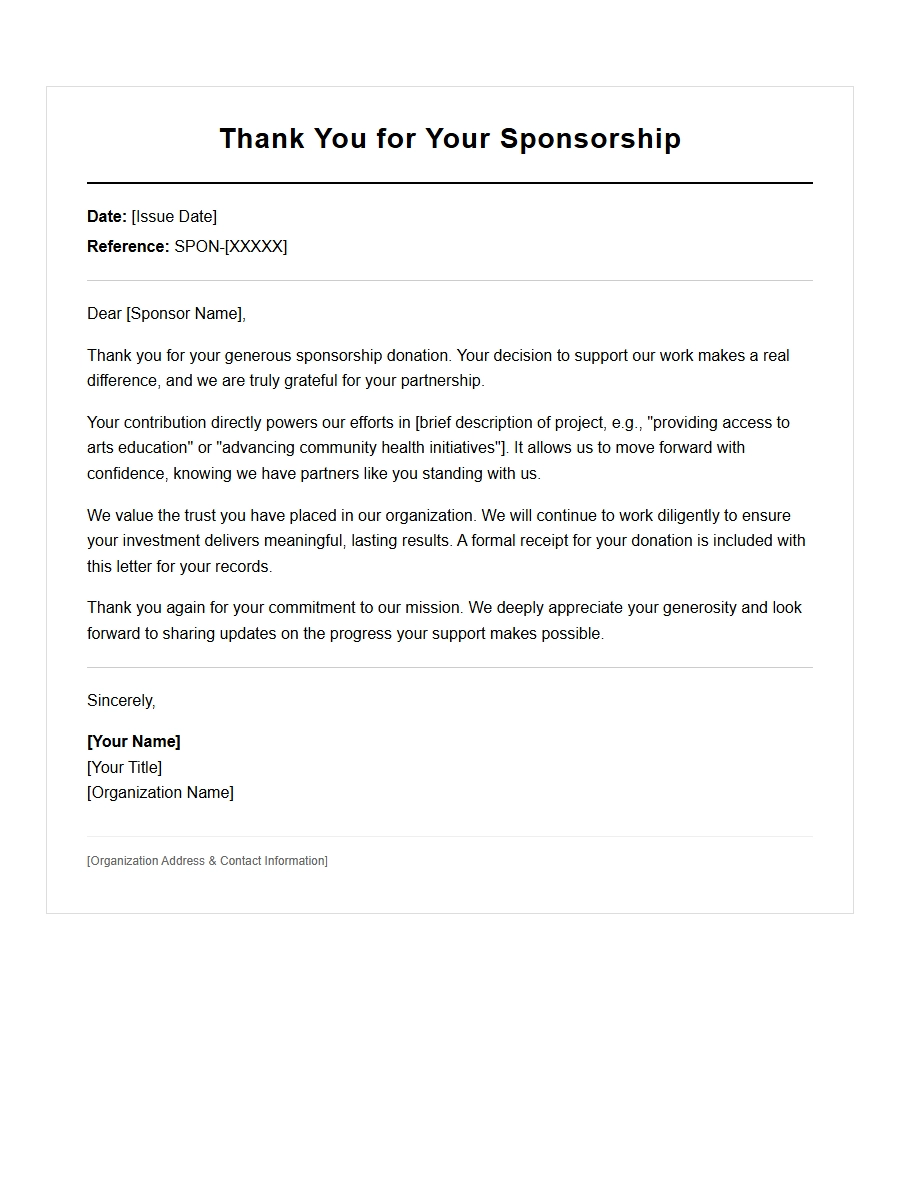 Thank You Letter for Sponsor Donation