You just finished a custom painting, a digital illustration, or a commissioned sculpture. The client is thrilled. But now you’re staring at a blank screen, trying to figure out how to say thanks in a way that feels professional yet personal. That frozen feeling is normal. The good news? A good sample thank you note for art commission completion can turn that anxiety into a confident draft in minutes.
Using a letter template isn’t cheating. It’s a smart shortcut. The best samples give you a solid structure—the right salutation, a warm closing, and the key phrases that make your appreciation sound genuine. You still get to add your own voice. Think of a sample as a scaffold: it holds everything up while you build the message that matches your relationship with the client. Category: Client Thank‑You Letters
When do you need a thank you note for an art commission?
Right after the artwork is delivered and accepted. This note isn’t just polite—it’s part of your professional correspondence. It confirms the transaction is complete, reinforces your client’s happiness, and often leads to referrals or repeat work. Whether you send it by email or a handwritten card, a short thank‑you is expected in most creative fields.
Pick the right sample for your situation
Not all thank‑you notes are the same. A formal letter for a corporate client buying a large piece will differ from a quick email to a friend who commissioned a portrait. Look for a sample that matches the tone you want. If the art commission was a big project with multiple revisions, your note should acknowledge the client’s patience. If it was a simple, fast commission, keep it light. The goal is to make the other person feel valued, not overwhelmed by formality.
When you choose a sample, pay attention to the letter structure—how the salutation, body, and closing flow together. A strong opening paragraph can grab attention. For example, instead of “Thank you for your commission,” try “It was a joy to bring your vision of [specific detail] to life.” Tailor that first sentence to something the client mentioned during the project. That small touch makes the whole note feel custom‑made.
Common mistakes to avoid
One frequent error is using an outdated salutation like “To whom it may concern” when you know the client’s name. Another is ignoring the format: an email thank‑you should have a clear subject line and a digital signature, while a printed card might benefit from a simple letterhead design. If you’re sending a digital letter format, keep the font readable and avoid long paragraphs. People scan email quickly.
Also, don’t forget to proofread. A typo in a thank‑you note can undercut the professionalism of the artwork you just delivered. Read it out loud or ask a friend to glance at it. Small mistakes in tone in writing—like sounding too casual for a formal client or too stiff for a relaxed one—are easy to fix with a little practice.
How to adapt a sample without losing your authentic voice
Start by putting the sample aside and writing your own draft first. Just a few sentences about what you enjoyed about the project. Then compare that to the sample. You’ll likely see where your natural words align and where you need structure. Use the sample for phrases that feel right, but change any wording that sounds like someone else. For instance, if the sample says “I sincerely appreciate your business” but you’d rather say “I’m grateful for the chance to create this piece,” go with your version.
After you’ve adapted the sample, add one detail that only you and the client share. Maybe it’s a funny moment during the commission or a specific color choice they loved. That personal anchor ensures the note feels real. Avoid generic filler like “your support means everything” unless you truly mean it. Clients can tell when you’re running on autopilot.
Remember, the best letters feel both professional and personal. Use the sample as a springboard, not a crutch. With each commission, writing these notes will get faster and feel more natural. And if you ever need a different style, check out templates for scenarios like product referral thank‑you letters, thank you for technical troubleshooting, or acknowledging a contract signing. The structure shifts, but the goal stays the same: say thanks in a way that keeps the door open for future projects.
Extra Samples
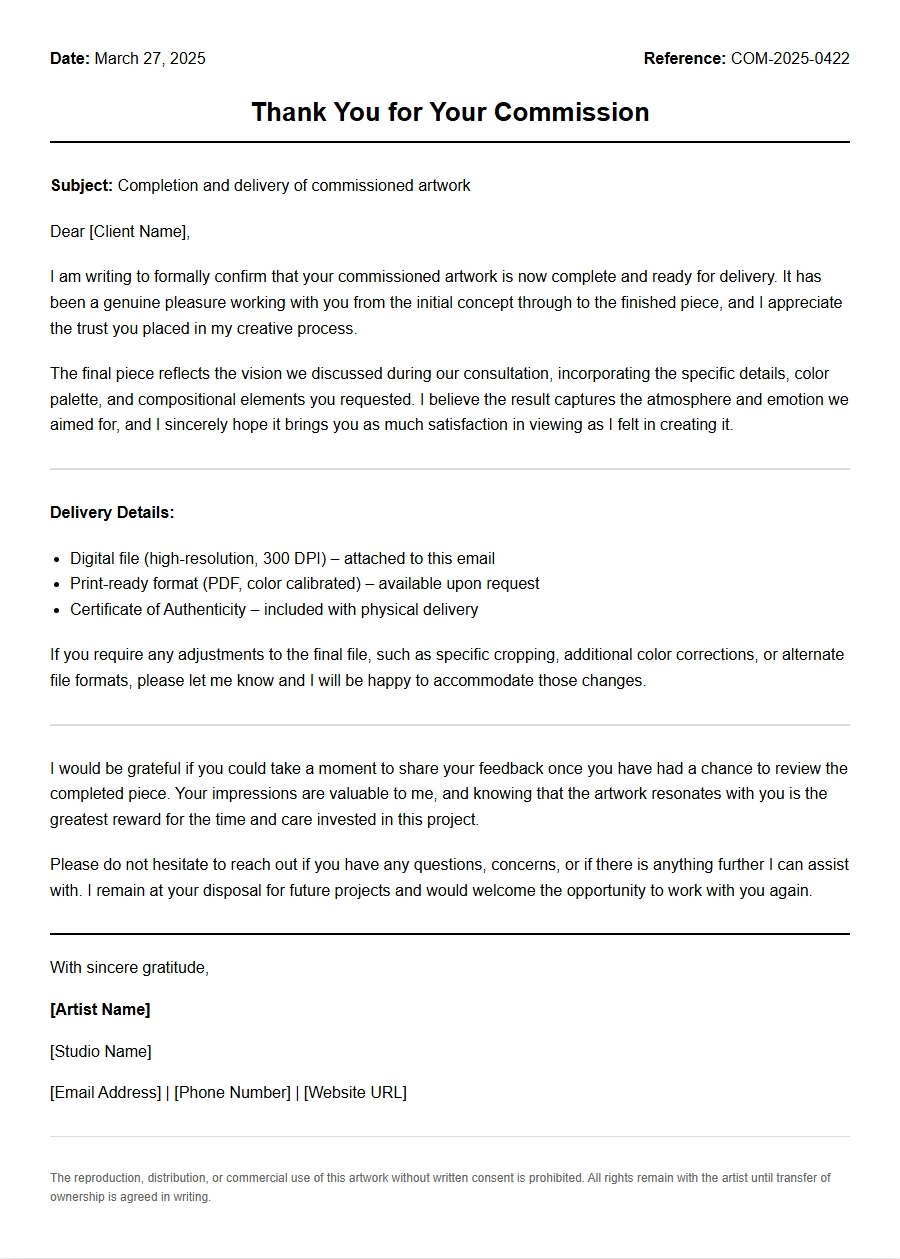
Thank You Note for Completed Art Commission
Formal Thank-You for Portrait Commission
Dear Mr. Reynolds,
Thank you for completing my commissioned portrait of my grandmother. I am deeply moved by the tenderness and accuracy you captured. The way you rendered the soft light in her eyes and the subtle folds of her shawl is exactly what I hoped for.
To confirm the details:
Commissioned piece: Oil on canvas, 24x36 inches
Completion date: March 15, 2025
Total fee: $2,400.00 (paid in full via bank transfer)
I will hang it in our family hallway with great pride. Please let me know if you need a photo of the final placement for your portfolio. I will gladly recommend your work to anyone seeking a meaningful portrait.
Warm regards, Eleanor Hart
Casual Thanks for Digital Illustration
Hey Jamie!
Just wanted to say a huge thank you for finishing the digital illustration of my D&D character. The vibrant colors and the way you designed her armor are absolutely perfect – you nailed the fierce-but-fun vibe I had in mind.
I love how you included all the details from our chat:
Phantom dagger glowing purple
Elf ears peeking through the hood
Battle scar on the left cheek
Signature rune on the belt buckle
I’ve already set it as my desktop wallpaper, and my gaming group is super jealous. If you ever open commissions again, count me in for another piece. Thanks again for your amazing talent and quick turnaround!
Cheers, Alex
Thank-You for Mural with Invoice Details
Dear Artful Walls Studio,
I am writing to express my sincere gratitude for the stunning mural you painted in our community library. The children’s reading corner now feels enchanted and welcoming. Every visitor stops to admire the whimsical forest scene with hidden animals.
Please find the transaction details below:
Item
Description
Amount
Mural labor
40 hours at $50/hr
$2,000.00
Materials
Professional acrylics, brushes, sealant
$450.00
Travel
Round trip mileage
$80.00
Total
$2,530.00
Payment of $2,530.00 was made via credit card (receipt #80923). Thank you for your patience during the booking process. We look forward to collaborating on future projects.
Best, Linda Park, Library Director
Thank-You for Custom Sculpture with Receipt
Dear Maya,
Thank you so much for completing the bronze sculpture of my late dog, Max. The likeness is uncanny – you perfectly captured his alert ears and gentle expression. It will sit on my mantelpiece as a lasting tribute.
I have attached a receipt for your records:
Item
Cost
Status
Bronze casting
$950.00
Paid
Patina finish
$250.00
Paid
Stone base (custom engraving)
$120.00
Paid
Shipping & insurance
$85.00
Paid
Total
$1,405.00
Cleared
Payment was made via PayPal on April 2nd. Your skill and craftsmanship are remarkable. I will recommend you to the local pet loss support group.
With heartfelt thanks, Robert Chen
Thank-You for Children’s Book Illustration
Dear Olivia,
Thank you from the bottom of my heart for finishing the watercolor illustrations for my children’s book Luna and the Starberry Forest. Your art brings the story to life in a way I could only dream of.
Here is a recap of the deliverables you provided:
12 full-page illustrations (8x10 inches, 300 DPI)
Endpaper design (night sky pattern)
Title page vignette
One map of the forest (full spread)
Each piece is so lovingly detailed – my favorite is the page where Luna meets the glowing squirrel. The kids in my test readings were mesmerized. I’ll be sure to credit you prominently on the copyright page. Payment of $1,800 has been sent as agreed.
Eagerly awaiting launch day! Yours, Sarah Mitchell
Thank-You for Logo Design with Service Breakdown
Hi Dan,
I am thrilled with the final logo design for my bakery, Whisk & Flame. The combination of the whisk and fire icon is clever and memorable. You perfectly balanced warmth and professionalism.
To summarize the project scope you completed:
Service
Description
Status
Logo concepts
3 initial concepts presented
Completed
Revisions
2 rounds of minor tweaks
Completed
Final files
SVG, PNG, EPS plus brand guide
Delivered
Color palette
Primary and secondary hues
Approved
Payment of $650 via invoice #2048 settled on May 1. I am excited to roll out the new branding on my storefront and social media. Thank you for your creativity and professionalism. I already recommended you to a friend starting a coffee shop.
Best, Mia Reynolds
Thank-You for Fantasy Art Commission with Timeline
Dear Leon,
A thousand thanks for completing my fantasy art commission – the scene of dragons soaring over a crystal mountain is everything I imagined and more. Your use of light and shadow gives the piece an epic, cinematic feel that will dominate my gaming room wall.
Here is the timeline you followed (very impressive):
February 10: Initial sketch approval
February 24: Color study (two options)
March 8: First fully rendered version
March 15: Final polished piece (digital, 6000x4000 px)
You were communicative and open to all my nerdy lore requests. The twin moons and the runic border made the painting feel truly part of my world. Payment of $1,200 sent via Venmo. Feel free to share the piece in your portfolio – I’m proud to be your client.
Soaring thanks, Gareth Blackwood
Thank-You for Calligraphy Commission with Material Table
Dear Isabella,
I am so grateful for the beautiful calligraphy piece you created for my wedding vows. The phrase “Where love grows, joy abounds” written in your elegant copperplate script is now framed above our entryway.
You used the following materials (as per our discussion):
Item
Details
Paper
Arches hot press, 140 lb, 8x10
Ink
Walnut ink, handmade by you
Nib
Hiro 41 blue pumpkin
Accents
Hand-illuminated initial “W” in gold leaf
Your attention to detail (the subtle flourishes and the gold leaf accent) makes it a true heirloom. Payment of $320 was made via cash on pickup. I will surely request another piece for our anniversary. Thank you for pouring your heart into this.
Fondly, Clara & Jacob
Thank-You for Pet Portrait Process Description
Dear Riley,
Thank you for the incredible pastel portrait of my cat Mochi. You not only captured her fluffy orange fur but also her mischievous “I just knocked over a cup” glint in her eye. It’s spot-on.
I loved learning about your process – here’s what you did:
Started with a grid sketch on pastel paper
Built up layers of soft pastel for the fur texture
Used a kneaded eraser to highlight whiskers
Fixed the final piece with archival spray
The whole experience, from our Zoom consultation to the final reveal, was delightful. Payment of $250 was sent via Zelle after delivery. I’ve already ordered a custom frame. Thank you for immortalizing my furry friend.
Purrs and gratitude, Olivia Tran
Thank-You for Wedding Invitation Design Checklist
Dear Natalie,
A heartfelt thank you for designing our wedding invitations. The elegant botanical theme with gold foil accents is exactly what we envisioned. Our families have received them and everyone raves about the quality.
As a final confirmation, here is the checklist of items you delivered:
Save-the-date cards (50 count)
Main invitation suite (50 count) – includes envelope, inner envelope, RSVP card, and details card
Reply envelopes (50 count)
Digital proofs for printing (PDF + JPG)
Extra belly bands and wax seal stickers (10 each)
All items are flawless – the font pairing and the watercolor leaves are perfect. We paid the final invoice of $750 on May 10. Thank you for your patience with our many revisions. We will definitely recommend you to our engaged friends.
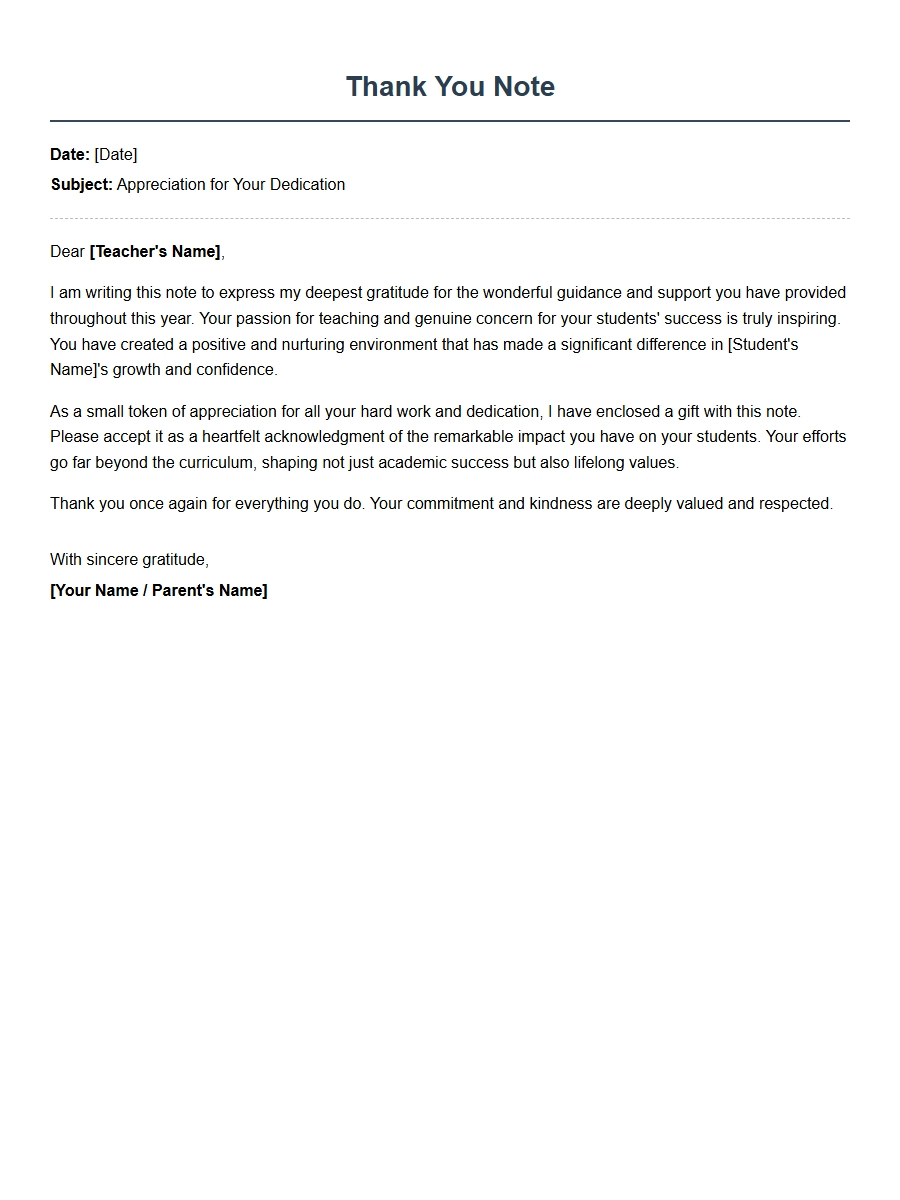 Sample Thank You Note for Teacher Gift
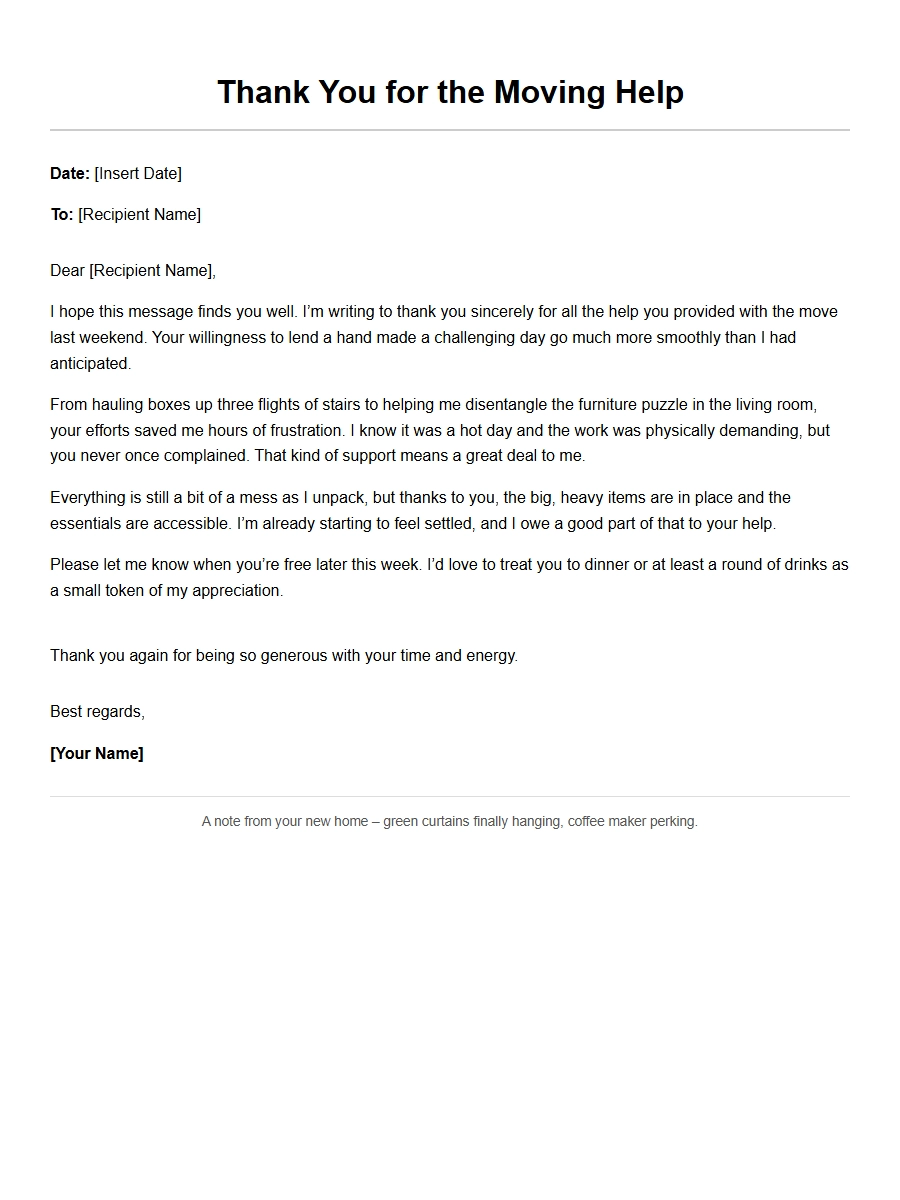 Thank-You Letter for Help with Moving
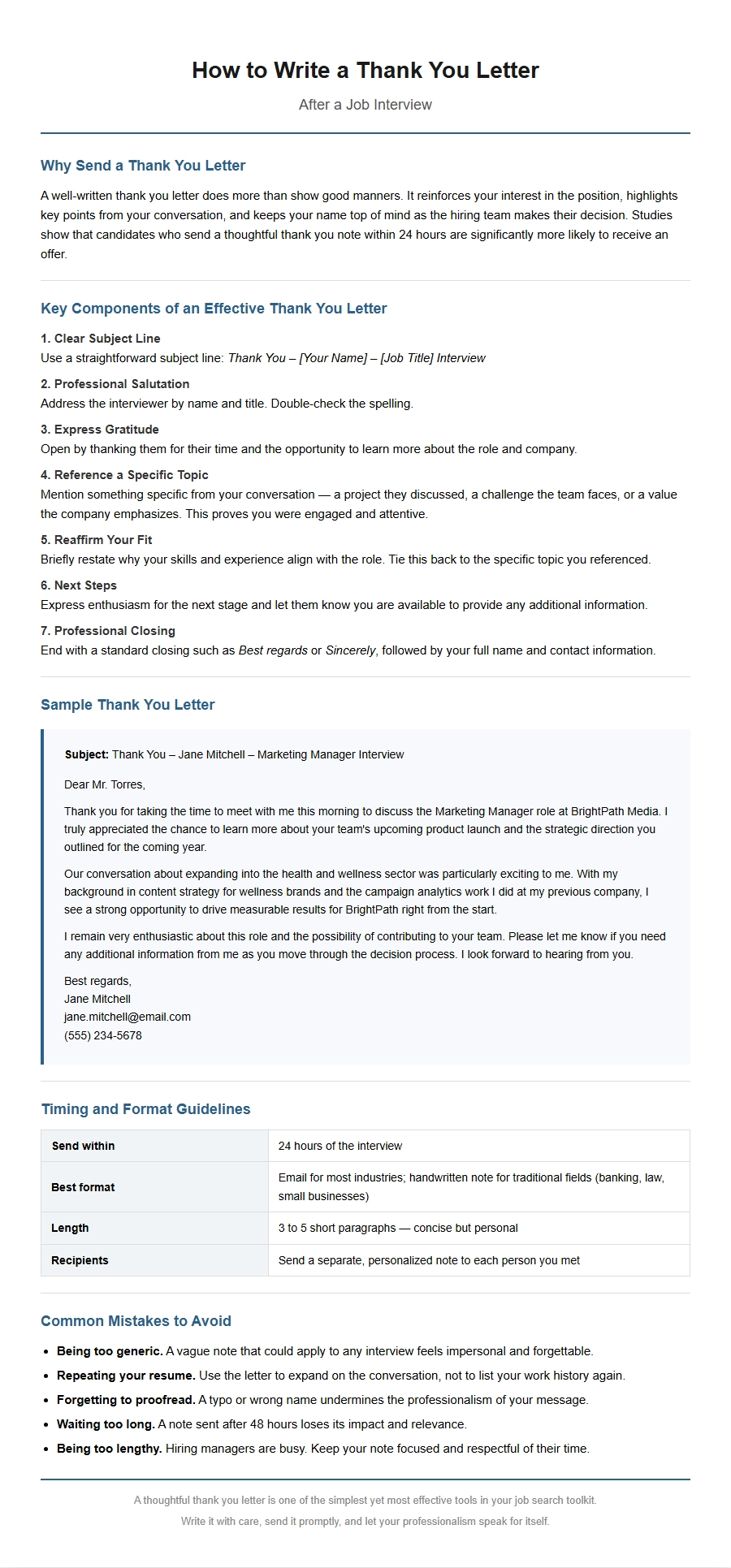 How to Write a Thank You Letter After an Interview
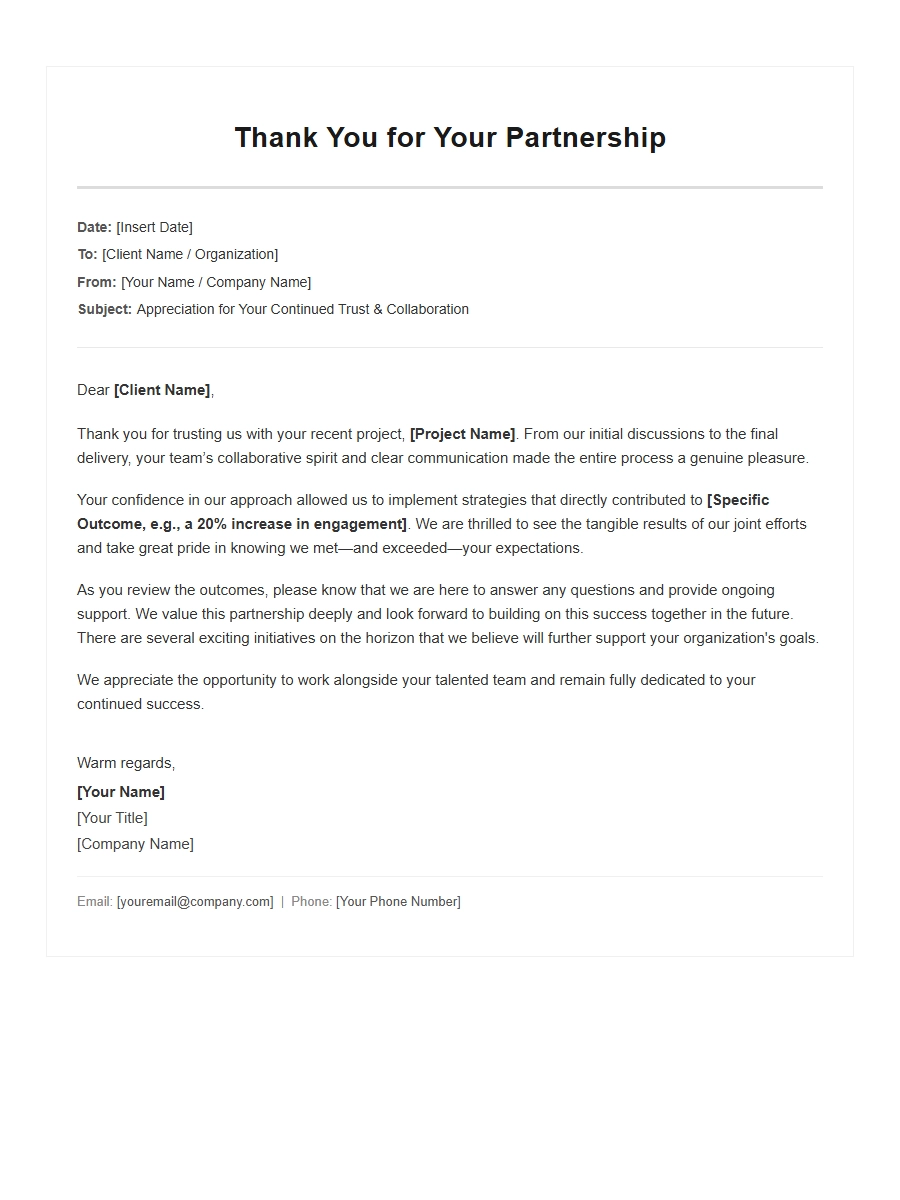 professional thank you email example for client - Thank-You Letters
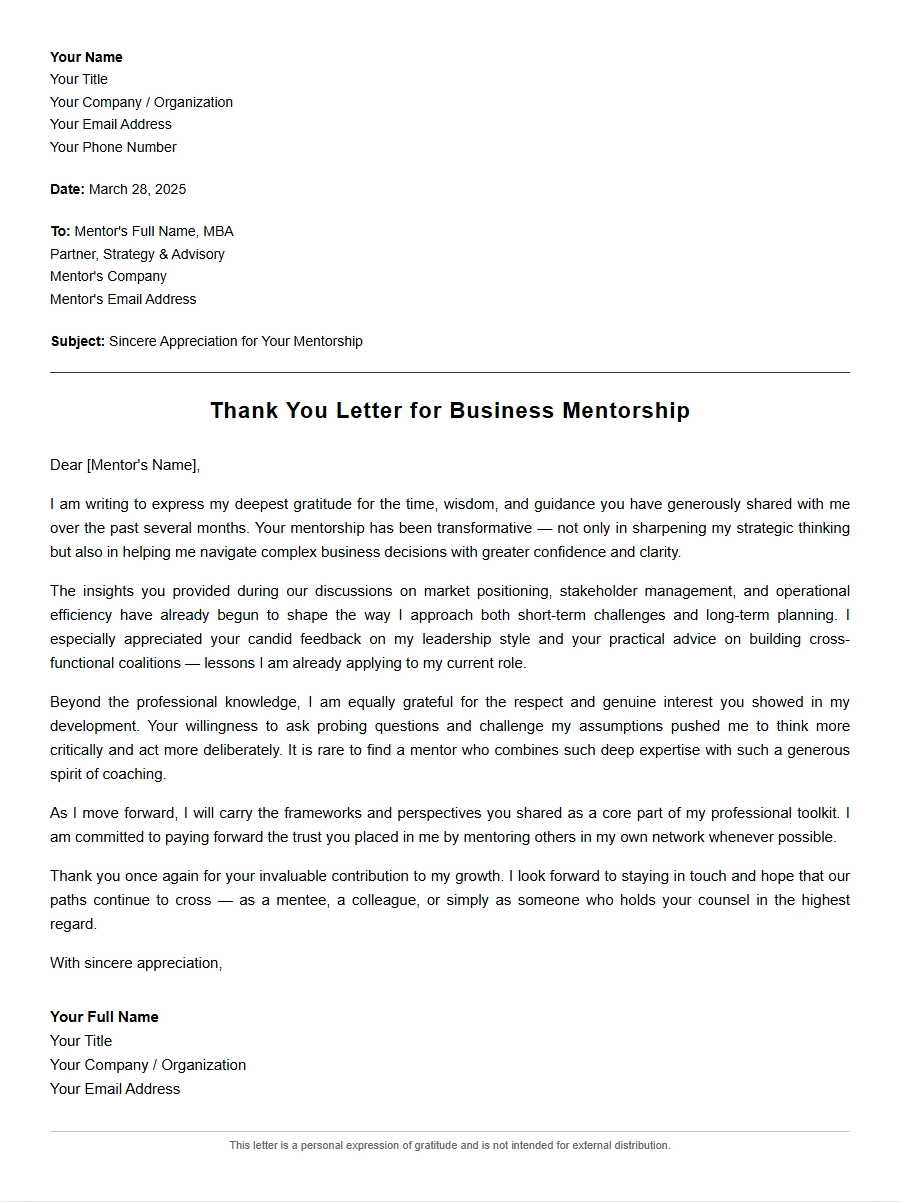 Business Mentor Thank-You Letter Guide
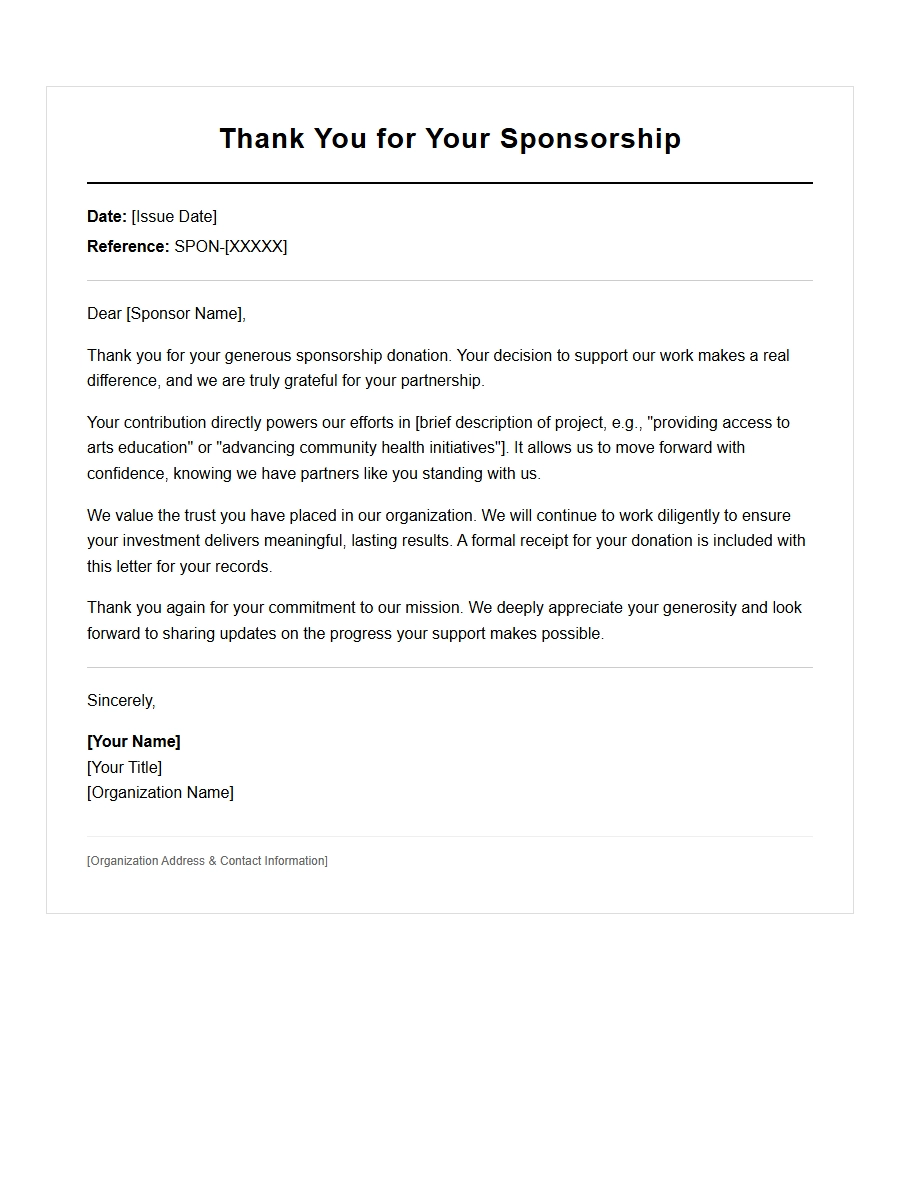 Thank You Letter for Sponsor Donation