You’ve just learned that a friend, family member, or colleague has lost an unborn child—and now you need to find the right words. It’s a moment when most people freeze. What do you say? What do you avoid? How do you acknowledge a loss that others might not have seen as a “real” baby?
Let’s be honest: writing a sympathy message for the loss of an unborn child feels heavier than most condolence notes. You’re not just offering comfort; you’re validating a grief that is easily overlooked. A well-written message can mean the world to someone who feels isolated in their pain. And a sample or template isn’t cheating—it’s a smart starting point. It gives you structure, a respectful tone, and key phrases, while leaving room for your own voice.
Why a Sample Helps—and How to Use It
A sympathy message sample saves you from staring at a blank page. It offers a framework: a warm salutation, a direct acknowledgment of the loss, an expression of sorrow, and a closing that offers ongoing support. But a sample is just bones. You have to add the flesh—your specific memories, the person’s name, the baby’s name if they’ve used it, and details that show you truly see them.
Think of it like a letter template for a difficult conversation. The structure handles the etiquette, so you can focus on being genuine. Avoid copying it word for word. The best condolence letters feel personal, not generic.
Choosing the Right Approach
First, consider your relationship. A close friend might welcome a handwritten note with a more intimate tone. A colleague or business acquaintance may prefer a thoughtful email. The tone in writing matters deeply here. For a coworker, keep it simple: “I was so sorry to hear about your loss. I’m thinking of you and your family.” For a close friend, you can be more direct: “I don’t have the right words, but I want you to know I’m holding you and your sweet baby in my heart.”
This falls under a category of condolence letters specifically for pregnancy and infant loss. It requires extra sensitivity. Many parents feel that others minimize their grief—so your message should never imply “you can try again” or “it wasn’t meant to be.” Instead, acknowledge the baby as real. Use the baby’s name if you know it. Say something like “I’m so sorry for the loss of your precious son, Ethan.”
Practical Advice for Writing Your Message
Start with a salutation that feels natural. “Dear [Name]” works for formal correspondence, but “Dearest [Name]” may feel warmer for a friend. Then state your sadness plainly: “I was heartbroken to hear the news.” Follow with a specific offering of support: “I’m here to listen if you want to talk, or to sit in silence if that’s what you need.” Avoid clichés like “everything happens for a reason.” They sting more than they soothe.
Proofreading is crucial. A small typo in a condolence message can feel careless. Read it out loud. Does it sound like you? If not, tweak it. And don’t worry about perfect letterhead design or a fancy digital letter format. A simple, clean note—handwritten or typed—carries far more weight than a glossy card with hollow words.
Common mistakes include using outdated salutations like “To Whom It May Concern” (never for this situation) or ignoring the format for email versus a printed letter. For email, keep the subject line short—“Thinking of you” is enough. For a physical card, a blank interior lets you write freely.
Putting It All Together
Let’s look at a short example you could adapt: “Dear Sarah, I am so deeply sorry for the loss of your baby. I can’t imagine what you’re going through, but I want you to know I’m holding you close in my thoughts. Please lean on me whenever you need. With love, [Your Name].” That’s honest, short, and respectful.
If you’re unsure about the overall format of a condolence letter, you might find it helpful to review examples of uplifting messages for grieving clients or a formal tone condolence letter for business settings. Those resources can guide you on structure and salutation, even if your situation is personal.
Similarly, if you later receive a thank-you note for your sympathy, you’ll want to acknowledge it gently. Our guide on how to write a thank-you note for sympathy gifts can help you respond without making the parent feel obligated.
And if the loss comes after a funeral or cremation, a condolence letter sent after the service can still bring comfort. Read our advice on sending condolences after cremation services for timing and phrasing tips.
Use This as a Springboard, Not a Crutch
Your goal is to show up for someone in their darkest moment. A sample gives you the confidence to start, but your authenticity makes the message matter. The first one will feel awkward. The next one will feel easier. Practice teaches you how to balance professionalism with genuine care. Let the sample be your guide—then write from your heart. That’s what the grieving parent will remember.
Examples You Can Adapt
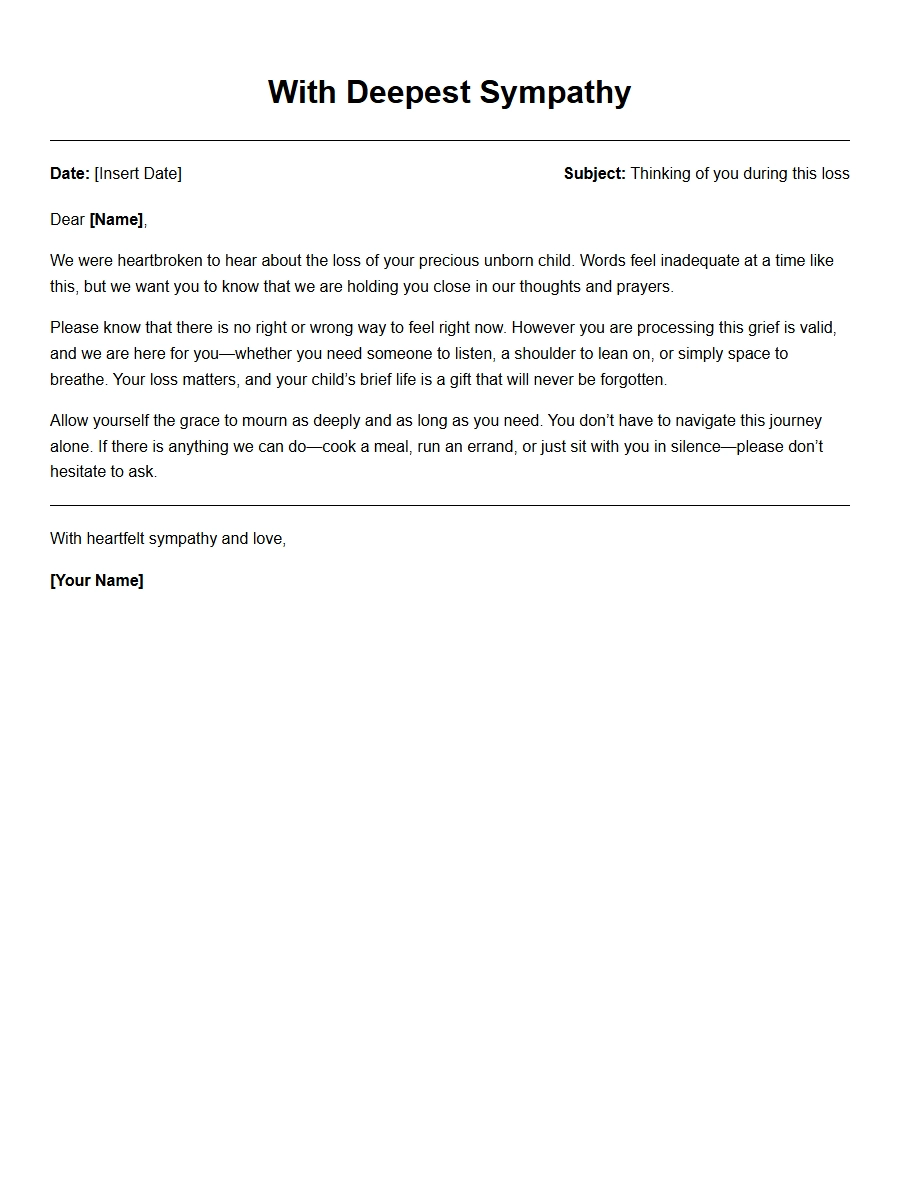
Sympathy Message for Loss of Unborn Child
A Letter of Shared Sorrow
Dear [Name],
We were devastated to learn of the loss of your precious baby. There are no words that can truly express the depth of sorrow we feel for you and your family. Please know that we are holding you close in our hearts during this unimaginably difficult time.
We remember how radiant you were during your pregnancy, how you spoke of your hopes and dreams for your child. That love and that bond will never be forgotten. It is okay to grieve, to weep, to feel numb. Your feelings are valid, and you are not alone.
We have prepared a small remembrance in honor of your baby's brief but meaningful life:
A donation in your baby's name to a charity supporting bereaved parents
A journal where you may write letters to your child
A meal delivery for two weeks to ease daily burdens
We will check in gently, respecting your need for space. Whenever you wish to talk, to be silent, or simply to have someone sit with you, we are here. With deepest sympathy and love, [Your Name]
For Parents Who Loss in Early Pregnancy
Dear [Name],
We are so sorry to hear about the loss of your pregnancy. This is a heartbreak that cannot be measured by the number of weeks, for it is your child, your hope, your future. Please do not feel you must rush your grief or pretend to be strong.
In the days ahead, you may encounter many questions and comments from others who do not understand the depth of this loss. You have every right to protect your heart and to set boundaries. We respect whatever you need—space, distraction, or companionship.
We have arranged a few small gestures to support you through this time:
Item
Details
Memorial Plant
A peace lily, symbolizing new life and remembrance
Grief Reading
"Empty Cradle, Broken Heart" by Deborah L. Davis
Weekly check-in
Someone to listen without advice, just presence
You are in our constant thoughts. We love you and we are here. With heartfelt condolences, [Your Name]
Sympathy to a Friend After Stillbirth
My dearest [Name],
I am writing this through tears, because your pain is now my pain. The news of your baby's stillbirth has shattered us all. I wish I could take away even a fraction of your agony. Please know that I am here, absolutely present, for whatever you need.
Your baby was real, was loved, was cherished. I remember the joy we felt when you shared the name, the nursery decorations, the little kicks you described. That joy is not erased—it is now mingled with sorrow. It is okay to feel both.
I will not pretend to understand your unique loss. But I promise to walk beside you. I have spoken with a few close friends and we have created a support plan for you:
Groceries delivered every Tuesday and Thursday
A companion for medical appointments if desired
A memory box to hold the handprints, blanket, and keepsakes
There is no timeline for grief. Take all the time you need. I will be here, quietly, always. With endless love, [Your Name]
To a Colleague Who Lost a Baby
Dear [Name],
I was deeply saddened to hear about the loss of your unborn child. While we may primarily work together, you are a person, a parent, a soul who carries this heavy burden. Please accept my most sincere condolences.
I want you to know that your workload will be fully covered during your leave. I have already spoken with the team, and we have prepared a schedule to ensure you have zero worries about work matters. Below is a summary of arrangements:
Support Area
Contact Person
Duration
Project handover
Jane Smith
4 weeks
Client communications
Mark Lee
As needed
Return-to-work plan
HR (confidential)
Flexible
Please do not feel pressured to respond. I will leave a card and a donation receipt at your desk for a charity that supports families after pregnancy loss. You are valued—not just as an employee, but as a human being. Take all the time you need. With sympathy, [Your Name]
For a Couple Who Lost Twins
Dear [Names],
We are so incredibly sorry for the loss of your twin babies, [Names if known]. The loss of two precious lives at once multiplies the heartache beyond words. We cannot imagine the depth of your sorrow, but we want you to know that we are grieving with you.
Your babies were loved from the moment you knew of their existence. We remember the double joy in your eyes at the ultrasound, the plans for two nurseries, the double stroller. That love does not disappear—it becomes a part of you, always.
We would like to honor your babies' memory in a few concrete ways:
A memorial tree planted with two stones bearing their names
A commissioned piece of artwork symbolizing two stars
Meals delivered for the next month to ease your days
There is no right way to grieve. Cry, scream, rest, talk—whatever you need, we are here without judgment. You are not alone. With deepest sorrow and love, [Your Name]
A Consoling Note from a Sibling
Dear big brother/sister [Name],
I don’t have the right words, but my heart is breaking for you. I’m so sorry about the loss of your baby. I know how much you wanted this child, how you already loved him/her completely. That love is real and will always be part of you.
I’m here for you—not to fix things, because some things can’t be fixed, but to be a shoulder. If you want to talk about the baby, I will listen. If you want to be silent, I can sit with you and watch a movie. Whatever you need, I am here.
I’ve made a small list of things I can help with so you don’t have to think about them:
Picking up prescriptions
Walking your dog
Making phone calls to cancel appointments
Just being present when you feel lonely
You are the strongest person I know, but strength doesn’t mean not feeling pain. Let yourself grieve. I love you. Always here, [Your Name]
To a Grandparent Grieving Their Grandchild
Dear [Name],
We are so deeply sorry for the loss of your precious grandchild. The joy of anticipating a new generation, the hopes of cradling and spoiling that little one—all gone too soon. Your pain is real, and we share in your sorrow.
We know that you are also supporting your own child through this tragic loss, which adds a layer of complexity to your grief. Please remember to take care of yourself as well. You are allowed to weep for the grandchild you never got to hold.
We have gathered a few resources that may help your family during this time:
Resource
Description
Bereavement support group
Grandparents Support Circle (online, weekly)
Memorial ideas
A small garden with a bench or a star naming
Practical help
Meal train, house cleaning, errand assistance
We love you and are holding you close in our hearts. Do not hesitate to reach out. With deepest sympathy, [Your Name]
A Letter of Understanding from a Fellow Loss Parent
Dear [Name],
I heard about the loss of your baby, and my heart broke for you. I know because I have walked this path—I lost my own child in the womb years ago. There are no comparisons in grief, but I want you to know that you are not alone, and your feelings are completely valid.
In the early days, everything feels raw. You may feel anger, numbness, guilt, or a million other emotions all at once. There is no timeline; the waves of grief will come and go. It’s okay to be broken. It’s okay to smile sometimes and then feel guilty. All of it is okay.
From my own journey, I offer a few suggestions that helped me, only if you find them helpful:
Write letters to your baby as a way to connect
Allow yourself to cry without apology
Set boundaries with well-meaning but hurtful comments
Seek a support group for pregnancy loss
I am here to listen, to cry with you, or to just be quiet. You will survive this, but you don't have to do it alone. With heartfelt understanding, [Your Name]
Sympathy Card Message for a Miscarriage
Dearest [Name],
We are so sorry for the loss of your precious baby. Although your time together was brief, that little life was deeply loved and will always be remembered. Please know you are in our thoughts and prayers.
We want to offer practical help in the coming weeks, so you can focus on healing. Here is a list of what we can do for you, just let us know what you need:
Cook and deliver meals on [days you choose]
Take care of children or pets
Accompany you to follow-up appointments
Help with thank-you notes if needed
You are surrounded by love. It’s okay to not be okay. We’re holding space for your grief. With heartfelt sympathy, [Your Name]
A Condolence Focused on the Baby’s Name
Dear [Name],
We were heartbroken to learn that your baby [Name] has passed away. We want you to know that we will always remember your child by that beautiful name you chose with so much love. [Name] existed, was real, and was part of your family story.
We know that you had dreams for [Name]—a future of first smiles, first steps, endless love. Those dreams are a testament to the depth of your love. Please do not feel pressured to forget or move on. Your bond with [Name] is eternal.
We would like to create a small memorial in [Name]'s honor. Please let us know your preference:
Option
Detail
Donation to charity
We will contribute to a cause that supports pregnancy loss families
Personalized keepsake
A custom piece of jewelry or a framed name poem
Garden stone
A stone with [Name]’s name engraved for your garden
We are with you in this deepest sorrow. Your baby's name will always be spoken with love. With sincere sympathy, [Your Name]
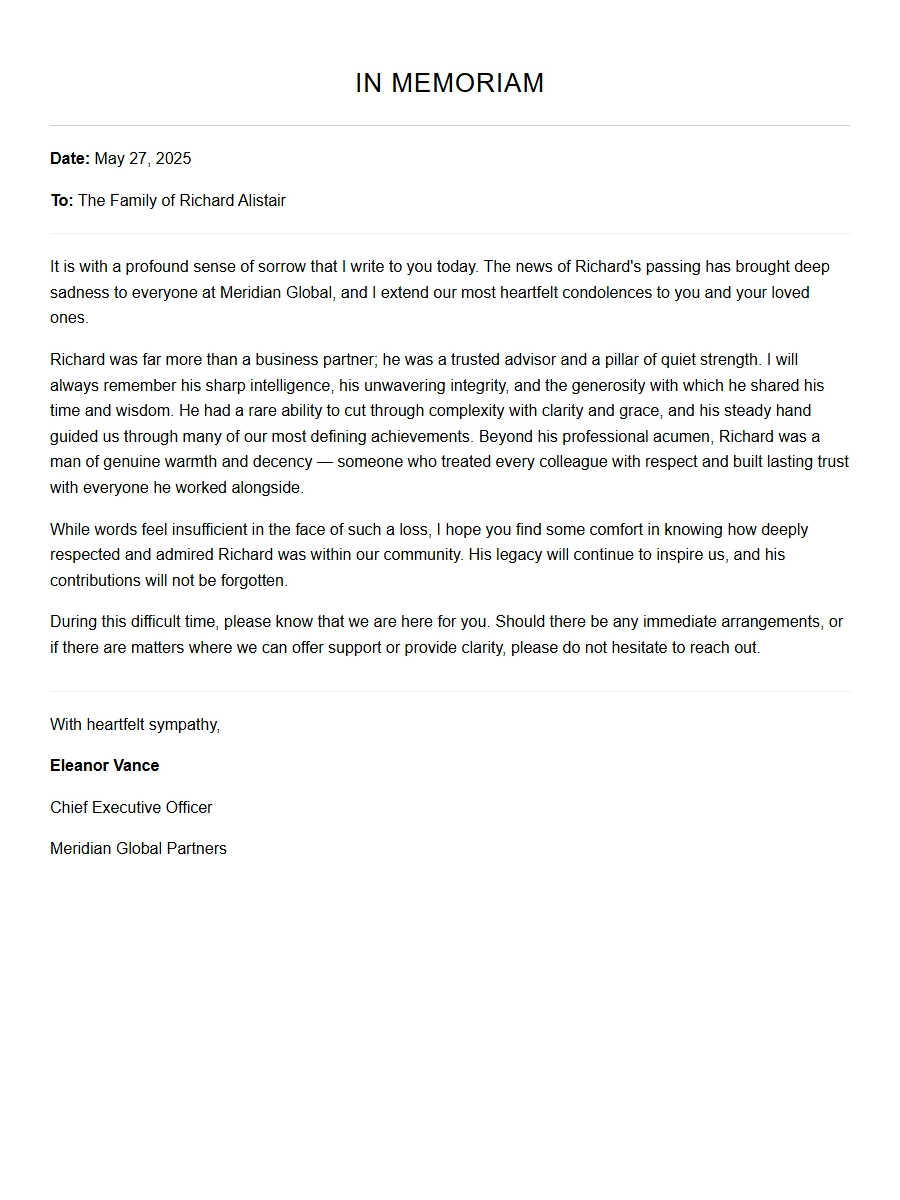 Formal Condolence Message for a Business Partner
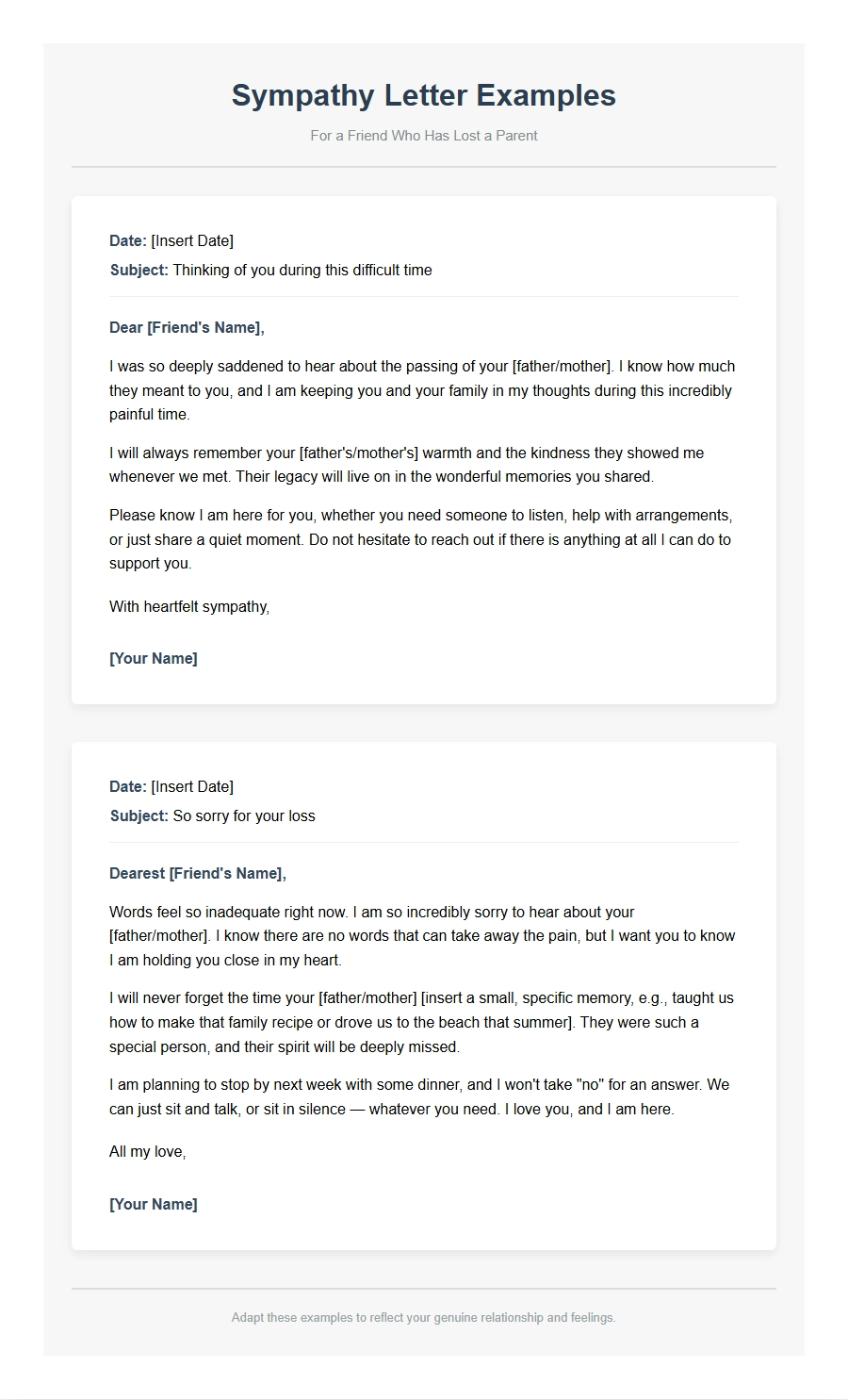 Sympathy Letter Examples for a Friend Who Lost a Parent
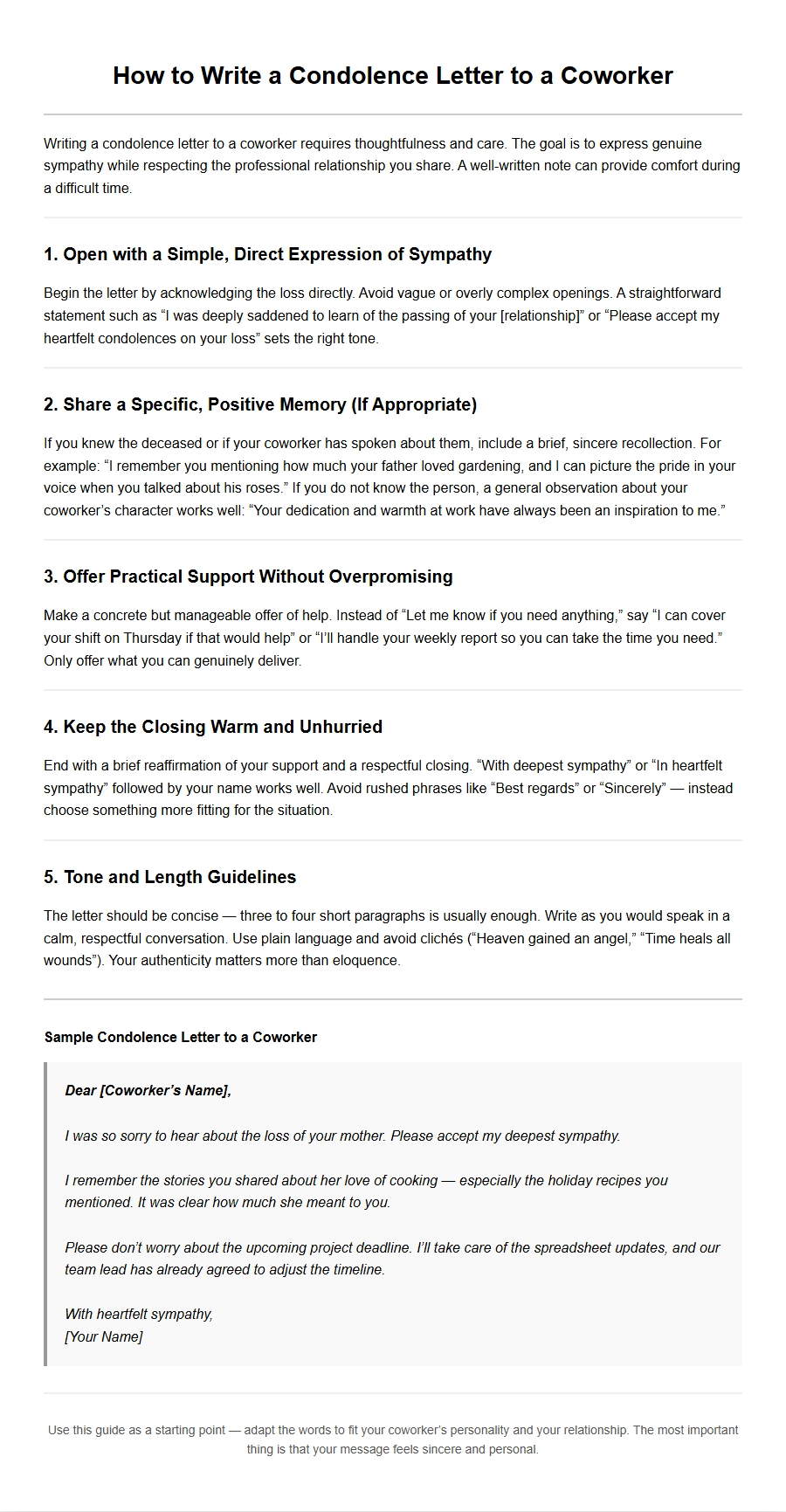 How to Write a Condolence Letter to a Coworker
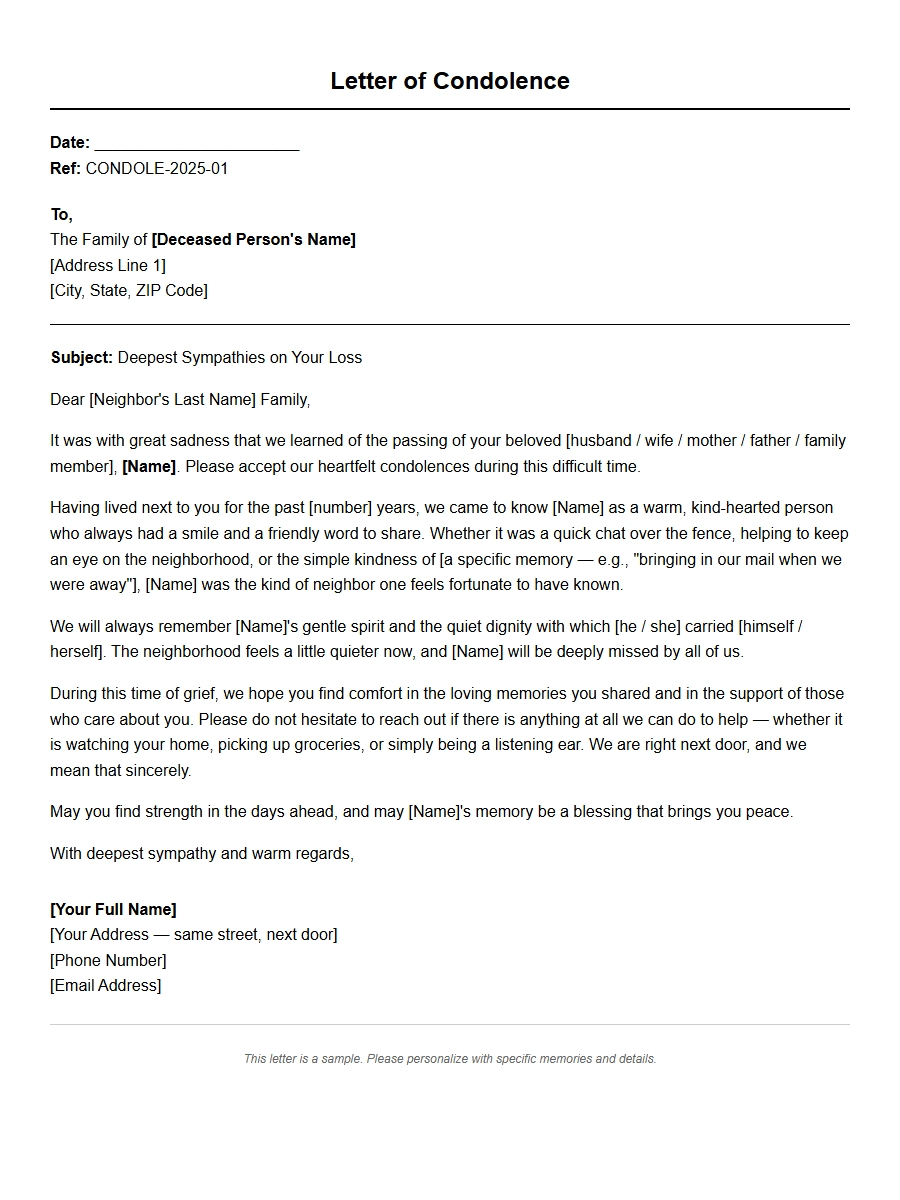 Condolence Letter Sample for a Neighbor
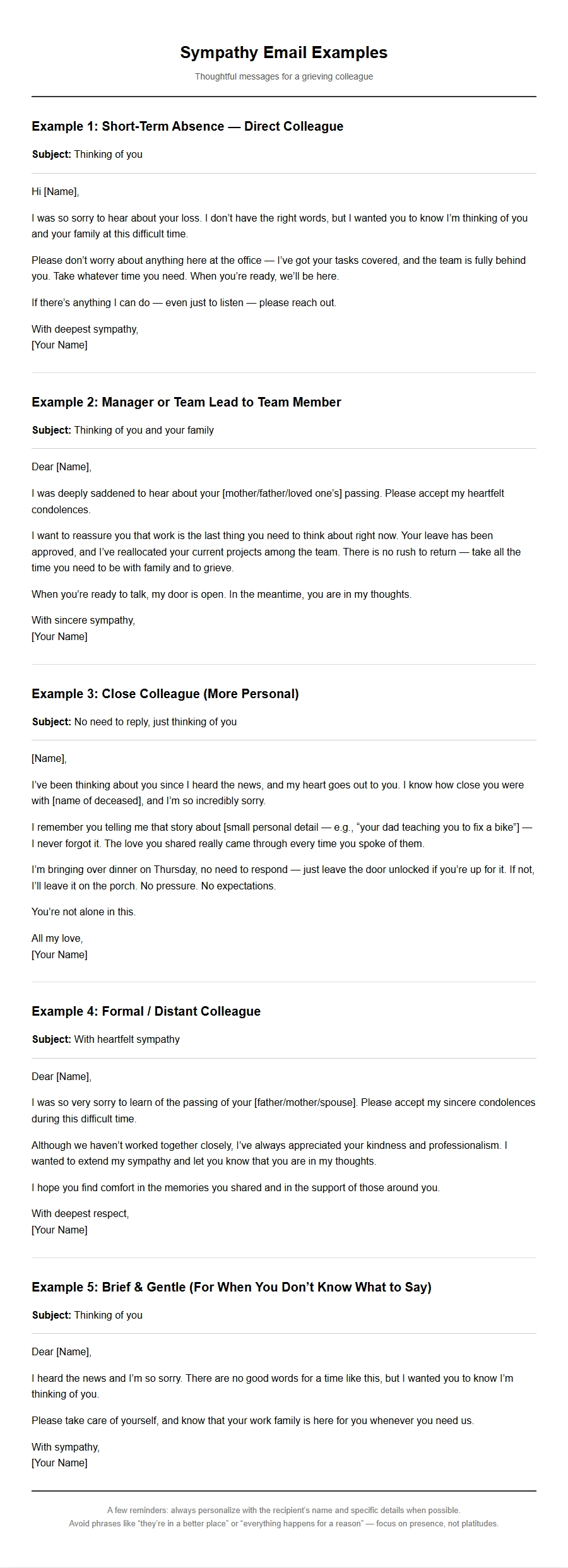 Sympathy Email Examples for a Grieving Colleague
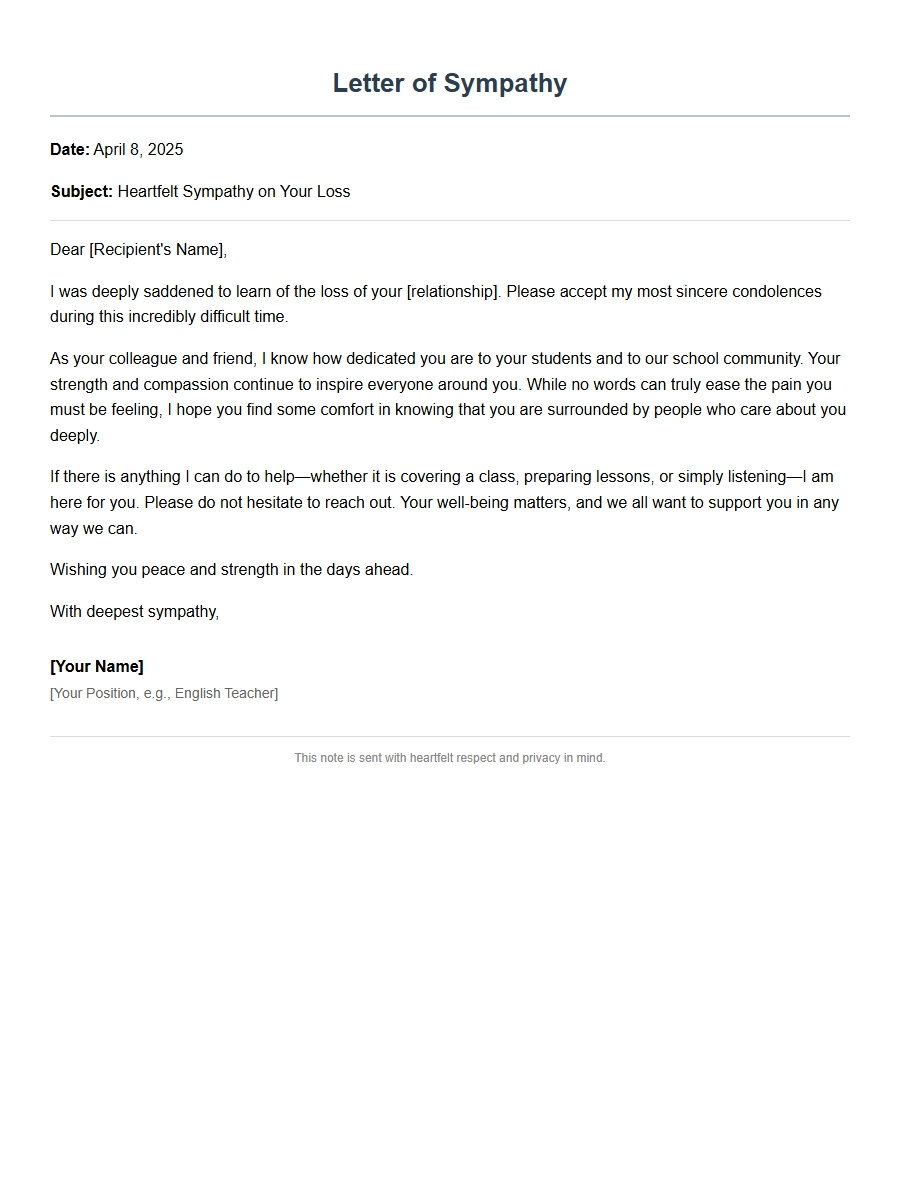 Condolence Words for a Teacher