You’ve been tasked with inviting your company’s top leaders to a strategy retreat. The pressure is on. These executives are busy, and the invitation needs to convince them that attending is worth their time. It has to be clear, professional, and compelling—but not overly salesy. Where do you start?
Using an invitation sample isn’t cheating. It’s a smart way to get the structure right and avoid forgetting key details like the retreat’s purpose, agenda highlights, or travel logistics. A good template gives you a solid framework. You then fill in the specifics and adjust the tone so the final letter sounds like you, not a machine.
Category: Business Invitation Templates
What makes an executive strategy retreat invitation different?
Unlike a casual get-together or a routine meeting invite, a strategy retreat asks senior leaders to step away from daily operations. The invitation should reflect the importance of the event. That means a formal tone—but not stiff. You want to sound professional and respectful while still being approachable. Think of it as a piece of professional correspondence that sets the stage for the retreat itself.
How to adapt a sample without losing your authentic voice
Start with a letter template that includes the standard parts: salutation, opening, body (purpose, logistics, expectations), closing, and call to action. Most samples already have the business letter format down. Your job is to replace generic phrases with real specifics.
For example, instead of “We are pleased to invite you to a strategy retreat,” try “Your perspective on our next growth phase is essential. Join us on March 15–17 at the lakeside lodge to shape the roadmap together.” That small shift makes the invitation feel personal and urgent.
Choose the right tone for your company culture
If your executive team values directness, skip flowery language. If they appreciate a bit of warmth, add a sentence about the shared vision. The tone in writing should match how your leaders normally communicate. A semi-formal tone often works best for strategy retreats because it signals seriousness without creating distance.
Avoid these common mistakes
One of the biggest errors is using an outdated salutation and closing. “To Whom It May Concern” feels impersonal. Instead, address each executive by name. If you’re sending the invitation by email, keep the digital letter format clean—short paragraphs, no giant attachments. For printed letters, use company letterhead design to reinforce professionalism.
Another mistake is forgetting to state what’s in it for them. Executives want to know how the retreat will help them do their jobs better. Clearly outline the objectives and expected outcomes. Also, don’t neglect logistics like start and end times, accommodation details, and how to RSVP. A customizable letter should let you plug in these details easily.
Finally, always proofread the letter before sending. A typo in the date or location undermines trust. Run it by a colleague or read it aloud. If you’re used to writing casual invitations—say, for a Halloween costume party—you’ll need to shift gears entirely. The same careful approach you’d use for a annual general meeting invite applies here.
Step-by-step: tailoring your invitation
Start with a strong subject line or header. Then write a short opening that explains why this retreat matters now. Follow with the agenda or themes (keep it high-level). Include practical details: date, location, who else is attending (if appropriate). End with a clear call to action—usually an RSVP deadline and contact person.
You can borrow the structure from other event invites you’ve seen, like a workshop registration invite, but adapt the language to be more strategic. Unlike a Thanksgiving meal gathering, this isn’t about socializing. It’s about aligning on big decisions. And unlike a rehearsal dinner invite, you don’t need to be sentimental—just respectful and direct.
A quick tip for the opening paragraph
Grab attention immediately. Start with the biggest challenge or opportunity the company faces. Then link the retreat to solving or seizing it. For example: “Our market share in Asia is growing faster than expected. We need a focused strategy to sustain that momentum—and we need you in the room to make it happen.” This makes the invitation feel less like an obligation and more like an urgent request for their expertise.
Use the sample as a springboard, not a crutch
The best invitation will feel both professional and personal. A sample gives you the skeleton—you supply the voice and the context. With practice, writing these will become faster. You’ll learn which phrases work for your team and which fall flat. Keep a few go-to templates saved, and adjust each time. That’s how you turn a blank page into a polished letter in minutes.
Samples for Inspiration
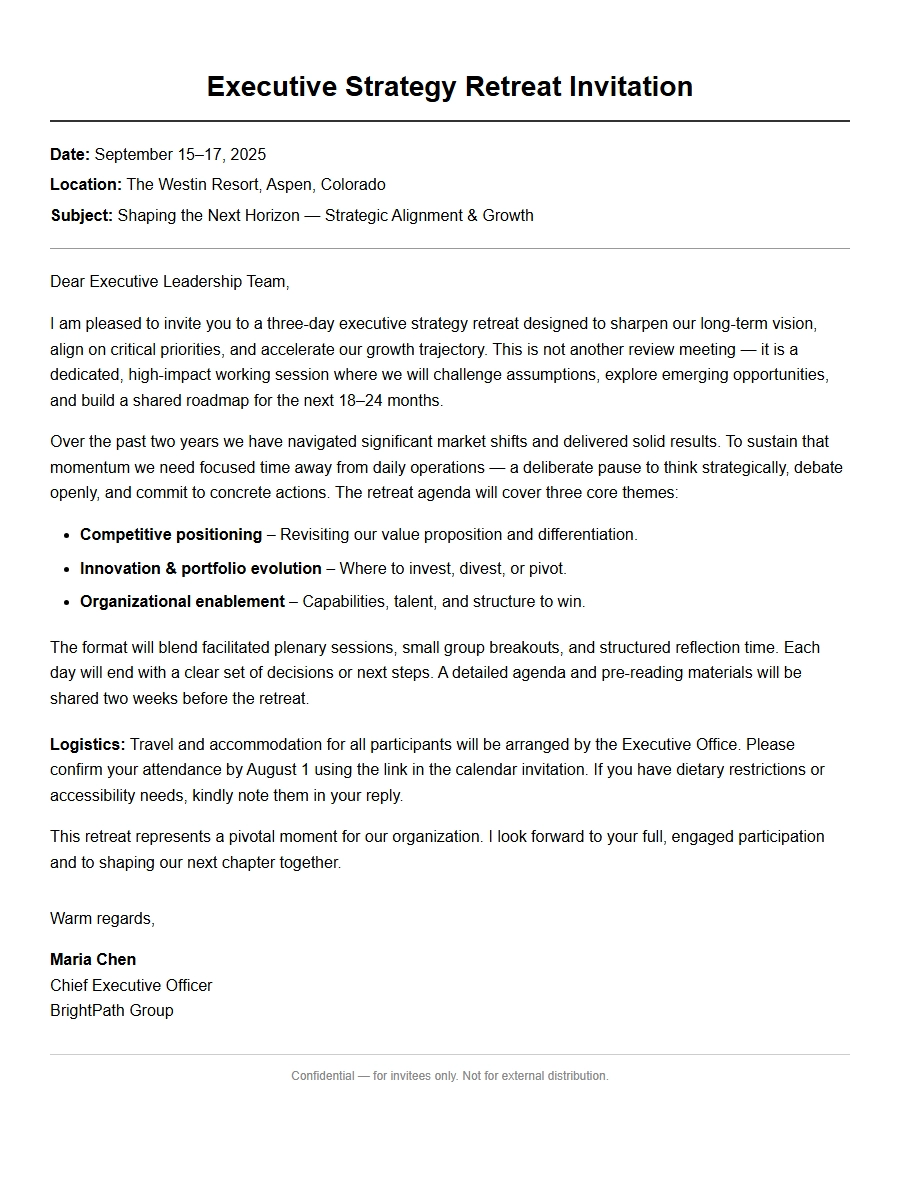
Executive Strategy Retreat Invitation Text
Formal CEO Invitation to Strategic Retreat
Dear Executive Team,
It is my distinct pleasure to invite you to the annual Executive Strategy Retreat, to be held from March 14–16, 2025, at the Mountain View Lodge & Conference Center.
This retreat is designed to align our leadership on the next three-year vision, challenge assumptions, and build stronger cross-functional relationships. Attendance is mandatory for all C-suite and Vice President roles.
Key Agenda Highlights:
Day 1: Off-site arrival, evening networking dinner & fireside chat
Day 2: Full-day strategy sessions with facilitated workshops
Day 3: Breakout sessions and closing action-planning
Please confirm your participation by February 28 via the internal portal. A detailed logistics pack will follow. I look forward to a productive and inspiring gathering.
Warm regards, Alexander Graham Chief Executive Officer
Agenda-Focused Retreat Invitation with Table
Dear Leadership Colleagues,
You are cordially invited to the Executive Strategy Retreat taking place April 10–12, 2025 at The Summit Conference Hotel, Aspen.
The retreat will focus on three critical pillars: Market Expansion, Digital Transformation, and Talent Innovation. Below is the high-level schedule:
Day
Theme
Key Sessions
Day 1
Vision & Alignment
Opening keynote, SWOT review, goal-setting
Day 2
Deep Dive Workshops
Innovation labs, breakout strategy sessions
Day 3
Action & Accountability
Commitment charter, resource planning
A detailed agenda with time slots and speaker names is attached to the portal. Please bring your individual department performance dashboards for reference.
We ask that you RSVP by March 20 to ensure seating and accommodation arrangements.
Best regards, Sarah Mitchell VP of Strategic Operations
Casual, Collaborative Retreat Invitation from HR
Hi Team,
We are thrilled to invite you to this year’s Executive Strategy Retreat – a chance to step away from day-to-day fires and focus on our shared future.
When?May 5–7, 2025 (arrive May 4 evening) Where? Harbor View Resort, San Diego
This retreat is less about slide decks and more about honest conversation. We will use open space technology and design sprints to tackle the biggest questions facing our organization.
What to bring:
An open mind
Your favorite problem you want to solve
Comfortable clothes for an outdoor team activity
Travel will be arranged by the admin team – please fill out the travel preference form by April 15. Dietary restrictions? Let us know.
We can’t wait to co-create the next chapter with you.
Cheers, Maya Chen Director of People & Culture
Virtual Executive Strategy Retreat Invitation
Dear Leadership Council,
You are invited to the Virtual Executive Strategy Retreat, a fully remote gathering designed to advance our strategic priorities without requiring travel.
Please ensure you have a reliable internet connection, a working webcam, and a quiet space. A tech check will be held June 10 at 10am ET.
RSVP by May 30 to receive the calendar invites and materials.
Best, David Okafor Head of Remote Operations
Retreat Invitation with Travel & Accommodation Table
Dear Executive Team,
We are pleased to invite you to the Executive Strategy Retreat, September 18–20, 2025, at the Lake Tahoe Resort & Spa.
All travel and accommodation will be centrally booked. Here is a summary of what is provided and what you need to arrange:
Item
Provided by Company
Action Needed from You
Flight (if required)
Economy class, round-trip
Submit preferred departure city
Hotel (3 nights)
Standard suite, all meals included
Check in by Sep 17 evening
Ground transport
Shuttle from airport to resort
Send flight itinerary to travel@
Evening reception
Cocktails & dinner (spouse optional)
RSVP for spouse by Sep 1
Please complete the attached travel preference form by August 14. We will send a finalized itinerary on September 1.
We look forward to seeing you at the lake!
Sincerely, Rebecca Liu VP of Administration
Follow-Up Invitation with RSVP Details
Dear Executive Colleagues,
This is a follow-up reminder regarding the upcoming Executive Strategy Retreat scheduled for October 9–11, 2025 at The Fairmont Banff Springs.
If you have already RSVP’d, thank you! If not, please respond by September 15 using the link in the original invitation. Your timely response helps us finalize workshop facilitators and accommodation.
Important RSVP fields to complete:
Full name and title
Dietary restrictions (if any)
Participation in the optional outdoor team challenge (yes/no)
Preference for breakout session track: Innovation, Operations, or People & Culture
We have also attached a preliminary reading list to the portal. Please review the three short articles before arrival – they will anchor our first discussion.
If you have any questions, contact Kim at ext. 4123.
Thank you, James Hart Executive Assistant to CEO
Invitation Highlighting Keynote Speaker
Dear Leadership Team,
We are excited to invite you to the Executive Strategy Retreat featuring a special keynote by Dr. Amara Singh, a globally recognized thought leader on organizational resilience and strategic foresight.
Dr. Singh will kick off the retreat on November 7, 2025 with a session titled “Leading Through Uncertainty: The Next Frontier of Strategy.” Following the keynote, we will apply her frameworks to our specific market context.
Retreat Details:
Location: The Ritz-Carlton, Amelia Island
Dates: November 7–9, 2025 (arrive Nov 6 evening)
Dress code: Business casual throughout, cocktail attire for keynote dinner
A limited number of one-on-one roundtables with Dr. Singh will be available. Indicate your interest when you RSVP by October 10.
We expect this retreat to be transformative, and we hope you will be part of the conversation.
Warmly, Nadia Patel Chief Strategy Officer
Retreat Invitation with Breakout Session Options
Dear Executive Committee,
You are invited to the Executive Strategy Retreat from January 23–25, 2026 at the Desert Springs Resort, Palm Springs.
This year, you can choose from three parallel breakout tracks. Please select your top two preferences when you register.
Track
Facilitator
Themes Covered
Track A: Market Expansion
Carlos Mendez
New geographies, M&A pipeline, brand strategy
Track B: Digital Evolution
Elena Rossi
AI integration, data maturity, platform modernization
Track C: Culture & Talent
Dr. Kenji Tanaka
Leadership development, DEI roadmap, retention
All tracks include hands-on workshops and produce actionable outputs that feed into the main strategic plan. You may switch tracks between sessions, but we encourage deep participation in one.
Registration deadline: January 2, 2026. Space in each track is capped at 12 participants, so please choose early.
We look forward to a dynamic and constructive retreat.
Best, Ines Vargas Retreat Planning Lead
Invitation with Pre-Retreat Preparation Checklist
Dear Executives,
We look forward to welcoming you to the Executive Strategy Retreat, February 20–22, 2026, at the Boston Harbor Hotel.
To ensure we hit the ground running, please complete the following preparation checklist before February 10:
Read: The pre-retreat briefing document (access in portal)
Fill out: Your individual SWOT analysis template (one page)
Bring: A one-page summary of your department’s key priorities for 2026
Think about: One strategic question that keeps you up at night – we will use these for a parking lot discussion
Logistics Reminder:
Check-in: Feb 19 (after 3pm) or Feb 20 (before 9am)
First session: Begins 9am sharp on Feb 20
Departure: Feb 22 after 4pm or Feb 23 morning
If you have any special requests or need assistance with travel, contact logistics@. Please confirm your participation by January 30.
See you in Boston, Michael Stern COO
High-Energy Invitation Emphasizing Team Building
Dear Crew,
Let’s get out of the office and into the wild – for the Executive Strategy Retreat! We’re mixing high-stakes strategy with real team bonding.
Dates: March 6–8, 2026 Location: Teton Mountain Ranch, Wyoming
Expect a blend of focused strategy sessions (mornings) and adventure activities (afternoons). Yes, we’ll be tackling strategic goals and also a ropes course and a guided hike.
Team Building Components:
Off-site arrival dinner with storytelling
Collaborative strategy mapping using giant whiteboards and sticky notes
Evening bonfire with constructive feedback circles
No formal attire required – just bring your energy, curiosity, and a willingness to connect on a deeper level. The retreat will end with a commitment ceremony where each executive will publicly share their top strategic pledge for the year.
RSVP by February 14 to secure your spot. Limited to 20 participants, so act fast.
Let’s make this the most memorable retreat yet!
Rock on, Jordan Blake Director of Strategic Initiatives
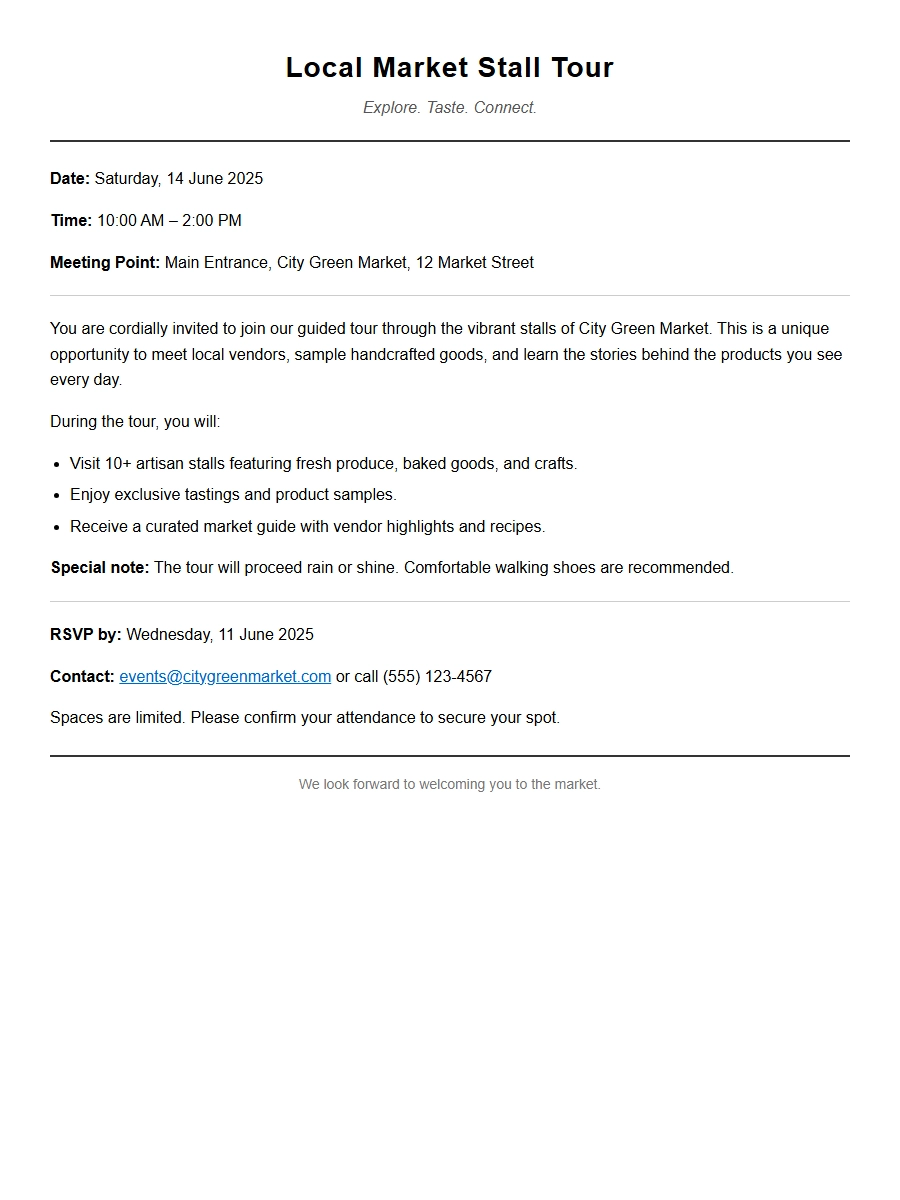 sample invitation for local market stall tour - Invitation Letters
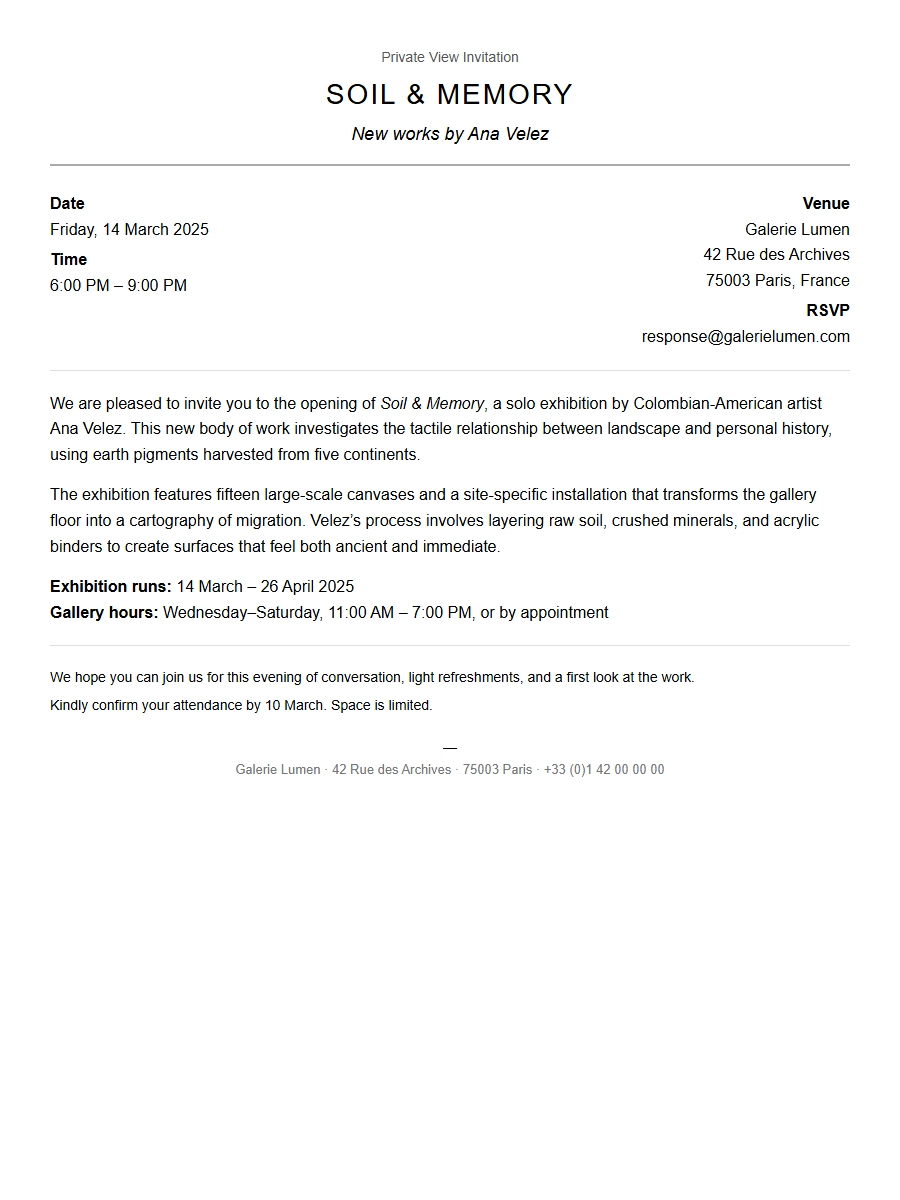 Art Exhibition Opening Invitation Wording Ideas
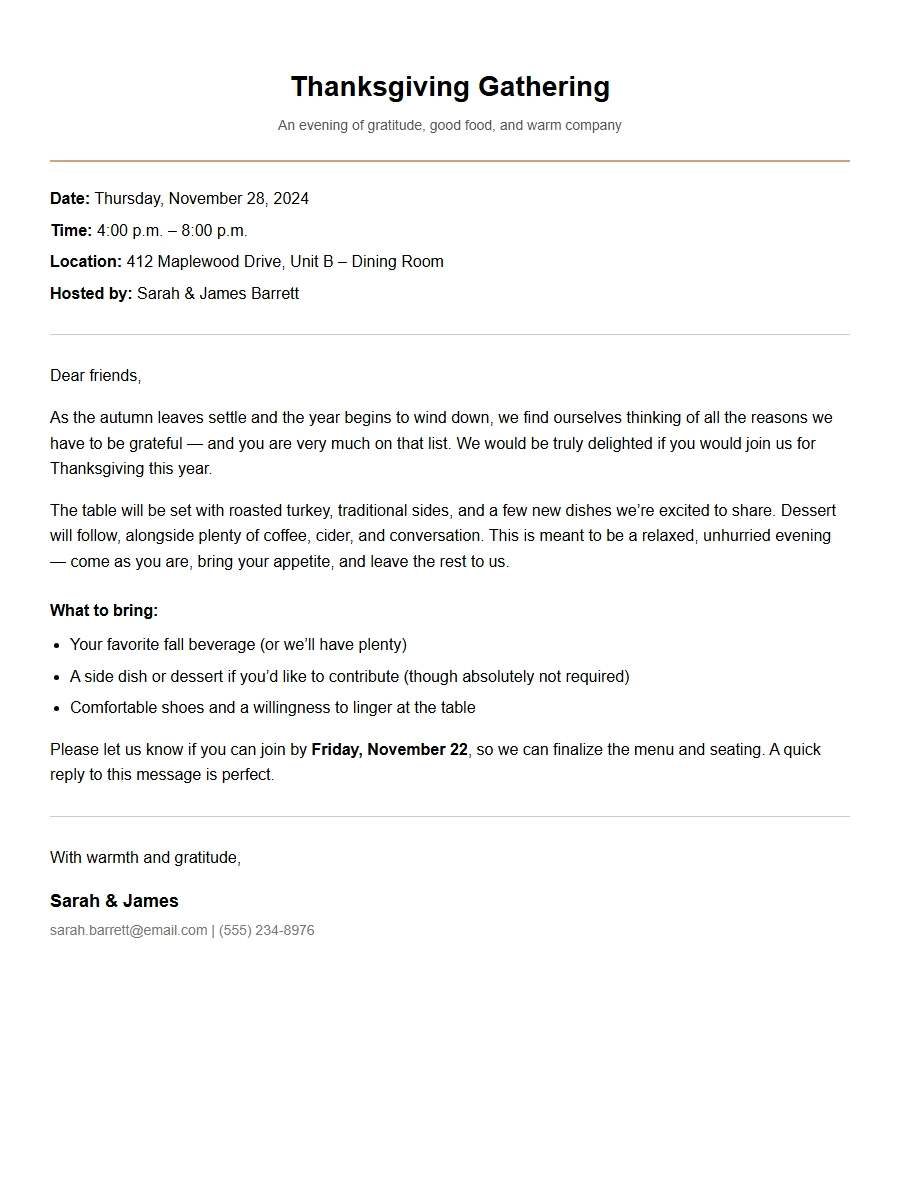 Thanksgiving Meal Gathering Invitation Text
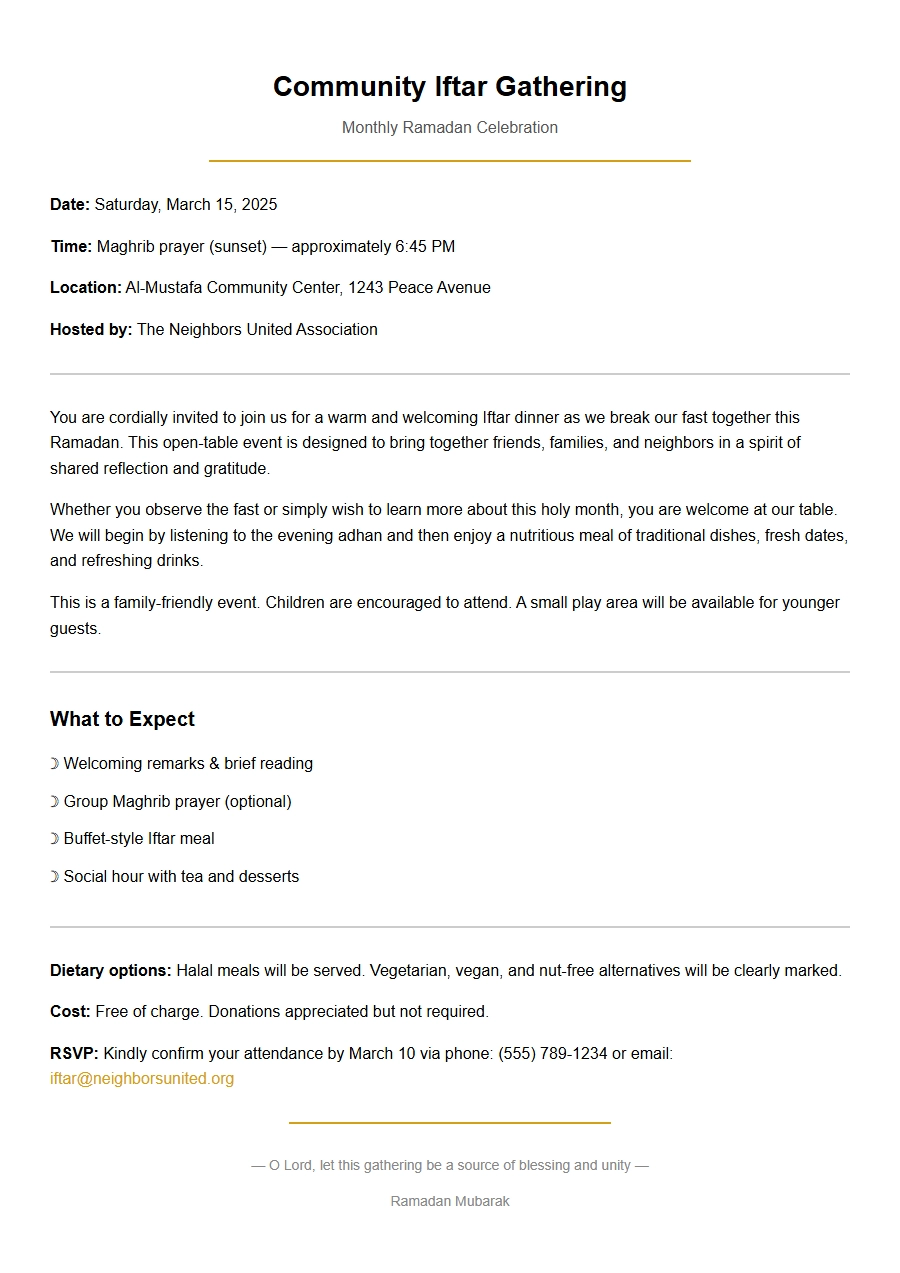 Ramadan Iftar Community Event Invitation
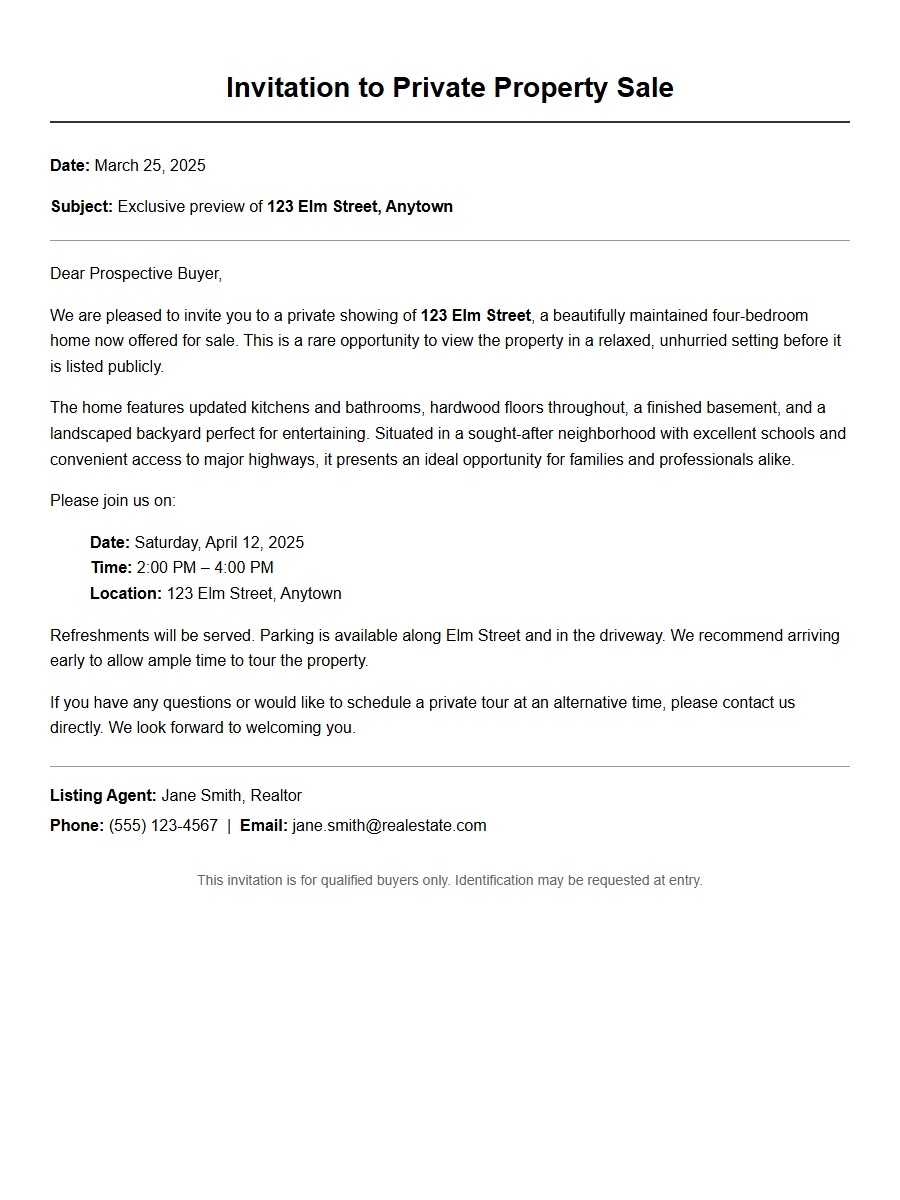 Sample Wording for Property Sale Invitations
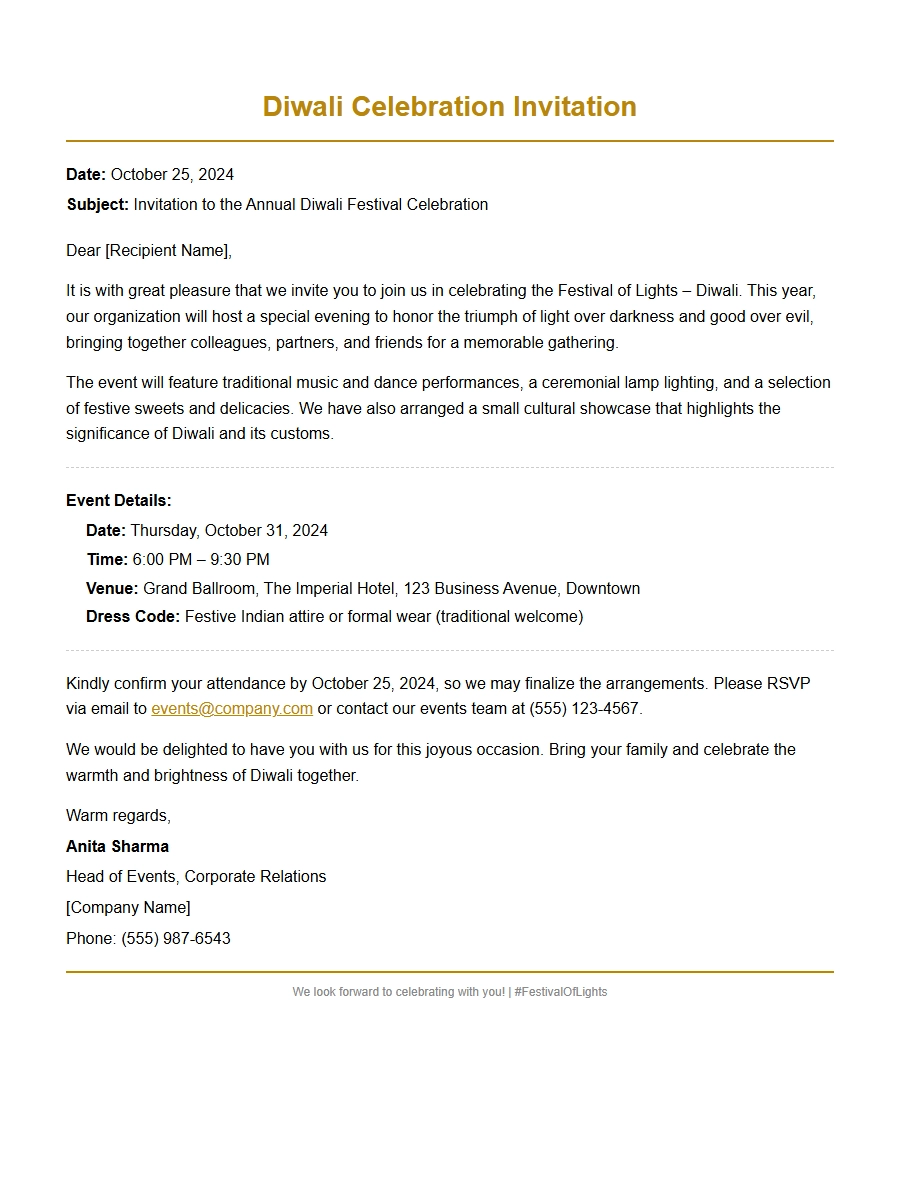 Diwali Festival Celebration Invitation Draft