how to write an invitation letter for business event - Invitation Letters
You’ve got a business event coming up—a product launch, a client appreciation dinner, a trade show booth. The date is set, the venue is booked, but now you need to actually invite people. And writing that invitation letter? It can feel surprisingly tricky. Too formal and it sounds cold; too casual and it might not be taken seriously. If you’re stuck staring at a blank page, you’re not alone. The good news is that using a well-crafted sample is not cheating—it’s a smart shortcut that gives you a proven structure, the right tone, and key phrases you can personalize in minutes. Think of it as a sturdy framework; you just add your own details and voice.
Category: Business Event Invitation Letters
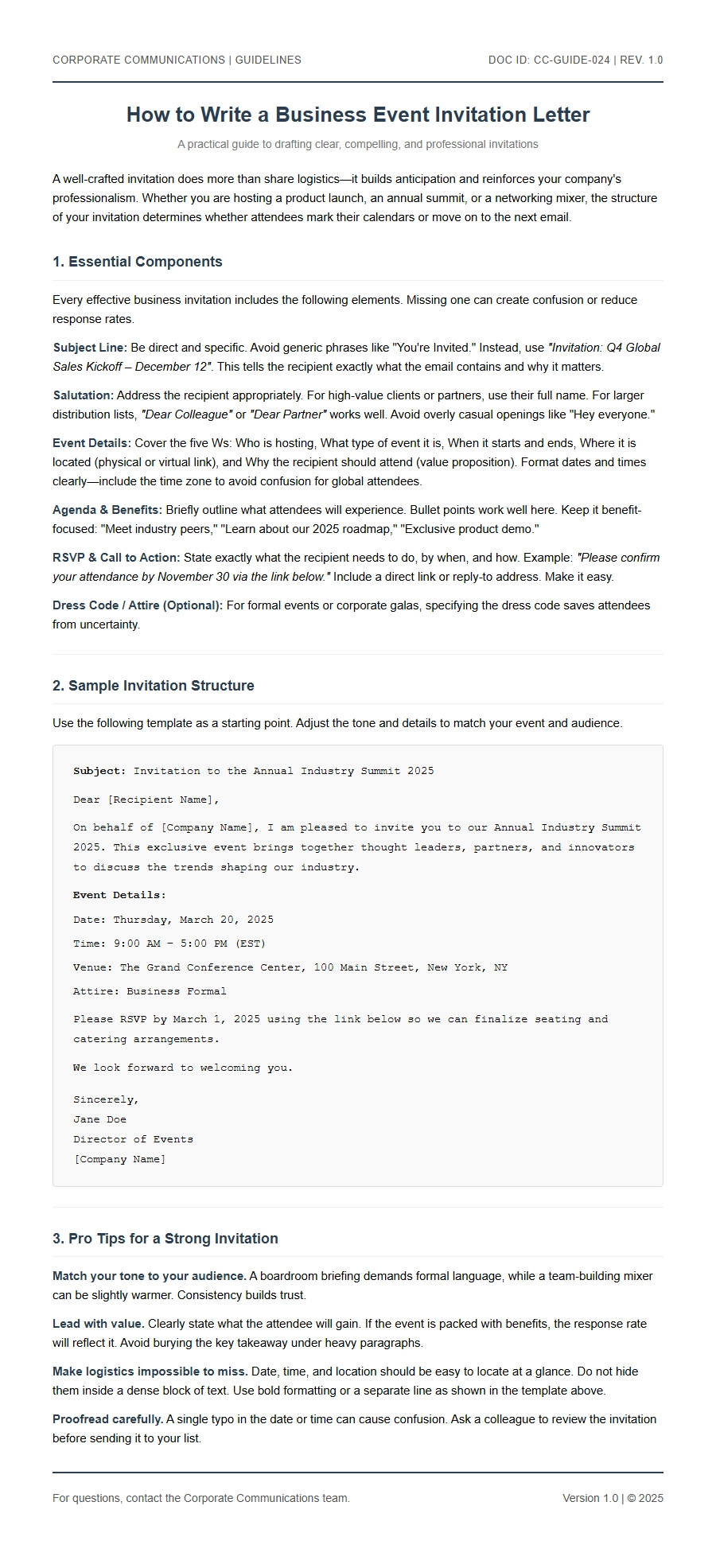
Let’s walk through how to write an invitation letter for a business event that feels professional, warm, and effective. Whether you’re sending it by email or printed mail, the core principles stay the same. Start by choosing the right template for your specific situation. A formal board meeting invitation needs a different structure than a casual networking mixer. Look for samples that match your industry and formality level. For instance, a board meeting invitation requires a clear agenda and RSVP instructions, while a company launch invitation can be more energetic and visually driven.
Once you have a sample that fits, resist the urge to copy it word for word. Instead, read it through, then rewrite the opening to grab your reader’s attention. A strong opening might mention why this event matters to them specifically—“We’re excited to share our latest innovation that could streamline your workflow.” That’s more engaging than “You are cordially invited to attend…” if your audience is busy professionals. Keep the salutation and closing appropriate: “Dear [Name]” for most business contacts, “Dear Mr./Ms. Last Name” for very formal situations, and avoid outdated closings like “Respectfully yours” unless it’s a very traditional industry.
Adapt the tone to match your brand. If your company culture is friendly and direct, don’t stuff your letter with stiff phrases. Drop “we would be honored” for “we’d love to see you there.” The sample gives you the skeleton; you add the personality. One common mistake is ignoring the format. An email invitation should have a clear subject line, a brief preview, and a clickable link for RSVPs. A printed letter might need letterhead design and a physical response card. Anniversary events often benefit from a more personal touch, but for business, keep the design clean and professional.
Proofreading is non-negotiable. A typo in a date or venue undermines your credibility. Read the letter aloud, check the salutation and closing, and verify all contact details. If you’re emailing, test the links. If you’re printing, check the paper quality. And remember: you can always customize the letter further for different segments of your guest list. VIP clients might get a slightly longer, more personal note; industry peers might get a shorter version.
Using a trade show booth invitation sample can save you hours of guesswork, but the best letters feel both professional and human. They show that you put thought into who you’re inviting and why. Over time, you’ll get faster at adapting samples, and you might even start writing drafts from scratch. But for now, grab a template, tweak it with your voice, and send it out with confidence. Your event deserves guests who feel genuinely welcomed.
Browse Sample Ideas
how to write an invitation letter for business event - Invitation Letters
Formal Invitation for Annual Industry Conference
Dear Valued Partner,
We are pleased to invite you to the Annual Industry Conference 2025, scheduled to bring together leaders and innovators from across the sector. Please find the event details below:
Detail
Information
Date
March 15, 2025
Time
9:00 AM – 5:00 PM
Venue
Grand Ballroom, City Convention Center
Theme
Innovation & Sustainability
The conference will feature keynote speeches, panel discussions, and networking opportunities. A detailed agenda is available upon request.
RSVP: Please confirm your attendance by February 28, 2025 via email at rsvp@conference.com or by calling (555) 123-4567. Seating is limited.
We look forward to your presence at this premier industry event.
Best regards, Event Committee
Networking Mixer Invitation for Startups
Hello Fellow Entrepreneur,
You are cordially invited to our Startup Networking Mixer—a perfect opportunity to connect with like-minded founders, investors, and mentors.
Date: Thursday, April 10, 2025
Time: 6:00 PM – 9:00 PM
Location: The Innovation Hub, 123 Tech Street, Suite 200
Highlights: Casual drinks, lightning pitches, and open discussions
This event is free for early-stage startups. Please bring your business cards and a 30-second elevator pitch.
Space is limited to 80 participants. Kindly RSVP by April 3 via the link: bit.ly/startupmixer25 or email mixer@startupnetwork.com.
We can’t wait to meet you!
Warmly, The Startup Network Team
Product Launch Event Invitation
Dear Industry Colleague,
We are thrilled to announce the launch of our latest product, NovaSync Pro, and invite you to the unveiling ceremony.
Event Detail
Description
Date
May 20, 2025
Time
4:00 PM – 7:00 PM
Venue
Skyline Rooftop, 456 Tower, Downtown
During the event you will enjoy a live demo, Q&A session with our engineers, and a cocktail reception. Each guest will receive an exclusive gift bag.
Please confirm your attendance by May 10. RSVP to events@novasync.com or call (555) 987-6543.
We look forward to sharing this milestone with you.
Sincerely, NovaSync Marketing Team
Invitation to Annual Corporate Gala Dinner
Dear Esteemed Guest,
On behalf of [Company Name], we have the honor of inviting you to our Annual Corporate Gala Dinner celebrating another year of achievements and partnerships.
The evening will include a formal dinner, live entertainment, and a keynote address by our CEO.
Date: Saturday, June 7, 2025
Time: 7:00 PM – Midnight
Venue: The Ritz-Carlton Grand Salon, 789 Luxury Ave.
Dress Code: Black Tie
Each guest may bring one plus-one. Please indicate any dietary restrictions when you RSVP.
RSVP by May 25: email gala@company.com or use the online portal: company.com/gala2025. A formal invitation with your table number will follow.
We eagerly await your presence at this splendid occasion.
Yours sincerely, The Event Planning Committee
Workshop on Digital Marketing Trends
Dear Marketing Professional,
We are excited to invite you to an exclusive half-day workshop: Mastering Digital Marketing Trends 2025.
This hands-on session will cover AI in advertising, SEO evolution, and social media analytics. Ideal for both beginners and seasoned marketers.
Details
Info
Date
July 12, 2025
Time
9:30 AM – 1:30 PM
Location
Blue Conference Room, 321 Business Park
Fee
$50 (includes materials & lunch)
Register now at workshop.digitaltrends.com as seats are limited to 30 participants. Use code EARLY20 for a 20% discount before June 30.
We look forward to seeing you there!
Best, Digital Marketing Institute
Invitation for Business Partner Meeting
Dear Partner,
You are cordially invited to a strategic business meeting to discuss our joint venture roadmap for the coming quarter.
Agenda items include progress review, resource allocation, and upcoming milestones. Your input is vital.
Date: August 5, 2025
Time: 10:00 AM – 12:00 PM
Location: Conference Room A, 555 Corporate Drive
Video conference option: Zoom link will be sent upon confirmation
Please bring any relevant reports and be prepared to share updates from your team. Refreshments will be served.
Kindly confirm your attendance by July 28 via email to meetings@company.com. If you have any specific agenda items to add, please let us know.
Thank you for your continued collaboration.
Warm regards, John Smith, Partnership Manager
Trade Show Booth Invitation
Dear Exhibitor and Prospect,
We are delighted to invite you to visit our booth at the International Trade Expo 2025. Experience our latest innovations firsthand.
Our team will be demonstrating new product lines and offering exclusive show discounts. Stop by for a chat and free samples.
Event Info
Details
Expo Dates
September 10-12, 2025
Booth Number
B-245
Location
Expo Center Hall B, 1000 Convention Blvd.
Show Hours
9 AM – 6 PM daily
To schedule a personalized meeting with our sales director, please RSVP to trade@ourcompany.com. Walk-ins are also welcome.
We look forward to welcoming you at booth B-245!
Best regards, Expo Team
Invitation to Executive Breakfast Seminar
Dear Executive,
We are pleased to invite you to an exclusive breakfast seminar titled Future of Remote Work: Strategies for Leaders.
Join us for a morning of insights, networking, and a delicious continental breakfast. Our guest speaker, Dr. Lisa Chen, will share data-driven approaches.
Date: October 8, 2025
Time: 8:00 AM – 10:30 AM (breakfast served at 8:00)
Venue: The Oak Room, The Grand Hotel, 200 Park Avenue
Attendance is complimentary but registration is mandatory. Please RSVP by September 25 via email breakfast@leadersforum.com or call (555) 222-3333. Spaces are limited to 50 senior leaders.
We look forward to your valuable contribution to the discussion.
Sincerely, Leaders Forum
Webinar Invitation: Supply Chain Innovations
Dear Supply Chain Professional,
You are invited to our FREE live webinar: Supply Chain Innovations 2025: AI and Automation.
Discover how emerging technologies are reshaping logistics, inventory management, and procurement. The session includes a live Q&A.
Detail
Information
Date
November 18, 2025
Time
2:00 PM – 3:30 PM EST
Platform
Zoom (link sent after registration)
Speaker
Dr. Mark Rivera, Supply Chain Expert
Register at webinar.supplychain.com/register. Upon registration you will receive a confirmation email with the link and materials.
We hope you can join us for this insightful session.
Best regards, Supply Chain Insights Team
Invitation for Business Anniversary Celebration
Dear Client, Partner, and Friend,
We are proud to celebrate 10 Years of Excellence and cordially invite you to our anniversary gala.
This milestone event will honor the relationships that have made our success possible. Enjoy an evening of networking, fine dining, and live music.
Date: December 5, 2025
Time: 7:00 PM – 11:00 PM
Venue: The Crystal Hall, 888 Gold Street
Attire: Cocktail attire
Please RSVP by November 20 by emailing anniversary@company.com or calling (555) 444-5678. Kindly indicate if you will bring a guest and any dietary restrictions.
A commemorative gift will be presented to each attendee. We look forward to sharing this special evening with you.
 sample invitation for local market stall tour - Invitation Letters
 Art Exhibition Opening Invitation Wording Ideas
 Thanksgiving Meal Gathering Invitation Text
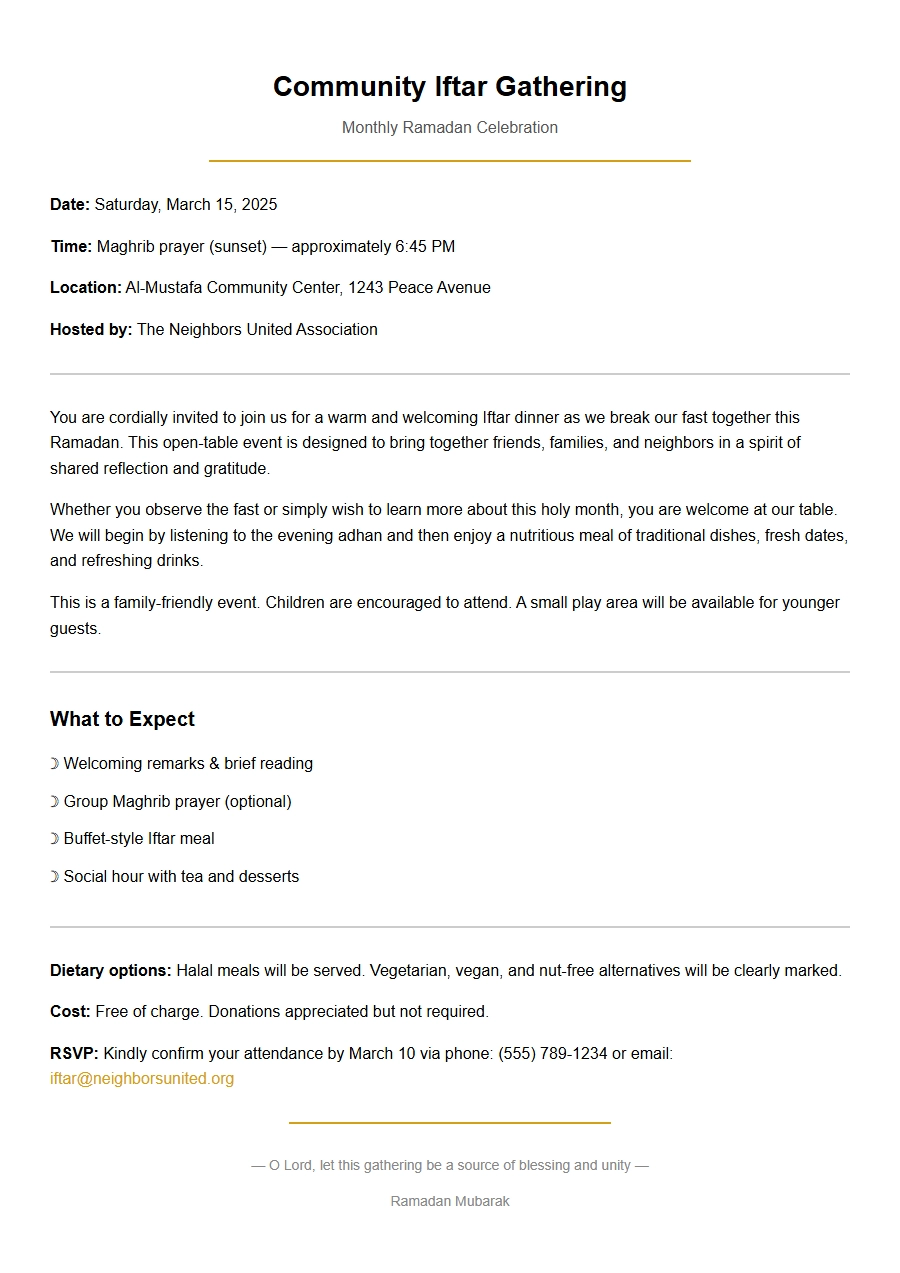 Ramadan Iftar Community Event Invitation
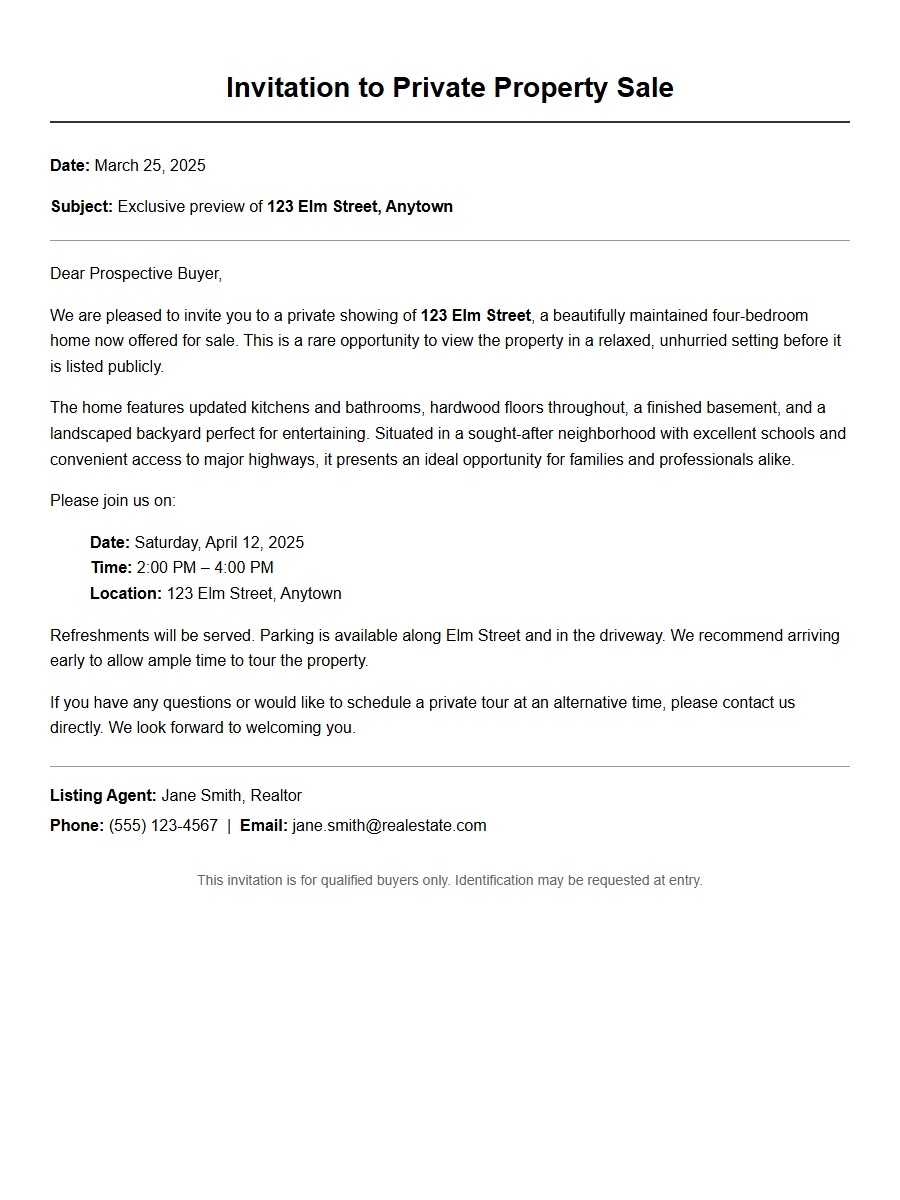 Sample Wording for Property Sale Invitations
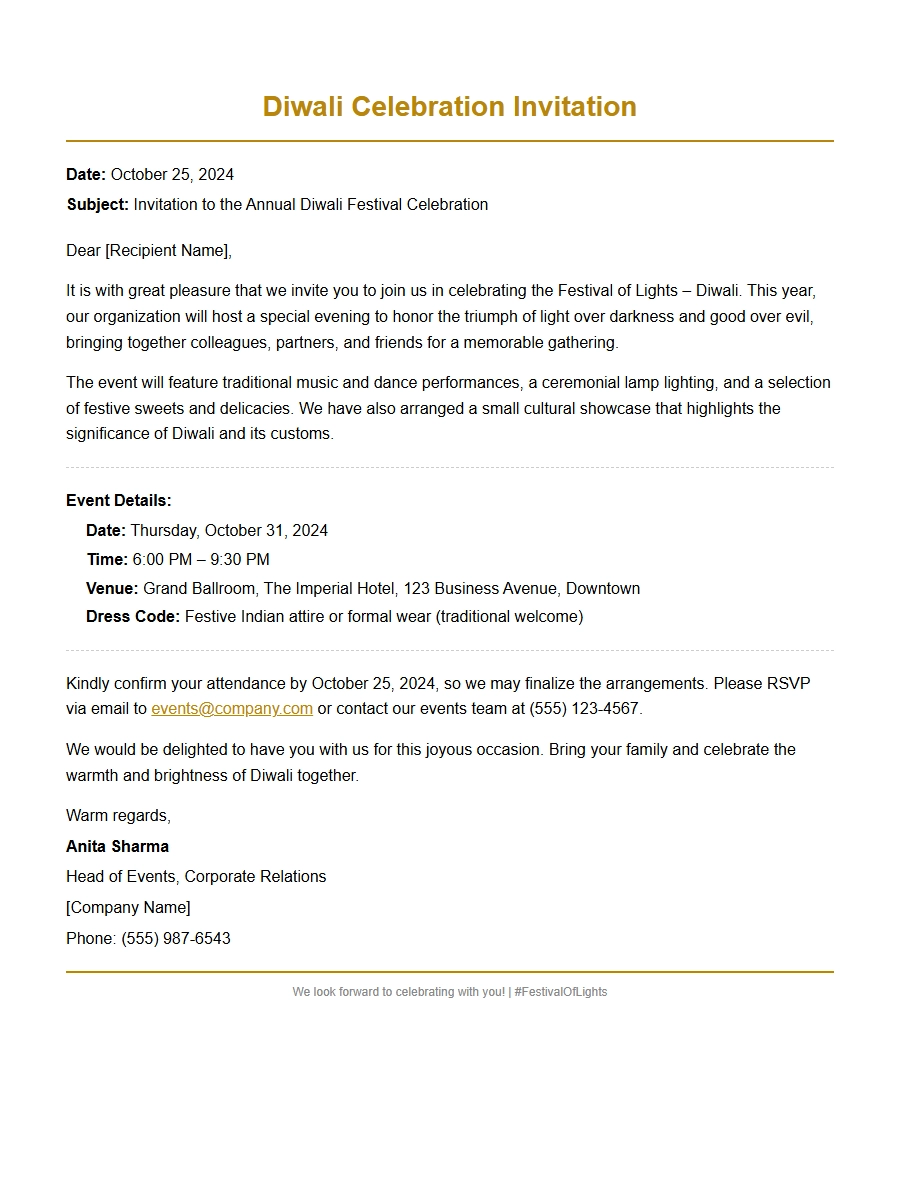 Diwali Festival Celebration Invitation Draft