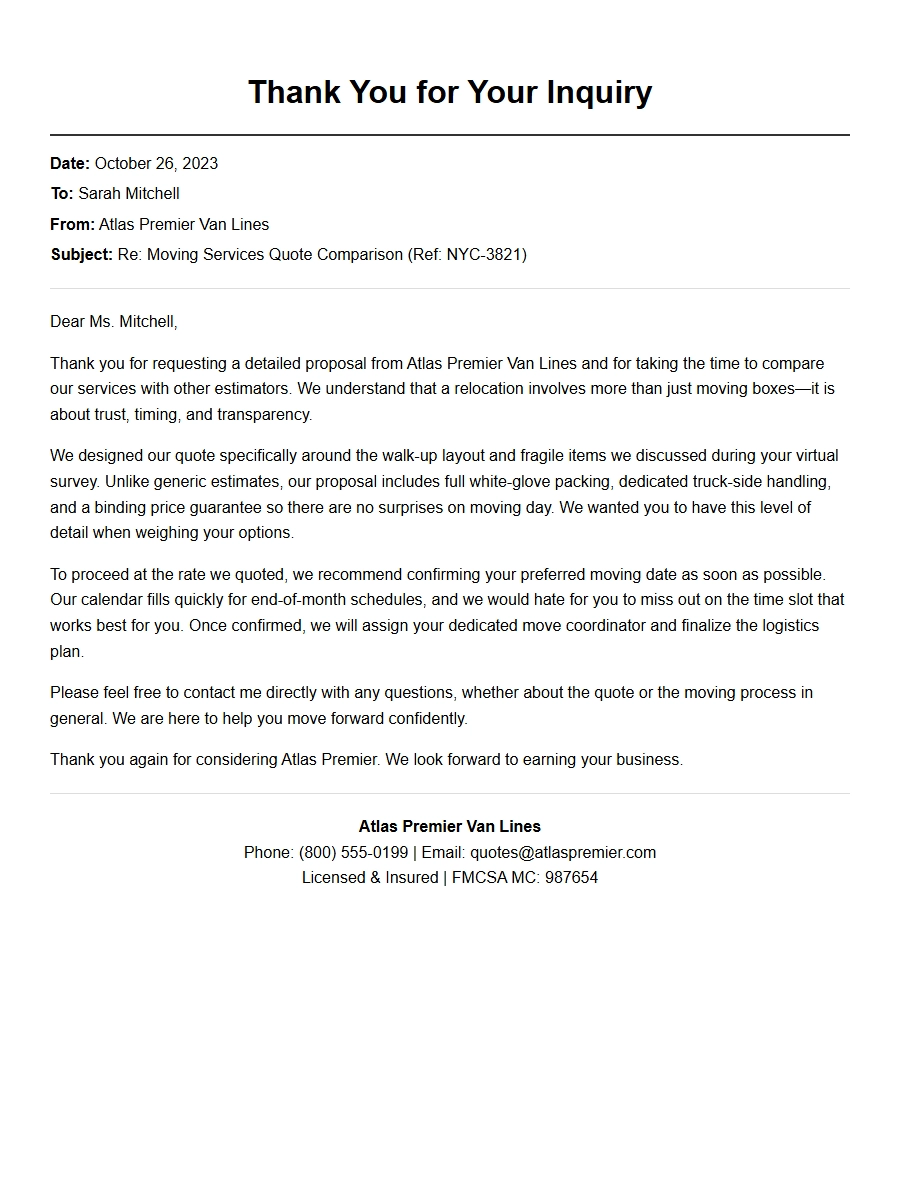
Sample Thank You Note for Moving Company Quote Comparison
You’ve spent hours collecting quotes from moving companies. You compared prices, services, and timelines. Finally you chose one. Now you need to send a polite thank-you to the others—but writing that note feels awkward. You don’t want to sound fake, yet you want to leave a good impression in case you need them later. That’s where a sample thank-you letter for moving company quote comparison can save you. It’s not cheating; it’s working smarter.
Category: Thank-You Letters
Why use a sample letter for moving quote responses?
A good letter template gives you structure and tone, especially when you’re pressed for time. You don’t have to start from scratch. You get the right salutation, a polite opening, and a clear closing. But the best part is that you can customize it to sound like you. Professional correspondence doesn’t mean robotic. A sample helps you hit the balance between gratitude and professionalism without overthinking every sentence.
How to choose the right sample for your situation
Not all moving company quotes are the same. Some movers sent detailed estimates with line items; others gave a flat rate. Your thank-you should reflect that. If a company took extra time to walk through your inventory, mention that detail. Look for a sample that allows a short, polite note—nothing wordy. Many free cover letter examples exist online, but for moving quotes you want something more direct. A business letter format with a simple subject line (if email) or a header works well. Remember the tone: friendly but not overly familiar. You’re thanking them, not asking for a favor.
Adapting the sample without losing your voice
Take the sample and read it aloud. If it sounds like someone else, change it. Swap “We appreciate your detailed proposal” with “Thanks for taking the time to break down the costs.” Keep the core structure—salutation, thanks, specific reason, closing—but use your natural phrases. A common mistake is copying the sample word for word and then forgetting to change the company name. That looks careless. Read the final version once more and make sure it sounds like you wrote it, not a bot.
Tailoring the opening to grab attention
The first sentence matters. Instead of a generic “Thank you for your quote,” try “Your quote for our move from Chicago to Denver stood out because of the clear pricing.” That shows you actually read their proposal. It also sets a personal tone. For printed letters, use proper letterhead design or a clean digital format. For email, keep the subject line specific: “Thank you for your moving quote – [Your Name].” That makes it easy for the recipient to recall the conversation.
Common mistakes to avoid
Using outdated salutations like “To whom it may concern” feels cold. If you have a contact name, use it. If not, “Dear [Company Name] team” works. Another mistake: ignoring the medium. An email thank-you needs a shorter body than a printed letter. Don’t include attachments unless you discussed them. Also, proofread your letter. A typo in a thank-you note can undo the goodwill. Simple proofreading letter habits—reading backward, using spell-check, reading aloud—catch most errors.
And don’t forget the closing. “Sincerely” is safe, but “Best regards” feels warmer. If you are thanking a neighbor for collecting mail while traveling, you can be more casual, but for business quotes, keep it polished. Need inspiration? Look at samples for thanking a neighbor or thanking a vendor for timely delivery—they follow similar etiquette but adjust tone accordingly.
Making the letter work for future reference
A well-written thank-you can keep you on their radar. Months later, if you need storage or another move, that company might remember your courteous note. That’s why it’s worth adding a brief line like “We hope to work with you in the future.” But don’t overpromise. If you already signed with another mover, be honest: “We went with a different company this time, but we appreciated your professionalism.” That’s still a positive impression.
Next time you need to write a professional letter—whether it’s a resignation letter sample, a cover letter, or a thank-you for a moving quote—you’ll feel less anxiety. The samples give you a map. You just bring the voice. The more you practice, the quicker it becomes. Soon you’ll be able to draft a short thank-you in two minutes, and it will sound exactly like you. That’s the goal: professional and personal, all at once.
Extra Samples
Sample Thank You Note for Moving Company Quote Comparison
Thank You for Providing Multiple Moving Quotes
Dear [Moving Company Name],
Thank you for promptly sending over a detailed quote for our upcoming move. We are in the process of comparing several estimates and truly appreciate the clarity and thoroughness of your proposal.
To help us make our final decision, we have summarized the key points we are evaluating across all quotes:
Base price – Your estimate of $2,450 is very competitive.
Included services – Packing and loading are included; however, we noted that furniture disassembly costs extra.
Insurance coverage – The valuation options you offered were clear and well explained.
Schedule flexibility – Your availability on our preferred weekend is a plus.
We will contact you within the next two business days with our decision. Thank you again for your time and transparency.
Sincerely, [Your Name]
Thanks for Helping Us Compare Moving Company Rates
Dear [Comparison Platform Name] Support Team,
Thank you for the easy-to-use quote comparison tool. We were able to quickly receive and compare quotes from five different moving companies for our cross‑state relocation. Your platform saved us hours of individual research.
Here is a quick summary of what we found most useful:
Attribute
Our Take
Price transparency
All quotes clearly showed base rates, fuel surcharges, and optional services.
Company ratings
Helpful to see customer reviews alongside each bid.
Speed of responses
We received three quotes within 24 hours.
We have selected a provider and expect to book later this week. Many thanks for making the comparison process so straightforward.
Best regards, [Your Name]
Gratitude for Itemized Moving Estimate
Hi [Contact Name],
Thank you for the detailed itemized quote for our household move. We are comparing several companies, and your breakdown helped us understand exactly what is included—and what might be extra.
We especially appreciated these items in your estimate:
Travel time – clearly stated as a flat fee of $350.
Packing materials – premium boxes and tape listed separately, which allowed us to decide how much DIY packing we want.
Stair / elevator fee – noted accurately for our third‑floor apartment.
We also liked that you offered an optional full‑value protection plan. This is helping us weigh cost versus coverage across all bids we received.
We will finalize our decision by Friday. Thank you again for your thoroughness and polite follow‑up.
Warmly, [Your Name]
Thank You for the Competitive Moving Quote
Dear [Moving Company Name],
I am writing to sincerely thank you for providing a moving quote for our long‑distance relocation. We have gathered quotes from three different companies, and yours stands out both in price and in the professionalism of your team.
Here is a quick comparison we have made among the quotes we received:
Company
Total Estimate
Included Services
Your Company
$3,200
Packing, loading, transport, 1 day storage
Competitor A
$3,450
Loading & transport only
Competitor B
$2,950
Packing & loading, no storage
Because your quote combines a fair price with included storage for one day (which we need), you are currently at the top of our list. We will confirm within 48 hours.
Thank you again for your time and for the transparent pricing.
Best, [Your Name]
Thanks for the Detailed Moving Service Quote
Hello [Agent Name],
Thank you so much for sending the comprehensive quote for our upcoming move. We are currently comparing three different providers, and your detailed list of services and costs is helping us make an informed choice.
We particularly value the clarity in these areas:
Binding versus non‑binding estimate – you clearly explained that your quote is a binding estimate, which gives us peace of mind.
Additional charges – potential fees for long carries and bulky items were listed upfront.
Timeline – you included a realistic delivery window of 5–7 business days.
We also appreciated the two‑week validity on the quote, as it allows us time to finish comparing without pressure.
Should we decide to proceed, we will reach out to schedule the pre‑move survey. Many thanks for your excellent customer service.
Sincerely, [Your Name]
Thank You for the Moving Quote Comparison from a Broker
Dear [Moving Broker Name],
Thank you for acting as our intermediary and providing us with three different moving company quotes for our interstate relocation. Your comparison saved us the hassle of contacting each mover individually.
Here is a brief overview of the options you presented:
Option 1 – Full‑service mover, quote $4,100, includes packing, loading, and debris removal.
Option 2 – Mid‑range mover, quote $3,600, loading and transport only.
We are leaning toward Option 1 because of the inclusive services, even though it is the priciest. We appreciate the way you explained each company’s insurance coverage and customer feedback.
Please let the company that we will be in touch directly. Thank you again for your efficient service and the clear format of the comparison sheet.
Best regards, [Your Name]
Thanks for the Follow‑Up After Quote Comparison
Hi [Moving Company Name],
Thank you for following up with us after sending your moving quote. We have now completed our comparison among five companies, and your offer remains very strong.
To assist our final decision, we created a simple scoring table that you might find interesting:
Criterion
Your Score
Industry Average
Price
8 / 10
7 / 10
Service Inclusions
9 / 10
7 / 10
Customer Service
10 / 10
8 / 10
Your high marks in service inclusions and customer service are particularly noteworthy. The only area where you were slightly less competitive was price, but the value you offer justifies the cost.
We expect to make a booking by the end of the week. Thanks again for your patience and for the additional information you provided during our phone call yesterday.
Warm regards, [Your Name]
Thank You for Patiently Answering Quote Comparison Questions
Dear [Customer Service Team],
Thank you for taking the time last Tuesday to answer all my questions about your moving quote. I had been comparing offers from several companies, and your representative, [Name], provided clear explanations regarding pricing, insurance, and scheduling.
Specifically, the following points helped me understand the value of your proposal:
Binding estimate guarantee – no surprises on moving day.
Full replacement value protection explained in plain language.
Flexible payment options – split payment before and after delivery.
After comparing all quotes, we have decided to choose your company because of the transparency and the helpfulness of your staff. We will call tomorrow to confirm the booking.
Thank you again for making the decision process smooth. We look forward to working with your team.
Sincerely, [Your Name]
Thank You for the Moving Quote Comparison Spreadsheet
Hello [Company/Agency Name],
Thank you for sending the comparison spreadsheet containing quotes from multiple moving companies. The side‑by‑side format was extremely helpful for our family to evaluate the options.
We found the following columns particularly useful:
Company Rating – allowed us to balance cost with reliability.
Total Estimated Cost – included all surcharges, no hidden fees.
Availability Window – essential for our tight schedule.
Based on your spreadsheet, we have narrowed it down to two movers. We are still deciding between Company X (cheapest) and Company Y (best reviews). We appreciate that you provided both price and non‑price factors in one place.
Once we choose, we will book directly through the link you provided. Many thanks for this time‑saving tool—it made our moving preparations far less stressful.
Best, [Your Name]
Thanks for the Customized Quote Comparison Assistance
Dear [Advisor Name],
Thank you for personally helping us compare moving company quotes for our cross‑country move. Your advice gave us a much clearer picture of what each estimate really covers.
You assisted us in understanding these differences:
Quote Detail
Company A
Company B
Why It Matters
Packing fee
Included
$400 extra
Huge cost variance
Fuel surcharge
15%
10%
Affects total price
Insurance type
Full value
Basic
Risk coverage trade‑offs
We especially valued your explanation of why Company B’s lower base quote might end up costing more once we add packing and better insurance. Thanks to your insight, we feel confident in selecting Company A.
We have already signed the contract. Thank you again for your patient, unbiased guidance—it made all the difference.
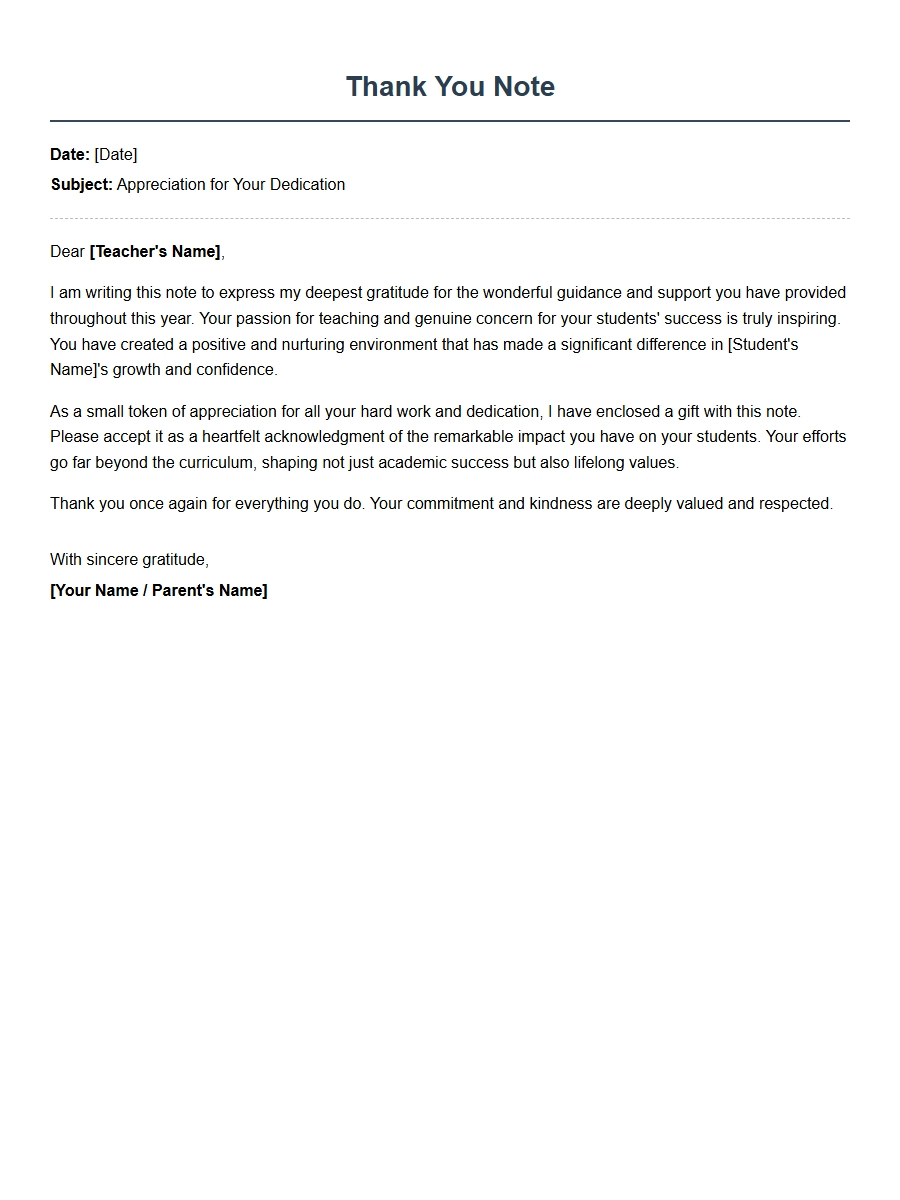 Sample Thank You Note for Teacher Gift
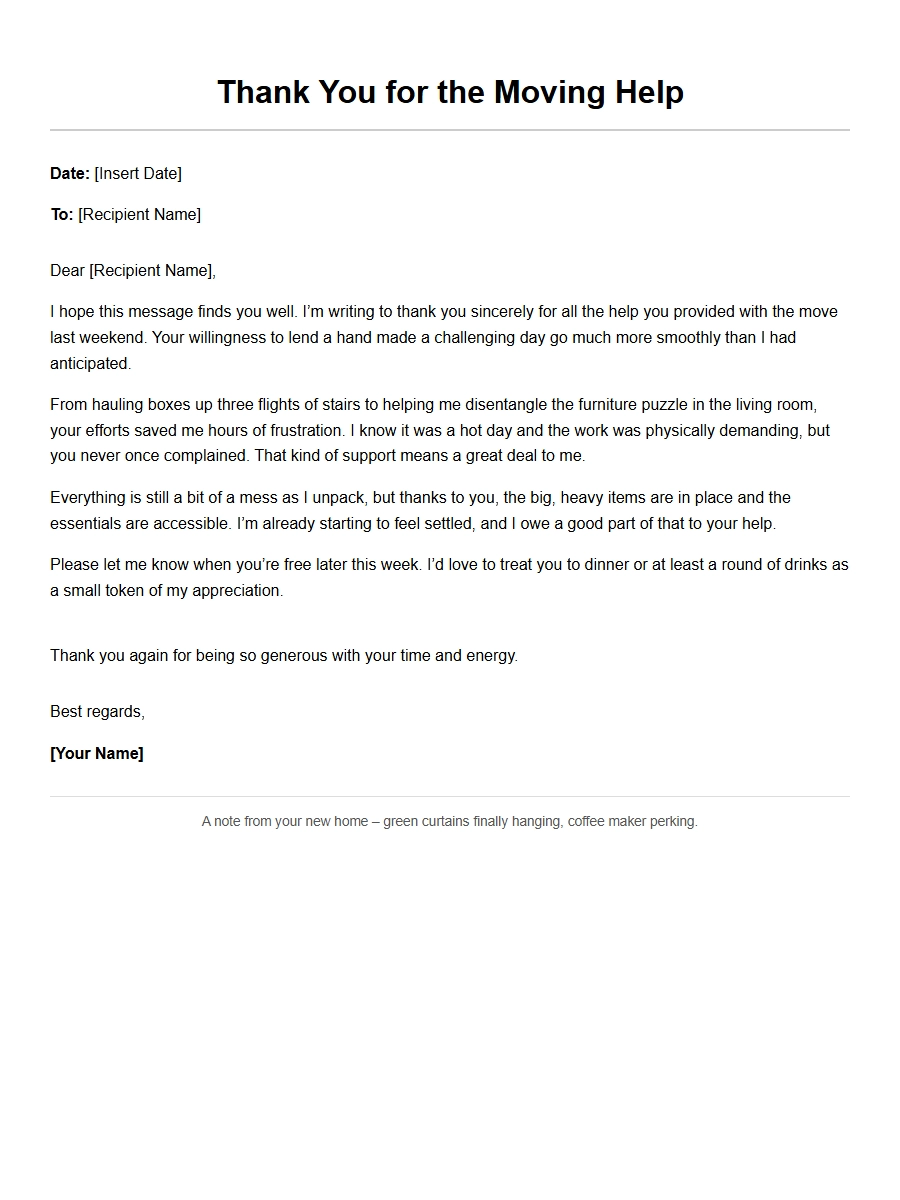 Thank-You Letter for Help with Moving
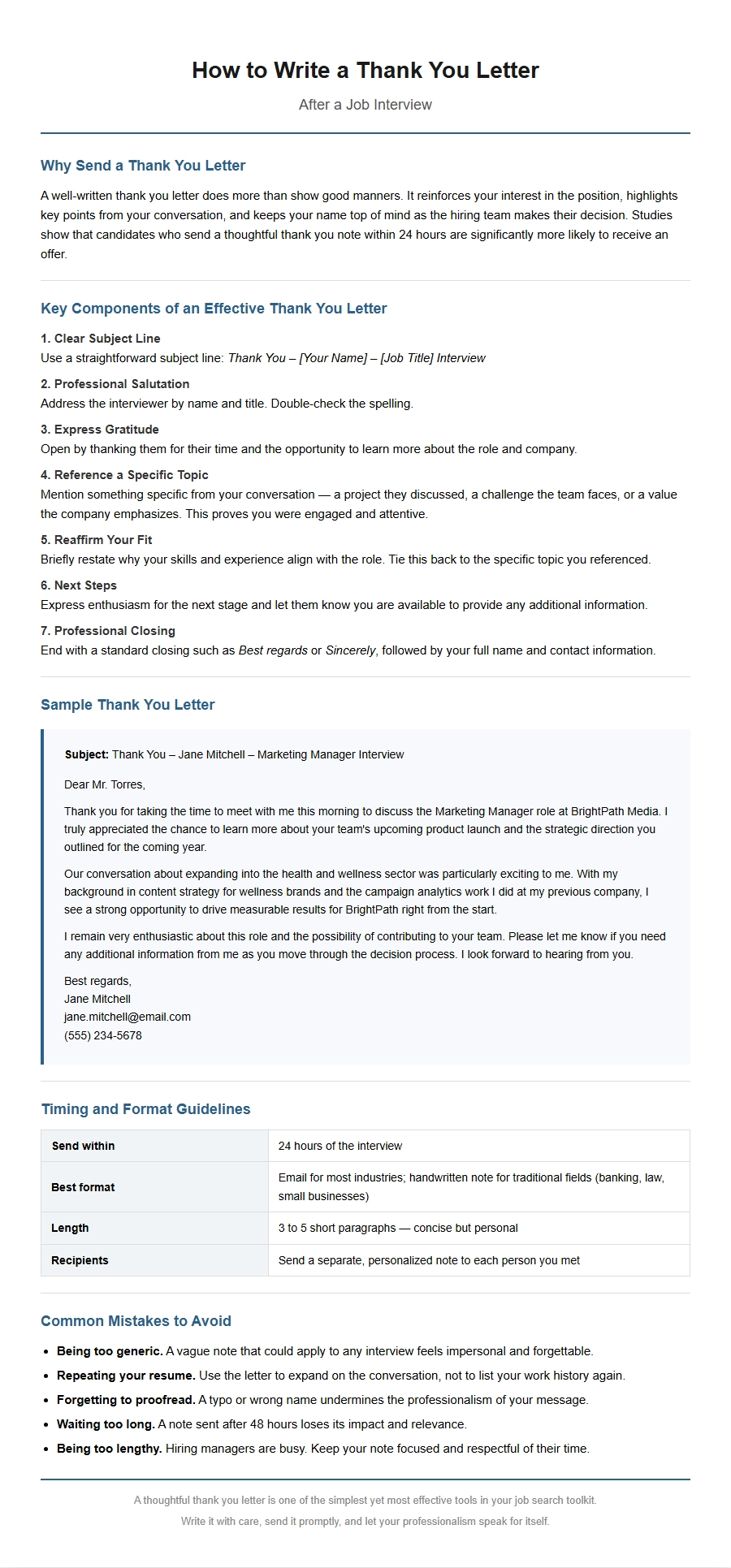 How to Write a Thank You Letter After an Interview
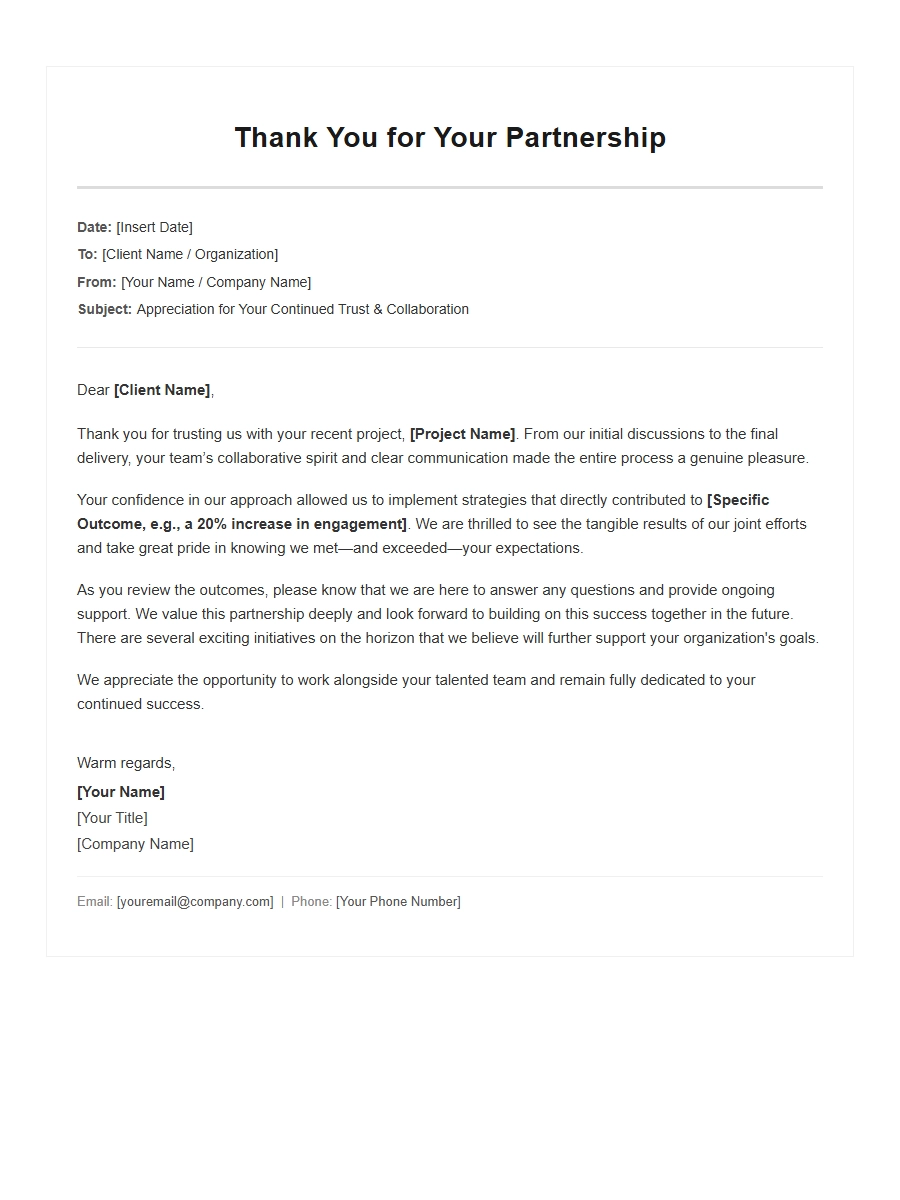 professional thank you email example for client - Thank-You Letters
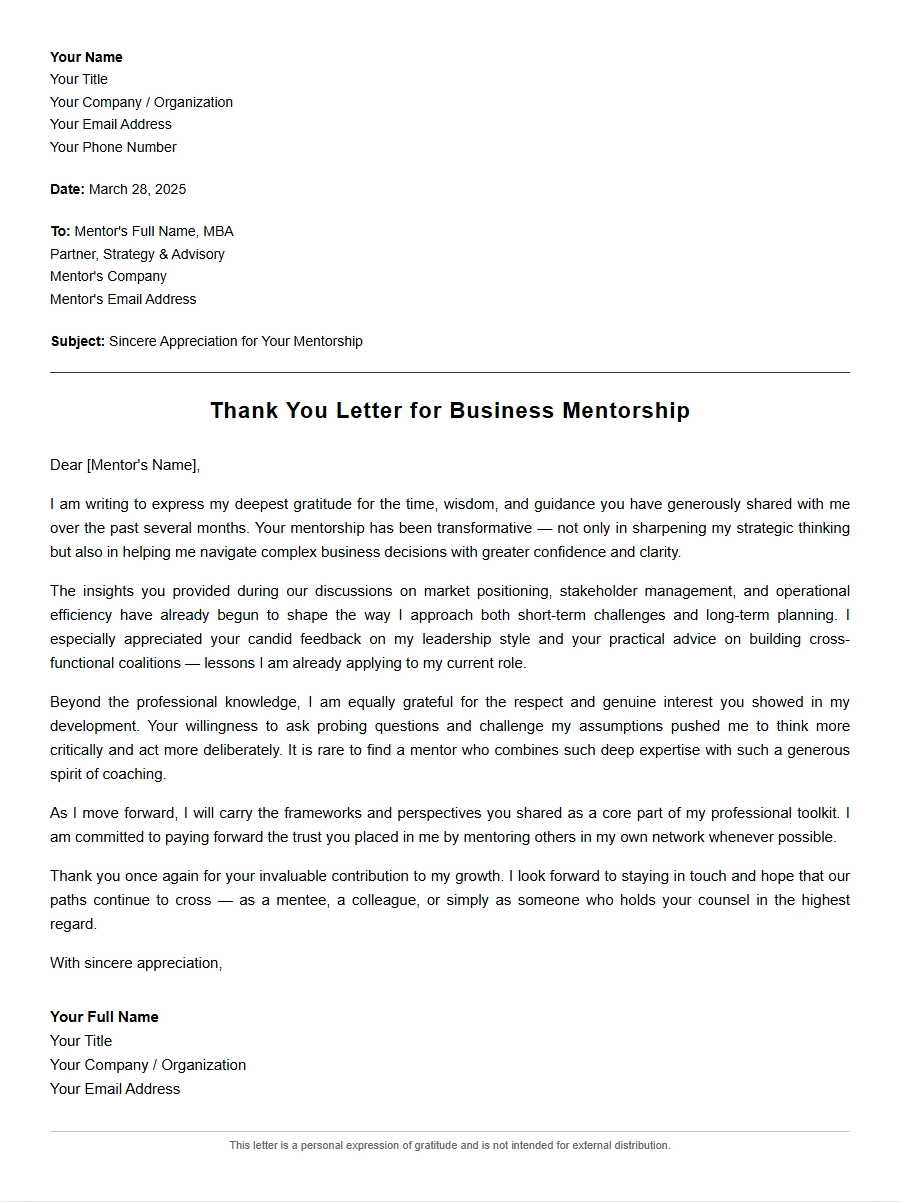 Business Mentor Thank-You Letter Guide
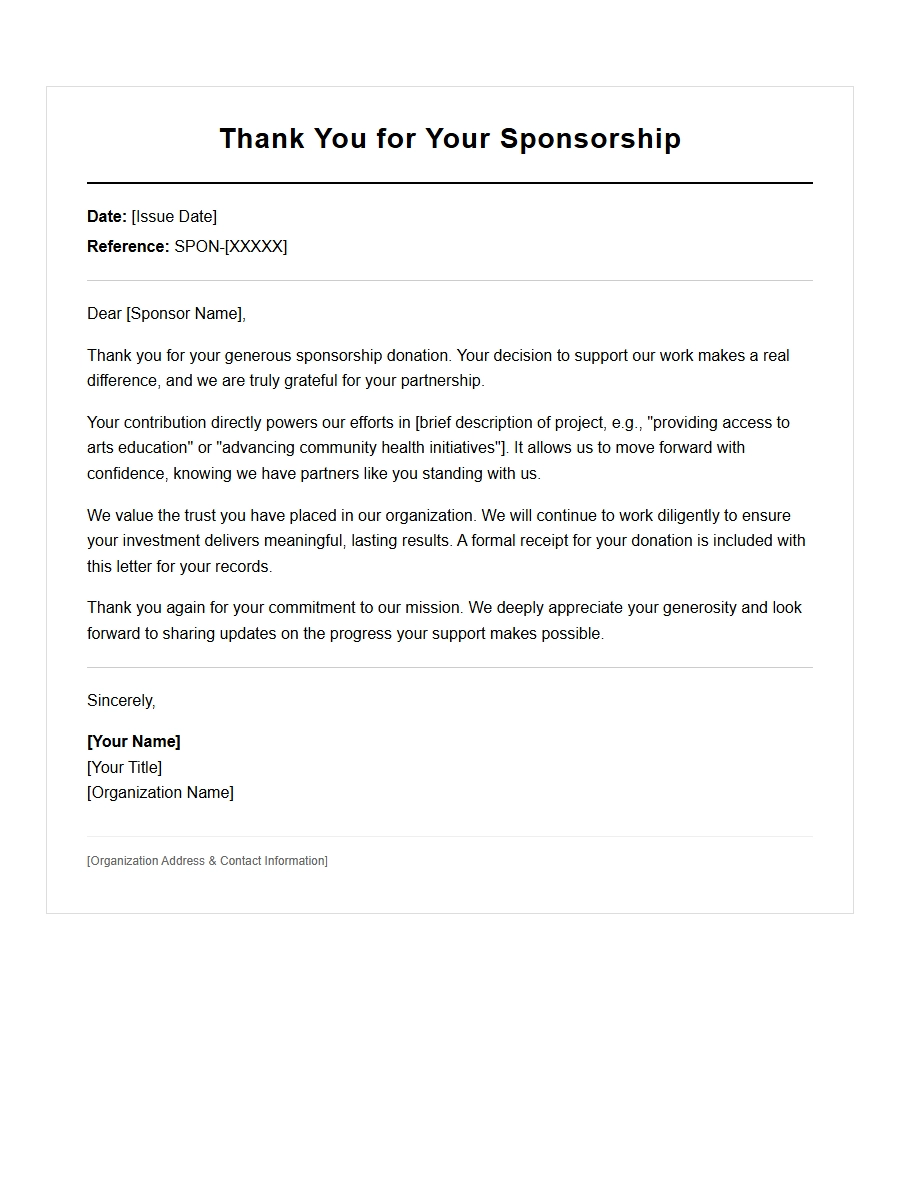 Thank You Letter for Sponsor Donation