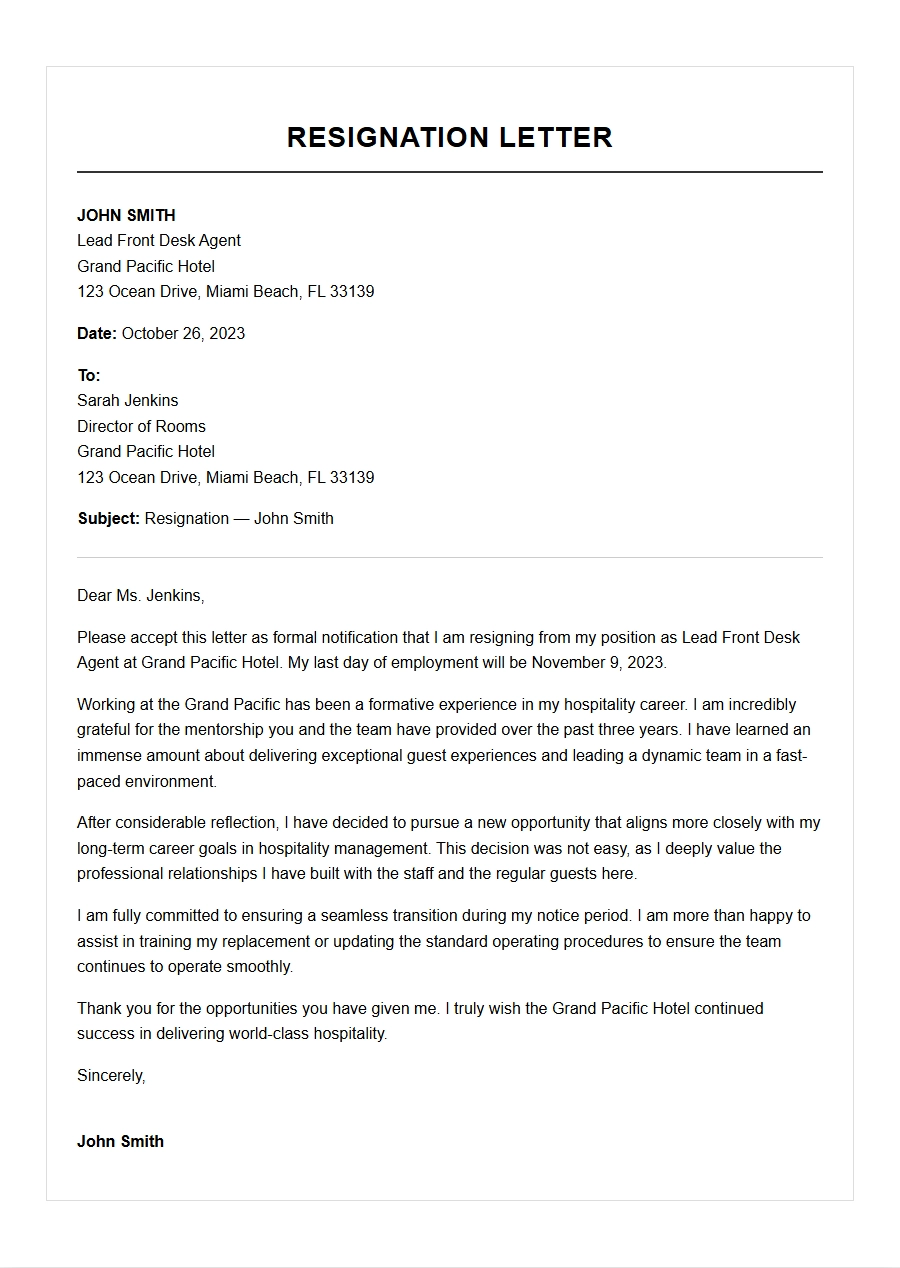
You need to send a resignation letter today but your mind is blank. Maybe you’re leaving a front desk job, a restaurant position, or a housekeeping role. The hospitality industry moves fast, and formal writing isn’t always part of your daily routine. That blank page can feel like a wall. But the right resignation letter sample turns that anxiety into a confident, polished draft in minutes.
Why using a sample isn’t cheating
Good professional correspondence starts with structure. A letter template gives you the bones: the salutation and closing, the standard business letter format, and the right tone in writing. It’s not about copying blindly. It’s about saving time while keeping your personal voice. Think of it as a starter house – you decorate the rooms. Many hospitality staff find that a customizable letter helps them hit the right note between friendly and formal. Ever received a letter that felt too stiff or too casual? A sample helps you avoid that.
Category: Workplace Communication Guides
Choosing the right sample for your situation
Hospitality covers everything from boutique hotels to chain restaurants. Your resignation letter should match your workplace culture. If you work at a casual café, a semi-formal letter works fine. If you’re leaving a luxury hotel, stick with professional correspondence that reflects the brand’s standards. Look for a sample resignation for hospitality industry staff that includes phrases like “thank you for the opportunity” and “my last day will be.” That shows you understand letter writing etiquette. Avoid samples that are too generic – they won’t sound like you.
For example, a sample might say: “Please accept this letter as formal notice of my resignation.” Good. But you could adapt it to: “Please accept this letter as my notice. I’ve truly enjoyed my time as a server at [Restaurant Name].” That little personal touch makes a difference. And if you’re sending it by email, remember digital letter format – no need for a letterhead design, but include a clear subject line like “Resignation – [Your Name].”
How to adapt a sample without losing your voice
Start by replacing the placeholder details – your name, position, last day. Then read through the body. Does it sound like you? If the sample says “I have decided to pursue new opportunities,” but you’re leaving for health reasons, change it. Use a resignation letter due to health reasons instead. Or if you’re going to a competitor for better pay, there are samples for that too. The key is to keep the structure but swap the wording to something honest and natural.
One common mistake: forgetting the opening paragraph. Grab attention by stating your purpose clearly in the first line. “I’m writing to resign from my role as bartender, effective [date].” That’s direct and respectful. Then explain briefly, but don’t over-explain. You don’t need a whole story. A short reason – “I’ve accepted a position that offers better compensation” – is enough.
Mistakes to avoid when writing your resignation letter
First, using outdated salutations. “To Whom It May Concern” is cold and impersonal. Use your manager’s name if possible. Second, ignoring formatting. In hospitality, many managers read emails on their phones. Keep paragraphs short. Use line breaks. Third, skipping proofreading. A typo in your letter of resignation can look careless. Read it out loud or ask a friend. Fourth, forgetting to mention your transition plan. Even a simple line like “I’m happy to train my replacement during my notice period” shows you’re professional.
Think about what you’ll miss. A sentence like “I’ve appreciated the support from my team and the regular guests” adds warmth without being too emotional. Keep the tone in writing consistent – if you start formal, stay formal. If you start conversational, don’t suddenly switch to stiff language. A sample resignation for hospitality industry staff often strikes this balance well. Use it as a guide, not a script.
And remember: you don’t have to include everything. Some people add a line about a letter of recommendation for the future. That’s fine, but only if you feel comfortable. You can always ask for one separately.
Finally, end with a forward-looking thought. Something like “I wish the hotel continued success” or “I hope our paths cross again.” That leaves the door open – especially important in hospitality, where connections matter. The best letters feel both professional and personal. With a good sample and a little practice, writing one becomes faster each time.
Please accept this letter as formal resignation from my position as Front Desk Clerk at Grand Horizon Hotel. My last day will be October 24, 2023, providing two weeks’ notice as outlined in my employment contract.
Working here has been a rewarding experience. I have grown in guest service skills and learned to handle busy check‑in and check‑out periods with efficiency. I especially appreciate the training on the PMS system and the supportive team environment.
To ensure a smooth handover, I have prepared the following transition notes:
Updated reservation logs for pending group bookings (attached).
Completed incident reports for last week’s maintenance issues.
Key cards and uniform will be returned on my final day.
I am happy to assist with training my replacement during the next two weeks. Thank you for the opportunity to be part of this team. I wish Grand Horizon continued success.
Sincerely, Anna Reyes
Server Ending Employment
Date: November 5, 2023
To: Manager, Bella Italia Restaurant
From: Marco DeLuca, Server
I am writing to resign from my role as Server at Bella Italia, effective November 19, 2023. This decision was difficult, but I have accepted a full‑time position in event catering that aligns with my long‑term career goals.
I am grateful for the mentorship and the skills I gained here, especially in managing high‑volume weekend dinner services and upselling specialty dishes. The relationships with regular guests have been a highlight of my time at Bella Italia.
My final week schedule is as follows:
Day
Shift
Notes
Nov 13
4pm – close
Last training shift for new hire
Nov 14
off
Nov 15
4pm – close
Final side work duties
I will leave my apron, order pad, and server kit in the break room locker. Thank you for the wonderful experience. I hope to stay in touch professionally.
Best regards, Marco DeLuca
Housekeeper Resignation
Date: December 1, 2023
To: Housekeeping Manager, Seaside Inn
From: Elena Torres, Room Attendant
Please accept this letter as my resignation from the position of Room Attendant at Seaside Inn. My final day of work will be December 15, 2023.
Over the past two years, I have valued the teamwork and the clean, safe environment we create for guests. I have learned efficient cleaning techniques and how to communicate with maintenance regarding repairs. However, personal family commitments require me to relocate to another state.
I have attached a list of tasks that need attention before my departure:
Deep clean of Room 204 (stain on carpet reported).
Re‑stock of linen cart on floor 3.
Return of master key and housekeeping phone.
I am willing to work extra shifts if needed during the transition. Thank you for the training and camaraderie. I will miss the team.
Yours sincerely, Elena Torres
Chef De Partie Resignation
Date: January 8, 2024
To: Executive Chef, The Gilded Fork Bistro
From: Liam O’Brien, Chef De Partie
I am writing to formally resign from my position as Chef De Partie. My last day will be January 22, 2024, as per the two‑week notice required.
This decision comes after careful thought. I have accepted an opportunity to become a sous chef at a resort in the mountains—a role that will challenge my leadership skills. I am grateful for the refined technical abilities I gained here, particularly in sauce work and plating.
To ensure continuity, I have documented my station’s mise en place and recipes:
Sauces: All demi‑glace and reductions are prepped through Friday.
Proteins: Portioned and labeled for the weekend.
Inventory: Low‑stock items noted on the clipboard.
I will store my knives and chef coat in my locker for pickup on the final day. Thank you for the mentorship and the disciplined kitchen environment—I will carry those lessons forward.
Respectfully, Liam O’Brien
Barista Leaving Coffee Shop
Date: February 14, 2024
To: Owner, Brew & Bean Café
From: Sophie Chen, Barista
Please accept this letter as my resignation from the Barista position at Brew & Bean Café. My last shift will be February 28, 2024.
I have loved my time here—especially mastering latte art and building a loyal customer base. Managing the morning rush and keeping the espresso machine calibrated taught me discipline and speed. However, I have decided to return to college full‑time for a hospitality management degree.
I want to make the transition smooth. Here are my handover notes:
Item
Status
Weekly order form
Completed for next week
Syrup inventory
Need 2 bottles of vanilla
Training checklist for new hire
Left in office
I will return my apron and name tag on the final day. Thank you for the flexibility and the wonderful coffee community. I hope to visit as a customer often.
Warmly, Sophie Chen
Activities Coordinator Resignation
Date: March 3, 2024
To: Resort Manager, Coral Bay Resort
From: Jake Patel, Activities Coordinator
I am resigning from my role as Activities Coordinator at Coral Bay Resort, effective March 17, 2024. I have accepted a position with a cruise line that offers international travel.
Planning daily excursions, managing guest sign‑ups, and leading snorkeling tours have been immensely fulfilling. I appreciate the trust you placed in me to handle large group bookings and safety briefings. The resort’s commitment to guest satisfaction has shaped my professional approach.
To prepare for the transition, I have summarized current bookings:
March 8: Sunset catamaran (16 guests, deposit paid)
March 10: Beach volleyball tournament (equipment ready)
March 15: Rainforest hike (guide confirmed)
I will pass all schedules and supplier contacts to my replacement. I am available to answer questions after my departure. Thank you for the incredible experiences at Coral Bay.
Sincerely, Jake Patel
Concierge Departure Notice
Date: April 1, 2024
To: Front Office Manager, The Sterling Hotel
From: Gabriela Santos, Concierge
Please accept this letter as my resignation from the Concierge position. My last day will be April 15, 2024. I am moving to a larger property where I can further develop my career in guest relations.
During my three years here, I built strong relationships with local vendors and often received guest commendations for restaurant and tour recommendations. I take pride in solving complex requests, from lost luggage to last‑minute theatre tickets.
Below is a list of key contacts I have compiled for the incoming concierge:
Service
Contact
Notes
Private car service
Mike’s Limo: 555‑0100
24hr, credit account set
Florist
Rose Petal: 555‑0101
Ask for Maria
Golf tee times
Greenview Club: 555‑0102
10% discount for guests
I will leave my resource folder, city maps, and iPad with reservation software in the concierge desk. Thank you for the professional growth opportunities.
Best regards, Gabriela Santos
Banquet Server Moving On
Date: May 10, 2024
To: Banquet Manager, Regency Convention Center
From: Derek Kim, Banquet Server
I am writing to resign from my position as Banquet Server. My final day will be May 24, 2024. I have decided to pursue a career in event planning, a path sparked by the large events I’ve helped execute here.
Setting up ballrooms, serving plated dinners, and managing bar stations for 300+ guests taught me teamwork under pressure. I am especially thankful for the training on tray service and wine presentation.
For the upcoming events I was scheduled for, I have prepared a quick summary:
May 15: Corporate gala (300 guests) – menu cards printed, table layout approved.
May 18: Wedding reception (150 guests) – final headcount due May 16.
May 20: Board dinner (20 guests) – special dietary needs flagged.
I will return my uniform, serving trays, and name tag on the last shift. Thank you for the camaraderie and for giving me the chance to grow. I hope to collaborate as an event planner in the future.
Sincerely, Derek Kim
Maintenance Technician Resignation
Date: June 17, 2024
To: Facilities Director, Pine Valley Lodge
From: Carlos Mendez, Maintenance Technician
Please accept this letter as my resignation from the Maintenance Technician position. My last day will be July 1, 2024.
After five years maintaining this lodge, I have decided to start my own handyman business. I appreciate the experience I gained repairing HVAC systems, plumbing issues, and guest room fixtures. The hands‑on problem solving prepared me well for self‑employment.
To ensure the property stays in good shape, I have noted pending work orders:
Work Order #
Issue
Priority
WO‑401
Pool pump motor noise
Medium
WO‑402
Room 112 toilet flush
High
WO‑403
Lobby A/C filter change
Low
I will return all tools, keys, and the service cart on my final day. I am happy to walk the new hire through the main systems. Thank you for the steady employment and the trust you placed in me.
Yours truly, Carlos Mendez
Cruise Ship Steward Notice
Date: July 22, 2024
To: Chief Housekeeper, MS Ocean Dream
From: Nina Fischer, Cabin Steward
I am writing to resign from my role as Cabin Steward on MS Ocean Dream. My last contract day will be August 5, 2024, upon completion of the current voyage.
Serving guests across 80 staterooms challenged my efficiency and attention to detail. I am proud of the high cleanliness scores we achieved during inspections. However, I have accepted a position ashore to be closer to family.
Before signing off, I will complete the following:
Final deep‑clean schedule for decks 5 and 6.
Return uniform, laundry bag, and master key to the office.
Submit my personal log and any guest commendation letters.
I have trained my assigned floater on standard procedures and emergency protocols. Thank you for the opportunity to sail with such a professional crew. I will always treasure the sunsets at sea.
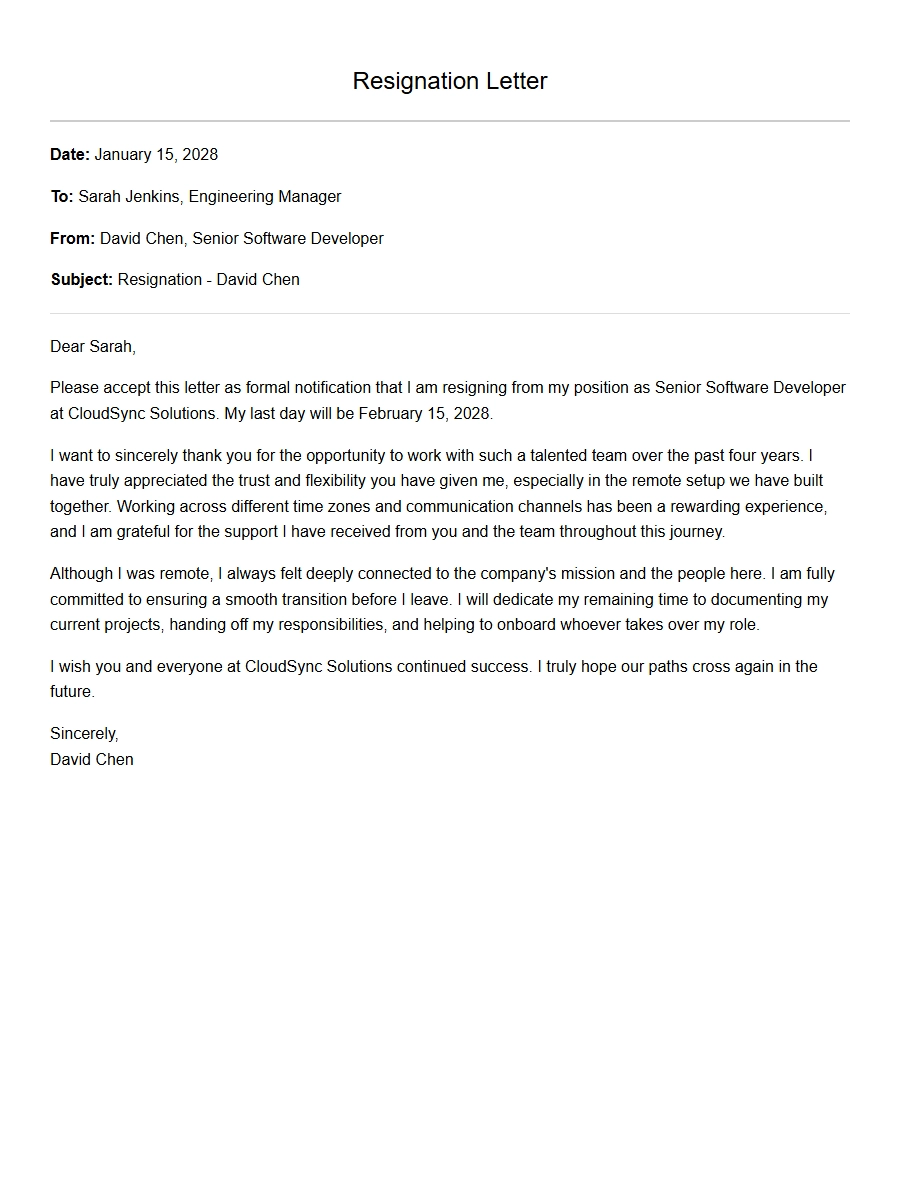 Polite Resignation Email for Remote Employees
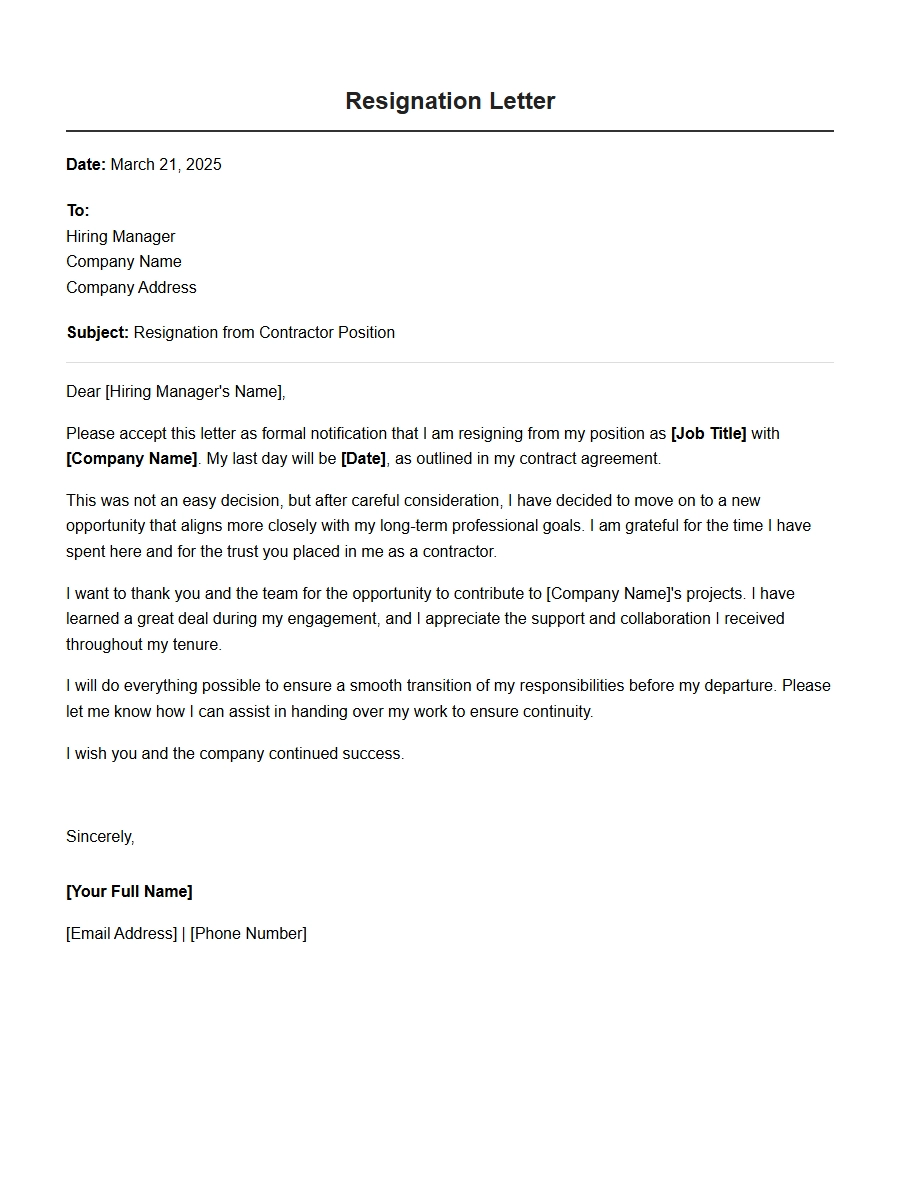 Short Resignation Letter for Contractor Position
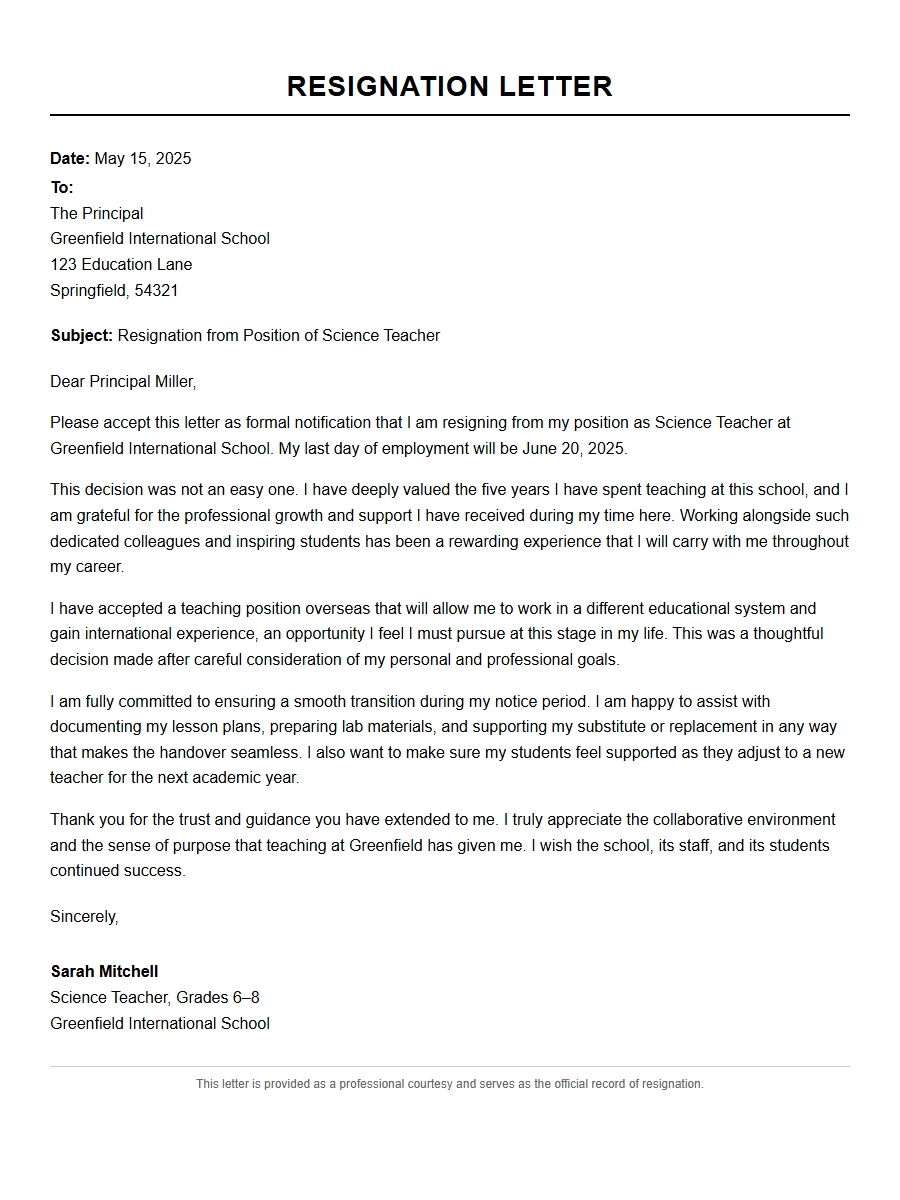 Teacher Resignation Letter Example
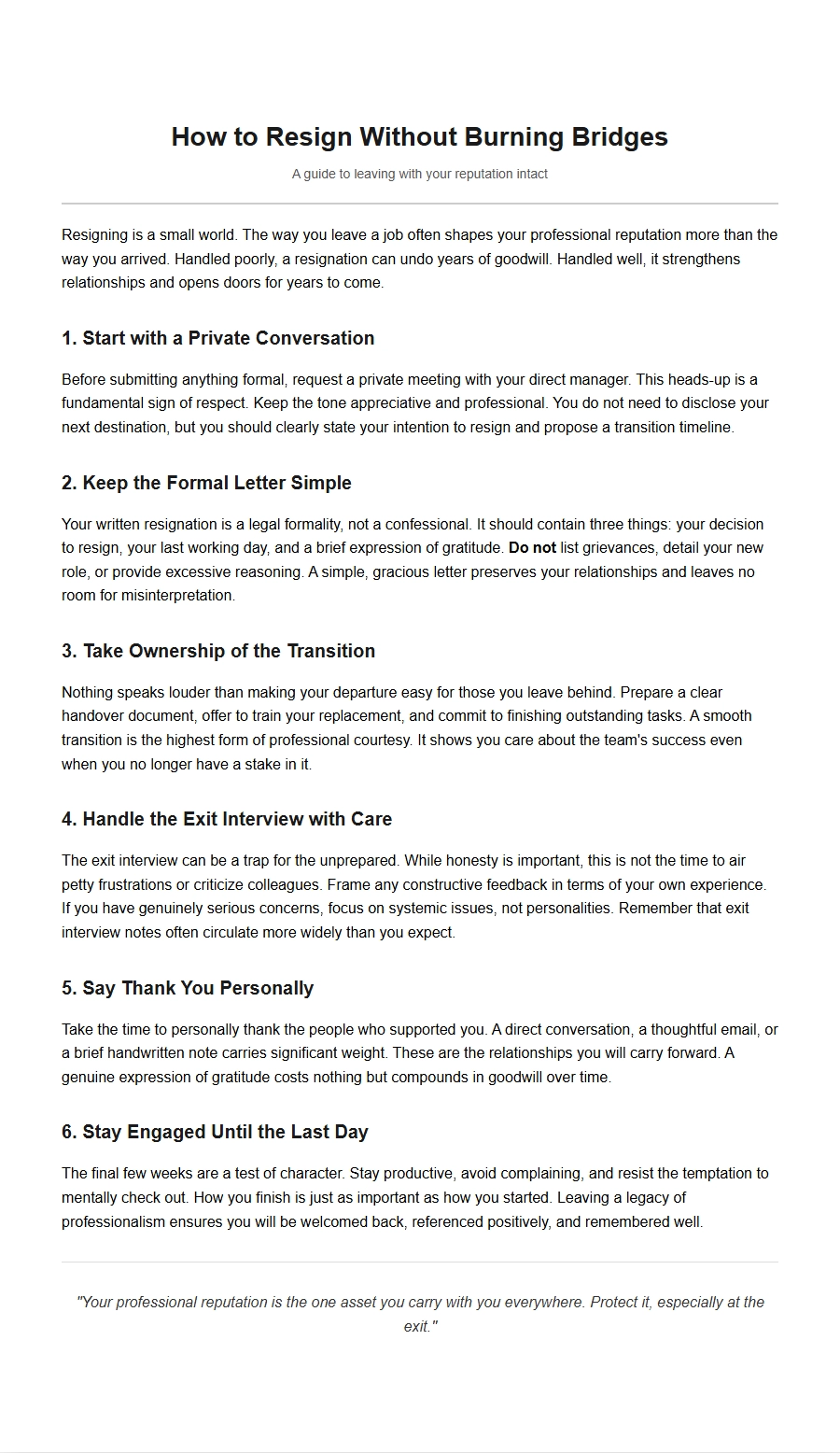 How to Resign Without Burning Bridges
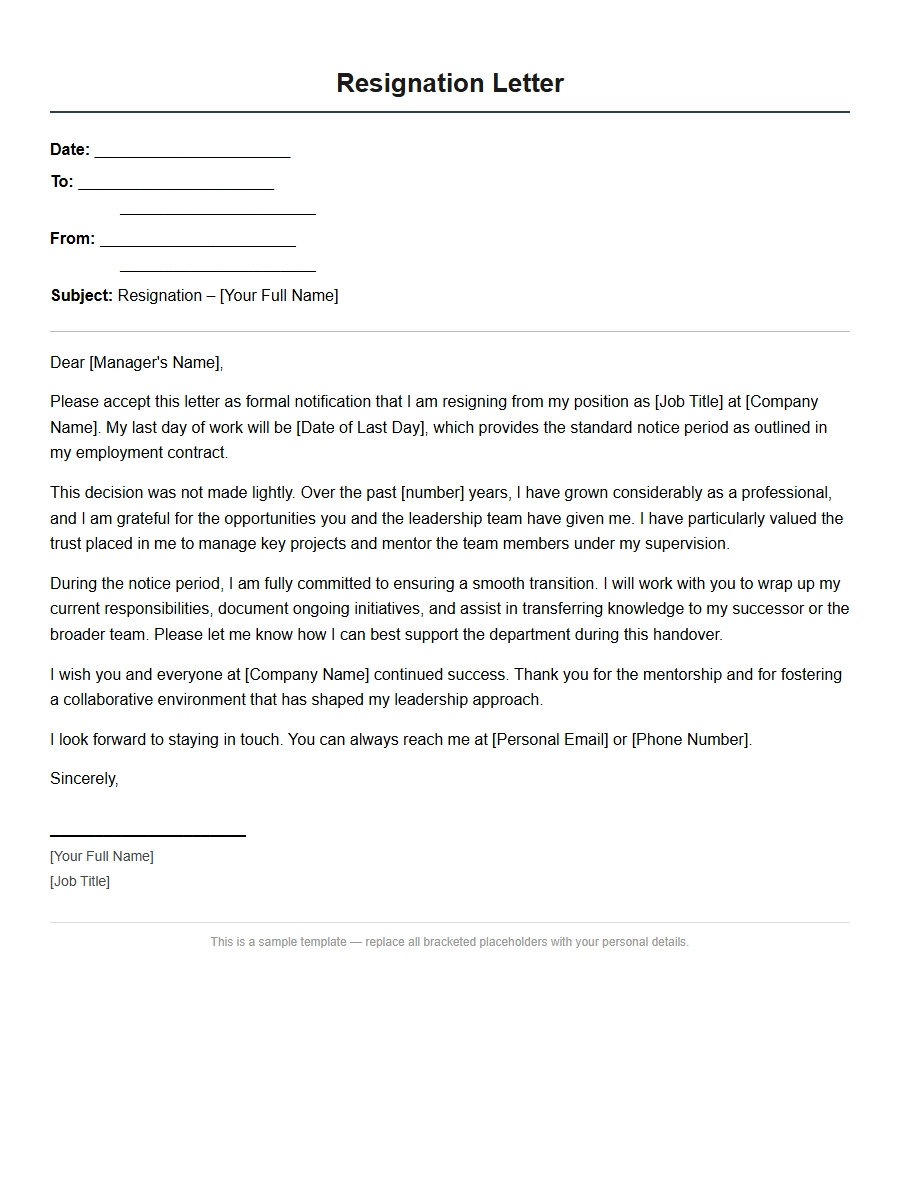 Formal Resignation Letter Sample for Manager
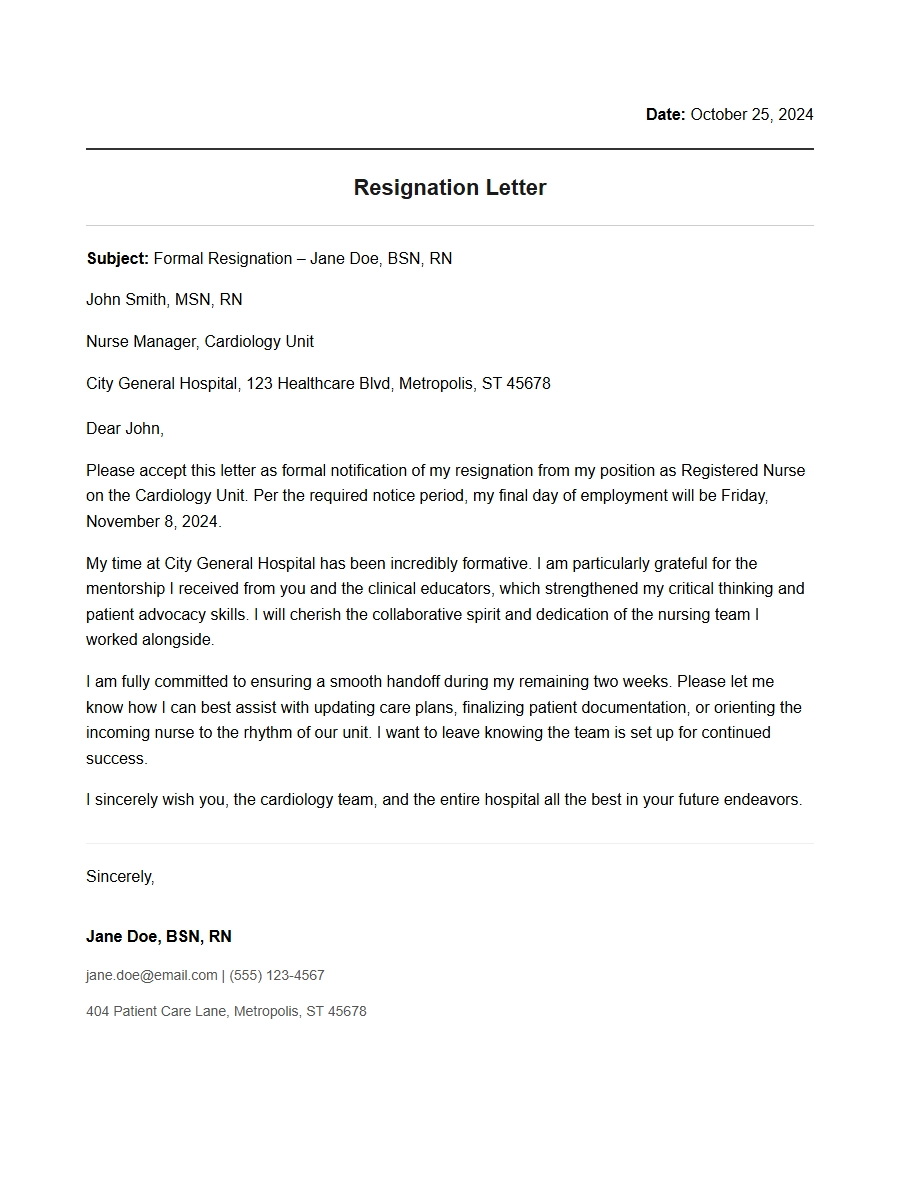 Nurse Resignation Letter with 2 Weeks Notice