You need to hand in a formal resignation letter to your manager today, but every blank page feels like a trap. Maybe you’re leaving on good terms and want to say the right thing without sounding cold — or perhaps you’re rushing to meet a notice period deadline. Either way, a solid sample can save you from staring at the cursor for another hour.
Using a letter template isn’t cheating. It’s a smart shortcut that gives you structure, a professional tone, and the key phrases you’ll need. Think of it as a starter house — you paint the walls and add your own furniture later. The best samples leave room for personalization, so your letter still sounds like you.
Category: Resignation Letters
What makes a good formal resignation letter sample for a manager?
First, the sample should match your situation. A formal resignation letter for a manager in a corporate office will look different than one for a startup founder. Look for samples that include proper business letter format — that means a clear salutation and closing, a subject line if you’re sending it as an email, and a logical letter structure. Also check the tone in writing: is it warm but professional? Too stiff can feel insincere; too casual might come across as unprofessional.
If you’re switching industries — say from a legal counsel role to a tech company — the best sample will feel neutral enough to adapt. For instance, our resignation letter for legal counsel position keeps a formal but respectful tone that works in many fields.
How to adapt a sample without losing your voice
Start by reading through the sample once. Underline the parts that match your own reasons for leaving — maybe a new opportunity, relocation, or personal growth. Then rewrite those sentences in your own words. If the sample says “I have accepted a position at another company,” you could change it to “I’ve decided to take on a new role that better aligns with my long-term goals.” The key is to keep the professional correspondence structure while injecting your natural speech.
One mistake people make: copying an old-fashioned salutation like “To Whom It May Concern.” Unless you’ve never spoken to your manager, use their name. A simple “Dear [Manager’s Name]” is enough. And don’t forget the closing — “Sincerely” still works, but “Best regards” feels a bit warmer without crossing a line.
Customization tips for the opening paragraph
The first paragraph needs to state your intent clearly: you are resigning, and here is your last working day. That’s the part readers scan first. Don’t bury it in fluff. A good sample will put that upfront)Skip right to it: “Please accept this letter as formal notification that I am resigning from my position as [Job Title], effective [Date].” Then add a sentence of gratitude to soften it. For example, “Thank you for the opportunities to grow within the team over the past two years.”
If you’re leaving on short notice — maybe due to an unexpected move — you can still use a sample, but you’ll need to adjust the timing section. Check out our sample resignation letter for immediate leave for the right wording.
Common pitfalls to avoid
Many people ignore the digital letter format. If you’re emailing your resignation, don’t paste a PDF attachment without a subject line that says “Resignation – [Your Name].” Also avoid adding negative comments about your manager or coworkers. The letter is not a complaint form. Keep it short — most managers appreciate one page or less.
Another oversight: forgetting proofreading letter. Spelling errors or wrong dates can ruin the professionalism. Read your final version out loud, or ask a friend to scan it. Even a customizable letter needs a final polish.
Your resignation letter isn’t just about leaving — it’s a chance to offer a smooth handover. Add a sentence like “I’m happy to assist with the transition during my final weeks.” This shows good letter writing etiquette. If you’re an intern, you might keep it even simpler. The graceful exit resignation letter for internship is a good reference.
And don’t worry about writing a letter of recommendation inside your resignation — that’s separate. Your resignation letter is about closing the chapter professionally, not asking for favors. Focus on the present.
Use the sample as a springboard, not a crutch
The best resignation letters feel both professional and personal. A sample gives you the bones; you provide the heart. With a little practice, you’ll write faster next time, and it won’t feel draining. Start with your draft, tweak the wording until it sounds like you, then send it with confidence. Your manager will remember how you left — make it a good one.
Helpful Examples
Formal Resignation Letter Sample for Manager
Standard Two-Week Notice
Date: January 15, 2025
To: Human Resources Manager ABC Corporation 123 Business Ave, City, State 12345
Subject: Formal Resignation – Manager Position
Dear [HR Manager's Name],
Please accept this letter as formal notification that I am resigning from my position as [Department] Manager at ABC Corporation, effective two weeks from today, January 29, 2025.
I have sincerely appreciated the opportunities for professional growth and the support I received during my tenure. The decision to leave was difficult, but I believe it is the right step for my career progression.
To ensure a smooth transition, I have outlined my key responsibilities and ongoing projects below:
Project / Responsibility
Current Status
Handover Plan
Team Performance Reviews
Q1 reviews completed
Provide summary to direct supervisor
Budget Planning 2025
Draft ready for review
Finalize by Jan 25 with finance team
Client Account Management
Active accounts maintained
Schedule transition meetings with assigned reps
I am committed to assisting with the handover and will be available for any questions during my final two weeks. Thank you for the opportunity to lead the team. I wish the company continued success.
Sincerely, [Your Name] [Phone Number]
Short Notice – Personal Emergency
Date: March 3, 2025
To: Regional Director GlobalTech Inc. 456 Innovation Drive, Metropolis, NY 10001
Subject: Urgent Resignation – Manager Position
Dear [Director's Name],
It is with deep regret that I submit my resignation as IT Manager, effective March 10, 2025 — seven days from today. Due to an unforeseen family medical emergency, I must relocate immediately to another state.
I understand this short notice is less than ideal, and I apologize for any disruption it may cause. I have prepared a detailed transition document and briefed my senior team members to ensure continuity. Below is a quick reference of critical items:
Open tickets: 12 priority issues — instructions for escalation shared with team lead.
Vendor contracts: Three renewals due in April — all files in shared drive under “Contracts 2025”.
Weekly status report: Template and last three reports saved in the reporting folder.
I am willing to take calls or emails for up to two weeks after my departure to assist with the transition. I have valued my time at GlobalTech and hope to leave on good terms. Thank you for understanding.
Respectfully, [Your Name] [Email]
Retirement Announcement
Date: April 10, 2025
To: Board of Directors Sunrise Manufacturing Ltd. 789 Industrial Park, Rivertown, OH 44100
Subject: Resignation due to Retirement – Operations Manager
Dear Board Members,
After 28 rewarding years with Sunrise Manufacturing, I am writing to formally announce my retirement from the position of Operations Manager, effective July 1, 2025. This decision has been carefully considered with my family and aligns with my long-term personal goals.
I am grateful for the trust placed in me to manage plant operations and lead a dedicated workforce. To ensure a seamless transition, I have prepared a six-week handover plan:
Phase
Duration
Focus Area
Phase 1
May 15 – May 31
Knowledge transfer to incoming manager – daily routines, safety protocols
Phase 2
June 1 – June 14
Shadowing on key supplier negotiations and inventory management
Phase 3
June 15 – June 30
Final review of Q3 budget, team introductions, and farewell
I am open to a part-time consulting arrangement for the remainder of the year if needed. Thank you for the incredible journey. I look forward to seeing Sunrise continue thriving.
Warmly, [Your Name] [Employee ID: EMP-1029]
Moving to a Competitor
Date: May 20, 2025
To: VP of Sales Premier Solutions Co. 321 Commerce Blvd, Laketown, FL 32000
Subject: Resignation – Regional Sales Manager
Dear [VP Name],
Please accept this letter as formal notice of my resignation from the Regional Sales Manager role, effective June 3, 2025. I have accepted a position with a company in a complementary industry, which I believe will challenge my skills in new ways.
I respect my obligations under the non‑compete agreement and will not disclose any confidential information. I am fully committed to a professional transition. Below are the accounts I currently manage and the recommended reassignments:
Account Name
Annual Revenue
Suggested Successor
Acme Corp
$1.2M
Jane Doe (Sr. Account Exec)
Beta Industries
$850K
John Smith (Team Lead)
Gamma Partners
$500K
To be assigned by manager
I will prepare a full account status report and conduct handover meetings next week. Thank you for the mentorship and the opportunities to exceed targets. I wish Premier Solutions continued success.
Best regards, [Your Name] [Phone]
Health Reasons – Reduced Hours
Date: June 1, 2025
To: Head of Human Resources Wellness Healthcare Group 555 Medical Drive, Healthtown, TX 75000
Subject: Resignation from Manager Position
Dear [HR Head's Name],
I am writing to formally resign from my position as Clinical Services Manager, effective June 15, 2025. My physician has strongly advised that I reduce my workload to manage a chronic health condition, and I have decided to prioritize my recovery.
I have cherished working with such a compassionate team and am grateful for the flexibility previously offered. To minimize disruption, I have prepared a task list for my replacement:
Staff scheduling: Template and rotation rules are documented in the HR shared folder.
Compliance audits: Quarterly audit checklist and pending items for June are saved as “Q2 Audit Progress”.
Patient feedback reports: Monthly summaries for the last six months are filed in the reporting portal.
I am happy to provide phone support during the first week after my departure. Thank you for the understanding and support throughout my tenure. I hope to be able to return to the workforce in the future.
Sincerely, [Your Name] [Employee ID]
Personal Reasons – Relocation
Date: July 8, 2025
To: General Manager Northern Lights Retail Inc. 777 Winter Street, Coldtown, MN 56000
Subject: Resignation due to Relocation – Store Manager
Dear [GM's Name],
Please accept this letter as my formal resignation from the position of Store Manager, effective August 5, 2025. My spouse has accepted a job transfer to a different state, and we will be relocating at the end of July.
I have enjoyed leading the team at Northern Lights and am proud of the sales growth we achieved. I want to ensure a smooth handover of my duties. Key areas to address include:
Area
Current Status
Action Required
Inventory count
Monthly count scheduled for July 20
Complete with assistant manager
Staff training plan
Three new hires in progress
Pass training binder to shift leads
Vendor relationships
Weekly check‑ins with top 5 vendors
Introduce assistant manager as contact
I will work diligently through my final weeks to leave everything in order. Thank you for the leadership opportunities. I will always appreciate the experience gained here.
With gratitude, [Your Name] [Phone]
Better Opportunity – Career Growth
Date: August 12, 2025
To: Senior Director of Engineering InnoTech Corp. 888 Silicon Valley, Tech City, CA 94000
Subject: Resignation – Engineering Manager
Dear [Director's Name],
I am writing to formally resign from my position as Engineering Manager at InnoTech, effective August 26, 2025. I have received an offer to join a startup in a CTO role, which aligns closely with my long‑term professional goals.
I am grateful for the mentorship and the chance to lead a talented team. To ensure continuity, I have documented my ongoing projects and recommendations:
Project Phoenix: In alpha testing – code repository and test results are stored in the team wiki.
Code review process: Updated guidelines were published last month; consider formalizing the peer review checklist.
Mentorship: I have been coaching two senior engineers for lead roles – please assign them a new mentor from the leadership team.
I am available to assist with hiring my replacement and can provide two weeks of remote consulting after my last day. Thank you for the incredible journey. I hope to stay in touch.
Best regards, [Your Name] [Email]
Non‑Renewal of Contract
Date: September 1, 2025
To: Contract Management Office Global Consulting Partners 444 Market Street, Metropolis, CA 90000
Subject: Notice of Non‑Renewal – Project Manager (Contractor)
Dear Contract Manager,
Pursuant to Section 6 of my independent contractor agreement, I am providing 30 days’ notice that I will not renew my contract as Project Manager. My last day of service will be October 1, 2025.
I have appreciated the collaboration on the digital transformation initiative. Below is a summary of deliverables I will complete before the end of the contract:
Deliverable
Due Date
Status
Final sprint retrospective report
Sep 15
In progress
Documentation of process flows
Sep 20
Draft ready for review
Knowledge transfer session with team
Sep 25
Scheduled
All project files and access credentials will be handed over on my final day. I wish Global Consulting Partners continued success on the transformation roadmap. Thank you for the opportunity.
Sincerely, [Your Name] [Contract ID: CON-4521]
Mutual Agreement – Role Elimination
Date: October 5, 2025
To: Chief Operations Officer LogiCorp Logistics 222 Freight Avenue, Shippington, IL 60000
Subject: Resignation by Mutual Agreement – Logistics Manager
Dear [COO's Name],
Following our recent discussions regarding the restructuring of the logistics department, I am writing to confirm my resignation from the position of Logistics Manager, effective October 31, 2025, as mutually agreed.
I understand that my role is being eliminated as part of the strategic reorganization, and I accept the separation package outlined in the letter dated September 28. I will continue to perform my duties through the notice period and assist with the transition of responsibilities to the regional distribution center.
Key handover actions planned:
Warehouse inventory system: Train two senior coordinators on the new software by Oct 20.
Carrier contracts: Review all active contracts and provide summary of renewal deadlines.
Safety compliance: Complete the quarterly audit report and file with HR.
I will also return all company property (laptop, badge, and vehicle keys) on my last day. Thank you for the open communication during this transition. I leave with respect for the team and the company.
Yours truly, [Your Name] [Employee ID: LOG-321]
Immediate Resignation – Unforeseen Circumstances
Date: November 12, 2025
To: Head of Department BrightPath Education 999 Learning Lane, Academictown, MA 02200
Subject: Immediate Resignation – Academic Program Manager
Dear [HOD's Name],
It is with sincere regret that I submit my immediate resignation from the Academic Program Manager position, effective today. A sudden family crisis requires my full attention and leaves me unable to continue my duties.
I apologize for any inconvenience caused by the lack of notice. To mitigate disruption, I have compiled a handover document containing:
Current student enrollment data (confidential spreadsheet in the department drive).
Pending course approvals – two applications that need final signatures (outlined in the handover doc).
Upcoming events – list of workshops scheduled through December with contact details for facilitators.
I have shared the document with my assistant manager and have cc'd the dean. I am reachable by phone for urgent clarifications during the next week. Thank you for understanding my situation. I deeply value the time spent at BrightPath.
 Polite Resignation Email for Remote Employees
 Short Resignation Letter for Contractor Position
 Teacher Resignation Letter Example
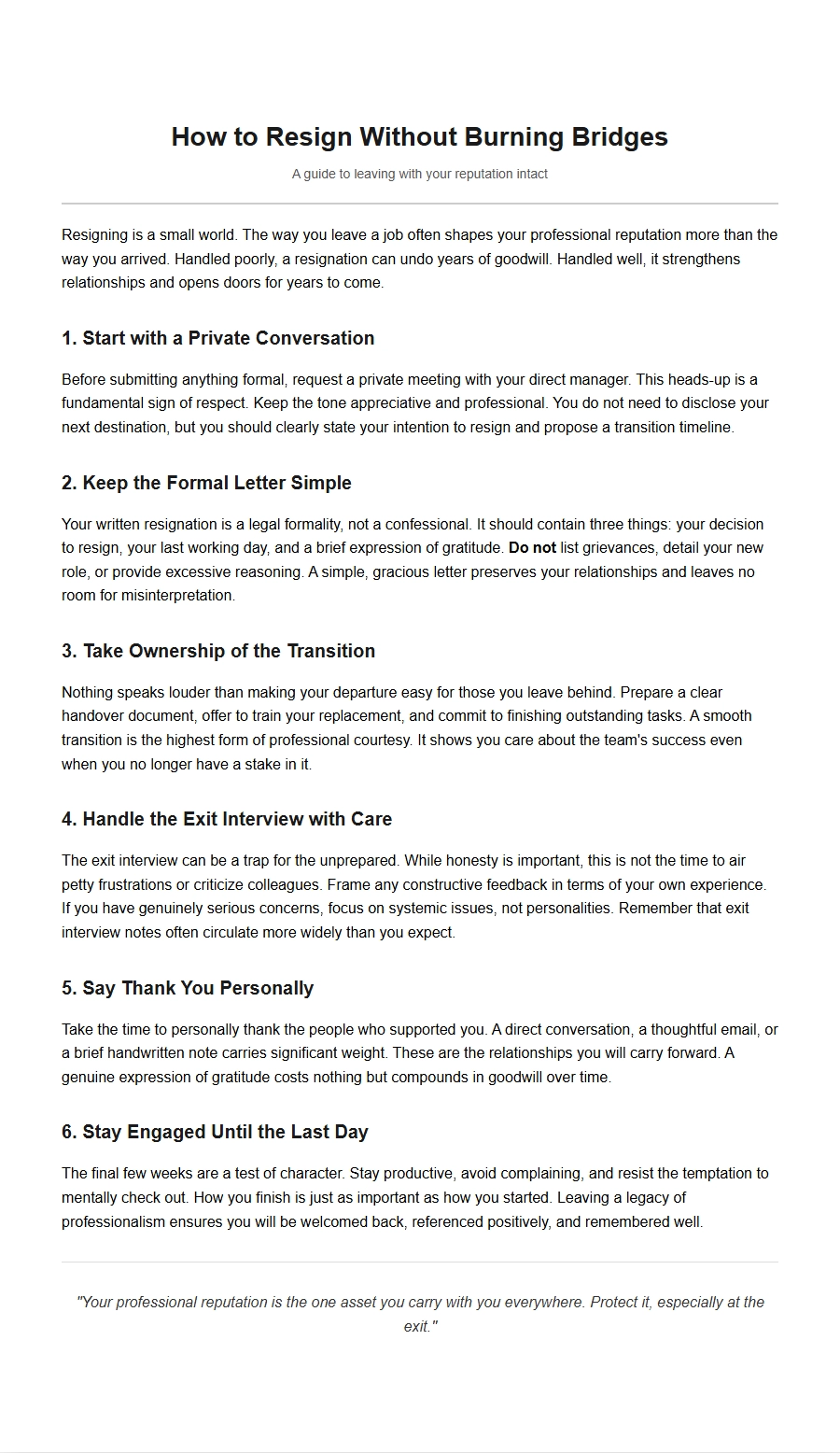 How to Resign Without Burning Bridges
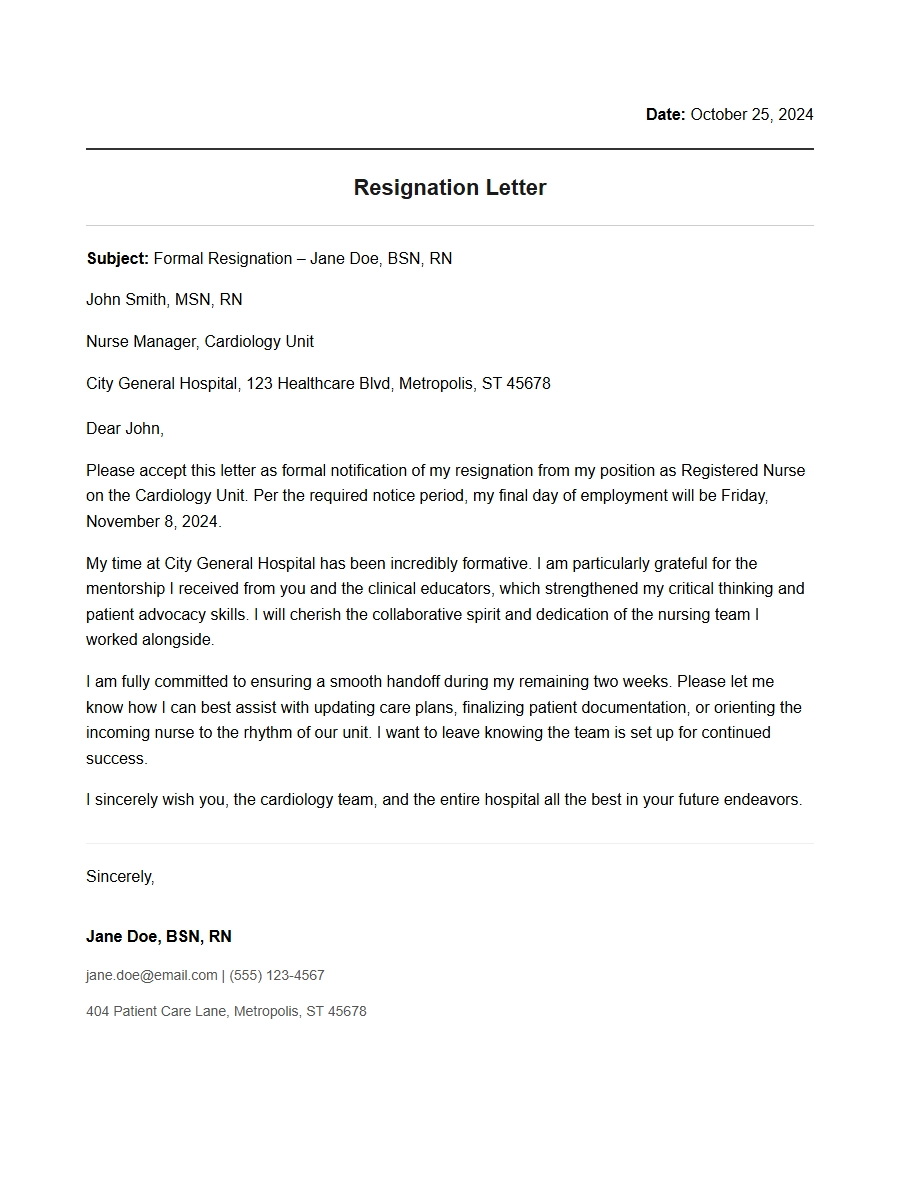 Nurse Resignation Letter with 2 Weeks Notice
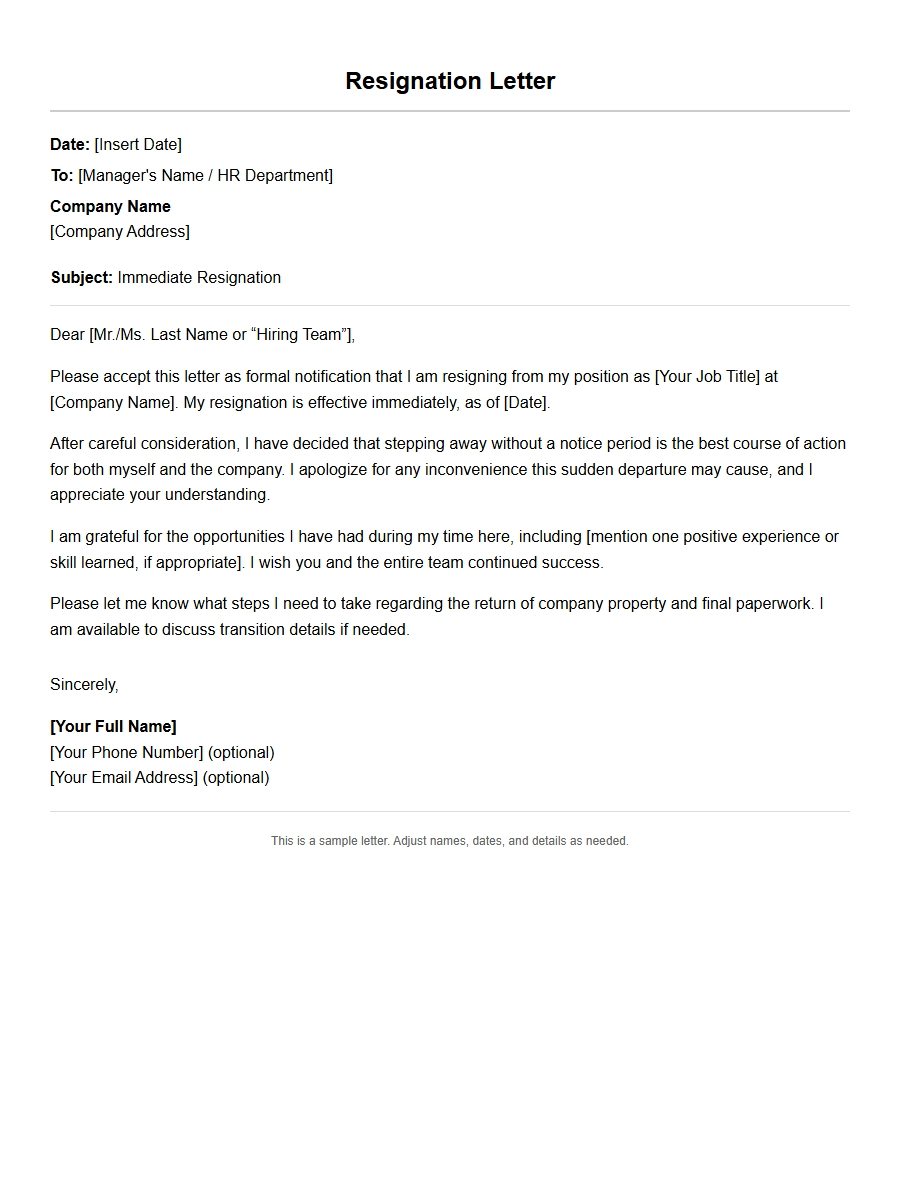 Sample Immediate Leave Resignation Letter