You got the reunion invitation weeks ago, and now the RSVP deadline is tomorrow. You want to go, but writing that confirmation note feels oddly stressful. Will you sound too stiff? Too casual? Will they even remember who you are? That blank reply card (or email field) can freeze anyone. But a simple sample note can turn that anxiety into a quick, confident response.
Why using a sample isn’t cheating
Reaching for a letter template when you need to confirm your presence at a reunion is a smart shortcut, not a cop-out. A good sample gives you the professional correspondence bones — the correct salutation, date line, and closing — so you don’t have to reinvent letter structure. You just replace the bracketed details with your own. It saves time, and it keeps you from accidentally sounding too formal or too chummy for the occasion.
Choose the right tone for your reunion
Not all reunion notes are the same. A high school class reunion usually calls for a friendly but organized tone: “I’m delighted to confirm my attendance. Looking forward to catching up.” A family reunion might be more casual, but still needs clarity: “Yes, I’ll be there with my partner and the kids.” On the other hand, a formal alumni dinner or a military unit reunion demands a business letter format with a proper salutation and closing.
Category: Personal Letters
Think about the group’s culture before you pick a sample. If the invitation itself is playful, match that energy. If it’s a formal printed card, mirror that tone. The tone in writing sets the stage for your entire response.
How to adapt a sample without sounding like a robot
Start by reading the sample you choose. Underline the parts that feel natural to you. Then rewrite those phrases in your own voice. For example, if the sample says “I am pleased to confirm my attendance,” and you’d never say “pleased” in real life, change it to “I’m happy to let you know I’ll be there.” Keep the structure — the date, the clear statement of attendance, the number of guests — but swap out words that feel stiff.
The first sentence of your confirmation note is your chance to show the organizers you care. Instead of “I am writing to confirm,” try “Thank you so much for organizing this reunion — I wouldn’t miss it.” That small personal touch makes the note feel less transactional. If you haven’t seen these people in years, add a quick memory: “Can’t wait to reminisce about those late-night study sessions.”
Common mistakes that undermine a good note
Even with a sample, people slip up. Here are the ones I see most often:
Ignoring the format. A printed reply card expects handwritten ink. An email should have a clear subject line (e.g., “RSVP: John Doe – 20th Reunion”). Don’t mix them.
Outdated salutations. “To Whom It May Concern” is almost never right for a reunion. Use the organizer’s name if you know it, or simply “Hi everyone.”
Forgetting details. Did the invitation ask for your meal preference? Guest names? Email address for updates? Read the original invitation before you send your note. Missing those specifics can frustrate the planning team.
Over-proofreading but under-customizing. It’s great to proofread your letter, but if you leave a placeholder like [Your Name] in the final version, you’ve wasted the effort. Read it out loud before you hit send.
Digital letter format vs. printed card
Most reunion confirmations today arrive by email or online form, but some still ask for a printed reply. For email, keep it compact: a letterhead design isn’t needed, but a simple sign-off with your name and phone number is wise. For a printed card, use a customizable letter approach: print your note on clean paper, fold it neatly, and sign by hand. Both formats benefit from the same core structure — clear attendance confirmation, number of guests, and any special request (dietary, accessibility, etc.).
The best reunion confirmation notes feel both professional and personal. They say, “Yes, I’m coming — and I’m excited about it.” A sample gives you the shape; your voice gives it the warmth. Practice once or twice, and soon you’ll be able to dash off a perfect note in under two minutes. And if you ever need to reach out after the event, a keeping in touch letter to a pen pal example can help you keep that connection alive long after the reunion ends.
Helpful Examples
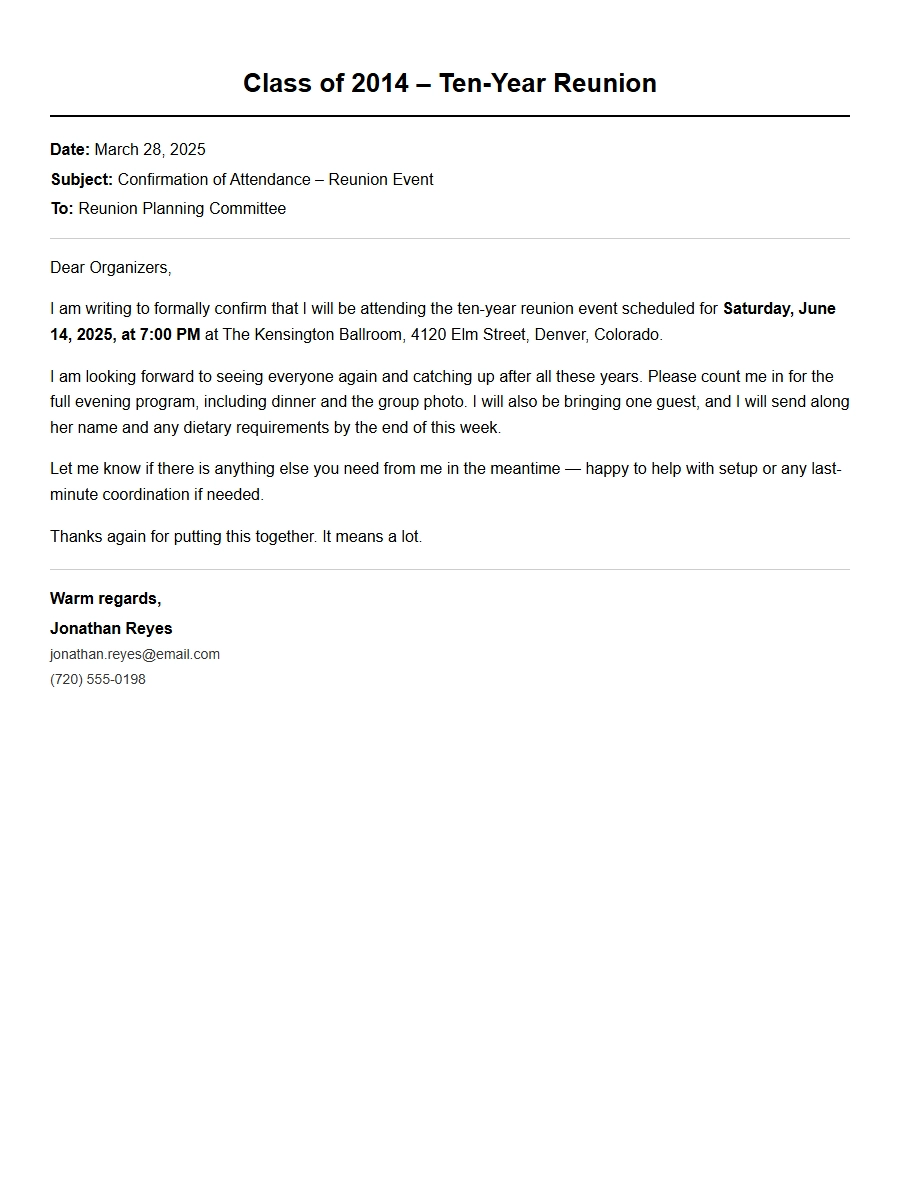
Confirming Your Reunion Event Presence
Acceptance of Family Reunion Invitation
Dear Family Reunion Committee,
Thank you for the invitation to the annual Smith family reunion scheduled for August 12, 2025. I am writing to confirm my presence at the event. I will be attending along with my spouse and two children, making a total of four people.
Please note the following details:
Vegetarian meal preference for my spouse
We will require parking space for one vehicle
We will bring a dessert to share
I look forward to catching up with everyone. Please let me know if there are any updates regarding the venue or schedule. My contact number is (555) 123-4567.
Warm regards, John Smith
Class Reunion Attendance Confirmation
Hello Reunion Committee,
I am delighted to confirm my attendance for the 20th High School Reunion of Westwood High Class of 2005 on June 15, 2025.
I will be attending solo. I have also volunteered to help with setup if needed. Please add my name to the list.
Could you please share the final itinerary and any suggested hotel accommodations? I look forward to reconnecting with old friends.
Best, Emily Johnson
RSVP for Military Reunion
To the Reunion Coordinator,
This confirms my attendance at the 3rd Battalion Reunion taking place on September 10-12, 2025 at Fort Bragg.
I will be accompanied by my wife. We request a room in the block reserved for veterans. Enclosed is the registration fee via check (number 1234).
Please include us in the Friday night barbecue and the Saturday memorial ceremony. If there is a muster list, please add my name as: Sgt. (Ret.) Michael Torres.
Contact: m.torres@email.com | (555) 987-6543
Thank you, Michael Torres
Informal Note to Friend About Reunion
Hey Sarah,
Got your invite for the college reunion picnic next Saturday. Count me in! I'll be there around noon with a cooler of soda and some chips.
Let me know if you need help with anything. Also, is it okay if I bring my new puppy? He's well behaved.
See you soon, Mark
Family Reunion Response with Dietary Restrictions
Dear Aunt Linda,
Thank you for organizing the family reunion on July 4th. I am happy to confirm that our family of five will attend.
However, we have some dietary restrictions that I need to note:
My son is allergic to peanuts and tree nuts.
My husband is gluten intolerant.
I am vegetarian.
Could you please ensure there are options for us? We will also bring a gluten-free pie and a nut-free dessert. Let me know if you need any other information.
Thanks, Jessica Brown
Formal Response to Reunion Invitation
To the Organizing Committee,
I am writing to formally confirm my presence at the 50th Anniversary Reunion of the Elmwood High School Alumni Association. The event is scheduled for October 20, 2025 at the Grand Ballroom.
I will be attending with a guest. Our names are: Mr. Robert Anderson (alumnus) Mrs. Patricia Anderson (guest)
We have enclosed a donation of $50 to support the scholarship fund. Please send confirmation of receipt and details about the evening's program.
Sincerely, Robert Anderson
Email Confirmation for College Reunion
Hello Alumni Reunion Team,
I confirm my attendance for the upcoming State University College of Engineering Reunion on May 25, 2025.
I will be attending with two other former classmates – David Lee and Susan Park. We all graduated in 2010. We would like to be seated together at the dinner.
Additionally, please reserve three tickets for the campus tour at 2 PM. Let me know if you need our T-shirt sizes.
Thank you, James Chen
Short Confirmation for Workplace Reunion
Hi All,
Just a quick note to confirm that I will be attending the department reunion picnic this Saturday. I'll bring a side dish – probably coleslaw.
Looking forward to seeing everyone!
Best, Tom
Detailed RSVP for Heritage Reunion
Dear Clan MacGregor Reunion Committee,
I am pleased to confirm my attendance at the 2025 Clan Gathering from August 5th to 8th at the Highland Estate.
Please find my details below:
Name
Relation
Age
Diet
Angus MacGregor
Self
45
Standard
Fiona MacGregor
Spouse
42
Vegetarian
Hamish MacGregor
Son
12
Standard
We will arrive on August 5th by noon. We request accommodation in the castle annex. We also wish to participate in the Highland games – please add my name to the caber toss and the tug-of-war.
I have sent the registration fee via PayPal. Please confirm receipt. Looking forward to a grand reunion!
Yours aye, Angus MacGregor
Reunion Attendance Note with Special Request
Dear Reunion Hosts,
I confirm my presence at the Annual Johnson Family Reunion on July 20, 2025. I will be coming alone, as my children have other commitments.
I have a special request: I would like to present a short slideshow of old family photos (about 10 minutes). I have a laptop and projector. Could you please ensure there is a screen or blank wall available? I will also need a power outlet nearby.
Additionally, I can help with registration table duties for an hour if needed.
 Thanking a Mentor for Guidance: Sample Messages
 Expressing Gratitude: Handwritten Letter Example
 Expressing Thanks in a Formal Personal Letter
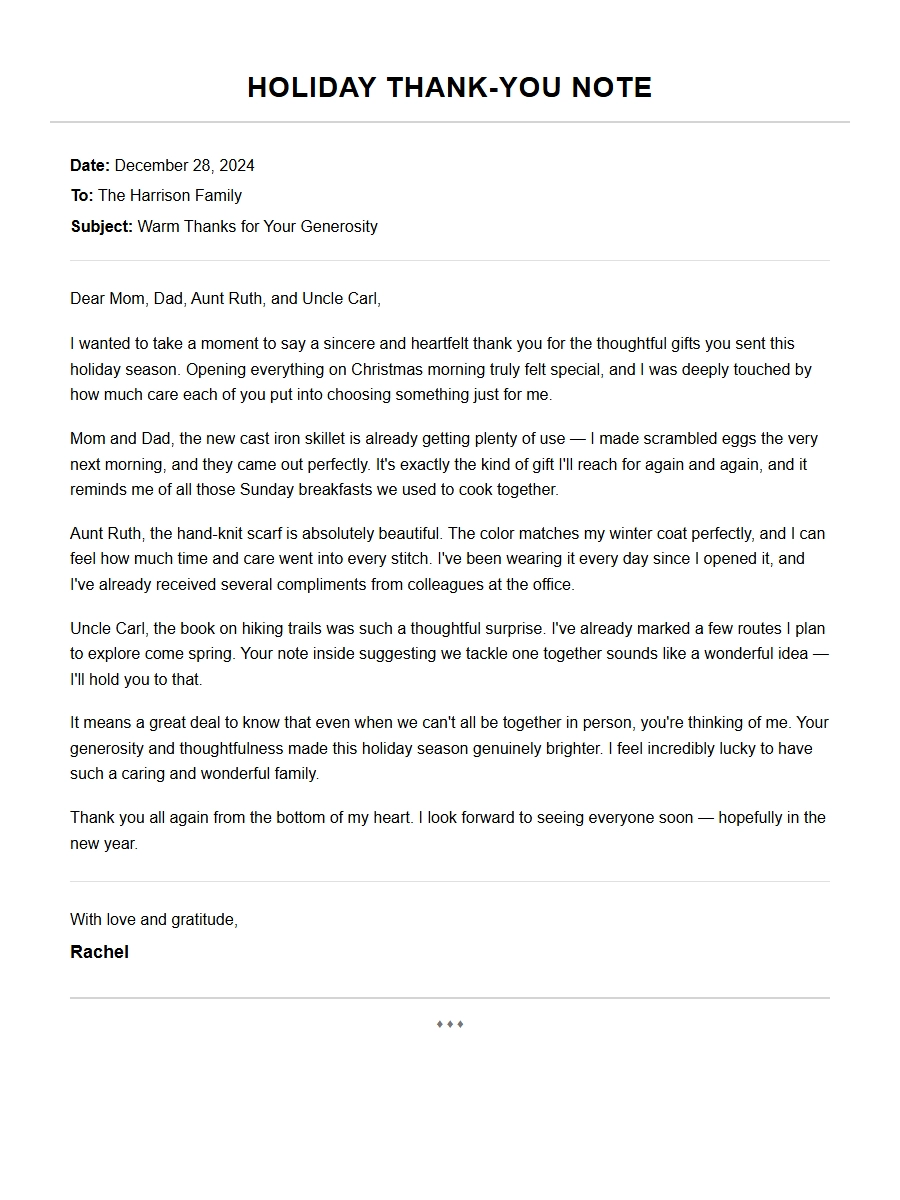 Thank You Letter Examples for Family Holiday Gifts
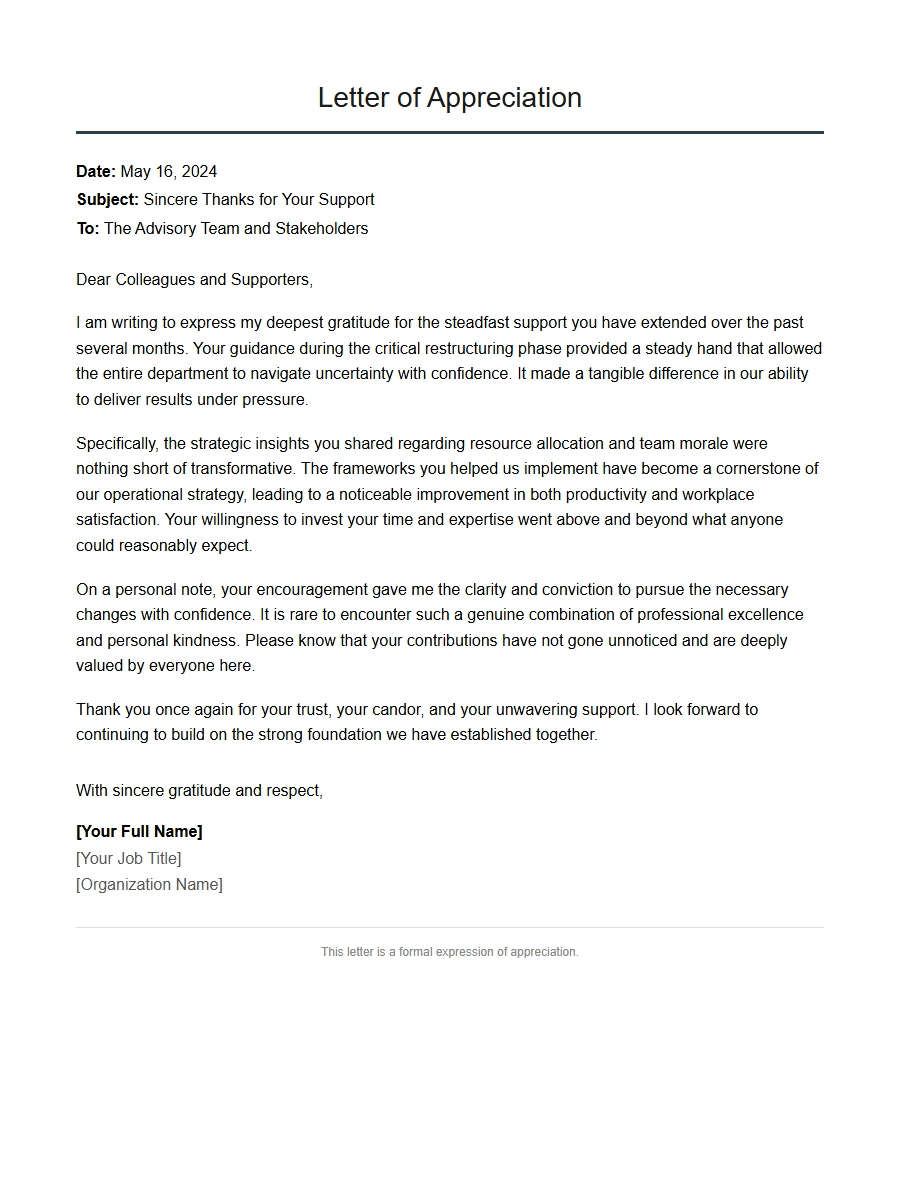 Sample Thank You Letter for Support
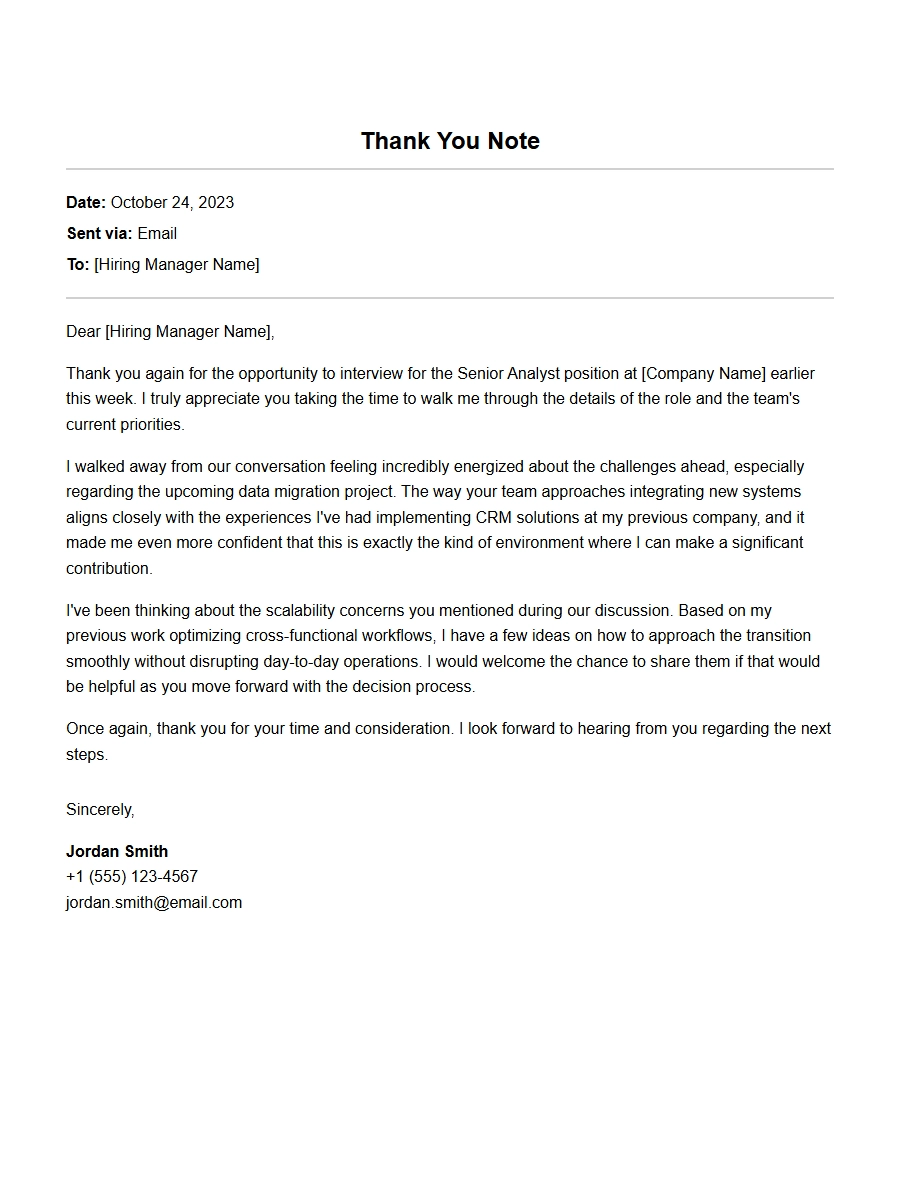 How to Write a Personal Thank-You Note After an Interview