expressing sorrow over death of colleague personal - Personal Letters
You sit down to write a letter expressing sorrow over the death of a colleague, and the words just won’t come. It’s not that you don’t care—you care a lot. But finding the right balance between professional distance and genuine warmth feels impossible. That blank page can make grief even harder to process.
Using a well-written sample is not cheating. It’s a smart way to get past the paralysis and focus on what matters: communicating your sympathy in a respectful, sincere way. A good letter template gives you structure, the right tone, and key phrases. You still make it your own by filling in specific memories or small gestures that show you knew the person. Think of it as a framework, not a script.
Category: Personal Letters
What makes a condolence letter to a colleague different?
Unlike a note to a close friend, professional correspondence about a colleague’s death has to respect workplace relationships. You might not know the family well, and you don’t want to overstep. But you also don’t want to sound robotic. The best letters feel like a conversation between two people who shared an office, a project, or a coffee break.
Start by choosing the right format. If you are sending a printed card, use standard business letter format with your contact information at the top. For email, a clear subject line like “With deepest sympathy” works fine. Avoid fancy letterhead design unless it’s an official company note. The message matters more than the design.
How to adapt a sample without losing your voice
When you find a sample that feels close to what you want, read it out loud. Does it sound like you? If it’s too formal, swap words. Change “the deceased” to the person’s name. Replace “we extend our condolences” with “I’m so sorry for your loss.” That small shift makes the tone in writing personal and authentic.
Pay attention to the opening paragraph. Instead of starting with “I was saddened to learn,” try “I was heartbroken to hear about John.” That grabs attention because it’s honest. Then mention one specific quality you appreciated about your colleague—their patience during a tough project, their sense of humor in meetings. That detail is what turns a generic note into something the family will read twice.
Common mistakes to avoid
One of the biggest pitfalls is using an outdated salutation and closing. “Dear Mr. Smith” might feel too stiff if you called him “Bob” at work. Trust your relationship. “Dear [Name]” or simply “Dear Family” is fine if you’re writing to the spouse. For the closing, “With deepest sympathy” is timeless, but “With sincere condolences” also works. Avoid “Sincerely” unless it’s a very formal letter.
Another mistake: ignoring the digital letter format if you’re sending an email. Keep the subject line simple, like “Thinking of you and the family.” Don’t attach a huge file or use a fancy font. And always proofread the letter before sending. A typo in a sympathy note feels careless. Read it twice, or ask a trusted friend to glance at it.
If you’re also asked to write a letter of recommendation for the colleague’s family (for example, a testimonial for a memorial program), keep the tone respectful and focused on professional qualities. That’s a different kind of professional correspondence, so use a separate format and adjust the tone.
Making the letter feel real
You don’t need to write a long essay. A paragraph or two is enough. Share one memory, acknowledge the loss, and offer support without forcing it. “I’ll miss his laugh in the morning meetings” is more powerful than “He will be missed.” If you’re closer to the family, you can add a line about being available for a chat or help with errands. But only if you mean it.
The best condolence letters feel both professional and personal. They don’t hide behind corporate language, but they also don’t overstep. Once you’ve written a few, you’ll get faster at finding the right words. Until then, lean on a sample the way you’d lean on a save-the-date template—it gets you started, and you add the heart.
And if you’re still unsure about the tone, remember a note to a bereaved friend or a professional apology letter both rely on the same foundation: honesty and thoughtfulness. Your colleague’s family doesn’t expect perfection. They just need to know you remember the person who mattered to them.
So take a deep breath. Pick a sample that feels close, tweak it until it sounds like you, and send it. You’ll be glad you did.
Samples You Can Use
expressing sorrow over death of colleague personal - Personal Letters
Condolence Letter to Spouse
Date: February 5, 2025
Dear Mrs. Chen,
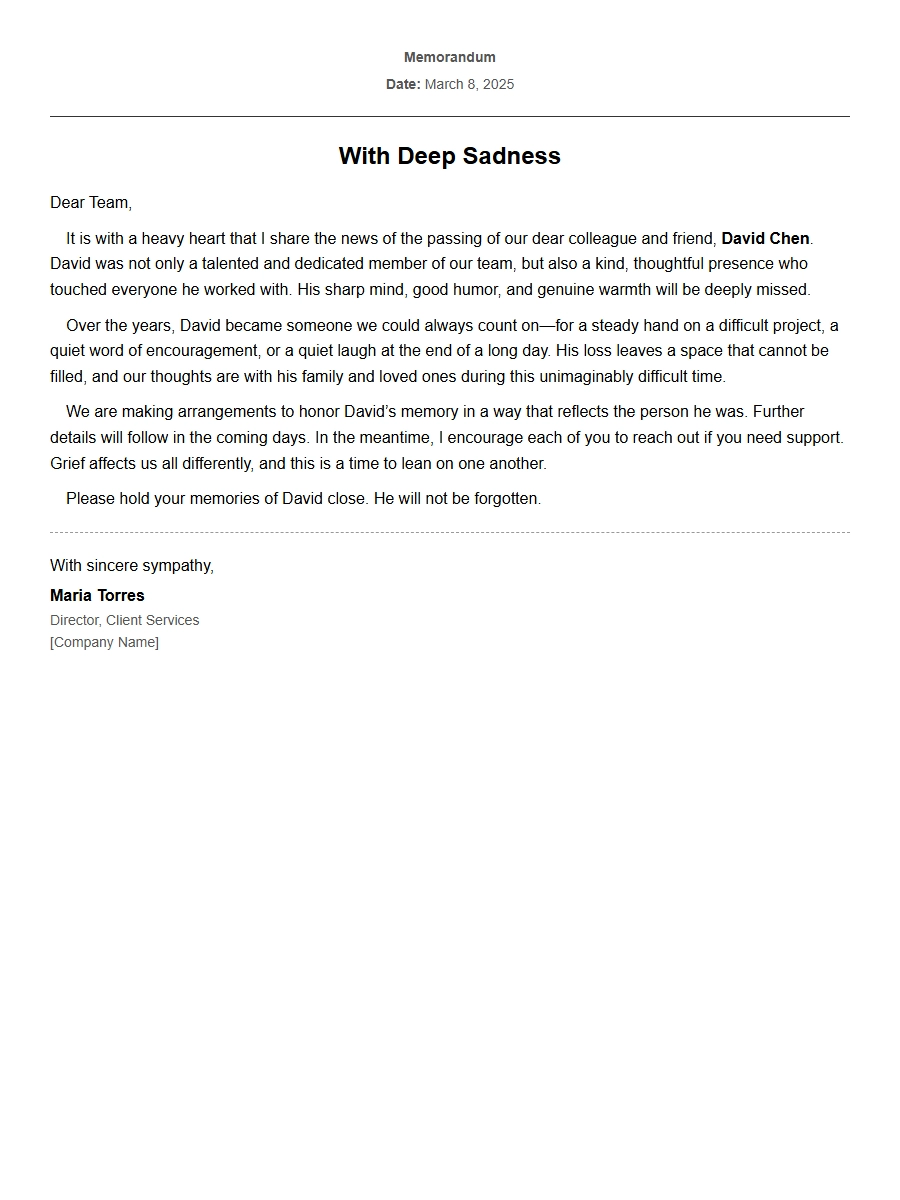
Words cannot express the shock and sorrow we felt upon hearing of David’s passing. He was not only a brilliant colleague but a true friend to everyone in our department. I will always remember his quiet sense of humor and the way he could calm a stressful meeting with just a few words.
David’s contributions to our team were immense. Below are just a few of the projects he led with such dedication:
Q4 2024 – Customer Service Redesign (reduced response time by 30%)
Q1 2025 – Employee Onboarding Portal launch
Ongoing – Mentorship program for junior analysts
We have set up a small memorial fund in David’s name at the local library. If you would like any assistance with arrangements, please do not hesitate to call me directly. Holding you and your family in our hearts.
With deepest sympathy, Alex Rivera
Sympathy Note to Department Head
To: Professor Kim, Department of Biology
Re: Passing of Dr. Elaine Torres
I am writing on behalf of the graduate student association to express our collective grief over the sudden loss of Dr. Torres. She was an inspiring mentor and a pillar of our research community.
Many of us have cherished memories of her guidance. A few examples:
Dr. Torres stayed late every Tuesday to help us with statistical models.
She organized the annual field trip to the wetlands for over a decade.
Her open-door policy made her office a safe space for students.
We would like to organize a memorial lecture in her honor. Please let us know how we can support the department and her family during this difficult time. Our thoughts are with all of you.
Respectfully, Maya Singh GSA President
Personal Note to a Fellow Colleague
Hi Jenna,
I know you’re hurting as much as I am right now. Sam was more than a cubicle neighbor — he was the guy who’d bring in homemade cookies on stressful Fridays and never missed a birthday. I keep replaying that inside joke we three had about the broken printer. It feels so empty without his laughter.
I wanted to share a small memory that comforts me:
Date
Memory
March 2024
Sam surprised us with a whiteboard doodle of our team as superheroes.
June 2024
He stayed late to help me debug a script, then insisted we order pizza.
If you ever want to talk, or just sit quietly together, I’m here. Let’s go for coffee this weekend at that place he liked. Thinking of you.
With love, Mike
Tribute for Memorial Service Program
In Loving Memory of Anita Roy
Anita joined our marketing team in 2019 and instantly became its heart. She had a gift for making everyone feel seen — from interns to senior directors. Her creative campaigns won awards, but what we will miss most is her daily warmth.
These are just a few of the qualities that defined her:
Generosity: She always brought extra snacks for the break room.
Encouragement: She sent handwritten “great job” notes after every big presentation.
Joy: Her desk was covered in photos of her family and tiny succulents she named.
Anita leaves a legacy of kindness that will continue to inspire our work. Rest well, dear friend.
— The Creative Team at Bright Ideas Agency
Letter to HR Requesting Support
Date: February 5, 2025
To: Human Resources Department
Re: Grief support following the death of Marcus Webb
I am writing as a team lead to formally express the profound sorrow our group is experiencing after our colleague Marcus died unexpectedly. Many staff members are struggling to focus, and some have asked about counseling options.
We would be grateful if you could arrange:
A grief counselor to meet with our team (virtual or in person)
Flexible deadlines for current projects for the next two weeks
A brief gathering or moment of silence during the next all-hands meeting
I have also compiled a list of coworkers who may need extra support:
Name
Role
Notes
Lena Foster
Senior Analyst
Worked with Marcus for 6 years
Tom Hendricks
Junior Developer
Marcus was his mentor
Diana Park
Admin Assistant
Shared office with Marcus
Thank you for your understanding. Please let me know how best to proceed.
Sincerely, Rachel Osei
Team Condolence Card Message
To the family of James Whitfield,
We, the staff of the Accounting Department, are heartbroken by the loss of our dear friend and colleague James. He was the steady hand in our chaos, always ready with a spreadsheet, a joke, or a listening ear. We will miss his “Happy Friday” emails and his unfailing positivity.
As a small token of our love, we want to share some of our favorite James moments:
He brought fresh bagels every Monday for five years.
He decorated his cubicle for every holiday, even National Pretzel Day.
He once spent an entire lunch hour helping a new hire fix a formula.
You are in our thoughts and prayers. If there is anything we can do — errands, meals, a phone call — please reach out to any of us. James was family to us too.
With deepest sympathy, Your colleagues at Numero Uno Corp
Letter to Company Leadership on Behalf of Staff
Date: February 5, 2025
To: Board of Directors, TechSolutions Inc.
Re: Grief over the loss of Chief Engineer Dr. Lisa Chen
On behalf of the entire engineering division, I write to share our immense sorrow at Dr. Chen’s passing and to request that her legacy be formally acknowledged. She was the visionary behind our flagship product and a mentor to hundreds of engineers.
We propose the following actions to honor her memory:
Name the new R&D lab the “Chen Innovation Center.”
Establish an annual scholarship in her name for women in STEM.
Hold a company-wide memorial event on March 15.
Additionally, many team members are struggling emotionally. We respectfully ask for a temporary reduction of project deliverables and access to grief counseling. Dr. Chen’s impact on our culture is immeasurable; we must honor it with compassion.
Respectfully, Dr. Marcus Grant Senior Director of Engineering
Short Eulogy for Colleague's Family
To the family of Rosa Martinez,
I was Rosa’s cubicle neighbor for six years, and I want you to know how special she was at work. She didn’t just meet deadlines — she made everyone around her better. I remember her saying, “We’re not just colleagues; we’re a working family.” And she meant it.
A few things that captured Rosa’s spirit:
Memory
What it showed
She baked cookies for every team member’s birthday.
Her thoughtfulness
She never missed a colleague’s farewell party.
Her loyalty
She could turn a tense meeting into a laughing session.
Her grace
Rosa often spoke of you, her family, with such pride. I hope you find comfort in knowing how much she was loved at work. Please accept my deepest sympathy.
With heartfelt condolences, Kevin Park
Letter Offering Practical Help to Family
Dear Mrs. Okonkwo,
I am writing as a close friend and former project partner of your husband, Emmanuel. I was deeply saddened to learn of his passing. He was a remarkable person and a cherished colleague.
I know that after a loss, everyday tasks can feel overwhelming. I and several other coworkers would like to help in tangible ways. Below is a list of what we can offer — please use any that would be helpful:
Help Offered
Available Days/Times
Contact Person
Meal delivery for a week
Any evening after 5 PM
Sarah (555-0102)
Childcare for your two children
Weekends or afternoons
Tom (555-0103)
Help with paperwork (insurance, etc.)
Flexible
I can assist myself
Please do not hesitate to call or text me at 555-0101. We are all thinking of you and your family, and we want to carry some of the burden. With love and support,
Amara Obi
Personal Journal Letter Reflecting on a Colleague's Death
Dear Journal,
Today we lost Greg. I can’t stop thinking about his voice — how he’d call out “Morning, champ!” every single day. It feels like a part of the office has vanished. I keep looking at his empty chair, half expecting him to walk in with his terrible coffee and big laugh.
I want to write down the things I loved about him, so I never forget:
His weird habit of humming 80s songs while coding.
The way he always defended the interns when they made mistakes.
How he remembered everyone’s coffee order — even mine, oat milk latte.
He never gossiped; he only said kind things.
The team is shattered. Maybe later I’ll write to his wife, but right now I just need to sit with this sorrow. Greg, thank you for making the tough days bearable. You were more than a colleague — you were a brother.
 Thanking a Mentor for Guidance: Sample Messages
 Expressing Gratitude: Handwritten Letter Example
 Expressing Thanks in a Formal Personal Letter
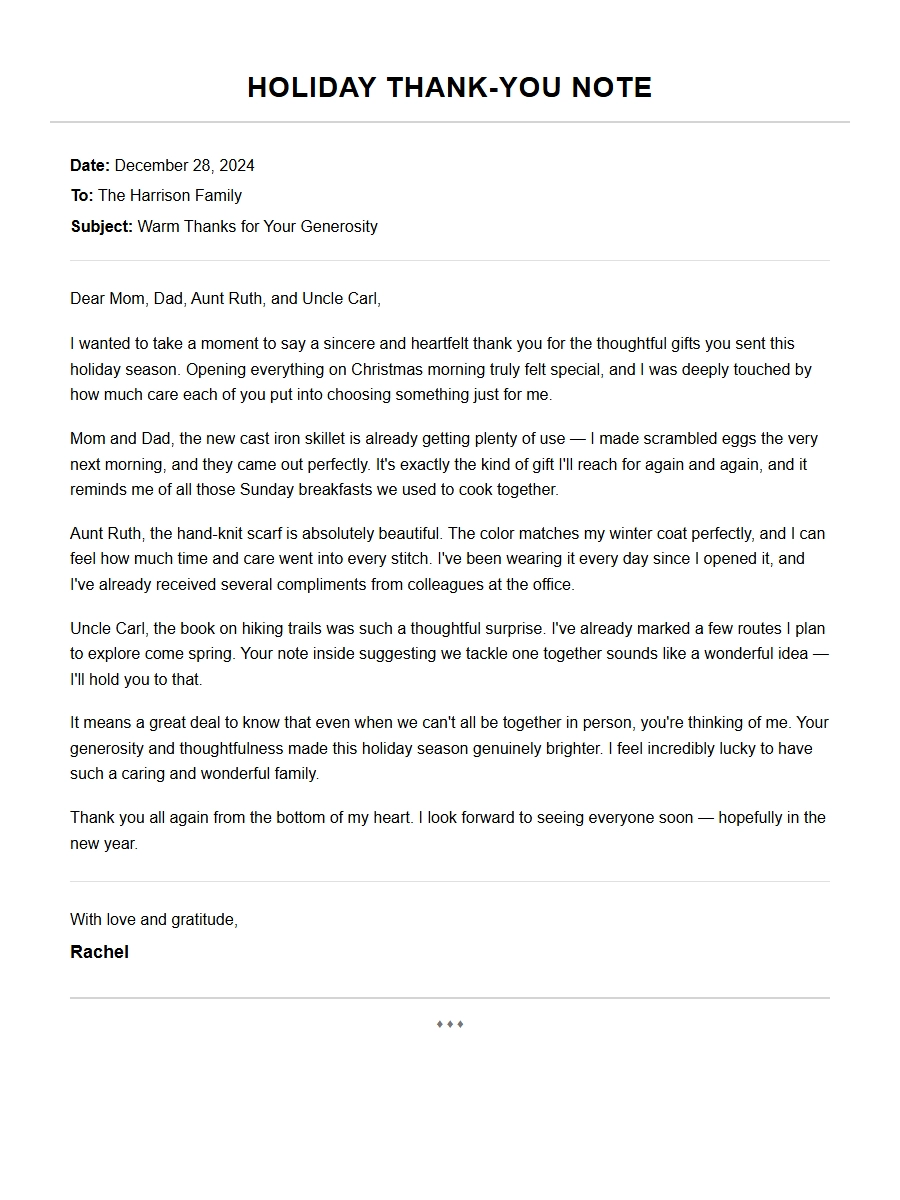 Thank You Letter Examples for Family Holiday Gifts
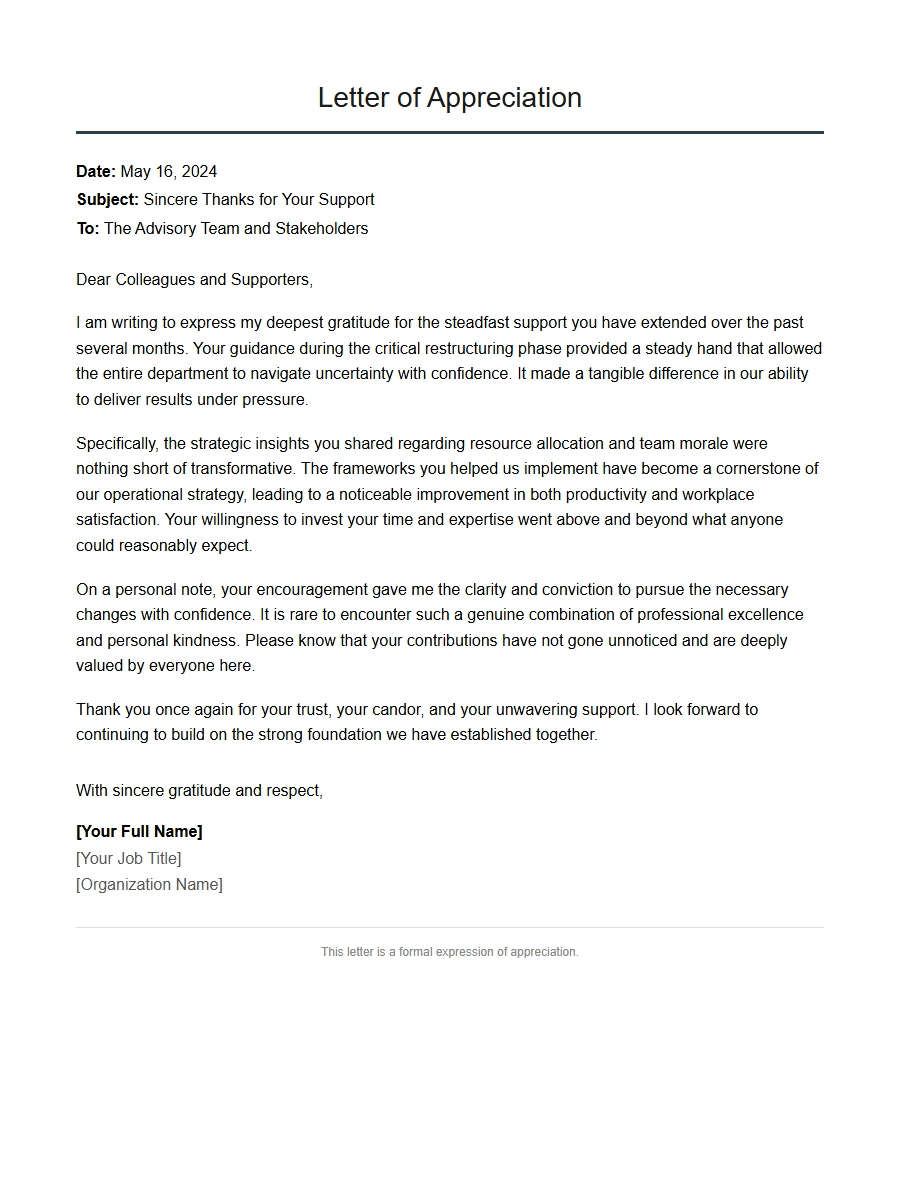 Sample Thank You Letter for Support
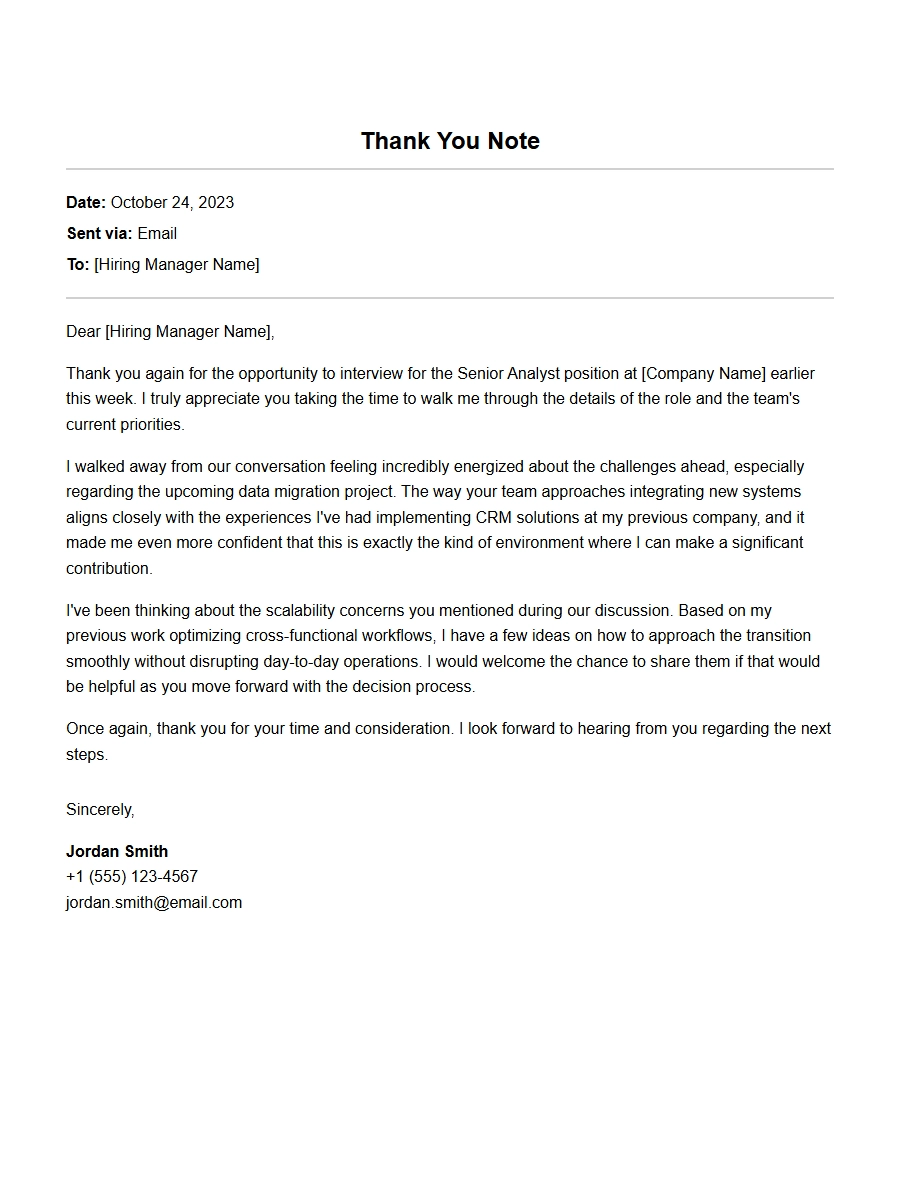 How to Write a Personal Thank-You Note After an Interview