How to Write a Comforting Note to a Grieving Friend
You want to say something meaningful to a friend who’s grieving, but every phrase you think of sounds either too hollow or too heavy. That blank sympathy card or empty email draft can feel impossible to fill. The weight of getting it wrong often stops people from sending anything at all. But your friend doesn’t need perfect words. They just need to know you haven’t forgotten them.
A comforting words for bereaved friend note isn’t about crafting a eulogy or solving their pain. It’s about showing up. The best messages are short, honest, and focused on the person who is hurting. You don’t need to be a writer. You just need a simple structure and a quiet moment to fill it in.
Start by acknowledging the loss directly. Say the name of the person who died. Avoid euphemisms like “passed on” or “lost their battle.” They feel distant. Try: “I was so sorry to hear that your mother, Linda, has died.” That single sentence does more work than a paragraph of vague sympathy.
Next, share a brief, genuine memory if you have one. Keep it small. “I’ll never forget how she made everyone laugh at the barbecue last summer.” If you didn’t know the person who died, skip this step. Don’t invent a connection. Instead, say something like: “I know how much she meant to you, and I’m thinking of you.”
Offer one specific way you can help, but only if you mean it. “I’m bringing dinner over on Thursday. I’ll text you to confirm the time” is far better than “Let me know if you need anything.” Grieving people rarely have the energy to ask for help. A specific offer removes that burden.
Close with a simple line that leaves the door open. “No need to reply. I’m holding you close in my thoughts.” This gives your friend permission to not respond, which is often a relief.
Many people worry about format. For a handwritten card, keep it short and use your natural handwriting. For an email, a standard business letter format isn’t appropriate here. Keep it warm. Use a simple salutation like “Dear Sarah,” and a closing like “With love,” or “Thinking of you,”. Avoid overly formal letter writing etiquette like “To whom it may concern” or “Sincerely,” when writing to a friend in grief. Tone in writing matters deeply here—warmth beats formality every time.
Common mistakes include minimizing the loss (“They’re in a better place”), comparing grief (“I know how you feel” — you don’t), or filling the note with religious language unless you are certain your friend shares those beliefs. It’s also easy to make the note about your own sadness. Keep the focus on your friend’s experience. A letter template can help you avoid these pitfalls. A good sample gives you the scaffolding, but you fill in the heart.
If you need a starting point, look for a customizable letter that lets you drop in the deceased’s name and your memory. Many cover letter examples and resignation letter sample resources exist online, but finding a template for personal notes of condolence is trickier. Look for ones that emphasize tone over structure. Your goal is a message that feels like you, not a form letter.
Proofreading your letter is still important, even in grief. Read it aloud. Does it sound like something you’d actually say? If a sentence feels stiff, rewrite it. You’re allowed to use contractions. “I’m sorry” sounds more natural than “I am sorry.” The goal is a note that feels like a hug, not a lecture.
If you’re sending a digital note, the same rules apply. You don’t need a fancy letterhead design. A plain email with a kind subject line like “Thinking of you” works fine. Avoid the impulse to write a long professional correspondence style email. This isn’t the moment for that.
Your note doesn’t need to be long. It needs to be sent. Grief is isolating. A short, honest message reminds your friend they aren’t alone. Send it today, even if you think it’s imperfect. The act of reaching out matters far more than the elegance of the words.
For other personal letters where tone matters just as much, you might find these guides helpful: a note to your property manager about a pet, an email explaining a project delay to a client, or a message updating your employer on an outside opportunity. You can also learn how to negotiate vendor rates directly or introduce yourself to a new business contact. Each of these situations benefits from the same principle: know the relationship, keep the tone right, and be specific.
Good letters are built on practice. The more you write, the easier it gets. Start with today’s note. It will mean the world to someone.
Common Sample Formats
How to Write a Comforting Note to a Grieving Friend
A Short Sympathy Note from a Close Friend
Dear Sarah,
I was so heartbroken to hear about your loss. There are no words that can truly ease the pain, but please know that I am holding you close in my thoughts. I remember all the laughter we shared with him, and I will cherish those memories forever.
If you ever need someone to sit with you in silence, or to help with the daily tasks, I am just a phone call away. You do not have to go through this alone. Sending you all my love during this impossible time.
With deepest sympathy, Emily
A Longer Letter Offering Specific Memories
My dearest Alex,
I am struggling to find the right words to express how deeply sorry I am for the loss of your grandmother. She was such a vibrant part of our lives.
I will never forget the summer afternoons we spent in her garden. She taught us how to identify every flower, and her laughter echoed among the roses. She had a way of making everyone feel special. One memory that always makes me smile: when she snuck us extra cookies even though she knew we had already had dessert.
Here are a few things I hold dear about her:
Her warm, comforting hugs.
The way she told stories with such vivid detail.
Her unwavering belief in the goodness of people.
I hope you can find some peace in remembering all the love she gave. I am here for you whenever you want to talk or simply sit together.
With love, Michael
A Note Focused on Practical Help Offers
Dear Jamie,
I am so incredibly sorry for your sudden loss. In this time of confusion and grief, I wanted to offer more than just words. Please let me know if any of these practical ways can lighten your load:
I can bring meals on Tuesday, Thursday, and Saturday. Just tell me your preferred dishes.
I am free to take your children to school and pick them up for the next two weeks.
I can handle any phone calls or emails you need sent out, especially to family or employers.
You do not need to respond immediately. Just know that these offers stand. Your only job right now is to take care of yourself and grieve. Sending you strength and peace.
Warmly, Chris
A Note from a Colleague
Dear Linda,
Our entire team was shocked and saddened to learn of the passing of your husband. We miss your presence in the office, but completely understand that you need time away. Please do not worry about work responsibilities for now—we have everything covered.
I wanted to share a few things that your husband often mentioned about you at company gatherings. He spoke with such pride about your dedication to your projects and your kindness to everyone around you. He was truly your biggest supporter.
We have created a memory board in the break room where colleagues can leave notes, but if you would like, I can collect them and bring them to you. You are in our thoughts constantly.
With heartfelt sympathy, Your friend and coworker, Daniel
A Note from a Distant Friend
Dear Rachel,
Even though miles separate us, my heart aches for you upon hearing about your brother. I know we haven't spoken in a while, but grief does not respect distance. I wanted you to know I am thinking of you.
I remember meeting your brother at your graduation party. He was so full of life, teasing you about your shoes and making everyone laugh. That spirit stays with all of us who were lucky to meet him.
If you ever want to talk on the phone or video call—even at 3 AM—please reach out. I can also send a care package with some of your favorite tea and a journal if that would help. You are not forgotten.
With deepest sympathy, Kaitlyn
A Note for a Friend Who Lost a Parent
Dear Tom,
I was devastated to learn that your mother passed away. The loss of a parent is like losing a part of your own foundation. I want you to know how much she meant to me as well.
She always welcomed me into your home with open arms and insisted on feeding me until I couldn't eat another bite. Her homemade apple pie was legendary. She had this incredible ability to listen without judgment and offer gentle advice that stayed with you for years.
Some things I will always remember:
The way she lit up when you walked into the room.
Her habit of humming old songs while cooking.
Her fierce protection of everyone she loved.
May those memories bring you comfort. I am here to help with anything, from packing her belongings to just being a shoulder to cry on.
With love, Jordan
A Note for a Friend Who Lost a Spouse
My dear Caroline,
I cannot begin to imagine the depth of your grief over losing Mark. The bond you two shared was truly special—a partnership built on laughter, trust, and mutual respect. I will always think of the two of you dancing in your kitchen, completely delighted in each other's company.
In the coming days, you may feel overwhelmed by the weight of daily tasks. Let me help. Below is a simple list of things I can take off your hands:
Task
My Availability
Notes
Walking the dog
Every morning, 7–8 am
I have a key.
Picking up prescriptions
Any afternoon
Just text the list.
Running groceries
Wednesday and Saturday
I can use your list.
You don't have to face this alone. Please let me be there for you in any way that helps.
All my love, Stephanie
A Note for a Friend Who Lost a Child
Dear Lisa and Mark,
Words fail me. There is no greater sorrow than losing a child. Your precious Emma brought so much light into the world in her short time. I remember her infectious giggle and the way she demanded piggyback rides from everyone.
I want to honor her memory by sharing a few small things that made her so unique:
She loved painting with her hands, even more than with brushes.
She insisted on wearing mismatched socks because she said they were happy.
She gave the best, tightest hugs at the end of every playdate.
Please know that you do not have to grieve alone. I will be here every step of the way—for as long as you need me. There is no timetable for healing. I am holding space for your pain and your memories.
With deepest love and sorrow, Anne
A Note with Religious Comfort
Dear Maria,
I was deeply saddened to hear about your father's passing. I know how much your faith means to you, and I hope these words bring you some solace.
In times of grief, we often turn to Scripture for strength. One verse I have held close during my own loss is: “The Lord is close to the brokenhearted and saves those who are crushed in spirit” (Psalm 34:18). Your father lived that faith—he was a pillar of kindness, always ready to help others.
I will be praying for you and your family. If you would like, I can join you for a short prayer or simply sit with you in quiet remembrance. The community also wants to support you; many have asked how to help. I have put together a small list of offered meals and tasks:
May you feel God's peace surround you. You are loved.
In faith, Reverend Susan
A Note Incorporating a Poem or Quote
Dear Nathan,
I was so sorry to learn about the loss of your sister. She had a wonderful soul. I came across a poem that reminded me of the way she lived—full of joy and grace. I copied it here for you:
“Do not stand at my grave and weep, I am not there, I do not sleep. I am a thousand winds that blow, I am the diamond glints on snow.”
I know you miss her deeply. That poem reminds me that she lives on in the breeze, the sunlight, and the laughter we still share. Her spirit is woven into the fabric of all who loved her.
You have taught me so much about resilience and love through this difficult time. Please know that I am here to walk beside you. I can bring over dinner this weekend, or we can just sit and look through old photos—whatever you need.
 Thanking a Mentor for Guidance: Sample Messages
 Expressing Gratitude: Handwritten Letter Example
 Expressing Thanks in a Formal Personal Letter
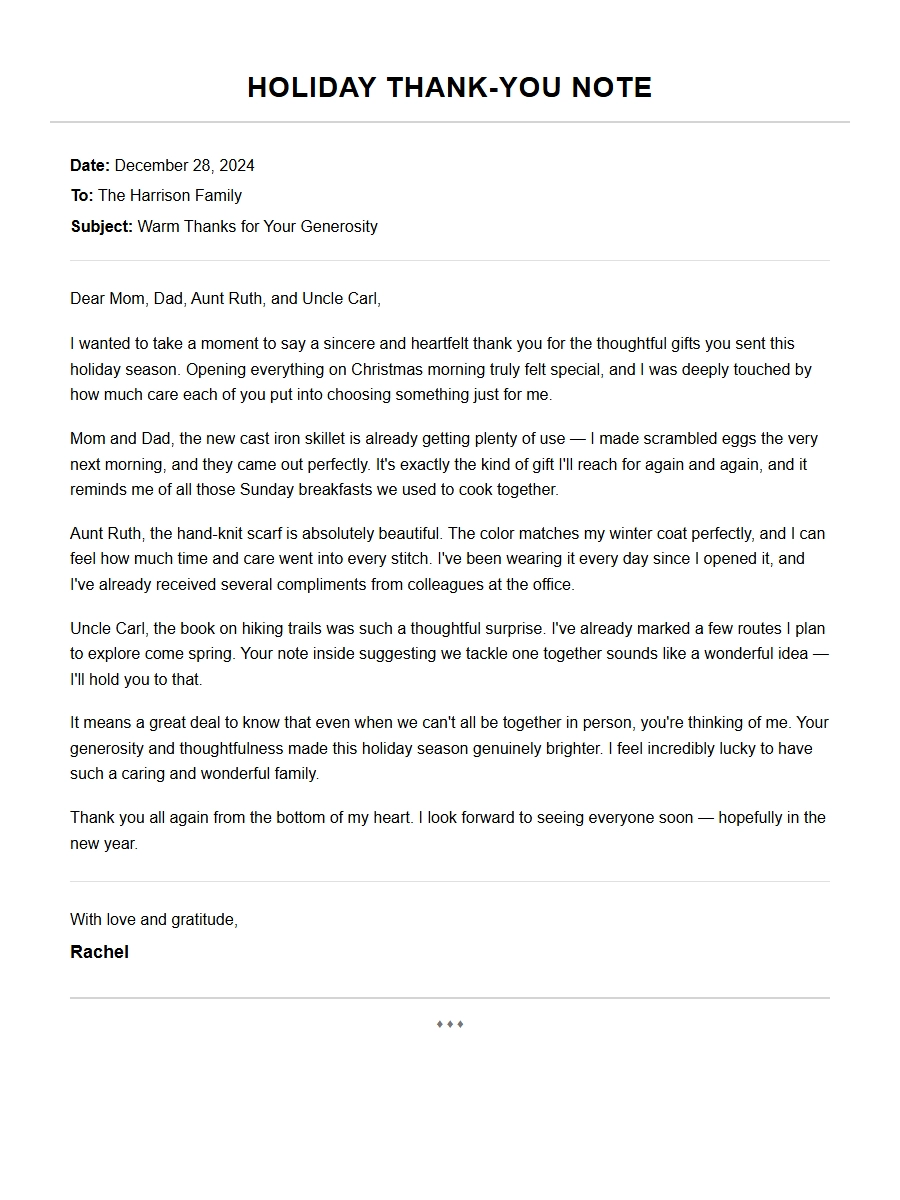 Thank You Letter Examples for Family Holiday Gifts
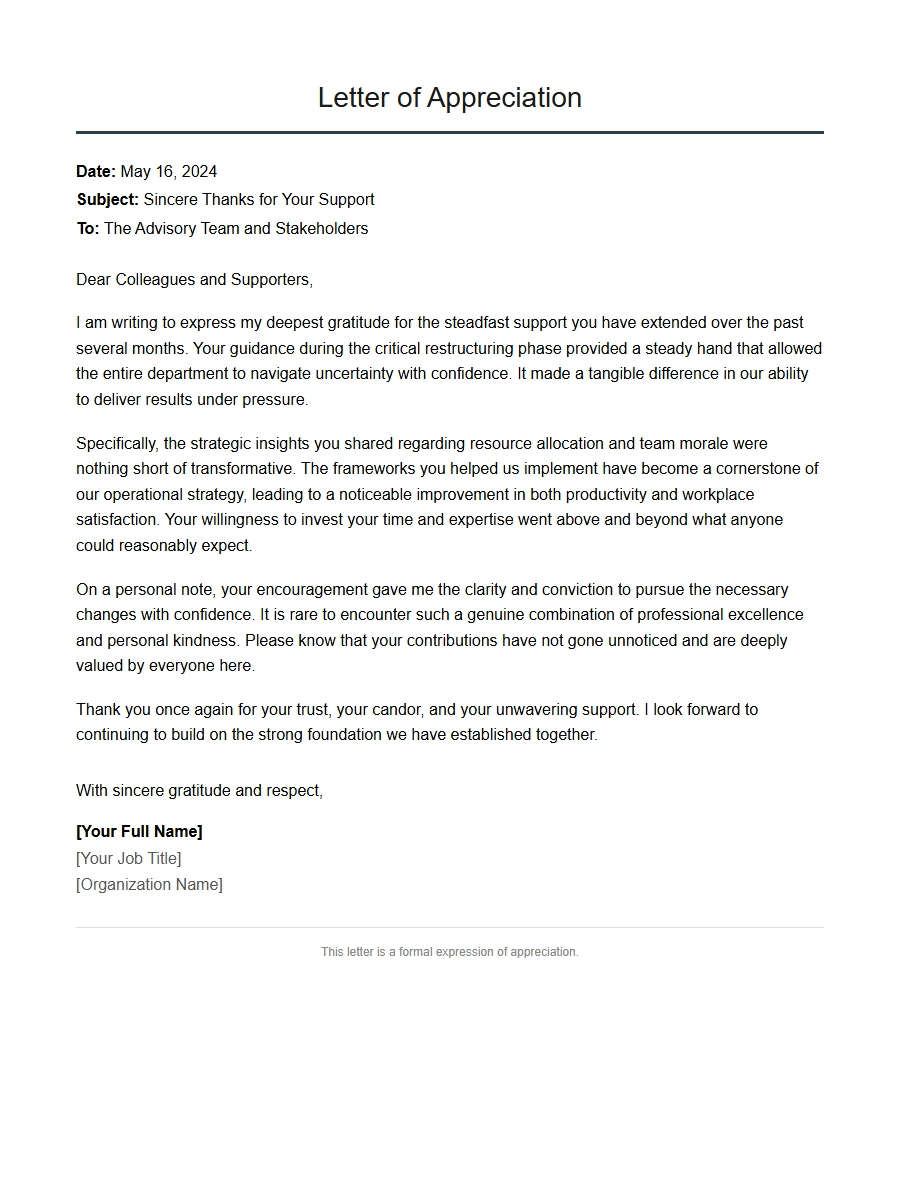 Sample Thank You Letter for Support
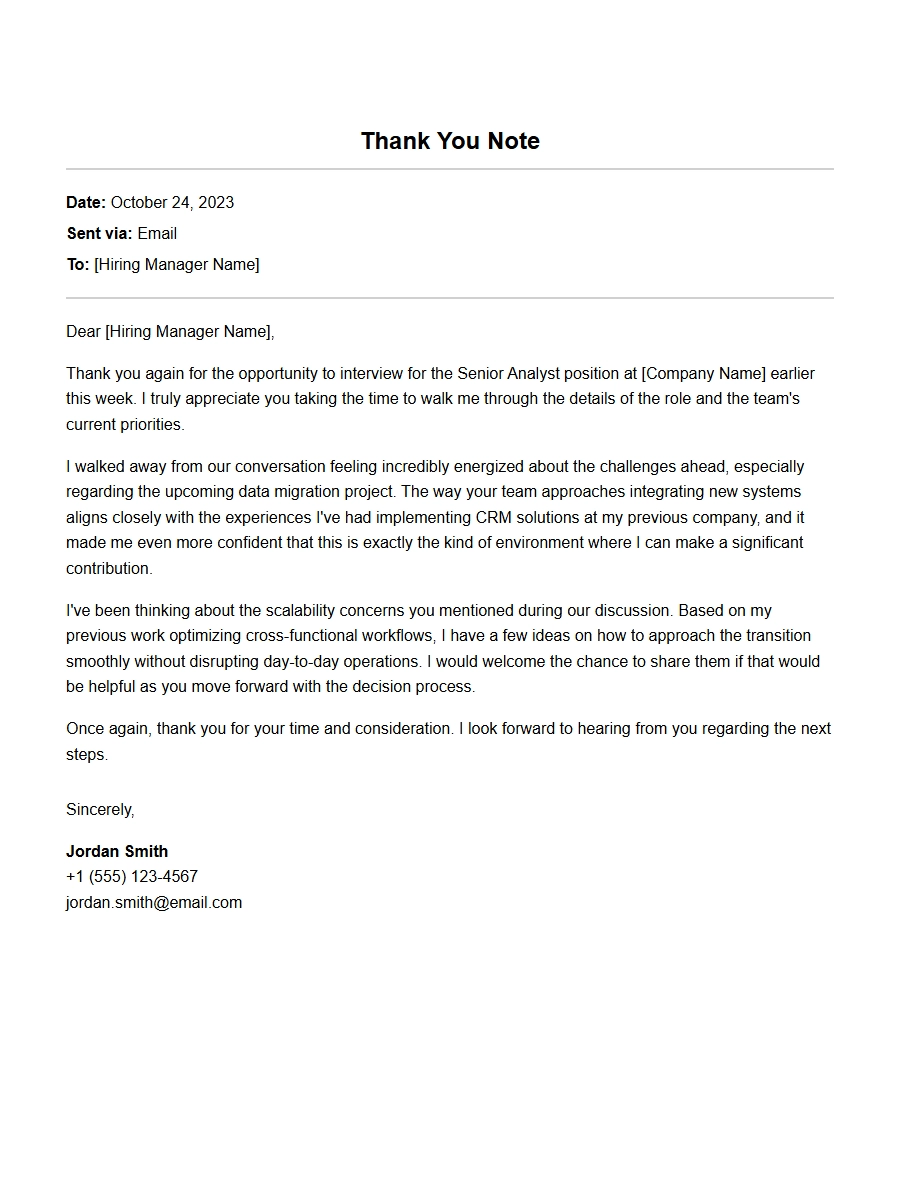 How to Write a Personal Thank-You Note After an Interview