Stepping Aside for Successor: Resignation Letter Example
You're in a leadership role, and it's time to pass the torch. Maybe you're retiring, taking a new position, or simply feel someone else is better equipped to lead. Writing a letter that announces your decision to step aside for a successor can feel delicate. You want to be gracious, clear, and professional—without sounding like a press release. That's where a solid example helps. Not as a crutch, but as a starting point that gets your thoughts organized.
What “stepping aside for a successor” actually means
This isn't a standard resignation. You're not leaving because of dissatisfaction. Instead, you're making a deliberate choice to hand over responsibility—often in a nonprofit, family business, or executive role. The letter needs to acknowledge your successor's strengths, reassure stakeholders, and explain your reasoning with dignity. A good example of stepping aside for a successor shows you how to balance humility with confidence.
Why a sample isn't cheating
Think of a letter template as a map. It saves you from wandering into awkward phrasing or leaving out key details. The best samples offer structure, standard business letter format, and tone cues—but they leave room for your voice. You adapt the salutation and closing, adjust the level of formality, and swap in your specific reasons. It's a smart shortcut, not a shortcut on authenticity.
How to choose the right example for your situation
Not every stepping-aside letter looks the same. If you're leaving a board position, your tone is more formal and your letterhead design matters. If you're stepping down from a small team, you can be warmer and more direct. Look for samples that match your industry and the relationship you have with your readers. A resignation letter sample for an executive role will have different language than one for a volunteer coordinator. Pay attention to the salutation and closing—those small signals set the right tone.
Once you find a good example, read it through. Notice how the writer frames the transition as a positive move for the organization. That's the core: you're not abandoning anyone, you're enabling growth.
Adapting a sample without losing your authentic voice
Start by replacing the placeholder details—names, dates, titles. Then read each sentence aloud. Does it sound like you? If it feels too stiff, loosen the phrasing. For instance, instead of “I hereby announce my departure,” try “I've decided it's the right time to hand over leadership to [Successor].” The structure stays the same, but the tone becomes yours.
One common mistake is ignoring the format. If you're sending a digital letter, skip the letterhead and use a clean subject line. If it's printed, include your contact info and date. Digital letter format is simpler but still needs a proper salutation (e.g., “Dear Team” or “Dear Board Members”).
Where most people stumble
They copy the sample's opening paragraph word for word. That opening is your hook—it sets the reader's expectation. Tailor it to your specific reason for stepping aside. Are you pursuing a new role? Mention it briefly. Are you making room for fresh ideas? Say that. The rest of the letter can follow the sample's flow, but that first paragraph should feel personal and direct.
Another pitfall: forgetting to proofread your final version. Proofreading your letter catches awkward transitions and typos that undermine your professionalism. Read it once for content, once for tone, once for spelling. Better yet, have a colleague glance at it.
Practical tips for writing your own letter
Keep it short. Two or three paragraphs is usually enough. State your decision, explain the timing, express confidence in your successor, and offer to help during the transition. Don't over-explain or justify—you're stepping aside, not defending yourself.
Stepping aside letters often fall under “graceful exits.” They're similar to a resignation letter for an internship in that you want to leave a good impression, but the stakes are higher. Stakeholders will read this. Make sure your letter demonstrates stability, not uncertainty.
One more thing: handling the handoff
Your successor might be reading the same letter. Mention them by name and highlight one or two qualities that make them the right choice. This reinforces confidence in the team and shows you're thinking about continuity. If you're also drafting a separate note for the successor, treat it like a voluntary dismissal notice with a personal touch—clear but supportive.
And if you're unsure about the timing, check your contract. Some roles require a formal resignation letter explaining your last day even when you're stepping aside for someone else. Get those details right to avoid confusion.
Finally, think of this letter as a springboard. It's not the last thing people remember about your leadership—it's the first step toward a smooth transition. Use the example to get started, then make it yours. The more you write these letters, the faster and more natural the process becomes. Next time, you won't even need the sample.
Common Sample Formats
Stepping Aside for Successor: Resignation Letter Example
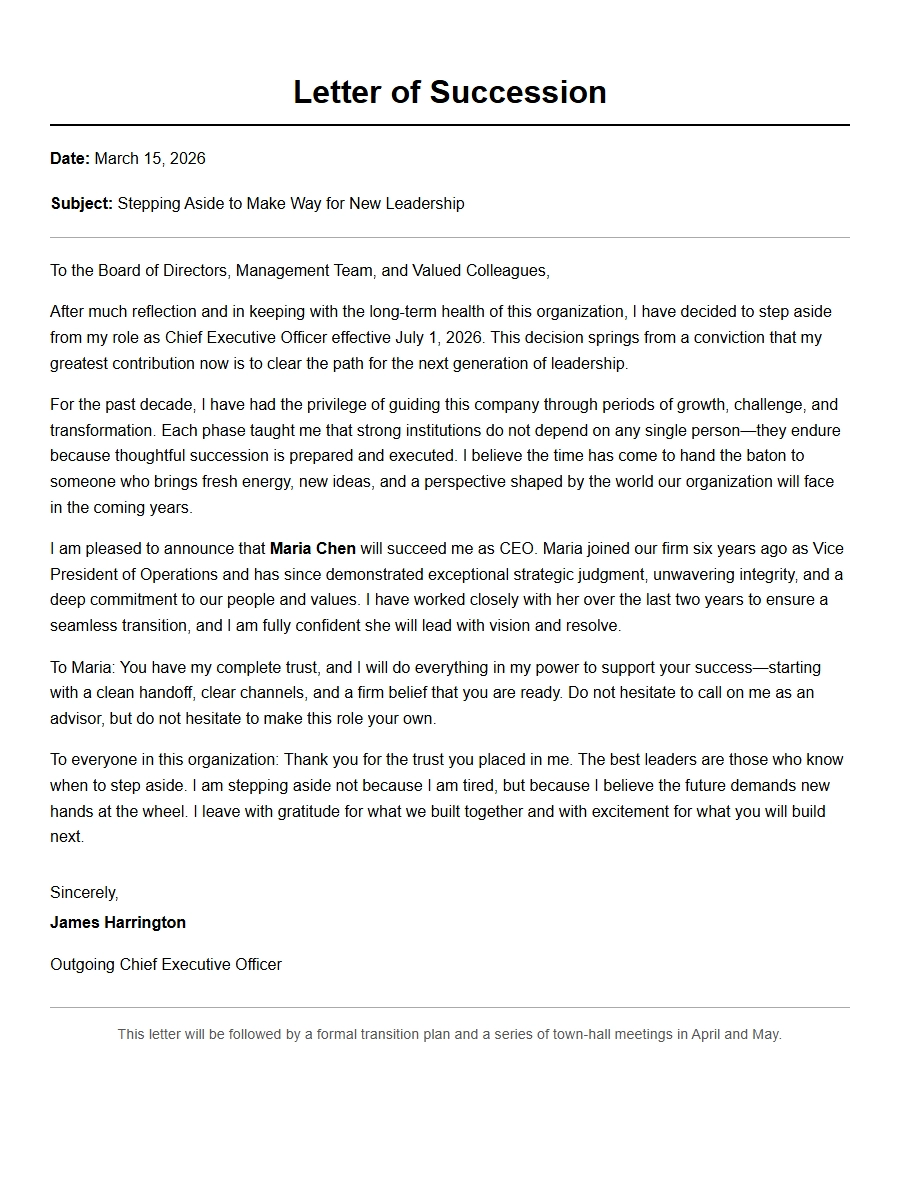
CEO Steps Down for Successor in Merger Transition
Dear Board of Directors,
I am writing to formally resign as Chief Executive Officer, effective as of the merger completion date. I believe stepping aside now allows my successor, Maria Chen, to lead the integration with her deep experience in cross-company operations. To ensure a smooth handover, I have prepared the following transition items:
Strategic roadmap for first 100 days
Key stakeholder contact list (board, major investors, regulators)
Pending decisions on product alignment
I will remain available for consultation for two weeks after my departure. It has been a privilege to serve this organization, and I am confident that Maria’s leadership will drive our combined future.
Sincerely, James T. Hart
Manager Resigns to Promote Next-Gen Leader
Dear Human Resources,
Please accept this letter as my resignation from the role of Senior Operations Manager, effective 30 days from today. I have long believed that innovation thrives when new voices take the helm. My successor, Priya Singh, has proven her ability through three successful product launches. I am stepping aside to give her the platform she deserves.
Below is a summary of handover responsibilities:
Area
Status
Owner
Supply chain contracts
Renewed through Q4
Priya Singh
Team mentoring program
Ongoing weekly sessions
Priya Singh
Budget planning FY25
Draft complete
Finance lead
I will ensure all documentation is updated and will introduce Priya to key partners before my last day. Thank you for the growth opportunities.
Best regards, Liam O'Brien
Founder Steps Aside for Hired CEO to Scale Company
To the Board and executive team,
I am resigning as President and Founder, effective immediately upon the onboarding of our new CEO, David Wu. My vision of turning a startup into a mature enterprise requires a leader with experience scaling beyond $100M revenue. I am stepping aside to let David bring his operational expertise.
Key handover priorities include:
Transition of investor relationships to David and CFO
Transfer of founder-led culture initiatives to Chief People Officer
Escrow of IP and founder shares (see legal agreement attached)
I will serve in an advisory role for six months. The company’s future is bright with David at the helm.
Warmly, Sophia Alvarez
Department Head Steps Aside for Promoted Internal Candidate
Dear All,
I am resigning from my position as Head of Marketing to allow my deputy, Raj Patel, to assume the role. Raj has led our digital transformation and doubled lead generation in nine months. I believe his internal promotion will boost team morale and continuity.
Below is the transition plan timeline:
Week
Action
Deliverable
1
Joint client meetings
Introduction emails sent
2
Budget handover
Updated forecasts
3
Team one-on-ones
Individual development plans
I will ensure all metrics dashboards are shared and documented. I have full confidence in Raj’s ability to take this department to the next level.
Sincerely, Julia Chen
Interim Director Resigns After Permanent Successor Found
Dear Search Committee,
I hereby resign from my interim directorship, effective upon the start date of Dr. Amanda Foster. I was asked to steady the ship after the previous director’s departure, and I promised to leave once a permanent leader was in place. Dr. Foster’s background in public health aligns perfectly with our mission.
Handover summary:
All ongoing projects transferred to Dr. Foster via shared drive
Key contacts: three grant sponsors, two regulatory bodies
Pending budget submissions for next fiscal year
I am grateful for the trust and happy to assist Dr. Foster during the first week if needed.
Respectfully, Mark Reynolds
Project Lead Steps Aside for Successor to Finalize Implementation
Dear Project Stakeholders,
I am resigning as Project Lead for the ERP implementation, effective two weeks from today. The project is 85% complete, and I believe it is the right moment to step aside so that my successor, Emma Liu, can see it through to go-live. Emma has been the technical architect and knows every module intimately.
Transition checklist:
Risk register review – complete
Vendor contract completion – Emma will manage final acceptance
Training documentation – handover scheduled for next Monday
I will support Emma remotely for one month if required. Thank you for allowing me to build the foundation.
Best, Carlos Mendez
Senior Advisor Steps Aside for Junior Successor to Foster Innovation
Dear Managing Partner,
With a mix of pride and humility, I resign from my Senior Advisor position, effective in 30 days. I have spent twenty years in this role, but our industry is changing rapidly. I am stepping aside to make room for my mentee, Maya Torres, whose digital strategy insights have already revitalized two client engagements.
Internal training curriculum – to be co-led with Maya during final weeks
I am confident Maya will bring the fresh perspective our firm needs.
Yours sincerely, Robert Kim
Law Firm Partner Steps Aside for New Partner’s Expertise
Dear Partnership Board,
I write to resign my partnership effective at the end of this fiscal year. I am stepping aside to welcome our incoming partner, Lisa Grant, whose expertise in intellectual property law will expand our practice significantly. Lisa has been an exceptional senior associate, and her leadership will better serve our clients.
Matters requiring handover:
Client
Matter
New Responsible Partner
TechWave Inc.
Patent portfolio review
Lisa Grant
BioHealth LLC
Trademark dispute
Lisa Grant (with mentor support)
Internal – Pro Bono Committee
Chair role
Lisa Grant
I will ensure all billing and case files are current. I look forward to supporting Lisa during the transition.
Respectfully, David Ng
Coach Resigns to Let Assistant Coach Lead the Team
Dear Athletic Director,
I am resigning as head coach of the women’s soccer team, effective immediately after our final match this season. I have been grooming my assistant, Sarah Jenkins, for two years, and she is ready. Stepping aside now gives her the continuity she needs to build on our winning strategy.
Handover details:
Season training plans – digital folder shared with Sarah
Recruitment contacts for three key prospects
Player development plans – individual feedback sessions completed
I will help with the transition camp next month. Sarah’s passion and tactical acumen will take the team further.
Thank you, Coach Mike Turner
Board Member Steps Aside for Successor with Specific Expertise
Dear Chairperson,
I hereby resign from the Board of Directors, effective at our next annual meeting. I have served for eight years, but our strategic shift toward renewable energy demands specialized knowledge. I am stepping aside to make room for Dr. Aisha Patel, whose engineering background and industry network are exactly what we need.
Areas to transition:
Audit committee responsibilities – Dr. Patel will join as observer for two meetings
Mentorship of two junior board candidates – completed
 Polite Resignation Email for Remote Employees
 Short Resignation Letter for Contractor Position
 Teacher Resignation Letter Example
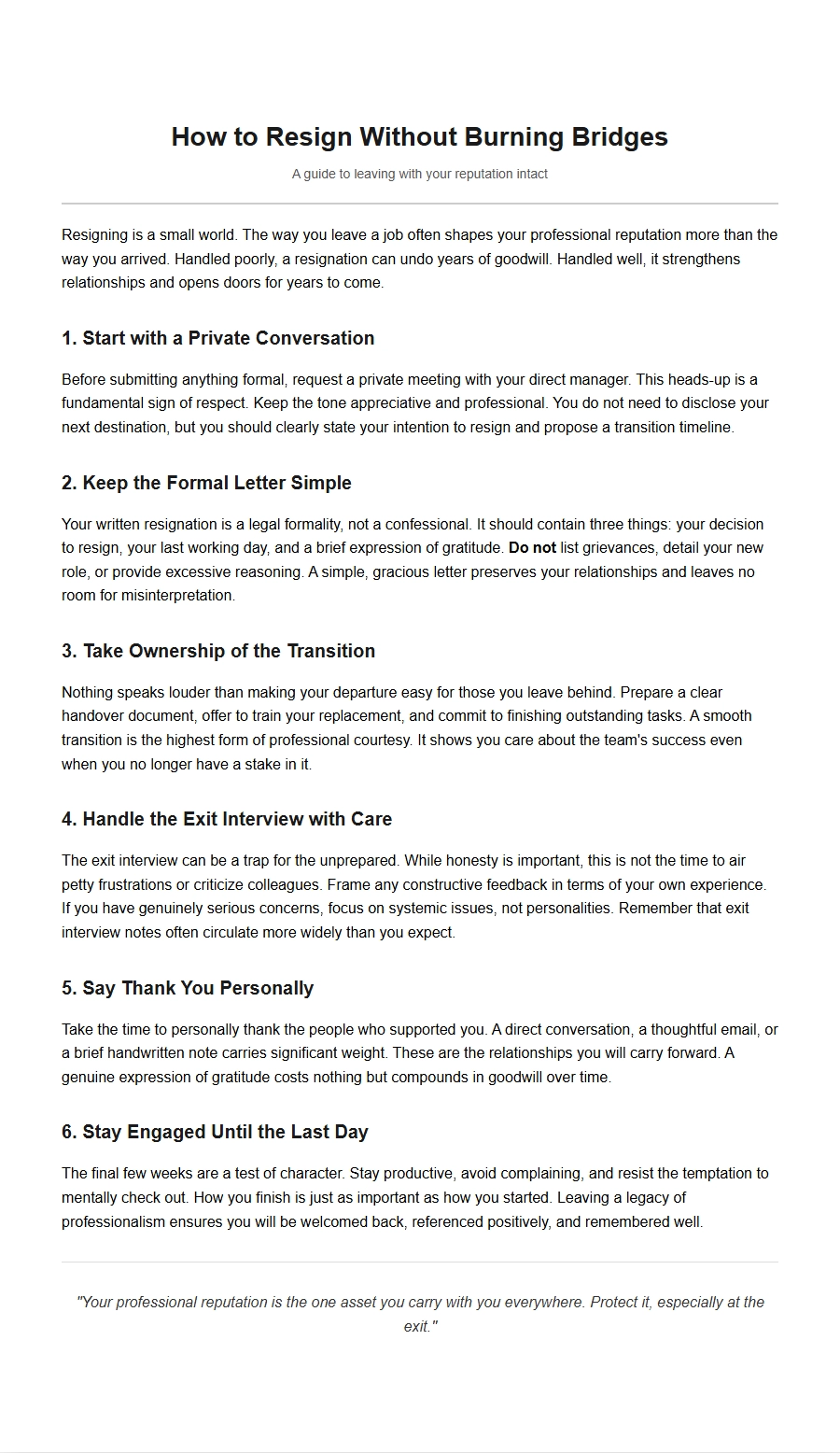 How to Resign Without Burning Bridges
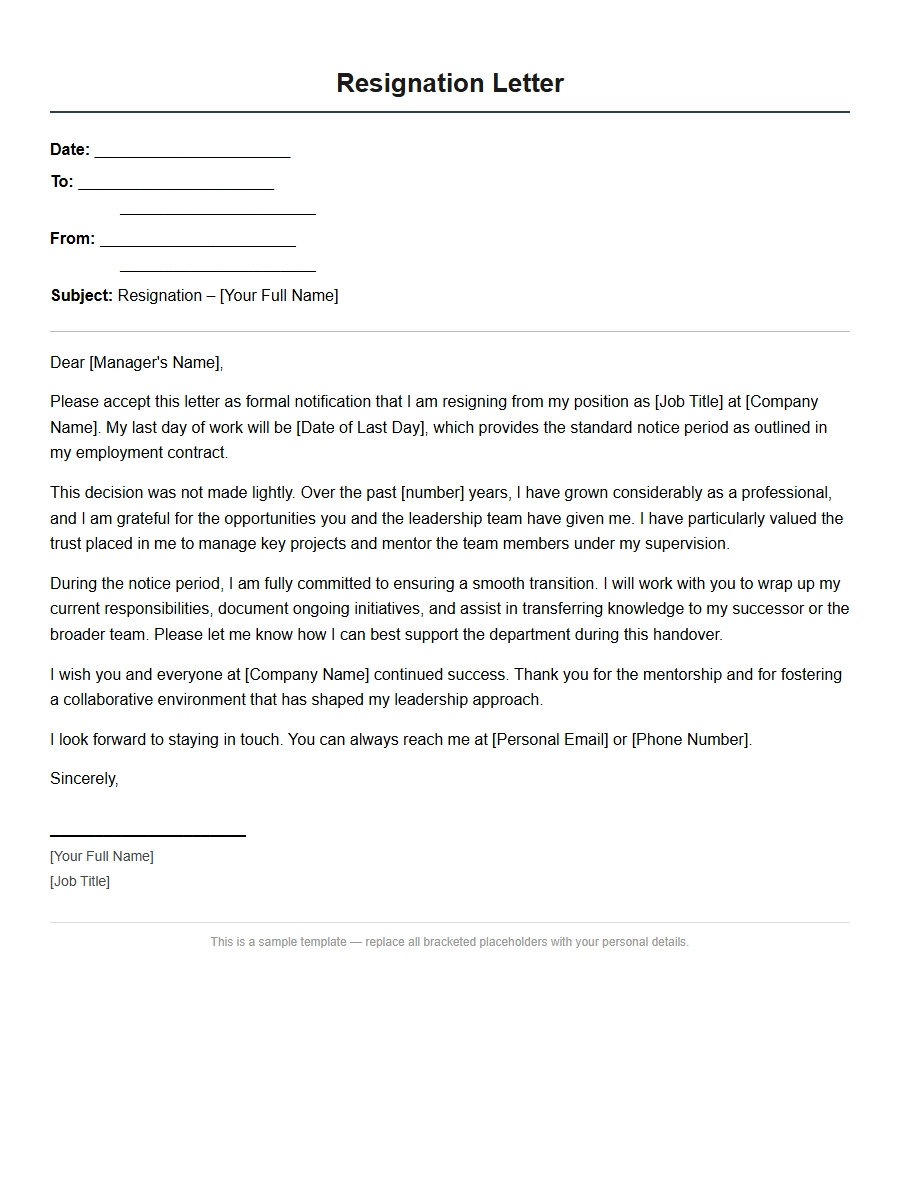 Formal Resignation Letter Sample for Manager
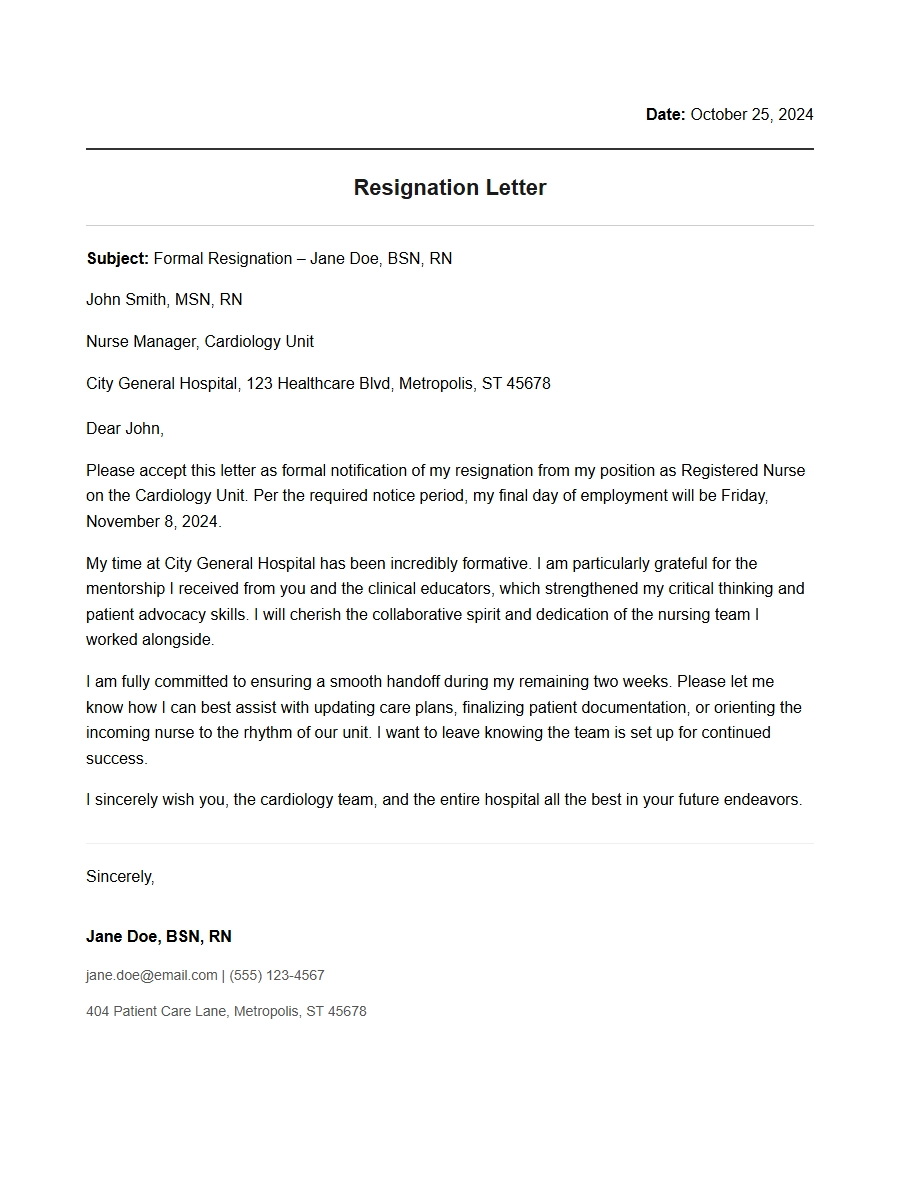 Nurse Resignation Letter with 2 Weeks Notice