You need to send a resignation letter for your internship today, but your mind is blank. Maybe you’re worried about burning bridges, or you just don’t know the right tone. I’ve been there. The good news is that a solid graceful exit resignation letter for internship doesn’t have to be written from scratch. Using a sample isn’t cheating—it’s a smart way to get structure, tone, and the right phrases while keeping your own voice.
Why a sample saves you time (and worry)
A resignation letter sample gives you a starting point that already follows letter writing etiquette. You don’t have to guess the salutation and closing or wonder whether to use “Dear [Name]” or “To whom it may concern.” It also shows you the standard business letter format for printed letters or the digital letter format for emails. You can adapt the core message to your situation—whether you’re leaving an internship early, finishing on a good note, or moving to another opportunity.
Category: Internship Resignation Letter
What a graceful exit letter looks like
A graceful exit letter is professional, appreciative, and clear. It thanks the supervisor and team, states your last working day, and offers to help with the transition. It doesn’t complain or over-explain. Think of it as a short piece of professional correspondence that leaves the door open for future letters of recommendation.
Here’s a simple outline you can follow:
Opening: Express gratitude. Something like “Thank you for the opportunity to intern with [Company].”
Statement of resignation: Clearly say you’re resigning and mention your last day.
Brief reason (optional): Keep it positive. “I’ve decided to focus on my final semester coursework.”
Offer to help: “I’m happy to help wrap up any pending tasks.”
Closing: Warm regards and a thank you again.
That’s the letter structure that works for almost any internship resignation. You can use it as a customizable letter that you tweak based on your relationship with your manager.
How to adapt a sample without losing your authentic voice
I see people copy a letter template word-for-word and it sounds robotic. Instead, read the sample, then rewrite it in your own words. Keep the tone friendly but not too casual. For example, if the sample says “I am writing to formally resign,” and you usually write “I’m letting you know I’m moving on,” go with the second. Tone in writing matters—especially for an internship where you’re likely younger than your manager. You want to be respectful but not stiff.
One common mistake is using outdated salutations like “Dear Sir/Madam.” That’s fine for a very formal company, but for most internships, “Dear [First Name]” works. Also, if you’re sending it by email, skip the letterhead design—just a clean subject line and your name at the bottom. Formal writing tips often say to maintain consistency: if you use “Dear [Name]” in the salutation, use “Sincerely” or “Best regards” in the closing.
Tailor the opening to grab attention (in a good way)
Your first sentence sets the tone. Don’t start with “I hope this email finds you well” because it’s overused. Instead, say something specific: “I’m writing to thank you for a great three months and to let you know I’ll be leaving my internship on June 30.” That’s direct and appreciative. If you’ve worked closely with a mentor, you could even mention a project you enjoyed. That personal touch shows letter writing etiquette at its best.
Mistakes to avoid when writing your resignation letter
First, don’t ignore the format. If your company uses email, send it as an email, not an attachment unless requested. Second, proofreading letter is non-negotiable—a typo in a resignation letter looks sloppy. Read it aloud or ask a friend to check it. Third, avoid negative reasons. Even if you hated the internship, the resignation letter is not the place to vent. Keep it positive and short.
Another mistake is forgetting to mention a transition plan. Offering to help shows maturity. You can say “I’m available to train the next intern or document my work.” That makes the exit graceful.
When you might need a more formal letter
If your internship was at a large corporation or a government agency, they might expect a formal declaration of intent to stop working (that’s a longer version of a resignation letter). In that case, your sample should include the full date, your manager’s full name, and a subject line. For most startups or smaller teams, a short email is fine. Knowing the culture helps you choose the right cover letter examples that match—but for resignation, it’s the same principle. You can also look at resignation letter referencing end of fiscal quarter if your timing aligns with a project milestone.
If you’re moving to another role inside the same organization, you’d write a different kind of letter. But for leaving an internship, keep it simple.
Make the letter feel both professional and personal
Use the sample as a springboard. Fill in the blanks with real details: the skills you learned, a thank you for a specific opportunity, and your future plans (if relevant). That’s what makes a resignation letter sample become your own. And don’t forget to send it to your supervisor and CC HR if needed.
After you send it, you might want to follow up with a handwritten thank-you note. That’s going above and beyond, but it can lead to a strong letter of recommendation later. The key is to leave with grace—so even if you’re stressed, your letter should sound calm and grateful.
Now you have a clear path. Write your draft, tweak the tone, and proofread. Soon you’ll have a polished resignation letter that feels good to send. And next time, you’ll write one in half the time because you’ll know the structure by heart.
Ready-to-Use Examples
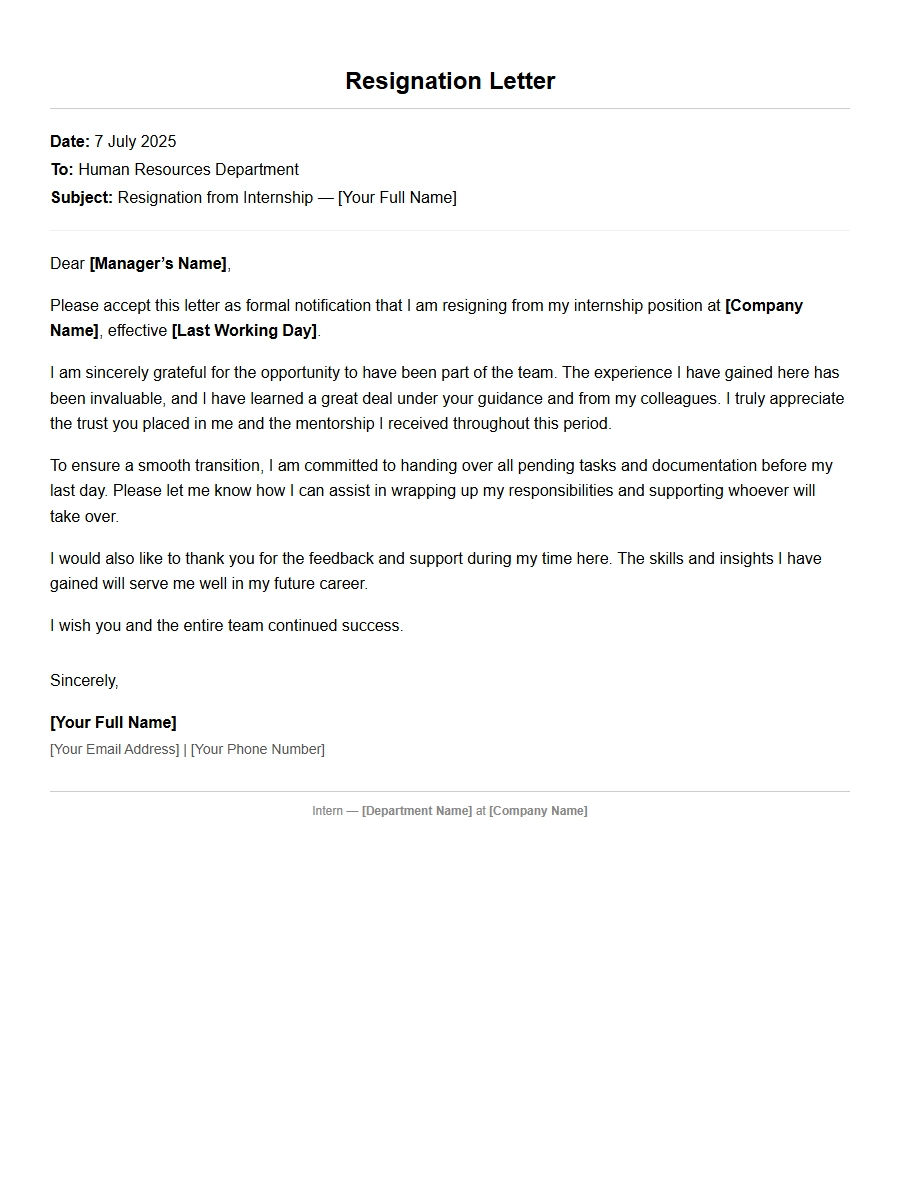
Graceful Exit Resignation Letter for Internship
Standard Gratitude-Focused Internship Resignation
Date: August 15, 2024
To: Margaret Chen, Internship Coordinator
From: Alex Rivera
Re: Resignation from Marketing Intern Position
Dear Margaret,
Please accept this letter as formal notification that I am resigning from my internship position at BrightWave Media, effective September 12, 2024. This decision was not easy, as my time here has been incredibly rewarding.
I want to express my sincere gratitude for the mentorship and hands-on experience I’ve gained. The projects I worked on—especially the social media campaign for EcoLeaf—taught me skills I will carry into my career. I appreciate the trust you placed in me to manage real responsibilities.
To ensure a smooth transition, I have prepared a handover document listing ongoing tasks, key contacts, and file locations. I am happy to discuss any details or help train my replacement. Below is a summary of my remaining deliverables:
Task
Deadline
Status
Weekly blog posts
Aug 30
Draft ready
Client report analysis
Sep 5
In progress
Thank you again for this opportunity. I will ensure my departure is as orderly as possible and am available via email if questions arise later.
Sincerely, Alex Rivera
Short Notice Internship Resignation with Apology
Date: September 3, 2024
To: David Okafor, HR Manager
From: Julia Kim
Re: Resignation – Engineering Intern | Personal Circumstance
Dear David,
With deep regret, I submit my resignation effective September 10, 2024, due to an unexpected family health matter. I apologize for the short notice, but I believe it is only fair to step aside now rather than compromise my performance.
I am grateful for the training I received at InnoTech Solutions. The weekly code reviews and agile stand-ups gave me real-world perspective. I have compiled a quick-reference list of my active tickets and documentation:
Ticket #452: API endpoint testing – 80% complete
Ticket #467: Bug fix on login module – resolved last week
Documentation: Setup guide for local environment (in /docs)
I am willing to work extra hours this week to finish the API tests. I also created a short video walkthrough of my current workflow, which I can share.
Thank you for understanding. Please let me know if you need further details.
Best regards, Julia Kim
Professional Intern Resignation with Future Reference Request
Date: October 1, 2024
To: Sarah Lee, Director of Operations
From: Michael Turner
Re: Resignation – Operations Intern
Dear Sarah,
I am writing to formally resign from my internship at Horizon Logistics, effective October 31, 2024. This was a difficult decision, but I have accepted a full-time position in another city. I want to sincerely thank you for the invaluable learning experience.
During my three months here, I improved my spreadsheet modeling skills, learned supply chain basics, and attended client meetings. I especially enjoyed optimizing the warehouse scheduling system, which reduced idle time by 15%. I hope I can count on you as a reference for future opportunities.
To make my departure seamless, I have listed my ongoing projects and pending deadlines below:
Project
Completion %
Next Steps
Inventory reconciliation
70%
Crosscheck with November shipments
Vendor contact sheet update
100%
Already saved on shared drive
I will return all company property (badge, laptop, password list) on my last day. I am grateful for your mentorship and hope to stay in touch via LinkedIn.
Warmly, Michael Turner
Intern Resignation for Academic Focus
Date: November 12, 2024
To: Laura Bennett, Program Manager
From: Olivia Ross
Re: Resignation – Research Intern | End of Semester
Dear Laura,
Please accept my resignation from the research internship at DataPulse Labs, effective December 5, 2024. With final exams approaching, I must focus on my coursework to maintain my GPA, which is essential for graduate school applications.
I appreciate the flexibility you gave me in balancing work and study. The statistical analysis I conducted on the customer churn dataset taught me Python and R in a real context. I have documented my methods and results in a shared folder. Highlights include:
Created a correlation matrix that identified key churn drivers
Built a simple logistic regression model (accuracy: 78%)
Drafted a one-page summary of recommendations for the client
I have already spoken with my colleague James to take over the weekly reporting. I will also leave a step-by-step guide for refreshing the data pipeline. I am happy to be available via email for quick questions up to December 15.
Thank you for understanding my need to prioritize academics. This internship has been a highlight of my year.
Respectfully, Olivia Ross
Intern Resignation Citing Career Change
Date: December 20, 2024
To: James Collins, Team Lead
From: Ethan Park
Re: Resignation – Design Intern
Dear James,
I am writing to resign from my position as a design intern at Creative Studio, effective January 10, 2025. After much reflection, I have decided to pivot toward user research, an area I discovered my passion for during our usability testing sessions.
I am grateful for the design skills I learned here—wireframing, prototyping in Figma, and presenting to stakeholders. The project I worked on for the HealthTrack dashboard allowed me to see how design impacts user behavior. This inspired me to pursue further training in UX research.
To ensure continuity, I have organized my design files and assets. Key ongoing tasks:
Asset
Status
Delivery Notes
Icon set (revised)
Complete
In shared library
Landing page mockup
90%
Awaiting final copy
I plan to help onboard the replacement intern for two days. Please let me know how I can best support the transition. Thank you for the amazing mentorship—I will carry these lessons forward.
I am resigning from my remote content internship at GreenLeaf Press, effective February 1, 2025. I have accepted a full-time editorial assistant position at another publisher. Thank you for the trust you placed in me despite the distance.
Working remotely taught me to manage my time and communicate proactively. I contributed 12 blog posts, 30 social media captions, and 4 newsletter templates. I compiled a style guide for future interns. My transition checklist:
Transfer all drafts in Google Docs to shared folder “Content Intern Archive.”
Share editorial calendar for February (already drafted).
Provide login credentials for Canva and Buffer to Priya.
Record a 10-minute Loom explaining my content workflow.
I will be fully available until my last day and can do a virtual handoff meeting anytime. I also wrote recommendation blurbs for each major project to help you evaluate the impact.
Thank you for making my first remote internship a success. I hope our paths cross again.
Sincerely, Sophie Laurent
Intern Resignation Due to Full-Time Offer
Date: February 10, 2025
To: Marcus Rivera, Head of Finance
From: Aisha Patel
Re: Resignation – Finance Intern
Dear Marcus,
I am writing to resign from my finance internship at CapitalEdge Investments, effective March 1, 2025. I have received a full-time offer from another firm, and after careful consideration, I have decided to accept it.
My internship here has been foundational. I learned financial modeling, how to read P&L statements, and the discipline of accuracy. I especially valued the weekly mentoring sessions where you explained real market cycles. I hope to apply these skills in my career.
I have prepared a detailed handover document. Below is a summary of ongoing reconciliations:
Account
Last Reconciliation Date
Outstanding Items
Client A – Expense Report
Feb 5
None
Client B – Vendor Payments
Feb 8
Two unverified invoices
I will complete all pending data entry before my last day. I also created a FAQ document for common error codes in the accounting software. Thank you for this opportunity; I leave with immense gratitude.
Respectfully, Aisha Patel
Very Short Intern Resignation with High Gratitude
Date: March 5, 2025
To: Dr. Emily Wang, Lab Supervisor
From: Lucas Hart
Re: Resignation – Lab Intern
Dear Dr. Wang,
Please accept my resignation from the lab internship at BioGen Research, effective March 20, 2025. This decision was difficult because I have grown so much under your guidance.
I cannot thank you enough for teaching me sterile technique, PCR protocols, and data interpretation. The four months here confirmed my desire to pursue a PhD in molecular biology. I will always remember your patience during my first gel electrophoresis.
To ensure the lab continues smoothly, I have:
Logged all samples in the inventory spreadsheet
Labeled and stored all reagents correctly
Written a one-page protocol for the new centrifuge
Informed the graduate student, Marie, of my ongoing culture experiments
I am willing to train anyone who takes over my tasks. I also left a note in the lab notebook explaining a recent anomaly in the cell growth curve. Thank you again for everything.
With sincere appreciation, Lucas Hart
Intern Resignation with Feedback Offer
Date: April 1, 2025
To: Naomi Carter, VP of Marketing
From: Zoe Adams
Re: Resignation – Marketing Intern
Dear Naomi,
I am submitting my resignation as marketing intern at BrightPath Agency, effective April 15, 2025. I have decided to take a gap semester to travel and volunteer. I feel privileged to have been part of this team.
I learned SEO basics, email marketing metrics, and how to brief a designer. My proudest achievement was the “Spring Sale” campaign that achieved a 12% click-through rate. I would love to share my honest feedback about the internship program if you’re interested—I filled out a small survey I can email.
My task handoff includes:
Campaign
Status
Key Files
Email sequence for May
Draft complete
“May_Newsletter_Draft”
Social calendar June
In progress
Shared via Trello
I will transfer all assets to the shared drive and record a short Loom overview. Thank you for the mentorship—your feedback on my writing improved it immensely.
Warm regards, Zoe Adams
Intern Resignation with Detailed Transition Table
Date: May 20, 2025
To: Kevin Huang, IT Manager
From: Natalie Wu
Re: Resignation – IT Support Intern
Dear Kevin,
Please accept this letter as my resignation from the IT support internship at TechBridge Solutions, effective June 7, 2025. I have been offered a junior sysadmin role at a startup, and after careful thought, I have decided to accept.
I am extremely grateful for the hands-on experience with ticketing systems, network troubleshooting, and asset management. I especially appreciated your guidance on configuring VLANs—a skill I will use daily in my new role.
To make the transition as smooth as possible, I have prepared a transition document. Current open tickets and their statuses:
Ticket ID
Issue
Priority
Status
#T-201
Printer offline (floor 2)
Medium
Waiting for hardware
#T-204
New hire laptop setup
High
OS installed, pending software
#T-209
VPN certificate renewal
Low
Documented
I will officially hand over to Jessie tomorrow and have shared my notes on the internal wiki. Thank you for making this internship a stepping stone to my career. I hope to stay connected on LinkedIn.
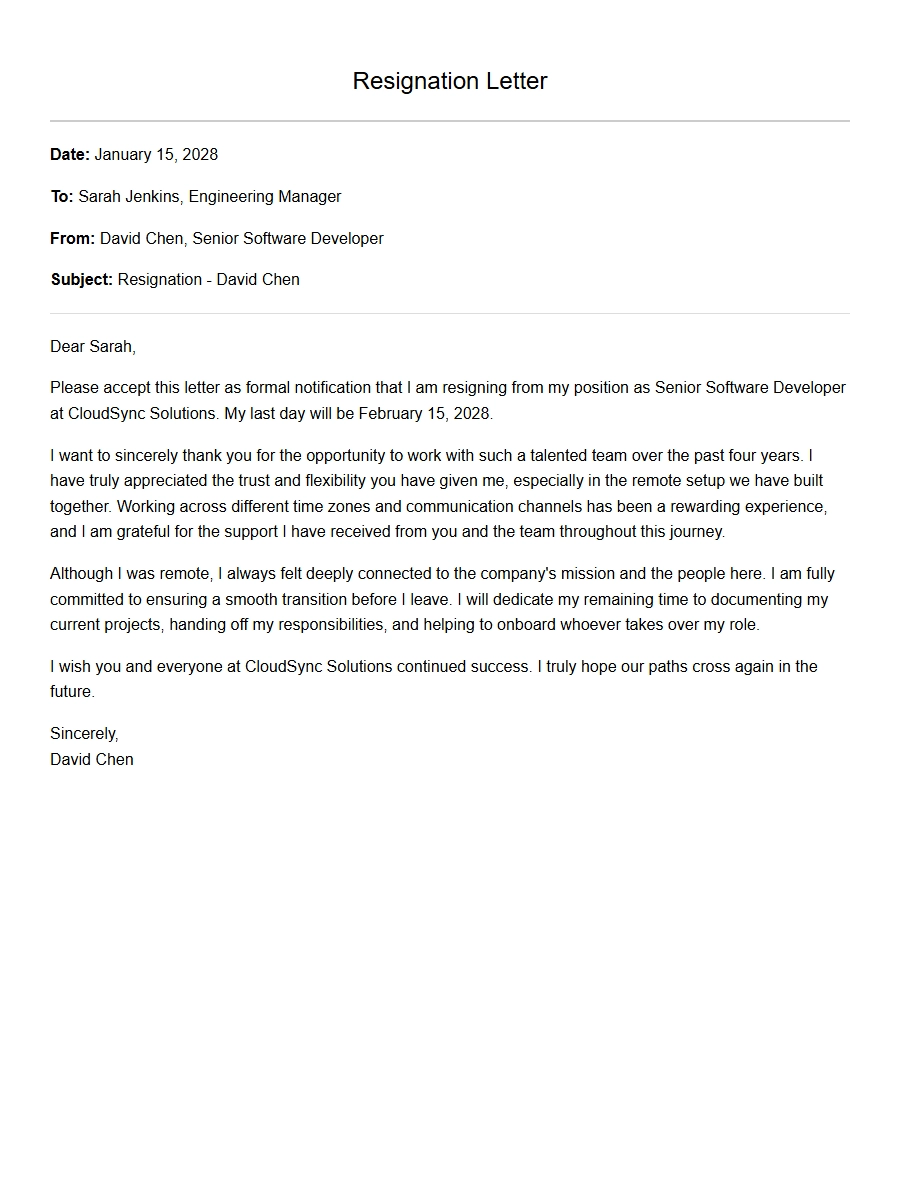 Polite Resignation Email for Remote Employees
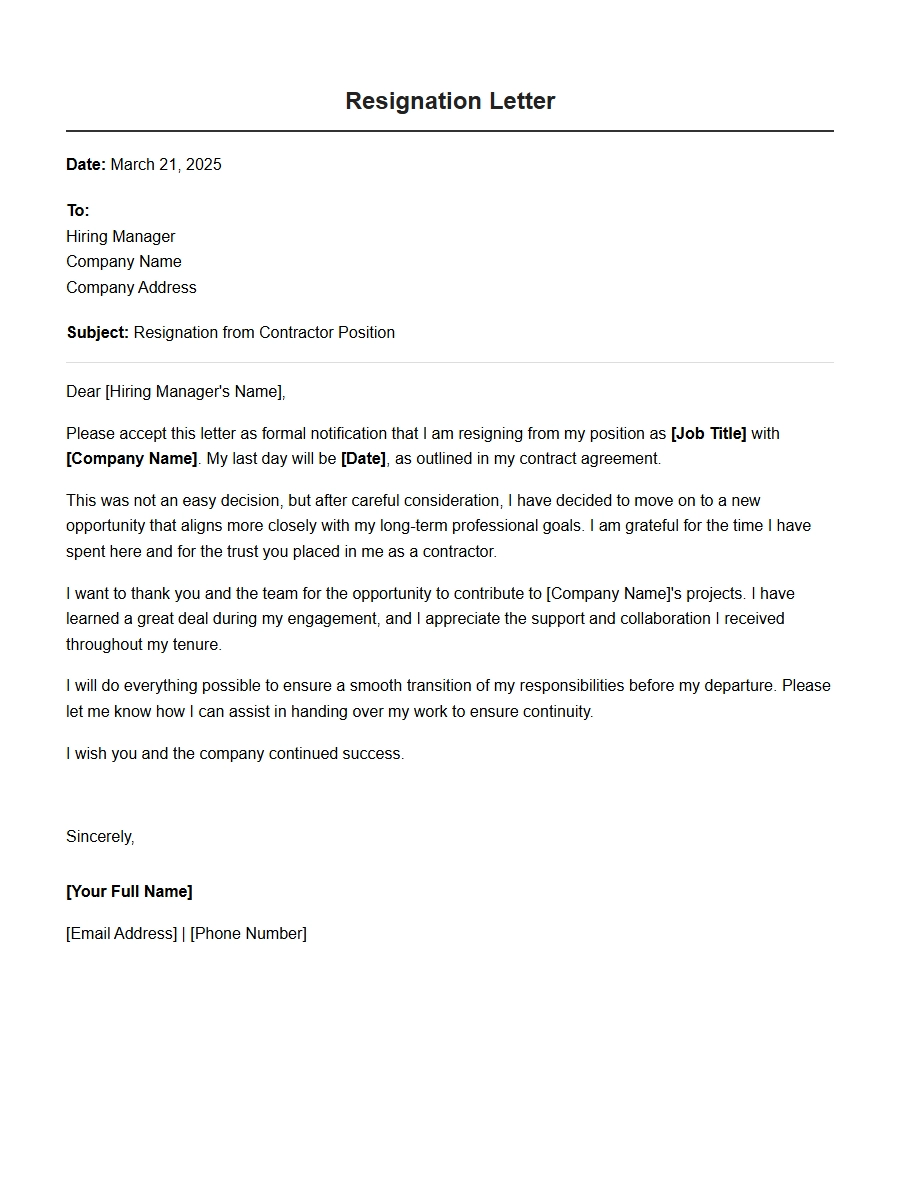 Short Resignation Letter for Contractor Position
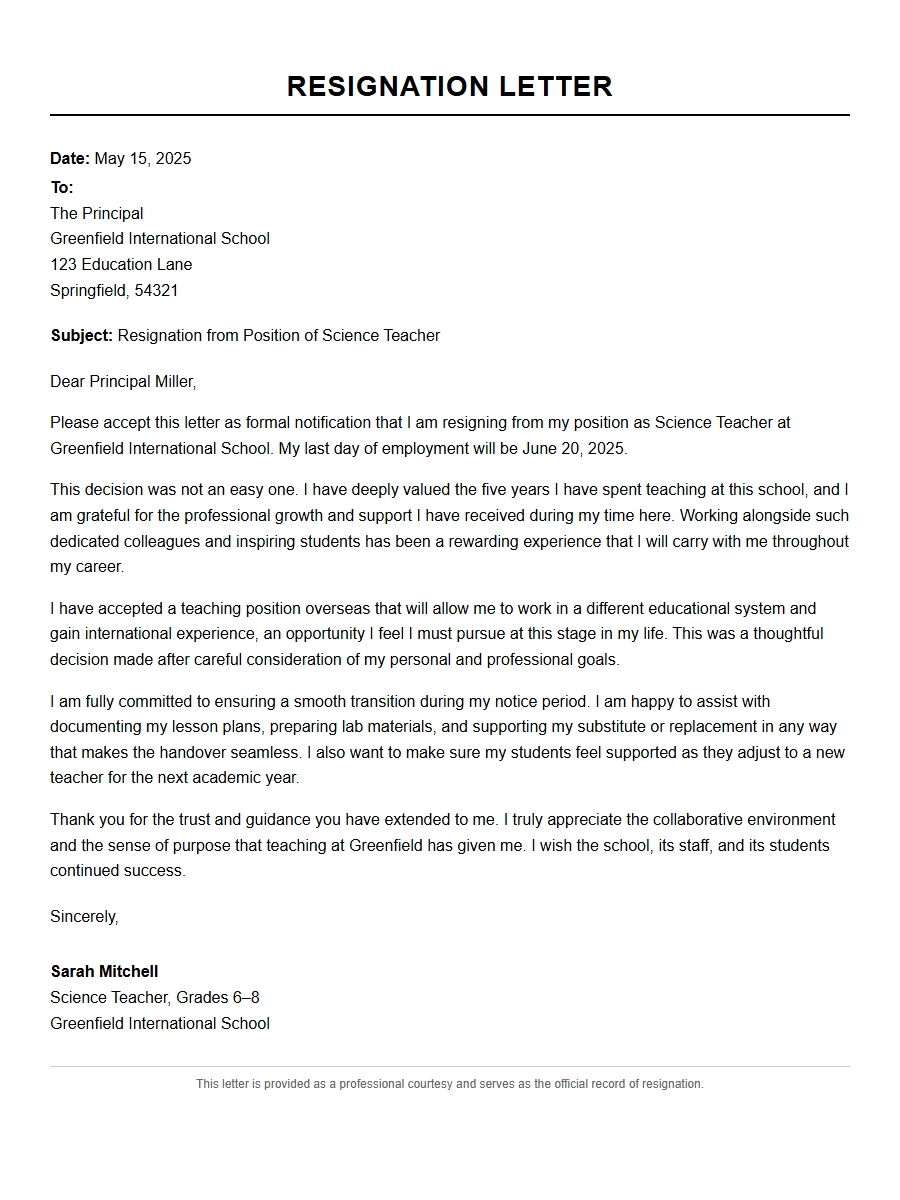 Teacher Resignation Letter Example
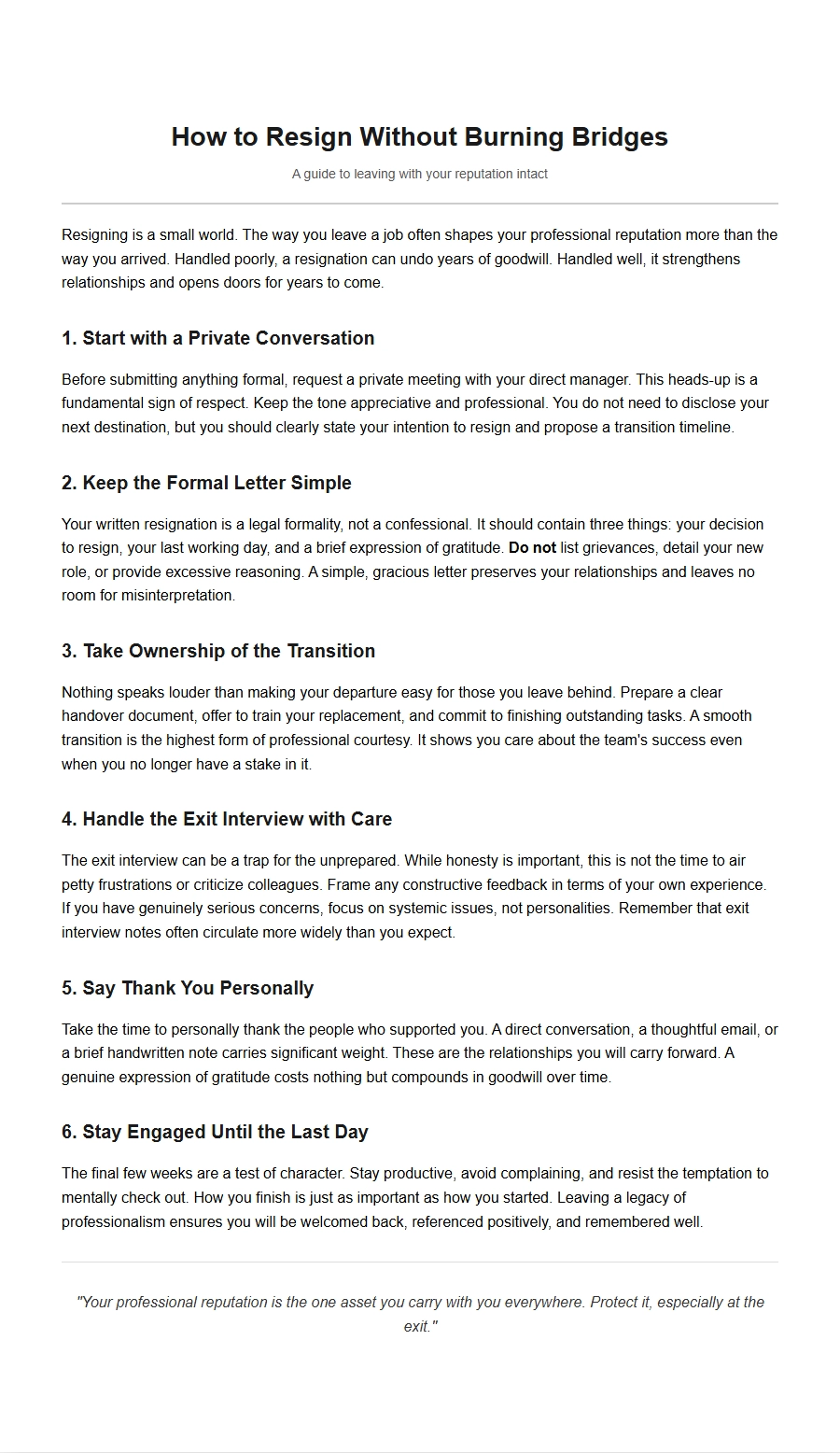 How to Resign Without Burning Bridges
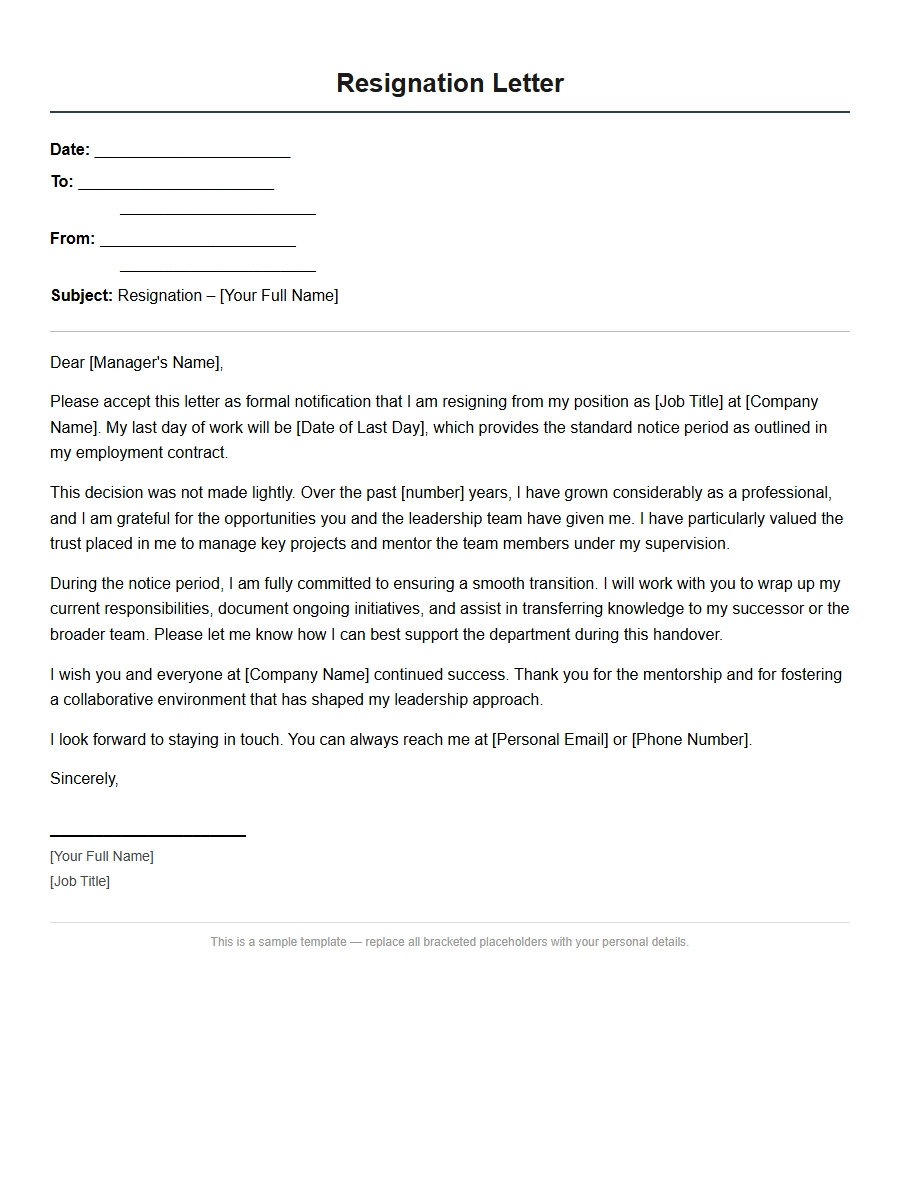 Formal Resignation Letter Sample for Manager
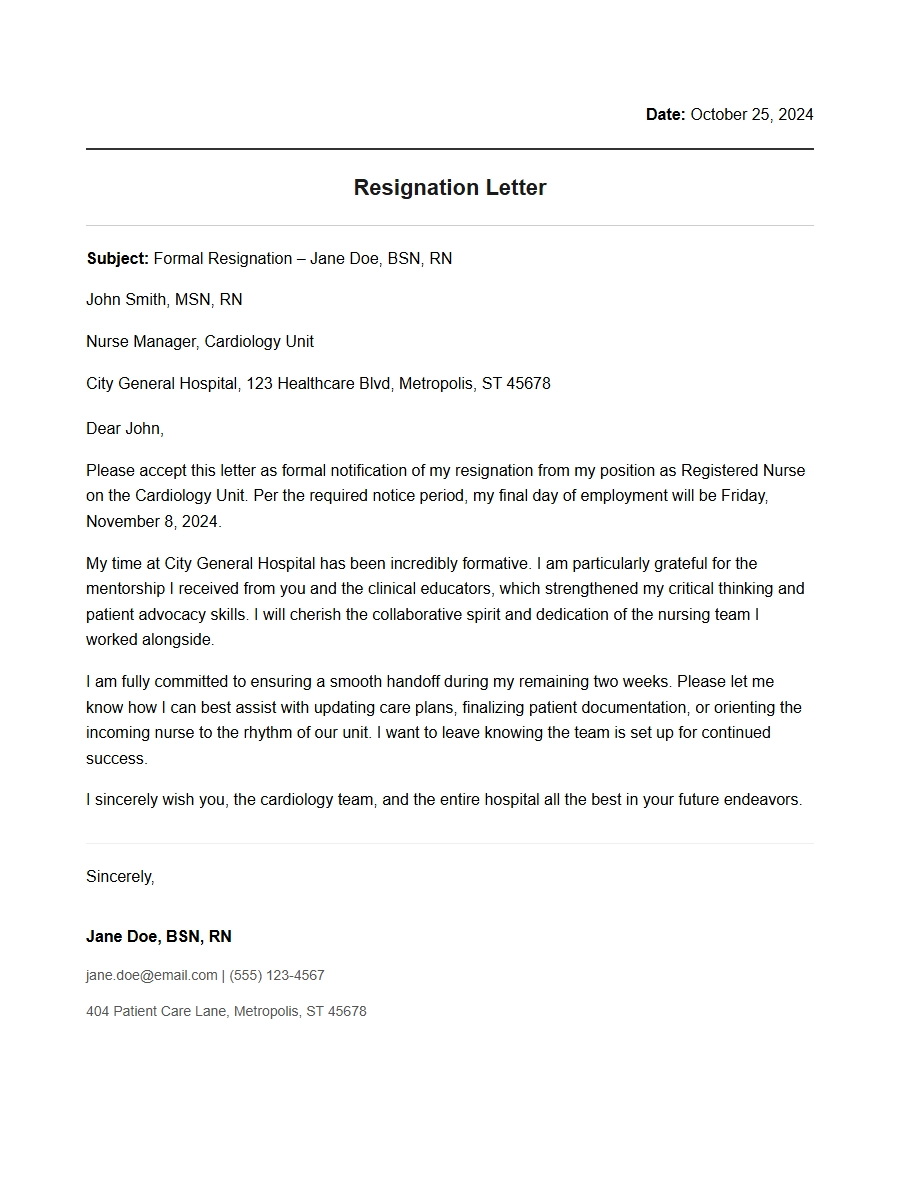 Nurse Resignation Letter with 2 Weeks Notice