You’re staring at a blank page with a cursor blinking like it’s mocking you. The resignation letter needs to be sent today, and every word feels either too stiff or too emotional. If that sounds familiar, you’re not alone. Resigning mid‑year carries its own weight—maybe you’re leaving a project unfinished, navigating a notice period, or just dreading the conversation. The good news? You don’t have to invent everything from scratch.
Using a resignation letter sample isn’t cheating. It’s a shortcut to structure, tone, and key phrases—leaving you room to make the letter yours. Think of a sample as a scaffold; you fill in the personal details without worrying about format. Smart professionals use them all the time, especially when time is tight.
Category: Resignation Letters
Let’s walk through how to pick and adapt a sample so your resignation feels professional but also genuine—not like a robot copied a template. You’ll save time and avoid the common mistakes that make a letter feel off.
How do you pick the right sample for your situation?
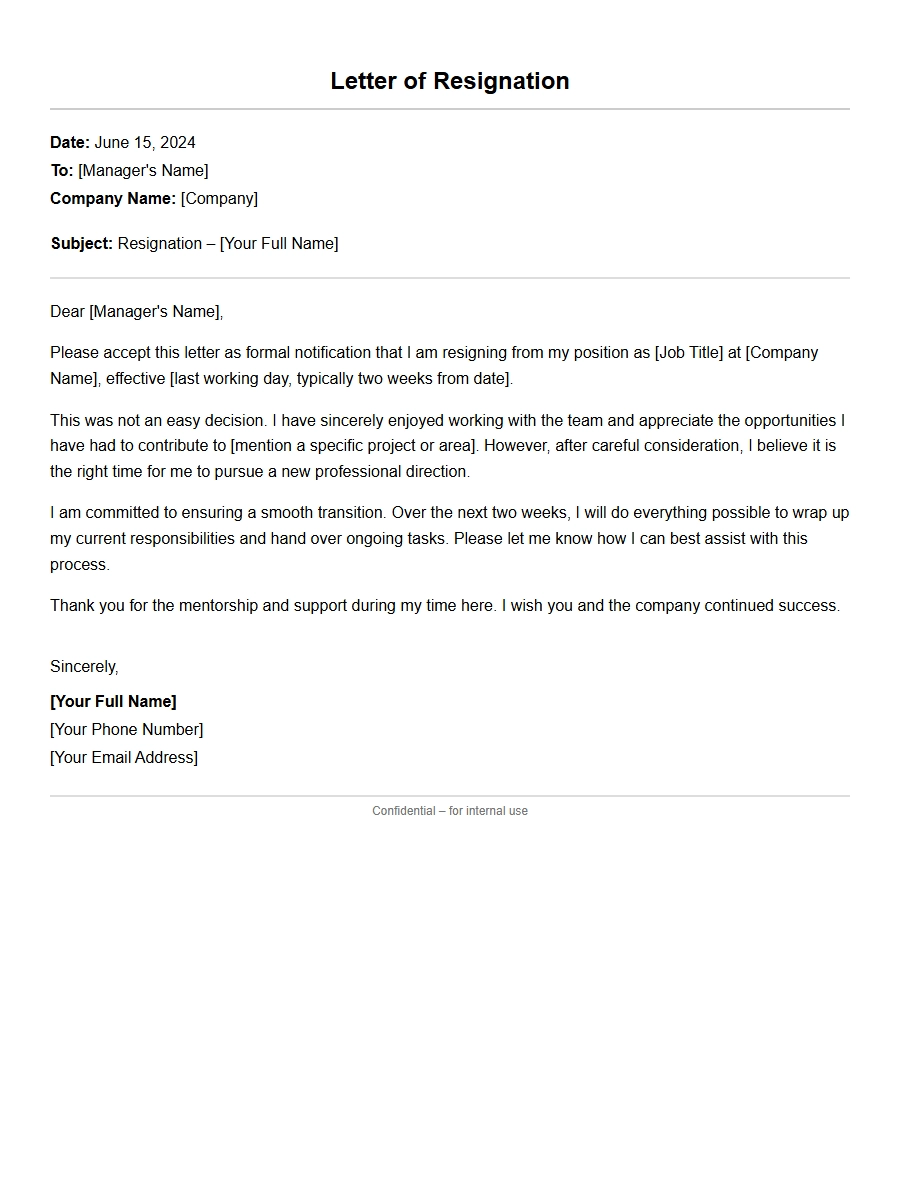
Not all resignation letters are the same. A letter handed to a manager in a close‑knit team will sound different from one sent to HR at a large corporation. If you’re resigning mid‑year, you might need to address unfinished work or mention timing politely. Look for samples that match your industry’s letter writing etiquette. For example, creative fields often accept a warmer tone, while finance or law leans formal. A sample labeled “resignation letter for shift work schedule change” probably won’t fit a corporate office. Instead, search for something like “professional resignation letter for mid‑year departure.” The right business letter format gives you a clean structure: date, inside address, salutation, body, and closing.
How to adapt a template without losing your voice
Once you have a sample, read it through. Then rewrite the opening paragraph in your own words. The sample’s job is to give you the bones—you provide the muscle. For instance, instead of “I am writing to formally resign,” try “After a lot of thought, I’ve decided to move on from my role here.” That small shift makes the tone in writing more natural. Keep the sample’s letter structure but swap out generic phrases for specifics. Mention a project you’ll miss, a colleague you value, or the exact date of your last day. That turns a “customizable letter” into something that reads like you wrote it from the heart.
The opening paragraph: grab attention without going overboard
Your first two sentences set the tone. State your intention clearly (resigning) and include your effective date. Then add a sentence of gratitude or reflection. Example: “I’m writing to resign from my position as senior engineer, effective June 30. I’ve appreciated the chance to lead the new product line.” Keep it short—this isn’t a farewell essay. Avoid phrases like “It is with mixed emotions…” unless you really mean it. Also, double‑check your salutation and closing. “Dear [Manager’s Name]” still works, but skip outdated options like “To Whom It May Concern” unless you have no other contact. For the closing, “Sincerely” or “Best regards” usually fits.
Common mistakes that ruin a good resignation letter
Even a solid sample can go wrong. One frequent error is ignoring the format. If you’re emailing, use digital letter format—put your details below your signature, not in a separate attachment. Printed letters need proper letterhead design if you’re using company stationery (check your employee handbook). Another mistake: skipping proofreading letter review. A typo in the date or your name looks careless. Read it aloud. Also, don’t copy the sample’s tone exactly—if it sounds too corporate and you’re a friendly person, it’ll feel fake. Finally, forget about a letter of recommendation now. Focus on resigning gracefully; you can ask for a reference later.
Ever received a letter that felt too stiff? Or one that was way too casual? Getting the professional correspondence tone right means matching your workplace culture. If everyone uses first names, you can be warmer. If bosses go by “Mr.” or “Ms.,” keep it formal. A good cover letter examples habit also applies here: imagine you’re writing to a respected colleague, not a faceless HR system. That’s the sweet spot.
Use the sample as a springboard, not a crutch. The more you practice writing these letters, the faster you’ll get. You’ll also learn what works for your voice. Before you hit send or print, run through a quick checklist: did you personalize the opening? Is the date correct? Does it feel like you? If yes, you’re ready. Resigning mid‑year doesn’t have to be painful—a good letter can leave the door open for future recommendations and keep your reputation intact.
Everyday Writing Examples
Professional Advice on Resigning Mid-Year
Standard Mid-Year Resignation with Professional Courtesy
Dear [Manager's Name],
Please accept this letter as formal notification that I am resigning from my position as [Job Title] at [Company Name], effective [Date]. My last day of work will be [Date], providing a standard two-week notice period as outlined in my employment contract.
I understand that resigning mid-year can be disruptive, and I want to ensure a smooth transition. I am committed to completing my current projects and assisting with handover documentation. Below are the key steps I propose:
Knowledge Transfer: I will prepare detailed notes on ongoing tasks and client accounts.
Training Replacement: If a successor is identified, I will spend time training them during my notice period.
Final Deliverables: I will finish all pending reports and submit them before my departure.
I sincerely appreciate the opportunities I've had here and am grateful for your guidance. Thank you for your understanding.
Sincerely, [Your Name]
Resigning for a Better Opportunity Mid-Year
Dear [Manager's Name],
I am writing to formally resign from my role as [Job Title] at [Company Name], effective [Date]. I have accepted a new position that aligns closely with my long-term career goals, and this decision was not made lightly.
Although it is mid-year, I believe this move will benefit both my professional growth and the company's continuity. I am committed to a thorough transition. My plan includes:
Project Wrap-Up: I will prioritize completing my current milestones and provide status updates.
Documentation: I will create step-by-step guides for my key responsibilities.
Availability: I am open to calls or emails after my departure for any urgent clarifications.
I am grateful for the skills I've developed here and for the supportive team. I will ensure my departure causes minimal disruption.
Thank you for the opportunities. I wish the company continued success.
Best regards, [Your Name]
Personal Reasons Resignation Mid-Year
Dear [Manager's Name],
This letter serves as my formal resignation from [Company Name], effective [Date]. Due to personal family circumstances, I need to step away from my role as [Job Title] at this time. I recognize that leaving mid-year is not ideal, and I apologize for any inconvenience this may cause.
To facilitate a smooth departure, I propose the following:
Handover Meeting: I will schedule a session with my team to discuss ongoing projects and client contacts.
Access Transfer: I will transfer all relevant files and passwords to a designated colleague.
Exit Checklist: I will complete any pending expense reports and return company property by my last day.
I deeply value the time I've spent here and am grateful for your understanding during this personal transition. Please let me know how I can best support the team before I leave.
With appreciation, [Your Name]
Retirement Resignation Mid-Year
Dear [Manager's Name],
After careful consideration, I have decided to retire from my position as [Job Title] at [Company Name], effective [Date]. While I know mid-year departures can be challenging, I am confident that with proper planning the transition will be seamless.
I have been with the company for [Number] years, and I am proud of what we've accomplished. To ensure continuity, I have prepared a detailed transition plan:
Task
Owner
Deadline
Finalize annual budget report
Myself
Two weeks before exit
Document institutional knowledge
Myself
One week before exit
Introduce successor to key clients
Myself & Manager
Last week
I am happy to mentor a replacement during my notice period. Thank you for the rewarding career. I hope to stay in touch.
Sincerely, [Your Name]
Relocation Resignation Mid-Year
Dear [Manager's Name],
Please accept this letter as notice of my resignation from [Company Name], effective [Date]. My family and I are relocating to [City/State] due to my spouse's job transfer, making it necessary for me to leave my role as [Job Title] in the middle of the year.
I apologize for the short notice and want to make this transition as smooth as possible. Below is my proposed handover schedule:
Week 1: Complete all critical tasks and document workflows.
Week 2: Train a colleague on my daily responsibilities and introduce them to key stakeholders.
Final Days: Return company equipment, submit final timesheet, and provide a list of outstanding items.
I am thankful for the flexibility and support I've received during my tenure. I hope to maintain professional connections in the future.
Best regards, [Your Name]
Health-Related Resignation Mid-Year
Dear [Manager's Name],
I am writing to resign from my position as [Job Title] at [Company Name], effective [Date]. Due to ongoing health concerns that require extended rest and treatment, I am unable to continue performing my duties effectively. Regrettably, this change comes mid-year, but my medical team advises that I prioritize recovery.
To minimize disruption, I will:
Update project statuses in our shared tracking system before leaving.
Arrange a handover call with my team to discuss pending tasks.
Provide contact information for key clients and vendors.
I am grateful for the understanding and support I've received. I hope to return to the workforce when my health improves. Thank you for everything.
With sincere thanks, [Your Name]
Resignation Due to Career Change Mid-Year
Dear [Manager's Name],
This letter is to formally resign from my role as [Job Title] at [Company Name], effective [Date]. I have decided to pursue a career change that requires full-time education starting this fall. Although it is mid-year, I believe this transition is necessary for my professional development.
I want to ensure a smooth departure. My handover plan includes:
Completing onboarding guides for ongoing projects.
Recording video walkthroughs of routine processes.
Offering after-hours support for two weeks post-resignation if needed.
I truly appreciate the skills I've gained here and the mentorship I've received. I will do my best to wrap up all responsibilities before my last day.
Thank you for your understanding and support.
Best wishes, [Your Name]
Resignation with Extended Notice Period Mid-Year
Dear [Manager's Name],
I am writing to announce my resignation from [Company Name] as [Job Title], effective [Date]. However, because I am leaving mid-year during a critical project phase, I am offering an extended notice period of four weeks to allow ample time for transition.
During this time, I will focus on:
Phase 1 (Week 1-2): Complete my active tasks and document all processes.
Phase 2 (Week 3): Train a replacement or share responsibilities with colleagues.
Phase 3 (Week 4): Finalize knowledge transfer and participate in exit interviews.
I appreciate the flexibility you have shown me. I hope this extended notice minimizes disruption to the team and ensures project continuity.
Thank you for the wonderful experience. I look forward to staying connected.
Sincerely, [Your Name]
Resignation During Probation Period Mid-Year
Dear [Manager's Name],
I am writing to resign from my position as [Job Title] at [Company Name]. As I am still within my probation period, I am providing the required one-week notice. My last day will be [Date].
After careful reflection, I have realized that my skills and interests do not align fully with this role. Leaving mid-year while still in probation is a difficult decision, but I believe it is in the best interest of both parties.
To assist with the transition, I will:
Compile a list of tasks completed and pending.
Return all company property on my last day.
Provide feedback in the exit interview to help improve onboarding.
I appreciate the opportunity to have been part of the team and wish the company continued success.
Thank you for your understanding.
Best regards, [Your Name]
Resignation with Detailed Transition Plan Mid-Year
Dear [Manager's Name],
Please accept this as my formal resignation from [Company Name], effective [Date]. Because resigning mid-year can disrupt workflow, I have prepared a detailed transition plan to ensure seamless continuity.
My transition timeline includes the following key activities:
Date Range
Activity
Deliverable
Week 1-2
Complete all ongoing assignments
Final reports and code commits
Week 3
Conduct knowledge transfer sessions
Training notes and recorded demos
Week 4
Handover responsibilities to team
Updated documentation and contacts
I am also available for remote consultations for two weeks after my departure. I deeply appreciate the growth I've experienced here and will do everything possible to leave on a positive note.
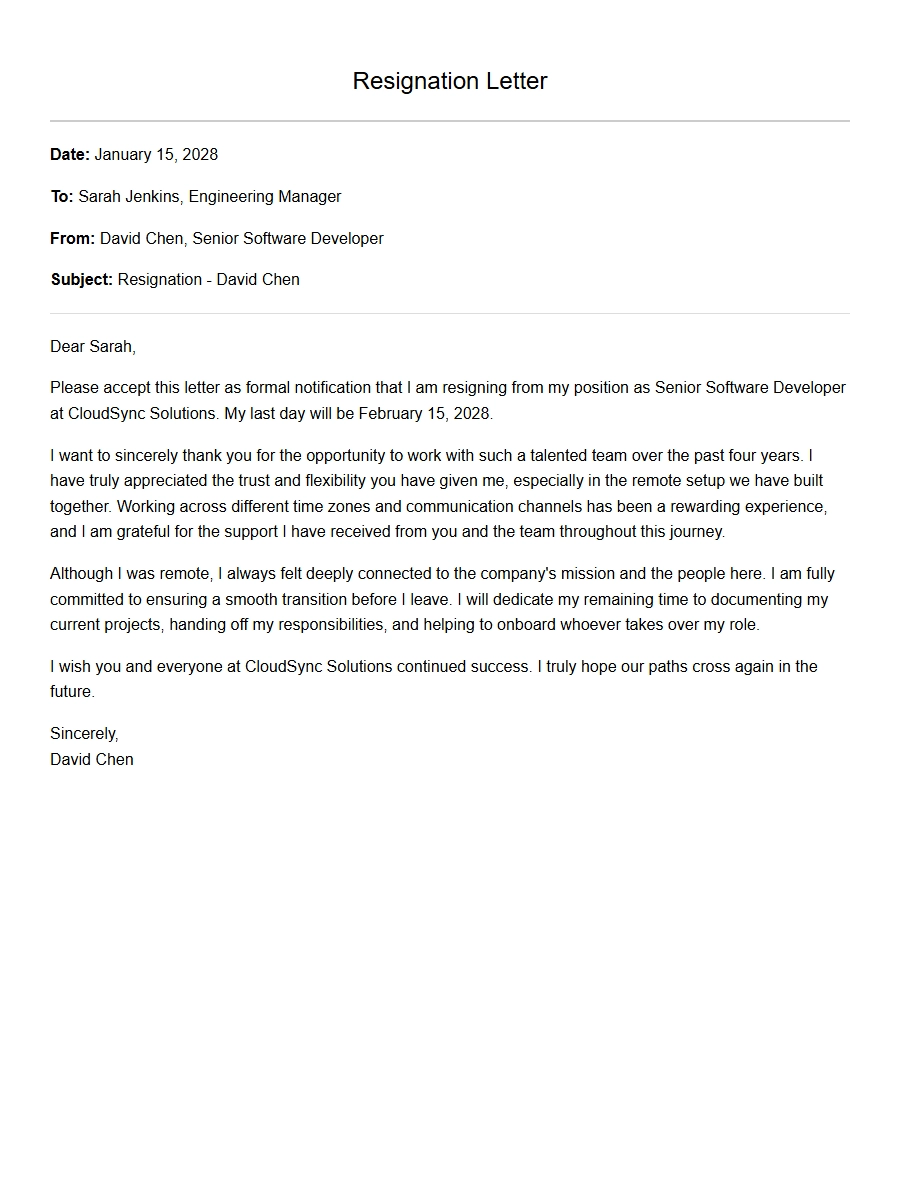 Polite Resignation Email for Remote Employees
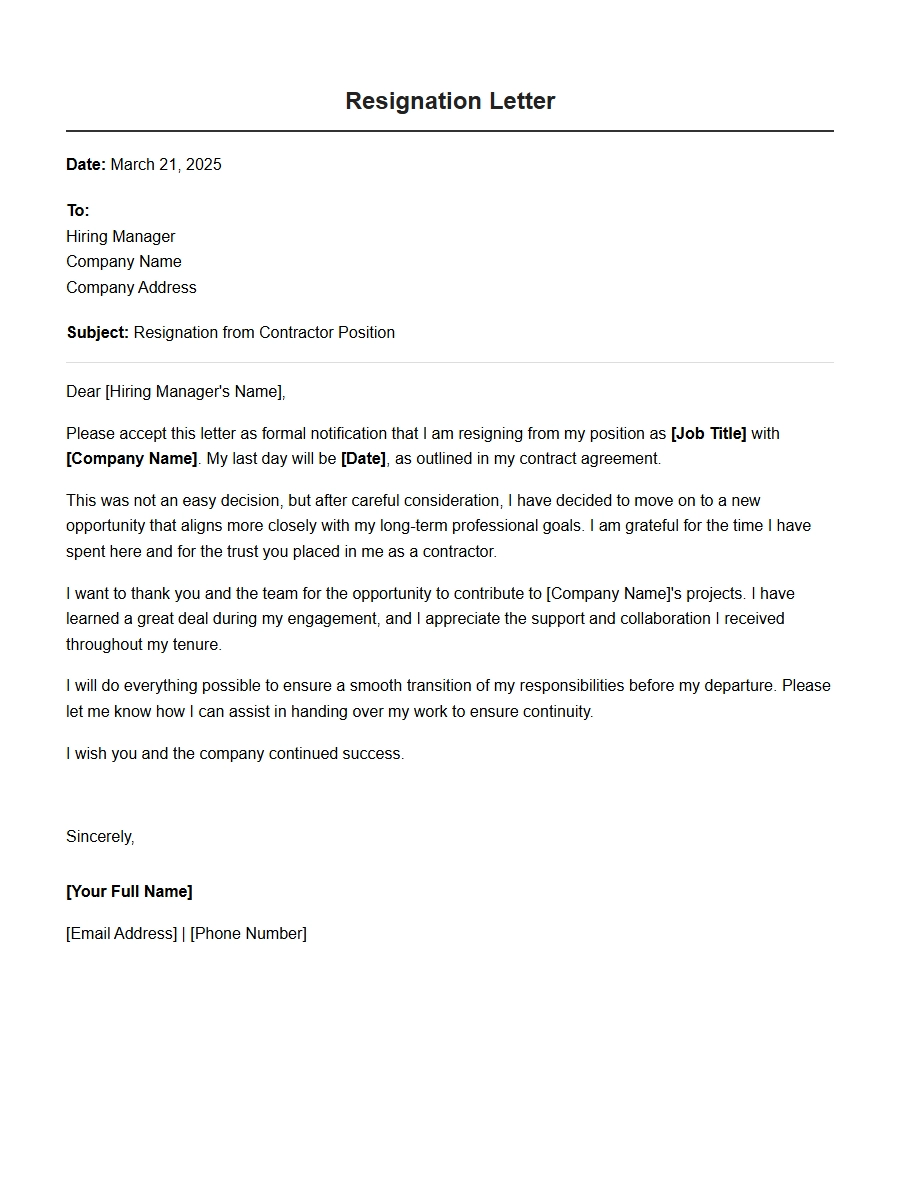 Short Resignation Letter for Contractor Position
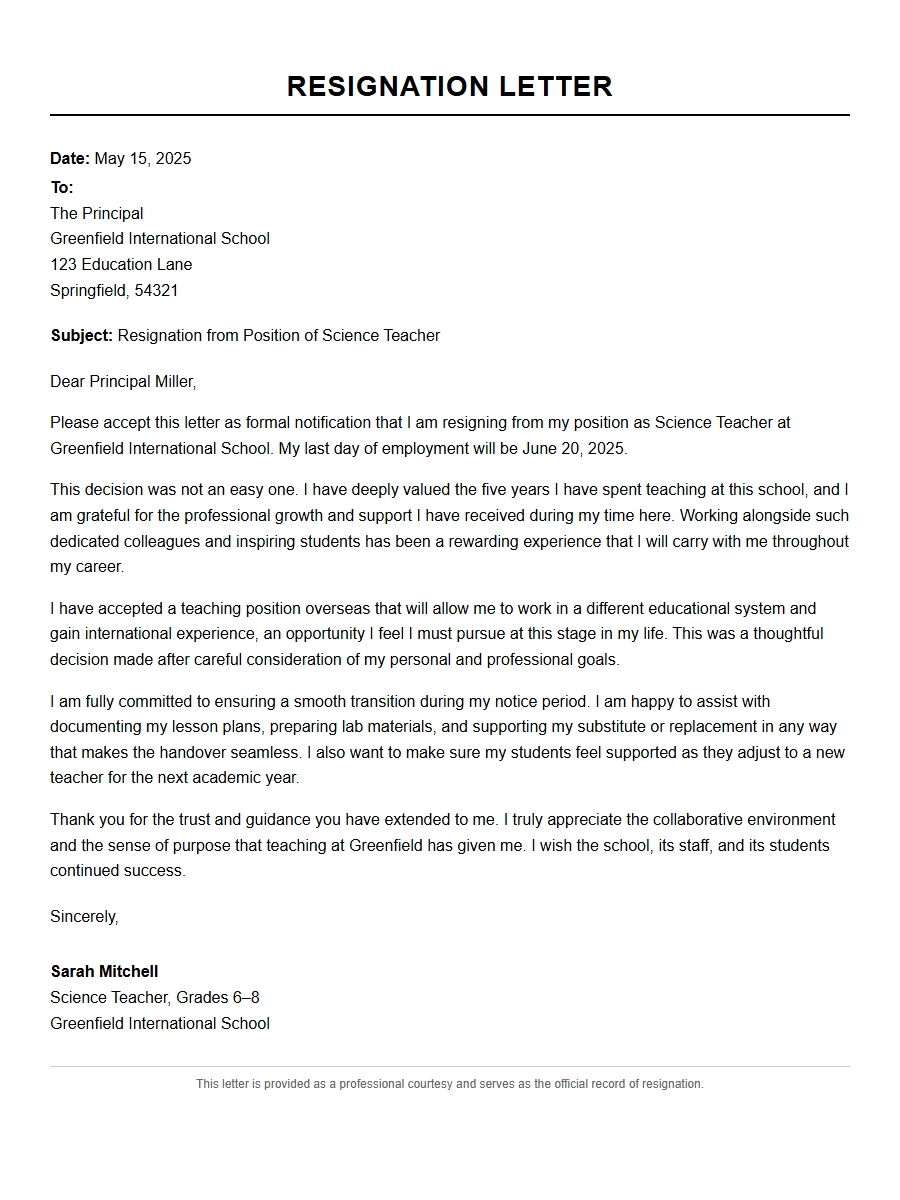 Teacher Resignation Letter Example
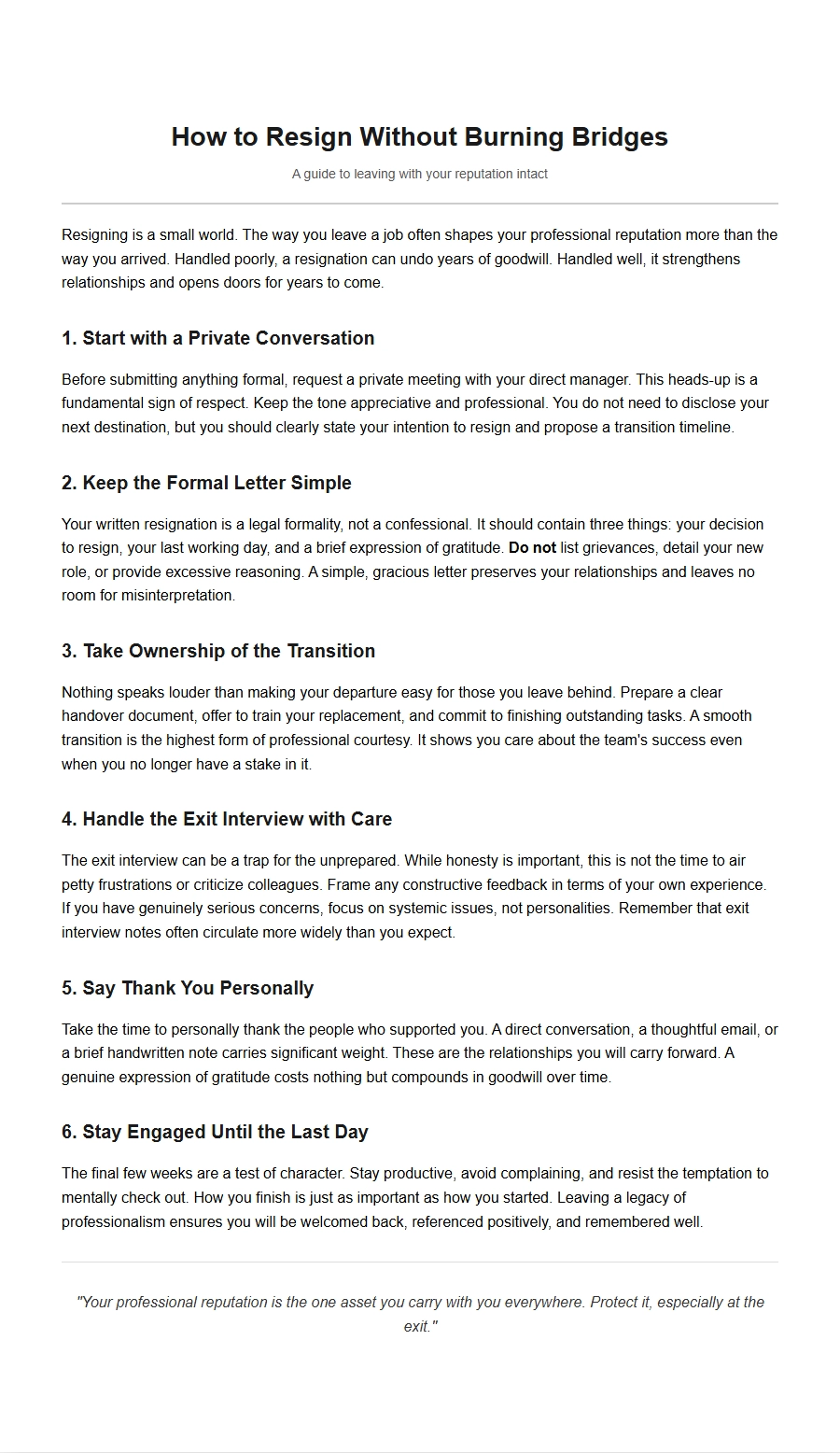 How to Resign Without Burning Bridges
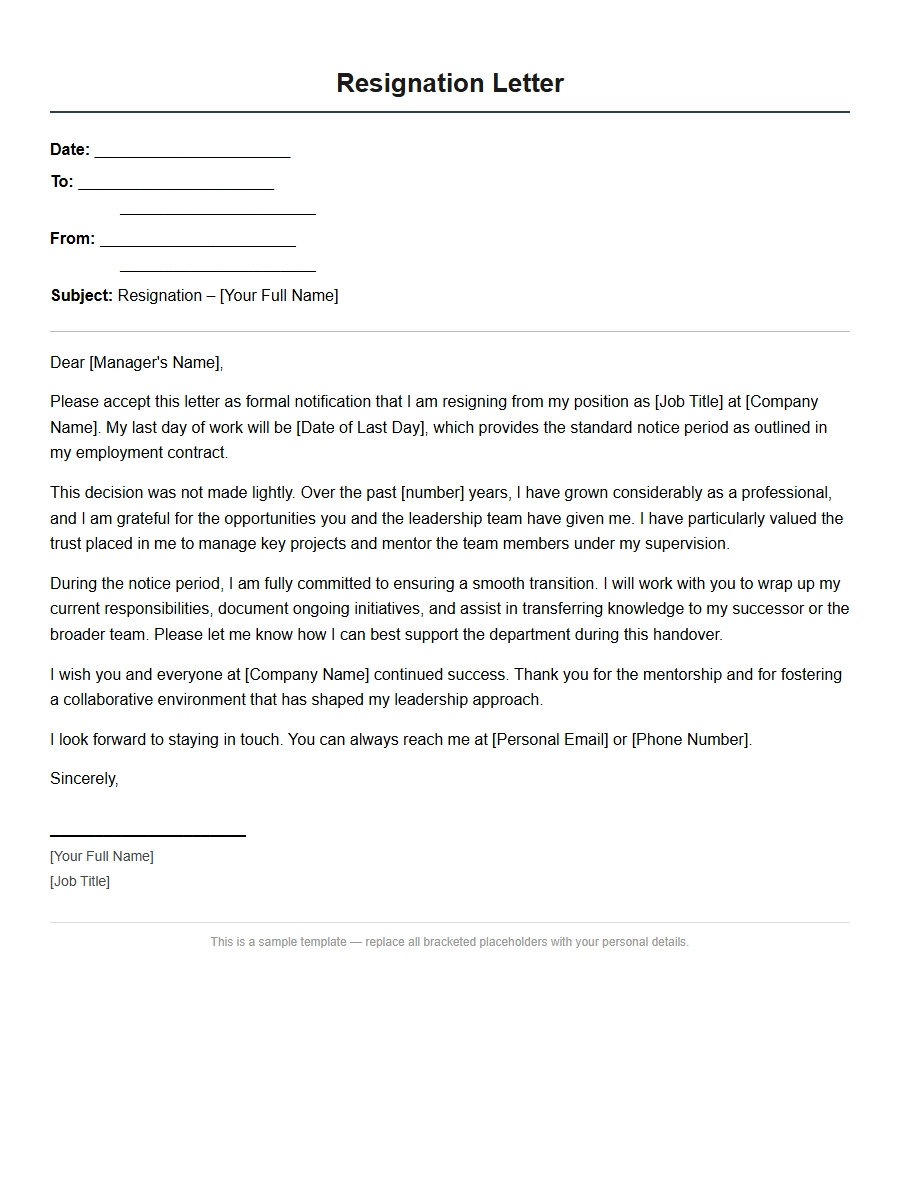 Formal Resignation Letter Sample for Manager
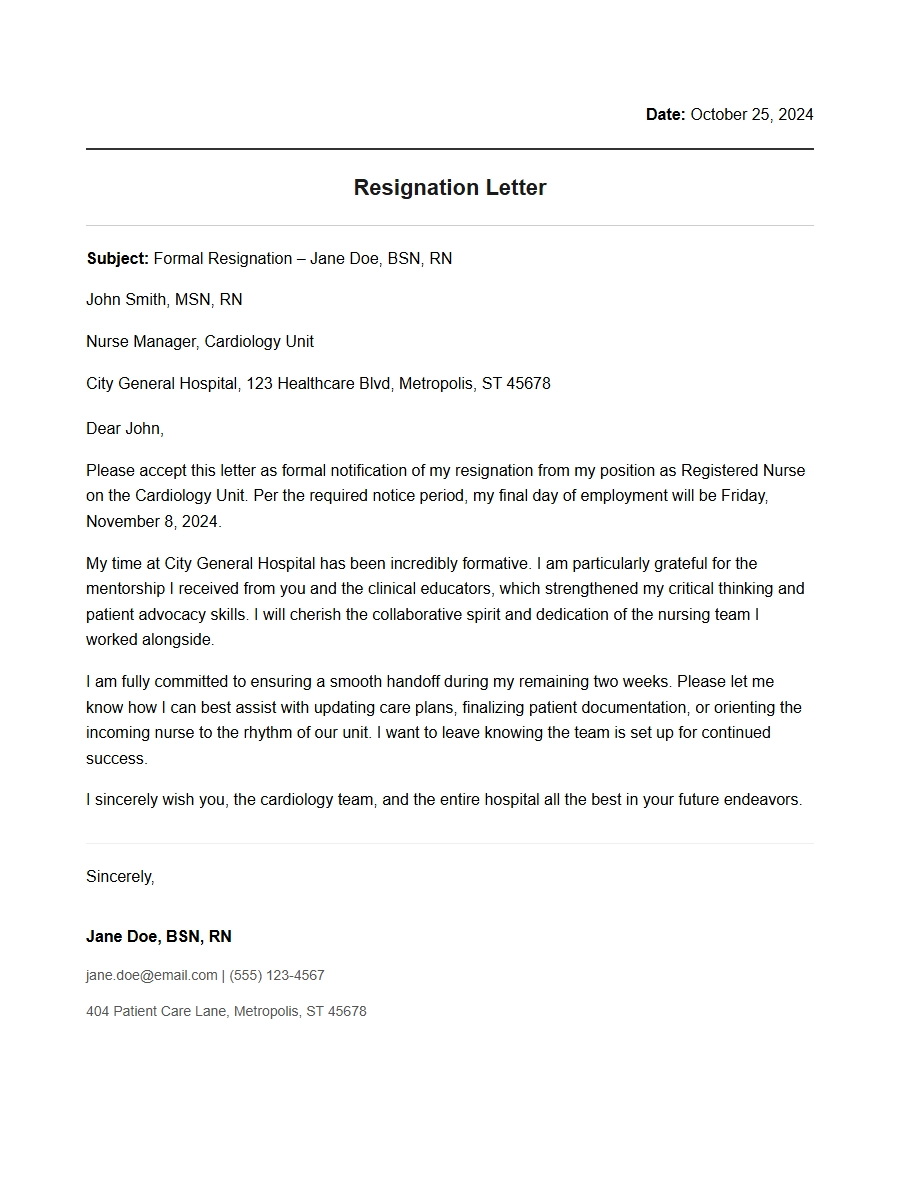 Nurse Resignation Letter with 2 Weeks Notice