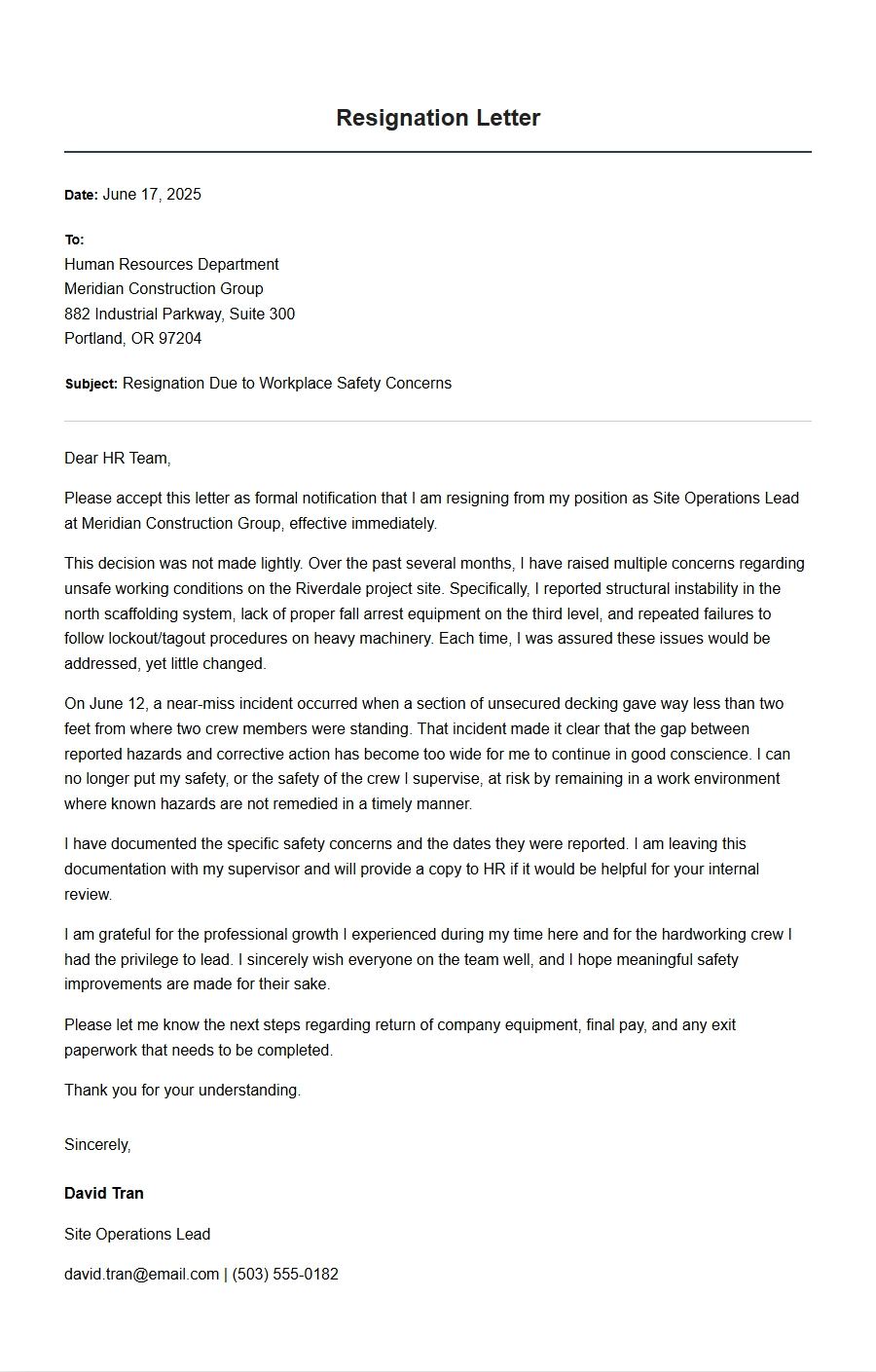
example of resignation due to safety concerns - Resignation Letters
You need to resign because your workplace feels unsafe, and writing that letter feels like walking a tightrope. Document the safety issue honestly without sounding like a liability. Keep it professional without hiding the real reason. It's a tough balance.
This guide gives you a practical example of resignation due to safety concerns, but more importantly, it shows you how to adapt it so the letter sounds like you—calm, professional, and firm.
Why Using a Sample Helps
Starting from a letter template isn't cheating. It's a strategic shortcut. A good template gives you the correct business letter format, the right salutation and closing, and an appropriate tone in writing. You don't have to invent the structure from scratch. You just customize the message.
This is especially useful when emotions are high. A safety concern is personal. Using a customizable letter lets you focus your energy on the facts, not on whether you wrote "Sincerely" or "Best regards."
Category: Resignation Letters
The Best Example of Resignation Due to Safety Concerns
Here is a simple, adaptable framework. Notice how it stays factual and avoids emotional language:
"I am writing to formally resign from my position at [Company Name], effective [date]. This decision is due to unresolved safety concerns regarding [specific issue, e.g., lack of proper ventilation, faulty equipment, repeated harassment] that have made it impossible for me to perform my duties safely."
"I have raised these concerns on [dates or general frequency] with [manager/department], but the issues remain unaddressed. I am providing this notice to ensure a smooth transition during my final weeks."
This structure works for both printed letters and a digital letter format. If you are sending it by email, keep the same body text but use a clear subject line like "Resignation – [Your Name]."
How to Adapt the Sample Without Losing Your Voice
The sample above is a framework, not a script. You should personalize it.
If you are deciding not to renew a contract because of these concerns, change the opening to reference the contract end date. Our sample on declining continued employment contracts covers this exact scenario.
If safety lapses are severe and you are worried about lost income, you might be negotiating a severance package as part of your exit. That guide explains how to separate the safety complaint from the financial negotiation politely.
Tip on opening paragraphs: Lead with your resignation and the core reason ("safety concerns"). Do not bury it in the middle. Managers and HR scan letters quickly. Make your reason clear from the start.
Common Mistakes to Avoid
I see people make three errors consistently when writing about safety:
1. Being too vague. Saying "I feel unsafe" is not enough. Give a concrete, factual example. "The broken lock on the emergency exit door has been reported three times and not fixed." This is harder to dismiss.
2. Using an outdated salutation. "To Whom It May Concern" feels cold, especially for a serious topic. Address it to your direct manager or the HR representative you have been dealing with. If you are formally announcing your departure to management, use their name and title.
3. Ignoring formatting for email vs. print. A printed letter needs letterhead design or at least your contact info at the top. An email needs a professional signature block. They are not interchangeable.
Before you hit send, do a thorough proofreading letter check. A typo in a safety resignation can make you look careless, undermining your serious allegation. Read it out loud to catch awkward phrasing.
Handling Tricky Situations
Sometimes safety concerns overlap with other legal documents. If you signed a non-compete agreement, you need to be careful about the language you use. Our article on handling non-competitive agreements in resignation letters shows you the right phrasing.
If you are not sure about your last day or absence from work due to the unsafe environment, check out the sample explaining absence from the last day. Some people choose to use remaining sick leave or PTO instead of working out their full notice period in a hazardous environment.
Quick tip on tone: Stay polite but firm. You do not need to apologize for leaving a job that is unsafe. "I appreciate the opportunities I had here, but I cannot continue under current conditions." That is professional, not aggressive.
Your Next Step
Use this sample as a springboard, not a crutch. The best letters feel both professional and personal. Keep a printed copy for your records. Then let the letter go and focus on finding a workplace that respects your safety.
You don't need to be a perfect writer to get this right. You just need a solid structure, clear facts, and someone who reminds you that your safety is not a negotiation.
Useful Formats
example of resignation due to safety concerns - Resignation Letters
Immediate Resignation Due to Biohazard Exposure
Date: October 15, 2024
To: Human Resources ManagerFrom: Jordan Blake, Lab Technician
Subject: Immediate Resignation Due to Safety Concerns
Dear Ms. Torres,
I am writing to formally resign from my position as Lab Technician, effective immediately. Over the past two weeks, I have repeatedly reported the improper storage of biohazard waste in our main lab, including unsealed containers and uncleaned spillages near workstations. Despite my written complaints on October 1, 8, and 12, no corrective action has been taken.
Yesterday, I discovered a puddle of unidentified biological fluid leaking from a cracked container under my desk. I notified the lab supervisor, who dismissed it as not urgent. I cannot continue working in an environment that poses a direct risk to my health and safety. My final paycheck should include all accrued leave and overtime as listed below:
Item
Amount
Wages up to Oct 15
$2,340.00
Accrued PTO (5 days)
$900.00
Overtime (12 hours)
$360.00
Total Due
$3,600.00
Please arrange for the return of my personal belongings from my locker. I will drop off my key card and lab coat by noon today.
Sincerely, Jordan Blake
Resignation After Electrical Hazards Ignored
Date: September 28, 2024
To: Plant Manager, ABC ManufacturingFrom: Carlos Mendez, Assembly Line Operator
Subject: Resignation Due to Unsafe Working Conditions
Dear Mr. Harrison,
I regret to inform you that I must resign my position effective immediately. Over the last three months, I have documented six instances of exposed wiring and malfunctioning circuit breakers on Line 3. Each report was verbally acknowledged but never logged or repaired.
On September 26, I received a mild shock from a control panel that had a frayed cord taped together. I filed a formal incident report, but today I learned it was reclassified as a minor annoyance rather than a safety near-miss. I cannot risk further injury or be part of a company that disregards worker safety. Please process my resignation accordingly.
Key issues I reported:
Exposed live wires near conveyor belt (July 10)
Melted outlet in break room (August 2)
Faulty emergency stop button (August 19)
Shock incident (September 26)
I request my final settlement and all safety report copies be sent to my email on file.
Sincerely, Carlos Mendez
Resignation Due to Lack of PPE Enforcement
Date: November 5, 2024
To: Site Safety SupervisorFrom: Elena Rossi, Construction Worker
Subject: Resignation Over PPE Protocol Violations
Dear Mr. Khan,
This letter serves as my formal resignation, effective one week from today, November 12. I have repeatedly raised concerns about the inconsistent enforcement of personal protective equipment rules on the Westside project. Hard hats, safety glasses, and high-visibility vests are often optional, and workers have been seen without them near active cranes and heavy machinery.
My safety complaints filed on October 3, 12, and 25 were met with promises of retraining that never materialized. On November 2, a co-worker was nearly struck by a swinging load because he wasn't wearing his hard hat. I cannot continue to work where safety is treated as optional. Below is a summary of my outstanding leave:
Leave Type
Days Remaining
Payout Value
Vacation
4
$680
Sick Leave
2
$340
Total
6
$1,020
I am willing to assist in training my replacement during my notice period, but only if all PPE rules are enforced during my remaining shifts.
Regards, Elena Rossi
Resignation After Mold Exposure in Office
Date: August 12, 2024
To: Building Management & HR DepartmentFrom: Sarah Kim, Administrative Coordinator
Subject: Resignation Due to Health Hazards from Mold
Dear Dr. Patel,
I am resigning from my position effective two weeks from today, August 26. Since June, I have reported visible mold growth in the ventilation ducts and the break room ceiling. My reports on June 10, July 8, and July 22 included photos and air quality complaints, but management claimed it was just mildew and declined to investigate.
I have since developed chronic coughing, headaches, and sinus infections. My doctor's note (attached) confirms these symptoms are consistent with mold exposure. I cannot continue working in a building that is clearly unsafe. My final duties will focus on transitioning my files. Please confirm the following items:
Return of building access fob and keys
Release of my final paycheck including severance if applicable
Reimbursement for my personal medical co-pays related to this issue
I expect written confirmation of my resignation acceptance within three business days.
Sincerely, Sarah Kim
Resignation Due to Fire Code Violations
Date: July 4, 2024
To: Director of OperationsFrom: James Okafor, Warehouse Supervisor
Subject: Immediate Resignation Over Fire Safety Risks
Dear Ms. Chen,
I am submitting my immediate resignation due to ongoing fire safety violations at your warehouse. Despite my memos on March 15, April 10, and May 2, these critical issues have not been addressed:
Blocked fire exits near Section C (reported 3 times)
Expired fire extinguishers (last checked 2021)
Flammable chemical storage next to electrical panels
On July 3, a small electrical fire broke out near the packing area. Fortunately, it was contained, but the extinguishers failed to operate. I told the shift manager, but he said not to worry, the insurance covers it. I am not willing to risk my life or my team's lives. My resignation is effective at the end of today. I will leave my keys, safety checklist, and security badge with the front office.
Best regards, James Okafor
Resignation for Unsafe Chemical Storage
Date: March 20, 2024
To: Lab Safety CommitteeFrom: Dr. Anita Vasquez, Senior Chemist
Subject: Resignation Due to Chemical Safety Violations
Dear Committee Members,
I am resigning my position effective immediately. Over the past year, I have filed seven formal reports regarding the improper labeling and storage of volatile chemicals in the Synthesis Lab. Most dangerously, benzene and acetone have been found stored next to open flame sources on multiple occasions.
My most recent report (March 5) included a photograph of an unlabeled bottle of nitric acid placed on a heat source. The committee's response was to verbally remind staff, with no written policy change. I cannot assume the liability of working in such a careless environment. Please ensure my final pay includes all contractually owed amounts as below:
Component
Value
Salary through March 20
$4,800
Unused PTO (10 days)
$3,080
Contract severance (2 weeks)
$2,400
Total
$10,280
I will arrange pickup of my personal items on Friday.
Yours, Dr. Anita Vasquez
Resignation After Repeated Slip-and-Fall Hazards
Date: February 14, 2024
To: Facilities ManagerFrom: Miguel Santos, Janitorial Staff
Subject: Resignation Due to Unsafe Floors
Dear Mr. Duncan,
I am writing to resign my position with a two-week notice, ending February 28. For the past two months, I have reported the dangerously wet floors in the north hallway near the employee entrance. The leaking pipe has been reported on January 3, 10, 17, 24, and February 5, yet it remains unrepaired. Floor mats are not replaced, and wet floor signs are often missing.
On February 12, I slipped and fell, injuring my right knee and back. I filed an incident report but was told it was my fault for not being careful. I cannot continue working where management refuses to correct known hazards. I want to formally note the following safety violations I have reported:
Wet floor area near north entrance (5 reports)
Broken handrail on stairwell B (2 reports)
Lack of proper lighting in supply closet (3 reports)
I will be using three of my remaining sick days for physiotherapy, and my last day will be February 28.
Respectfully, Miguel Santos
Resignation Due to Workplace Violence Risk
Date: December 10, 2024
To: Human Resources DirectorFrom: Priya Sharma, Customer Service Representative
Subject: Resignation Over Unsafe Work Environment
Dear Ms. O'Brien,
I am resigning effective immediately because I no longer feel safe at work. Over the past six months, I have witnessed increasingly aggressive behavior from a colleague in the call center, including shouting, throwing objects, and making threats toward other staff members. I reported each incident to my supervisor on June 14, August 22, and October 10, but no formal investigation was ever opened. Instead, I was told to just avoid him.
On December 9, that colleague cornered me in the break room and screamed at me for taking his seat. When I reported it to HR yesterday, I was told the situation would be reviewed when time permits. I cannot trade my personal safety for a paycheck. Below are my resignation details:
Requirement
Status
Last Day of Work
December 10, 2024
Notice Period Waived
Yes, due to safety
Final Paycheck Due
Within 3 business days
Return Company Laptop & Badge
Today at 5 PM
I expect my final payment without delay. Thank you.
Sincerely, Priya Sharma
Resignation Due to Unsafe Equipment
Date: January 22, 2024
To: Maintenance SupervisorFrom: Tomás Reyes, Machine Operator
Subject: Resignation Over Defective Machinery
Dear Mr. Fischer,
This letter is to formally resign from my position, effective two weeks from today (February 5). I have been a machine operator for 12 years, and I have never worked in a facility where safety is so openly ignored. The press brake I am assigned to has faulty guards, an inconsistent emergency brake, and emits a loud grinding noise that suggests imminent mechanical failure.
I reported these issues on December 4, December 20, and January 8. Each time, maintenance affixed a temporary fix with tape, which fails within days. On January 15, the brake failed partially during operation, almost crushing my hand. I filed an incident report, but no one from management followed up. I cannot wait for a catastrophic accident. I will complete my remaining shifts only if the machine is locked out until repaired.
Please confirm the following before my departure:
Final paycheck including overtime and shift differential
Return of my tools and locker contents
A letter of recommendation acknowledging my clean safety record
Thank you, Tomás Reyes
Resignation After Asbestos Discovery
Date: April 18, 2024
To: Corporate Safety OfficerFrom: Linda Johansson, Office Manager
Subject: Resignation Due to Asbestos Contamination
Dear Dr. Wells,
I am resigning my position effective immediately. On April 5, a contractor conducting renovations in the east wing discovered asbestos-containing materials in the ceiling tiles and pipe insulation. I alerted you and building management that same daywag and recommended immediate evacuation and professional abatement.
Despite the known hazard, staff were told to continue working as usual with just opening windows. I provided a report on April 9 detailing the health risks, but no action was taken. On April 15, I myself began experiencing shortness of breath and chest tightness. I consulted my physician, who strongly advised me to leave the building immediately. I cannot stay in an environment where my long-term health is risked for short-term convenience.
Below is a record of my notifications:
Date
Method
Recipient
April 5
Email
Building Manager
April 9
Written report
Safety Office
April 16
Phone call
HR Director
I will send someone to collect my personal effects next week.
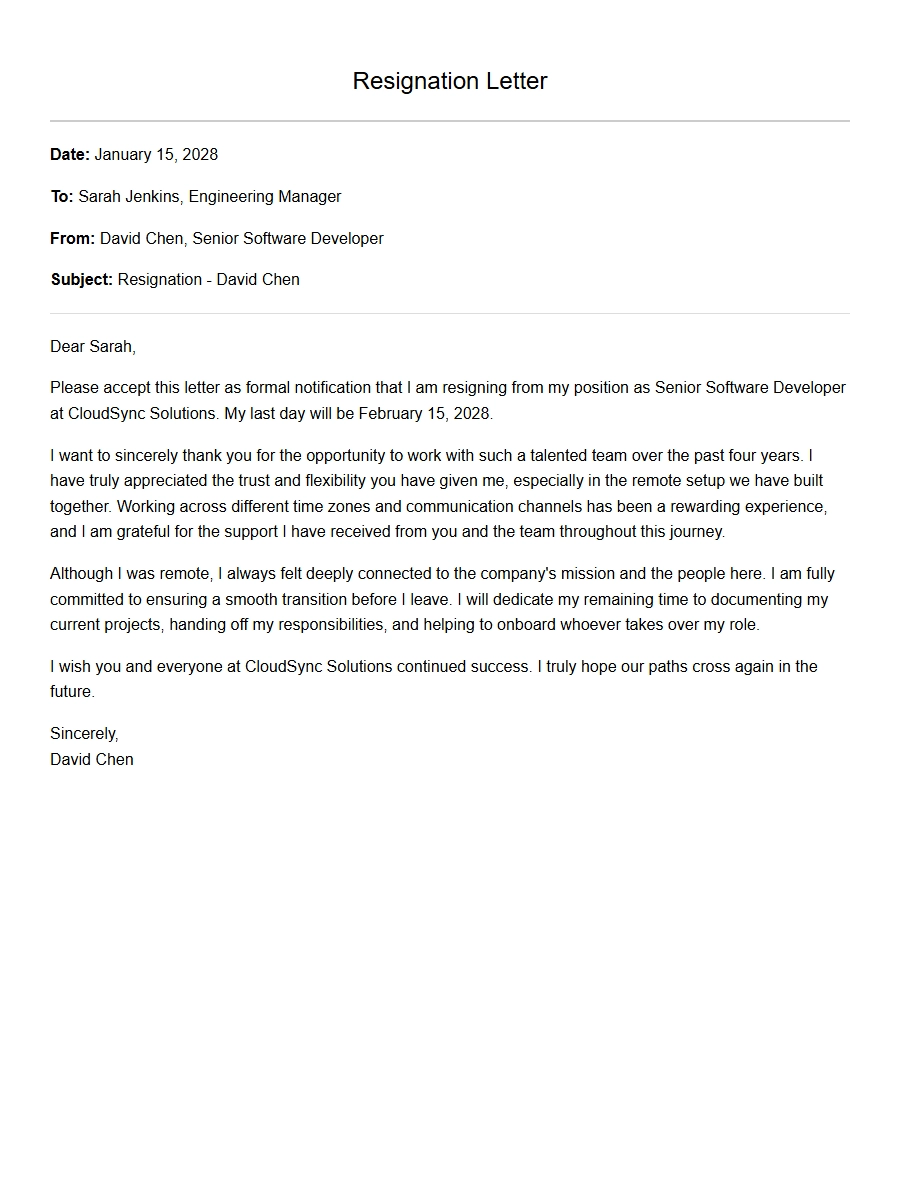 Polite Resignation Email for Remote Employees
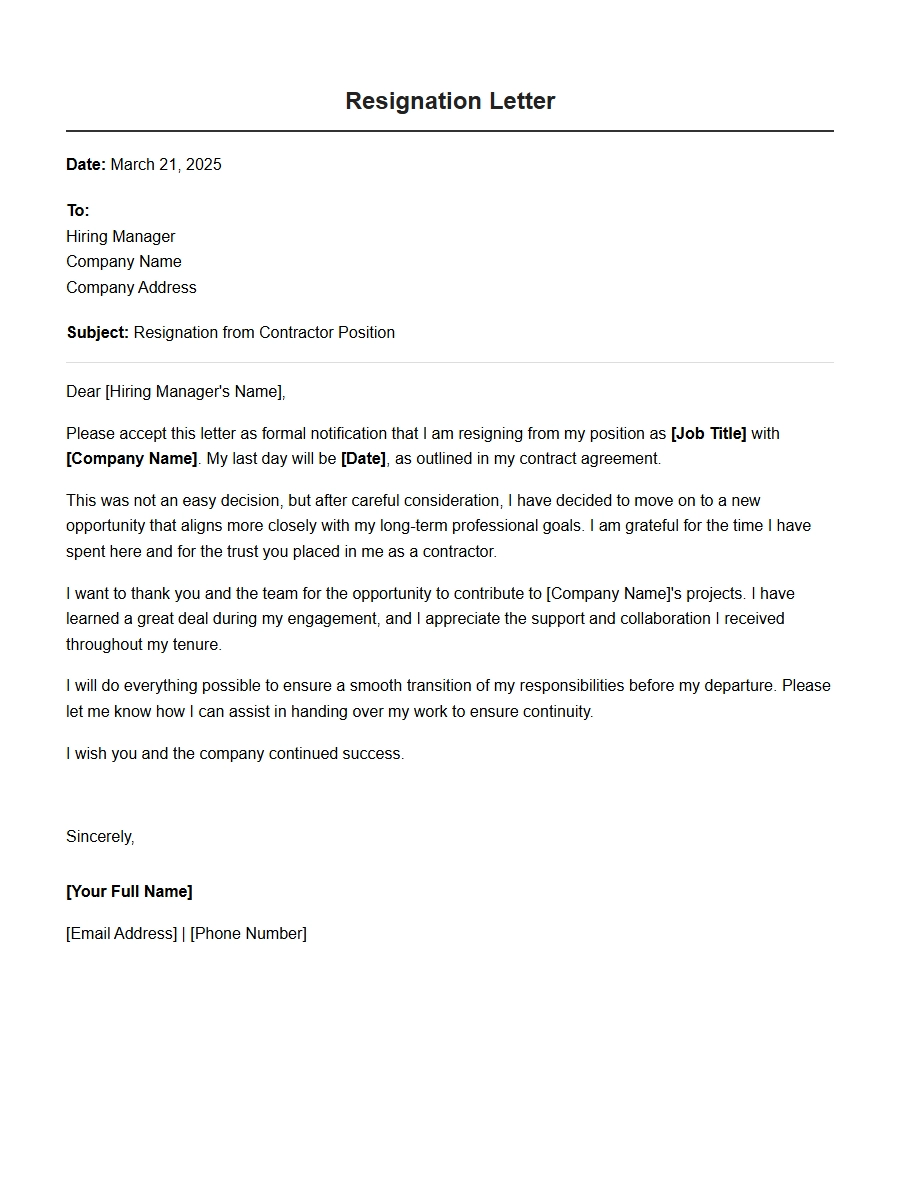 Short Resignation Letter for Contractor Position
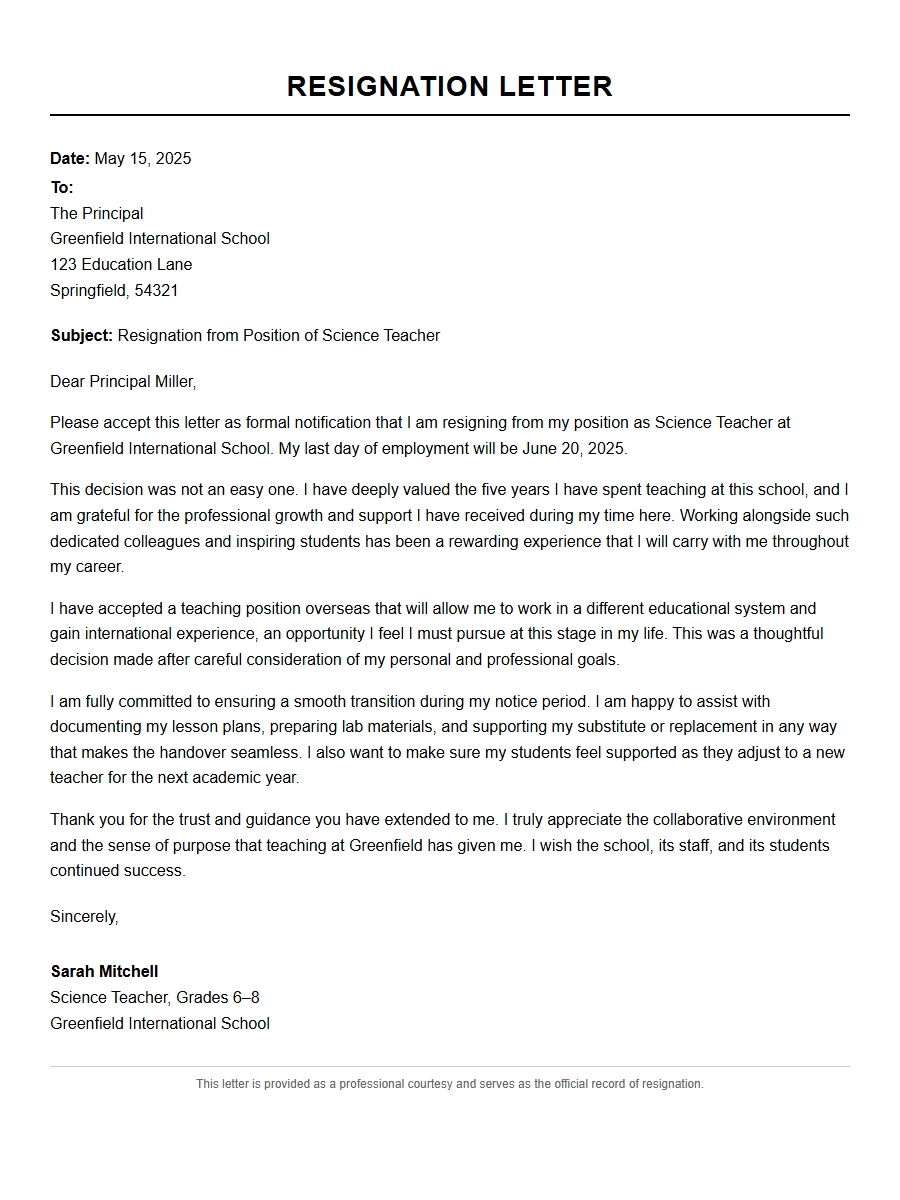 Teacher Resignation Letter Example
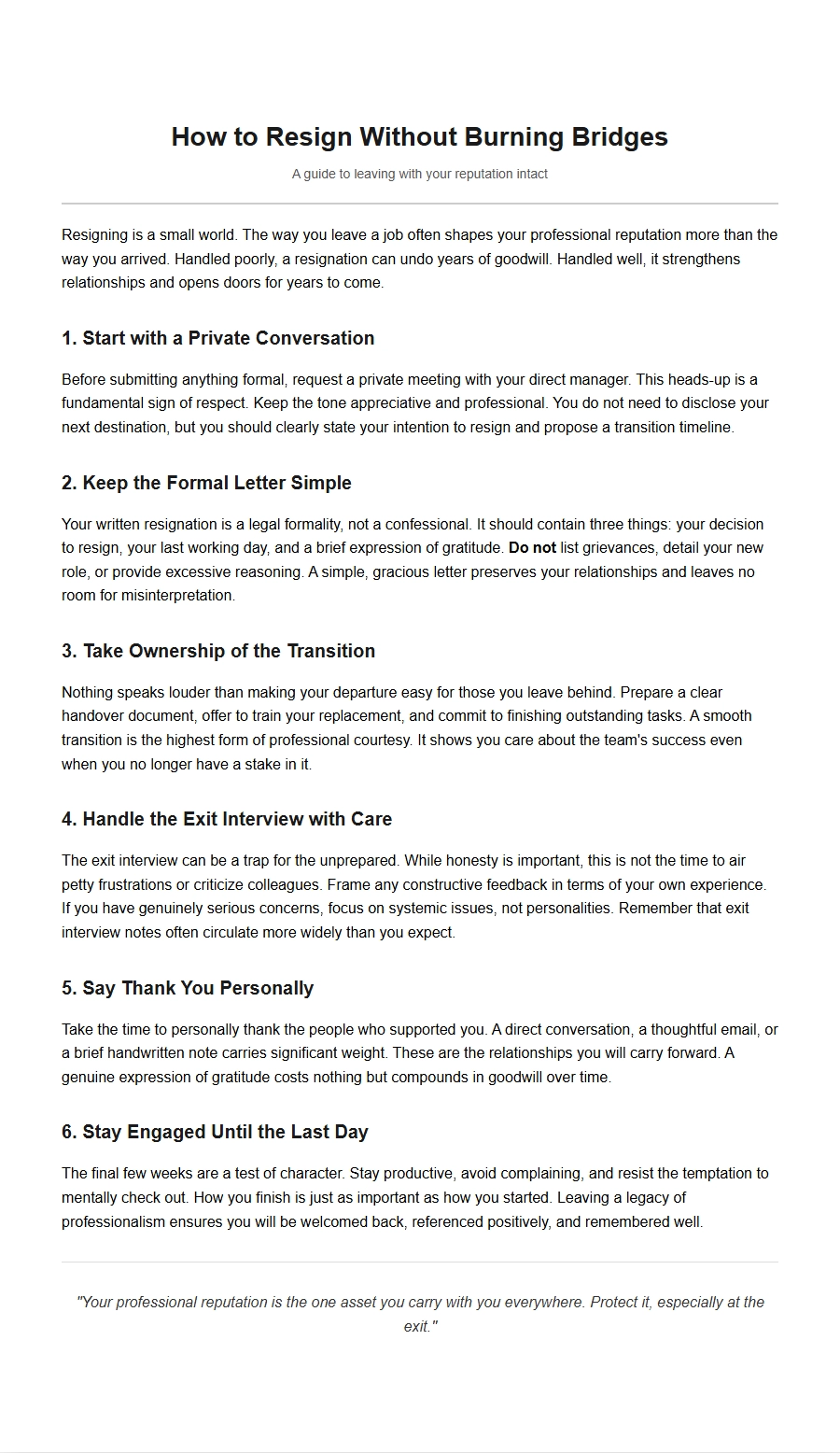 How to Resign Without Burning Bridges
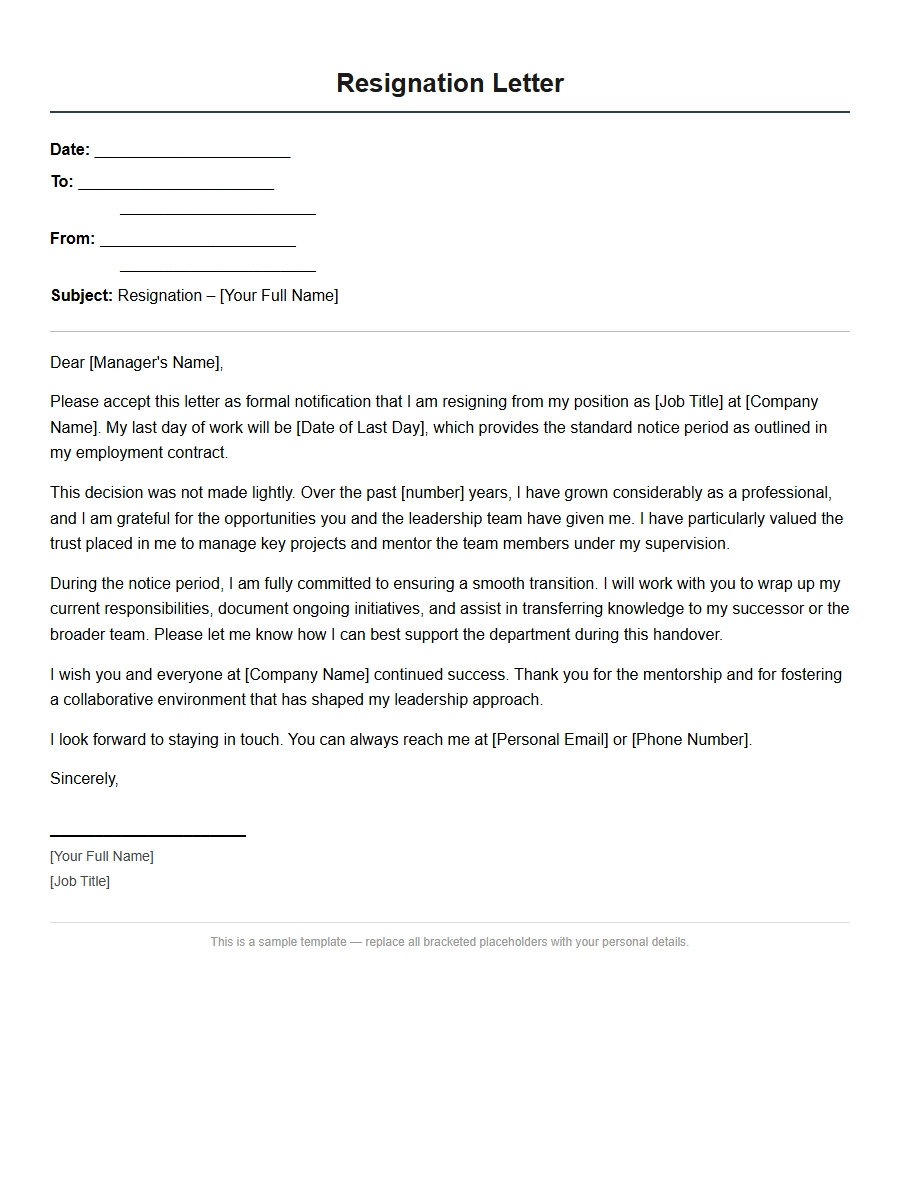 Formal Resignation Letter Sample for Manager
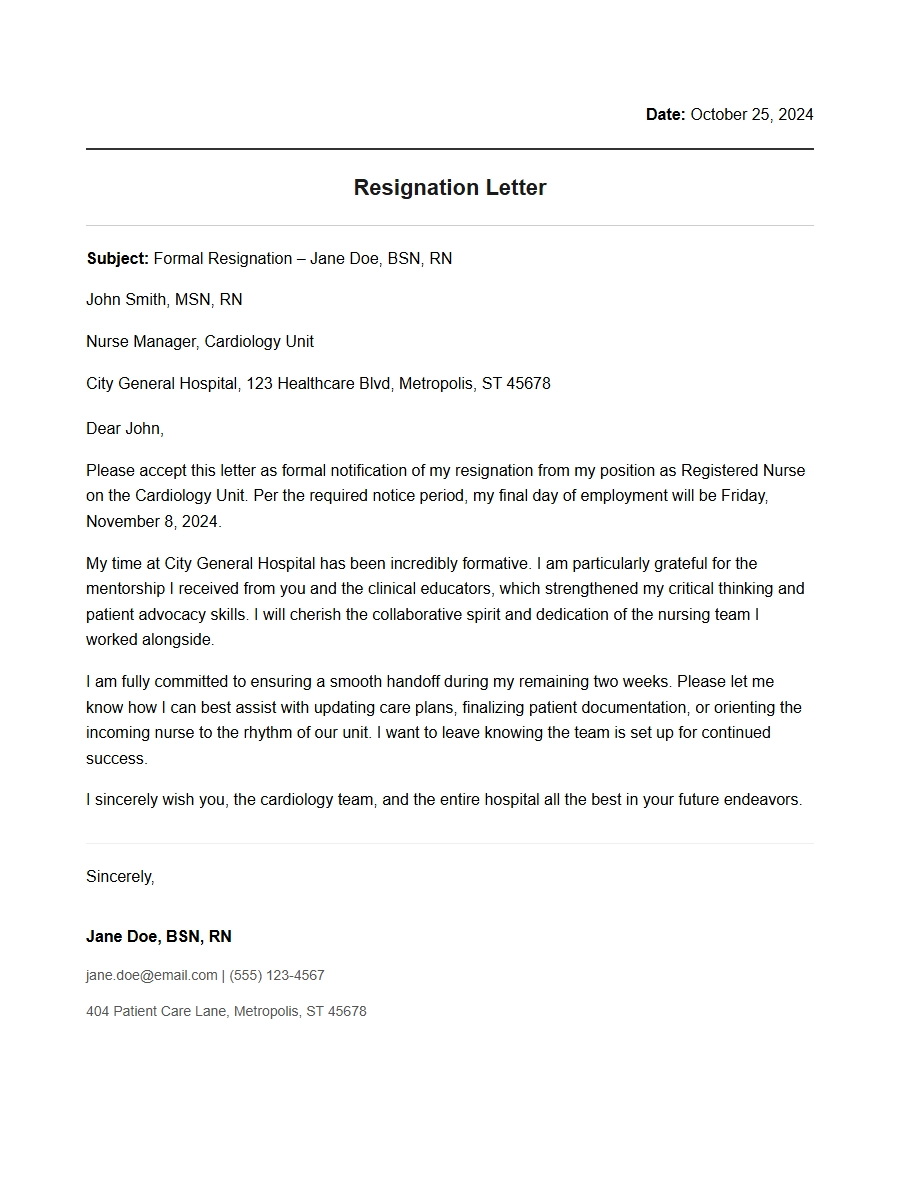 Nurse Resignation Letter with 2 Weeks Notice