Declining a Continued Employment Contract: Example Letter
You need to decline a continued employment contract offer, and you probably want the email done yesterday. The pressure to be polite while protecting your professional reputation makes it easy to freeze up. That blank page feels heavier because you know this letter matters for your references and your peace of mind.
Let’s be clear: using a sample to write this kind of professional correspondence isn’t cheating. It’s a smart shortcut. A good letter template gives you the structure and tone you need, so you only have to focus on the personal details. Think of it like following a recipe the first time you cook a complicated dish—you learn the steps without starting from scratch.
What does “declining a continued employment contract” actually look like?
This isn’t a standard resignation. You’re not quitting mid-project. Instead, you’re telling your employer that you won’t be accepting a renewal offer for a fixed-term or ongoing position. The core message is simple: “Thank you for the offer, but I will not be continuing.”
You’ll see this situation most often after a fixed-term contract ends, during a probation review, or when a company offers to extend a contractor role full-time. The key is to stay gracious without over-explaining your reasons.
Which sample fits your situation?
The format matters. If you’re declining a contract renewal at a corporate job, use a formal business letter format with a proper salutation and closing. If you’re in a creative field or smaller company, a semi-formal email with a friendly opener works fine.
For example, declining a role in a medical practice might need more formal letter writing etiquette than turning down a freelance design retainer. The relationship and company culture guide your tone.
How to adapt a template without sounding robotic
Here’s where most people go wrong. They copy a sample word-for-word and it feels stiff. Instead, follow this process:
First, read the sample aloud. Does it sound like something you’d actually say? If not, change the sentences until they match your voice. Swap formal phrases like “I hereby notify” for “I’m writing to let you know.” Keep the letter structure but adjust the language.
Second, personalize the opening paragraph immediately. Mention the specific offer or contract. Something like: “Thank you for offering me the continued contract for the senior analyst position. After careful thought, I’ve decided not to accept the renewal.” This proves you’re not sending a generic form.
Common mistakes to avoid
Ever received a letter that felt too stiff or too casual? That’s the biggest trap. A robotic tone in writing makes you sound distant. On the flip side, being too informal (“Hey, thanks but no thanks”) can burn bridges.
Another mistake: ignoring formatting for email versus printed letter. If you’re sending it via email, skip the letterhead design and use a clear subject line like “Decision regarding contract renewal – [Your Name].” For a printed version, include your contact details and date.
Also, avoid vague reasons. You don’t need to say “I found a better opportunity” if you’re leaving for personal reasons. A simple “I’ve decided to pursue a different direction” is enough.
Making your letter more specific
You can tailor your language by looking at examples from similar roles. A resignation letter sample for a bank teller will be more formal than one for a creative agency. If you’re a medical doctor, your professional resignation correspondence should include a handoff plan for patient care. Always check the digital letter format your recipient expects.
When you’re ready to write, use internal links to find examples that match your industry. For instance, if you’re declining a role without having a replacement ready, this guide on resigning without immediate replacement can help you manage the transition gracefully. If your decision is about limited career growth, this resignation letter for lack of growth offers language that stays professional.
Quick steps to finish your letter today
Start with a clear subject line or header. Open with gratitude for the offer. State your decision plainly in the first paragraph. Add one or two sentences of appreciation for the work you’ve done together. Close with a polite offer to assist with the transition.
Read the draft once for proofreading letter errors. Then send it. You don’t need to overthink it. A clear, polite refusal is always better than a delayed, anxious one.
If you need a more specific letter of recommendation for your next step, ask your manager now while they’re still thinking positively about your work. That’s a smart move that protects your future.
The best letters feel both professional and personal. Use the sample as your scaffolding, but make the words your own. With a little practice, this whole process will take you fifteen minutes instead of two hours.
Common Sample Formats
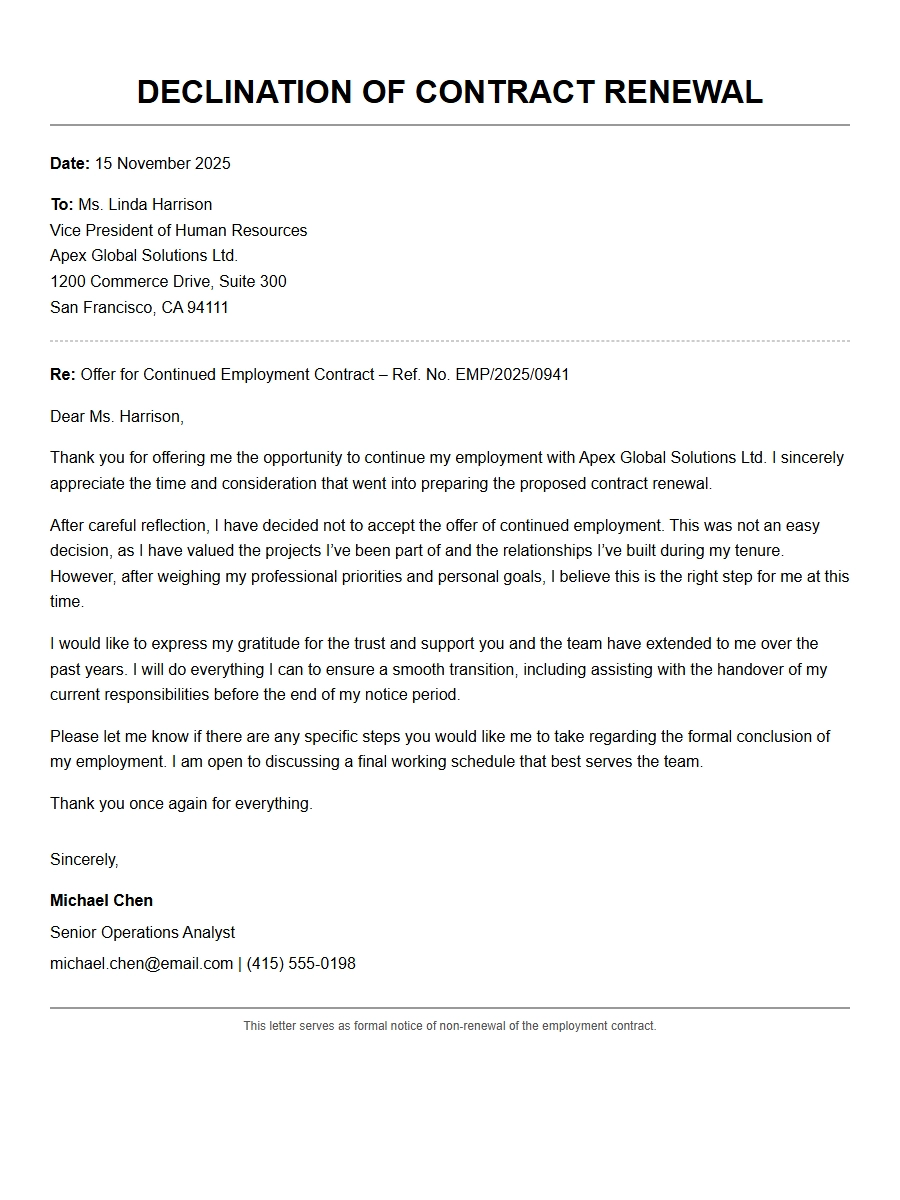
Declining a Continued Employment Contract: Example Letter
Formal Letter Declining Contract Renewal Due to Personal Reasons
Date: January 15, 2025
To: Human Resources Manager Company: ABC Enterprises Ltd. Subject: Decline of Continued Employment Contract Renewal
Dear [Manager's Name],
I am writing to formally notify you that I will not be accepting the renewal of my employment contract, which is set to expire on March 31, 2025. After careful consideration, I have decided to decline the continued contract due to personal reasons that require my full attention at this time.
I have deeply valued my time at ABC Enterprises and am grateful for the opportunities provided. Please consider this as my official resignation effective the contract end date. I will ensure a smooth handover of my responsibilities over the remaining period.
Thank you for offering me the opportunity to extend my employment contract beyond its current term ending April 30, 2025. After thorough evaluation, I have decided to decline the extension.
This was a difficult decision because I have truly enjoyed working with the team on the Aurora project. However, I have accepted a full-time role at another organization that aligns more closely with my long-term career goals. My last working day will be April 30, 2025, as per the original contract.
I am committed to ensuring a seamless transition. Let me know how I can assist during the notice period.
Best regards, John Smith Project Coordinator
Letter Declining Fixed-Term Contract Renewal
Date: February 10, 2025
To: Contracts Manager Company: GlobalTech Solutions Subject: Notice of Non-Renewal of Fixed-Term Contract
Dear Mr. Chen,
Please accept this letter as my formal notification that I will not renew my fixed-term employment contract, which concludes on June 30, 2025. This decision is based on my intention to return to full-time academia to pursue a master's degree.
I wish to express my sincere appreciation for the mentorship and experiences gained during my two-year tenure. Below is a summary of my pending tasks and transition plan:
Task
Completion Status
Handover Notes
Client report Q1
Drafting
Will finalize by May 15
Database migration
In progress
Documentation completed
I am available to discuss the handover at your earliest convenience.
Yours sincerely, Alex Rivera Data Analyst
Resignation from Contract Role with Notice Period
Date: March 1, 2025
To: [Supervisor Name] Department: IT Services Subject: Resignation and Decline of Contract Renewal
Dear Priya,
I am writing to formally resign from my position as Senior Developer under the current contract, effective 30 days from today. As per the contract terms, I am also declining the proposed renewal starting July 2025.
My decision stems from a desire to start my own tech venture. I have appreciated the collaborative environment and challenging projects at InnovateCorp. To facilitate a smooth transition, I have outlined key deliverables for my remaining weeks:
Complete code review for module X-7
Mentor junior developer on legacy system
Update technical documentation
Please let me know if you need any adjustments to this timeline.
With gratitude, Mei-Ling Wu Employee Code: DEV-3321
Declining Contract Renewal Due to Better Opportunity
Date: January 28, 2025
To: Operations Director Company: Logistics Pro Ltd. Subject: Decline of Continued Contract
Dear Mr. Okafor,
I am writing to inform you that I will not be signing the renewal of my employment contract, effective upon its expiry on May 31, 2025. I have received an offer for a permanent position with a different company that provides a more suitable career path.
I am grateful for the flexibility and support you have shown during my time here. Below is a list of ongoing projects I will prioritize before departure:
Warehouse optimization: Handover report ready by May 10
Supplier audit: Final documentation by May 20
I look forward to ensuring a seamless handover. Thank you for the opportunity to be part of this dynamic team.
Best regards, Carlos Mendez Supply Chain Analyst
Declining Contract Renewal Due to Relocation
Date: April 5, 2025
To: HR Department Company: BrightFuture Inc. Subject: Notification of Contract Non-Renewal
Dear Ms. Kim,
Please accept this letter as my formal decision to decline the renewal of my employment contract, which expires on August 15, 2025. My family and I are relocating to another state, making it impractical for me to continue in this role.
I have sincerely enjoyed working at BrightFuture and appreciate the trust you placed in me. My final two months will be dedicated to completing training materials for my successor. The following table outlines my key deliverables:
Deliverable
Status
Expected Completion
Onboarding guide
50% done
June 1
Client portfolio summary
Not started
July 1
I remain committed to a smooth transition. Thank you for everything.
Sincerely, Emma Hart Account Manager
Declining Contract Renewal – Change in Career Path
Date: March 20, 2025
To: [Manager's Name] Subject: Decision Regarding Contract Renewal
Dear David,
After much reflection, I have decided to decline the renewal of my employment contract as Graphic Designer ending June 30, 2025. I am shifting my career towards user experience research, a field I have been studying part-time.
I am deeply thankful for the creative freedom and mentorship provided at Artisan Media. During the notice period, I will focus on:
Completing ongoing branding projects
Documenting design system guidelines
Transitioning active files to the design lead
I would be happy to assist in recruiting my replacement if needed. Thank you for a wonderful two years.
With appreciation, Sophia Lin Designer
Short Notice Declination of Contract Extension
Date: February 1, 2025
To: Project Manager Subject: Urgent: Decline of Contract Extension
Dear Tom,
I regret to inform you that I must decline the proposed contract extension due to unforeseen personal circumstances. My current contract ends on February 28, 2025, and I am unable to continue beyond that date.
I apologize for the short notice. To minimize disruption, I have prepared a handover document available in the shared drive. Please find below a quick reference list of my current task statuses:
Task
Status
Contact Person
Vendor invoices
All submitted
Finance dept.
Weekly report
Last one done
[Name]
Thank you for the opportunity to work on this project. I hope to stay in touch.
Best, Rita Wang Consultant
Declining Continued Contract After Temporary Assignment
Date: May 10, 2025
To: Hiring Manager Company: Seasonal Staffing Corp.
Subject: Notice of Non-Renewal of Temporary Contract
Dear Ms. Patel,
I am writing to confirm that my temporary assignment ends on June 30, 2025, and I will not be accepting the permanent contract you offered. While I have enjoyed the fast-paced environment, I have decided to pursue a different role that aligns with my academic schedule.
Thank you for the training and support. During my final weeks, I will:
Complete daily transactions as per standard
Train two new hires on point-of-sale system
Return all company property
Please let me know if there are any additional steps required for offboarding.
Respectfully, James Carter Seasonal Associate – ID 7890
Declining Contract Renewal with Gratitude and Transition Support
Date: June 1, 2025
To: Executive Director Company: GreenFuture NGO Subject: Decision on Contract Renewal
Dear Maria,
With mixed emotions, I inform you that I will not renew my employment contract expiring September 30, 2025. This decision was made after long consideration. I have accepted a fellowship opportunity abroad.
I am immensely grateful for the rewarding experiences at GreenFuture. To aid transition, I propose the following timeline:
Activity
Target Date
Finalize grant reports
August 15
Train replacement
September 1–30
Handover documentation
September 20
I am happy to assist in finding a suitable successor. Thank you for the support over these years.
With sincere thanks, Daniel Osei Program Coordinator
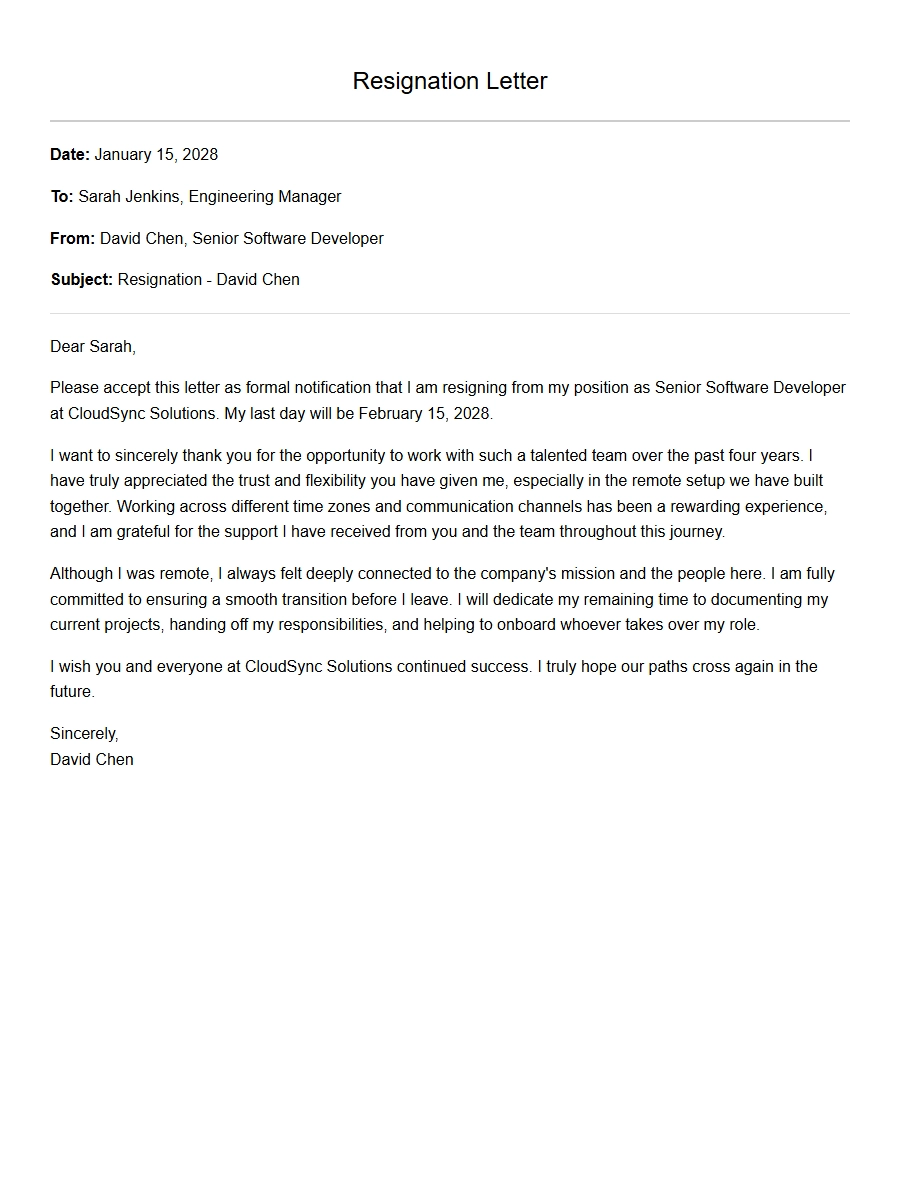 Polite Resignation Email for Remote Employees
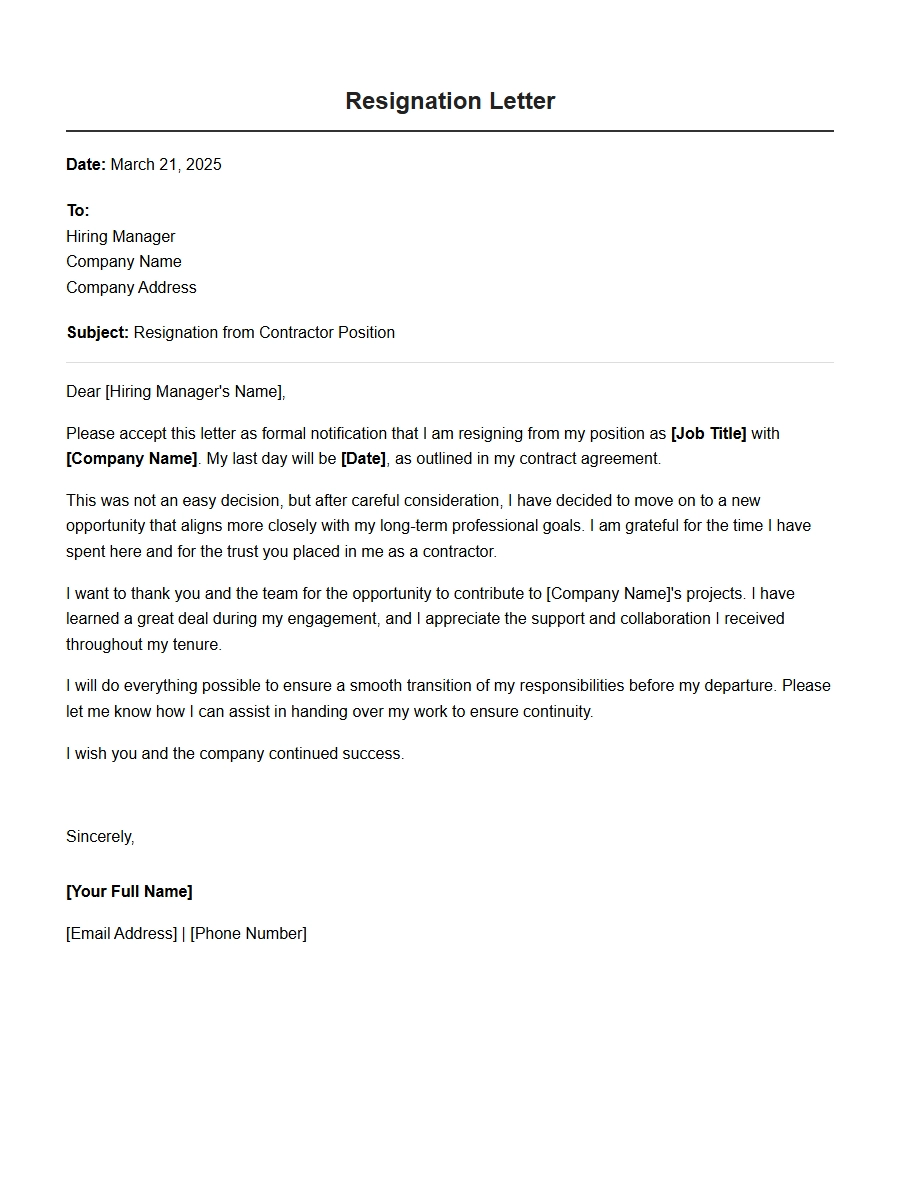 Short Resignation Letter for Contractor Position
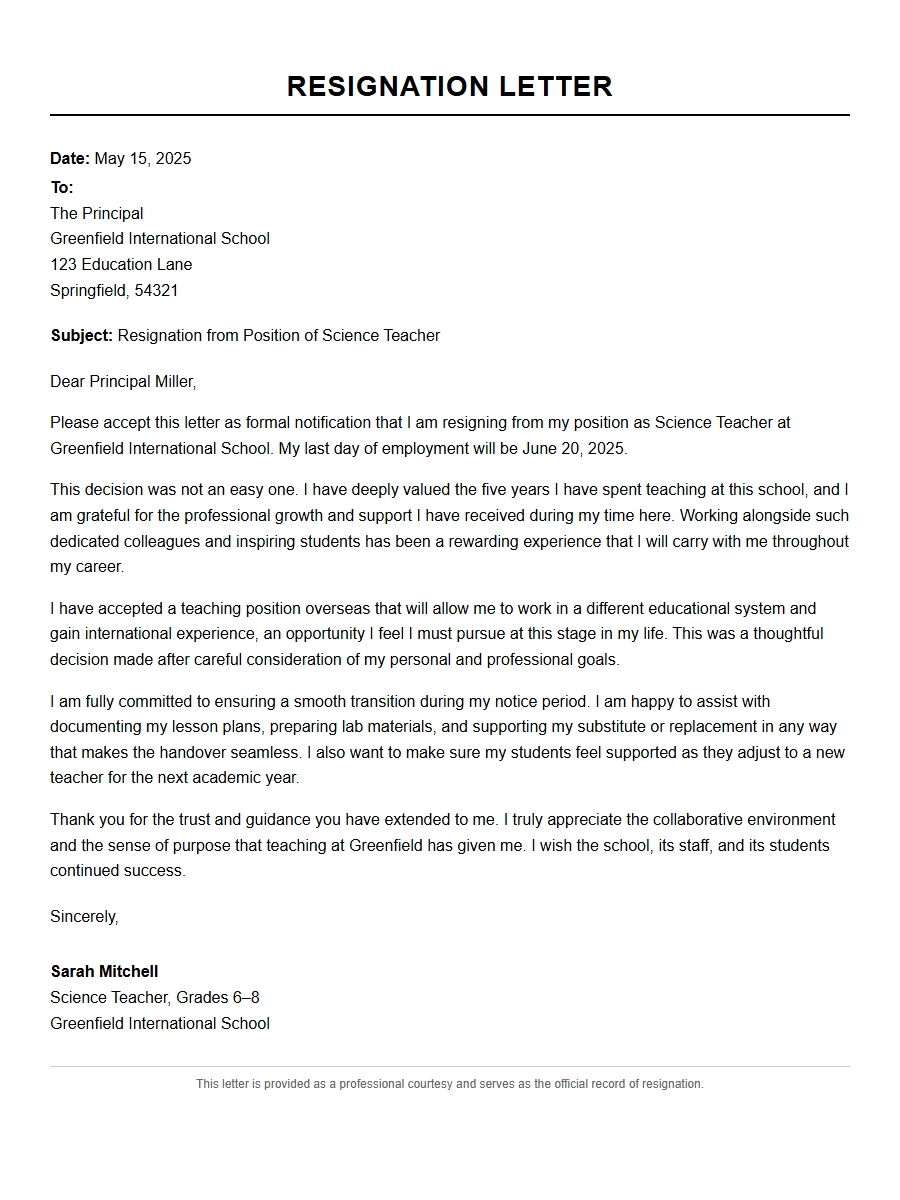 Teacher Resignation Letter Example
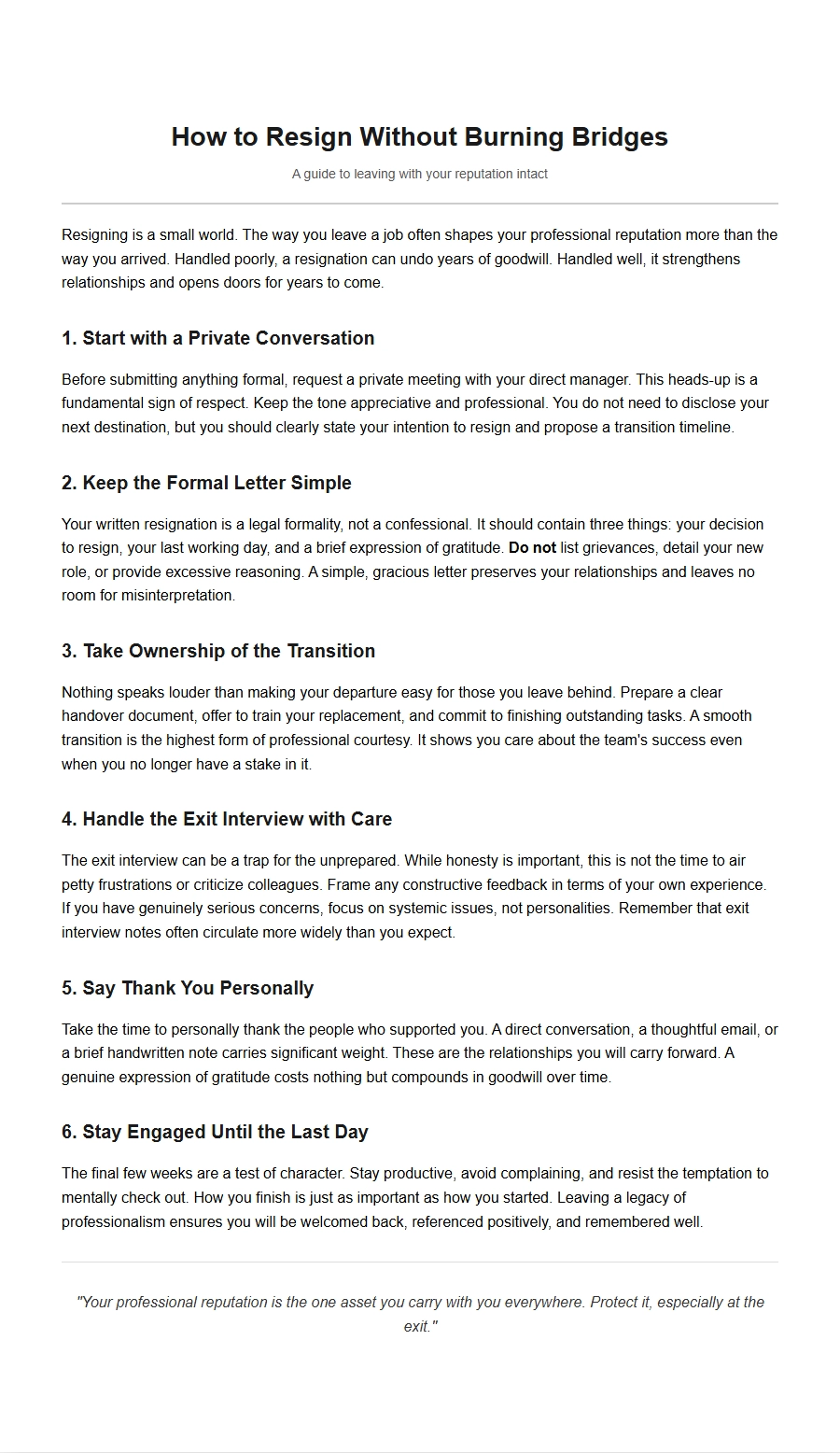 How to Resign Without Burning Bridges
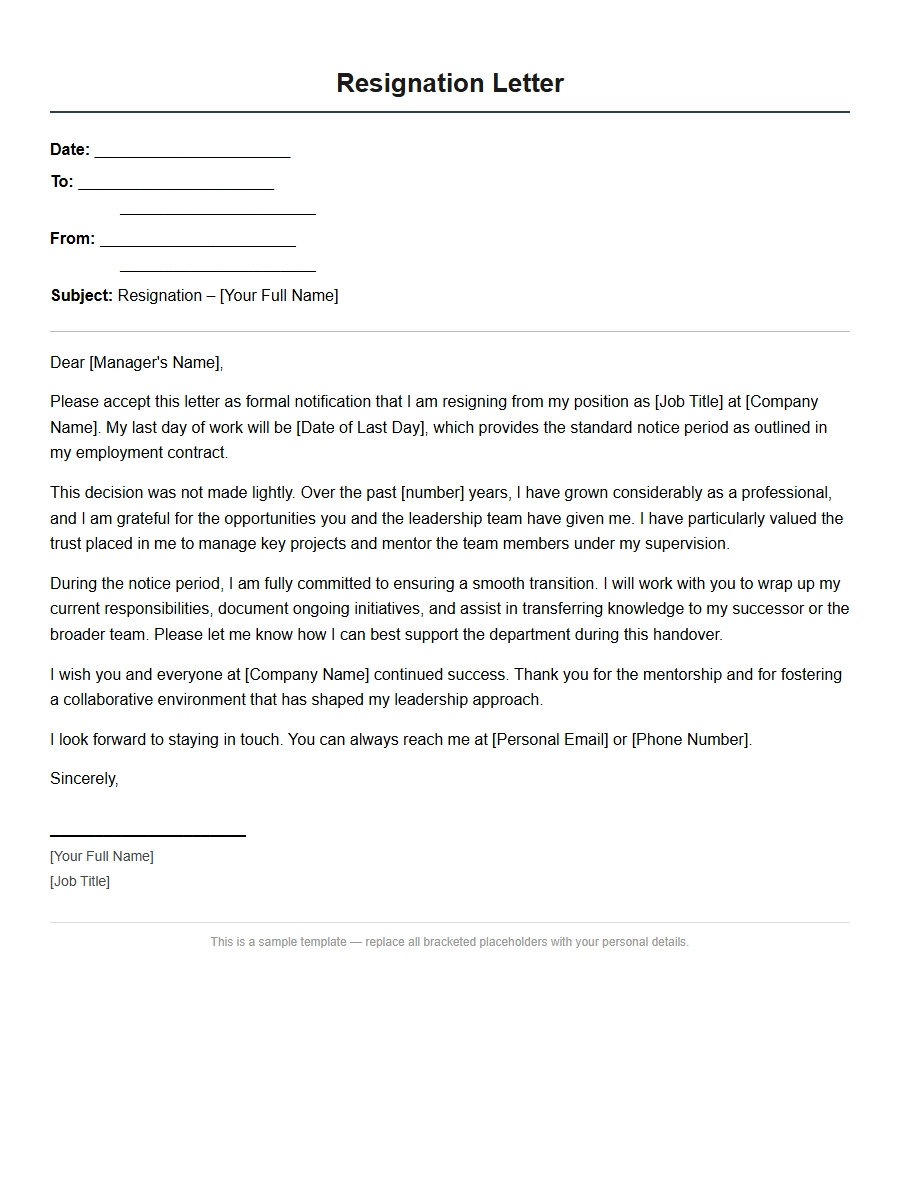 Formal Resignation Letter Sample for Manager
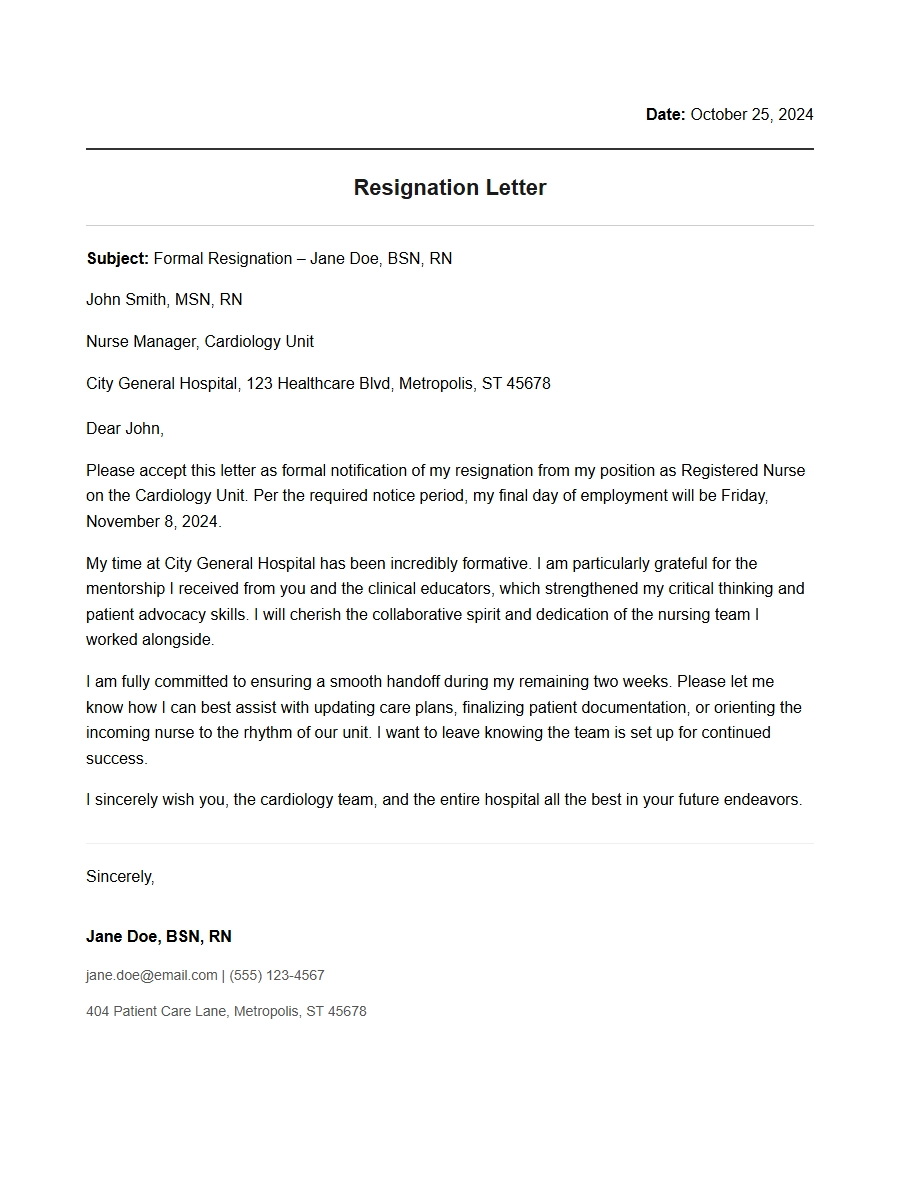 Nurse Resignation Letter with 2 Weeks Notice