You got the job. That rush of relief and excitement is real. But then you realize you need to write a thank-you note—and suddenly you're not sure what to say. Should it be formal? How long? Email or handwritten? The pressure to get it right can turn a happy moment into a stressful one. You're not alone. Most people feel this way, and a good sample can help you write something that sounds like you, not a robot.
Using a thank-you letter sample after being hired isn't cheating. It's smart. A well-crafted sample gives you a solid letter structure, shows you the right salutation and closing, and reminds you of the tone in writing that fits the situation. You then customize it with your own words. Think of it as training wheels—you don't need them forever, but they keep you from falling while you get your balance.
Category: Thank-You Letters After Hiring
The first step is choosing the right letter template for your situation. If you're emailing a quick note to your new boss, a short, warm message works. If you're sending a formal professional correspondence to a hiring committee, you'll want a more structured format. Look for samples that match your industry and the culture of the company. A startup might appreciate a casual tone, while a law firm expects business letter format and proper letter writing etiquette.
Once you have a sample, adapt it without losing your authentic voice. Start by replacing generic phrases with specifics. Instead of "Thank you for the opportunity," say "I'm grateful for the chance to join your marketing team—I've admired your campaigns for years." That small change makes the note feel personal. The opening paragraph is your hook. Mention something specific from the interview or offer conversation. It shows you were paying attention and care enough to remember.
h2>Common Mistakes to Avoid
One big mistake is using outdated salutations like "To Whom It May Concern" or "Dear Sir." You know the name of the person who hired you—use it. Another mistake is ignoring format. If you're sending a digital letter via email, skip the letterhead design and keep it clean. A simple subject line like "Thank you—Excited to join [Company Name]" works well. If you're printing and mailing, use standard digital letter format with your contact info at the top.
Don't forget to proofread. A typo in a thank-you note after being hired can feel careless. Read it out loud, or ask a friend to glance at it. Proofreading letter mistakes is quick but saves embarrassment. Also, watch your length. Keep it to three or four short paragraphs. Long notes can feel like a cover letter.
A good thank-you note can also open doors later. If you mention you'd love to learn from senior team members, that's a soft way to ask for guidance. Some people even request a letter of recommendation after starting—but that's a separate step. For now, focus on gratitude and enthusiasm.
Remember, you're not just being polite. You're reinforcing your reputation as someone who follows through. A prompt, well-written thank-you says, "I'm professional, I'm grateful, and I'm ready to contribute." That impression matters.
Use the sample as a springboard, not a crutch. The goal is to sound like a real person who is genuinely thankful. Practice makes the process faster. Next time you need to write a professional note, you'll do it in minutes, not hours.
Templates and Samples
How to Write a Thank You After Being Hired
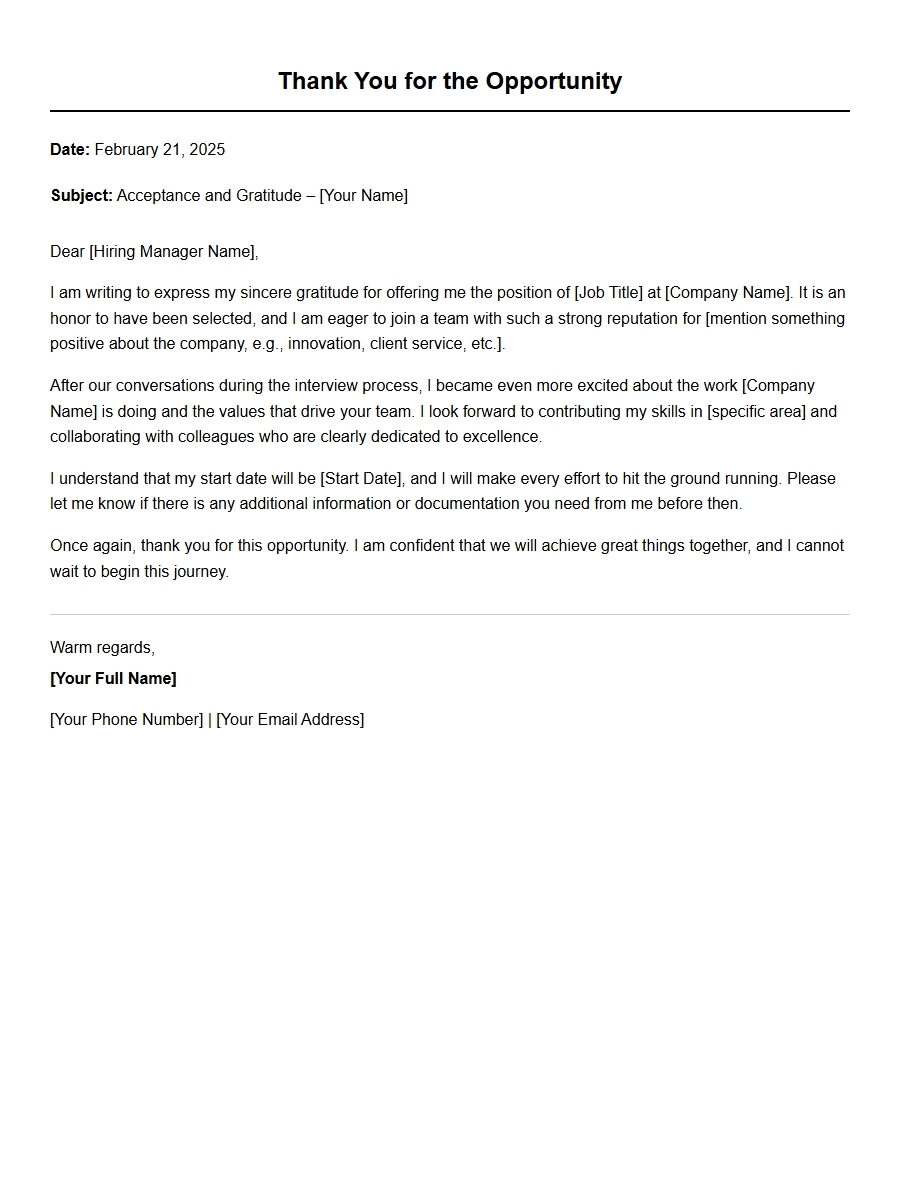
Thank You to Hiring Manager for the Opportunity
Dear Mr. Chen,
I want to express my sincere gratitude for offering me the position of Senior Marketing Analyst at NovaTech Solutions. I am thrilled to accept and join the team starting March 1, 2025.
Your confidence in my skills during the selection process means a great deal to me. I particularly appreciated our discussion about data-driven campaign strategies, and I am eager to contribute to the upcoming Q2 launch projects.
To ensure a smooth transition, I have outlined a few initial steps:
Complete the pre‑onboarding paperwork by February 20
Review the team’s current dashboard and reports
Schedule one‑on‑one meetings with each team member in the first week
I look forward to working with you and the entire Growth Marketing division. Thank you again for this wonderful opportunity.
Best regards, Li Wei
Expressing Gratitude to the Interview Panel
Hello Dr. Patel, Ms. Rivera, and Mr. Okonkwo,
Thank you all for the warm welcome and for selecting me as the new Clinical Research Coordinator at Boston Health Alliance. I am excited to begin on April 7, 2025.
I deeply appreciated the thoughtful questions you each asked during the panel interview—they gave me a clear picture of the collaborative culture here. The example you shared about the recent Cardiovascular Outcomes Study especially inspired me.
As I prepare for my start, here are the resources I will need access to:
Item
Purpose
Preferred Deadline
IRB training module
Research compliance
By Day 3
EPIC system credentials
Patient data entry
Before first patient visit
Lab safety orientation
Handling specimens
During Week 1
I am confident that my experience in multi‑center trials will allow me to contribute meaningfully from the start. Thank you again for this honor.
Sincerely, Amara Obi
Thank You to the Team for the Warm Welcome
Hi everyone,
I wanted to send a quick note to say thank you for the incredible welcome I received during my first day as a Frontend Developer at AppVista. The welcome banner, the desk treats, and the team lunch made me feel instantly at home.
I especially enjoyed meeting each of you and learning about the projects you’re working on. A few highlights from our conversations:
Sarah – the new design system is going to be a game changer.
Carlos – your insights on micro‑frontends were exactly what I hoped to explore.
Yuki – I look forward to pairing on the dashboard unit tests next sprint.
I have already started reviewing the codebase and will push my first small fix by Thursday. Please let me know if there is any specific onboarding material I should prioritize.
Thank you for making my transition so smooth. I can’t wait to start building together!
Best, Alex Rivera
Acknowledging a Mentor for Support During Hiring
Dear Mentor Stephanie,
I am writing this email with immense gratitude. Thanks to your guidance, I have accepted an offer for the Product Manager role at LuminaTech. I start on June 2, 2025.
Your advice during the interview prep was invaluable—especially the mock product strategy session where you pushed me to think about user retention metrics. That exercise directly helped me ace the case interview.
I want to share a few of the specific ways you helped me, as a reminder of your impact:
Refining my STAR stories for behavioral questions
Connecting me with your former colleague who now works at LuminaTech
Reviewing my thank‑you note drafts after each round
I hope to pay it forward by mentoring incoming PMs in the future. Thank you again for believing in me.
With appreciation, Jordan Lee
Thank You to Recruiter for Guiding the Process
Hello Katherine,
I wanted to personally thank you for your exceptional support throughout my hiring process for the Data Engineer position at CloudSync Inc. I have signed the offer and will officially join on May 5, 2025.
From the initial phone screen to the final negotiation, you made everything transparent and stress‑free. I especially appreciated your honest insights about team culture and the tools they use—that information helped me decide confidently.
Here is a quick recap of the timeline you managed so well:
Stage
Date
Outcome
Phone Screen
Feb 10
Passed
Technical Round
Feb 18
Excellent feedback
Final Interview
Mar 2
Offered
Offer Accepted
Mar 7
Signed
I will be sure to recommend your services to colleagues in the future. Thank you for being an advocate!
Warmly, Samir Gupta
Formal Thank You to HR Department
Dear Human Resources Team,
I would like to formally express my gratitude for the efficient and professional onboarding experience that culminated in my acceptance of the Financial Analyst position at Horizon Corp. My start date is July 1, 2025.
Special thanks to Ms. Diane Torres for coordinating the background check and benefits enrollment seamlessly. Every email was timely, and the welcome packet provided clear instructions on next steps.
I have completed the following pre‑employment tasks:
Signed offer letter and NDA
Submitted tax forms (W‑4 and state withholding)
Enrolled in health insurance (plan effective 7/1)
Set up company email and laptop request
I am eager to contribute to the Corporate Finance division and look forward to meeting the team during orientation. Please let me know if any additional documentation is required before day one.
Thank you again for making the process so smooth.
Sincerely, Maya Patel
Thank You Note to a Former Colleague Who Referred You
Hi Liam,
Great news—I accepted the UX Designer offer at DesignLab Collective! I start on August 11, 2025. None of this would have happened without your referral, and I am so grateful.
Your recommendation to the hiring manager really opened the door. I also appreciated you sharing your portfolio tips and the internal design system documentation—it gave me a huge head start.
To celebrate, I would love to grab lunch or coffee next week. My treat! Let me know what works for you:
Option A: Thursday Aug 14 at 12:30 (your office area)
Option B: Friday Aug 15 at 1:00 (near the waterfront café)
I hope we can work together again in the future—maybe on a cross‑team project. Thank you for being an amazing supporter.
Cheers, Emily Tran
Appreciation Letter to the CEO for the Offer
Dear Ms. Keller,
I am writing to express my sincere appreciation for the offer to join GreenLeaf Energy as the Director of Operations. I have accepted and will officially begin on September 15, 2025.
Our conversation during the final interview about the company’s mission to achieve carbon‑neutral operations by 2030 deeply resonated with me. I am honored to be entrusted with a role that can directly impact that goal.
During my first month, I plan to focus on:
Understanding current supply chain inefficiencies
Building relationships with regional logistics partners
Reviewing the sustainability dashboard and KPIs
I am confident that my experience in scaling logistics at clean‑tech companies will help drive measurable results. Thank you for this incredible opportunity to contribute to such a meaningful vision.
Respectfully, Nora Halim
Thank You for an Internal Promotion (Hired into New Role)
Dear Manager Sarah and HR Lead Tom,
I am thrilled to accept the promotion to Team Lead, Engineering effective October 1, 2025. Thank you for recognizing my contributions and trusting me with this leadership opportunity.
In my new role, I will be responsible for guiding a team of 8 developers while continuing to drive the Project Aurora initiative. I have already started identifying areas where we can enhance our agile processes.
To ensure a smooth transition, I propose the following handover plan for my previous duties:
Current Duty
New Owner (Tentative)
Transition Date
Backend API maintenance
Priya
Oct 1–5
Code reviews
Rotation among 3 seniors
Oct 6 onward
Monthly technical reporting
Alex
Oct 8
I look forward to working closely with you to develop our engineers and deliver high‑quality products. Thank you again for this vote of confidence.
Best regards, Carlos Mendez
Thank You to the Onboarding Coordinator for a Smooth Start
Hi Rachel,
Thank you so much for making my first week as a Content Strategist at BrightMedia so seamless. From the pre‑onboarding checklist to the welcome gift, every detail was thoughtful.
I especially appreciated that you scheduled my IT setup and benefits meeting before my start date. That saved me from waiting in lines on Day 1. Also, the interactive office map you shared helped me find the restrooms and kitchen without awkward wandering!
For future new hires, here are a few things that might be worth adding to your already excellent plan:
A short video tour of the office by a current employee
A Slack channel where newbies can ask quick questions
A buddy system for the first two weeks
I am fully set up now and already diving into the editorial calendar. Thank you again for your warmth and efficiency.
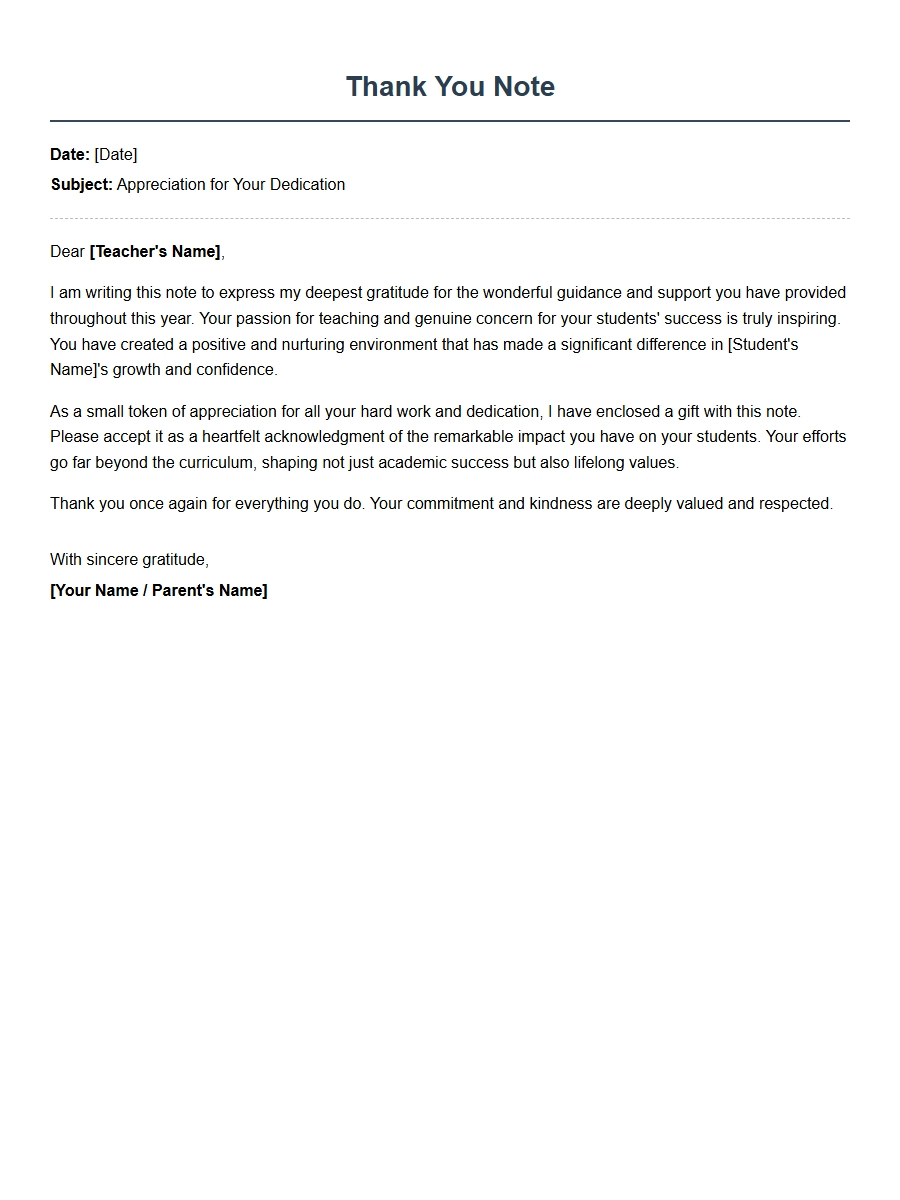 Sample Thank You Note for Teacher Gift
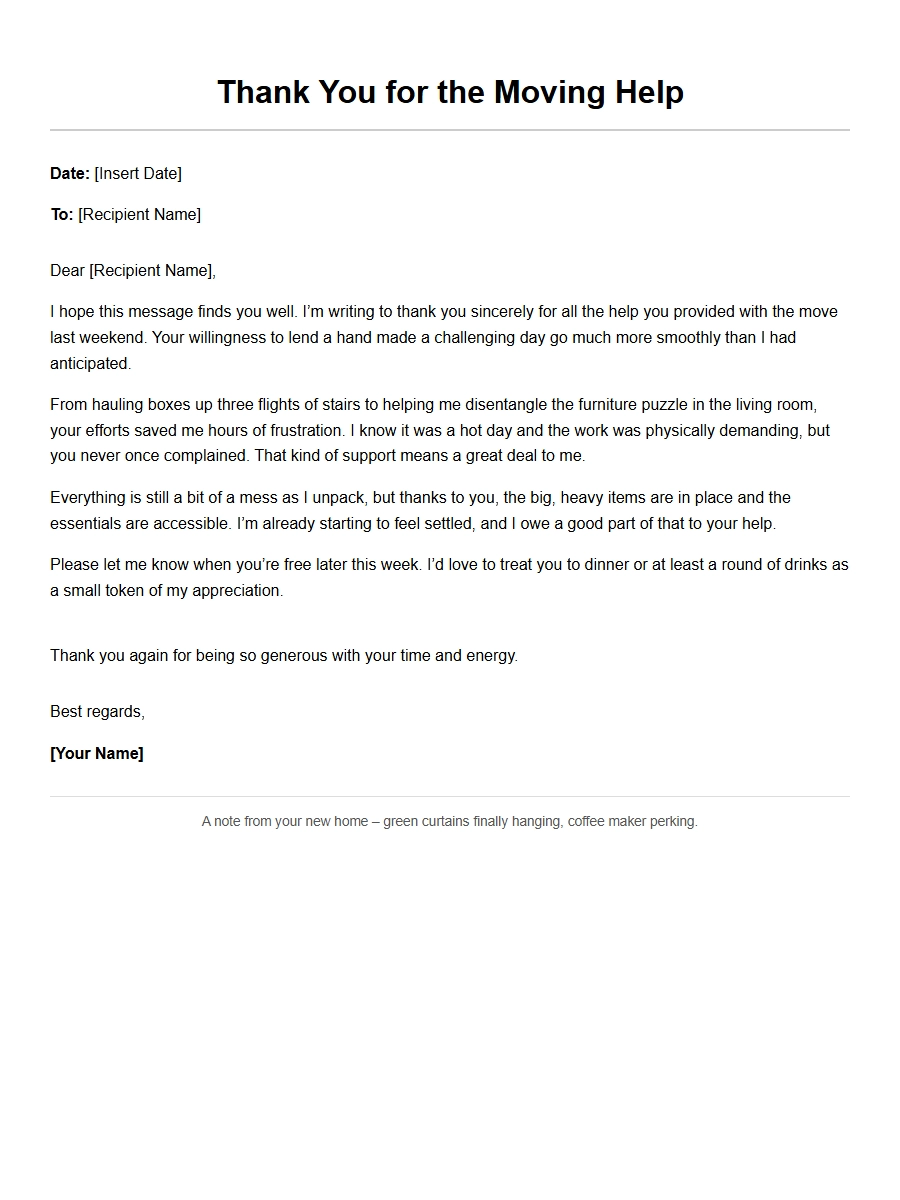 Thank-You Letter for Help with Moving
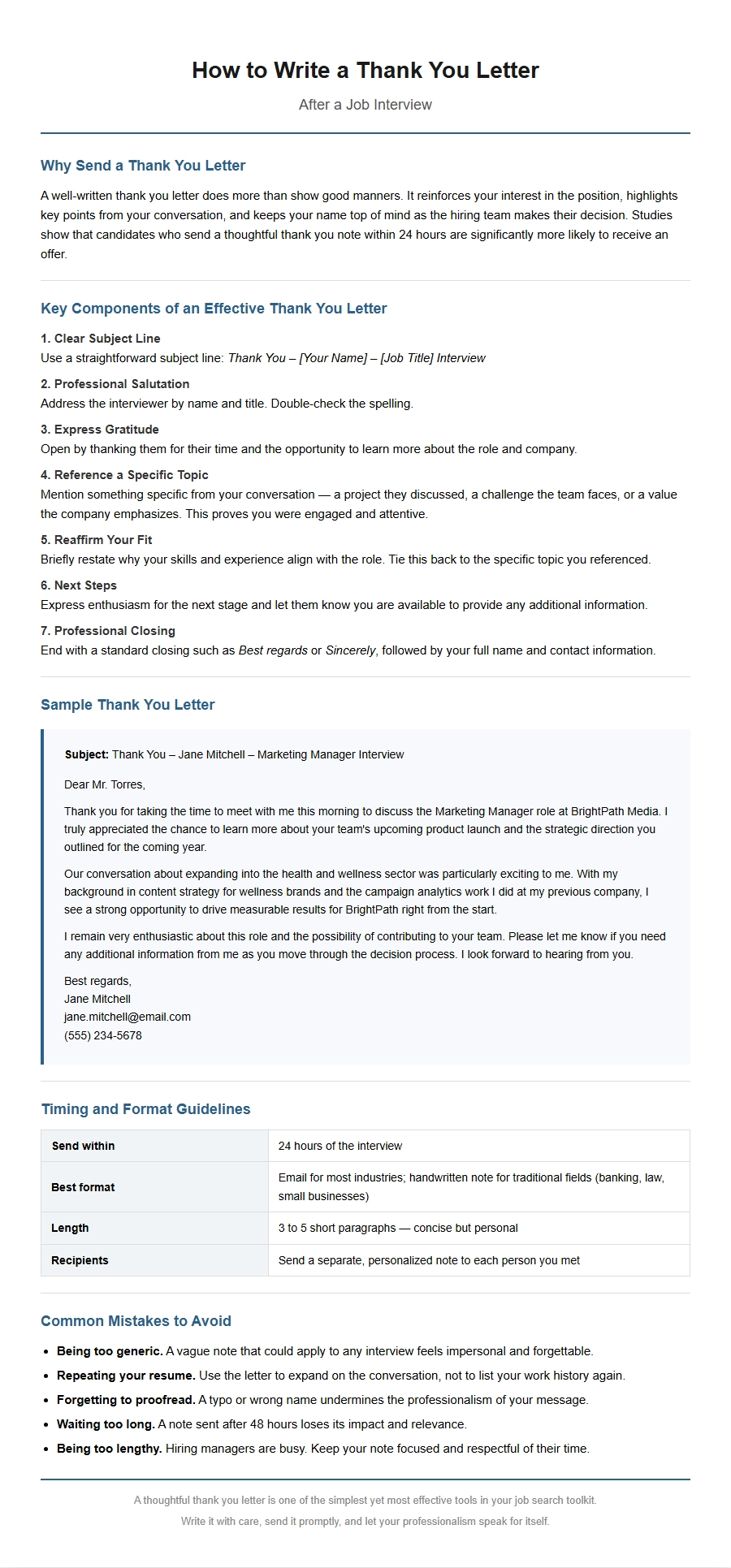 How to Write a Thank You Letter After an Interview
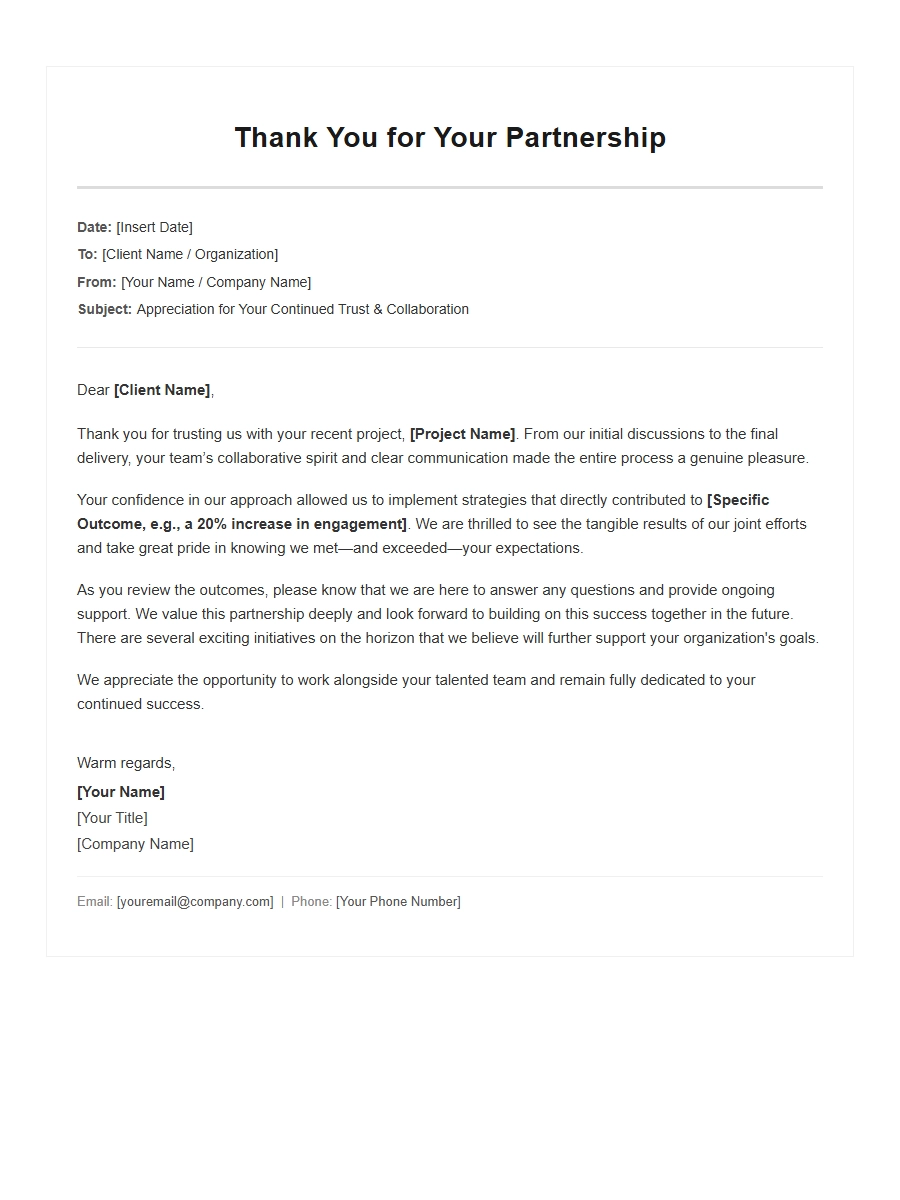 professional thank you email example for client - Thank-You Letters
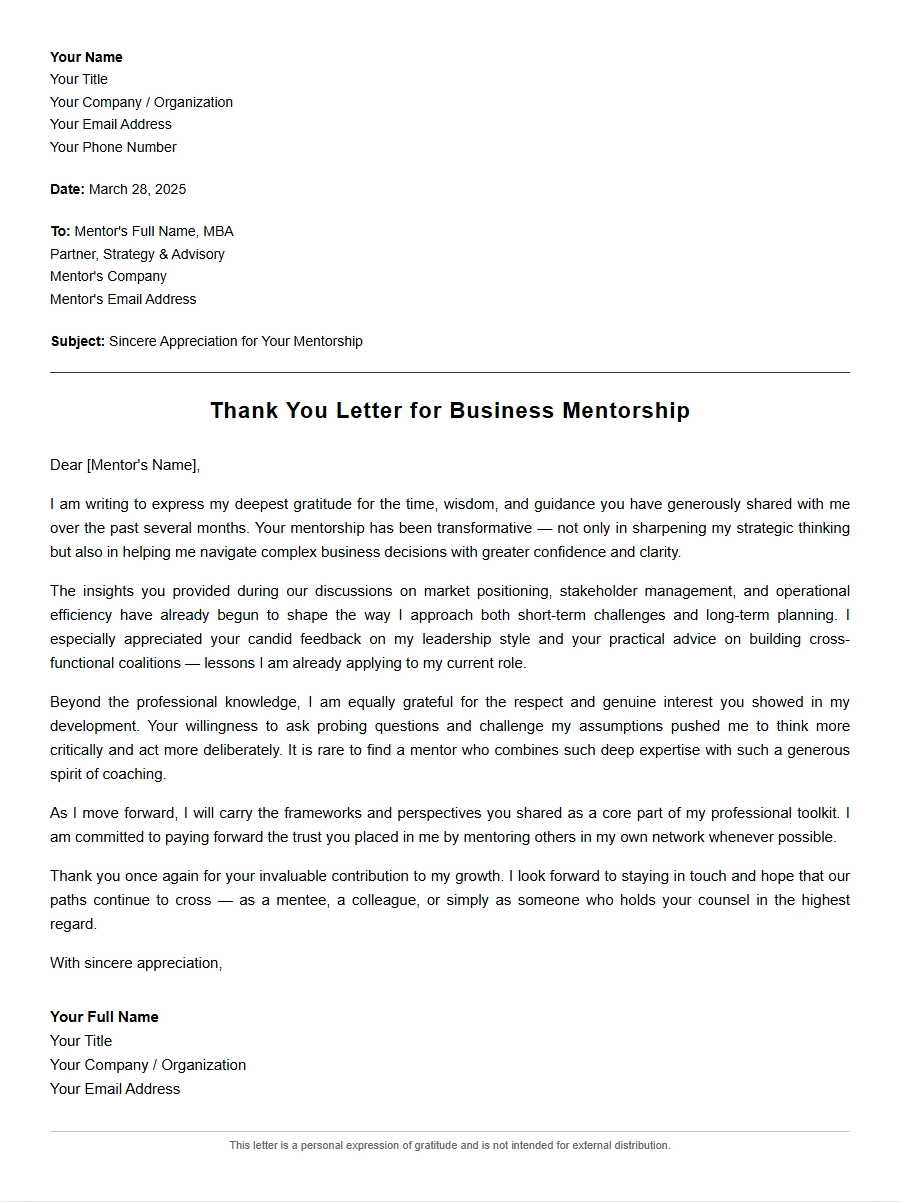 Business Mentor Thank-You Letter Guide
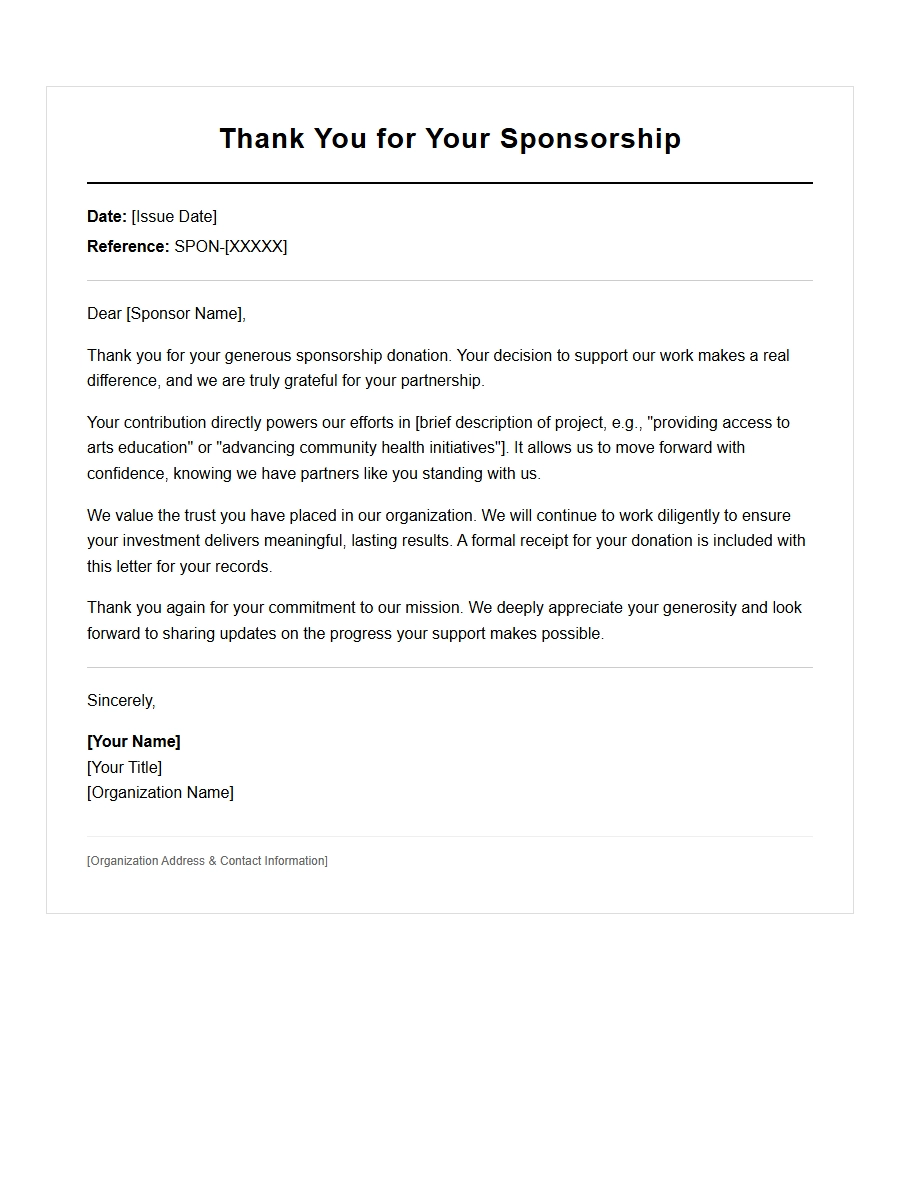 Thank You Letter for Sponsor Donation