You’ve just finished a medical exam follow-up appointment. The doctor was thorough, listened carefully, and maybe even called to check on your test results. Now you want to say thank you. But when you sit down to write, the words feel awkward or too stiff. That’s completely normal. A short thank-you note is a simple gesture, but getting the tone right can take a few tries.
Category: Medical Thank-You Letters
Using a sample isn’t cheating—it’s a smart way to save time while keeping your message professional and warm. A good letter template gives you a clear structure, shows you the right level of formality, and offers phrases you can borrow. You just add your specific details to make it yours. Think of it as training wheels: you’ll be writing comfortably on your own before long.
Why a Sample Helps with Professional Correspondence
When you’re writing to a doctor, you want to show respect without sounding robotic. A sample gives you a framework: the salutation and closing, the flow from thanks to specific reasons, and a polite request for continued care. It also guides you on tone in writing—should you be formal or can you be a little warmer? For a doctor you’ve seen a few times, a semi‑formal tone usually works best. For a new specialist, a more traditional business letter format is safer.
Don’t worry about sounding like everyone else. A customizable letter lets you swap in your own experiences. Maybe you mention how the doctor’s explanation helped you understand your condition. Or you thank them for fitting you in last minute. Those details make the letter personal and memorable.
Choose the Right Letter Structure
Start by deciding whether you’ll send a printed card or an email. If it’s a digital letter format, keep the subject line simple, like “Thanks for last week’s follow‑up.” For printed mail, consider using letterhead design (your own or a nice card stock) to make it a bit more formal. Either way, the letter structure stays similar:
A clear salutation – “Dear Dr. [Last Name],” is always correct.
An opening that states your gratitude – “Thank you so much for the follow‑up appointment yesterday.”
A middle part that explains why you’re grateful – mention a specific action, like explaining test results or easing a worry.
A closing that expresses continued trust – “I appreciate your care and look forward to our next visit.”
A polite sign‑off – “Best regards,” or “Sincerely,” followed by your name.
That’s the skeleton. Now you need to fill it with your own voice.
Adapt the Sample Without Losing Your Voice
The biggest mistake people make is copying a sample word for word. It ends up feeling hollow. Instead, read the sample, then close it and write your own draft. Keep the structure but use your own phrases. For example, if the sample says “I am grateful for your time,” you might say “Thanks again for making time to answer all my questions.” It’s more natural and sounds like you.
Another common slip‑up is using outdated salutations like “To Whom It May Concern” or “Dear Sir/Madam.” For a doctor you know, use their name. And if you’re thanking them for a letter of recommendation they wrote for you, that’s a different situation entirely—you’d want to thank them for that specific favor. (We have a separate guide on thanking someone for a reference check that covers that scenario.)
Watch Out for These Letter Writing Etiquette Pitfalls
Proofreading your letter is non‑negotiable. A typo in a thanks note can seem careless. Read it aloud once to catch awkward phrasing. Also, check that your salutation and closing match in level of formality. Starting with “Dear Dr. Jones” and ending with “Cheers!” feels inconsistent. Stick with “Best regards” or “Warmly.”
If you’re sending the note by email, remember that digital letter format still requires a proper subject line and a polite closing. Don’t treat it like a text message. And if you’re printing it, consider whether you need a full letterhead design or a simple card. Both are fine—just make sure the paper is clean and the writing is legible.
Make the Opening Grab Their Attention
The first sentence is your best chance to show genuine feeling. Instead of “I am writing to express my gratitude,” try “Thank you for the excellent follow‑up care. I especially appreciated how you walked me through the lab results.” That hooks the reader with a specific detail. It shows you paid attention and that their effort mattered to you.
Don’t overthink it. Pick a simple letter template that matches your relationship with the doctor. Adapt it with your own words. Keep it short—three or four sentences is plenty. Then proofread it once and send it. Your doctor will appreciate the gesture, and you’ll feel good knowing you expressed your thanks.
As you get more comfortable, consider writing a few thank‑you notes for other situations—like after hosting a dinner party or acknowledging a contract signing. Each one teaches you to write with your own voice, and soon you won’t need any sample at all. For now, let the sample be your springboard. The best letters are both professional and personal—and yours will be exactly that.
Examples for Different Needs
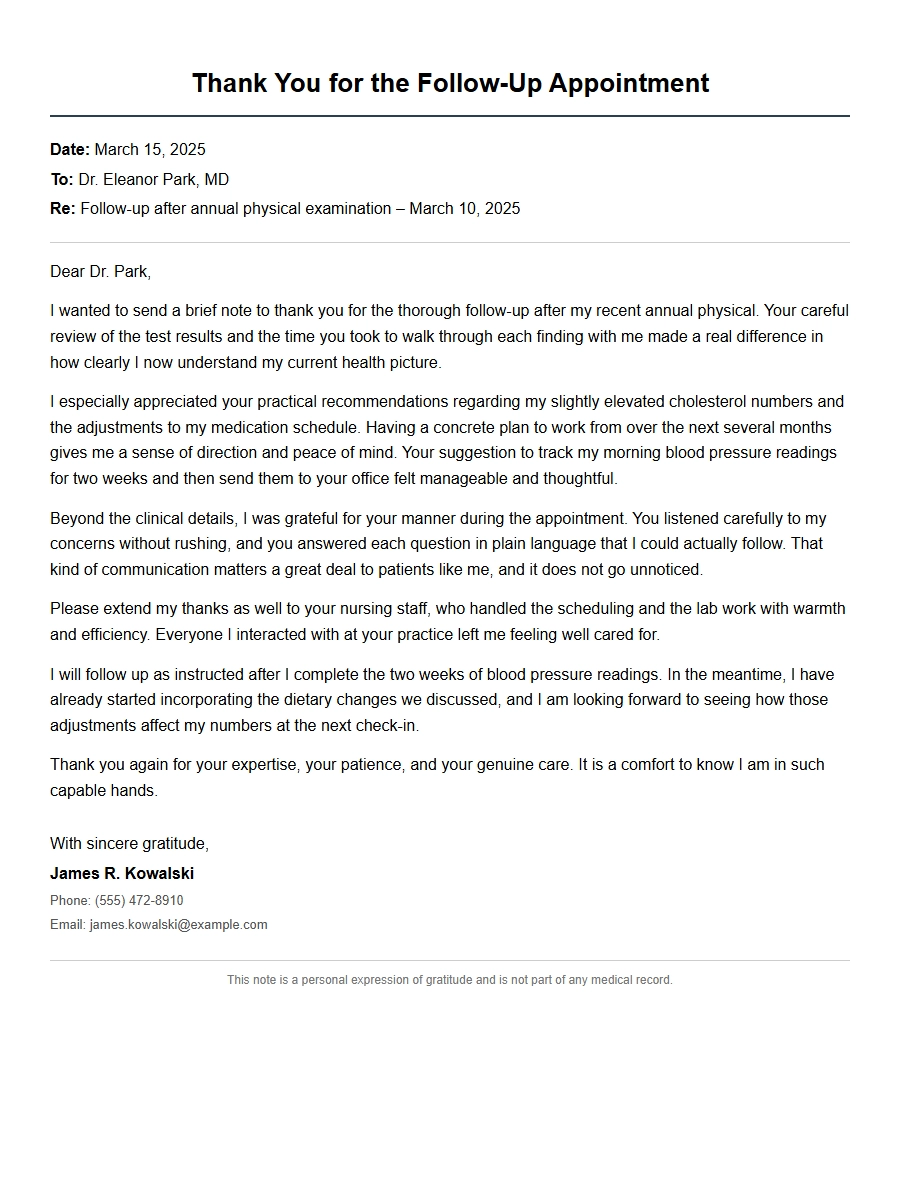
Thank You Doctor for Medical Follow-Up
Thank You for Routine Physical Follow-Up
Dear Dr. Smith,
Thank you for the thorough follow-up after my annual physical exam last Thursday. Your detailed explanation of my lab results and the personalized advice on diet and exercise gave me a clear path forward. I especially appreciated the time you took to address my concerns about cholesterol levels.
Here are the key takeaways from our discussion:
Continue moderate cardio 30 minutes daily
Limit saturated fats and increase fiber
Schedule next lipid panel in six months
I have already made an appointment for the nutritionist you recommended. Thank you again for your compassionate care.
Best regards, Jane Doe
Gratitude for Specialist Consultation Follow-Up
Dear Dr. Patel,
I am writing to express my sincere thanks for the follow-up call yesterday regarding my endocrinology consultation. Your clear summary of my thyroid ultrasound results and the proposed medication plan helped me understand the next steps with confidence.
Below is the treatment schedule we agreed upon:
Medication
Dosage
Timing
Levothyroxine
75 mcg
Daily before breakfast
Vitamin D
2000 IU
With dinner
Your patience in answering my questions about potential side effects was remarkable. I will report back after four weeks as instructed.
Warmly, Robert Chen
Thank You for Pediatric Check-Up Follow-Up
Dear Dr. Garcia,
Thank you so much for following up after Liam’s 5-year well-child visit. Your guidance on his growth percentiles and the vaccination schedule made us feel at ease. We were especially grateful for the growth chart you shared.
Based on your recommendations, we will:
Introduce more iron-rich foods (spinach, lean beef)
Limit screen time to one hour per day
Read together for 20 minutes nightly
Liam is already excited about his new “big kid” check-up goals. Thank you for making the experience positive for him.
With thanks, Emily and Mark Torres
Thanks for Geriatric Assessment Follow-Up
Dear Dr. Okafor,
I want to thank you for the comprehensive follow-up after my mother’s geriatric assessment last week. Your detailed medication review and fall prevention plan have given our family peace of mind. The home safety checklist you provided is already being implemented.
Key modifications we are making:
Installing grab bars in the bathroom
Removing loose rugs
Adding night lights in hallways
Your referral to the physical therapist was also very timely. My mother has started her balance exercises and feels more steady. Thank you for your patience in explaining each step.
Sincerely, Linda Chang
Thank You for Post-Surgery Follow-Up Care
Dear Dr. Martinez,
Thank you for the thorough follow-up appointment yesterday regarding my knee arthroscopy recovery. Your clear instructions on exercise progression and medication tapering are exactly what I needed. I am now walking without crutches for short distances.
Here is my current progress according to your plan:
Week
Activity
Status
2
Gentle range-of-motion
Completed
4
Stationary bike low resistance
Starting today
Your team’s responsiveness to my post-op questions has been outstanding. I feel confident in my recovery journey.
Warmest regards, Chris Williams
Appreciation for Telemedicine Follow-Up
Dear Dr. Kim,
Thank you for the virtual follow-up this morning regarding my hypertension management. Despite not meeting in person, the video call felt very personal and effective. You reviewed my home blood pressure readings and adjusted my medication accordingly.
Your new plan includes:
Take lisinopril 10 mg now in the evening
Monitor BP twice daily (morning and bedtime)
Log readings in the app you recommended
I really appreciate that you sent the summary and the prescription electronically. The convenience and clarity of your follow-up exceeded my expectations.
Best, David Park
Gratitude for Urgent Care Follow-Up
Dear Dr. Nguyen,
I want to thank you for the phone follow-up after my urgent care visit for the allergic reaction. Your reassurance and the clear instructions on tapering the antihistamine made a difficult night much easier. The rash has completely resolved, and I am back to normal activities.
Just to confirm, here is what I will continue:
Cetirizine 10 mg daily for another week
Avoid known triggers (shellfish, aspirin)
Carry an epinephrine auto-injector as prescribed
Your prompt follow-up shows true dedication to patient care. Thank you again.
Sincerely, Megan Stewart
Thanks for Preventive Screening Follow-Up
Dear Dr. Walker,
Thank you for the detailed follow-up letter discussing my colonoscopy results from last week. I am relieved that no polyps were found and appreciate your clear guidelines on future screening intervals. Your advice on maintaining a high-fiber diet was also very helpful.
Based on your recommendations, I will:
Schedule next colonoscopy in 10 years
Consume 25-30g fiber daily
Continue annual FIT tests in between
I also want to thank your scheduling team for the prompt appointment. Your thorough approach makes preventive care easy to stay on top of.
Best regards, Thomas Baker
Thank You for Coordinated Care Follow-Up
Dear Dr. Lee,
Thank you for the follow-up meeting in which you reviewed my lab work and coordinated with my rheumatologist. Your comprehensive summary and the updated treatment plan truly reflect exceptional collaborative care. I now have a clear medication schedule.
Current medications as per the plan:
Drug
Purpose
Next refill
Methotrexate 15 mg
RA control
March 15
Folic acid 1 mg
Side effect prevention
March 15
Your effort in updating my specialist and pharmacy saved me multiple phone calls. I feel very supported.
Warmly, Sarah Jensen
Appreciation for Follow-Up After Abnormal Result
Dear Dr. Hernandez,
Thank you for the compassionate follow-up after my abnormal mammogram. Your calm explanation of the need for additional imaging and the step-by-step plan relieved a lot of anxiety. You even arranged the diagnostic appointment for next week.
Steps we discussed:
Diagnostic mammogram and ultrasound on Friday
Biopsy only if imaging is suspicious
Results expected within 48 hours
Thank you for providing the reading materials and the contact number for our questions. Your prompt attention to this follow-up gives me confidence in my care.
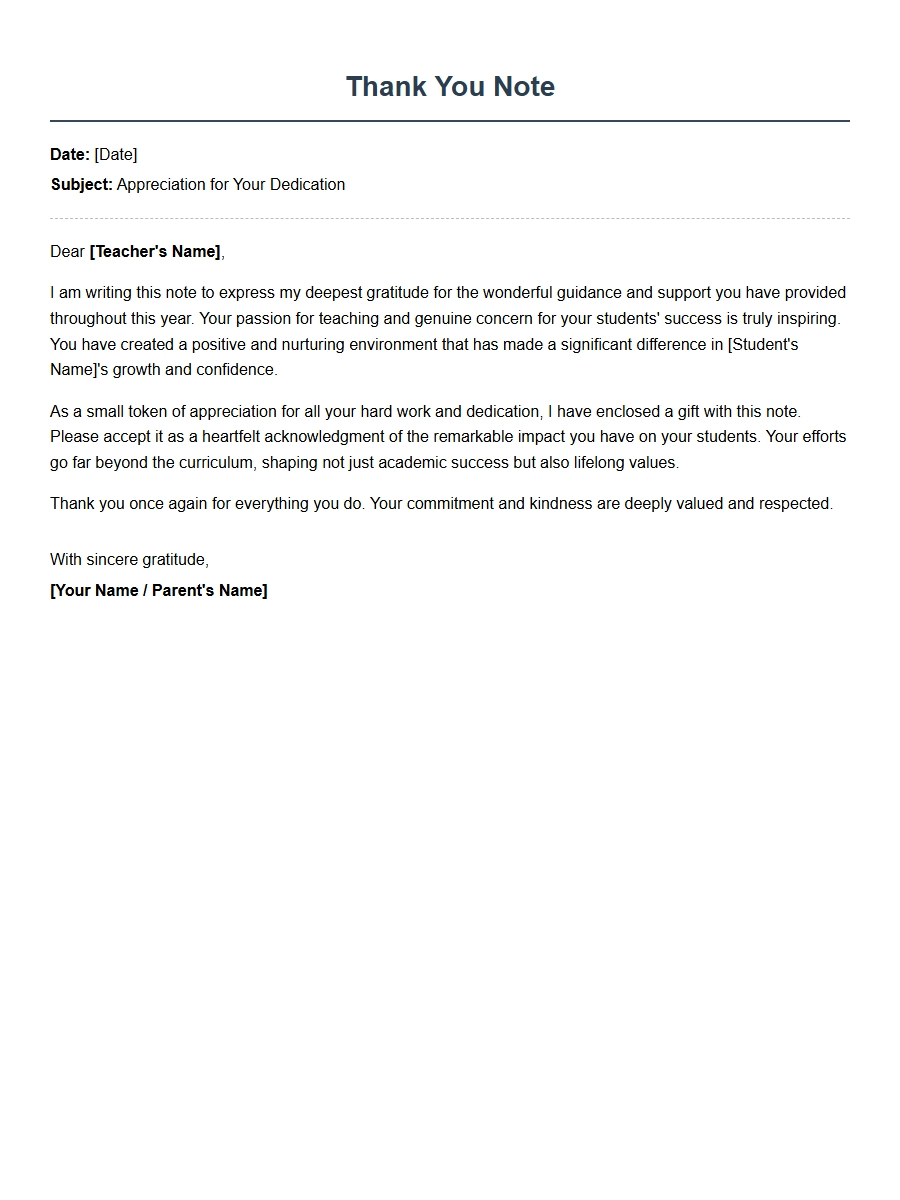 Sample Thank You Note for Teacher Gift
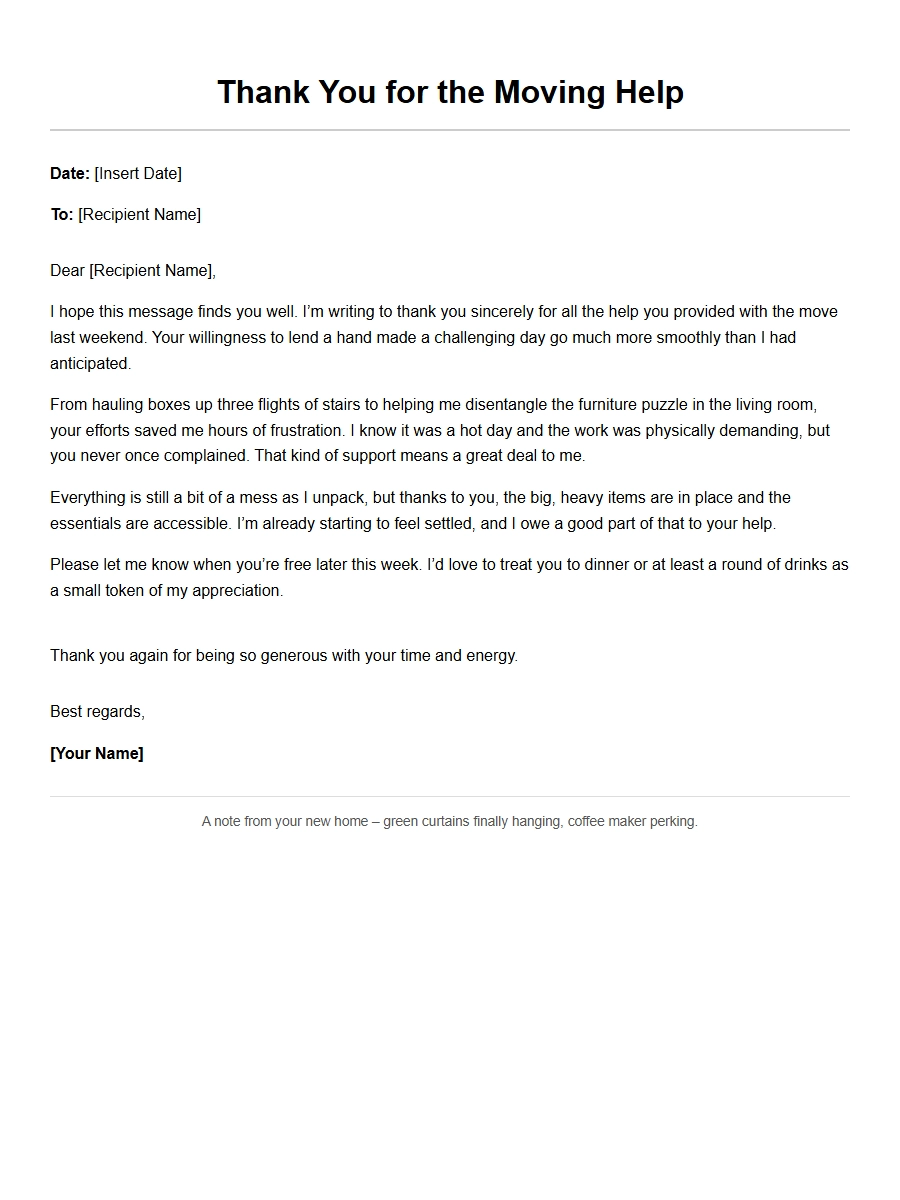 Thank-You Letter for Help with Moving
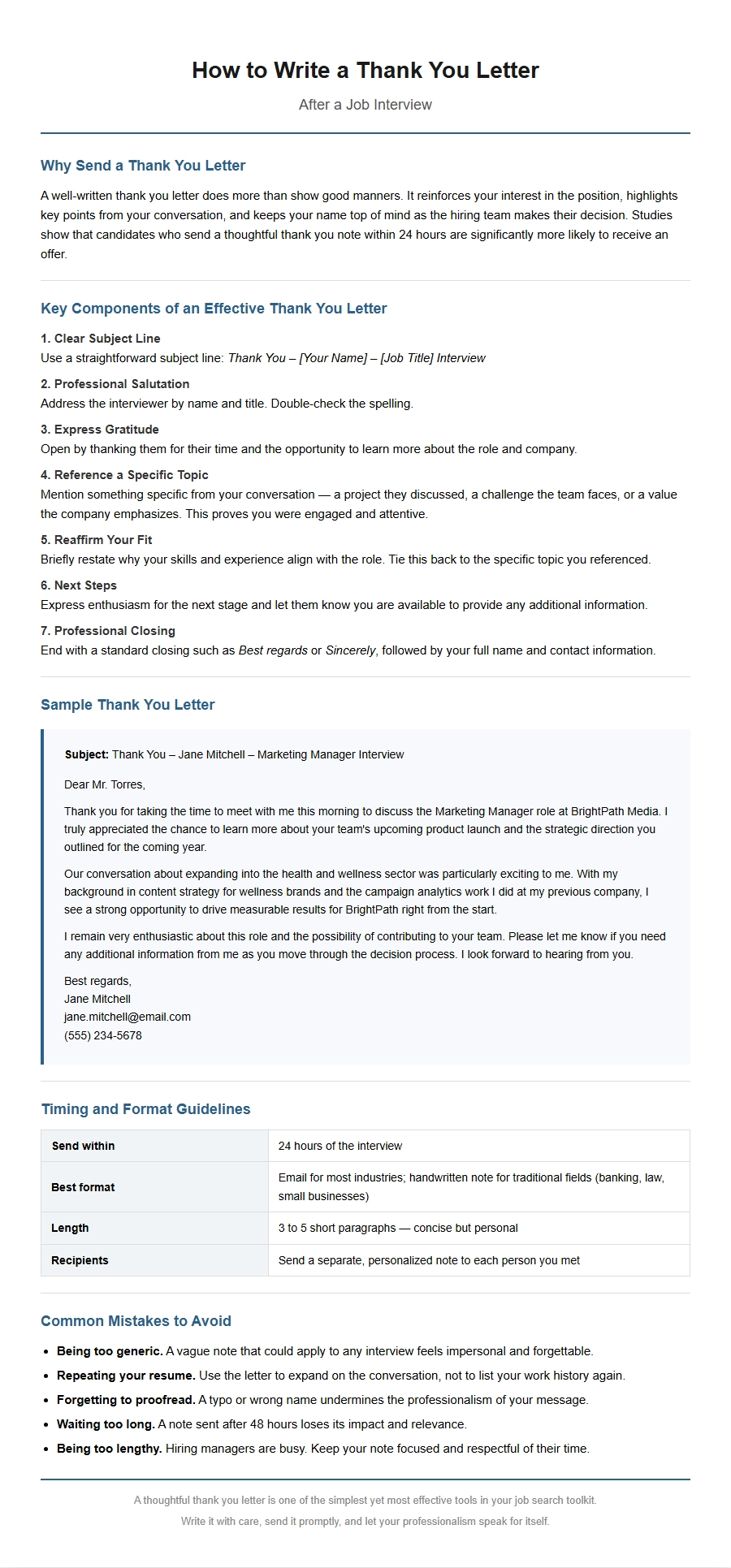 How to Write a Thank You Letter After an Interview
 professional thank you email example for client - Thank-You Letters
 Business Mentor Thank-You Letter Guide
 Thank You Letter for Sponsor Donation