You need to resign today, and you don't have time to craft the perfect letter from scratch. Maybe your situation is urgent—a new job offer came fast, or a personal matter requires you to leave immediately. Staring at a blank page only adds stress. Using a sample resignation letter for immediate leave is not cheating. It’s a smart shortcut that gives you a professional structure, the right tone, and key phrases you can personalize in minutes.
Think of a sample as a template, not a cage. It shows you how to write a formal business letter without guessing the formatting or salutation. Once you see a well-written example, you can adapt it to sound like you—not a robot. Below, I’ll walk you through how to pick the right sample, tailor it, and avoid common missteps.
Why a resignation letter for immediate leave is different
Most resignation letters give two weeks’ notice. But when you need to leave right away—whether for health, family, or a sudden opportunity—your letter must be clear and respectful. It should state your last day upfront and explain (briefly) why the departure is immediate. A good sample letter handles this delicate balance: it’s direct without sounding rude, and professional without being cold.
The key is to focus on letter structure and tone in writing. Your letter needs a clear subject line (if emailed), a proper salutation and closing, and a body that states your resignation, expresses gratitude, and mentions the effective date. A sample gives you all that framework.
How to choose the right sample for your situation
Not all resignation letters are the same. You might need a very formal version for a corporate office, or a more relaxed one for a small team. Look for a sample that matches your industry and your relationship with your employer. If you’ve worked closely with your manager, a semi-formal tone works better. If you’re leaving a large company, stick with standard business letter format.
Also check whether the sample is written for email or printed letter. Email uses a subject line and no letterhead; a printed letter often has a letterhead design at the top. Choose accordingly. A good sample will show both digital letter format and professional correspondence options.
One common mistake to avoid
Don’t copy the sample word for word. Your letter should sound like you. Replace formal phrases you wouldn’t normally say, and add a personal sentence about what you appreciated—like a project you enjoyed or a skill you learned. That’s how a template becomes your own customizable letter.
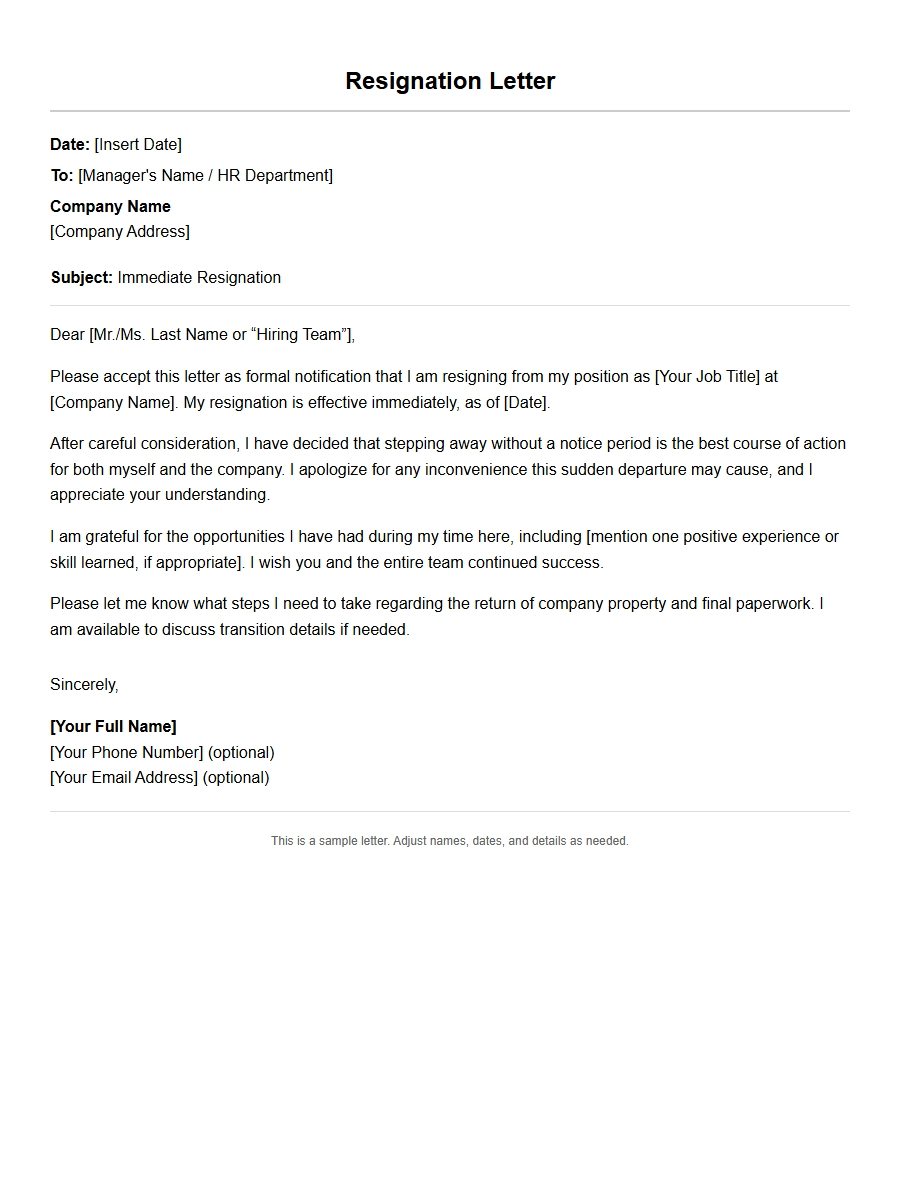
Another mistake: ignoring the opening. The first line should grab attention without being dramatic. Start with something like, “Please accept this letter as my formal resignation from [Company Name], effective immediately.” Then briefly explain the reason if you feel comfortable. You don’t need to over-explain.
Practical steps to adapt any sample
Start by reading two or three samples to get a feel for structure. Then write your own version in your voice. Use the sample’s letter template as a skeleton. Keep the salutation, body paragraphs, and closing. But change the details to fit your story.
For example, if the sample says “I have decided to pursue a new opportunity,” but you’re leaving for personal reasons, change it to “Due to a family matter, I need to resign effective immediately.” Honest and direct is fine.
Always proofread once before sending. Run spell check, read aloud, and check that the date and recipient’s name are correct. Careless typos in a resignation letter can leave a bad last impression. Taking two extra minutes for proofreading letter is worth it.
If you simply need to withdraw quickly without details, a standard notice of withdrawal from position works well. Keep it under five sentences: state your resignation, effective date, thank you, and offer to help with the transition (if possible).
Forward-looking thought
A resignation letter signals the end of one chapter, but it’s also your last chance to leave a professional impression. Use the sample as a springboard, not a crutch. Write something that feels honest and respectful. With practice, the process gets faster—and you’ll know exactly how to handle it next time.
Browse Sample Ideas
Sample Immediate Leave Resignation Letter
Personal Emergency Resignation
Date: March 22, 2025
To: HR Manager, BrightTech Solutions From: James Carter, Marketing Coordinator
Subject: Immediate Resignation Due to Personal Emergency
Dear [HR Manager],
Please accept this letter as my formal resignation from the position of Marketing Coordinator at BrightTech Solutions, effective immediately. Due to a sudden and serious personal emergency in my family, I must leave without serving the standard notice period. I deeply regret any inconvenience this causes.
Below is a summary of my details:
Field
Details
Employee Name
James Carter
Position
Marketing Coordinator
Last Working Day
March 22, 2025
Reason for Immediate Leave
Personal family emergency
I will ensure a smooth handover of my current projects within the next 24 hours. Please let me know how I can assist in transferring responsibilities. I appreciate the opportunities I have had here and thank you for your understanding.
Sincerely, James Carter
Health-Related Immediate Resignation
Date: March 22, 2025
To: Department Head, MedCore Inc. From: Sarah Lim, Nurse Practitioner
Subject: Resignation Due to Health Reasons – Immediate Effect
Dear [Department Head],
I am writing to resign from my position as Nurse Practitioner at MedCore Inc., effective today. My physician has advised immediate rest and treatment for a condition that prevents me from continuing work without risk to my wellbeing. I cannot fulfill my duties and must prioritize recovery.
The following table outlines my resignation details:
Item
Information
Notice Intended
Immediate (medical exigency)
Last Day Worked
March 21, 2025
Accrued Leave Balance
12 days (unused)
Handover Contact
Rebecca Tan (ext. 3421)
I am grateful for the support and growth I experienced here. I will provide medical documentation if required. Please process my final settlement and benefits accordingly. I wish the team all the best.
Thank you, Sarah Lim
Family Relocation Resignation
Date: March 22, 2025
To: Director of Operations, GlobalLink Logistics From: David Park, Logistics Coordinator
Subject: Immediate Resignation Due to Relocation
Dear [Director],
I regret to inform you that I must resign from my role as Logistics Coordinator effective immediately. My spouse has been transferred abroad on an urgent assignment, and I need to relocate with my family within 48 hours. This leaves no time for a standard notice period.
Below are my resignation specifics:
Name: David Park
Department: Logistics
Last Available: March 22, 2025
Reason: Urgent family relocation (overseas)
I have prepared a handover document listing outstanding shipments and vendor contacts. I will forward it to my supervisor by end of day. I apologize for the abrupt departure and hope for an amicable separation. Thank you for the professional development you have provided.
Best regards, David Park
Unforeseen Circumstances Resignation
Date: March 22, 2025
To: CEO, TechStartup Labs From: Anna Rivera, Software Developer
Subject: Resignation Due to Unforeseen Circumstances
Dear [CEO],
It is with deep regret that I submit my immediate resignation as Software Developer, due to unforeseen personal circumstances that require my full attention. I am unable to continue working and must leave today.
Please find my details for HR processing:
Detail
Value
Employee ID
DEV-4523
Notice Period
0 days (immediate)
Pending Code Reviews
3 (handed to team lead)
Project Docs Location
Shared Drive > Archive
I will remain reachable via email for the next week to answer any questions. I appreciate your understanding and flexibility during this difficult time. Thank you for the wonderful work environment.
Sincerely, Anna Rivera
Immediate Resignation for Medical Leave
Date: March 22, 2025
To: HR Department, GreenField Hospital From: Dr. Maria Gonzalez, Senior Physician
Subject: Resignation – Medical Leave (Immediate)
Dear HR Team,
I am writing to resign from my position as Senior Physician with immediate effect. My health condition has worsened, and my doctor has ordered long-term bed rest. I cannot perform my duties and must prioritize recovery.
Key resignation data:
Name: Dr. Maria Gonzalez
Department: Internal Medicine
Effective Date: March 22, 2025
Unused Sick Leave: 15 days
I will submit the medical certificate tomorrow. Please inform me about final settlement and insurance continuation. I am grateful for the years of support and will miss my colleagues. I hope to maintain good relations in the future.
With gratitude, Dr. Maria Gonzalez
Immediate Resignation Due to Stress
Date: March 22, 2025
To: Manager, Peak Performance Corp From: Liam Chen, Sales Executive
I am resigning from my role as Sales Executive effective today. My mental health has deteriorated significantly due to workplace stress, and I can no longer continue productively. I need to step away immediately for my wellbeing.
Summary of departure:
Field
Details
Employee
Liam Chen
Notice Served
None (immediate)
Pending Deals
4 (files transferred to team)
HR Contact
jane.doe@peakcorp.com
I will return company assets (laptop, phone) by tomorrow. I apologize for the short notice. I appreciate the opportunities I had and hope you understand my decision. Thank you.
Best regards, Liam Chen
Better Opportunity – Immediate Notice
Date: March 22, 2025
To: Team Lead, Alpha Digital Agency From: Olivia Wright, Graphic Designer
Subject: Immediate Resignation – Unexpected Career Opportunity
Dear [Team Lead],
I am writing to resign from my position as Graphic Designer with immediate effect. An unexpected and time-sensitive career opportunity has arisen that requires me to start immediately. Although I prefer a standard notice, this offer cannot be delayed.
Details for your reference:
Name: Olivia Wright
Role: Graphic Designer
Last Day: March 22, 2025
Reason: Immediate start at new company
I have completed final rendering for current projects and saved them in the shared folder. I will send a handover email with login credentials and design files. Thank you for the creative freedom and mentorship. I regret any disruption but hope for an understanding.
Sincerely, Olivia Wright
Personal Conflict Resignation
Date: March 22, 2025
To: Human Resources, Harmony Financials From: Ethan Brooks, Financial Analyst
Subject: Immediate Resignation – Personal Conflict
Dear HR,
I hereby resign from my position as Financial Analyst effective today, due to an unresolved personal conflict with a coworker that has made the work environment untenable. I believe immediate departure is best for both parties.
Resignation summary:
Item
Information
Employee Name
Ethan Brooks
Notice Provided
None (immediate)
Pending Reports
2 (passed to Sarah)
Assets to Return
Badge, laptop, calculator
I will complete a brief handover document today. I appreciate the professional growth I experienced. I hope my resignation is processed amicably. Thank you for your time.
Regards, Ethan Brooks
Education Pursuit Resignation
Date: March 22, 2025
To: Academic Director, EdTech Institute From: Maya Patel, Curriculum Developer
Subject: Immediate Resignation for Full-Time Studies
Dear [Director],
Please accept this letter as my immediate resignation from the Curriculum Developer role. I have been accepted into a full-time graduate program that commences next week, leaving no time for a notice period. I must seize this educational opportunity.
Quick details:
Name: Maya Patel
Department: Content Development
Last Working Day: March 22, 2025
Reason: Immediate enrollment in MBA program
I have compiled lesson plans and resource links in a handover note. I will ensure my colleague John has access. Thank you for the collaborative environment and learning opportunities. I hope to stay connected and wish the institute continued success.
Best wishes, Maya Patel
Caring for Dependent Resignation
Date: March 22, 2025
To: Department Supervisor, HomeCare Services Ltd. From: Robert Kim, Care Coordinator
Subject: Immediate Resignation – Caring for Ill Parent
Dear [Supervisor],
I am writing to resign from my position as Care Coordinator, effective immediately. My father has suffered a stroke and requires round-the-clock care. I must leave work to be his primary caregiver. I cannot continue employment at this time.
Resignation overview:
Description
Detail
Employee
Robert Kim
Notice
Immediate (family emergency)
Outstanding Tasks
3 case files (handed to Amanda)
Employee ID
CC-7843
I will return the company phone and files by tomorrow afternoon. I deeply appreciate the flexibility and support I have received. Please let me know about final pay and benefits. Thank you for understanding my situation.
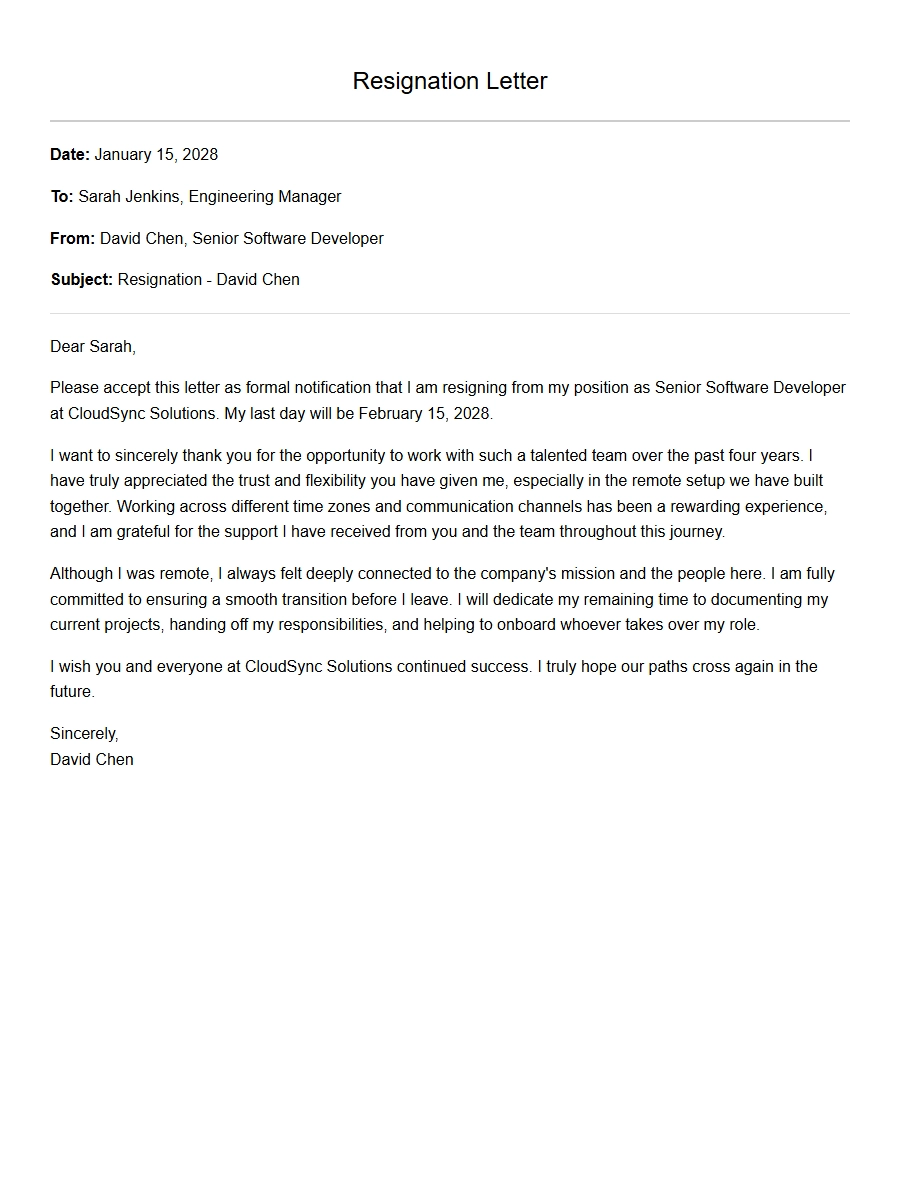 Polite Resignation Email for Remote Employees
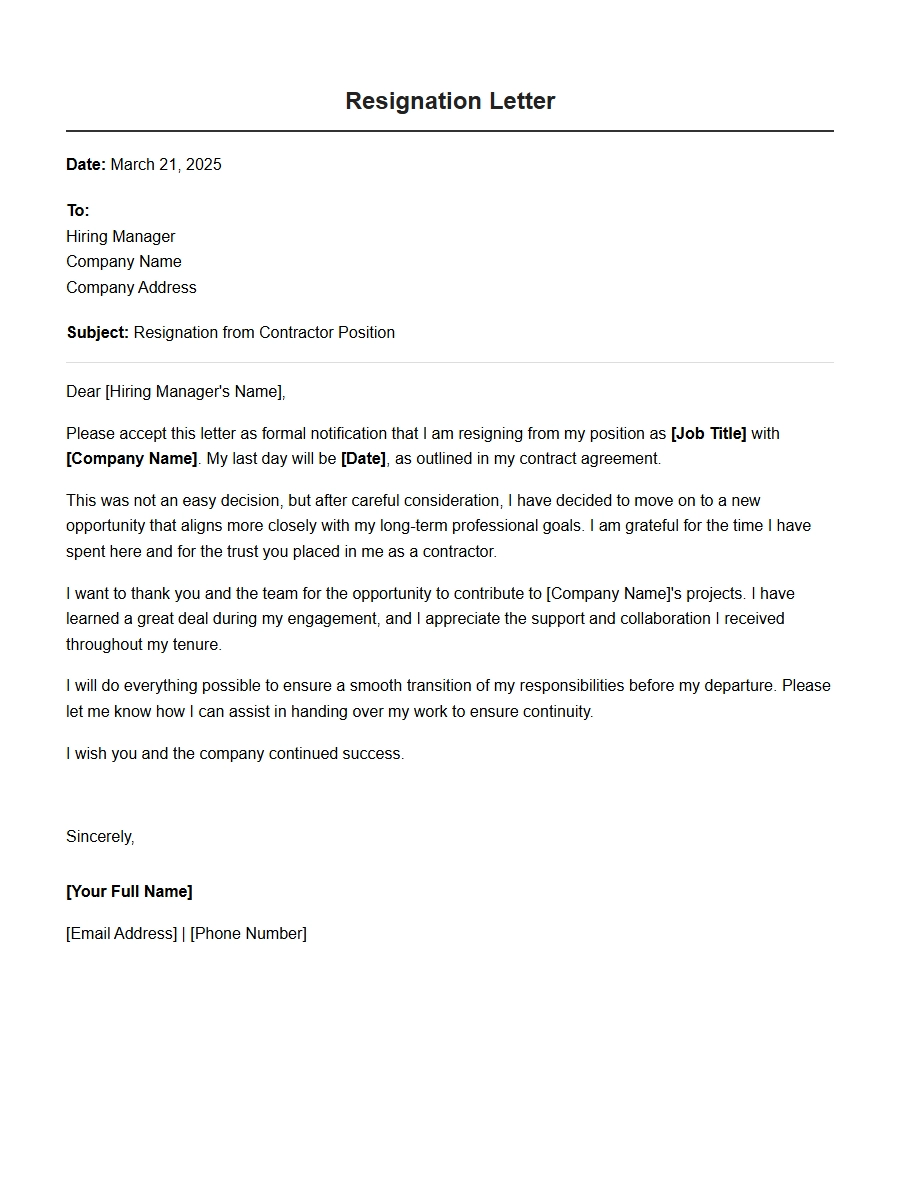 Short Resignation Letter for Contractor Position
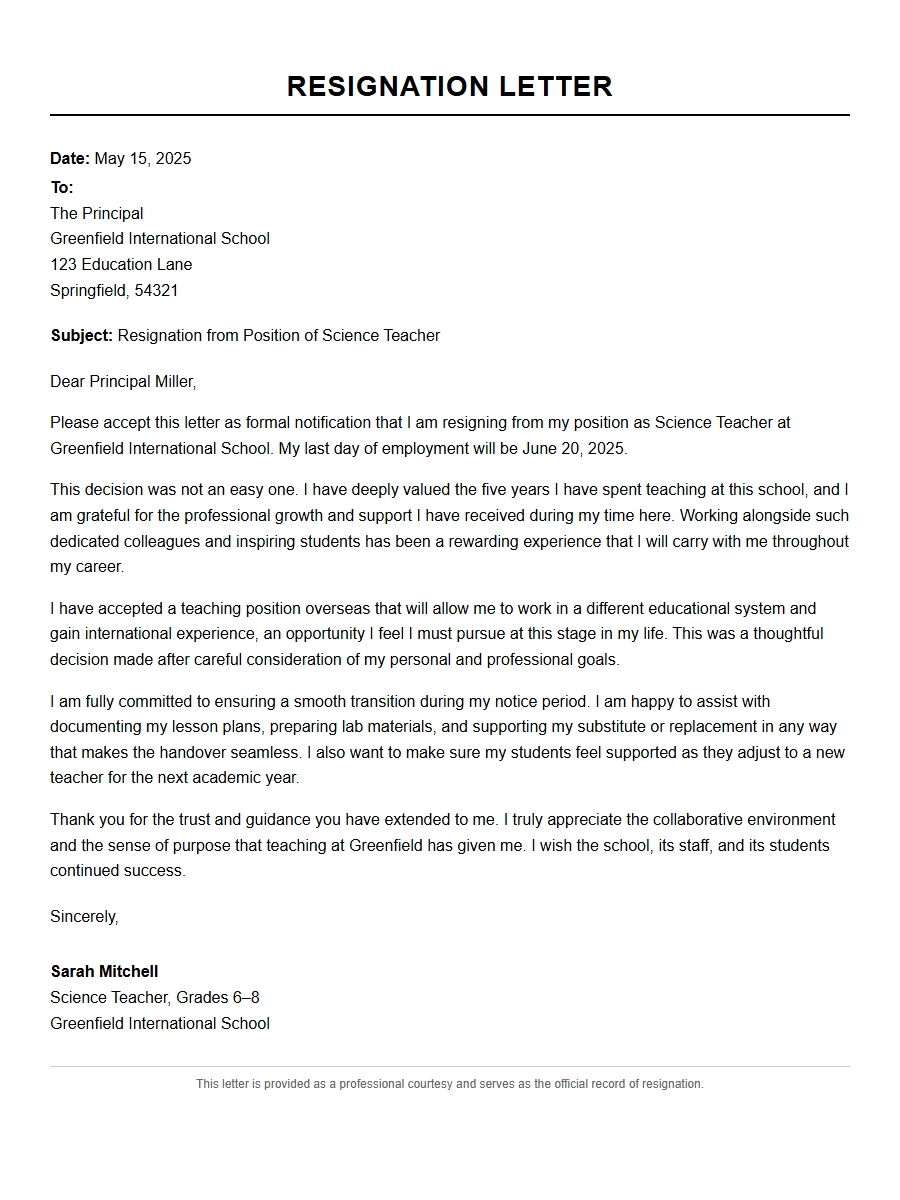 Teacher Resignation Letter Example
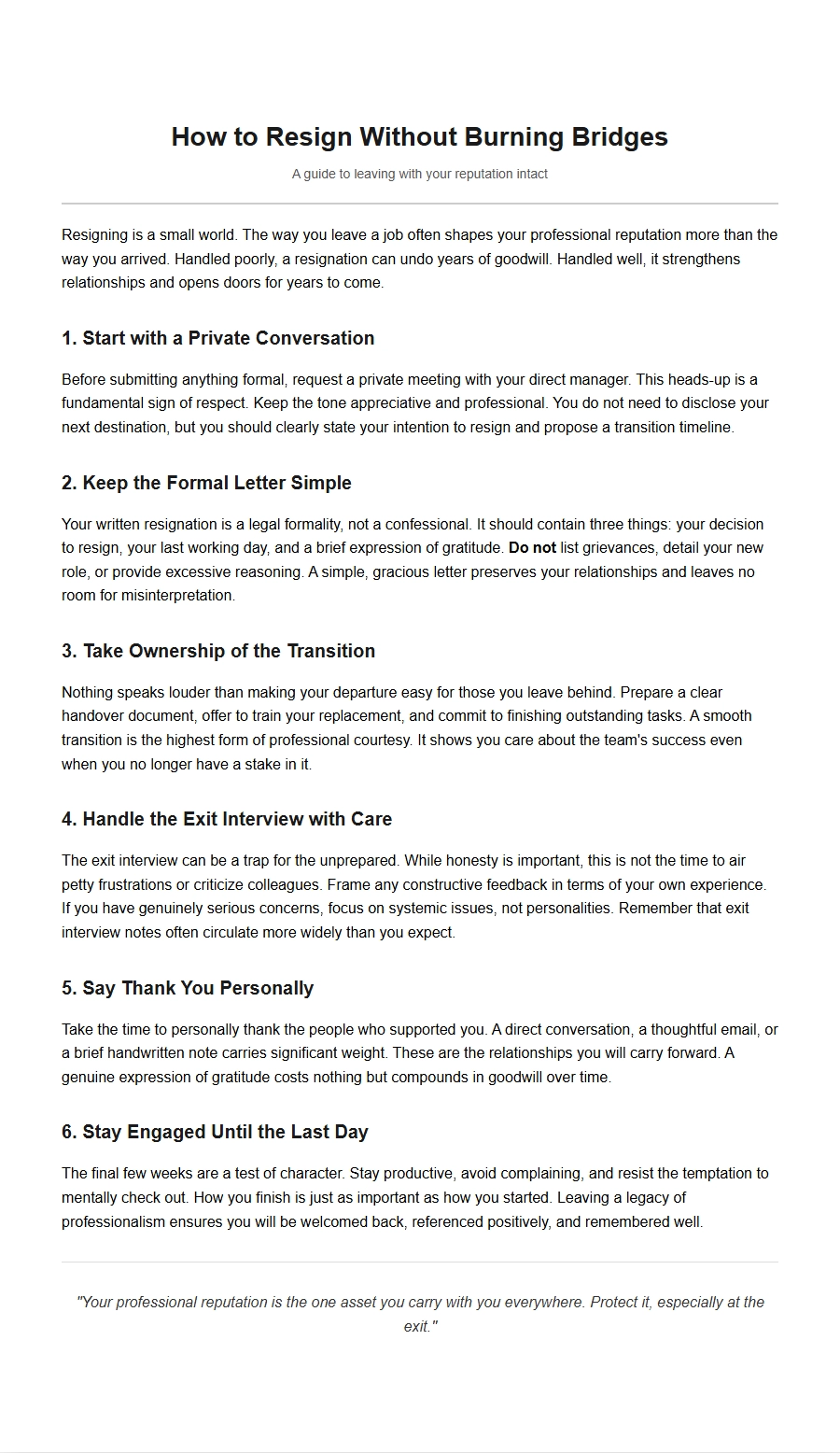 How to Resign Without Burning Bridges
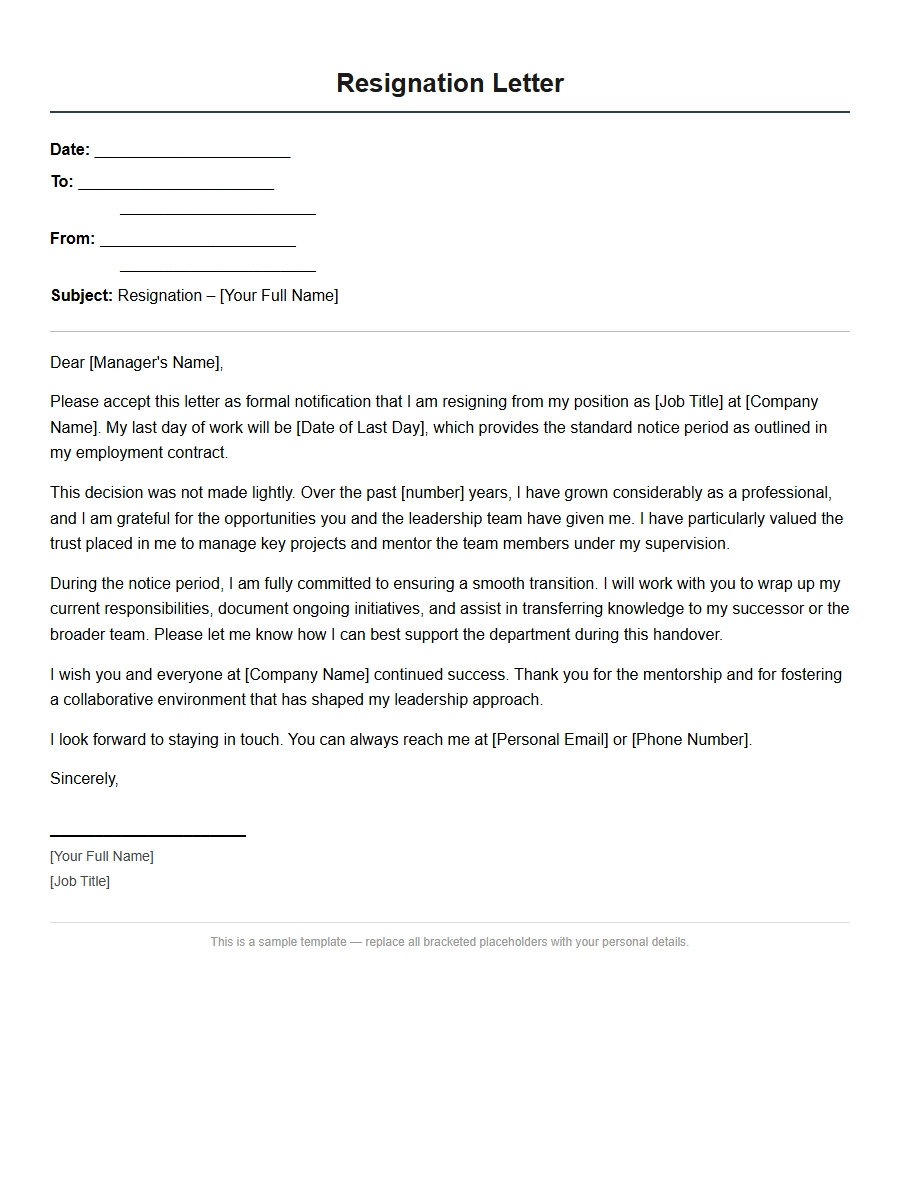 Formal Resignation Letter Sample for Manager
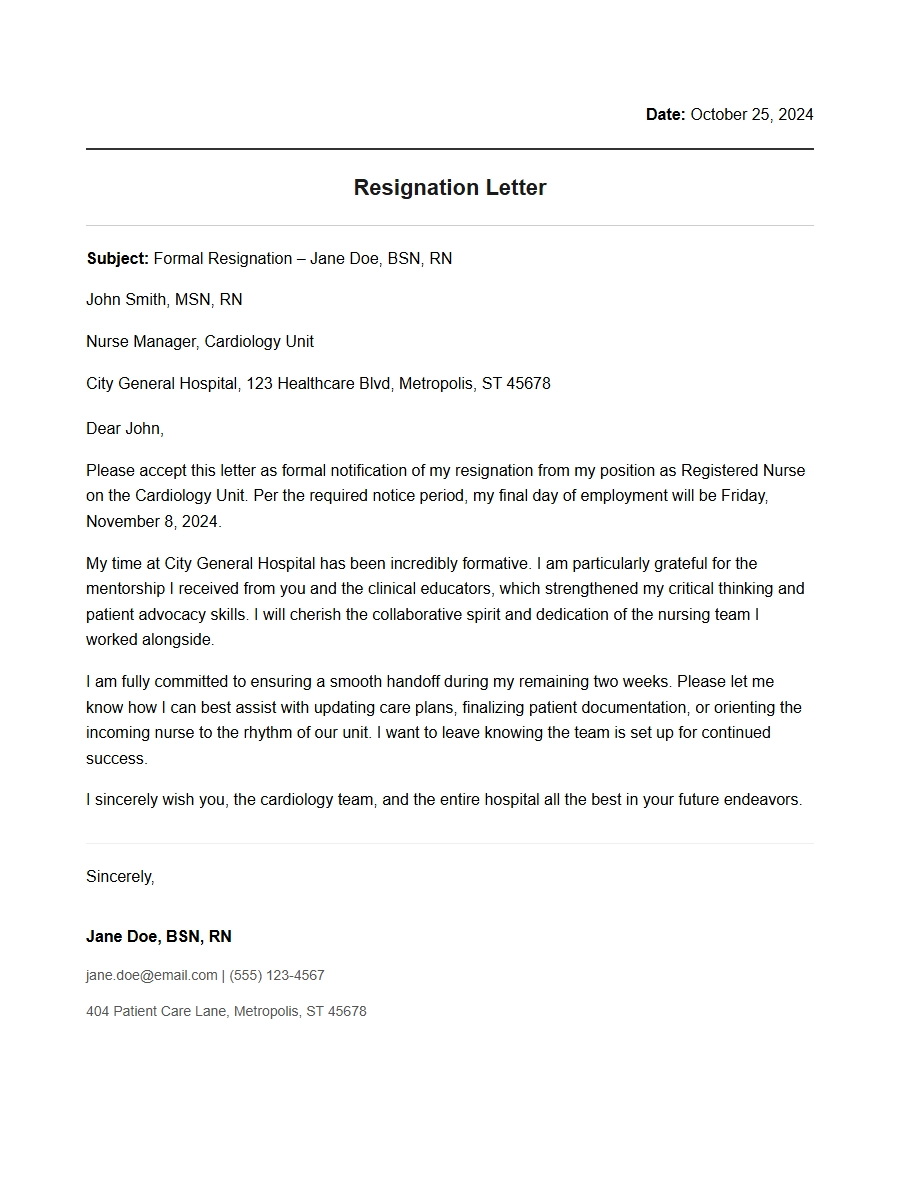 Nurse Resignation Letter with 2 Weeks Notice