You referred a strong candidate, they aced the interviews, and now they’ve accepted an offer. That should trigger a referral bonus—but only if you’re eligible. Maybe your company’s policy is unclear, or you’re unsure whether the hire qualifies under the fine print. Drafting a request for referral bonus eligibility check can feel awkward. You don’t want to sound greedy or pushy, yet you also don’t want to leave money on the table. A clear, professional letter solves that tension.
Using a letter template for this isn’t cheating. It’s a time-saver that gives you a solid structure, a professional tone, and key phrases you might forget under pressure. The sample becomes your starting point—you adapt it with your specific details, your company’s policy language, and your own voice. That combination makes the request both respectful and effective.
First, pick the right sample for your situation. If your company culture is formal, choose a business letter format with a proper salutation and closing. If you communicate with HR via email, a digital letter format works better—shorter subject line, no letterhead, but still polite. Most professional correspondence of this type is semi-formal: direct but not stiff. Avoid outdated phrases like “To Whom It May Concern” unless you have no contact name.
Once you have a sample, adapt it without losing your authentic voice. Swap out generic language for your actual referral details: the candidate’s name, the date they applied, the offer acceptance date. Check your company’s referral policy for eligibility rules—some require the hire to stay 90 days, others pay immediately. Mention the specific policy clause if you can. That shows you’ve done your homework.
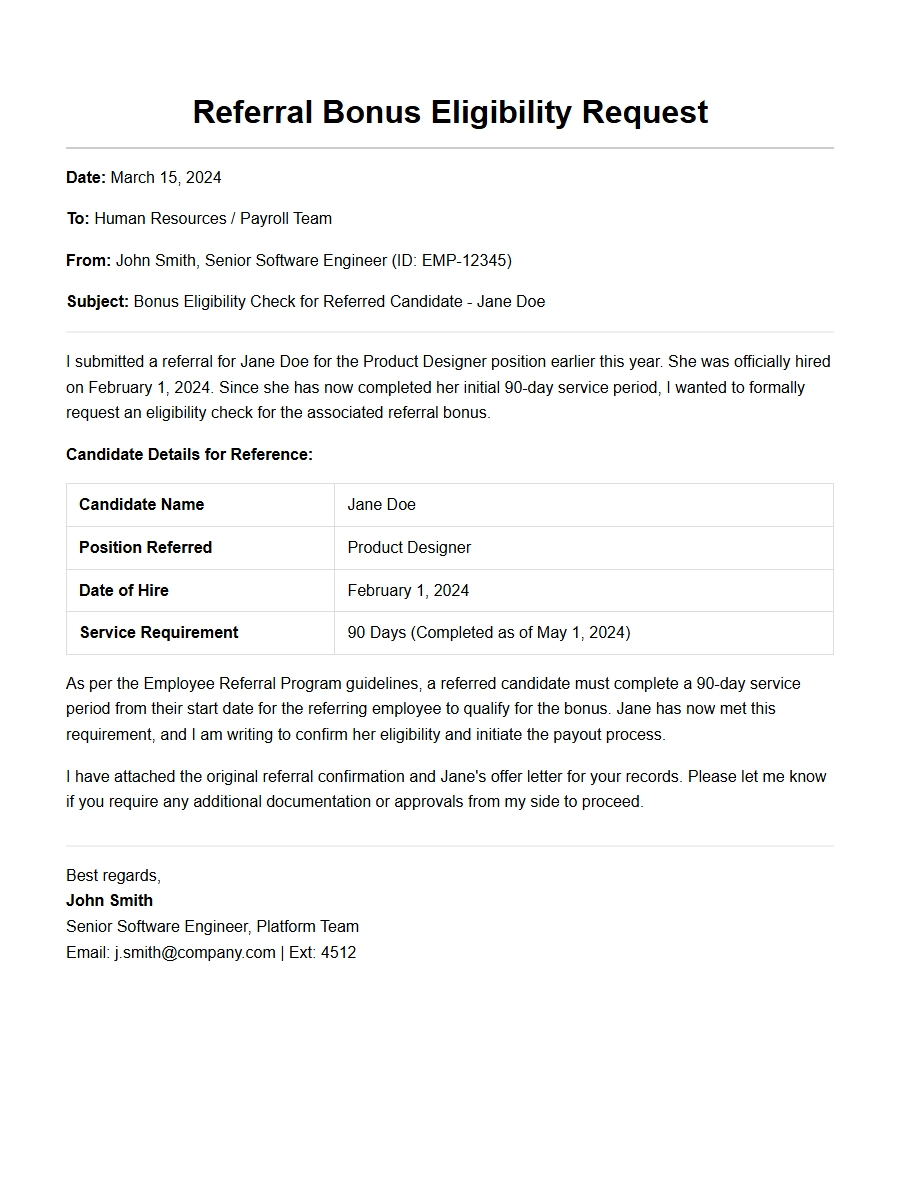
Your opening paragraph is your hook. Start with a friendly reminder: “I’m writing to follow up on the referral I submitted for [Candidate Name] on [Date]. They started on [Start Date], and I’d like to confirm whether I qualify for the referral bonus under our policy.” This is direct but not demanding. It also invites a quick answer from HR.
Common mistakes to avoid:
Forgetting to include the referral date or policy reference. HR deals with dozens of referrals; make it easy for them.
Using an overly casual tone like “Hey, where’s my bonus?” That can backfire.
Ignoring the format—if you’re sending an email, don’t attach a formal letterhead as a PDF unless requested. Keep it in the email body.
Neglecting to proofread your letter. A typo can undermine the professionalism of your request.
Letter writing etiquette matters here. Be polite, specific, and patient. Ask for a confirmation, not an immediate payout. “Could you please check my eligibility and let me know the next steps?” That’s a reasonable request that respects HR’s timeline.
If you’re uncertain about the tone in writing, aim for warm professionalism. Think of it as a conversation with a colleague who can help you. Avoid passive-aggressive statements like “I assume you’ll process it soon.” And don’t assume you’re not eligible; let HR clarify.
For letter structure, a simple template might look like:
One last tip: after you send your request, give HR a reasonable window—two weeks is common—before following up. If you don’t hear back, send a polite reminder referencing your original request. That’s better than resending the same letter.
Remember, the best letters feel both professional and personal. A sample is a springboard, not a crutch. Each time you write one of these requests, you’ll get faster and more confident. Soon you’ll know exactly which phrases work for your company culture and which ones to skip. That’s the real value of practice—and a good template. So go ahead, adapt that sample, send your request, and get the bonus you earned.
Browse Sample Ideas
Apology Regarding Referral Bonus Eligibility
Apology for Delay in Processing Referral Bonus Eligibility Check
Dear Jane Doe,
I sincerely apologize for the delay in processing your request for a referral bonus eligibility check. Our team has been experiencing an unusually high volume of requests, which has caused your submission to remain unaddressed longer than expected.
Below are the details of your referral for tracking purposes:
Referral Name
Referral ID
Date Submitted
Status
John Smith
REF-2025-0312
2025-03-12
Pending Review
We have now prioritized your request and will complete the eligibility check within the next 3 business days. You will receive an email notification once the review is finalized.
Again, I apologize for this inconvenience and appreciate your patience. Please feel free to reply to this message if you have any further questions.
Best regards, Sarah Johnson HR Compensation Team
Apology for Missing the Referral Bonus Eligibility Deadline
Dear Mark Lee,
Please accept my apologies for failing to process your referral bonus eligibility check before the programme deadline of 31 March 2025. Due to an administrative oversight, your request was not escalated in time.
Here is a summary of the referral you submitted:
Referred Candidate: Emily Chen
Candidate ID: CAN-9876
Submission Date: 15 March 2025
Deadline Missed: 31 March 2025
As a goodwill gesture, I have asked our management to review your case for a possible exception. We will provide a definitive answer by 10 April 2025. I understand this may be frustrating, and I take full responsibility for the error.
Thank you for your understanding.
Sincerely, David Brown Referral Programme Coordinator
Apology for Incorrect Referral Bonus Eligibility Decision
Dear Lisa Wang,
I am writing to sincerely apologise for the erroneous decision communicated to you regarding your referral bonus eligibility for the candidate Michael Torres.
Upon review, we discovered that an internal data entry error incorrectly flagged your referral as ineligible. The correct eligibility status should have been Approved. Please find corrected details below:
Field
Previous Value
Corrected Value
Eligibility Status
Denied
Approved
Bonus Amount
$0
$500
Payment Date
N/A
30 April 2025
The bonus will be processed automatically in the next payroll cycle. Please disregard the earlier notification. I deeply regret the confusion this has caused and assure you that steps are being taken to prevent similar mistakes.
Please accept our apologies.
Warm regards, Jennifer Adams Payroll Services
Apology for Losing the Referral Bonus Documentation
Dear Robert Kim,
I must apologise for the inconvenience caused by the loss of the supporting documents you provided for your referral bonus eligibility check regarding candidate Anna Patel.
Due to a system migration error, the attachments you uploaded on 20 February 2025 were not saved correctly. To proceed with the eligibility review, we kindly ask you to resubmit the following:
Signed referral form (PDF)
Proof of hire (offer letter or onboarding confirmation)
Candidate’s employee ID (if already on boarded)
You can upload these via the employee portal at hr.company.com/referrals. Once received, we will expedite the check within 2 business days. Again, I apologise for this setback and appreciate your cooperation.
If you have any questions, please reach out directly.
Regards, Tom Garcia HR Operations
Apology for Not Following Up on Referral Bonus Eligibility Request
Dear Sarah Mitchell,
I apologise for failing to follow up on your referral bonus eligibility request submitted on 5 February 2025 for the candidate David Wilson. My oversight resulted in no progress updates being sent to you over the past six weeks.
To rectify this, I have personally reviewed your referral and can confirm the following current status:
Eligibility Check: In progress
Required Action: Verification of candidate’s start date
Estimated Completion: 12 April 2025
As compensation, I have authorised a $50 goodwill voucher to be added to your account, which you can redeem via the employee rewards platform.
I truly value your participation in the referral programme and regret the lack of communication. Moving forward, you will receive automatic weekly updates until the decision is finalised.
Thank you for your patience.
Best, Alice Chen Referral Programme Lead
Apology for System Error Affecting Referral Bonus Check
Dear James O’Neil,
I am writing to apologise for a system error that has affected the processing of your referral bonus eligibility check for candidate Sophia Martinez.
On 25 March 2025, our HR database underwent an unscheduled maintenance that corrupted the eligibility flags for several referral records, including yours. As a result, your request was automatically moved to a “failed” state.
Our IT team has since restored the data. Below is the corrected information:
Item
Details
Referral Name
Sophia Martinez
Candidate ID
CAN-5432
Status After Fix
Under Review
Expected Resolution
8 April 2025
We have added a priority flag to your case to ensure it is handled promptly. I deeply regret the technical trouble and any anxiety it may have caused. Should you experience further issues, please contact our IT helpdesk.
Apologies again.
Yours sincerely, Emma Watson HR IT Support
Apology for Miscommunication About Referral Bonus Eligibility Criteria
Dear Michael Brown,
I apologise for the confusion caused by conflicting information regarding the eligibility criteria for your referral bonus request concerning Priya Singh.
Our earlier emails erroneously stated that your referral met all requirements, but a subsequent audit revealed that the candidate’s employment start date fell outside the approved window. The correct policy requires the candidate to begin work within 90 days of the referral submission date. In this case, the start date was 120 days later.
Please find a summary of the criteria and your referral’s status:
Criterion
Required
Your Referral
Referral within 90 days of hire
Yes
No (120 days)
Candidate hired full-time
Yes
Yes
Referral submitted before candidate applied
Yes
Yes
We understand this is disappointing. To make amends, we would like to offer you a $100 referral voucher for your next successful placement. I apologise for the earlier miscommunication and hope this gesture helps.
Thank you for your understanding.
Regards, Karen White HR Policy Advisor
Apology for Duplicate Referral Bonus Inquiry
Dear Chris Evans,
Please accept my apologies for the duplicate follow-up messages you received regarding your referral bonus eligibility check for candidate Amy Lee.
Due to a synchronisation glitch between our ticketing system and email platform, three identical notifications were generated and sent to you within the same hour. I understand how confusing and annoying this can be.
Let me clarify the actual status of your request:
Referral Name: Amy Lee
Request ID: RB-2025-078
Eligibility Status: Approved
Bonus Amount: $750
Payment Date: 15 May 2025
No further action is required from your side. The bonus will be deposited automatically. We have also removed the duplicate tickets from the system to prevent any further confusion.
Once again, I am sorry for the inconvenience and appreciate your patience.
Yours faithfully, Olivia Taylor Employee Services
Apology for Failing to Notify About Referral Bonus Eligibility Outcome
Dear Daniel Kim,
I am writing to sincerely apologise for not informing you of the outcome of your referral bonus eligibility check for candidate Natalie Brooks.
The review was completed on 10 March 2025, but due to a notification error, you were never sent the result. I have now retrieved the details and present them below:
Field
Details
Referral Name
Natalie Brooks
Employee ID
EMP-3456
Eligibility Decision
Eligible – Bonus Granted
Bonus Amount
$1,000
Expected Deposit Date
31 March 2025 (already processed)
The bonus was actually paid on time, but you were left in the dark about the decision. This is unacceptable, and I apologise for the lack of communication. I have added your email to a priority notification list to ensure this does not happen again.
If you have any concerns about the amount or timeline, please contact me directly.
Best regards, Sophie Miller Compensation Specialist
Apology for Referral Bonus Eligibility Check Rejected Due to Error
Dear Andrew Scott,
I must apologise for the erroneous rejection of your referral bonus eligibility request for candidate Rebecca Jones.
Our team mistakenly flagged the candidate as being referred after the application was submitted, when in fact you had referred her before she applied. An internal review of timestamps confirmed this. The correct status should be Approved.
Below is the comparison of the original and corrected data:
Detail
Original (Incorrect)
Corrected
Eligibility Decision
Rejected
Approved
Reason
Late referral
On-time referral
Bonus Amount
$0
$500
The bonus will be included in your next paycheck. I deeply regret the stress caused by this mistake and have taken steps to re-train the reviewing team on timestamp verification.
Thank you for bringing this to our attention, and please accept our sincere apologies.
Sincerely, Michael Green Referral Programme Manager
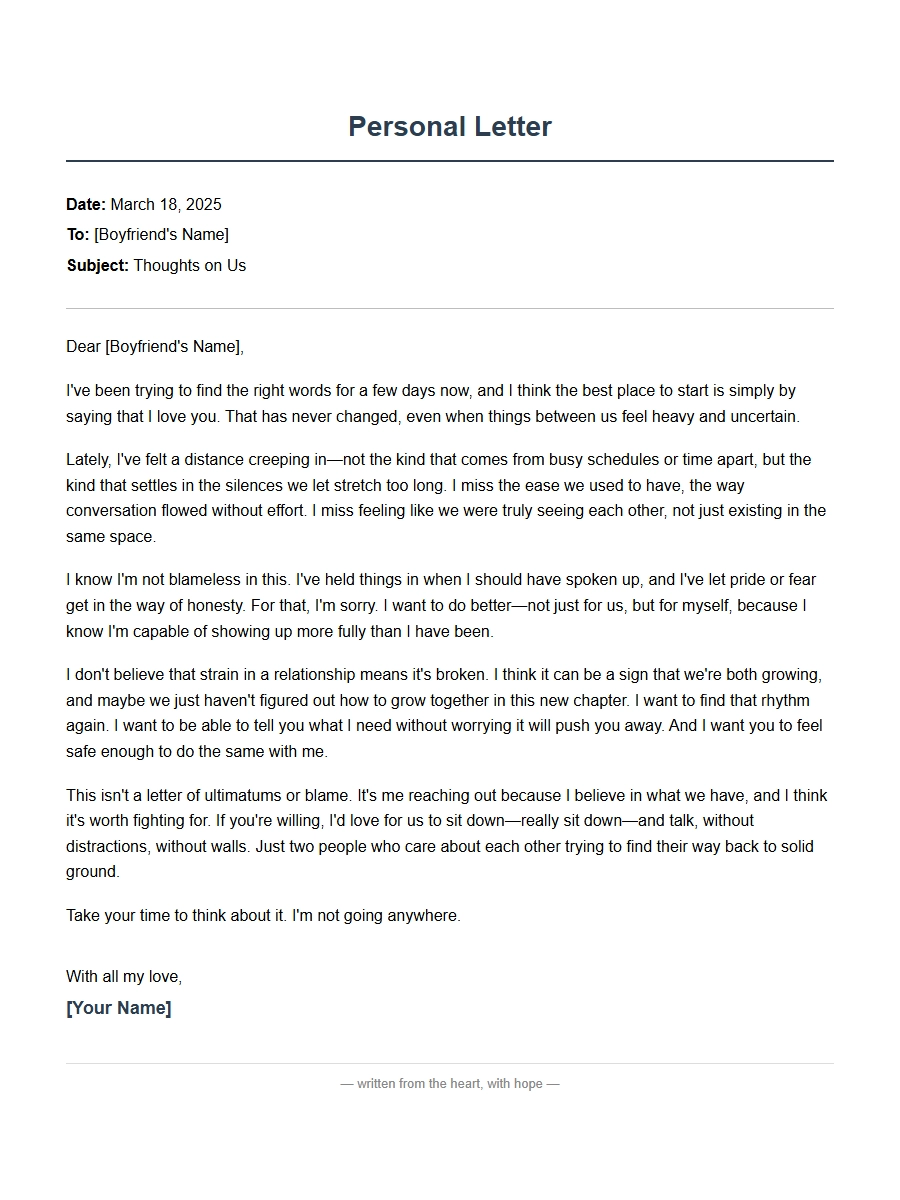 Personal Apology Letter for Boyfriend Relationship Strain
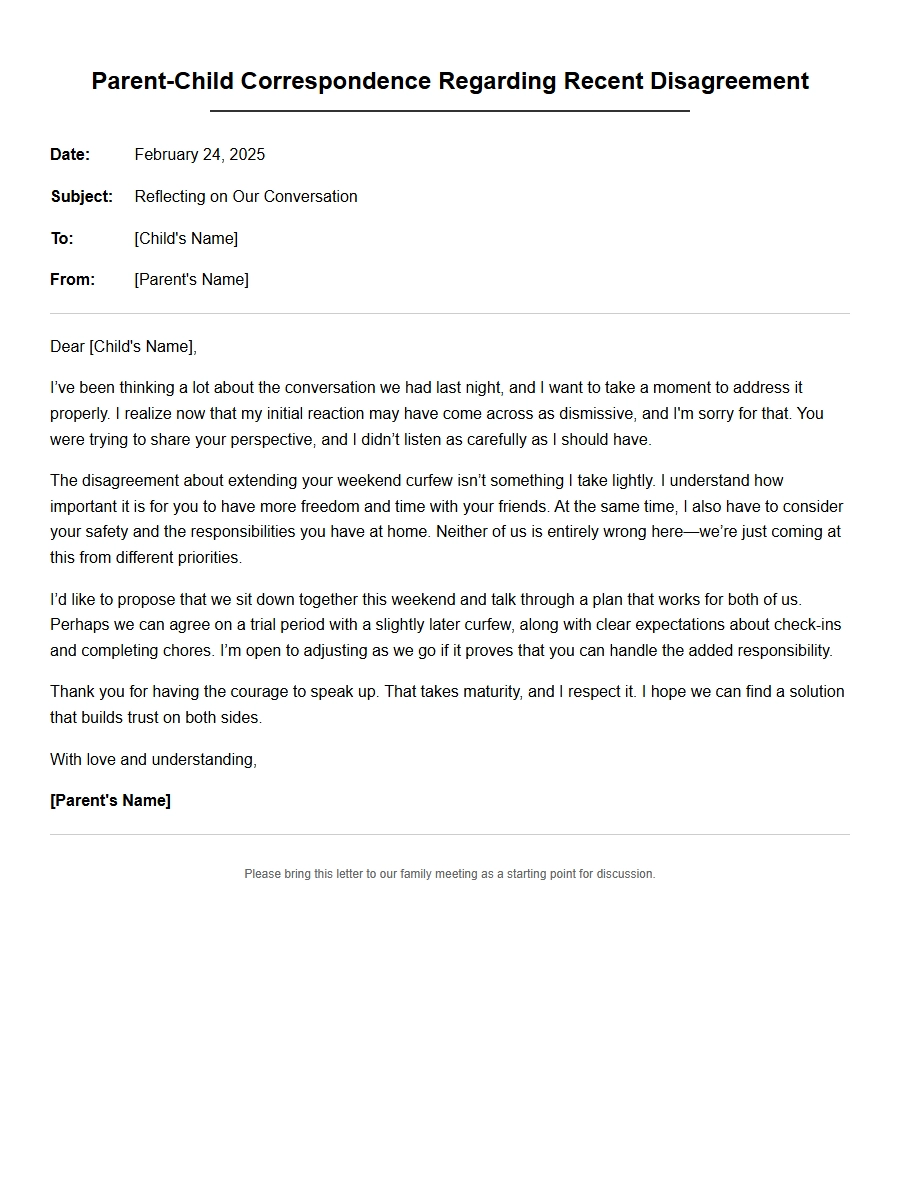 Apology Correspondence for Parent-Child Disagreements
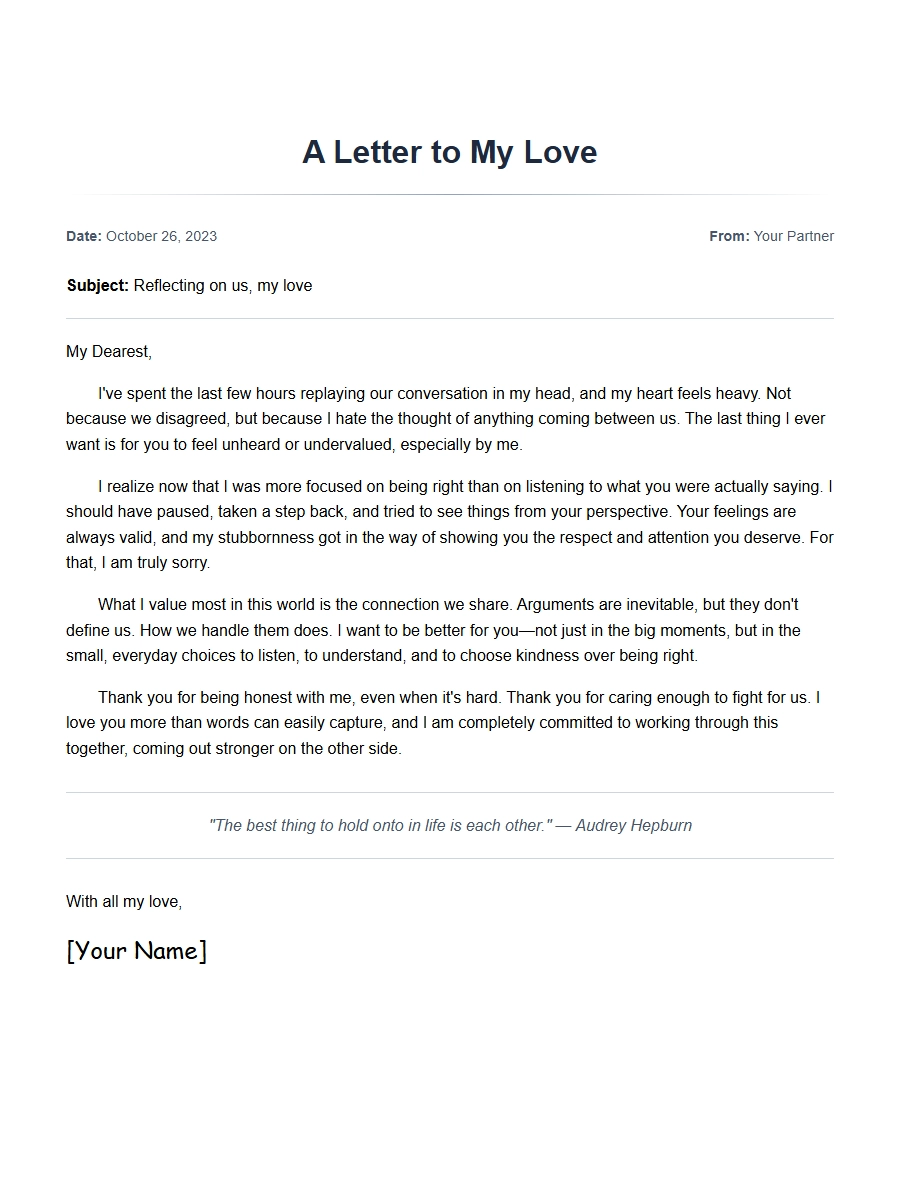 Apology Message for Girlfriend After Argument
 note for friend stealing item - Apology Letters
 Apology to Boss for Micromanagement Complaint
 Apology Document for Vendor Supply Chain Issue