executive overview proposal letter - Business Proposal Letters
Staring at a blank page when you need to write an executive overview proposal letter can feel paralyzing—but the right sample turns that anxiety into a confident, polished draft in minutes. Maybe you're preparing a high-stakes business proposal and the executive summary section feels too important to get wrong. Or perhaps you've written dozens of proposals before, but this one needs a fresh perspective. Either way, you don't have to start from scratch.
Why use a sample? It's not cheating, it's smart
Using a letter sample or template is a time-saving strategy that gives you a proven structure. An executive overview proposal letter is the first thing a busy executive will read—it needs to be clear, concise, and persuasive. A good sample shows you how to arrange the key components: the problem, your solution, the expected outcome, and a call to action. It also provides the right tone and key phrases. But you still have room to personalize it. Think of a sample as a blueprint, not a prison.
Category: Business Proposal Letters
What exactly is an executive overview proposal letter?
This is a short, high-level summary of a larger business proposal. It's usually placed at the beginning of the document and aimed at decision-makers who may not have time to read the full proposal. It covers the core value proposition, key benefits, and a brief outline of the approach. The tone in writing should be confident and respectful, avoiding jargon unless it's explained. A well-crafted executive overview can make or break your proposal because it sets the stage for everything that follows.
How to choose the right sample for your situation
Not all proposal letters are the same. A formal proposal for a government contract will have different requirements than a semi-formal one for a potential partner. When picking a sample, look for one that matches the level of formality you need. For example, if you're pitching a new service to a corporate client, you'll want a sample that uses a professional business letter format with a clear salutation and closing. On the other hand, an internal proposal might allow for a more conversational tone.
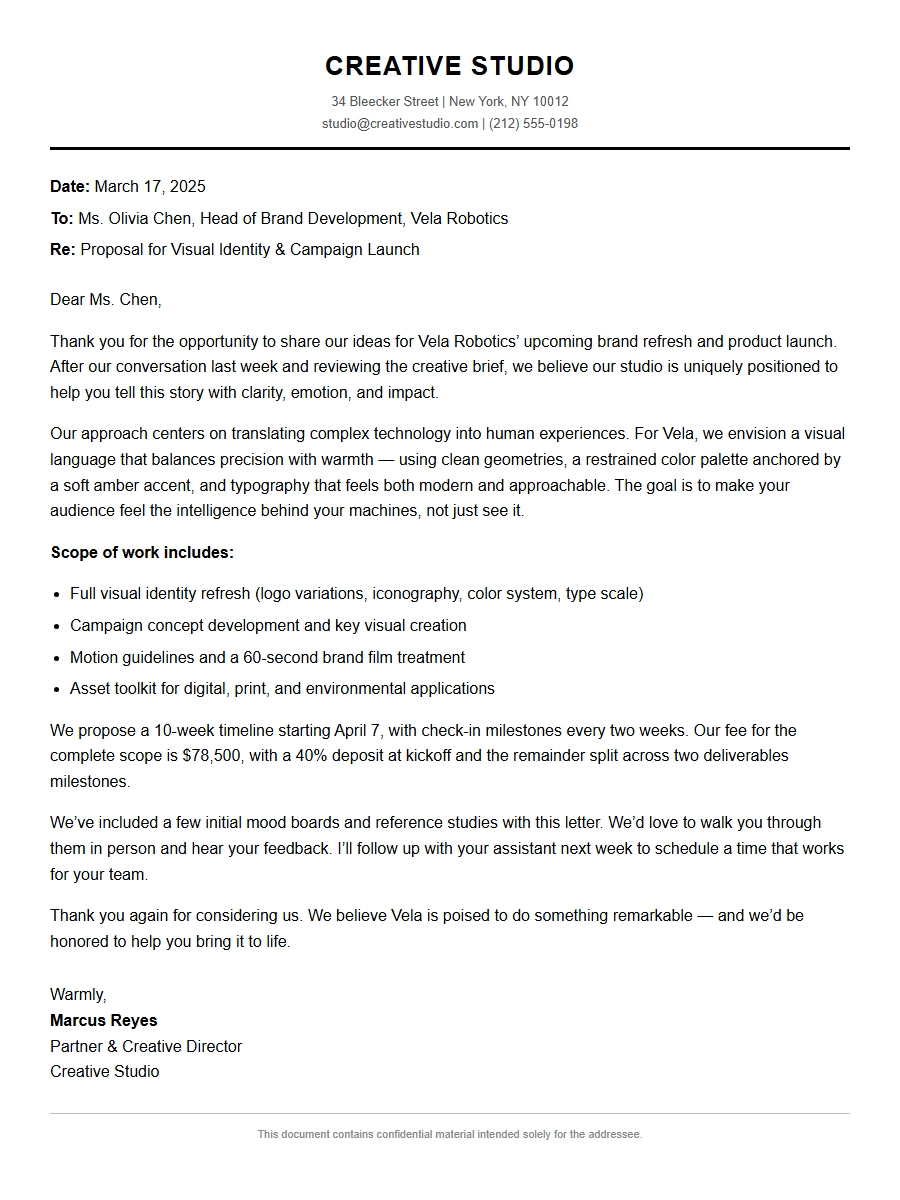
Pay attention to the industry too. A creative studio project proposal letter might use more visual language and flexibility, while an accounting firm merger proposal letter needs precise financial language. The sample you choose should reflect the expectations of your audience.
Adapting the sample without losing your authentic voice
Once you have a sample, start by replacing the placeholder details with your own. But don't stop there. Read the sample aloud and adjust phrases that don't sound like you. If the sample says "We are delighted to present," but your natural style is more direct, change it to "Here is our proposal for." Authenticity builds trust. The best professional correspondence feels both personal and polished.
A common mistake is using outdated salutations like "To Whom It May Concern" or "Gentlemen." Instead, find a specific name if possible. If you can't, use "Dear Hiring Manager" or "Dear Team." Similarly, the closing should match the tone—"Sincerely" works for most formal letters, while "Best regards" is fine for semi-formal ones.
Tailor the opening paragraph to grab attention
Your executive overview proposal letter should start with a strong hook. State the purpose and the main benefit within the first two sentences. For example: "This proposal outlines how our hybrid office arrangement can reduce your real estate costs by 20% while boosting employee satisfaction." Avoid generic openings like "We are writing to submit our proposal." Be specific. If you're referencing a previous conversation, mention it: "Following our discussion last week, we've prepared a solution tailored to your team's needs."
For a franchise opportunity proposal letter, you might begin with the market demand and the proven business model. For a case study reference proposal letter, you could start with a success story from a similar client. The key is to make the reader want to continue.
Formatting matters: email vs. printed letter
In today's digital world, many executive overview proposal letters are sent as attachments or pasted into email bodies. If you're sending via email, use a simple digital letter format without complicated letterhead design—a clean signature block is enough. For printed letters, a professional letterhead with your company logo and contact info adds credibility. Always proofread your letter. A single typo can undermine your professionalism. Use a proofreading letter checklist: check names, dates, numbers, and consistency in tone.
Common mistakes to avoid
One frequent error is making the executive overview too long. Keep it to one or two paragraphs, max. Executives scan, not read word-for-word. Another mistake is being too vague. If you say "we offer excellent solutions," that's weak. Instead, be specific: "Our software reduces processing time by 30%." Also, don't forget to include a clear call to action. Tell the reader what you want them to do next—whether it's schedule a meeting, review a financial model, or approve a budget.
When adapting a sample, avoid copying entire sentences that don't fit your situation. For instance, if you're writing a letter of recommendation as part of a proposal (like a testimonial), make sure the tone matches the endorsement. Similarly, cover letter examples can inspire the structure but not the content of your executive overview.
Use samples as a springboard, not a crutch
The more you practice writing executive overview proposal letters, the faster and more natural it becomes. Use samples to understand letter structure and letter writing etiquette, then gradually rely on them less. Over time, you'll develop your own patterns. The best letters balance professionalism with a human touch. They make the reader feel understood and confident that you can deliver.
Remember, a sample is just a starting point. Your real expertise and your specific knowledge of the project will make the letter shine. So take that sample, adapt it, personalize it, and send it with confidence. You'll be glad you did.
executive overview proposal letter - Business Proposal Letters
Consulting Engagement Letter
To: Board of Directors, Apex Industries From: John Mercer, Senior Partner, StratBridge Consulting Date: March 18, 2025 Subject: Executive Overview – Operational Efficiency Review
We propose a four-week diagnostic to identify cost-saving opportunities across your supply chain. Our approach includes a high-level interview series, data audit, and a final roadmap. Below is a summary of the engagement structure:
Phase
Duration
Deliverable
Discovery
Week 1
Process map & bottleneck report
Analysis
Weeks 2-3
Financial modeling & recommendation
Presentation
Week 4
Executive overview deck & implementation plan
Investment for this engagement is $45,000. We anticipate a 5:1 ROI within the first year. Please review the attached full proposal. We are available to discuss on March 25.
Software Implementation Proposal
To: CTO, GreenLeaf Logistics From: Emily Tran, Solutions Director, CloudFleet Inc. Date: April 2, 2025 Subject: Executive Overview – Fleet Management Platform
We are excited to present a tailored deployment of our FleetOS software. This letter covers the key benefits, timeline, and pricing for your executive review.
Why this matters: Your current manual routing costs an estimated $350,000 annually in overtime fuel. Our system will pay for itself in under 6 months.
We request a 30-minute high-level call to walk through the ROI model. A complete proposal is attached.
Marketing Campaign Proposal
To: VP Marketing, Blue Horizon Brands From: Carlos Mendez, Campaign Lead, Pulse Creative Date: March 22, 2025 Subject: Executive Overview – Q2 Brand Awareness Push
We recommend a multi-channel campaign targeting millennials through TikTok, Instagram Reels, and paid search. Below is our high-level approach and expected impact.
Channel
Budget
Expected Reach
CPM
TikTok
$35,000
1.2M
$29
Instagram
$25,000
800K
$31
Google Ads
$15,000
400K
$37
Total investment: $75,000 over 8 weeks. Estimated cost per new customer: under $12. We are ready to launch by April 10th. Attached is the full creative brief and performance projections.
Strategic Partnership Letter
To: CEO, Navarro Manufacturing From: Lisa Park, Director of Strategic Alliances, EcoSupply Partners Date: April 5, 2025 Subject: Executive Overview – Sustainability Co-Brand Program
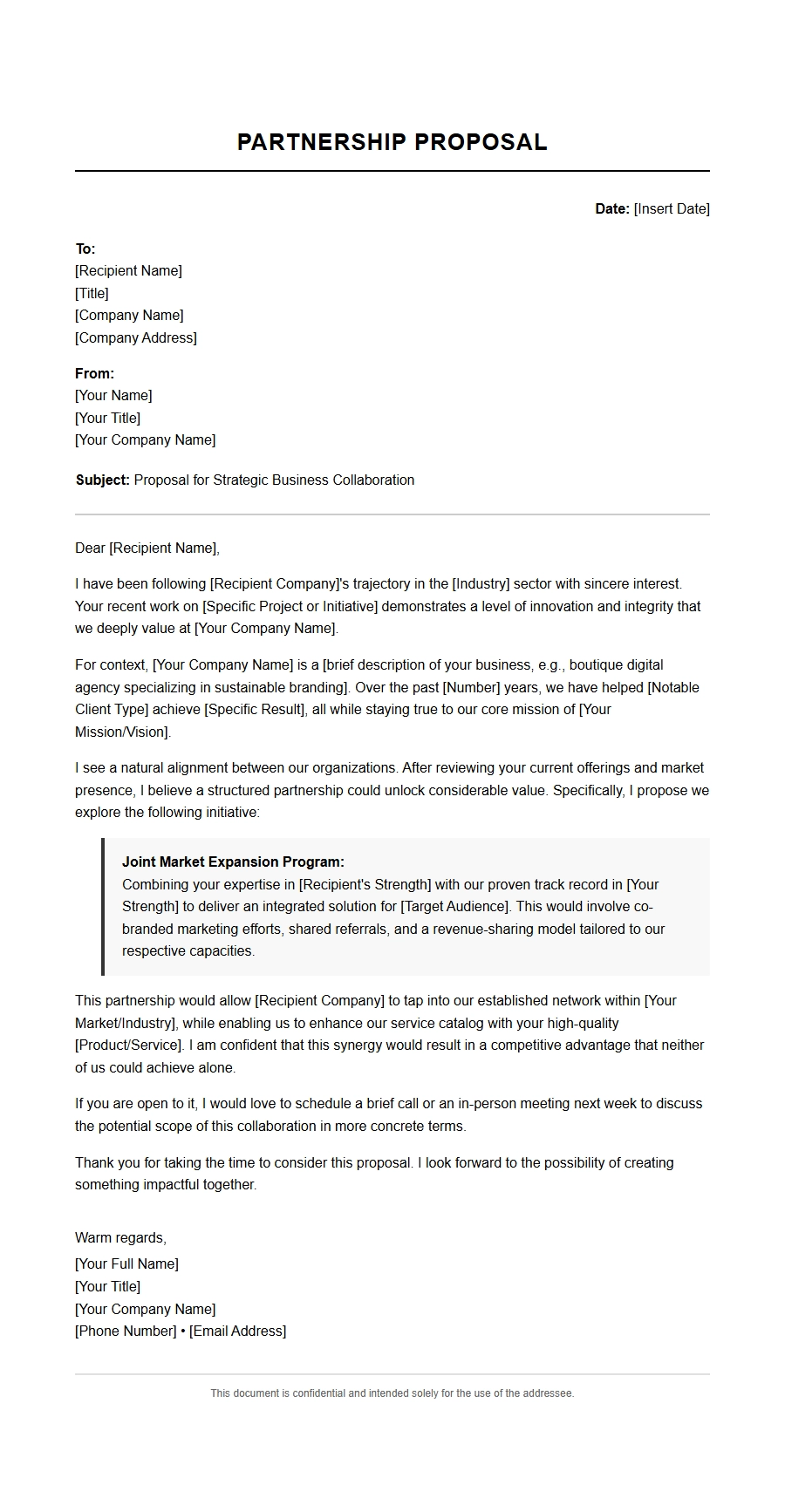
We propose a joint venture to produce eco-friendly packaging for both our client bases. The partnership would combine your manufacturing capacity with our sustainable material patents.
Revenue Share: 60% to EcoSupply, 40% to Navarro for the first three years.
Launch Date: Target Q4 2025 with a pilot run at 5 major retailers.
This initiative positions both companies as leaders in green manufacturing. A detailed term sheet is attached. We propose a joint executive meeting week of April 14.
Funding Request Summary
To: Investment Committee, Vertex Capital From: Ryan O'Malley, CEO, SafeHome Technologies Date: March 30, 2025 Subject: Executive Overview – Series A Funding Round
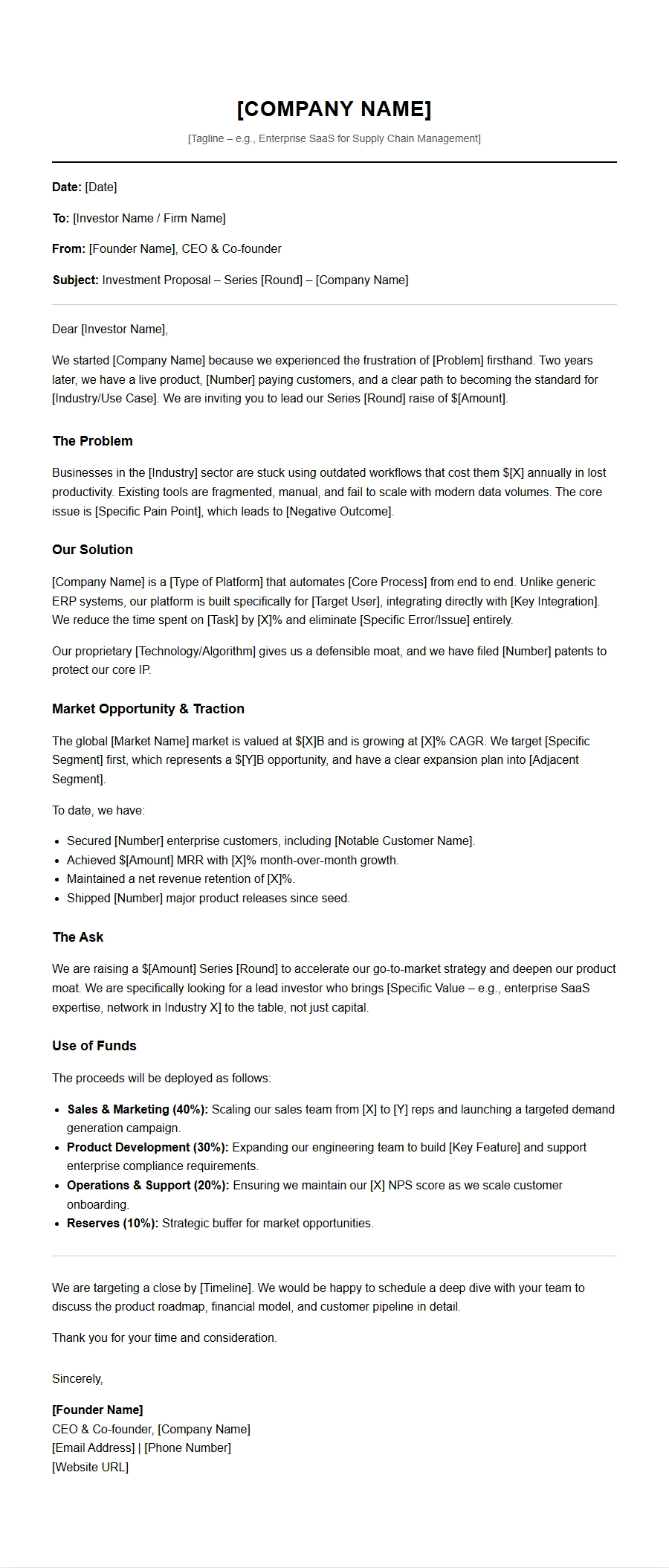
SafeHome is seeking $2.5M to expand our smart home security product line. Here is our funding overview:
Use of Funds
Amount
Percentage
R&D (new sensors)
$800,000
32%
Marketing & sales
$1,000,000
40%
Working capital
$700,000
28%
We have 2,000 monthly active users and a 95% retention rate. Revenue this year is projected at $800K. We offer a 20% equity stake. A full pitch deck and financial model are enclosed.
Product Launch Proposal
To: Executive Team, Viva Foods From: Sarah Goldstein, Product Director Date: April 8, 2025 Subject: Executive Overview – Plant-Based Protein Bar Launch
I recommend launching our new NutriBar in Q3 with a targeted $1.2M budget. Key highlights include:
Product: 12g protein, organic, three flavors – direct response to competitor gaps.
Go-to-market: Grocery chains (Kroger, Whole Foods) supported by influencer campaign.
Financials: Break-even in 8 months, 25% margin at $3.99 retail.
We have secured supplier contracts and initial packaging designs. The attached rollout plan details production milestones and retail agreements. Request approval by April 30 to hit Q3 shelf dates.
Process Improvement Overview
To: COO, Metro Logistics From: Derek Chan, Lean Six Sigma Consultant Date: April 10, 2025 Subject: Executive Overview – Warehouse Throughput Enhancement
Over six weeks, we applied Lean methods to your Houston DC with the following results:
Metric
Baseline
After Pilot
Improvement
Orders/hour
45
68
+51%
Picking errors
3.2%
0.8%
−75%
Labor hours/week
480
410
−15%
I propose a full rollout across 5 DCs at a cost of $180,000, yielding annual savings of $750,000. A complete implementation schedule and training plan are attached.
Executive Training Program Letter
To: CHRO, Sterling Financial From: Dr. Karen Wu, Learning & Development Lead, PeakPerformance Inc. Date: April 12, 2025 Subject: Executive Overview – Leadership Resilience Program
We propose a 3-month cohort-based program for your top 15 executives. The curriculum focuses on adaptive decision-making, emotional intelligence, and strategic agility.
Format: 6 half-day workshops, 3 one-on-one coaching sessions per participant.
Investment: $85,000 (includes assessments and follow-up report).
We have delivered similar programs at four Fortune 500 companies. A program outline and client testimonials are attached. We propose a kickoff in June.
Strategic Alliance Memo
To: CEO & Board, Pacific Tech From: Andrea Ross, VP Business Development Date: April 15, 2025 Subject: Executive Overview – Joint AI Development with Helion Labs
We have an opportunity to co-develop an AI fraud detection module for financial institutions. The alliance would combine our data infrastructure with Helion’s algorithms.
Contributions
Pacific Tech
Helion Labs
Technology
Data pipeline, servers
ML models, IP
Funding
$500K initial
$300K initial
Revenue Split
55%
45%
First-year projected revenue is $2M. We recommend signing a non-binding LOI by April 30. The full feasibility study and partnership term sheet are ready for your review.
Vendor Selection Recommendation
To: Procurement Committee, National Health Corp From: Liam Foster, Sourcing Manager Date: April 18, 2025 Subject: Executive Overview – IT Services Vendor Selection
After evaluating five vendors for managed IT services, we recommend contracting with SecuriTech Solutions. Here is the comparative summary:
Criterion
SecuriTech
Runner-up (NetServe)
Response time (SLA)
15 min
30 min
Annual cost
$320,000
$295,000
Cyber maturity rating
4.8/5
3.9/5
SecuriTech’s lower risk profile and faster response justify the marginal cost increase. A detailed vendor scorecard and contract draft are attached. Request approval to proceed with contract negotiations.
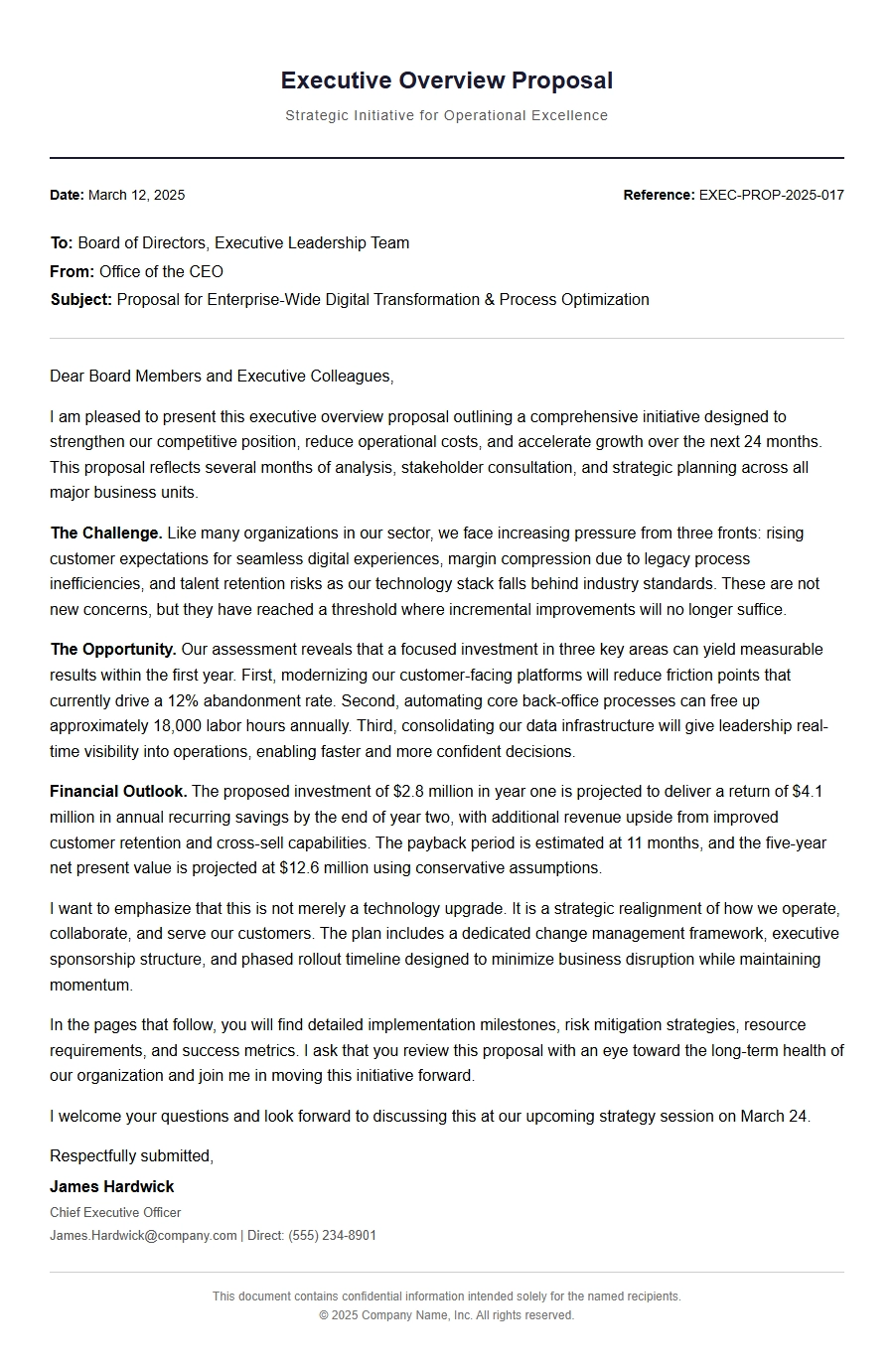
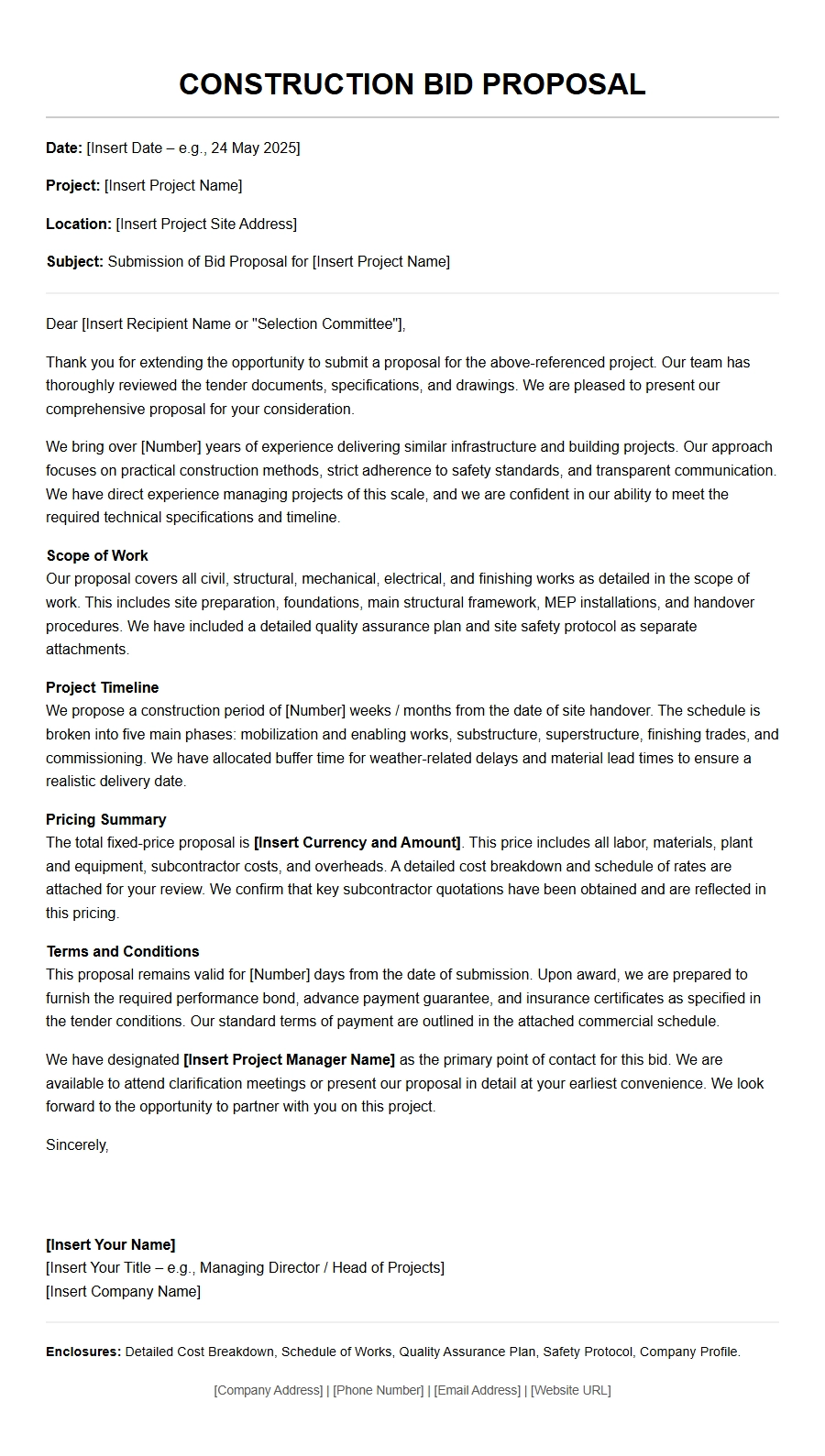 Sample Construction Bid Proposal Letter
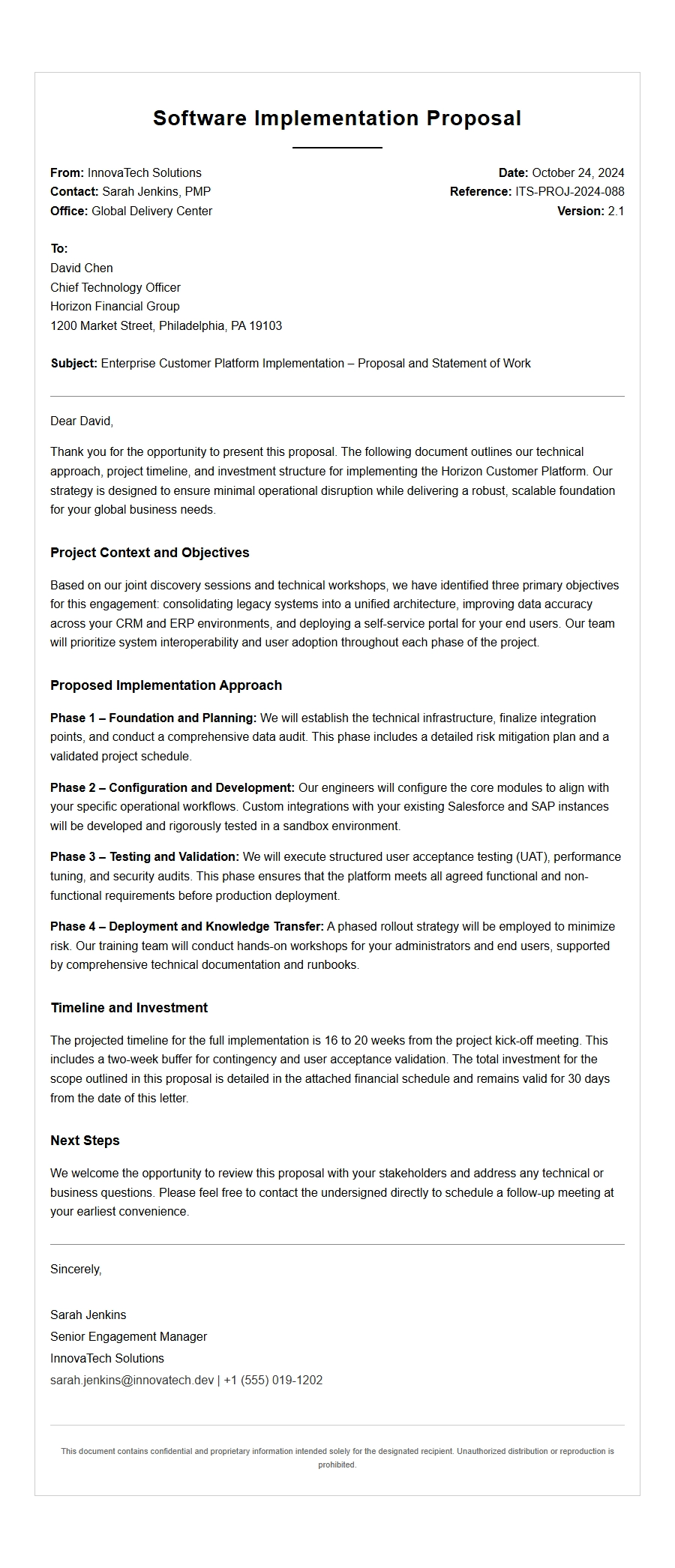 Enterprise Software Implementation Proposal Letter Example
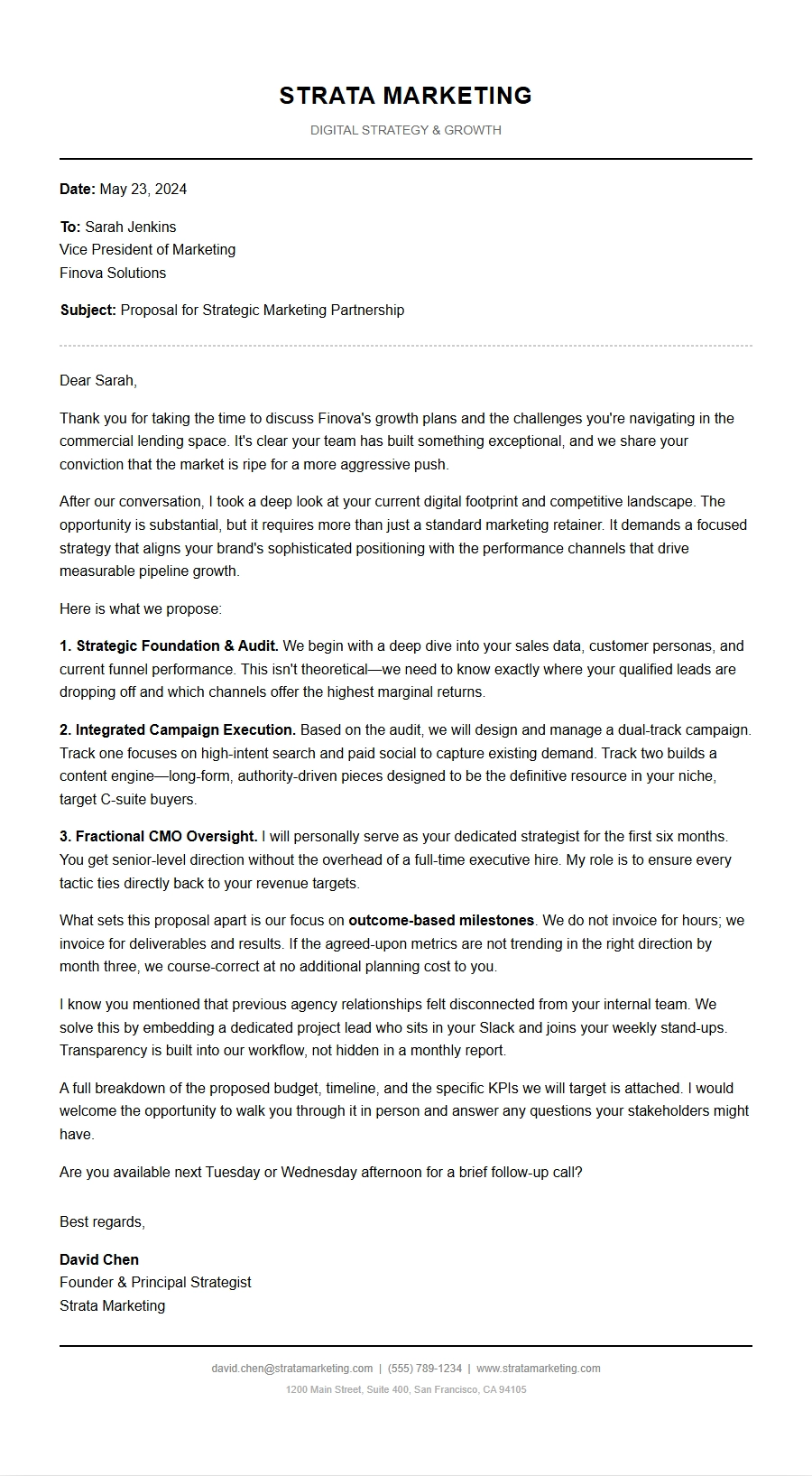 Marketing Agency Service Proposal Letter Template
 Creative Studio Project Proposal Letter
 Small Business Partnership Proposal Letter Template
 Startup Investment Proposal Letter Template