You're a construction project manager who knows how to move dirt, manage subs, and keep a job site on schedule. So why does writing a one-page cover letter feel harder than pouring a foundation in the rain? Staring at a blank screen when you need to write a professional letter can stop anyone cold. The good news is you don't need to reinvent the wheel.
Using a project manager construction site cover letter sample isn't cheating. It's a smart time-saving strategy. A solid sample gives you the skeleton: the correct business letter format, the professional salutation and closing, and the basic letter structure. Your job is to add the muscle. That muscle is your specific experience with budgets, safety protocols, and project timelines. A sample handles the formal writing tips so you can focus on selling your real-world results.
Category: Cover Letter Samples & Writing Guides
Not all cover letter examples are created equal. A letter for a $50 million high-rise needs a different tone than one for a row of townhomes. Look for a letter template that matches the scale of your experience. If you're targeting large commercial projects, your tone in writing should lean formal and authoritative. Emphasize logistics, safety compliance, and risk management. For a smaller development role, you might sound more hands-on and collaborative. The key is matching the voice to the audience.
As you work with a customizable letter, avoid the easy trap of swapping in names and dates. The opening paragraph is where you win or lose the reader. Instead of "I am writing to apply for the PM position," try a specific claim. "Delivered the downtown medical complex two weeks ahead of schedule and $200,000 under budget. I'm ready to bring that same precision to your Riverfront project." This immediately signals that you understand real-world construction outcomes, not just office paperwork.
A quick tip on tailoring: read the job description closely. If the posting emphasizes safety records, lead with your OSHA stats. If it focuses on client relationships, highlight your stakeholder communication. Your cover letter isn't a letter of recommendation—it's a targeted argument for why you're the right person for that specific site.
Common mistakes can sink a good draft. Using outdated salutations like "To Whom It May Concern" is a red flag. Spend five minutes on LinkedIn to find the hiring manager's name. Also consider format. If you're emailing your digital letter format, skip the full mailing address and use a clear subject line. If printing, use matching letterhead design for a polished look. Above all, never skip the proofreading letter stage. A typo in a construction cover letter suggests a lack of attention to detail that is a dealbreaker for a safety-critical role.
Think of your sample as a springboard, not a crutch. The best letters feel both professional and personal. They show you understand construction and that you've thought carefully about how your specific experience fits this specific team. You've got the hard skills. Your cover letter just needs to prove you can communicate them clearly. Practice makes the process faster. Next time, the blank page won't stand a chance.
Browse Sample Ideas
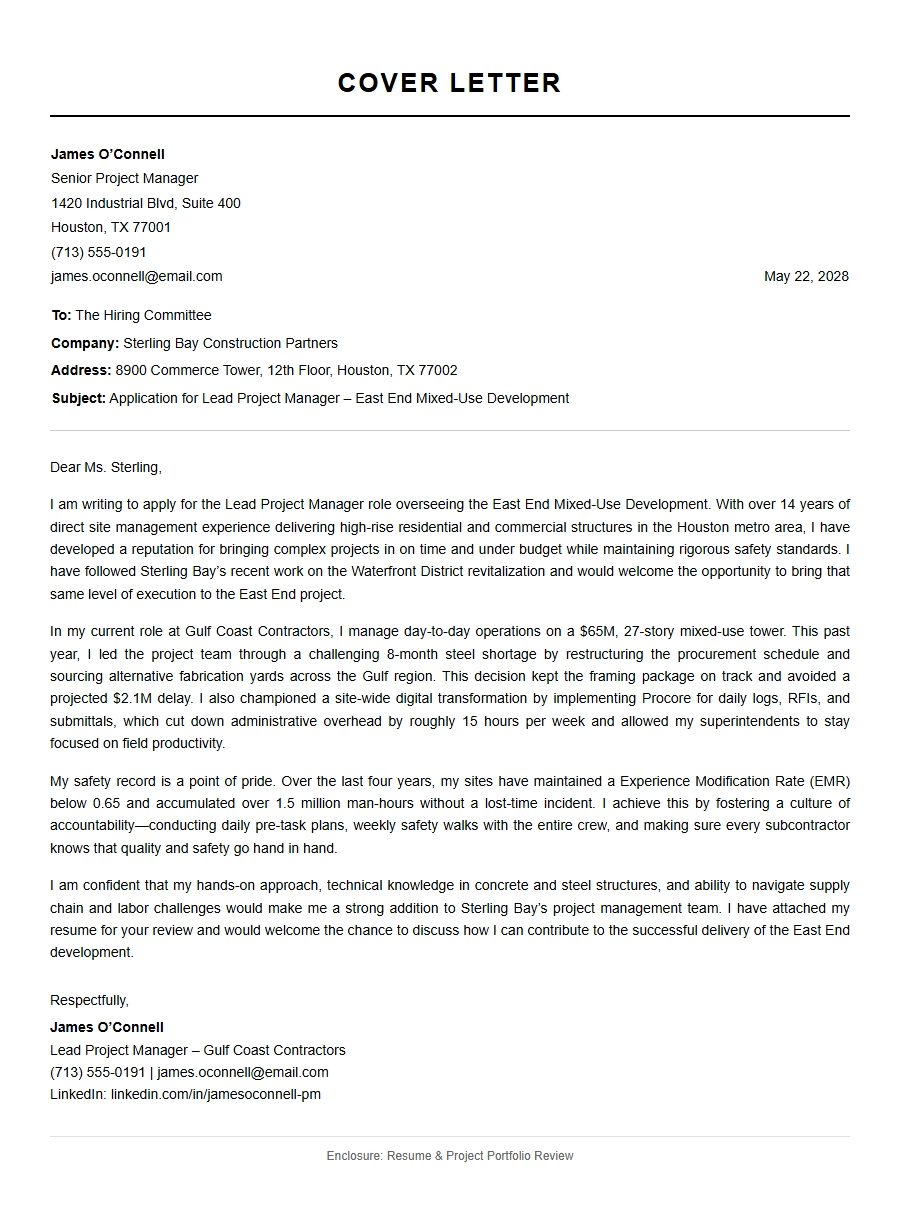
Construction Site Project Manager Cover Letter
Experienced High-Rise Residential PM
Dear Hiring Manager,
I am writing to apply for the Project Manager position at your construction firm, specifically for the upcoming high-rise residential development in downtown. With over 10 years of experience managing complex vertical construction projects, I bring proven leadership in coordinating subcontractors, maintaining schedules, and ensuring quality control.
Key achievements that align with your needs:
Successfully delivered a 35-story condominium tower on time and under budget, saving $1.2M through value engineering.
Implemented a digital tracking system that reduced RFI response times by 40%.
Managed safety protocols resulting in zero lost-time incidents over three consecutive projects.
I am eager to apply my technical knowledge of reinforced concrete and steel framing to your Park Avenue project. I look forward to discussing how my leadership can drive your next milestone.
Sincerely, Alex Martinez
Heavy Civil & Infrastructure PM
Dear Selection Committee,
I am excited to submit my application for the Project Manager role on your bridge and highway expansion program. My background includes 8 years of managing large-scale civil infrastructure projects, including a $45M interchange reconstruction and a 3-mile urban roadway upgrade.
Relevant experience:
Coordinated with state DOTs, environmental agencies, and utility companies to secure permits and minimize delays.
Supervised self-perform crews and subcontractors across earthwork, drainage, and paving operations.
Your reputation for delivering complex infrastructure on budget is impressive-negative. I am confident my hands-on approach and dedication to community engagement will make me a valuable addition to your team.
Best regards, Jordan Chen
Transitioning from Assistant to Full PM
Dear Hiring Team,
I am writing to express my strong interest in the Project Manager position for your construction site projects. Having served as an Assistant Project Manager for four years with a top general contractor, I am ready to take full ownership of project execution.
In my current role, I have:
Led weekly subcontractor coordination meetings and updated lookahead schedules.
Processed submittals and shop drawings using Procore, ensuring timely approval workflows.
Resolved field conflicts between MEP and structural trades, saving two weeks of rework.
I hold a Bachelor’s in Construction Management and an OSHA 30 certification. I understand the challenges of site logistics, material procurement, and client communication. Your firm’s focus on commercial interiors aligns perfectly with my hands-on experience. I would welcome the opportunity to grow with your team.
Thank you, Taylor Reed
Green Building & Sustainable Construction PM
Dear Mr. Williams,
I am thrilled to apply for the Project Manager position focused on sustainable construction. With a LEED AP credential and five successful LEED-certified projects, I specialize in integrating green building practices without compromising schedule or budget.
Highlights from my portfolio:
Managed a net-zero energy office building that achieved LEED Platinum, including solar arrays and greywater systems.
Coordinated with design teams to specify low-VOC materials and improve building envelope performance.
Led waste diversion programs achieving 90%+ recycling rates on job sites.
I am particularly drawn to your company’s commitment to the Living Building Challenge. My experience with material transparency and regenerative design would allow me to contribute from day one. I look forward to discussing how I can support your next eco-friendly project.
Warmly, Priya Singh
Industrial & Warehouse PM
Dear Hiring Manager,
I am applying for the Project Manager role to oversee your new logistics center construction. My past seven years have been dedicated to industrial projects, including distribution warehouses, cold storage facilities, and manufacturing plants.
Key qualifications:
Delivered a 500,000 sq ft e-commerce fulfillment center four weeks early by accelerating site prep and concrete pours.
Negotiated bulk material orders saving $800k across two consecutive warehouse builds.
Managed up to 15 subcontractors simultaneously, ensuring seamless integration of racking, conveyor systems, and HVAC.
I understand the complexities of tilt-up construction, large floor flatness specifications, and fast-track schedules typical of industrial sites. Your upcoming project in the industrial park is exactly the challenge I thrive on. Let’s discuss how I can help you meet your operational targets.
Respectfully, Marcus Johnson
PM with Strong Safety Record
Dear Safety-Driven Team,
I am writing to apply for the Project Manager position, emphasizing my commitment to safety excellence. Over my 12-year career, I have led construction sites with an exemplary safety record, winning two industry safety awards.
Safety achievements include:
Zero serious injuries across five consecutive projects totaling 600,000 employee-hours.
Implemented a behavior-based safety observation program that reduced near-misses by 60%.
Conducted weekly toolbox talks and daily pre-task hazard assessments.
I hold certifications in OSHA 500, EM 385-1-1, and Certified Safety Professional (CSP) candidate status. I also enforce strict housekeeping and fall protection protocols. Your company’s reputation for prioritizing worker well-being resonates with my personal values. I am confident I can maintain your safety culture while delivering quality projects on time.
Yours in safety, David Kim
Cost Control & Budget Management Focus
Dear Finance Committee,
I am submitting my candidacy for the Project Manager role with a focus on maximizing value. My 9 years of experience include managing multi-million dollar budgets, delivering projects within tight margins, and driving profitability.
Reduced project costs by 12% across a portfolio of three mixed-use developments through strategic procurement and subcontractor negotiation.
Developed monthly cost forecasts and variance reports that improved executive decision-making.
Recovered $250k in disputed change orders via diligent documentation and negotiation.
I am skilled in Sage 300, Viewpoint, and Excel-based budgeting tools. Your recent project in the downtown core has complex phasing; my analytical approach will ensure financial control throughout. I look forward to discussing how I can protect your bottom line.
Sincerely, Emily Torres
International Project Experience PM
Dear Hiring Manager,
I am excited to apply for the Project Manager position, bringing diverse international construction experience. Having managed projects in Southeast Asia, the Middle East, and North America, I adapt quickly to different regulatory environments and cultural contexts.
Led a $120M airport terminal expansion in Qatar, coordinating multinational teams speaking six languages.
Navigated complex permitting processes in Singapore for a high-rise residential complex.
Implemented remote site monitoring using drones and collaboration tools across time zones.
Your firm’s global portfolio appeals to me. I am skilled in contract administration under FIDIC and common law standards. I can bring best practices from around the world to your next construction site.
Looking forward to connecting, Olivia Fernandez
Renovation & Retrofit Project PM
Dear Project Team,
I am applying for the Project Manager position focused on renovation and adaptive reuse projects. My 6 years of experience in historic restorations and tenant fit-outs make me ideal for your upcoming building retrofit program.
Notable projects:
Managed the structural upgrade and facade restoration of a 1920s office building, preserving original details while adding modern MEP systems.
Oversaw the phased renovation of a hospital wing, maintaining operations in adjacent areas during construction.
Coordinated asbestos abatement, lead paint removal, and selective demolition with minimal community disruption.
I understand the challenge of working within existing structures, dealing with unforeseen conditions, and maintaining tight schedules. Your company’s expertise in breathing new life into old buildings excites me. I would welcome the chance to contribute my practical field skills.
Best regards, Nathan Brooks
Communication & Stakeholder Management PM
Dear Hiring Manager,
I am writing to apply for the Project Manager position, emphasizing my strength in communication and stakeholder relationships. With 7 years of experience on complex construction sites, I excel at keeping owners, architects, and trades aligned.
Developed a weekly dashboard reporting system that improved client satisfaction scores by 30%.
Facilitated conflict resolution between design team and contractor, avoiding costly redesigns.
Led public outreach meetings for a mixed-use project, gaining community support through transparent updates.
I am fluent in Spanish and English, enabling clear communication with diverse crews. My ability to translate technical issues into business impacts makes me an effective bridge between field and office. Your company’s emphasis on collaborative delivery matches my style. I am eager to bring my relationship-building skills to your next site.
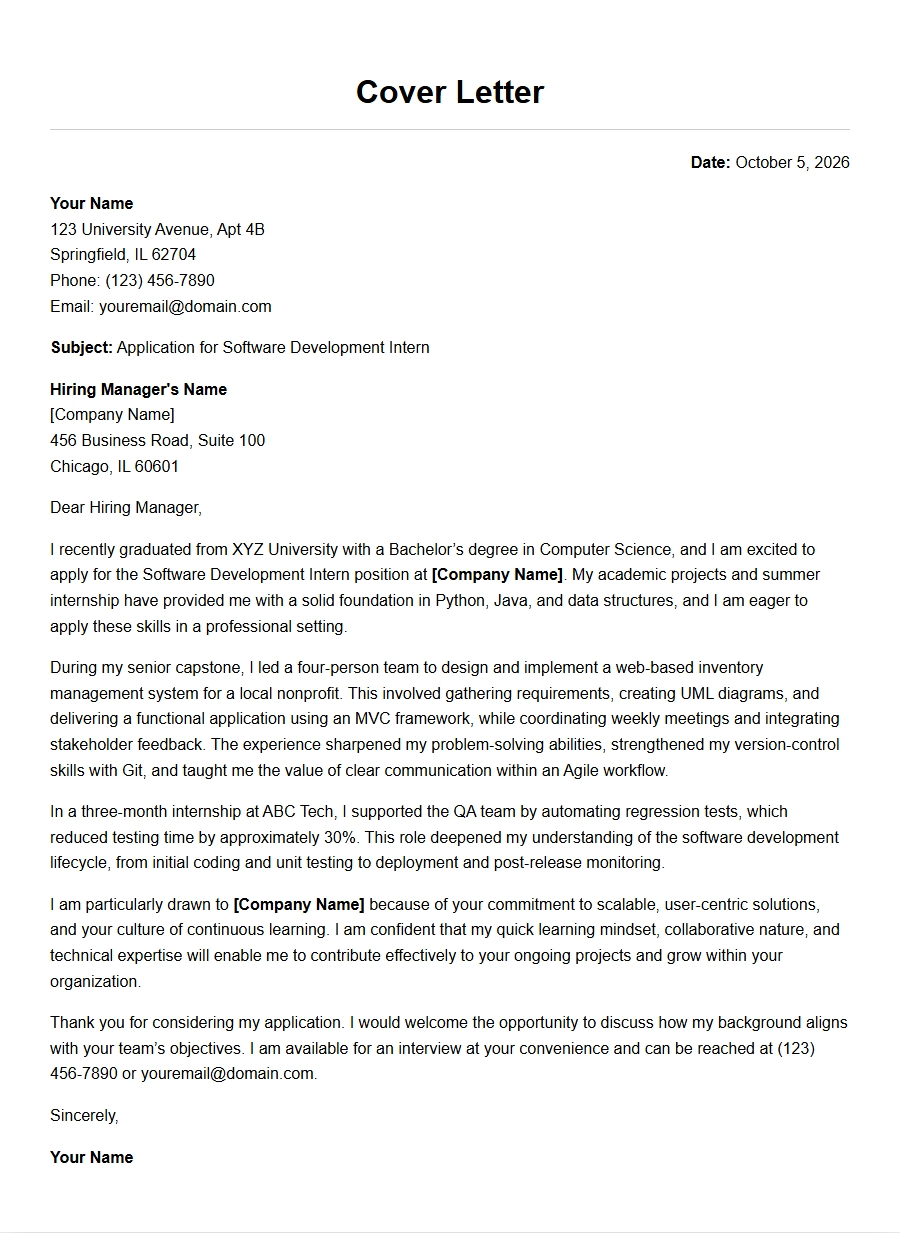 Recent College Student Cover Letter for Internship
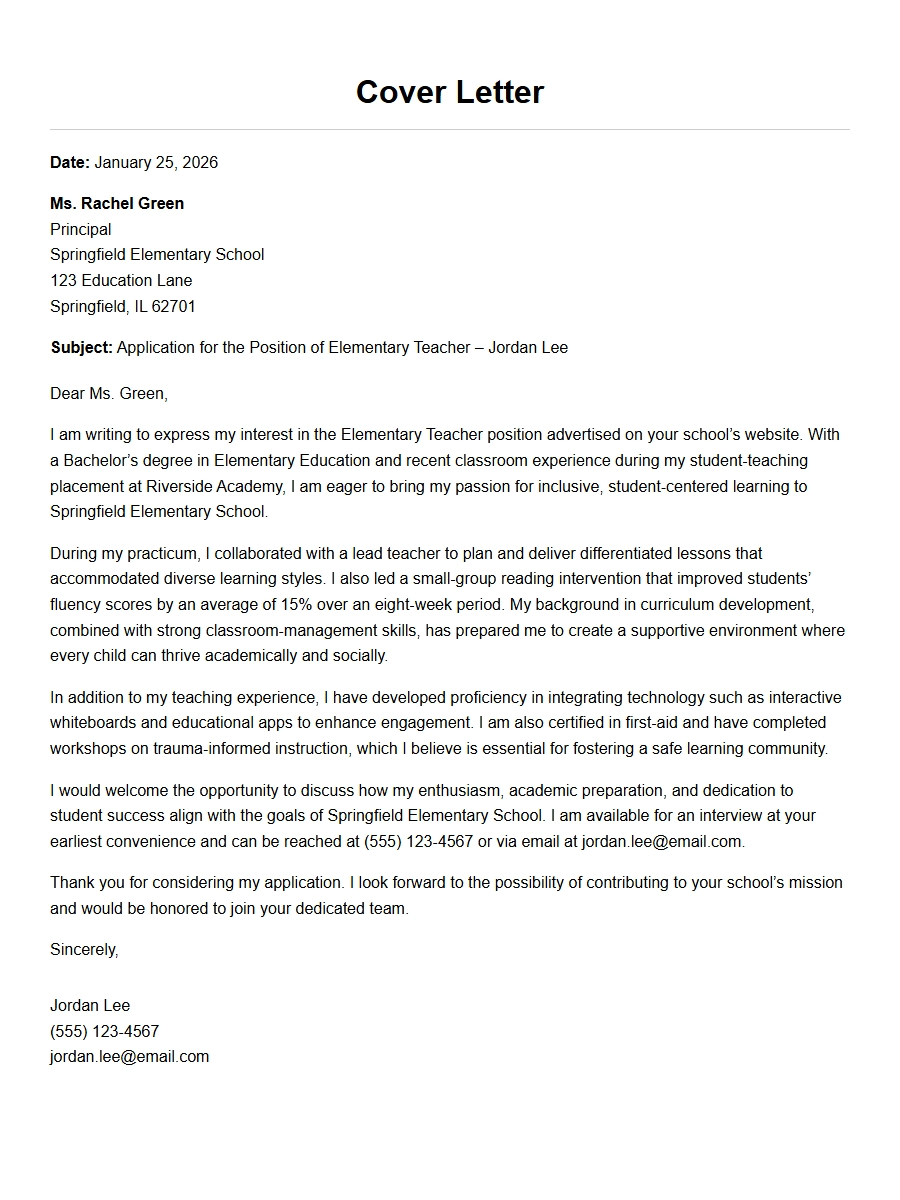 Entry Level Teacher Cover Letter Examples
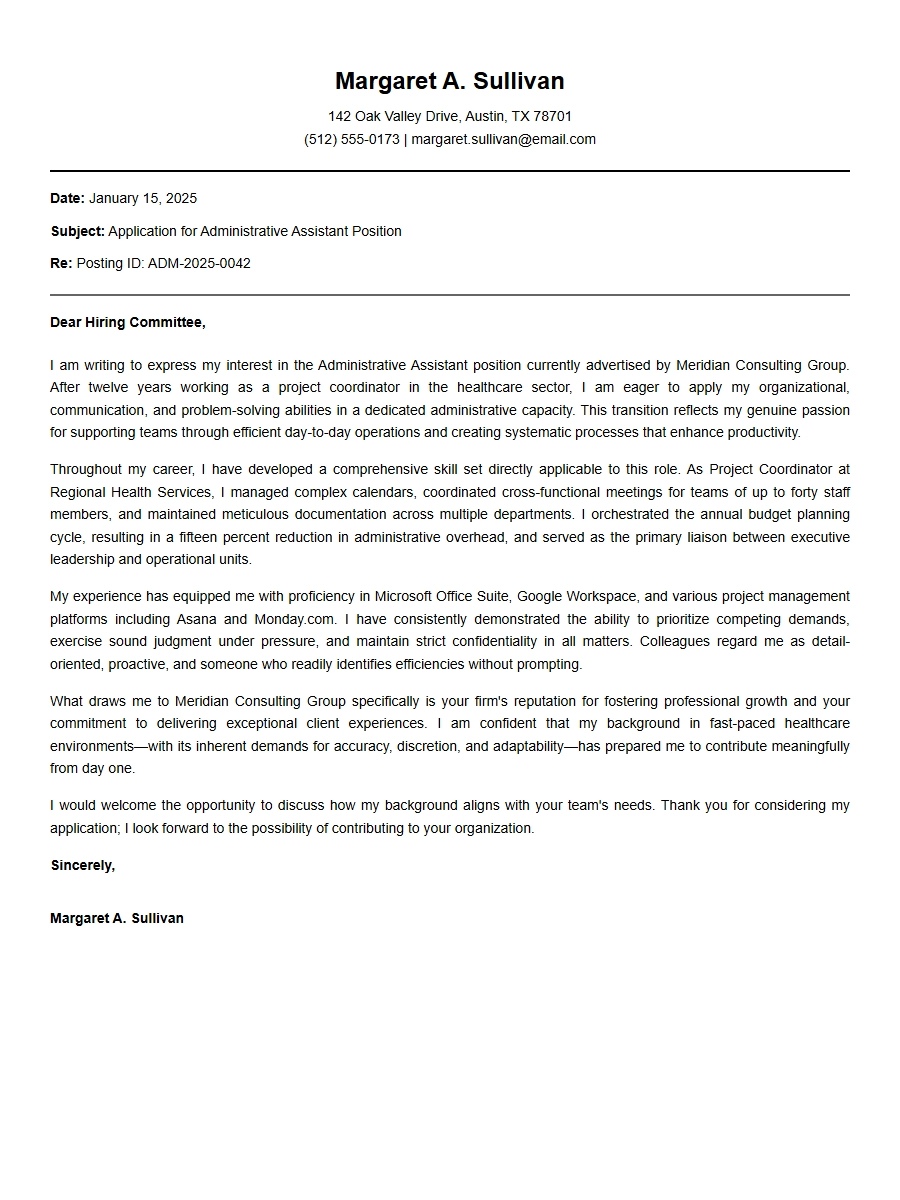 Career Changer Administrative Assistant Cover Letter
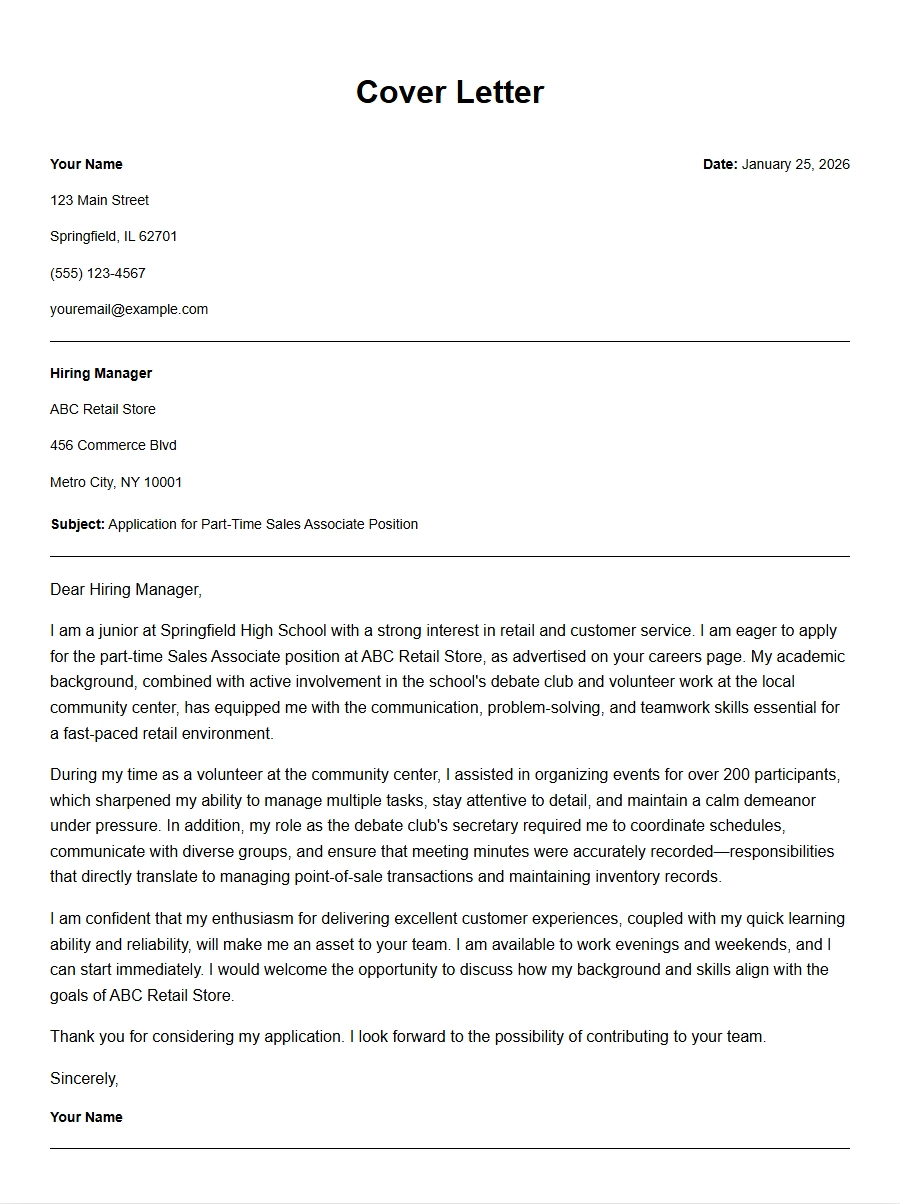 High School Student Part Time Job Cover Letter
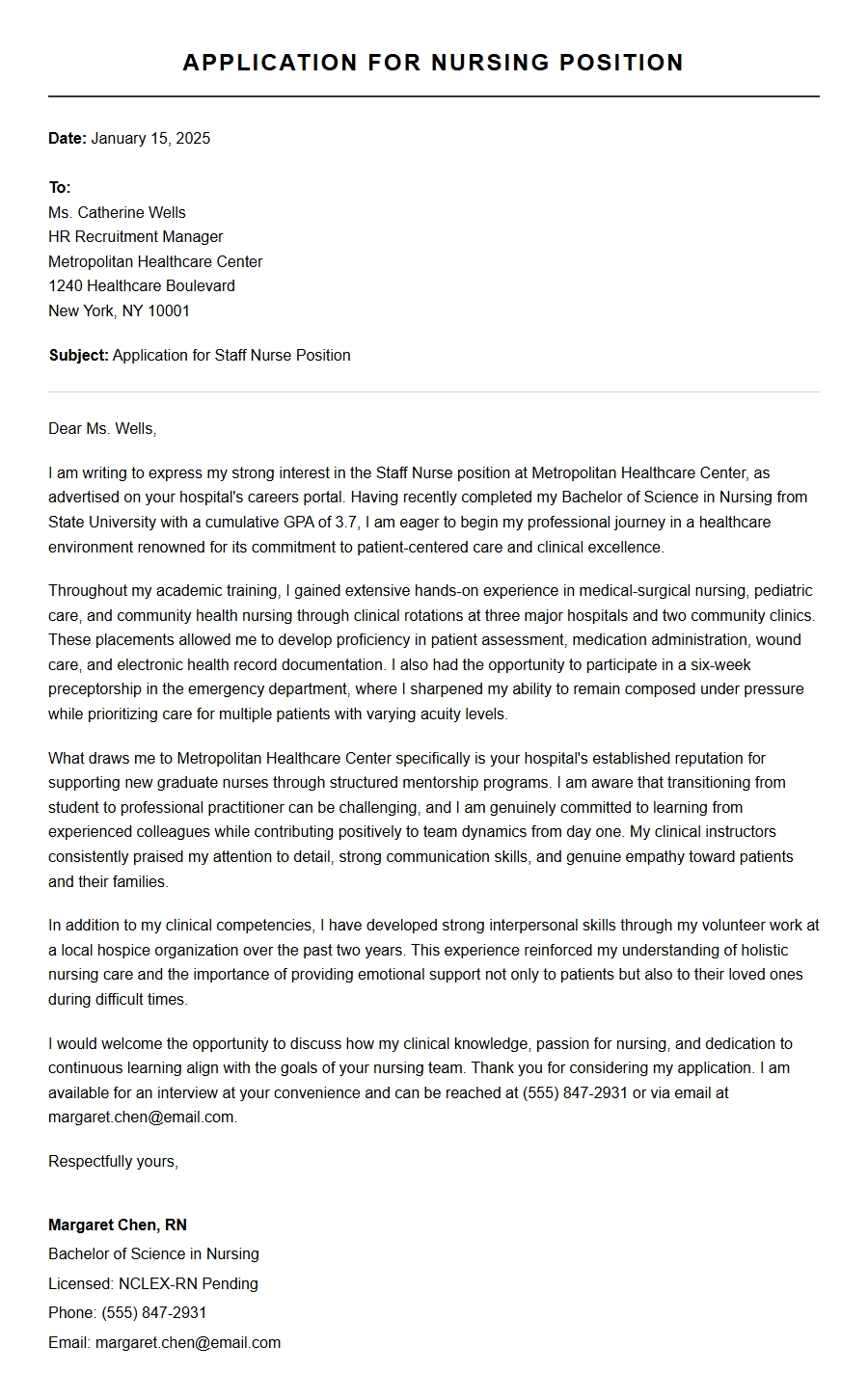 Fresh Graduate Nursing Application Letter
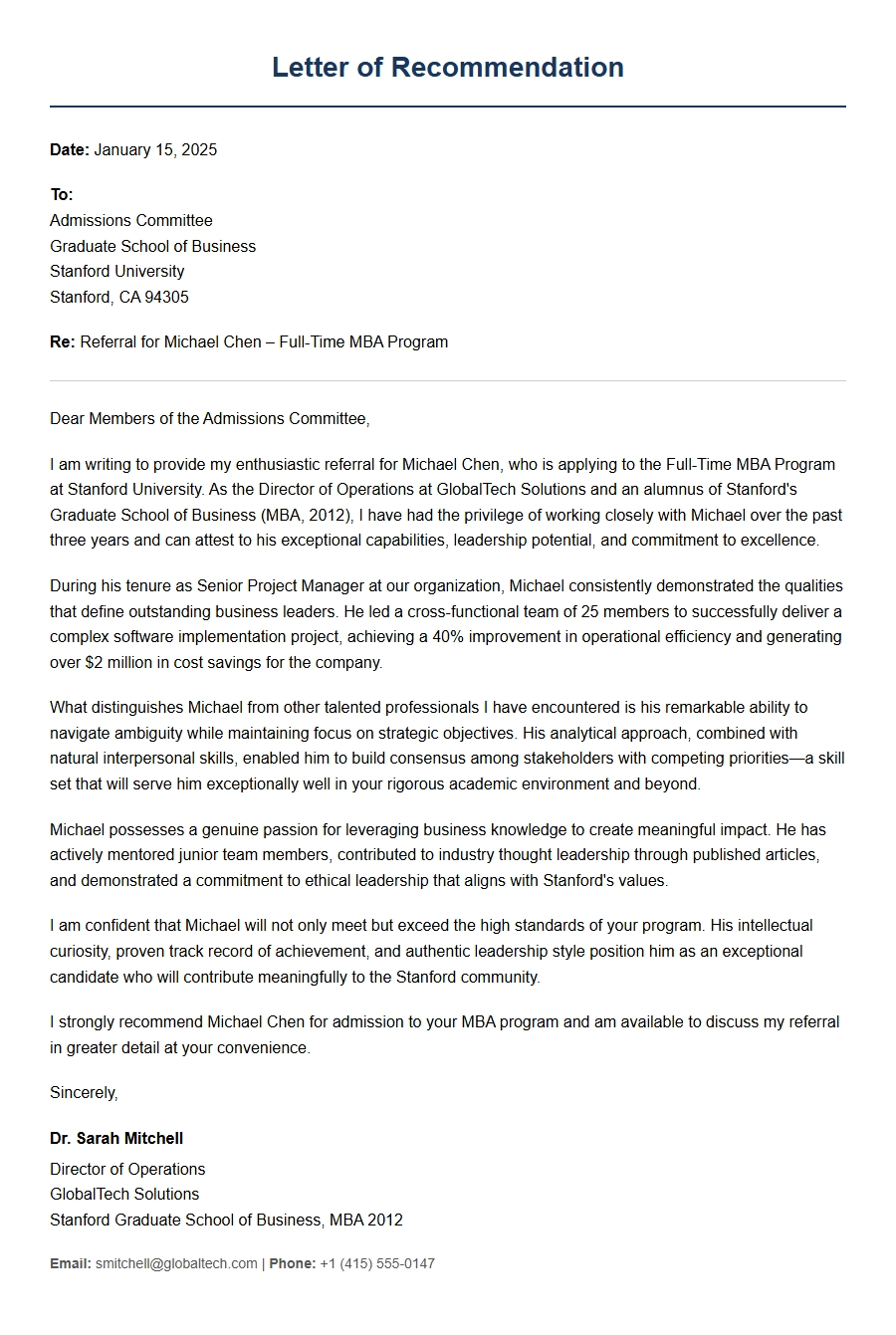 University Alumni Referral Email Cover Letter