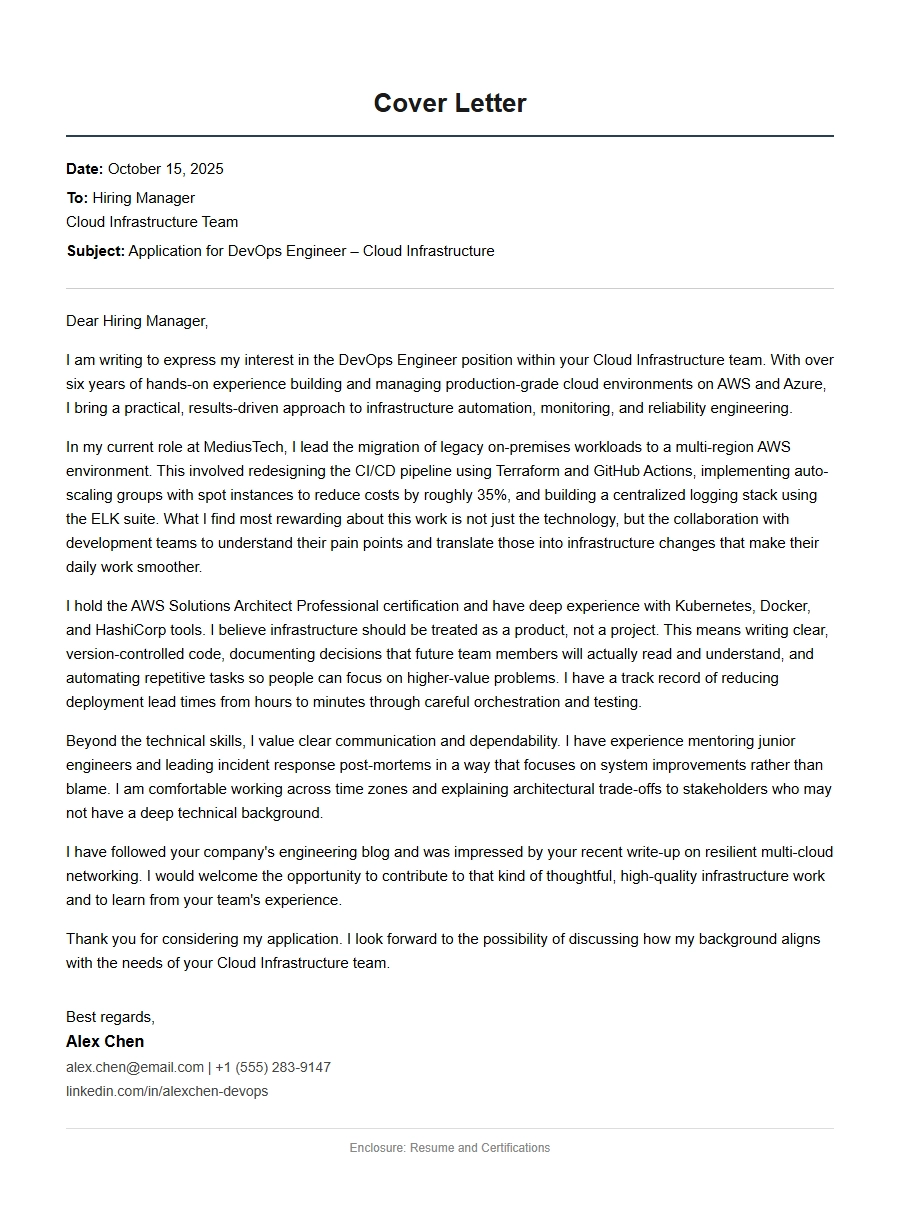
DevOps Engineer Cover Letter for Cloud Infrastructure
Staring at a blank page when you need to write a DevOps engineer cloud infrastructure cover letter can feel paralyzing—but the right sample turns that anxiety into a confident, polished draft in minutes. You're applying for a role that demands both deep technical know-how and the ability to communicate clearly with SREs, product managers, and executives. The cover letter is your first chance to show you can bridge that gap.
Using a letter sample isn't cheating. It's a smart, time-saving strategy. A well-structured letter template gives you a proven framework for professional correspondence. It provides the letter structure, the right tone, and key phrases you can adapt. You still do the real work: replacing generic lines with your specific experience with AWS, Kubernetes, CI/CD pipelines, and Infrastructure as Code. The sample is just the scaffolding.
Category: Professional Cover Letters & Correspondence
Why Use a Sample for a DevOps Cover Letter?
Cover letters for cloud infrastructure roles have a unique balancing act. You need to sound competent in Terraform, Docker, and monitoring tools, but you also have to come across as someone who collaborates well during incidents and planning. A good cover letter example shows you how to weave technical achievements into a narrative that feels human, not like a resume dump.
Ever read a letter that felt too stiff or too casual? The right sample helps you calibrate your tone in writing so you land somewhere between formal and conversational. For a DevOps role, it's fine to write “I automated deployment across three cloud regions” rather than “I was responsible for the automation of deployment across three cloud regions.” Short, active sentences read better.
How to Adapt a Sample Without Losing Your Voice
Start by selecting a sample meant for technical or engineering roles. Avoid generic “customer service” templates. Then follow these three steps:
Swap the opening paragraph. Instead of “I am writing to apply for the DevOps Engineer position,” try something like “I've been following your team's migration to a serverless architecture—I faced a similar challenge at my last company and I'd love to help.” That immediately shows you understand their context.
Keep the body structure. Most effective cover letters follow a problem–solution–result pattern. The sample shows you where to slot your own examples. Use specific numbers and tools: “Reduced deployment time by 40% using Spinnaker and Terraform.” Replace any vague filler with your actual projects.
Choose your salutation and closing carefully. “Dear [Hiring Manager's Name]” is best. If you can't find the name, “Dear Hiring Team” works. For the closing, “Best regards” or “Sincerely” are safe. Avoid outdated options like “Dear Sir or Madam.”
Your letter must be customizable for each job. A sample that you treat as a fill-in-the-blank template won't stand out. Instead, use it as a checklist: Does my opening hook address their specific need? Did I show, not just tell, my cloud infrastructure skills? Did I mention a tool or process that's relevant to their stack?
Common Mistakes in Cloud Infrastructure Cover Letters
Even with a great sample, people trip up on small details. Here are the ones I see most often:
Ignoring format. If you're sending an email, use a clear subject line like “DevOps Engineer Application – [Your Name].” If you're attaching a PDF, follow standard business letter format with your contact info, date, and recipient details. A professional letterhead design adds polish but keep it simple—no fancy graphics that slow down parsing.
Overloading with tech jargon. Yes, you need to show expertise. But a paragraph full of “K8s, Helm charts, observability pipelines, and blue-green deployments” can overwhelm the reader. Pick two or three key achievements and explain them briefly. Let the rest come out in the interview.
Skipping proofreading. A single typo in a document you wrote specifically for this job screams carelessness. Always proofreading your letter out loud. Better yet, ask a friend to read it. A fresh pair of eyes catches awkward phrasing and missing words.
Also watch your letter writing etiquette when adapting a resignation letter sample or any other type. The same principles of respect, clarity, and professionalism apply here. For a cover letter, you're selling yourself, but don't exaggerate. If you haven't scaled a multi-cloud infrastructure, don't claim you did. Focus on what you actually built or improved.
Putting It All Together: From Sample to Standout
A sample saves you from the blank page, but your personal experience makes the letter memorable. After you draft your first version, read it as if you were the hiring manager. Does it answer “Why you for this role?” Does it feel like it's written by a real person, not a robot?
Different situations call for different approaches. A career pivot letter for someone returning to the workforce, like our stay-at-home mom returning to work, has a different tone, but the same structural principles apply. You can apply these same strategies to other specialized roles—an architectural drafter needs to highlight CAD skills, a financial advisor focuses on trust and planning, and a technical writer must demonstrate clarity. Even a civil engineer can benefit from the same framework—just change the examples.
One last tip: write your first draft without worrying about perfection. Then step away for a few hours. When you come back, you'll notice sentences you can tighten and places where the digital letter format (plain text vs. PDF) might affect readability. If you're printing, consider a simple letterhead design with your name and contact info. If it's an email, keep the subject line clear and start the body directly.
The best cover letters feel both professional and personal. They use a sample as a springboard, not a crutch. Practice makes the process faster. Next time you need to write a cover letter or even a resignation letter sample, you'll know exactly how to start—and you'll finish with something that sounds like you.
Everyday Writing Examples
DevOps Engineer Cover Letter for Cloud Infrastructure
[
{
"title"
"Experienced DevOps Engineer for Cloud Infrastructure Role",
"body"
"
Date: October 15, 2024
Hiring Manager TechCorp Solutions 123 Innovation Drive San Francisco, CA 94105
Re: Application for Senior DevOps Engineer – Cloud Infrastructure
Dear Hiring Manager,
With over six years of hands-on experience in designing, automating, and managing cloud-native infrastructure, I am thrilled to apply for the Senior DevOps Engineer position at TechCorp Solutions. At my current role with CloudOps Inc., I lead a team responsible for migrating a legacy on-premises environment to AWS, achieving a 40% reduction in operational costs while improving deployment frequency by 3x.
My expertise aligns directly with your requirements:
Cloud Platforms: Proficient in AWS (EC2, S3, RDS, Lambda, CloudFormation) and Azure (ARM templates, AKS).
CI/CD & Automation: Designed robust pipelines using Jenkins, GitLab CI, and Terraform; integrated automated testing and security scanning.
Container Orchestration: Managed Kubernetes clusters (EKS, AKS) with Helm charts and service mesh (Istio).
Monitoring & Observability: Implemented Prometheus, Grafana, and ELK stack for real-time metrics and log analysis.
I am eager to bring my infrastructure-as-code mindset and disaster recovery planning skills to TechCorp. I welcome the chance to discuss how I can help scale your cloud infrastructure securely and efficiently. Thank you for your consideration.
Sincerely, Jane Doe jane.doe@email.com | (555) 123-4567
"
},
{
"title"
"DevOps Engineer Focusing on AWS Migration and Automation",
"body"
"
Date: November 1, 2024
Hiring Committee DataStream Analytics 456 Cloud Avenue New York, NY 10001
Subject: DevOps Engineer Application – Cloud Infrastructure Lead
Dear Team,
I am writing to express my strong interest in the DevOps Engineer role at DataStream Analytics. As a certified AWS Solutions Architect with five years of experience, I specialize in migrating complex workloads to the cloud and building scalable, cost-effective infrastructure.
In my previous position at FinServe Ltd., I orchestrated the migration of over 200 servers to AWS using Terraform and Ansible, cutting server provisioning time from days to minutes. I also implemented a GitOps workflow with ArgoCD, reducing rollback time by 90%. Key accomplishments include:
Designed a multi-region, highly available architecture with RDS Multi-AZ and S3 cross-region replication.
Reduced monthly cloud spend by 25% through right-sizing and reserved instance optimization.
Built a comprehensive CI/CD pipeline using GitHub Actions and Docker, achieving 99.9% uptime.
I am passionate about reliability engineering and am eager to contribute to DataStream’s cloud transformation. I look forward to discussing how my hands-on skills in AWS, Kubernetes, and Infrastructure as Code can drive your team’s success.
Best regards, Alex Smith alex.smith@email.com | (555) 987-6543
"
},
{
"title"
"Junior DevOps Engineer with Cloud Certifications",
"body"
"
Date: October 20, 2024
Hiring Manager StartupXYZ 789 Tech Park Blvd Austin, TX 78701
RE: Application for Junior DevOps Engineer – Cloud Infrastructure
Dear Hiring Manager,
As a recent graduate with a B.S. in Computer Science and certifications in AWS (Associate) and HashiCorp Terraform, I am eager to launch my career as a DevOps Engineer at StartupXYZ. During my internship at CloudFirst, I supported the infrastructure team in automating deployments and maintaining CI/CD pipelines.
Key skills I bring to your team:
Cloud Fundamentals: Hands-on with AWS services (EC2, S3, VPC, IAM) and basic Azure resource management.
Automation Tools: Experience with Ansible playbooks and Terraform modules; wrote simple scripts in Python and Bash.
Container Basics: Built Docker images and used Docker Compose for local development; familiar with Kubernetes concepts.
Monitoring: Configured CloudWatch alarms and set up basic Grafana dashboards.
I am a quick learner with strong problem-solving skills and a passion for automating repetitive tasks. I look forward to contributing to StartupXYZ’s cloud infrastructure and growing under your mentorship. Thank you for your time and consideration.
Sincerely, Maria Garcia maria.garcia@email.com | (555) 321-0987
"
},
{
"title"
"DevOps Engineer for Multi-Cloud (AWS & GCP) Infrastructure",
"body"
"
Date: October 28, 2024
Hiring Manager GlobalNet Inc. 321 Cloud Street Seattle, WA 98101
I am writing to apply for the DevOps Engineer position at GlobalNet Inc. With four years of experience managing both AWS and Google Cloud Platform (GCP) environments, I thrive in multi-cloud architectures and have a proven track record of improving reliability and reducing costs.
In my current role at MultiCloud Corp, I manage hybrid deployments spanning AWS (EKS, RDS, Route53) and GCP (GKE, Cloud SQL, Cloud CDN). I recently led a project to unify monitoring across both clouds using Prometheus and Thanos, reducing alert noise by 60%. My core competencies include:
Infrastructure as Code: Extensive Terraform and Pulumi experience for provisioning across providers.
CI/CD: Built pipelines using Spinnaker and GitLab CI that deploy to both clouds seamlessly.
Security: Implemented IAM policies, VPC peering, and encryption at rest/transit.
Cost Optimization: Analyzed usage patterns and applied committed use discounts, saving 30% on GCP costs.
I am excited about the opportunity to bring multi-cloud expertise to GlobalNet and help architect a resilient, scalable infrastructure. I welcome a conversation about how my background aligns with your needs.
Best regards, David Kim david.kim@email.com | (555) 456-7890
"
},
{
"title"
"Senior DevOps Engineer Specializing in Kubernetes and Automation",
"body"
"
Date: November 5, 2024
Hiring Team ContainerWorks 555 Harbor Drive Portland, OR 97201
I am a DevOps engineer with seven years of experience, the last four focused exclusively on Kubernetes and cloud-native ecosystems. Your job description for a Senior DevOps Engineer at ContainerWorks immediately caught my attention because of your reliance on Kubernetes for microservices orchestration.
At my current position with MicroServices Inc., I manage a fleet of 500+ Kubernetes nodes across multiple AWS accounts. I have designed custom operators, implemented service mesh (Linkerd), and automated canary deployments using Flagger. My contributions include:
Area
Tools & Practices
Impact
Cluster Management
Kops, EKS, Terraform
99.99% uptime
CI/CD
Jenkins X, ArgoCD
50% faster release cycles
Monitoring
Prometheus, Grafana, Loki
MTTR reduced by 70%
Security
OPA Gatekeeper, Falco
Compliant with PCI DSS
I am passionate about reliability and automation and am eager to bring these skills to ContainerWorks. Thank you for your consideration. I look forward to discussing how I can contribute to your cloud infrastructure roadmap.
"DevOps Engineer with Security Focus for Cloud Infrastructure",
"body"
"
Date: November 2, 2024
Hiring Manager SecureCloud LLC 888 Security Lane Denver, CO 80202
Subject: Application for DevOps Engineer – Cloud Infrastructure (Security Emphasis)
Dear Hiring Manager,
I am writing to express my enthusiasm for the DevOps Engineer role at SecureCloud. With five years in DevOps and a strong background in cloud security (AWS Certified Security – Specialty), I bring a unique ability to integrate security into every layer of infrastructure.
In my previous role at FinSecure, I led the implementation of a DevSecOps pipeline that included:
Automated vulnerability scanning using Trivy and Snyk within CI/CD.
Infrastructure compliance via Terraform Sentinel policies and AWS Config rules.
Incident response automation with Lambda functions to quarantine compromised resources.
Secrets management using HashiCorp Vault and AWS Secrets Manager.
I also reduced time-to-fix for security findings by 80% through automation and monitoring. My cloud infrastructure skills span provisioning, scaling, and disaster recovery, all with a security-first mindset. I am eager to help SecureCloud maintain a robust, compliant cloud environment while enabling developer velocity. Thank you for your time.
Best regards, Michael Brown michael.brown@email.com | (555) 789-0123
"
},
{
"title"
"DevOps Engineer for a Fast-Growing Startup (CI/CD & Scalability)",
"body"
"
Date: October 25, 2024
Founding Team ScaleUp AI 456 Innovation Alley San Jose, CA 95110
Re: DevOps Engineer – Cloud Infrastructure for High Growth
Dear Team,
I am excited to apply for the DevOps Engineer position at ScaleUp AI. As a DevOps generalist with three years of experience in startup environments, I love building infrastructure that scales effortlessly and empowers developers to ship faster.
At my last startup, I was the sole infrastructure engineer responsible for:
Setting up automated CI/CD with GitHub Actions and AWS CodeDeploy, cutting deployment time from 2 hours to 15 minutes.
Migrating from a monolithic architecture to Kubernetes on EKS, enabling independent scaling of services.
Implementing blue/green deployments and feature flags (LaunchDarkly) to reduce release risk.
Building monitoring dashboards with Datadog that reduced on-call response time by 50%.
I am comfortable with the ambiguity and fast pace of a startup and enjoy automating away toil. I am particularly interested in ScaleUp AI’s mission to revolutionize machine learning operations. I am confident my hands-on cloud and DevOps skills can contribute immediately. I look forward to hearing from you.
Sincerely, Sarah Johnson sarah.johnson@email.com | (555) 890-1234
"
},
{
"title"
"DevOps Engineer Cover Letter Highlighting Infrastructure as Code",
"body"
"
Date: November 8, 2024
Hiring Manager InfraPro Inc. 789 Code Street Chicago, IL 60601
Subject: DevOps Engineer Application – Cloud Infrastructure with IaC Focus
Dear Hiring Manager,
I am a DevOps engineer passionate about Infrastructure as Code (IaC) and repeatable, version-controlled environments. With six years of experience, I have built and maintained cloud infrastructure solely through code, using tools like Terraform, Pulumi, and CloudFormation.
At my current employer, I manage a multi-account AWS setup with hundreds of resources defined as reusable Terraform modules. Key achievements:
Capability
Tool
Result
Provisioning
Terraform + Terragrunt
Full environment spun up in 10 minutes
Configuration Management
Ansible
Zero drift across 300+ servers
Testing
Terratest, InSpec
100% infrastructure test coverage
Version Control
Git + Atlassian Bitbucket
Collaborative infrastructure changes with peer review
I also contributed to open-source Terraform providers and have written custom modules for internal use. My approach ensures that infrastructure changes are as rigorous as application code changes. I am excited about bringing this disciplined IaC practice to InfraPro and helping your team achieve greater reliability and speed. Thank you for your consideration.
Best regards, James Lee james.lee@email.com | (555) 567-8901
I am writing to apply for the DevOps Engineer role at HybridCloud Systems. I have extensive experience with Microsoft Azure and hybrid cloud environments, having spent the last five years helping enterprises migrate and manage workloads across Azure and on-premises data centers.
Notable accomplishments at my current position:
Designed a Hub-Spoke network topology in Azure with ExpressRoute, achieving secure connectivity to on-prem systems.
Automated provisioning of AKS clusters using Terraform and Azure DevOps pipelines.
Implemented Azure Policy and Blueprints for governance, ensuring compliance with ISO 27001.
Reduced deployment failures by 80% through automated testing and canary releases using Azure Traffic Manager.
I hold the Azure DevOps Engineer Expert and Azure Solutions Architect Expert certifications. I am comfortable working in a hybrid environment and can help streamline your infrastructure operations. I am excited about the possibility of joining HybridCloud and contributing to your cloud journey. Thank you for your time.
"DevOps Engineer Cover Letter – Emphasis on Monitoring & Reliability",
"body"
"
Date: November 15, 2024
Hiring Manager ReliableOps LLC 567 Resilience Road Phoenix, AZ 85001
Subject: Application for DevOps Engineer – Cloud Infrastructure Reliability
Dear Hiring Manager,
I am a DevOps engineer with a passion for observability and site reliability engineering. With four years of experience building monitoring and alerting systems for cloud infrastructure, I help teams achieve high availability and rapid incident response.
At my current role at MonitorFirst, I maintain a complex AWS infrastructure and lead the observability strategy. My key contributions:
Metrics & Dashboards: Built custom Grafana dashboards for
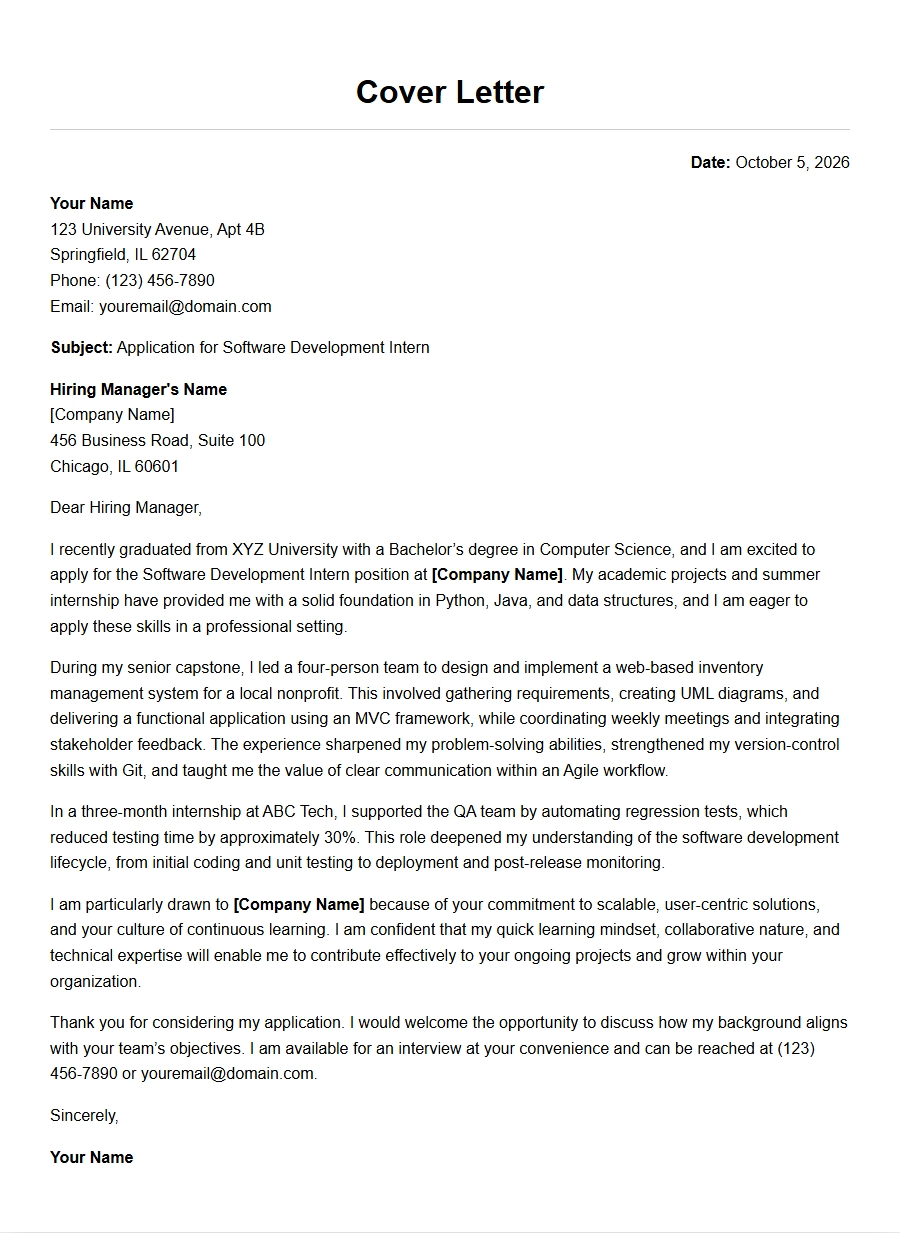 Recent College Student Cover Letter for Internship
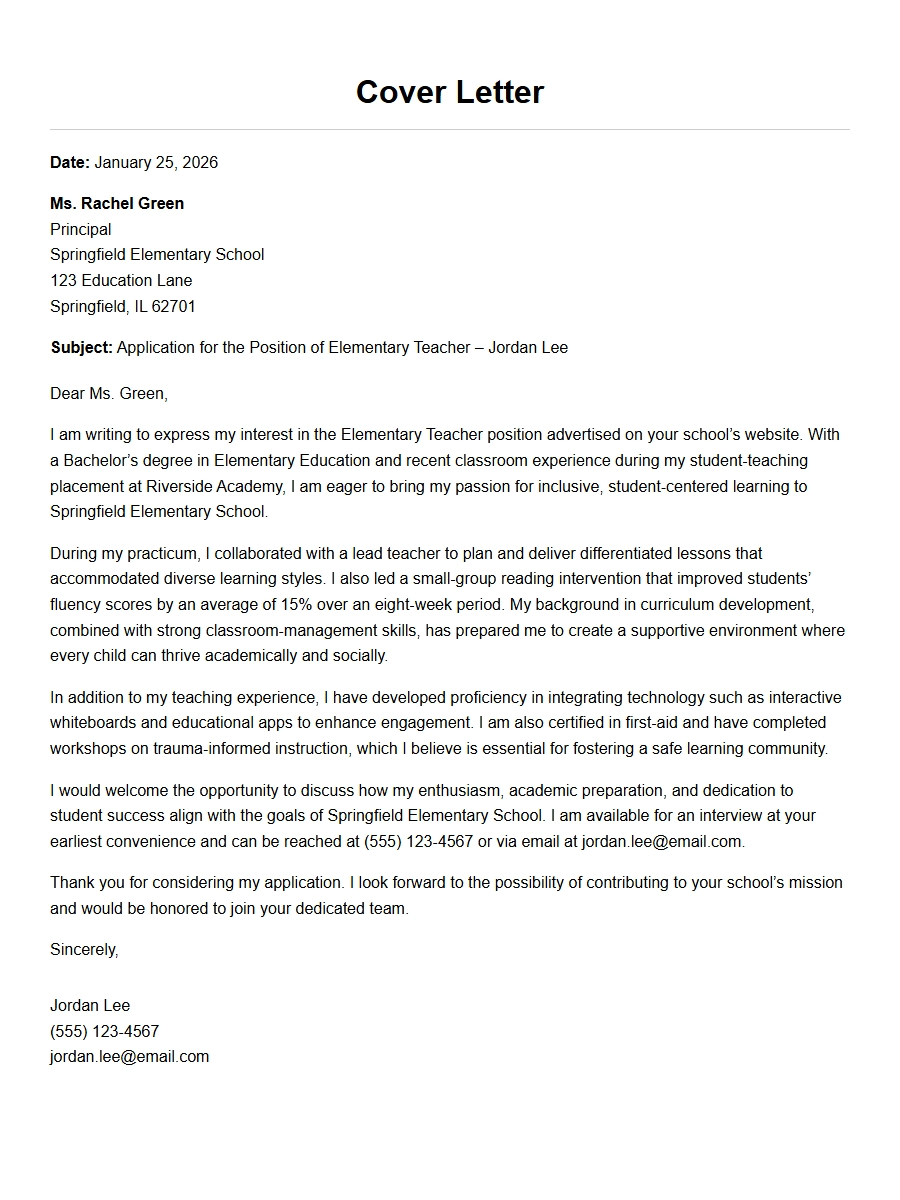 Entry Level Teacher Cover Letter Examples
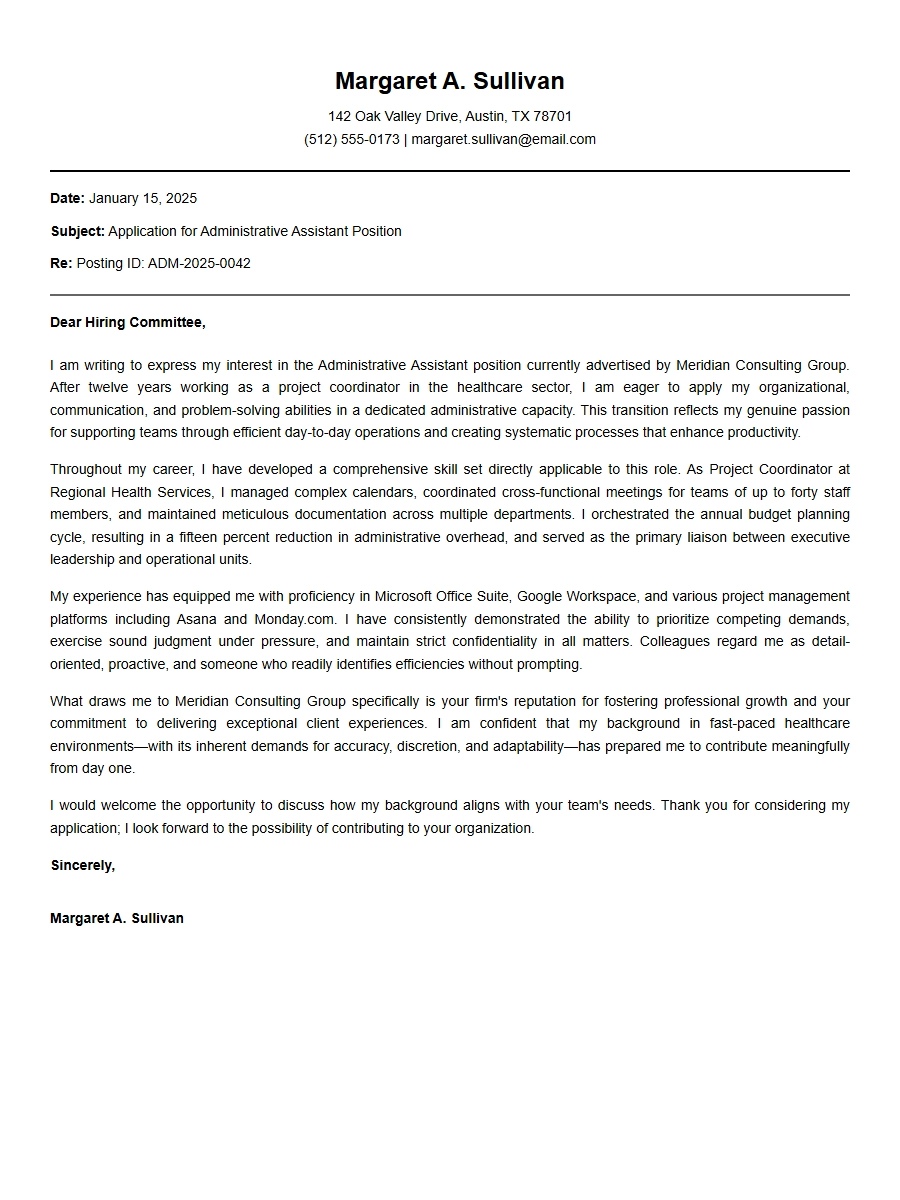 Career Changer Administrative Assistant Cover Letter
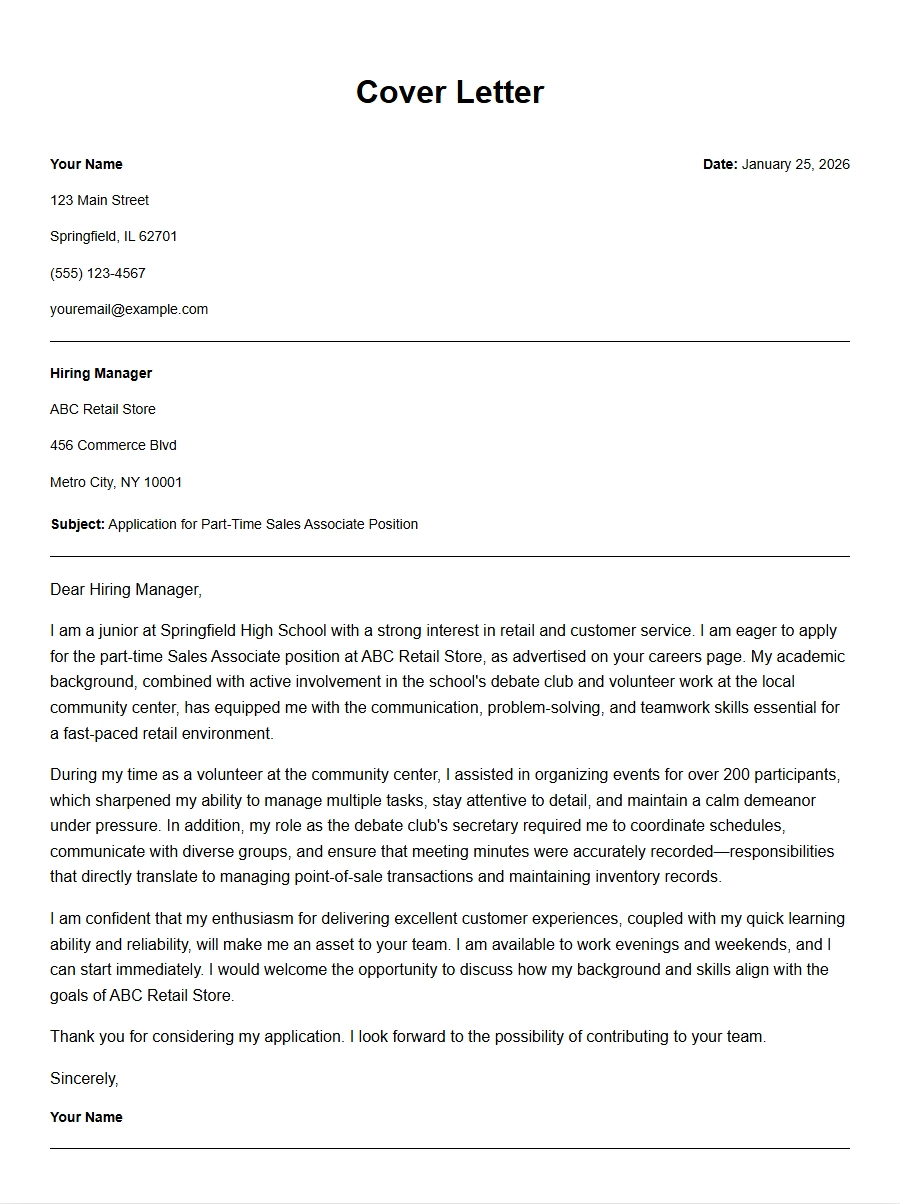 High School Student Part Time Job Cover Letter
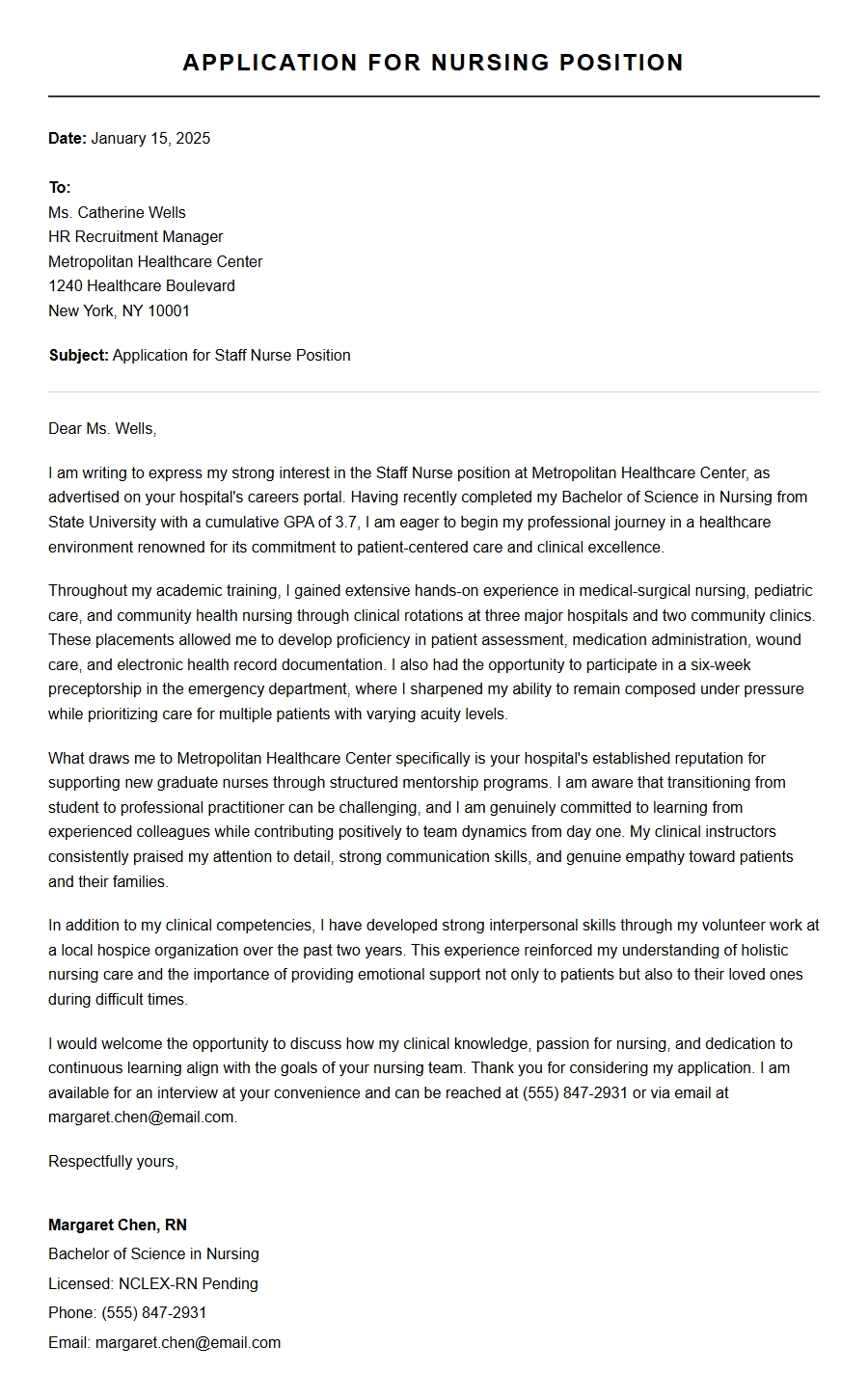 Fresh Graduate Nursing Application Letter
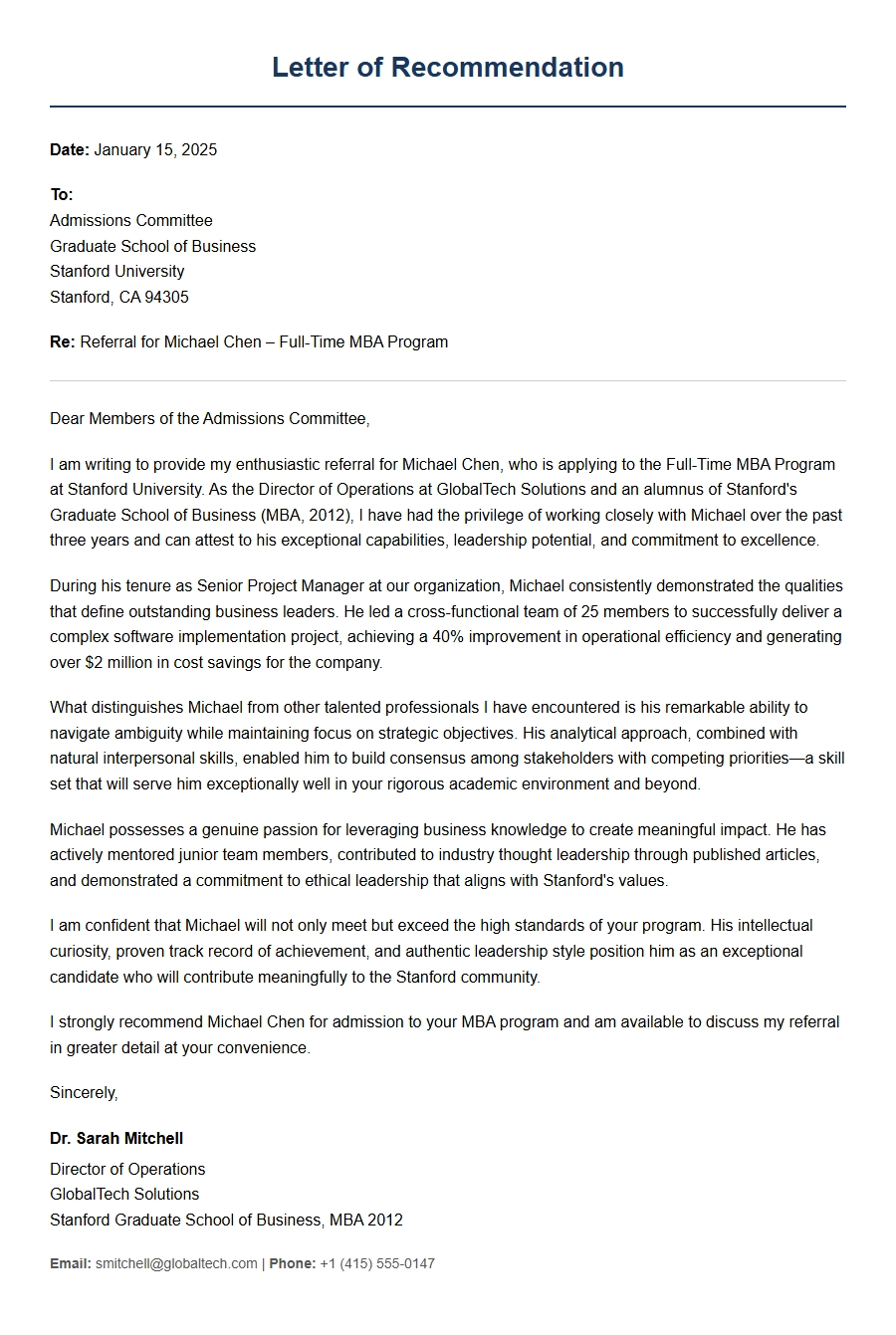 University Alumni Referral Email Cover Letter