Career Changer Administrative Assistant Cover Letter
You're staring at a blinking cursor, maybe an hour until your shift ends and you need to send that resignation letter. Or perhaps you're drafting a cover letter for the first time in years—maybe after a career pivot—and the thought of explaining a non-linear path feels overwhelming. Sound familiar? That blank-page paralysis is real, and it happens to the best of us.
Here's the thing: using a sample isn't cutting corners. It's a smart starting point that saves you hours of second-guessing. A good letter template gives you the bones of professional correspondence—structure, tone, key phrases—while you fill in the parts that are uniquely yours. Think of it like a scaffolding, not a script.
When you're crafting something like a cover letter for a career change, the stakes feel higher because you're not just proving you can do the job—you're explaining a narrative shift. That's exactly where a well-chosen sample helps most.
Choosing the Right Sample for Your Situation
Not all letters are created equal, and the first mistake people make is grabbing the first template they find. Think about whether you need something formal (like a resignation letter) or semi-formal (like a cover letter for an admin role). Industry matters too. A letter for a culinary management position will sound different than one for a medical office, even if both involve administrative tasks.
Look for samples that match your situation closely. If you're pivoting from customer service to an administrative assistant role, find examples that show how people highlight transferrable skills—things like scheduling, email management, or conflict resolution. A mismatched sample can actually make your letter feel less authentic, not more.
Making the Sample Work for You
Once you've found a solid starting point, here's where most people get stuck: they copy too much. The goal isn't to swap out names and hit send. Instead, read the sample once for structure, then a second time to note phrases that feel natural to you. Keep those. Edit out the rest.
Your opening paragraph is your hook. Skip the generic "I am writing to express my interest in..." Instead, try something that actually grabs attention. If you're coming from a completely different field, lead with what you bring that's unexpected. Maybe you managed inventory for five years in retail—guess what? That's scheduling, logistics, and vendor communication. Those are admin skills in disguise.
The closing matters too. Avoid vaguesign-offs like "I look forward to hearing from you." Instead, try something that shows you've done your homework: "I'd love to discuss how my experience in fast-paced environments translates to streamlining your office operations." It feels specific, and it shows initiative.
Common Mistakes That Undermine Your Letter
Avoid outdated salutations like "To Whom It May Concern" when you can find the hiring manager's name. And don't ignore format differences—if you're sending an email, you can relax the strict business letter format a bit, but a printed letter still needs proper spacing and a clean letterhead
Proofreading is where many letters fall apart. Typos and grammatical errors signal carelessness to employers—and for an administrative role, attention to detail is literally the job. Read your letter out loud before sending it. Better yet, ask someone else to read it too. Fresh eyes catch things you miss.
Putting It All Together
The best letters feel both professional and personal. They prove you understand the role while showing something about who you are. Your cover letter should serve as your first writing sample—because in admin work, communication is everything.
Adapting a sample takes practice. Don't expect to nail it on the first try. Review it the next morning with fresh eyes. Check that your tone matches the company culture—tech startups often appreciate a conversational voice, while law firms expect formality. These nuances matter.
Your Next Step
Find one sample that matches your situation closely. Study its structure—not every word. Then rewrite it using your own experiences and voice. That's the approach that works, whether you're transitioning from healthcare or any other field into administration.
The goal is a letter that sounds like you wrote it—which means taking the template and making it yours. With a little practice, you'll find yourself drafting polished letters in under an hour. When you need a starting point, come back here and use the samples as your scaffolding. You've got this.
Everyday Writing Examples
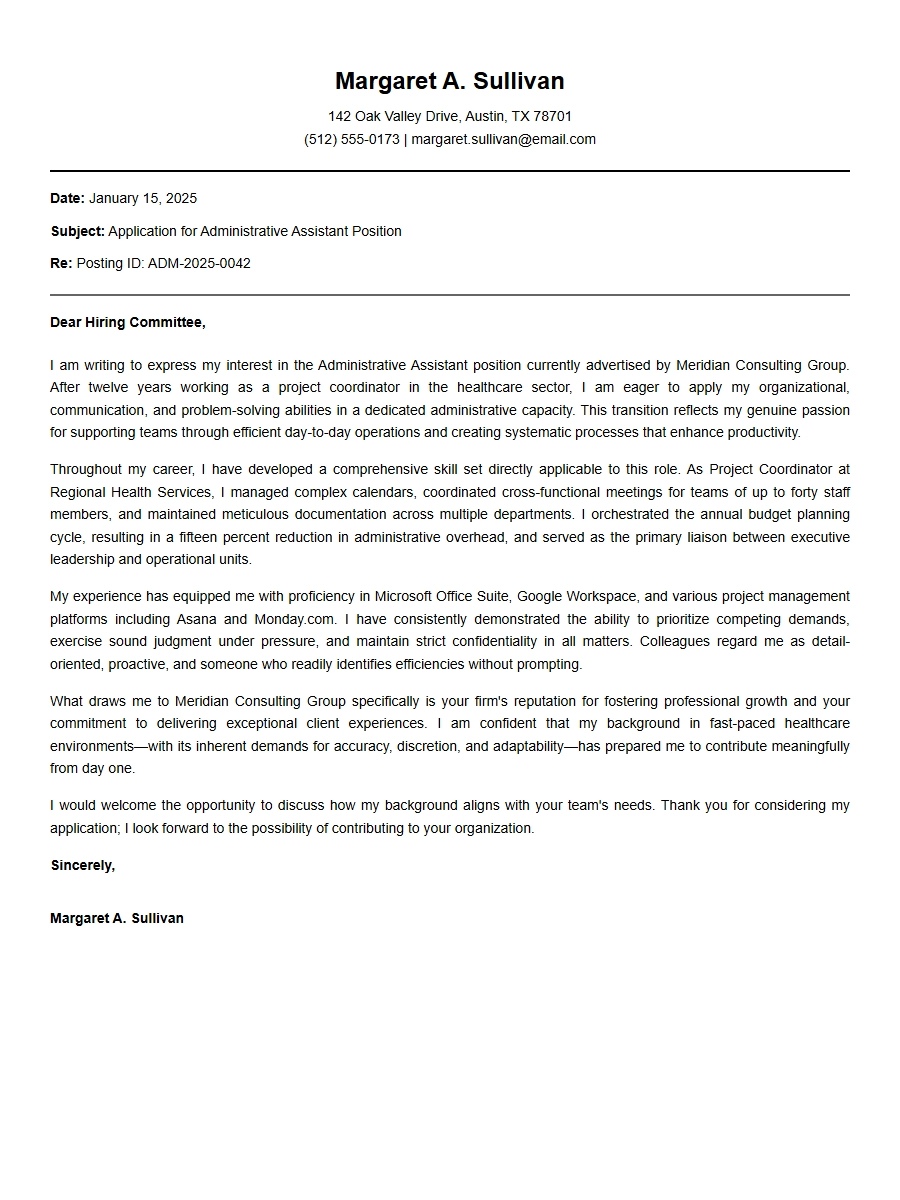
Career Changer Administrative Assistant Cover Letter
Career Change Cover Letter – Teacher to Administrative Assistant
Name
Phone
Email
Alex Johnson
(555) 123‑4567
alex.johnson@email.com
Dear Hiring Team,
I am excited to apply for the Administrative Assistant position at XYZ Company. As a former middle school teacher with six years of experience managing classrooms of up to 30 students, I have honed strong organizational, communication, and multitasking abilities that directly translate to an office environment.
My key transferable skills include:
Calendar management and scheduling for teachers, parent‑teacher conferences, and staff meetings;
Document preparation, record keeping, and data entry using Microsoft Office Suite;
Conflict resolution and customer‑focused communication developed through parent interactions;
Event coordination for school assemblies, open houses, and professional development days.
I am confident that my proven ability to prioritize tasks, maintain confidentiality, and support a dynamic team will add value to your organization. I would welcome the opportunity to discuss how my background aligns with your needs.
Thank you for considering my application.
Sincerely, Alex Johnson
Career Change Cover Letter – Retail Manager to Administrative Assistant
Name
Phone
Email
Maria Garcia
(555) 234‑5678
maria.garcia@email.com
Dear Hiring Manager,
I am eager to bring my five‑year retail management background to the Administrative Assistant role at ABC Corp. In my most recent position, I oversaw daily store operations, coordinated inventory, and led a team of 12 employees, all of which required meticulous planning and the ability to handle fast‑paced administrative tasks.
My transferable competencies include:
Scheduling and time‑tracking for staff while maintaining accurate payroll records;
Vendor communication and purchase order management, ensuring timely delivery of supplies;
Customer service excellence, resolving inquiries and complaints with professionalism;
Proficiency in Microsoft Outlook, Excel, and Word for reports, spreadsheets, and correspondence.
These experiences have equipped me with a sharp eye for detail, strong organizational skills, and the capacity to support senior leadership effectively. I look forward to contributing to your team.
Thank you for your time and consideration.
Sincerely, Maria Garcia
Career Change Cover Letter – Hospitality Manager to Administrative Assistant
Name
Phone
Email
James Liu
(555) 345‑6789
james.liu@email.com
Dear Recruitment Team,
Having spent six years as a hospitality manager at a busy boutique hotel, I am now seeking to leverage my operational expertise in an office setting as an Administrative Assistant with Global Services Inc. My role required seamless coordination of guest services, staff schedules, and front‑desk operations, all of which mirror the multitasking demands of an administrative position.
Key transferable skills include:
Advanced calendar management for executive meetings and conference room reservations;
Budget monitoring and expense reporting, ensuring fiscal compliance;
Training and supervising a diverse team, fostering a collaborative work environment;
Expertise in reservation software, Microsoft Office, and internal communication platforms.
I am confident that my problem‑solving mindset, attention to detail, and dedication to exceptional service will make me an asset to your organization.
Thank you for reviewing my application.
Sincerely, James Liu
Career Change Cover Letter – Customer Service Rep to Administrative Assistant
Name
Phone
Email
Sarah Patel
(555) 456‑7890
sarah.patel@email.com
Dear Hiring Team,
I am enthusiastic about the opportunity to transition from a customer service role to an Administrative Assistant position at Bright Solutions. For the past four years I have handled high‑volume inbound calls, resolved client issues, and maintained detailed records for a telecommunications company, providing me with a solid foundation in office support and information management.
My relevant strengths include:
Exceptional verbal and written communication, crafting clear correspondence and reports;
Strong organizational skills, prioritizing tasks to meet tight deadlines;
Proficiency in data entry and database maintenance using Excel and CRM platforms;
Conflict resolution and de‑escalation techniques that promote a positive work environment.
I am ready to apply my customer‑focused approach to streamline office operations and support your staff. I would love to discuss how my background aligns with your needs.
Thank you for your consideration.
Sincerely, Sarah Patel
Career Change Cover Letter – Healthcare Admin to Administrative Assistant
Name
Phone
Email
Emily Nguyen
(555) 567‑8901
emily.nguyen@email.com
Dear Hiring Manager,
I am writing to express my interest in the Administrative Assistant vacancy at HealthFirst Clinic. My three years as a medical billing coordinator have equipped me with a thorough understanding of regulatory compliance, patient record management, and insurance processing, all of which are directly applicable to an office support role.
Transferable abilities I bring include:
Expertise in maintaining confidential patient files and ensuring HIPAA compliance;
Proficient use of electronic health record (EHR) systems and Microsoft Office Suite;
Strong analytical skills for reconciling accounts and generating financial reports;
Effective communication with physicians, staff, and patients to facilitate smooth workflow.
I am confident that my attention to detail, ability to handle sensitive information, and proactive attitude will contribute to the efficiency of your team.
Thank you for reviewing my application.
Sincerely, Emily Nguyen
Career Change Cover Letter – IT Support Specialist to Administrative Assistant
Name
Phone
Email
David Kim
(555) 678‑9012
david.kim@email.com
Dear Recruitment Team,
I am excited to apply for the Administrative Assistant role at TechPro Solutions, where I can channel my five years of IT support experience into streamlined office operations. My background in troubleshooting hardware and software issues, managing ticketing systems, and training end‑users has sharpened my problem‑solving and organizational capabilities.
Key transferable skills include:
Scheduling and coordinating technology upgrades and maintenance windows;
Creating and updating documentation, user guides, and SOPs;
Managing inventory of IT equipment and ordering supplies as needed;
Excellent communication skills, translating technical jargon for non‑technical staff.
I am confident that my technical acumen combined with strong interpersonal abilities will enhance your administrative functions. I welcome the chance to discuss how I can support your team.
Thank you for your time and consideration.
Sincerely, David Kim
Career Change Cover Letter – Marketing Coordinator to Administrative Assistant
Name
Phone
Email
Jessica Martinez
(555) 789‑0123
jessica.martinez@email.com
Dear Hiring Committee,
After three years as a marketing coordinator at a fast‑growing digital agency, I am eager to pivot into an Administrative Assistant position at Creative Solutions LLC. My role required me to manage campaign timelines, coordinate with cross‑functional teams, and handle budgets, all of which demand the precise organization and administrative expertise your opening calls for.
What I bring to your team:
Proficient in project management tools such as Asana and Trello to track deliverables;
Skilled in preparing presentations, meeting minutes, and internal communications;
Strong attention to detail when proofreading marketing materials and contracts;
Experience supervising vendor relationships and processing invoices.
I am confident that my proactive mindset, ability to juggle multiple priorities, and passion for supporting colleagues will make me a valuable asset.
Thank you for reviewing my application.
Sincerely, Jessica Martinez
Career Change Cover Letter – Finance Analyst to Administrative Assistant
Name
Phone
Email
Robert Chang
(555) 890‑1234
robert.chang@email.com
Dear Hiring Manager,
I am interested in transitioning from a finance analyst role to an Administrative Assistant position at Pinnacle Corp. In my four‑year tenure, I prepared detailed financial reports, managed expense tracking, and coordinated cross‑department meetings, all of which required rigorous organization and precision.
Transferable competencies I can offer:
Advanced Excel skills for data compilation, budgeting, and forecasting;
Experience handling confidential financial information with discretion;
Strong communication skills, presenting complex data in clear summaries;
Ability to streamline administrative processes, reducing overhead and improving efficiency.
I am excited about the prospect of applying my analytical mindset to support your executive team and enhance day‑to‑day office operations.
Thank you for your consideration.
Sincerely, Robert Chang
Career Change Cover Letter – Event Planner to Administrative Assistant
Name
Phone
Email
Linda Davis
(555) 901‑2345
linda.davis@email.com
Dear Hiring Team,
I am enthusiastic about moving from event planning into an Administrative Assistant role at Elite Events Co. My career has involved orchestrating conferences, managing budgets, and liaising with vendors, all of which require meticulous planning, time management, and the ability to juggle multiple priorities—skills that are essential for an administrative position.
Key strengths I bring include:
Comprehensive logistical coordination, from venue selection to on‑site execution;
Proficient in budgeting, negotiating contracts, and tracking expenses;
Strong communication skills for correspondences, meeting minutes, and reports;
Expertise in using event management software and Microsoft Office tools.
I am confident that my organizational flair and problem‑solving attitude will help keep your office running smoothly.
Thank you for reviewing my application.
Sincerely, Linda Davis
Career Change Cover Letter – Nonprofit Program Coordinator to Administrative Assistant
Name
Phone
Email
Michael Brown
(555) 012‑3456
michael.brown@email.com
Dear Recruitment Committee,
I am excited to apply for the Administrative Assistant vacancy at Community Partners Inc., where I can leverage my three years as a nonprofit program coordinator. In that role I oversaw grant reporting, volunteer scheduling, and community outreach initiatives, all of which demand strong administrative oversight and the capacity to support diverse stakeholders.
My transferable assets include:
Skilled in maintaining detailed records, compliance documentation, and donor databases;
Proficient in Microsoft Excel, Word, and Outlook for correspondence and reporting;
Excellent organization of multiple projects, meeting tight deadlines while maintaining quality;
Strong interpersonal skills, working with volunteers, board members, and external partners.
I am confident that my dedication to service, attention to detail, and ability to streamline operations will make me a valuable addition to your team.
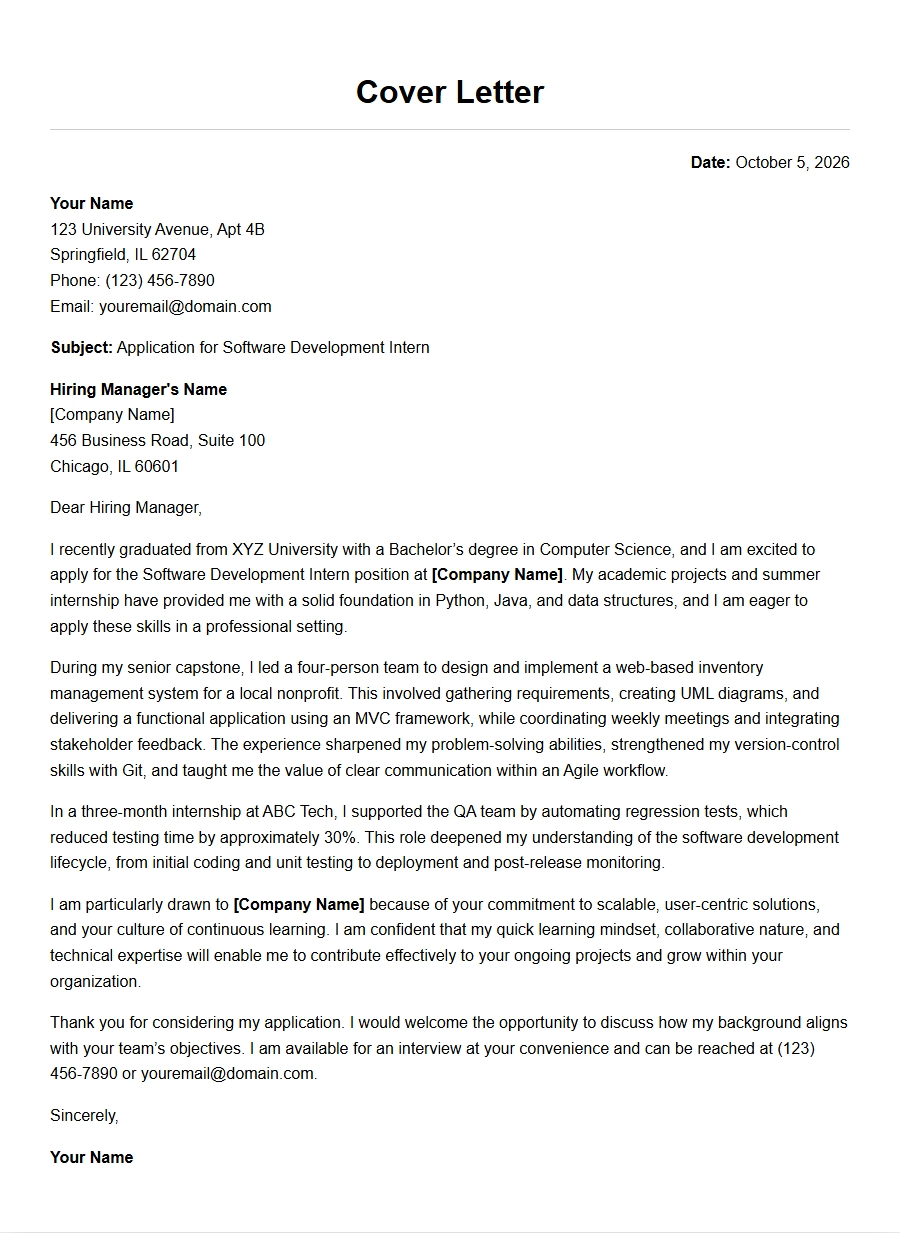 Recent College Student Cover Letter for Internship
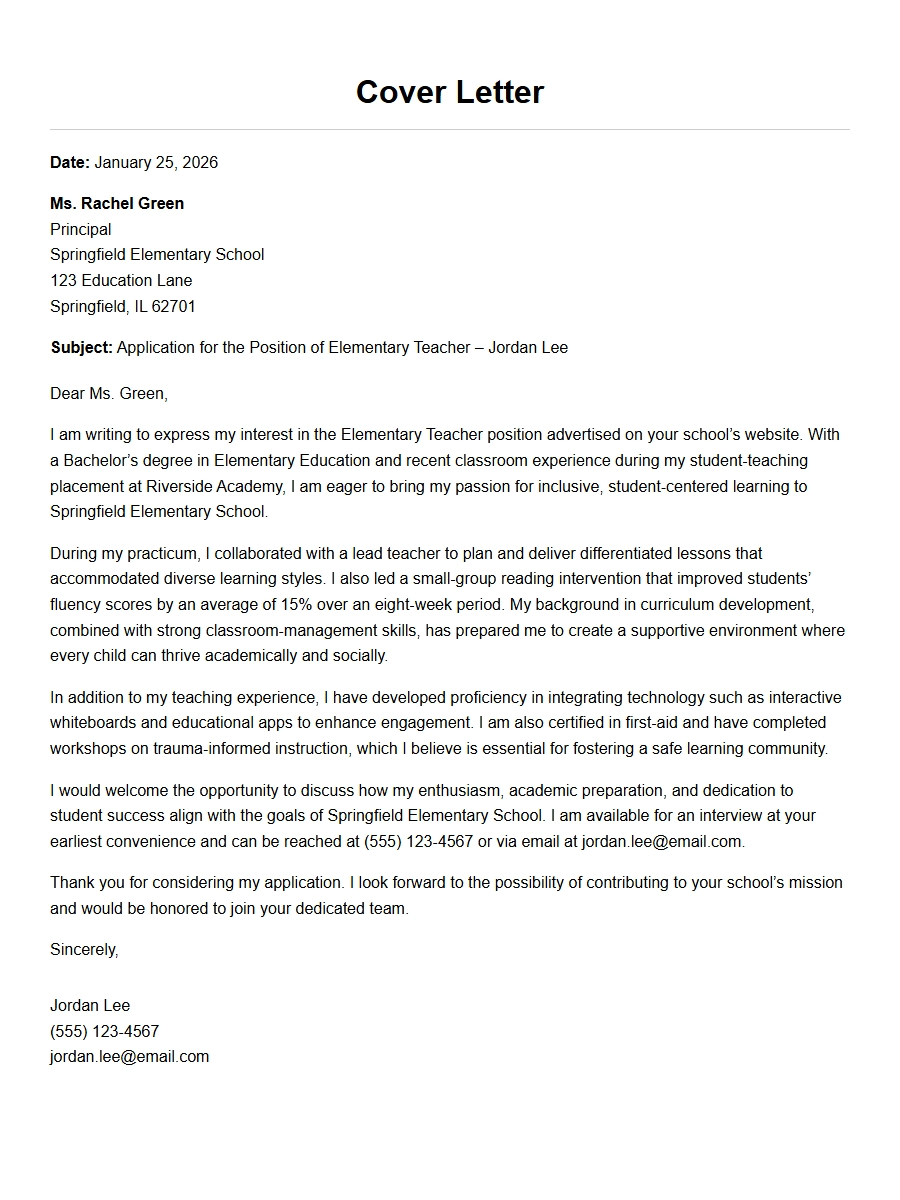 Entry Level Teacher Cover Letter Examples
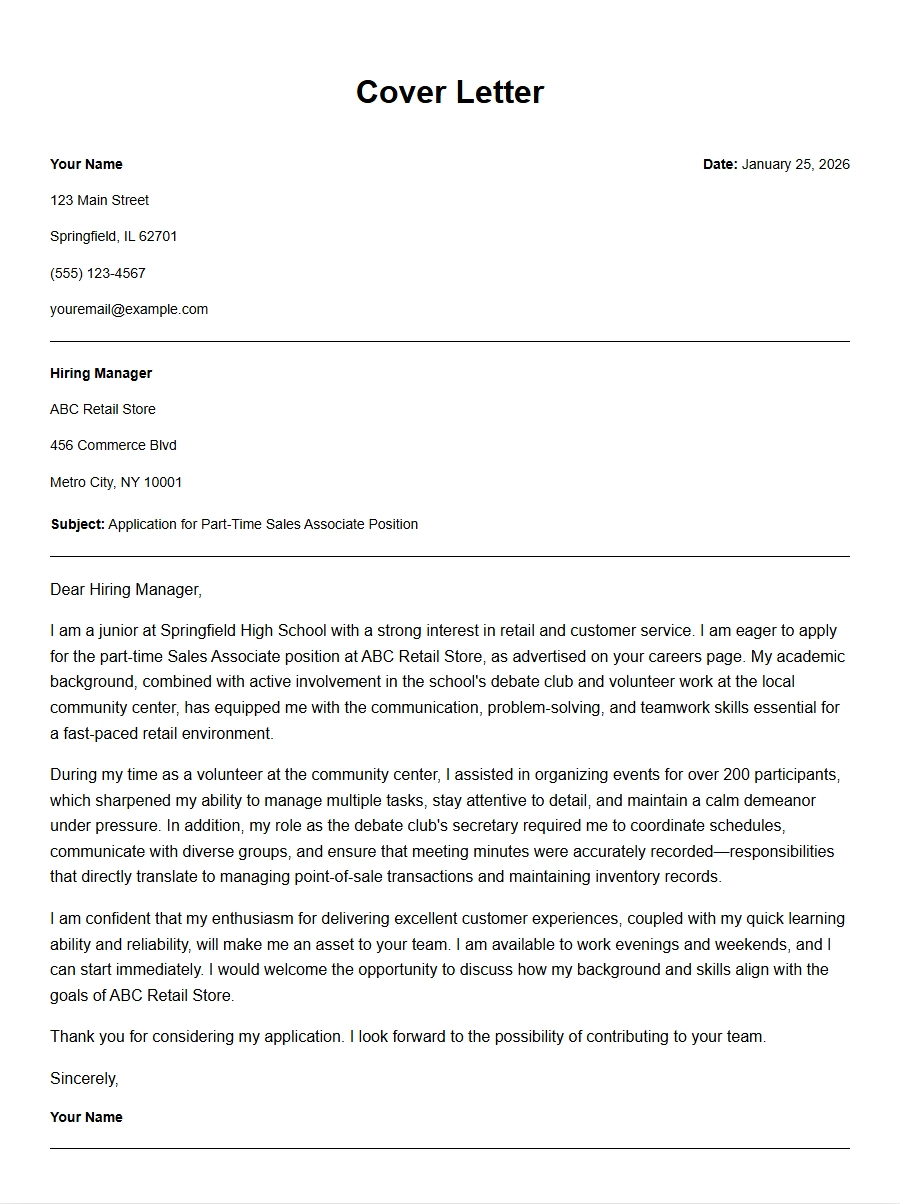 High School Student Part Time Job Cover Letter
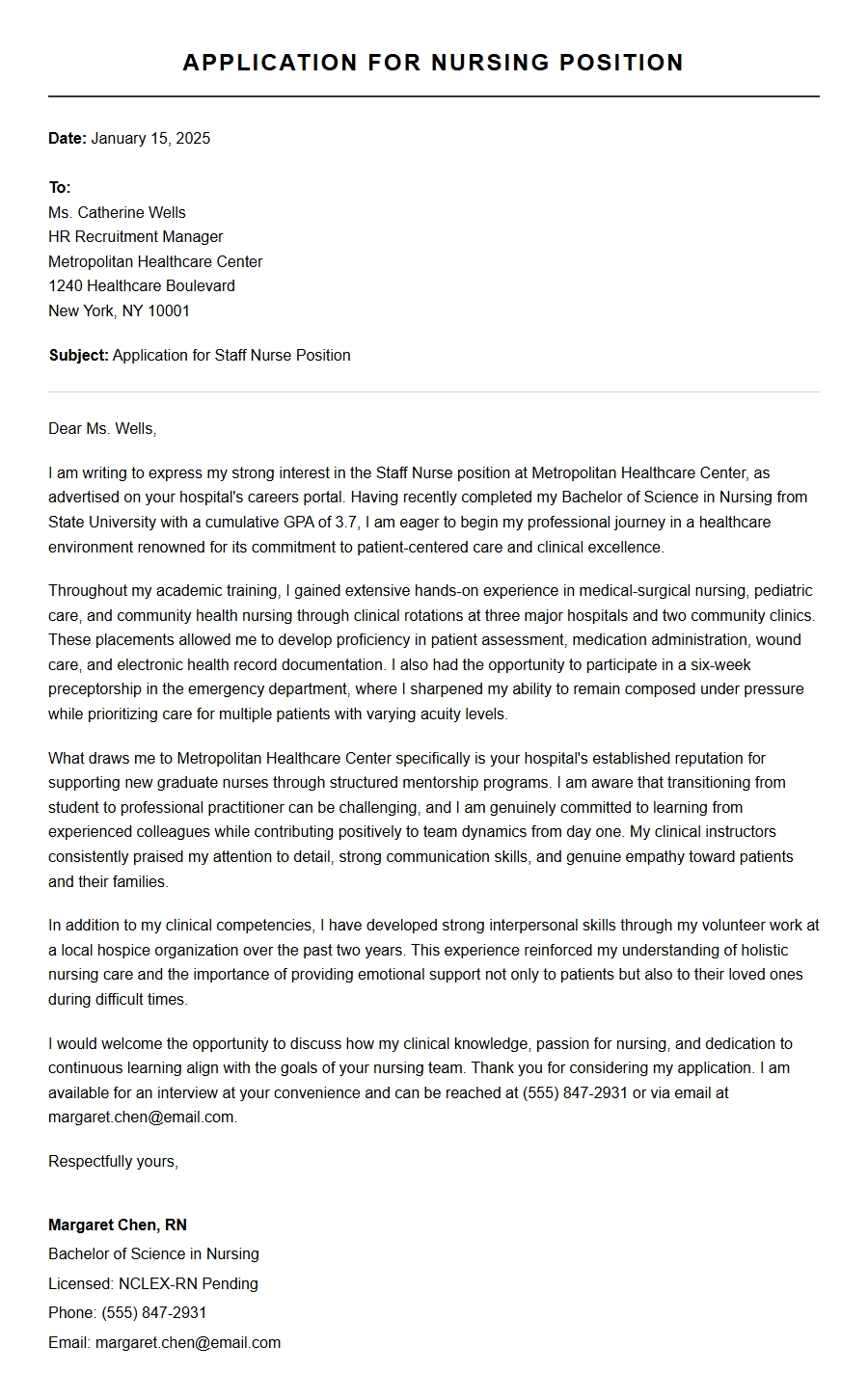 Fresh Graduate Nursing Application Letter
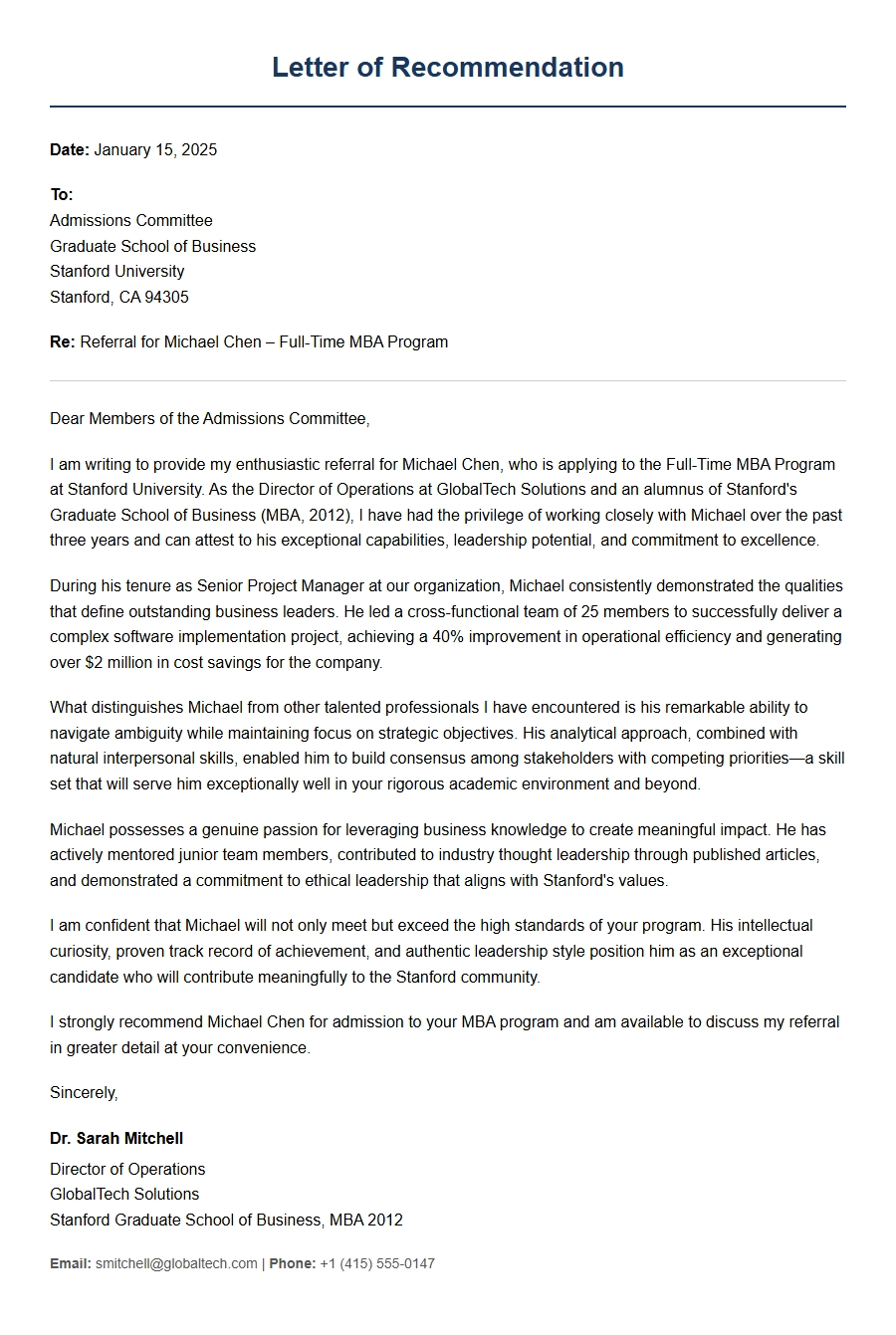 University Alumni Referral Email Cover Letter
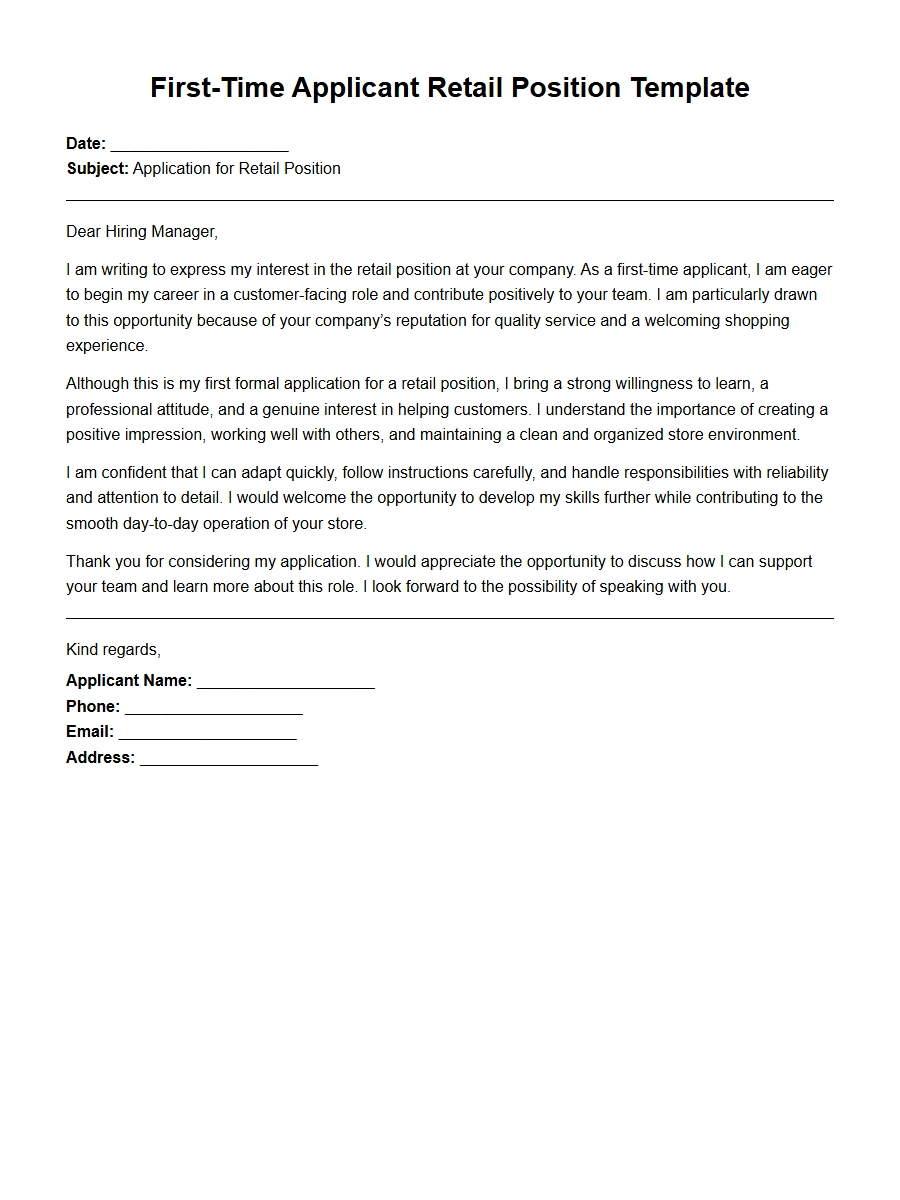 Cover Letter Template for First-Time Retail Applicant