Staring at a blank page when you need to write a professional letter can feel paralyzing—but the right sample turns that anxiety into a confident, polished draft in minutes. For investment banking analyst roles, that pressure is even higher. You're competing against hundreds of sharp, driven candidates who all have the same basic qualifications. A generic intro won't cut it. But a well-structured letter sample that you adapt carefully? That's your foundation.
Why a sample is your smartest starting point
Let's be clear up front: using a sample isn't cheating. It's a smart, time-saving strategy. Think of it as a blueprint. A good sample gives you the professional correspondence framework—the correct business letter format, the right salutation and closing, and the expected tone in writing. You don't have to reinvent the wheel. Ever seen a cover letter that felt like it was written by a robot? That happens when someone copies a sample without thought. Your job is to take the structure and fill it with your story, your skills, and your specific interest in the bank.
Investment banking is a relationship-driven business. Your cover letter is often your first handshake. It needs to be firm, brief, and professional. The right letter template ensures you won't accidentally come off too casual or too stiff. (Category: Professional Correspondence / Finance Cover Letters).
How to choose the right sample for IB
Not all cover letter examples are equal. A general template written for a marketing role won't help you here. You need a sample designed for junior finance roles. Look for ones that naturally include financial analysis, deal experience, or technical skills like valuation. A good customizable letter will let you swap in your own deal experience while keeping the letter structure tight and focused. Avoid fluffy paragraphs about being a 'hard worker' or a 'quick learner.' Those are table stakes. Show them you understand the job.
Tailoring the sample without losing your voice
Start with the opening paragraph. Don't just swap the bank's name. Do your homework. Mention a specific deal the bank recently closed or a sector they dominate. This immediately signals you didn't just copy a template—you researched them. "I was particularly impressed by your advisory role in the X acquisition, and I want to contribute to similar high-impact work." That's far stronger than "I am writing to apply for the analyst position."
In the body, show your technical skills through specific examples. "I built a DCF model that supported a $50 million fundraising round." Numbers speak louder than adjectives. Keep your language confident but grounded. Avoid jargon you cannot explain in an interview. Your cover letter should feel like a strong letter of recommendation—except you are the one writing it, and you have everything to prove.
Common mistakes that sink IB applications
Mistakes in a proofreading letter stage can damage your credibility. A single typo suggests you lack attention to detail—a fatal flaw in banking. Here are a few specific mistakes to avoid:
Using outdated salutations. "To Whom It May Concern" tells the reader you did no research. Find a name on LinkedIn or use "Dear [Bank Name] Investment Banking Team." Also, don't ignore letterhead design. Keep it clean: your name, phone, email, and LinkedIn at the top. No graphics, no fancy fonts. If you are emailing it, consider the digital letter format. A PDF is standard for attachments. If you paste it into the email body, strip all formatting to keep it readable.
Referral emails can change the game. If you have an internal connection, a specific university alumni referral email cover letter might be more effective than a cold application. It changes the dynamic entirely.
For roles requiring extreme precision, like in healthcare, clarity is everything. Our pharmacy technician prescription handling cover letter shows how specific you can get with your examples—a strategy that works well for banking, too.
If you're coming from a non-traditional background, like the military, you'll want a guide that helps translate your experience. Our military transition civilian cover letter guide offers strategies that work well for high-discipline fields like investment banking.
Use the sample as a springboard, not a crutch
A sample gets you past the blank page. It saves you time and establishes a solid structure. But the best letters feel both professional and deeply personal. They sound like a capable human being wrote them—someone a managing director would actually want on their team. Write enough of these, and the process becomes second nature. You will stop staring at blank pages and start building your career.
Writing Examples
Investment Banking Analyst Cover Letter Tips
Formal Cover Letter for Boutique Bank
[Your Name] [Address] | [Phone] | [Email]
[Date]
[Hiring Manager Name] [Bank Name] | [Address]
Dear [Hiring Manager],
I am writing to express my strong interest in the Junior Investment Banking Analyst position at [Bank Name]. Having followed your firm’s work in mid-market M&A transactions, I am impressed by your focus on technology and healthcare deals. During my internship at a regional investment bank, I supported three deal teams through financial modeling, due diligence, and pitch book preparation. For one acquisition, I built a DCF model that highlighted synergies, directly influencing the final offer price.
I am proficient in Excel, Bloomberg, and financial statement analysis, and I hold the CFA Level I candidacy. My ability to work under tight deadlines and communicate complex analysis clearly will allow me to contribute immediately. I would welcome the opportunity to discuss how my skills align with [Bank Name]’s deal pipeline.
Thank you for taking the time to speak with me last week about the junior analyst role at [Bank Name]. Our conversation about cross-border M&A in Latin America confirmed that your team’s international focus aligns perfectly with my background. As a double major in finance and Spanish, I bring language skills and cultural fluency that will add value to your transactions.
During my previous internship, I prepared comparable company analyses and leveraged my knowledge of local market regulations to help the team evaluate a target in Chile. I am eager to apply that experience at [Bank Name] while learning from your experienced professionals. I have attached my resume and a sample financial model I created during my coursework.
Thank you again for guidance. I look forward to the next steps.
Best regards, [Your Name]
Transferable Skills Cover Letter (Career Changer)
[Your Name] [Address] | [Phone] | [Email]
[Date]
[Hiring Manager] [Bank Name]
Dear [Hiring Manager],
As a former valuation analyst at a boutique advisory firm, I am seeking to transition into investment banking through the junior analyst role at [Bank Name]. My three years of experience building LBO models, conducting industry research, and preparing client materials have given me a strong foundation for IBD. One highlight: I led the valuation for a $200 million acquisition, producing a sensitivity analysis that changed the offer structure.
I have also completed the Wall Street Prep financial modeling course and currently study for the GMAT to strengthen my quantitative background. My ability to interpret financial statements and manage multiple work streams will enable me to hit the ground running. I understand the demanding nature of banking and am ready to commit fully.
I would be thrilled to bring my analytical rigor to your team. Thank you for your consideration.
Sincerely, [Your Name]
Cover Letter Highlighting Summer Internship
[Your Name] [Email] | [Phone]
[Date]
[Hiring Manager] [Bank Name] | [Address]
Dear [Hiring Manager],
I am applying for the Junior Analyst position at [Bank Name] after completing a highly successful summer internship in corporate finance. During that program, I supported the M&A team on two live deals — a divestiture and an acquisition. My responsibilities included running weekly valuation updates, drafting sections of the CIM, and maintaining the data room.
I also developed a PowerPoint template for investor presentations that reduced preparation time by 20%. This efficiency gain was recognized by the managing director. I am now looking to turn my internship experience into a full-time role where I can continue to learn and contribute. I am particularly drawn to [Bank Name]’s strength in the energy sector.
Please find attached my resume and transcript. I would love to speak further about my qualifications.
Best regards, [Your Name]
Quant Focus Cover Letter (STEM Background)
[Your Name] [Phone] | [Email]
[Date]
[Hiring Manager] [Bank Name]
Dear [Hiring Manager],
Combining my degree in applied mathematics with a minor in economics, I bring a quantitative perspective to the Junior Analyst role. At [Bank Name], I know that complex financial models require precision and creativity — skills I honed through research and coursework. In a team project, I built a Monte Carlo simulation to price convertible bonds, achieving a 95% confidence interval that matched market data.
I also interned at a fintech startup where I automated data extraction using Python, saving 10 hours per week for the analytics team. I am eager to apply these skills to your deals, especially in industries like financial sponsors or tech. I am comfortable with Excel VBA and SQL and am currently learning Bloomberg terminal shortcuts.
I am confident that my technical skills and work ethic will make me a valuable addition to your analyst class.
I am writing to apply for the Junior Analyst role at [Bank Name], drawn by the firm’s premier M&A franchise and its commitment to analyst development. Having attended your campus information session and spoken with two current analysts, I admire the hands-on deal experience and the mentorship culture.
My academic background in finance and accounting, combined with a summer internship at a middle-market bank, has prepared me to contribute immediately. There, I helped with merger model builds, produced industry snapshots for client pitches, and assisted with QoE adjustments. My performance earned me the highest rating in my intern cohort.
I am excited about the opportunity to work on large, complex deals at [Bank Name] and to learn from your team. I am diligent, detail-oriented, and ready to put in the hours necessary for success.
Thank you for considering my application.
Best regards, [Your Name]
Cover Letter with Deal Experience Table
[Your Name] [Phone] | [Email]
[Date]
[Hiring Manager] [Bank Name]
Dear [Hiring Manager],
I am eager to join [Bank Name] as a Junior Analyst. During my internship, I supported the following transactions:
Deal Type
Role
Value
Buy-Side M&A
Financial modeling, due diligence
$150M
Sell-Side Advisory
CIM drafting, data room management
$80M
Refinancing
Capital structure analysis
$200M
These experiences taught me to manage tight deadlines, produce accurate work, and collaborate with senior bankers. I am proficient in LBO and DCF modeling. I believe my hands-on deal exposure, coupled with strong communication skills, will allow me to contribute meaningfully at [Bank Name].
I have attached my resume and a sample pitch book I co-created. I look forward to the opportunity to interview.
Sincerely, [Your Name]
Cover Letter for Diversity Program Pipeline
[Your Name] [Email] | [Phone]
[Date]
[Recruiting Team] [Bank Name] – Diversity Program
Dear Recruiting Team,
As a candidate for the [Bank Name] Diversity Junior Analyst Program, I am excited to bring my unique perspective to investment banking. Growing up in a first‑generation immigrant household, I learned resilience and adaptability, skills that are essential in high‑pressure banking environments.
Academically, I have maintained a 3.8 GPA while serving as president of the Finance Club. Last summer, I interned at a local investment bank where I contributed to two live deals — one in healthcare and one in consumer retail. I compiled competitive landscape analyses, updated comp sheets, and attended client calls. My attention to detail was recognized by my supervisor.
I believe diversity of thought and background strengthens deal teams. I am eager to bring my problem‑solving abilities and cultural fluency to [Bank Name] and to support clients globally.
Thank you for your time.
Best regards, [Your Name]
Short and Direct Cover Letter (Online Application)
[Your Name] [Phone] | [Email] | [LinkedIn]
[Date]
[Hiring Manager] [Bank Name]
Dear [Hiring Manager],
I am applying for the Junior Investment Banking Analyst position at [Bank Name] because I am ready to contribute to your top‑ranked M&A team. With a strong foundation in financial modeling and a proven track record of managing multiple workstreams, I can step in from day one.
Key qualifications:
Completed 2 internships: one in equity research, one in investment banking
Built three DCF models and one LBO model during internships
Proficient in Excel, FactSet, and PowerPoint
Dean’s List all semesters, CFA Level I candidate
I am passionate about financing and advisory work. My resume and a writing sample are attached. I appreciate your consideration.
Sincerely, [Your Name]
Cover Letter Emphasizing Soft Skills & Team Fit
[Your Name] [Email] | [Phone]
[Date]
[Hiring Manager] [Bank Name]
Dear [Hiring Manager],
When I spoke with [Name] from your analyst class, she highlighted the collaborative culture at [Bank Name] — a quality I value deeply. I am not only strong in financial analysis but also excel at building trust with team members and clients. In a recent case competition, I led a diverse team of five to a second‑place finish through structured brainstorming and active listening.
Technically, I have a solid grasp of valuation methodologies and am comfortable creating integrated financial models. I also pride myself on being proactive: during an internship I suggested using a waterfall chart for a board presentation, which the team adopted. My goal is to be the analyst everyone wants on their deal team because I communicate clearly and deliver error‑free work.
I would be honored to bring my energy and dedication to [Bank Name]. Thank you for your time.
 Recent College Student Cover Letter for Internship
 Entry Level Teacher Cover Letter Examples
 Career Changer Administrative Assistant Cover Letter
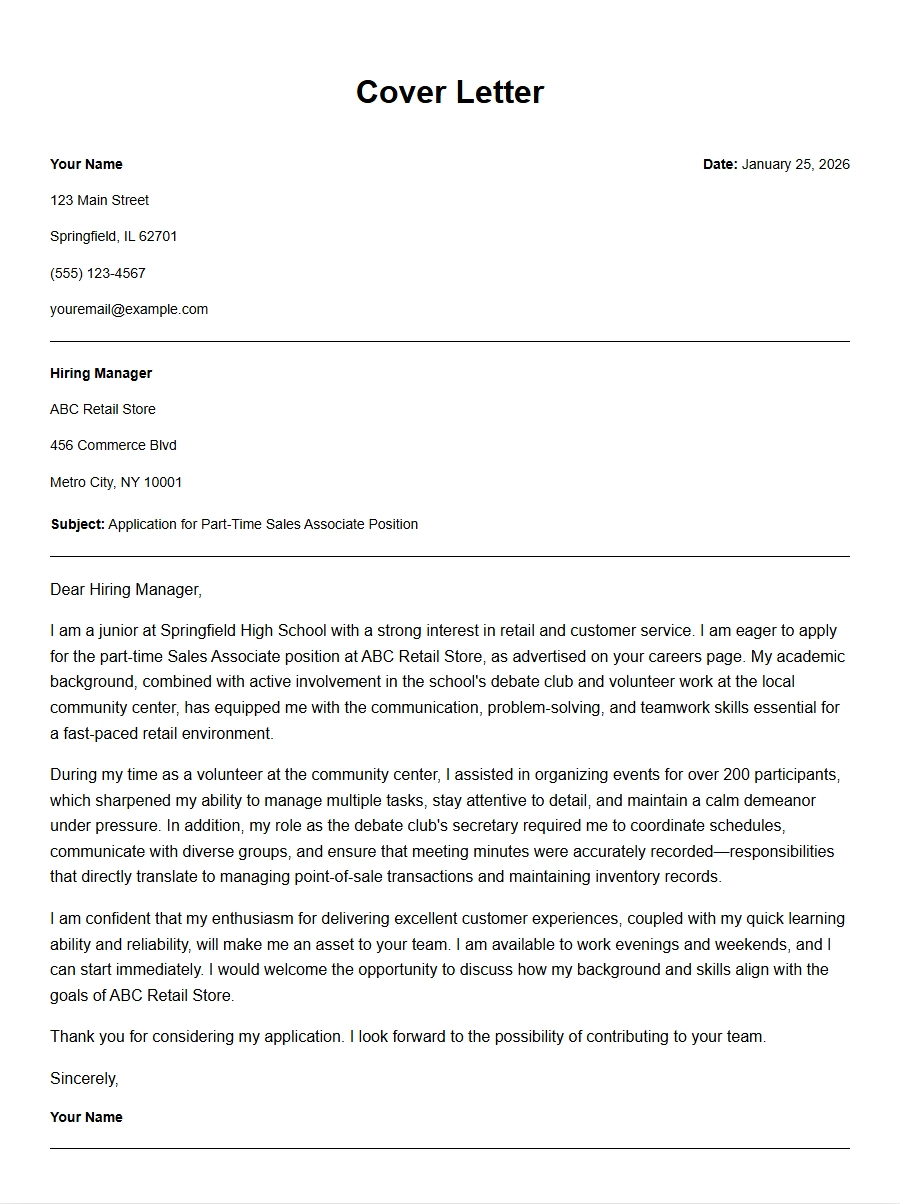 High School Student Part Time Job Cover Letter
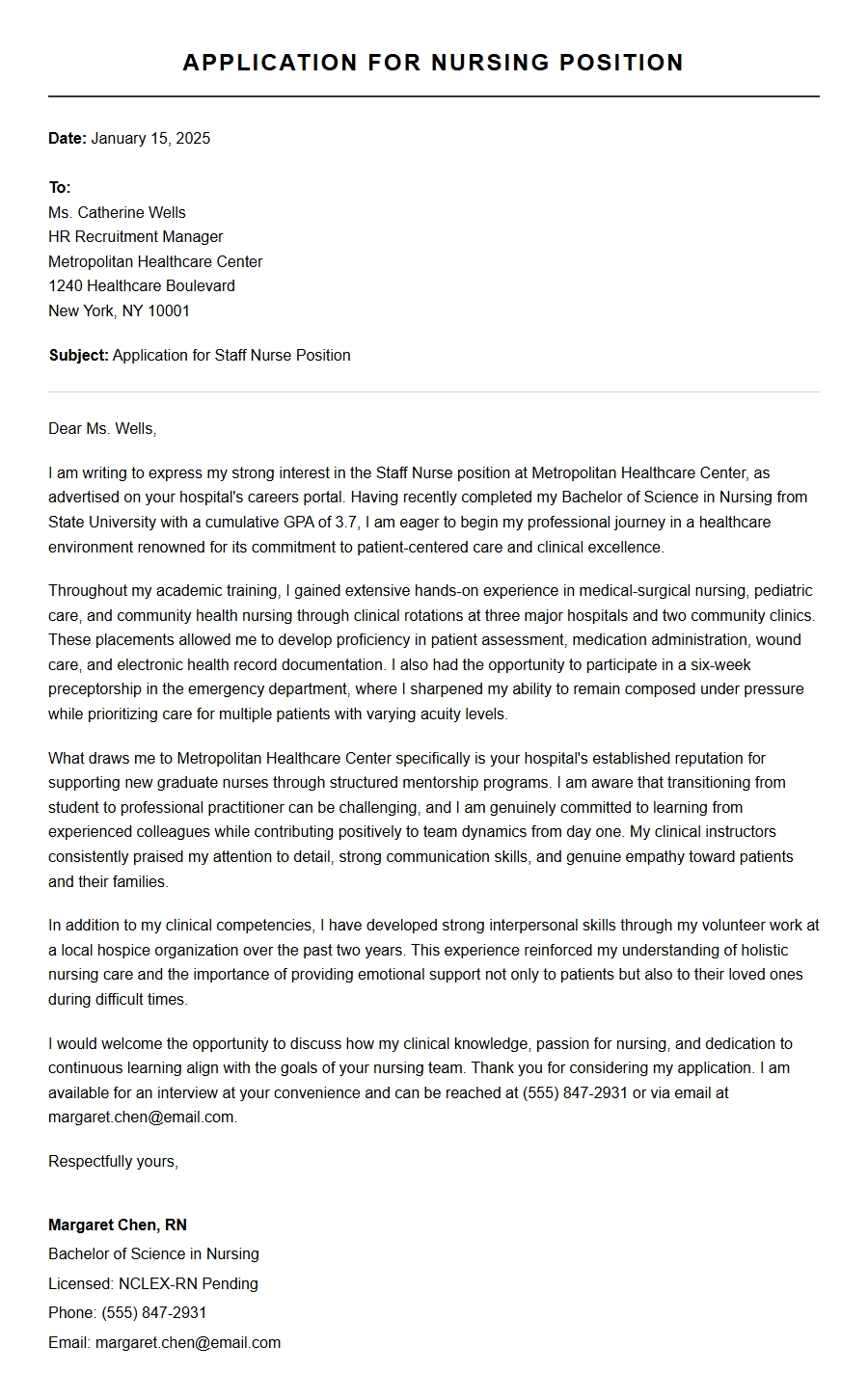 Fresh Graduate Nursing Application Letter
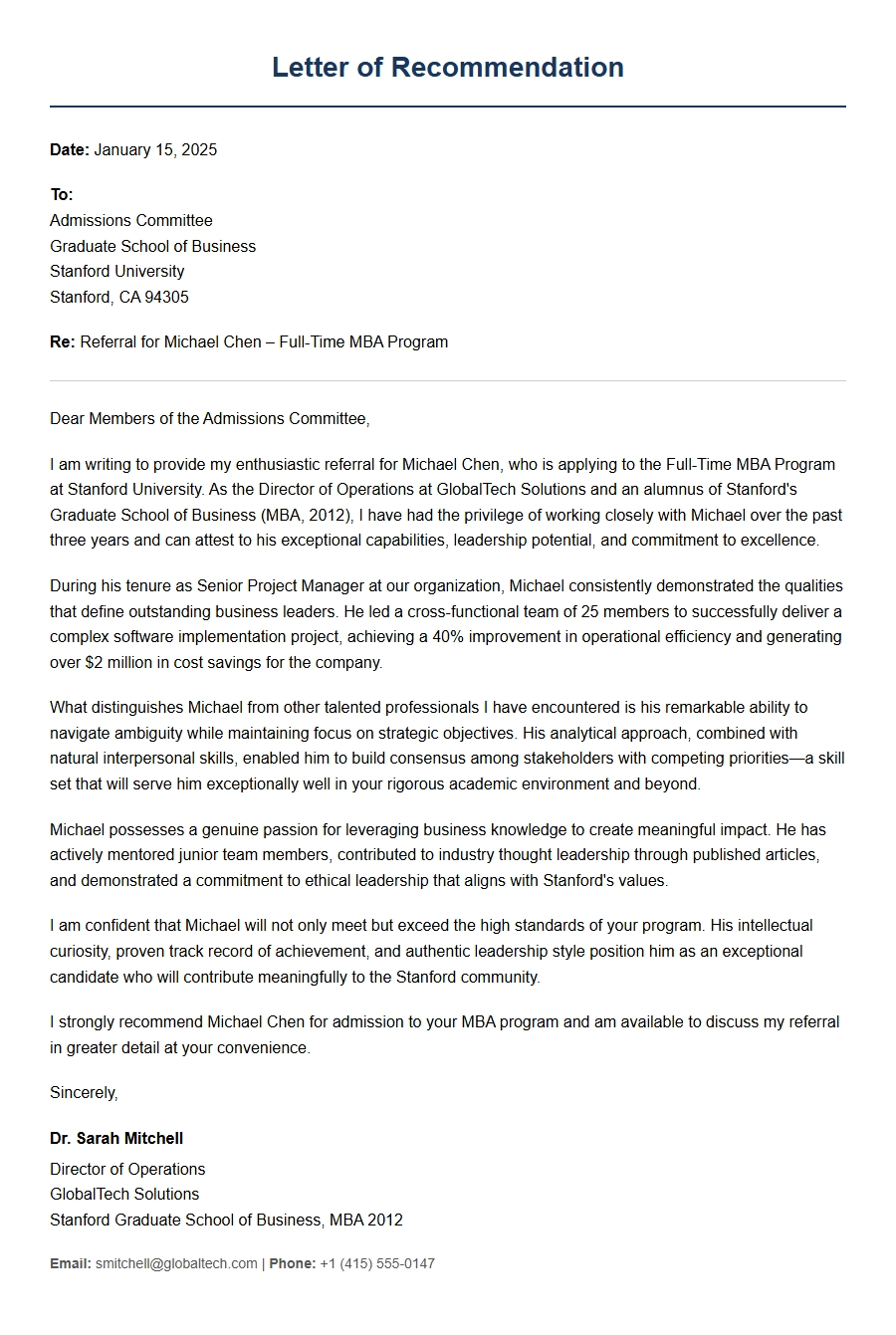 University Alumni Referral Email Cover Letter