You're staring at a blank screen, and the clock is ticking. Maybe you need to resign from your retail job today, but you haven't written a formal letter in years. Or perhaps you want to leave on good terms, but you're not sure what to say. That tension is real—and the right sample can cut through it in minutes.
Using a professional resignation letter example for retail staff isn't cheating. It's a smart shortcut. A good sample gives you structure, the right tone, and key phrases you can adjust. It also helps you avoid awkward, outdated language that makes you sound like a robot. Think of it as a skeleton you can dress with your own voice.
Category: resignation letter templates
Resignation letters in retail have their own flavor. You're often dealing with shift supervisors, store managers, or district leads. The setting is fast-paced, and the relationship is usually more informal than in a corporate office. Still, you want to show respect and professionalism. A generic template written for an accountant might feel stiff in a retail context. That's why picking a sample tailored to your industry matters.
What to look for in a retail resignation letter sample
A good sample should have a clear structure: a proper salutation, a straightforward statement of resignation, your last working day, a thank-you note, and a polite closing. The tone should be warm but not overly chummy. "Dear [Manager's Name]" works fine. Avoid "To Whom It May Concern"—it's too formal and impersonal.
Also, pay attention to the letter format. If you're emailing your resignation, skip the letterhead design and go with a clean subject line like "Resignation – [Your Name]." If you're printing it, a simple business letter format with your name and date at the top is enough. Your store probably doesn't expect fancy stationery.
How to customize a sample without losing your voice
The mistake most people make is copying a sample word-for-word. That usually sounds hollow. Instead, start with the sample's skeleton, then swap out generic phrases for your own experience. For example, if the sample says "I have enjoyed my time here," you can write: "I've learned a lot from the team on the floor, especially the weekend crew." That's specific and genuine.
Your opening paragraph needs to be clear and direct. Say you're resigning, and state your last day. Avoid vague openings like "I am writing to inform you of my decision to move on." That wastes space. Get to the point: "Please accept this letter as my formal resignation from [Store Name]. My last day will be [date]."
Next, add a sentence or two about what you appreciated. Maybe it's the flexible schedule, the customer service training, or the friendships you made. Keep it honest. If you hated the job, just say you're grateful for the opportunity—that's still professional.
Finally, offer to help with the transition. In retail, that could mean training a replacement or helping out until your last shift. It shows you're thinking about the store's needs, which strengthens your professional correspondence and leaves a good impression.
Common mistakes to avoid
One big error is ignoring the difference between a printed letter and an email. If you're emailing, don't paste your entire letter into the body with no subject line. Use a clear subject, a polite greeting, and your full name in the signature. For a paper letter, check your salutation and closing. "Sincerely" is safe. "Best regards" works too. Avoid "Yours truly" unless you're writing to royalty.
Another mistake is skipping proofreading. A typo in a resignation letter can make you look careless. Read it aloud or ask a friend to glance at it. Proofreading letter content is quick but saves embarrassment.
Also, don't over-explain your reason for leaving. You don't need to list grievances. If you're leaving for a better job, just say you've accepted another position. If it's personal, keep it vague. The letter is a formal notice, not a therapy session.
Your tone should match your relationship with your manager. If you're close, you can be slightly more personal. If you've barely spoken, keep it cordial and professional. Tone in writing is like the volume on a radio—too loud and you're rude, too quiet and you're forgettable. Aim for warm and respectful.
And remember, your digital letter format matters. Use a standard font like Arial or Calibri, size 11 or 12. No fun colors or clip art. Keep it simple.
Use the sample as a springboard
The best resignation letters feel both professional and personal. A sample gives you the safety net, but your own words make it real. Practice writing a few versions. After the second try, you'll feel faster.
Please accept this letter as formal notification of my resignation from the position of Sales Associate at Downtown Retail. My last day of work will be May 29, 2025, providing two weeks’ notice as required by company policy.
I have appreciated the opportunity to work with the team and serve our customers. To ensure a smooth transition, I have outlined my remaining tasks:
Complete daily inventory counts through May 28
Finalize customer exchanges and returns on my register
Train cover associate on back‑stock procedures
I am committed to making this change as seamless as possible. Thank you for the support and training I received during my employment.
Sincerely, Jordan Adams
Resignation Due to Relocation
Date: June 3, 2025
To: HR Manager, CityMall Retail
I am writing to formally resign from my role as Retail Sales Lead, effective June 17, 2025. My family is relocating to another state, making it necessary for me to leave this position.
I have greatly valued my time at CityMall and appreciate the professional growth I’ve experienced. Below are key details regarding my departure:
Item
Details
Last Working Day
June 17, 2025
Notice Period
2 weeks
Pending Handovers
Shift schedules, keyholder duties
I will ensure all shift logs and inventory records are up‑to‑date before my departure. Thank you for understanding this personal change.
Best regards, Maria Lopez
Part-Time Student Resignation
Date: April 22, 2025
To: Assistant Store Manager, U‑Mart
I am writing to resign from my part‑time position as Retail Associate, effective May 6, 2025. Increased academic commitments and exam schedules prevent me from continuing my current hours.
I would like to thank you for the flexible scheduling that helped me balance school and work. My remaining shifts are as follows:
April 24 – 4:00 pm to 9:00 pm
April 28 – 10:00 am to 3:00 pm
May 2 – 5:00 pm to 9:00 pm
I will complete all assigned tasks during these shifts and return my uniform on my last day. I appreciate the opportunity and skills I gained here.
Yours sincerely, Chris Tran
Career Change Resignation
Date: March 10, 2025
To: Store Director, Fashion Hub
Please accept this letter as my resignation from the Retail Assistant position, effective March 24, 2025. I have decided to pursue formal education in graphic design, and this career change requires my full attention.
I am grateful for the mentorship and customer service skills I developed at Fashion Hub. To assist with the transition, I have prepared a task list for my replacement:
Review visual merchandising guidelines
Complete weekly stock replenishment routine
Learn POS end‑of‑day procedures
I will train the new hire during my final two weeks if you schedule them promptly. Thank you for the wonderful experience.
Sincerely, Alex Kim
Store Manager Three-Week Notice
Date: July 1, 2025
To: Regional Manager, GreenLeaf Grocers
I hereby resign from my position as Store Manager, effective July 22, 2025. I am providing three weeks’ notice to ensure a thorough handover of management responsibilities.
During this transition period, I will focus on:
Area
Actions Planned
Staff Scheduling
Finalize August schedule
Inventory
Conduct final audit
Reports
Complete monthly sales report
Training
Mentor assistant manager
I appreciate the trust you placed in me to lead the team. Thank you for the opportunities and support over the past three years.
Best regards, Patricia Nguyen
Resignation for Personal Health Reasons
Date: August 12, 2025
To: Human Resources, HealthStyle Fitness Retail
Please accept this letter as my resignation from the position of Sales Consultant. Due to ongoing medical concerns, I must step down effective August 19, 2025. I am unable to provide the full two‑week notice period, and I apologize for the short timeline.
I have appreciated the accommodating environment you provided. Below are current pending duties I will complete before leaving:
Return key fob and discount card to HR
Submit final timesheet
Leave detailed notes for my assigned accounts
Thank you for understanding my situation. Working here has been a positive experience.
Sincerely, Derek Brown
Cashier Resignation with Shift Handover
Date: September 5, 2025
To: Front‑End Supervisor, QuickMart
I am resigning from my cashier position, with my last day being September 19, 2025. I am moving to a full‑time job outside retail.
To ensure a smooth handover, I will provide the following documentation:
Item
Status
Daily cash reconciliation sheets
Current up to Sept 4
Customer complaint log
Need final entry on 9/19
Register drawer keys
To be returned on last day
I will train the evening cashier on lottery machine procedures during my remaining shifts. Thank you for the flexibility and the team atmosphere.
Best wishes, Linda Garcia
Retail Assistant Thank You & Training
Date: October 10, 2025
To: Store Owner, Boutique Bliss
I am writing to formally resign from my Retail Assistant role, effective October 24, 2025. I am moving to a different city and regretfully must leave this wonderful team.
I want to express my heartfelt gratitude for the training and growth opportunities. During my notice period I will:
Complete a training binder for new hires
Update the opening/closing checklist
Assist in training the incoming assistant
I will also leave a list of regular customers with their preferences. Thank you for making this job so fulfilling. I will always remember the warm atmosphere at Boutique Bliss.
Sincerely, Sarah Johnson
Resignation for Better Opportunity
Date: November 1, 2025
To: Store Manager, TechZone Electronics
I am resigning from my position as Sales Representative to accept a role in corporate retail management. My last day will be November 15, 2025.
This decision was difficult as I have enjoyed working with your team. I have prepared a transition document covering:
Topic
Content
Customer follow‑ups
List of pending orders
Product knowledge
Top‑selling items cheat sheet
Floor procedures
Break schedule and zone rotation
I appreciate the leadership lessons you provided. I am ready to assist in interviewing my replacement during the final week.
Yours faithfully, Ryan Patel
Seasonal Staff End-of-Contract Resignation
Date: December 26, 2025
To: Seasonal Coordinator, Holiday Mart
As my seasonal contract concludes at the end of December, I am writing to confirm my resignation from the position of Seasonal Sales Associate. My last scheduled shift is December 31, 2025.
I have enjoyed being part of the holiday rush and learning retail operations. Before my departure I will ensure:
All clearance items are properly tagged
My assigned register is balanced
Returns are processed according to policy
I will also return my name badge and vest on the final day. Thank you for the temporary opportunity; it gave me valuable experience in customer service.
 Polite Resignation Email for Remote Employees
 Short Resignation Letter for Contractor Position
 Teacher Resignation Letter Example
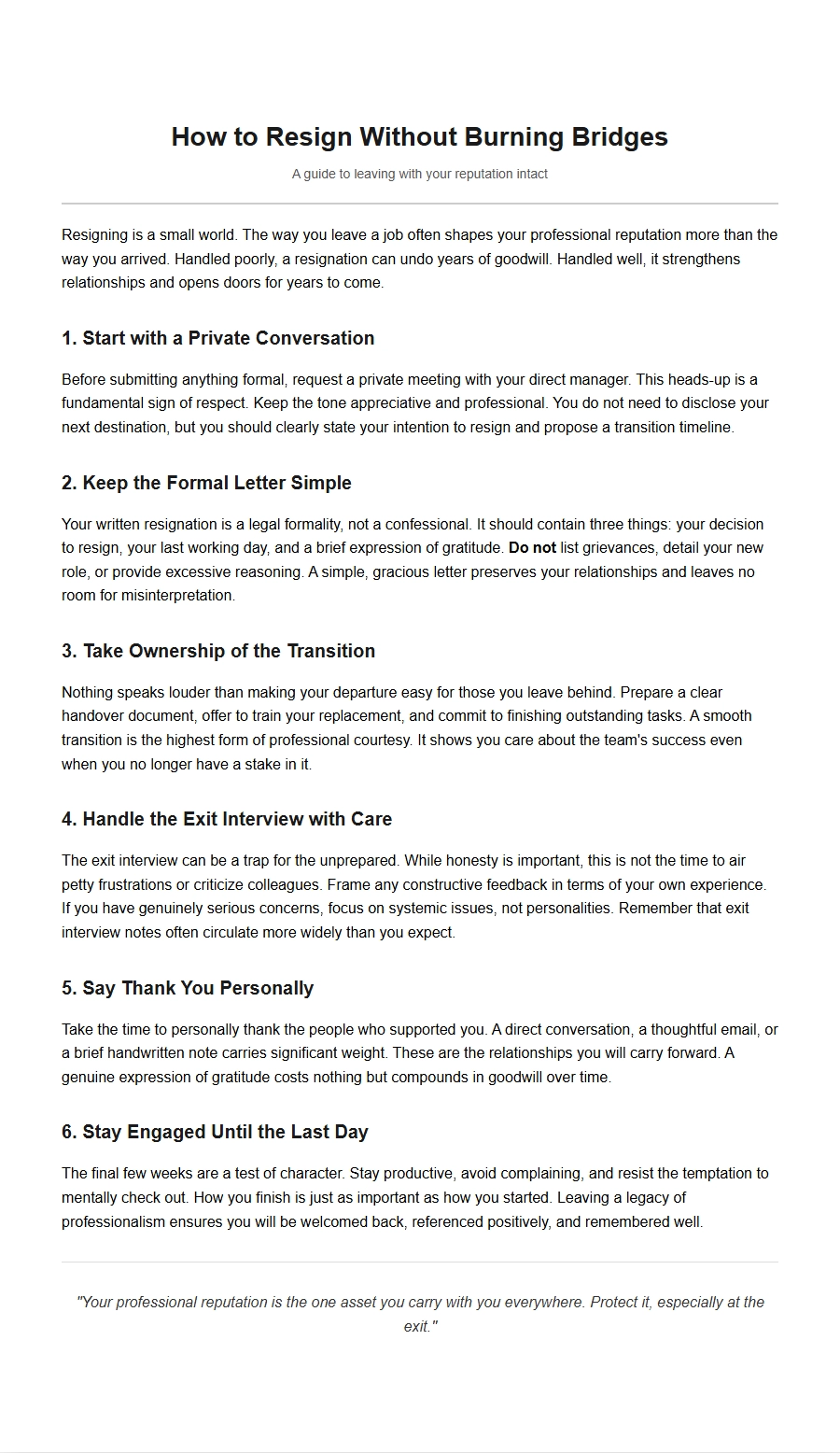 How to Resign Without Burning Bridges
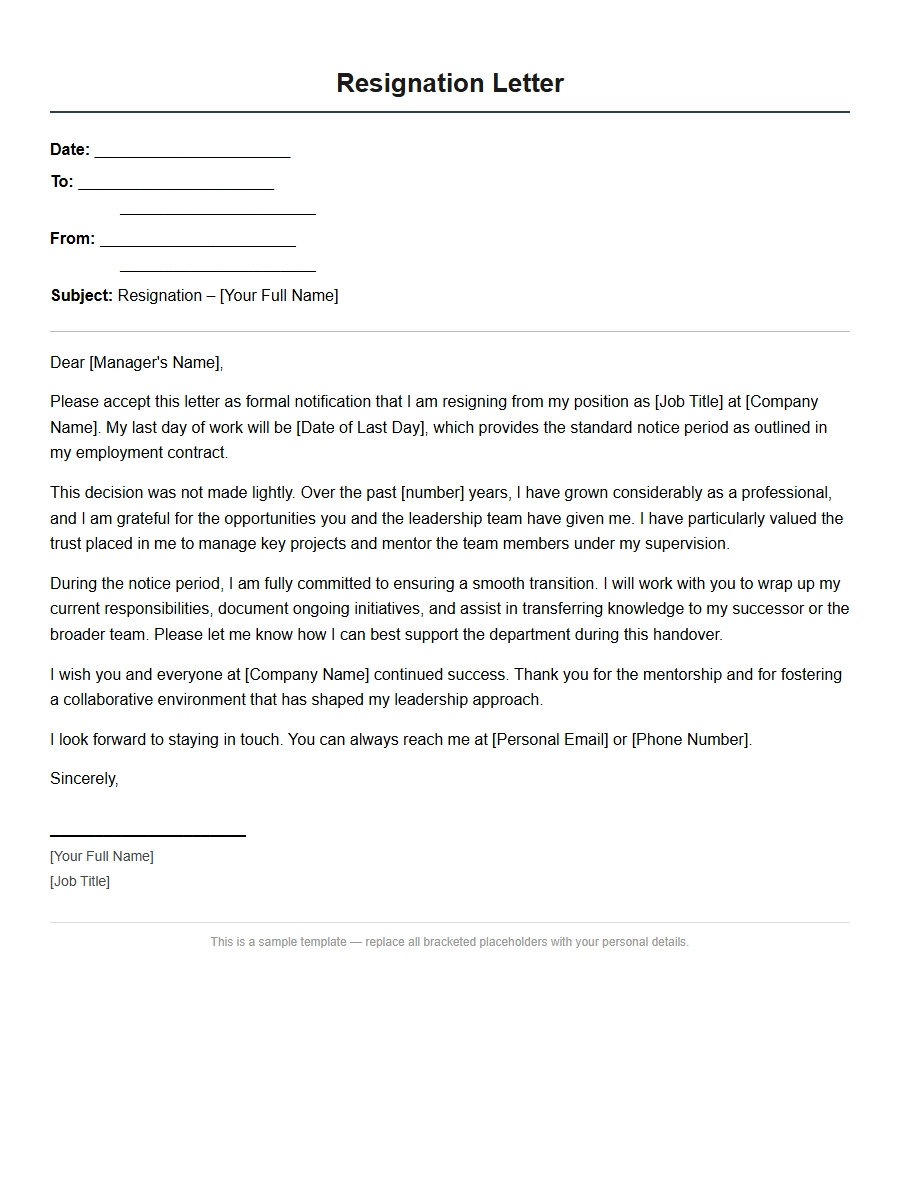 Formal Resignation Letter Sample for Manager
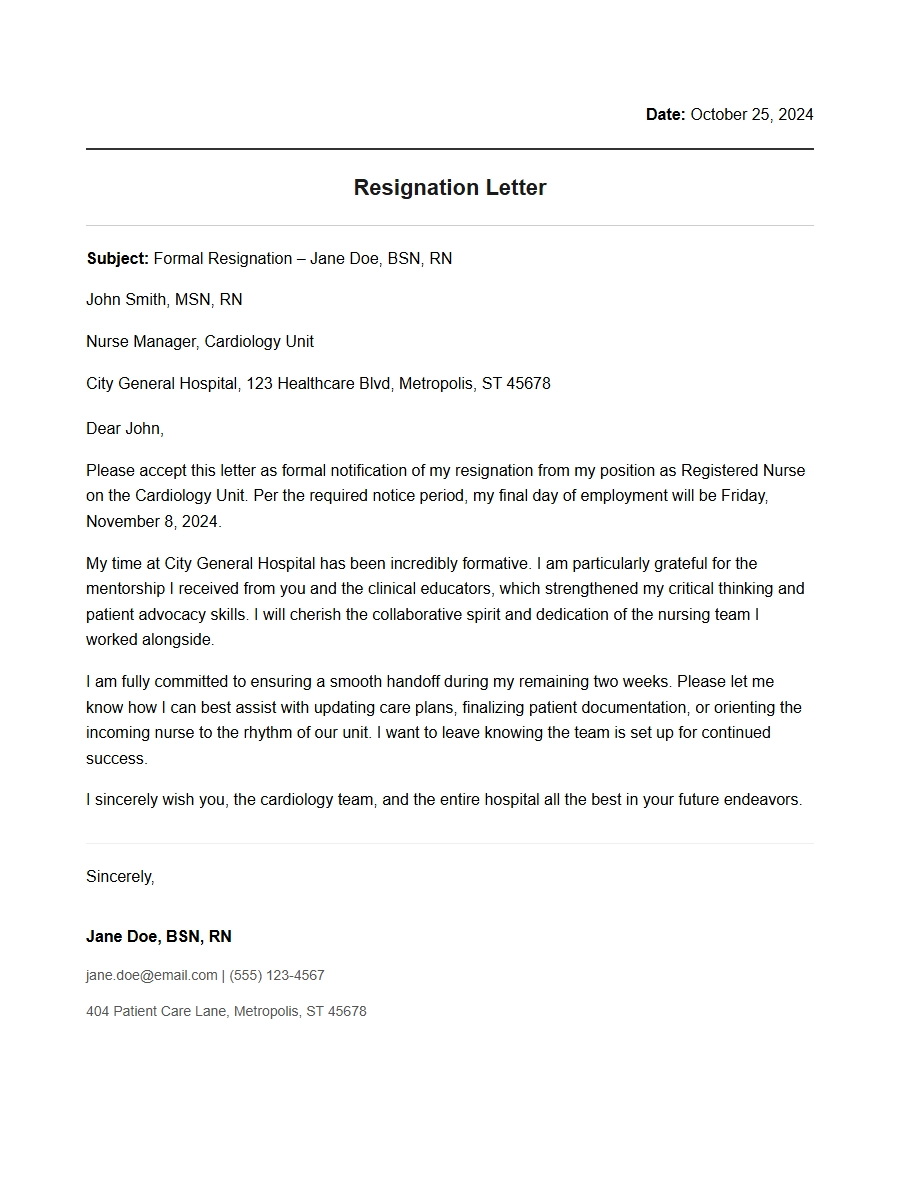 Nurse Resignation Letter with 2 Weeks Notice