You need to send a payment terms proposal letter to a client, but the blank page is staring back at you. Maybe you’re asking for a deposit upfront, negotiating net‑30 versus net‑60, or trying to standardize your fees. The pressure to get it right—without sounding pushy or unprofessional—can freeze even experienced freelancers and small business owners.
Using a well‑crafted sample isn’t cheating. It’s a smart shortcut. A good letter template gives you the structure, tone, and key phrases you need, leaving you room to personalize the details. Think of it as a map: you still drive the car. Whether you’re a consultant, agency owner, or independent contractor, a payment terms proposal letter helps you set clear expectations before work begins.
Category: Business Proposal Letters
Why a payment terms proposal letter matters
This isn’t just a polite request for money. It’s a piece of professional correspondence that protects both parties. When you spell out due dates, late fees, and acceptable payment methods, you reduce misunderstandings and awkward follow‑ups. A formal writing tip: treat this letter as seriously as you would a contract. It shows you’re organized and that you value your time.
You’ll often find yourself writing one when onboarding a new client, renegotiating an existing agreement, or responding to a request for proposal. The business letter format you choose should match the relationship. A long‑time client may appreciate a semi‑formal tone; a new corporate account might expect more formality.
How to choose the right sample for your situation
Not all payment terms letters are the same. Are you proposing a one‑time project fee or a recurring retainer? Is the client a small business or a large corporation? Look for a sample that mirrors your industry and the complexity of your arrangement. For instance, if you’re offering consulting services, our consulting engagement proposal letter can give you a strong foundation. If you work with insurance coverage providers, adapt the framework from our insurance coverage provider proposal letter.
Once you pick a template, don’t copy it word for word. Read it aloud and tweak the language until it sounds like you. If the sample says “We respectfully request,” but you normally write “I’d appreciate,” go with your natural tone. The goal is to sound professional, not robotic. Your client should feel they’re corresponding with a real person, not a form letter.
Start by rewriting the opening paragraph. Hook them with a specific reason for the letter—maybe a recent project success or a new service offering. Then smoothly transition into your proposed terms. Avoid outdated salutations like “To Whom It May Concern” unless you truly don’t know the recipient. When you do know a name, use “Dear [First Name]” for a semi‑formal feel.
Common mistakes to avoid
One frequent error is ignoring the difference between email and printed letters. A digital letter format usually includes a clear subject line and a brief context in the body before the terms. For printed letters, use proper letterhead design with your company name, address, and contact info. Another mistake: burying the due date or late fee in a dense paragraph. Highlight it with a short sentence or bold text—but use bold sparingly.
Also, pay attention to proofreading letter etiquette. A typo on a payment date can cause days of confusion. Read it once for spelling, once for numbers, and once for tone. If possible, have someone else glance at it.
Tailoring the opening and closing
The first sentence should answer “why now?” For example: “Following our discussion last week, I’m writing to confirm the payment schedule for the upcoming project.” The closing should be clear on next steps—ask for a signed agreement or a reply confirming acceptance. End with a professional salutation and closing like “Best regards,” followed by your name and contact info.
Remember that tone in writing sets expectations. If you ask for net‑15 terms, your language can be direct but polite. If you’re proposing a small increase, soften it with a brief explanation of added value.
Use samples as a springboard, not a crutch
Every good payment terms proposal letter reflects the writer’s personality and business reality. The more you practice customizing samples, the faster the process becomes. Soon you’ll have a mental library of openings, closings, and phrasing that works for you. Keep a few versions handy—one formal, one casual—and update them as your rates or policies change. The key is to write with clarity and respect, so both you and your client know exactly what to expect.
Extra Samples
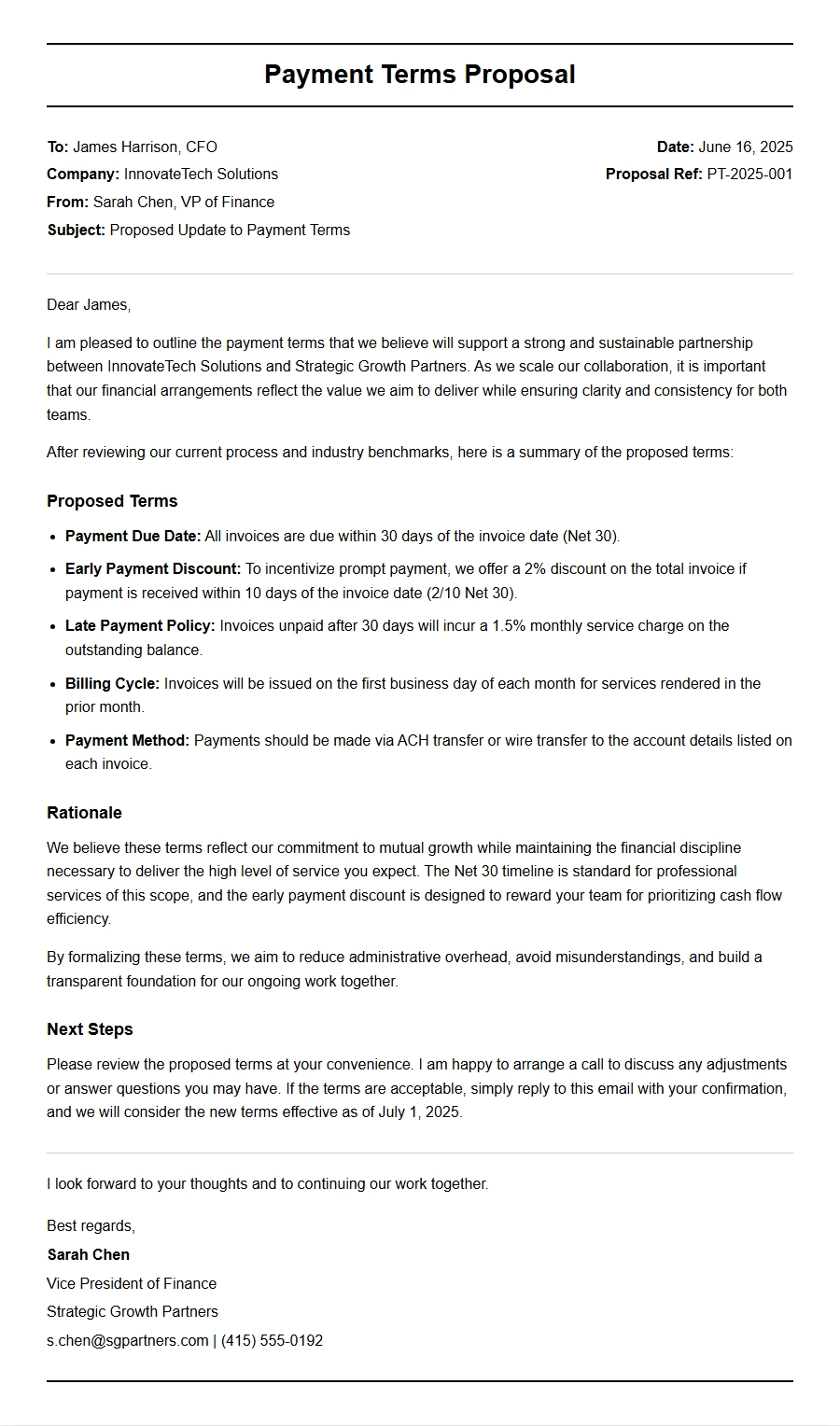
How to Draft a Payment Terms Proposal Letter
Standard Net 30 Payment Terms Proposal
Dear Client,
We are pleased to propose the following payment terms for our services under the agreement dated March 1, 2025. All invoices will be issued upon completion of the work described in the proposal.
Item
Amount
Due Date
Consulting Fee (March)
$5,000.00
Net 30 from invoice date
Software License (Q2)
$2,500.00
Net 30 from invoice date
Payment Terms: All amounts are due within 30 calendar days of the invoice date. Late payments will incur a 1.5% monthly finance charge. Please remit payments via wire transfer to account ending in 7890. We look forward to your confirmation.
Early Payment Discount Offer
Dear Partner,
We value your business and would like to offer an early payment discount on the upcoming invoice for Project Alpha (total: $12,000.00).
Option A: Pay within 10 days of invoice date and receive a 2% discount (pay $11,760.00).
Option B: Standard Net 30 terms (pay full $12,000.00 within 30 days).
This discount is valid for invoices issued before April 15, 2025. Please indicate your preference in writing. We believe this flexibility helps both parties maintain healthy cash flow. Thank you for your prompt attention.
Milestone-Based Payment Schedule for Project
Dear Team,
For the Website Development Project (budget $25,000), we propose the following milestone-based payment schedule to align with deliverables.
Milestone
Delivery Date
Payment Amount
Wireframe & Design Approval
May 1, 2025
$7,500
Development Complete (Beta)
June 15, 2025
$10,000
Final Launch & Handover
July 1, 2025
$7,500
Each payment is due within 15 days of milestone completion and invoice. This ensures both parties share progress risk. We are open to adjusting the schedule per mutual agreement. Please sign below to accept.
Installment Payment Plan for Large Order
Dear Customer,
Regarding your order of 50 industrial printers (total: $150,000), we propose an installment plan to ease your cash flow.
Installment
Due Date
Amount
1st (Deposit)
Upon order acceptance
$30,000
2nd
30 days after shipment
$40,000
3rd
60 days after shipment
$40,000
4th (Final)
90 days after shipment
$40,000
No interest is charged if payments are made on time. A 5% late fee applies to overdue amounts. We will issue separate invoices for each installment. Please confirm acceptance by returning this letter with your signature.
Retainer Payment Terms Proposal
Dear Client,
We are happy to continue our collaboration under a retainer model for monthly marketing services. The proposed terms are:
Retainer amount: $3,000 per month (billed on the 1st of each month).
Payment due: Net 15 from invoice date.
Services covered: 20 hours of consulting, social media management, and reporting.
Additional hours: billed at $150/hour, invoiced monthly.
We require a three-month minimum commitment with a 30-day cancellation notice. The first retainer invoice will be sent on April 1, 2025. Please review and sign below to authorize.
Letter of Credit Payment Terms for International Trade
Dear Supplier,
For the purchase of 10,000 kg of cocoa beans (value: $85,000) shipped from Ghana to Rotterdam, we propose payment via an irrevocable Letter of Credit (L/C).
Term
Detail
Type
Confirmed, irrevocable L/C at sight
Issuing Bank
First National Bank, New York (SWIFT: FNBUS33)
Beneficiary
Ghana Cocoa Exporters Ltd.
Documents Required
Bill of Lading, Certificate of Origin, Phytosanitary
Expiry Date
June 30, 2025
All banking charges are for the applicant's account. We will open the L/C within 5 business days after contract signing. Please confirm your acceptance of these terms.
Deferred Payment Terms for Startup Client
Dear Founder,
We understand startups have tight cash flow. For the SaaS Implementation Project (quote: $18,000), we offer deferred payment terms:
Now: Pay only $3,000 (16.7%) as a commitment fee upon signing.
Deferred balance: $15,000 due 120 days after go-live.
No interest or late fees during the deferral period.
This allows you to deploy the solution and generate revenue before the major payment. We require a personal guarantee from the CEO. The deferred balance will be invoiced on October 1, 2025 (assuming go-live by June 1). Please sign to accept this proposal.
Deposit + Balance Payment Terms
Dear Customer,
Thank you for choosing us for your custom kitchen renovation (total estimate: $28,500). Our payment terms are as follows:
Payment
Percentage
Amount
Due
Deposit
50%
$14,250
Upon contract signing
Balance
50%
$14,250
Upon completion & final walkthrough
The deposit secures our materials and labor scheduling. The final balance is due within 7 days of project completion. We will issue a detailed invoice for each stage. Please initial the table above to confirm.
Recurring Payment Terms for Subscription Service
Dear Subscriber,
We offer two subscription plans for our Cloud Backup Service. Below are the payment terms:
Plan
Monthly Fee
Billing Cycle
Payment Due
Standard (1TB)
$49.99
Monthly, auto-renew
1st of each month
Professional (5TB)
$99.99
Monthly, auto-renew
1st of each month
All plans include a 30-day free trial, after which the first payment is due.
Payments are processed via credit card on file; a $5 late fee applies after a 5-day grace period.
You may cancel anytime before the next billing date to avoid charges.
By signing below, you authorize recurring charges. We look forward to serving you.
Consignment Payment Terms Proposal
Dear Retailer,
We propose a consignment arrangement for our handcrafted ceramic line. Under this model, you only pay for items sold.
Term
Detail
Consignment Stock Value
$8,000 (100 pieces)
Payment to Us
50% of retail price per item sold
Payment Frequency
Monthly, by the 15th for prior month sales
Unsold Items
Returned after 90 days or at mutual agreement
You will provide a monthly sales report. Payment will be made via ACH within 10 days of report issuance. This reduces your risk and aligns incentives. Please indicate acceptance by signing below.
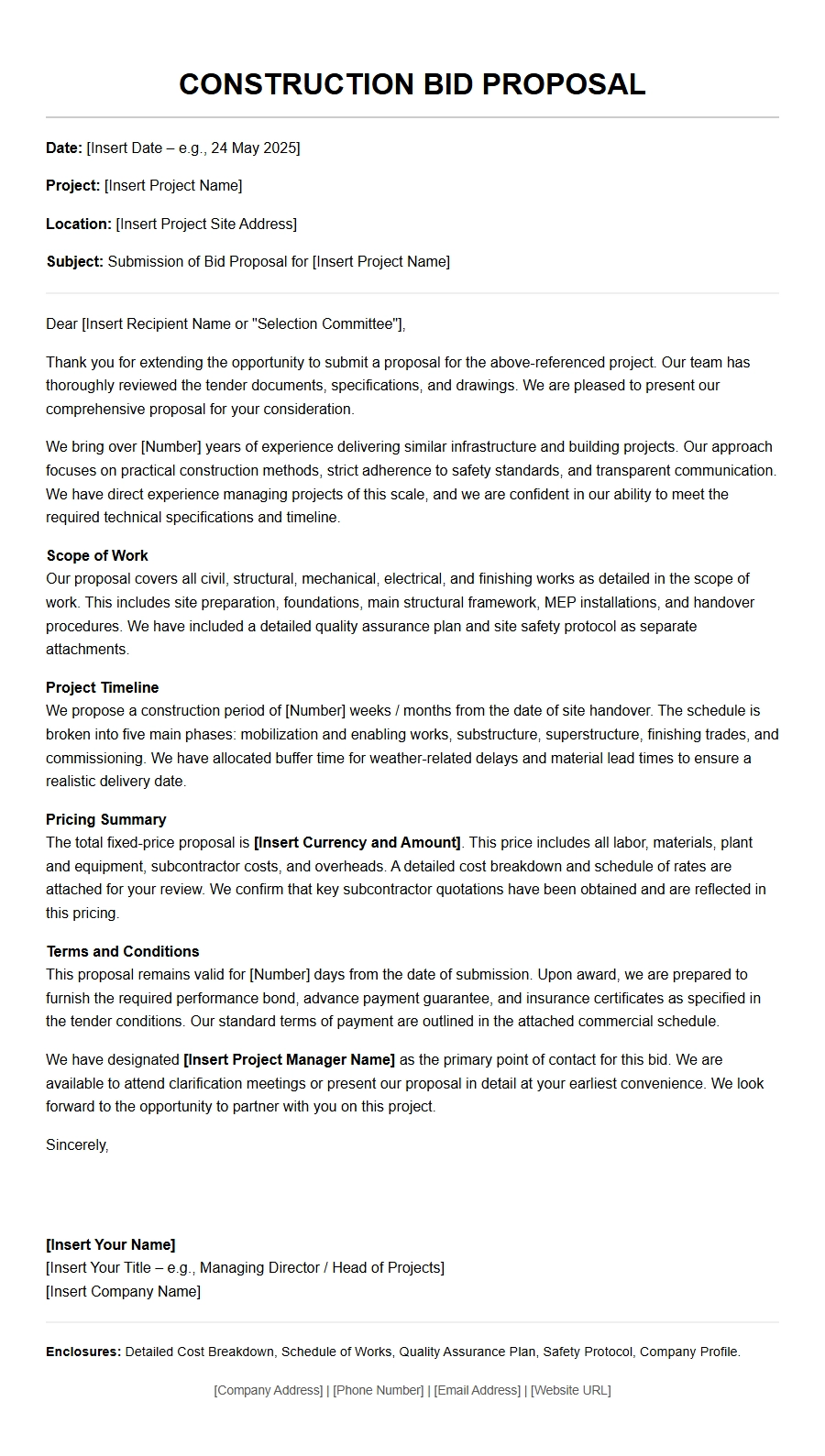 Sample Construction Bid Proposal Letter
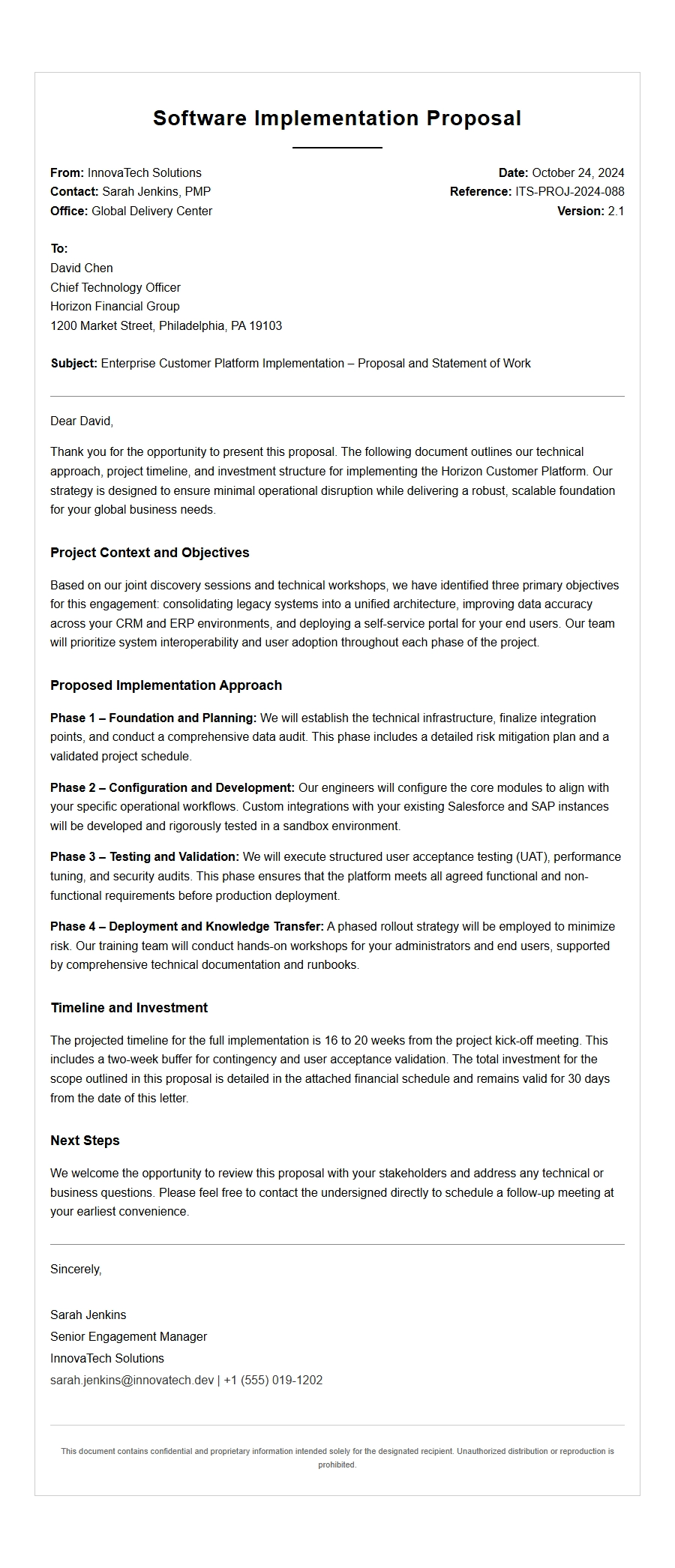 Enterprise Software Implementation Proposal Letter Example
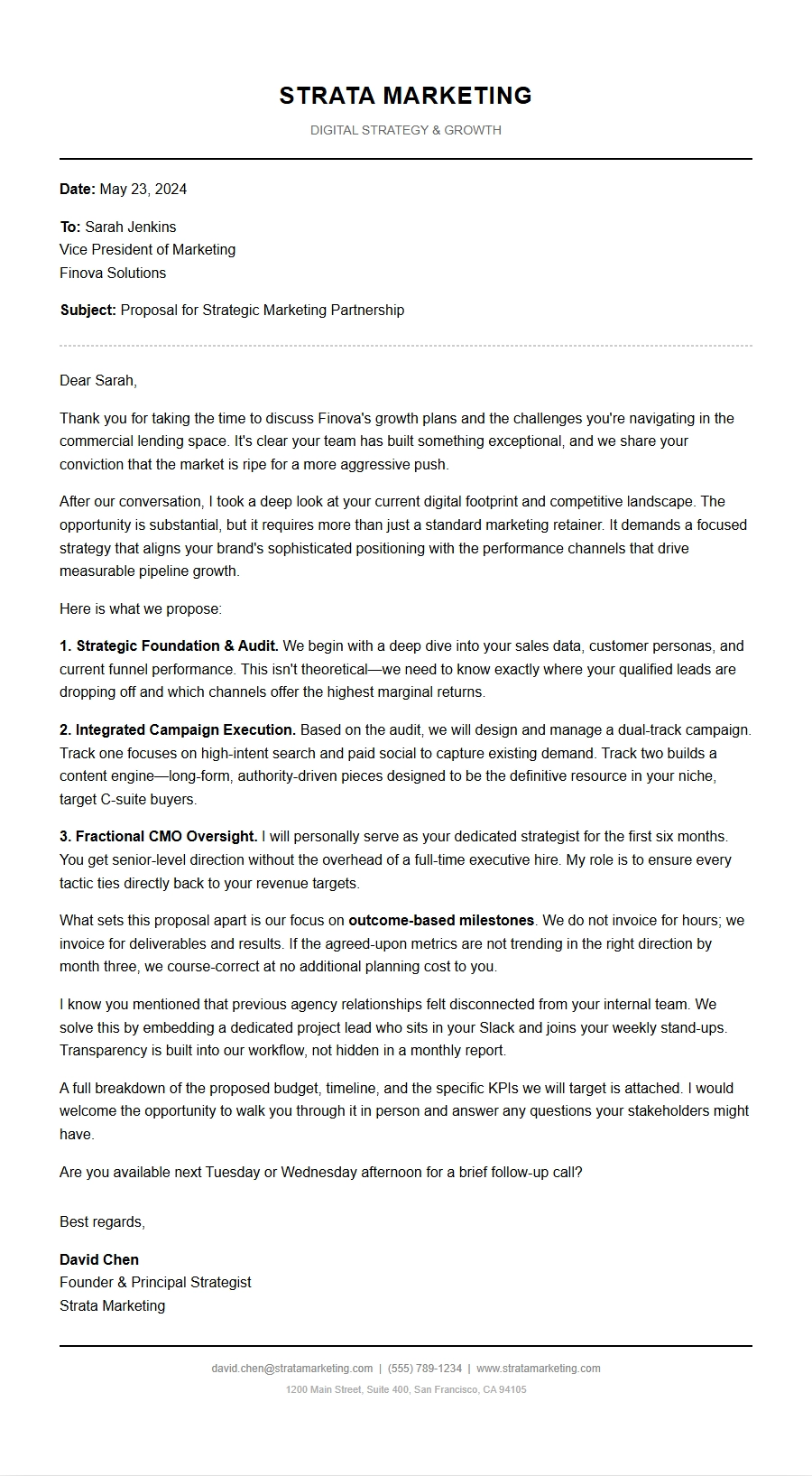 Marketing Agency Service Proposal Letter Template
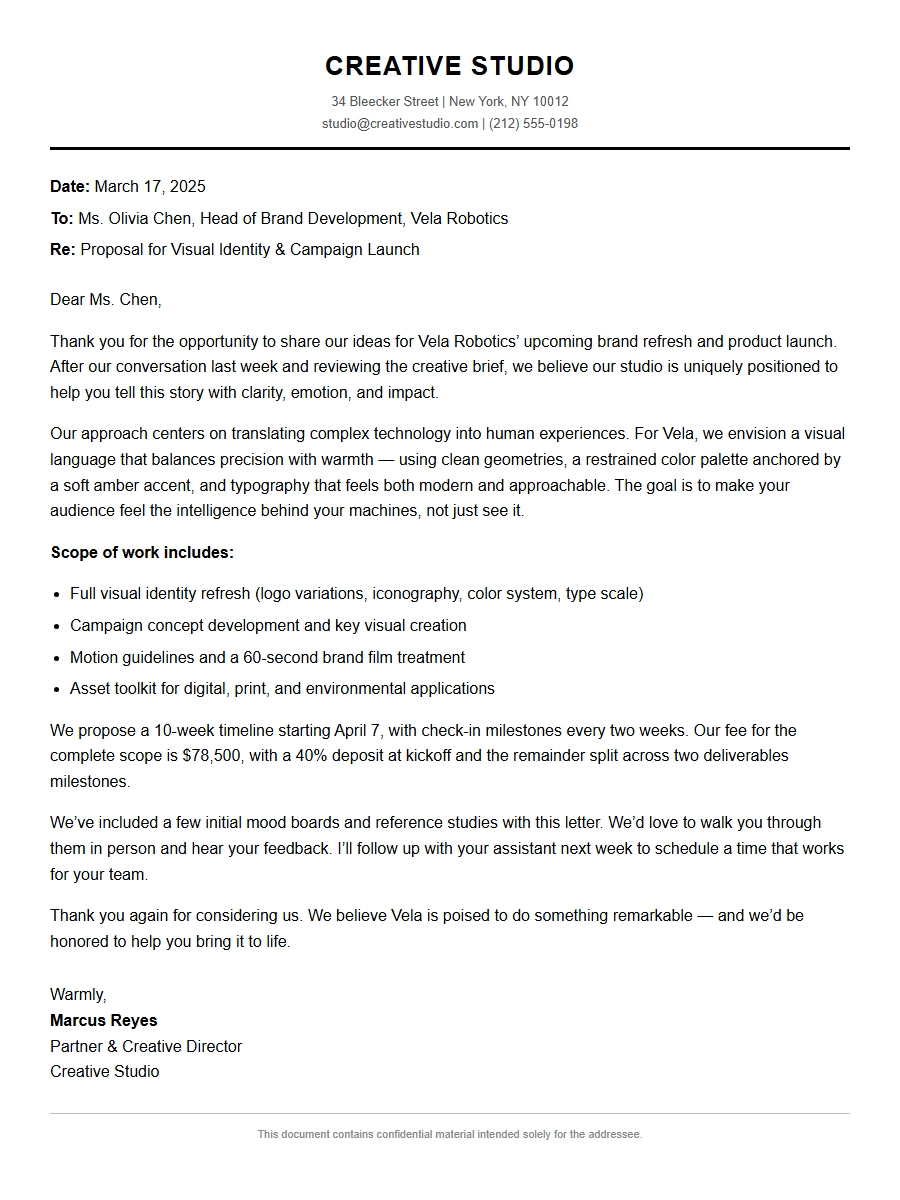 Creative Studio Project Proposal Letter
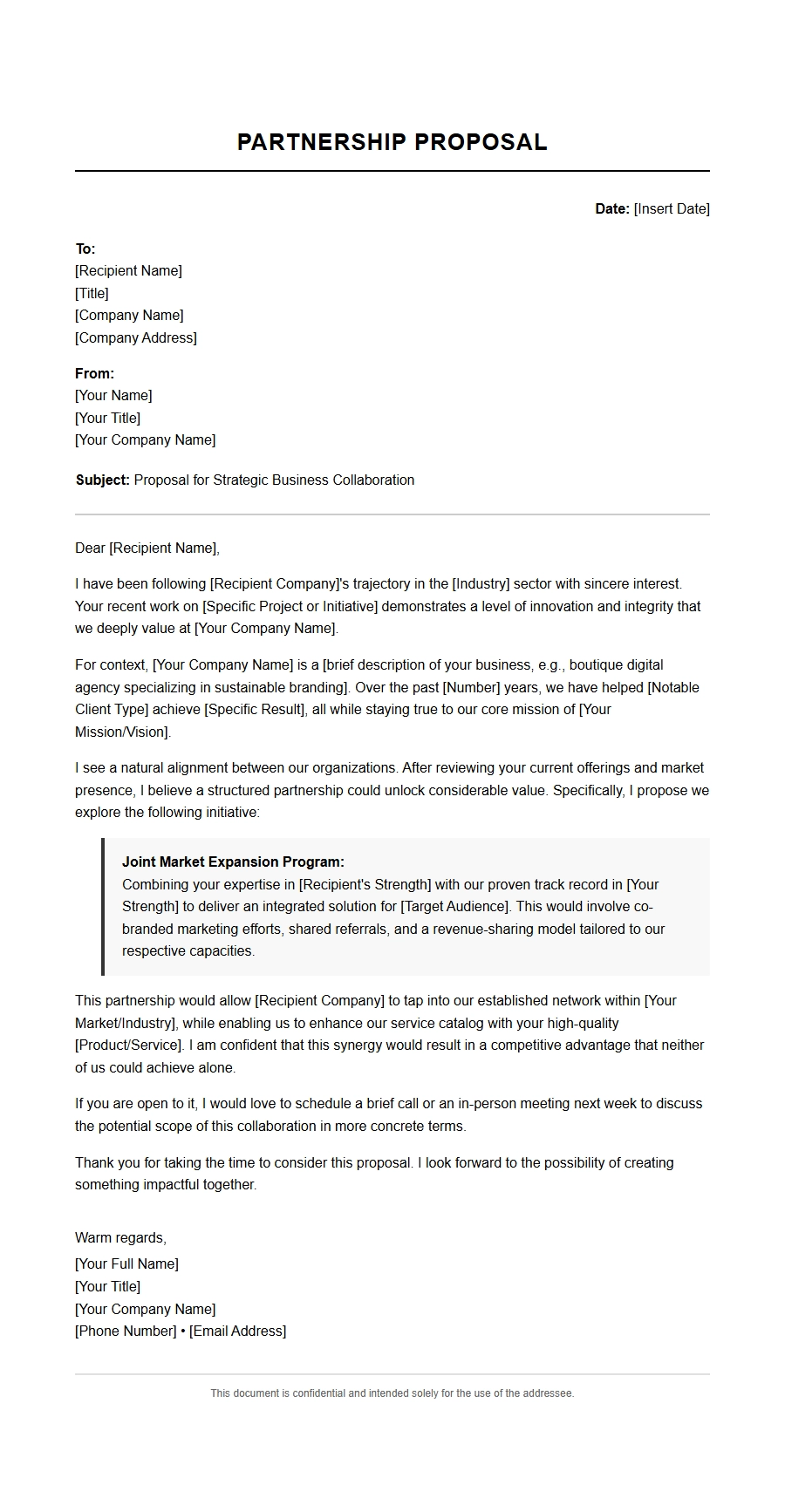 Small Business Partnership Proposal Letter Template
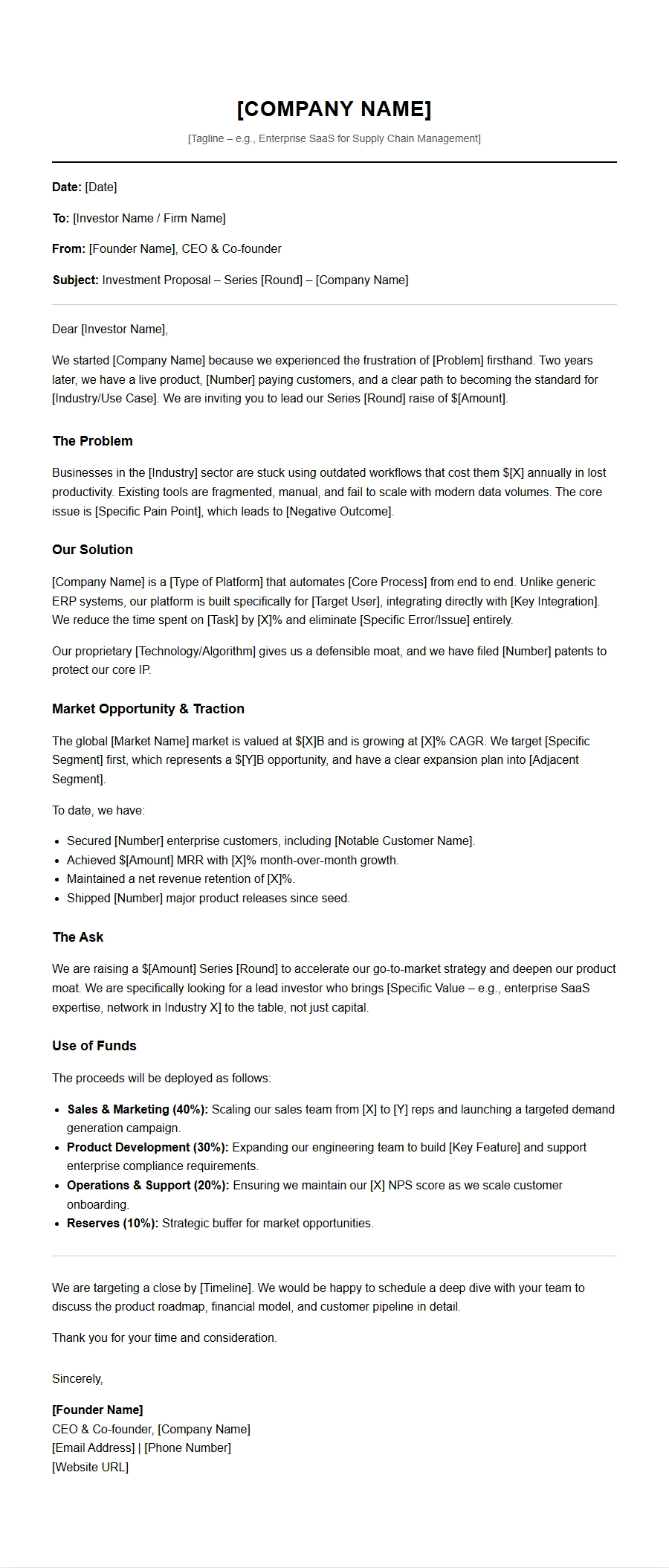 Startup Investment Proposal Letter Template